

Quick answer: specify packaging as a damage-control system
Choose an arcade machine export packaging supplier that can match protection to the machine, the route and the way the shipment will be handled after it leaves the factory. For a commercial order, the minimum credible plan normally identifies the protection for screens, acrylics, control panels, doors, moving parts and loose accessories; uses bubble wrap and thick foam at contact and impact points; reinforces heavy or tall cabinets with a wooden frame or crate; adds waterproof film for a sea leg; labels each package against the packing list; and records the final condition before loading. The supplier should also show how mixed machines are braced, how moisture is managed, and how the buyer will check the cargo on receipt.
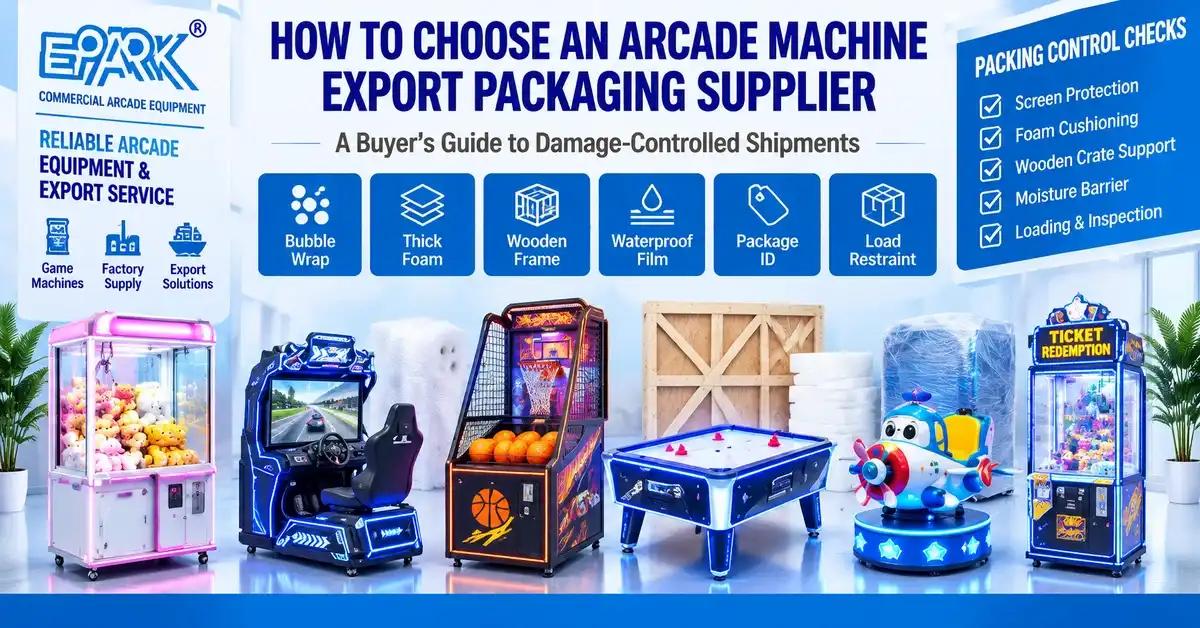
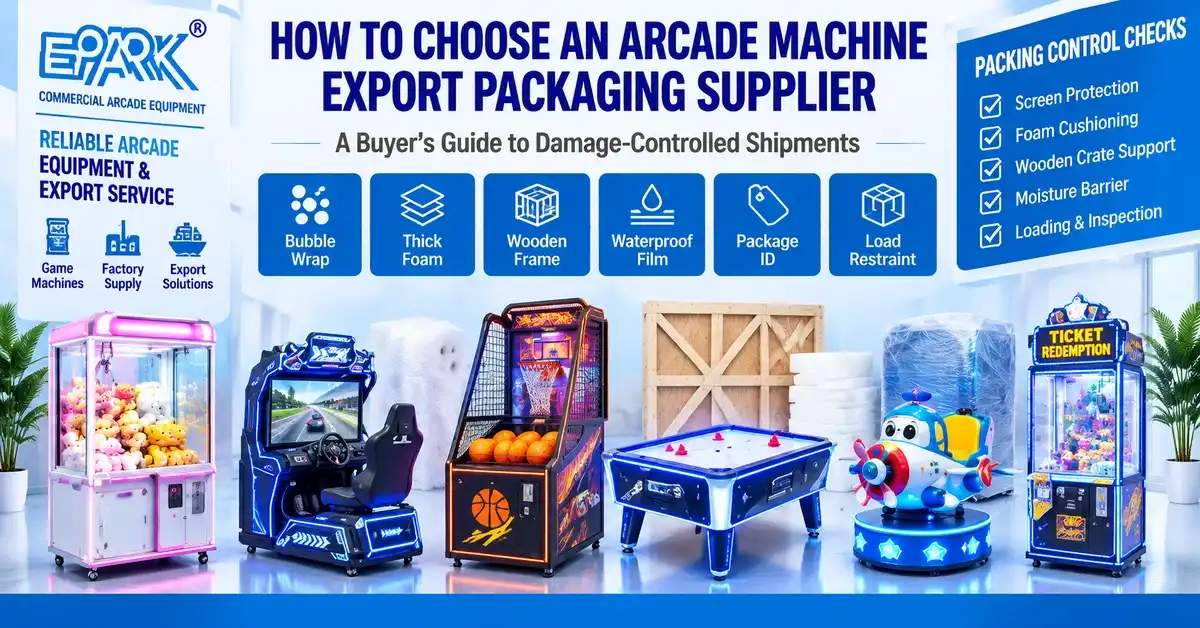
EPARK publicly describes export packing with bubble wrap, thick foam, wooden-frame or crate reinforcement and waterproof film for sea shipment. Those materials are useful only when applied to a documented packing method. A thin film around an unrestrained cabinet is not a moisture-control system, and a strong crate that touches a display can create a new failure point. Ask for a model-specific packing drawing or photo set, not a generic promise that every machine is “well packed.”
This article deals with packaging engineering and receiving control. EPARK has separate resources on export documentation, container order planning and container loading service. Linking those activities is sensible, but they should not be allowed to hide an unclear protection plan.
What an export packaging supplier is actually responsible for
Packaging sits between production quality and delivered quality. The factory may release a correctly tested machine, yet the buyer receives a cracked acrylic panel, a shifted monitor, a bent coin door or a missing cable because the package did not control the forces and handoffs in transit. An export packaging supplier is therefore responsible for more than buying cartons. It should translate the machine's geometry and weak points into a pack that survives lifting, stacking, vibration, condensation, temporary storage and destination handling.
Define the boundary in writing. Does the supplier design the internal protection, supply the crate, wrap spare parts, identify packages, load and lash the container, photograph the finished cargo, or only place a carton around a completed cabinet? “Export packing included” can mean very different things in two quotations. Your purchase order should state the protection level, package dimensions, materials, marking, loading evidence and responsibility for correcting a package that does not match the approved sample.
Packaging is not the same as installation
Machines can be packed correctly and still need careful unpacking, leveling, assembly, electrical connection and commissioning. Conversely, an installation team cannot repair transit damage that the package failed to prevent. Separate export packing, destination unloading, inside delivery and installation in the commercial scope. For a large FEC or mall project, send the supplier the receiving route, door widths, lift limits and storage conditions so the crate is strong enough without becoming impossible to move into the venue.
Start with a package risk register
Before comparing suppliers, list what can break, detach, scratch, bend, corrode or disappear. A claw machine may have a glass or acrylic viewing area, a crane mechanism, a prize door and a payment assembly. A racing simulator may have a seat, steering wheel, pedals, monitor, speakers, motion platform and linked cables. A basketball game has a large frame, sensor, backboard and loose balls. A VR unit may include a headset, tracking accessories and a computer that needs shock and moisture control. Treat the machine category as a packaging specification, not merely a product name.
| Risk area | Typical exposure | Packaging control to request | Receiving evidence |
|---|---|---|---|
| Screen or acrylic | Point impact, rubbing, frame distortion | Non-abrasive surface layer, shaped foam, rigid face protection and clearance from timber | Photograph before opening and after removal |
| Moving assembly | Swing, shock, misalignment or motor load | Transport lock, immobilization and clear release instruction | Check lock and mechanism condition |
| Cabinet finish | Scratches, moisture, corner crush | Soft wrap, corner blocks, separation and waterproof outer film | Record dents, wet marks and film breach |
| Loose accessories | Loss, cross-packing or incorrect model | Sealed accessory bag, package ID and line-item list | Count against packing list |
| Tall or heavy cabinet | Tip, forklift contact, stack load | Base restraint, marked lifting points, frame or crate and no unsupported stack | Inspect base and lifting contact points |
Ask how each packaging layer works
A useful quotation describes layers by function. The first layer prevents cosmetic rubbing and keeps small parts together. Foam absorbs and distributes localized impact. A rigid panel or frame keeps a force away from a screen or acrylic. The outer wrap limits dust and liquid contact. The crate or wooden frame carries restraint loads and gives handlers a visible boundary. Dunnage, straps and blocking stop the package moving inside a container. Every layer should have a reason, and no layer should create pressure on a fragile part.
Bubble wrap and thick foam
Bubble wrap is a separation and light-impact layer, not a substitute for structural restraint. Ask whether the bubbles are placed against a protected finish, whether an interleaf prevents imprinting, and whether the wrap is held so it cannot slide into a fan, hinge or moving mechanism. Thick foam should be shaped around corners, feet and protrusions. It should support the cabinet at designed load points rather than compressing a control panel or screen bezel.
Request a close photograph of the foam installed before the outer wrap is applied. A single picture of a finished white package cannot prove that the foam is present at the critical points. For repeat orders, retain the approved internal arrangement and specify what may change only with written approval. Foam density, thickness and cut shape can alter the result even when the supplier uses the same word, “foam,” in every quotation.
Wooden frame or crate
A wooden frame can resist side loads while leaving a lighter package than a fully closed crate. A crate adds panels and can improve puncture resistance, but it also adds volume, weight and handling requirements. Ask what the structure is designed to restrain, where the machine touches it, how the forklift can approach, and whether the package can be safely opened without striking the cabinet. For heavy equipment, a base skid and a positive connection to the cabinet are more useful than decorative timber around an unsupported package.
If raw wood is used in international trade, confirm the destination's requirements for treated wood and marking. The International Plant Protection Convention's ISPM 15 resource explains that the standard covers raw-wood packaging and dunnage used to support or carry cargo, while processed wood products can fall under different treatment rules. Do not assume every country accepts the same crate. Ask the supplier for the wood-treatment status and supporting mark or document where applicable, then check it against your import broker's advice.
Waterproof film and moisture control
Waterproof film limits direct splashes and condensation contact; it does not dry a wet cabinet or guarantee a stable humidity environment inside a sealed package. Ask whether the cabinet is dry before wrapping, whether ventilation or desiccant is used when appropriate, and whether the film is placed outside cushioning so it does not trap water against a finish. Electronics, printed artwork, metal fasteners and exposed connectors can respond differently to humidity. A practical pack list identifies moisture-sensitive contents and the opening instructions.
Protect the vulnerable parts buyers actually pay for
Damage claims often focus on the obvious cabinet dent, while the expensive delay comes from a small component that stops commissioning. Ask for packaging controls by subsystem. Screens need a rigid face barrier and clearance from timber. Acrylics need soft contact material and no concentrated strap pressure. Control panels need support from below, not a strap across a joystick or button. Speakers and LED modules need protection from loose hardware. Motion systems need transport locks and a release procedure. Payment readers, PCBs and cables need sealed, labelled accessory protection.
For a linked racing set, package identity must preserve the relationship between seats, screens, steering units, computers and network cables. For a redemption game, ticket dispensers, hoppers and spare sensors should not be hidden in an unrelated carton. For a claw machine, the crane mechanism and viewing panels require separate attention. Ask for package numbers such as “RACING-02-A” and a component list so the receiving team can locate the correct accessories before installation.
Do not let straps become a new damage source
Straps and bands should restrain the package, not cut into painted panels or bend a door. Request photographs showing corner protection under each strap, the strap route and the attachment point. Ask whether the machine is bolted to a skid, blocked at the base or simply wrapped. A package may look secure while the cabinet can still slide several centimetres inside the frame. If the supplier cannot explain the restraint path, request a revised packing method before mass packing begins.
Specify packing for mixed-container orders
Mixed orders are where generic packing promises fail. Different heights, weights and package shapes create voids, stack decisions and forklift constraints. Ask the supplier to produce a package schedule with package ID, machine model, quantity, dimensions, gross weight, stackability, lifting orientation and container position. The schedule should be reconciled to the commercial packing list. It is not enough to know the total number of machines; the receiving team needs to know which accessories and spare parts belong to which unit.
| Field | Why it matters | Buyer check |
|---|---|---|
| Package ID and model | Connects physical cargo to the purchase order | No duplicate or unexplained IDs |
| Outer dimensions and gross weight | Supports freight booking and safe handling | Matches measured or evidenced values |
| Stack and orientation mark | Prevents incorrect loading or storage | Mark is visible on two sides |
| Accessory and spare-parts location | Reduces missing-item delays | Bag and carton number recorded |
| Photo reference | Creates a pre-shipment condition record | Image shows label and protection |
Loading order should reflect the venue's unloading sequence where practical. A package needed first should not be buried behind a heavier cabinet. Leave safe access for lashing and inspection. Use dunnage and restraints to control movement, and do not rely on friction between packages. Ask for a loading diagram and final photographs that show the container floor, package labels, blocking, lashing and the sealed-door condition.
Use standards intelligently, without turning them into a sales badge
International standards can sharpen a discussion, but a standard name is not evidence that your package passed a test. ISO 2247 describes fixed-low-frequency vibration testing for complete filled transport packages, and ISO 13355 describes vertical random vibration testing. These references help a buyer ask whether a packaging design has been evaluated against a relevant hazard. They do not automatically certify an arcade cabinet, and a supplier should not imply that a generic “drop test” proves every route and handling condition.
Ask what test was performed, on which package, at what condition, with what result and what changed afterward. A test on a small standard cabinet may not represent a tall motion simulator. If no formal test exists, use practical evidence: photographs of internal supports, prior comparable shipments, damage records, package dimensions, loading method and a receiving inspection process. Honest limits are more useful than a certificate unrelated to the purchased model.
Export marks and package identification
Mark fragile, upright, centre-of-gravity, lifting and no-stack instructions where they apply. Use labels that survive moisture and handling. A package mark should identify the buyer's purchase order, package sequence and model, while confidential pricing need not be printed on the outside. Include a separate accessory map inside the package and in the digital packing list. Ask the supplier to photograph the labels before wrapping and after container loading.
What evidence should arrive before shipment approval?
Set a release gate. Before approving the balance or container release, request a package-level photo set: bare machine condition, vulnerable-part protection, foam and frame installation, outer film, label, dimensions or scale reference, accessory bag, and loaded-container position. Add the final packing list, package schedule, gross weights, crate or wood-treatment information where applicable, and a statement of any approved deviation from the sample.
For a large order, ask for a video or live call that follows a selected package from final test to packing. EPARK states publicly that each machine receives a 48-hour full-operation test before shipment; a buyer can connect that process to packaging evidence by asking for the test status, model reference and package ID, while keeping the test record and packing record traceable. Do not accept a beautiful packing photograph that cannot be tied to the approved machine configuration.
Write receiving and damage procedures before the cargo moves
Packaging works best when the destination team knows what to record. Name the person responsible for receiving, the time window for external inspection, the photos required before opening, the process for noting visible damage on the transport document, and the contact who decides whether to open a package. A wet or crushed package should be documented before the film is removed. Use package IDs so the factory can identify the model, accessories and production records quickly.
After opening, photograph the internal protection before discarding it. Check screens, acrylics, corners, doors, controls, wiring, wheels, bases and loose parts. Power-up should follow the supplier's safe commissioning instructions; it should not be the first response to a wet cabinet. Record serial numbers, missing items and any deviation from the approved sample. A disciplined receiving record protects the buyer's claim and gives the supplier useful evidence for improving the next shipment.
For a distributor, the same record should feed the next purchase decision. Track damage by model, package type, carrier handoff and failure location. If one cabinet repeatedly arrives with a crushed lower corner, the correction may be a stronger base skid rather than more film around the whole machine. If accessories are repeatedly missing, change the package map and the final count process. This turns export packaging from a one-time cost line into a measurable supplier-control activity.
Packaging cost versus landed cost
A stronger package can increase material cost, package volume and freight. A cheaper package can increase damage, replacement freight, technician visits, opening delays and lost opening-day revenue. Compare the full landed effect: packaging materials, gross weight, cubic volume, container utilization, insurance assumptions, expected inspection time, replacement part cost and downtime. Ask the supplier to show how the selected package dimensions affect the container plan rather than accepting a low packing line that creates an expensive void or a second shipment.
Do not optimize every box for the smallest possible volume. A cabinet that fits tightly against another machine may save space while transferring vibration and rubbing. The correct question is whether the package protects the machine at a reasonable total cost and can be handled safely at both ends.
Questions to ask an arcade machine export packaging supplier
| Question | Evidence of a useful answer |
|---|---|
| Which parts of this model are most vulnerable in transit? | A model-specific risk explanation with photos or drawing |
| Where do foam, straps and the frame contact the cabinet? | Clear internal packing photographs before wrapping |
| How are moving mechanisms locked? | A transport-lock method and release instruction |
| How are packages identified in a mixed container? | Package schedule, labels and accessory map |
| What wood treatment or marking applies? | Destination-specific confirmation, not a generic certificate image |
| What photos are supplied before loading? | A defined photo set tied to package IDs |
| What happens when a package differs from the approved sample? | A hold-and-approval process before shipment |
FAQ: arcade machine export packaging
Is bubble wrap enough for an arcade machine export shipment?
No. Bubble wrap can limit light contact and scratches, but it does not stop a heavy cabinet from moving or protect a screen from concentrated impact. Combine it with shaped foam, rigid protection, restraint and an outer barrier suited to the route.
Should every arcade machine be placed in a wooden crate?
Not necessarily. A crate can improve puncture and handling protection, while a frame may provide adequate restraint with less volume. The choice should follow the machine's weak points, weight, handling route and destination requirements.
What should I request for a mixed arcade machine container?
Request a package schedule with model, package ID, dimensions, weight, stackability, orientation, accessory location and loading position. Add photographs showing labels, internal protection, blocking and lashing.
How can I reduce moisture damage during sea freight?
Confirm the machine is dry before wrapping, use a suitable waterproof outer layer, keep electronics and accessories sealed, consider desiccant where appropriate, and define opening and receiving checks. Film alone is not a humidity guarantee.
Does ISPM 15 apply to every wooden export package?
It generally concerns raw-wood packaging and dunnage used in international trade, while some processed wood products are treated differently. Confirm the destination rule and the supplier's treatment and marking evidence with your customs or plant-health adviser.
What photos prove that an arcade package was packed correctly?
A useful set shows the tested machine, vulnerable-part protection, foam placement, frame or crate contact points, waterproof film, package label, accessory bag, loaded position and sealed container. Each image should be traceable to a package ID.
Can better packaging reduce total landed cost?
It can reduce damage claims, replacement freight, commissioning delays and emergency parts orders, but it may add volume or weight. Compare total landed exposure rather than the lowest packing line item.
Conclusion
The right arcade machine export packaging supplier is the one that can explain and prove how each machine will survive its actual route. Require a model-specific risk register, functional packaging layers, protection for screens and moving systems, traceable accessories, destination-aware wood treatment, mixed-container planning, pre-shipment photographs and a disciplined receiving process. EPARK's published packaging and testing information provides a useful starting point, but your order should still convert those capabilities into written, package-level acceptance criteria. For a new FEC, distributor shipment or mall project, send the machine mix, destination, handling route and opening date to EPARK through its project contact team so the packing plan, equipment selection and technical support can be reviewed together.
Disclaimer
The information provided on this website is for general informational purposes only.
While EPARK Arcade Game Machine Manufacturer strives to ensure accuracy and reliability, no warranties—express or implied—are made regarding completeness, performance, or applicability.
Product specifications, designs, and features may vary depending on usage, customization, and customer requirements.
Buyers are responsible for verifying all technical details, compliance certifications, and suitability before procurement.
EPARK shall not be held liable for any direct, indirect, incidental, or consequential damages arising from the use of this website or its content, including but not limited to business losses, data errors, or equipment misuse.
For tailored solutions or further verification, please visit our Contact Us
Intellectual Property Notice
All articles, product images, videos, catalogs, software, and related materials published on this website are the intellectual property of EPARK, unless otherwise stated.
Unauthorized reproduction, distribution, modification, or commercial use of any content is strictly prohibited without prior written consent from EPARK.
EPARK reserves the right to take legal action against any unauthorized use, including but not limited to copyright infringement, misrepresentation, or unfair competition.
Trademarks
The name EPARK, the EPARK logo, and all related brand elements displayed on this website are registered trademarks or trade names of Guangzhou EPARK Electronic Technology Co., Ltd.
Other product names, company names, or logos mentioned on this site may be trademarks of their respective owners.
Unauthorized use of EPARK's trademarks for commercial purposes, including advertising, promotions, or product packaging, is strictly prohibited.
Governing Law
These terms are governed by the laws of the People's Republic of China.