

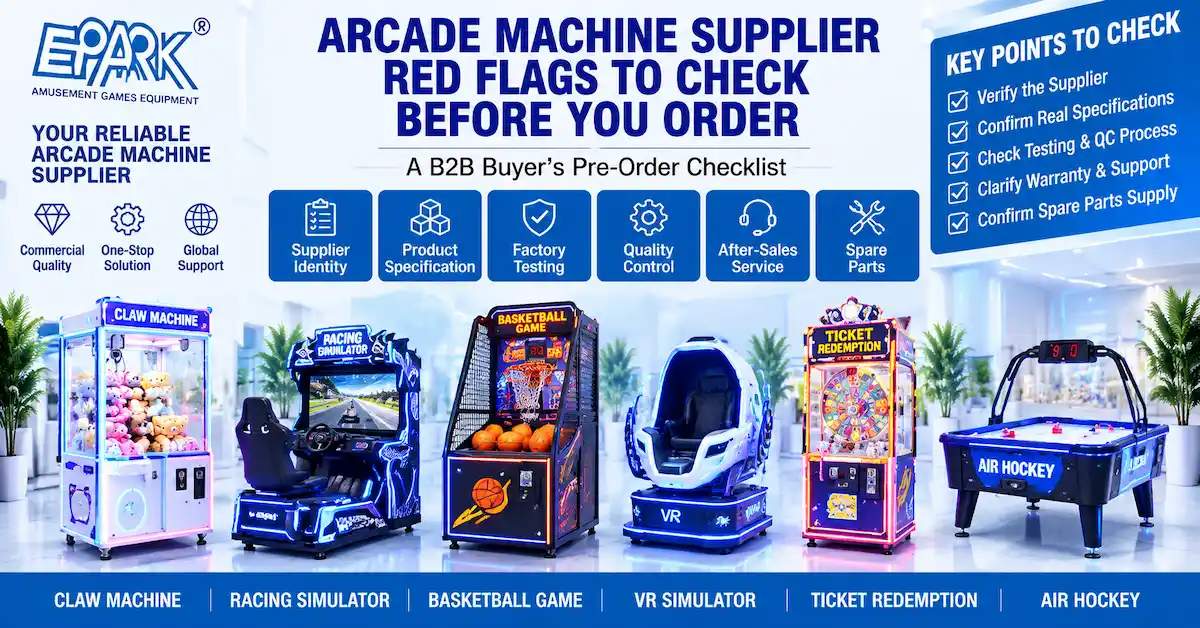
Quick answer: reject evidence gaps, not just a high price
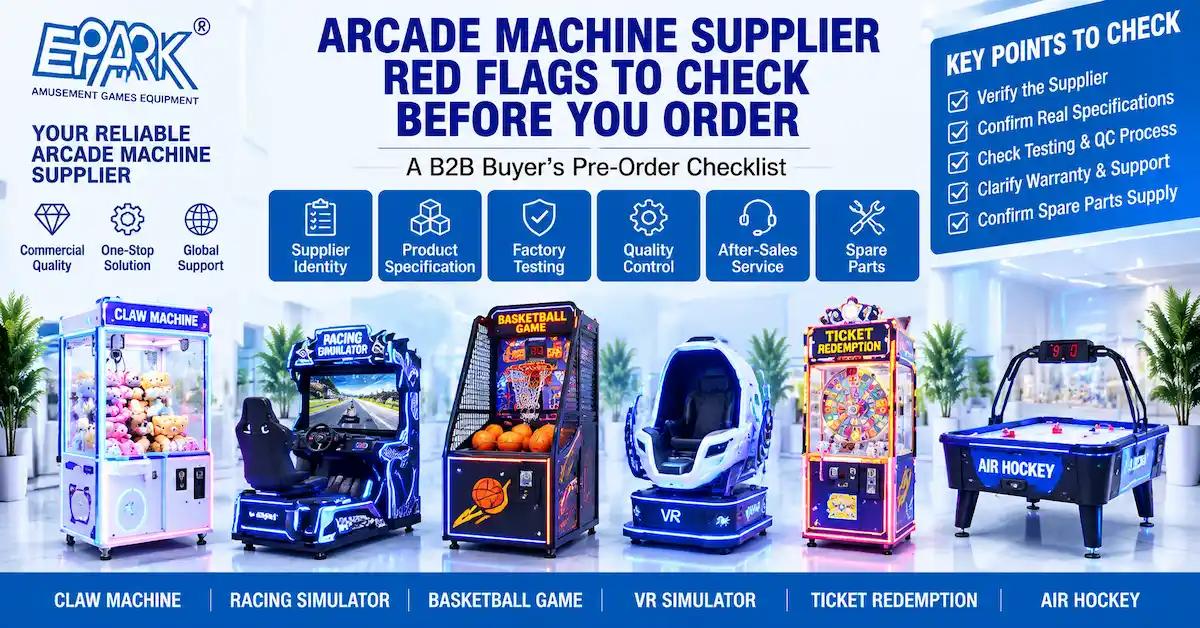
The most serious arcade machine supplier red flags are not a slow reply or an expensive quote. They are evidence gaps that make the delivered equipment impossible to verify: a supplier cannot identify the exact model and revision, changes specifications after approval, avoids a written scope, cannot explain factory testing, gives no practical parts route, or turns a general warranty statement into an undefined promise. One red flag may justify a follow-up question. Several connected red flags should make an operator pause the order, protect the deposit and compare another supplier.
This guide is a pre-order rejection screen for FEC operators, mall entertainment buyers, distributors and project contractors. It is different from a generic “how to choose an arcade supplier” article: the useful output is a stop, verify or proceed decision. The goal is not to punish a supplier for incomplete public information. It is to distinguish an honest “we need to confirm that” from a supplier that keeps commercial, technical and service facts deliberately vague.

Use a red-flag framework before comparing unit prices
Start by separating three kinds of warning. A hard stop blocks the purchase until resolved, such as a payment destination that does not match the contracting entity or a refusal to identify the goods being sold. A verification hold means the supplier may be legitimate, but the buyer needs documents, a sample or a factory answer before paying. A commercial caution affects margin or project execution but may be acceptable when priced and assigned clearly.
| Level | Typical signal | Buyer action |
|---|---|---|
| Hard stop | Identity, payment, product or contract cannot be verified | Do not pay; verify independently or reject |
| Verification hold | Testing, compliance, specification or service evidence is incomplete | Set a document deadline and keep the order pending |
| Commercial caution | Scope, freight, options or change control are ambiguous | Price the risk and assign responsibility in writing |
Do not use the framework as a substitute for legal, electrical or safety review. It is a procurement control that helps the project team know when a sales conversation has not yet become an auditable order.
Red flag 1: the supplier cannot identify the contracting party
Before discussing models, ask who will sign the quotation, receive the payment and issue the commercial invoice. The legal entity, bank beneficiary, email domain and shipping documents should be explainable as one transaction. A small difference can be legitimate, such as a group company or export agent, but the relationship should be documented before a deposit.
Be cautious when the sales contact insists that payment must go to an unrelated personal account, changes the beneficiary at the last minute, or refuses to provide a company address and invoice. A polished website does not resolve an identity mismatch. Ask for the quotation, pro forma invoice, bank details, company registration information required by your finance team and the name of the entity responsible for warranty claims.
Do not confuse a sales channel with manufacturing proof
A distributor, trading company or factory-backed sales office can be a valid supplier. The red flag is not “this is not the factory.” The red flag is when the supplier will not state which party manufactures, tests, packs, exports and supports the machine. Ask for the responsibility chain and the contact who approves technical changes. If the answer is “we use different factories depending on price,” require a model-specific manufacturer and test route before proceeding.
EPARK's public pages identify EPARK as a manufacturer and supplier of commercial amusement equipment and describe a factory process. For any project, still confirm the contracting entity, selected model, destination documents and service scope in the quotation rather than treating a website identity as a contract term.
Red flag 2: the quote sells a category, not a defined machine
“One racing machine,” “premium claw game” or “commercial VR” is not enough to approve a purchase. The quotation should identify a model reference, revision or configuration code, dimensions, power and voltage, payment method, included options, language, artwork, packed data and destination assumptions. If the supplier cannot state what will arrive, the buyer cannot compare offers or inspect substitutions.
Ask the supplier to mark each line as standard, optional, excluded or pending confirmation. Separate cabinet, display, controls, software or content, payment reader, tickets or points, artwork, packing, freight, installation, training and spare parts. A low headline price often becomes expensive when a reader, transformer, shipping crate or commissioning visit appears later as an “extra.”
Watch for catalog substitutions
A supplier may show a photograph of one cabinet and quote another internal configuration. Request current photographs or a sample tied to the quoted model. If the supplier proposes a replacement component, ask for compatibility, updated drawings, test evidence and a new price if the change affects cost. “Same appearance” does not prove the same controller, reader, motor, screen or service procedure.
Put a no-unapproved-substitution rule into the purchase documentation when the project depends on consistent operation. A buyer can accept a controlled change; the risk comes from learning about it after the machine is in a mall or FEC.
Red flag 3: specifications change after the buyer asks a precise question
Inconsistency is more serious than a missing figure. A supplier that first states one voltage, size, warranty or lead time and later quietly replaces it may be working from several uncontrolled documents. Ask the supplier to consolidate the answer into a versioned configuration sheet. Record the date, model, options and person approving it.
Pay attention to answers that use “about,” “normally” or “standard” for a site-critical field without a range or condition. Those words can be reasonable during early planning, but they should be replaced by a confirmed value before production. Dimensions, packed weight, electrical load, payment interface, prize capacity and service clearance can affect the venue plan and should not remain informal.
Do not force a supplier to invent a value it does not know. An honest “we will measure the final packed unit” is safer than a confident number that changes later. Set a deadline for the measurement and make it an order condition.
Red flag 4: the supplier promises certification without defining scope
Compliance documents are important, but a logo or a sentence saying “CE certified” is not a complete answer. Ask which model, market, configuration and document are covered, who issued the report or declaration, and whether the document is current. Confirm whether your importing country, mall landlord, insurer or electrical inspector requires additional evidence.
The red flag is not that a document is unavailable on a public page. The red flag is refusal to identify what exists or an attempt to apply one certificate to every cabinet, board, payment reader and custom variant. Ask for the available declaration, test report reference, label photograph and technical file contact where appropriate. Keep the request proportional to the equipment and jurisdiction.
EPARK's public information references quality and compliance information, but the knowledge base does not provide a universal certificate number, scope and expiry for every product. Treat exact model and destination coverage as a pre-order confirmation item.
Red flag 5: factory testing is described only as “100% tested”
Testing language should tell the buyer what was tested, when, and against which configuration. Ask whether the check covers power-up, controls, display, sound, lighting, sensors, movement, payment, tickets or points, fault recovery and a complete operating cycle. Ask whether the record is tied to a model or serial range.
A supplier may have a real test process and still provide an unhelpful answer. The correction is to request a checklist, sample record or pre-shipment video, not to assume the factory is dishonest. The hard stop appears when the supplier refuses to explain the test, will not allow a reasonable acceptance process, or changes the quoted configuration after testing.
Ask how failed acceptance is handled
Define what happens if a sample or receiving inspection fails: remote correction, replacement part, factory rework, credit, delayed shipment or another remedy. Clarify who pays additional freight and local labor. Warranty language often covers manufacturing defects but does not automatically define opening acceptance, transport damage or installation rework.
EPARK's Design & Process material describes production, function testing and export preparation, including a public statement about full-operation testing before dispatch. For a project purchase, request the exact checklist and configuration covered by the order.
Red flag 6: the supplier refuses to discuss service access
An arcade cabinet can be operationally expensive even when its components are reliable if technicians cannot reach them. Ask for operating and service footprints, access panels, tool requirements, common replacement steps and the parts most likely to stop play. A supplier that only shows the front of the cabinet is not necessarily bad; a supplier that refuses to show the service side is a serious risk for a commercial venue.
Check whether a technician must pull the machine away from a wall, remove glass, empty prizes, dismantle neighboring units or work inside a queue. Add the service footprint to the venue layout. Ask which actions venue staff may perform and which require trained technicians. This protects uptime and avoids unsafe “quick fixes.”
Ask for a model-specific spare-parts list with references and compatibility notes. “We can send parts later” does not tell you whether the part is stocked, made to order, interchangeable or subject to a minimum order. It also does not define freight, warranty evidence or local labor.
Red flag 7: after-sales promises have no route, evidence or boundary
Be cautious when a supplier advertises 24/7 or lifetime support without explaining how a case is opened. Ask for the channel, required model and serial data, photos or video, diagnostic steps, escalation owner, parts approval and final closure. Confirm whether the supplier provides remote guidance, spare parts, software support, local partners or on-site service for the selected destination.
EPARK's public service and FAQ materials describe remote technical support, video guidance, spare-parts supply and warranty information. The public material also distinguishes response language from repair or replacement obligations. Do not rewrite “24/7 support” or a response statement as a guaranteed repair-time SLA unless the contract says so.
Warranty ambiguity is a procurement risk
Ask the warranty start date, covered parts, manufacturing-defect definition, consumables, misuse, transport damage, unauthorized modification, freight and local labor. EPARK's expanded FAQ states a two-year warranty from shipment for EPARK machines and identifies exclusions such as consumables and misuse-related damage, while the exact claim route requires serial number, problem description and photos or video. Confirm the selected model and destination terms rather than applying a general statement to every commercial cost.
A red flag appears when a supplier uses a long warranty period to avoid answering what happens when the cabinet is down. A shorter but precise warranty with a clear parts route may be easier to manage than a longer promise that excludes the parts most likely to fail.
Red flag 8: payment, freight and installation are deliberately vague
A supplier can lose a project margin without any machine defect if the commercial scope is incomplete. Ask whether the price includes packing, freight, insurance if requested, customs documents, unloading, installation, payment integration, training and spare parts. Confirm the trade term, delivery point, destination assumptions and who handles local building access.
Be careful when a supplier gives a very low factory price but refuses to provide packed dimensions, gross weight or a loading plan. Those details affect container utilization, freight class, unloading equipment and storage. A quote cannot be compared fairly without the same freight basis and scope.
Ask for an itemized pro forma invoice and a responsibility matrix. If the payment beneficiary changes, stop and verify through a known company channel. Do not rely on a message that says “the account is urgent” or “the old account is unavailable.”
Red flag 9: the sample is treated as proof of every future model
A sample can answer important questions about build, controls, finish, payment and service access. It cannot validate an unapproved bulk variant automatically. Ask whether the sample uses the same board, reader, motor, screen, artwork, language and options as production. Record the model, revision and open issues.
Reject a sample process that prohibits reasonable inspection, refuses to identify changes or asks the buyer to approve from a marketing video only. A supplier may protect proprietary details, but it should still allow the customer to test the functions relevant to the order. For a multi-site project, test the configuration that will be repeated, not the most attractive cabinet in the showroom.
Red flag 10: the supplier cannot control repeat orders
For distributors and chains, the real risk appears on the second order. Ask how the supplier records internal SKU, artwork, cabinet revision, payment option, firmware or board reference, test record and parts list. Ask how material substitutions are announced and approved. If each reorder begins from a fresh photo and a new salesperson's memory, training and service costs rise.
Configuration control does not mean every future order must be identical. It means changes are visible, priced, tested and documented. A supplier that can reproduce an approved configuration is easier to scale than a supplier that simply promises “same as last time.”
Use the EPARK commercial FEC game machine page as a reference when building a model matrix. Request the exact model references, options and repeat-order controls for your project instead of relying on category labels.

Turn red flags into a supplier rejection checklist
Before approval, ask the project team to mark each item verified, open or rejected. Evidence should be attached to the quote or purchase file. A supplier may score well on product range but fail on identity, payment, testing or after-sales scope. Use weighted criteria that reflect the cost of failure at your venue.
| Check | Acceptable evidence | Reject or hold when |
|---|---|---|
| Identity and payment | Contracting entity, invoice and beneficiary reconcile | Unrelated account or unexplained entity change |
| Product definition | Model, revision, options and packed data are written | Only category words or a showroom photo |
| Quality and compliance | Model-specific test and applicable documents | Universal certificate or testing claim without scope |
| Service and parts | Access drawing, part references and case route | No service side, no compatible parts or no escalation |
| Commercial scope | Itemized quote, freight basis and responsibility matrix | Low total with hidden or undefined scope |
Set a decision rule before emotions enter the negotiation. For example, any unresolved hard stop blocks payment; two unresolved verification holds require a management review; commercial cautions must be costed or assigned. The exact rule belongs to your organization, but the principle is to decide from evidence rather than deadline pressure.
Questions to send before rejecting or approving a supplier
Send a single written request: “Please identify the contracting entity, exact manufacturer, model and revision for each quoted machine. Provide operating and service dimensions, packed dimensions, power, payment interface, included options, applicable compliance documents, factory test scope, packing method, installation responsibility, compatible spare-parts list, warranty start and exclusions, remote-support process, freight basis and repeat-order change-control procedure. Please label standard, optional, excluded and pending items.”
The answer quality matters as much as the content. A supplier may not have every document ready on the first reply, but it should acknowledge the gap, name the owner and provide a date. A refusal, contradiction or unexplained substitution should move the supplier to hold or reject status.
Frequently asked questions
What are the biggest arcade machine supplier red flags?
The most serious are an unverified contracting party or payment account, undefined machine model, changing specifications, unsupported certification claims, unexplained testing, no parts route, vague warranty boundaries and hidden freight or installation scope.
Should I reject a supplier that does not publish every technical document online?
Not automatically. Treat missing public information as a verification hold and ask for the model-specific document or a clear confirmation date. Reject when the supplier refuses to identify the scope or keeps contradicting its own answers.
Is a very low arcade machine price a red flag?
It is a caution, not proof of a problem. Normalize options, payment hardware, packing, freight, installation, taxes, spare parts and warranty scope before deciding whether the price is genuinely lower.
How can I verify that the quoted machine is the one I will receive?
Use a versioned configuration sheet with model, revision, dimensions, options, payment, artwork and test scope. Approve a sample or first article where risk is high and prohibit unapproved substitutions.
What should a supplier provide about factory testing?
Request the test scope, checklist, configuration covered, serial or batch reference and failed-test remedy. “100% tested” without these details is not enough for a commercial acceptance process.
Does a long warranty eliminate supplier risk?
No. Confirm covered parts, exclusions, consumables, freight, local labor, evidence requirements and response route. A warranty period does not automatically cover every downtime or installation cost.
Should I reject a supplier that uses a distributor or trading company?
No. Ask the supplier to identify the manufacturer, contracting entity, testing party, exporter and warranty owner. A transparent supply chain can be workable; an unexplained chain is the risk.
When should I stop negotiating and choose another supplier?
Stop when a hard-stop issue remains unresolved, payment or identity cannot be verified, the product cannot be defined, or the supplier refuses reasonable testing and service documentation. Deadline pressure is not evidence.
Conclusion
The best way to identify arcade machine supplier red flags is to test whether the supplier can turn sales claims into traceable evidence. Verify identity and payment, define the machine, freeze the specification, check compliance scope, inspect testing, confirm service access and parts, price freight and installation, and document warranty and repeat-order control. Reject or hold the order when these fundamentals remain unclear.
EPARK's public manufacturing, testing, packing and service information offers a useful basis for a model-specific review. Send your machine list, destination and evidence questions to request a scoped quotation rather than relying on a catalogue or a deadline-driven promise.
Disclaimer
The information provided on this website is for general informational purposes only.
While EPARK Arcade Game Machine Manufacturer strives to ensure accuracy and reliability, no warranties—express or implied—are made regarding completeness, performance, or applicability.
Product specifications, designs, and features may vary depending on usage, customization, and customer requirements.
Buyers are responsible for verifying all technical details, compliance certifications, and suitability before procurement.
EPARK shall not be held liable for any direct, indirect, incidental, or consequential damages arising from the use of this website or its content, including but not limited to business losses, data errors, or equipment misuse.
For tailored solutions or further verification, please visit our Contact Us
Intellectual Property Notice
All articles, product images, videos, catalogs, software, and related materials published on this website are the intellectual property of EPARK, unless otherwise stated.
Unauthorized reproduction, distribution, modification, or commercial use of any content is strictly prohibited without prior written consent from EPARK.
EPARK reserves the right to take legal action against any unauthorized use, including but not limited to copyright infringement, misrepresentation, or unfair competition.
Trademarks
The name EPARK, the EPARK logo, and all related brand elements displayed on this website are registered trademarks or trade names of Guangzhou EPARK Electronic Technology Co., Ltd.
Other product names, company names, or logos mentioned on this site may be trademarks of their respective owners.
Unauthorized use of EPARK's trademarks for commercial purposes, including advertising, promotions, or product packaging, is strictly prohibited.
Governing Law
These terms are governed by the laws of the People's Republic of China.