

Quick answer: verify the order path, not the factory backdrop
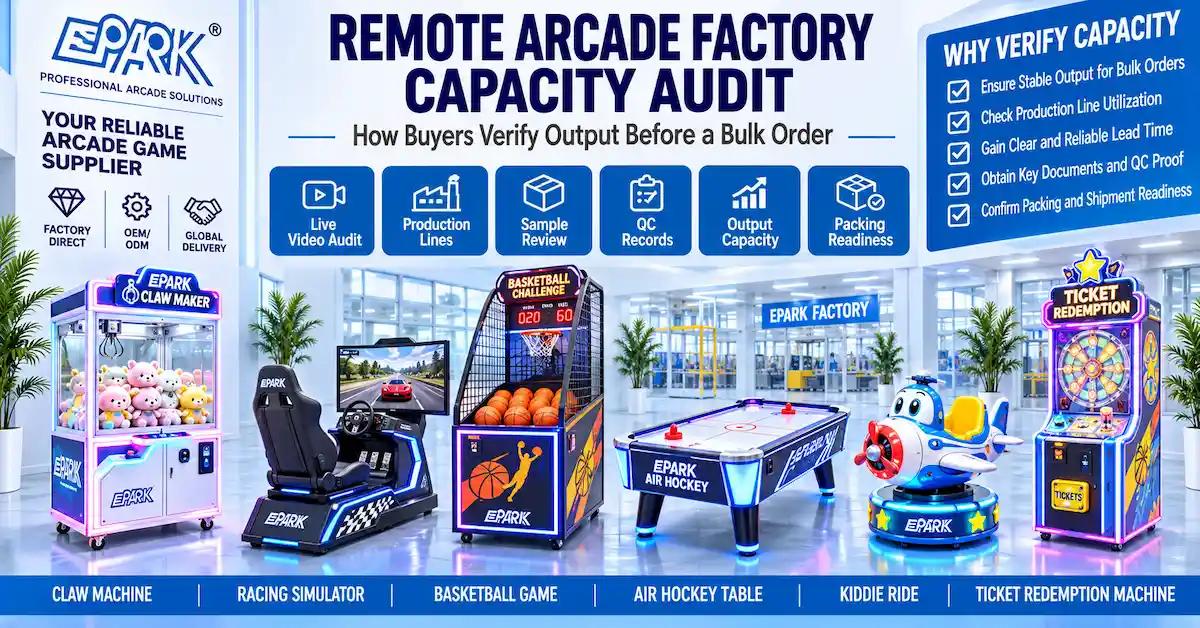
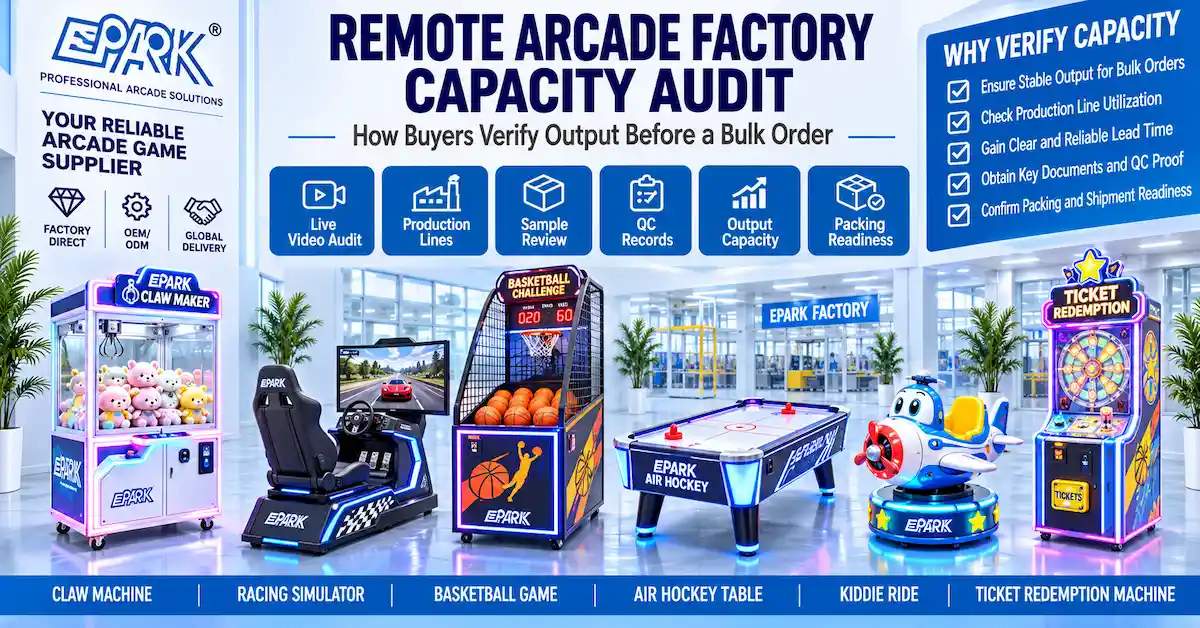
An arcade factory capacity audit can be performed remotely, but it should not be reduced to a video tour of a large workshop. The useful question is whether the supplier can complete your defined mix of cabinets, electronics, artwork, software configuration, final assembly, endurance testing and export packing inside the required production window while other orders are already using the same resources. Check that question with a live process walk, time-stamped production records, a model-by-model order plan, current workload, demonstrated cycle times, bottleneck capacity, material status, test positions, rework control and packing resources. When the evidence is incomplete or the order risk is high, add an independent on-site factory assessment.
This is a capacity decision, not a factory-identity decision. EPARK already has a separate guide on verifying whether an arcade supplier is a real factory. The task here begins after the supplier's identity and production location have been checked. It asks whether the factory can absorb one particular order without moving risk into late testing, uncontrolled subcontracting, rushed packing or an unrealistic shipment promise.
Remote assessment has legitimate limits. ISO describes remote auditing methods as a useful audit tool rather than a replacement for every on-site method, and the International Accreditation Forum's ICT guidance emphasizes planning, information integrity and controls around remotely collected evidence. A buyer is not conducting a certification audit by following this article, but the same discipline is valuable: define the audit objective, decide which evidence can be trusted remotely and identify what still requires physical verification.
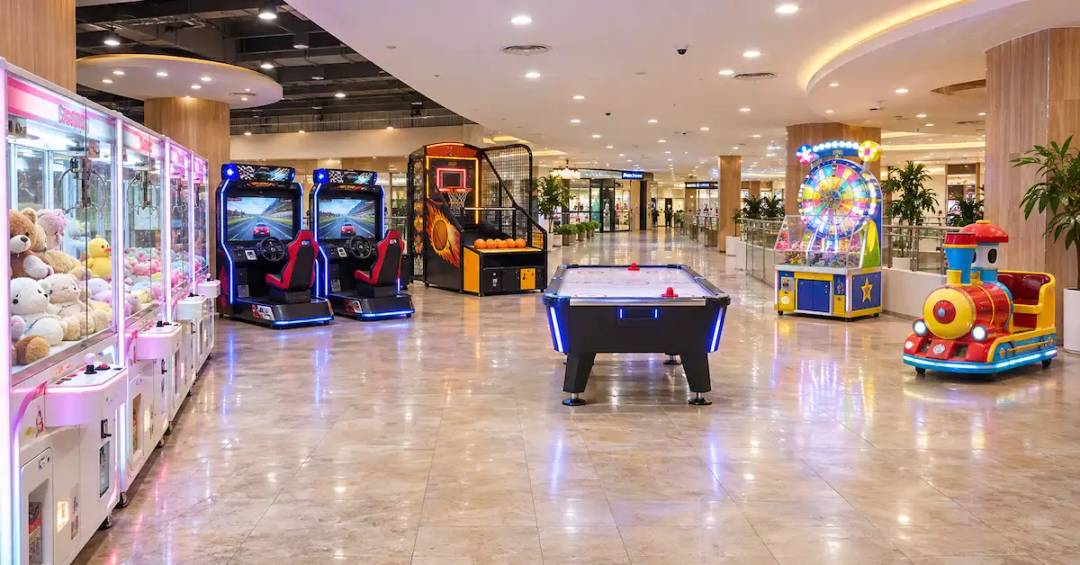
What production capacity means for an arcade machine order
“Capacity” is often presented as one number: machines per month, workers on site or square metres of factory space. None of those figures is enough for a commercial arcade order. A factory may be able to assemble many standard claw machines but have limited capacity for painted custom cabinets, linked racing sets, motion systems, multilingual software, payment-reader integration or 48-hour operation testing. Capacity belongs to the product route and time period being purchased.
Use four separate terms. Capability means the supplier knows how to perform the work. Nameplate capacity is a theoretical output under assumed conditions. Effective capacity is the output available after normal constraints, planned downtime, yield, staffing and changeovers. Available capacity is the portion of effective capacity that remains after confirmed and likely orders consume it. A buyer needs the fourth figure for the relevant bottleneck, not a brochure's nameplate figure.
Capacity must cover the complete release path
An arcade machine is not finished when a cabinet leaves assembly. The release path can include engineering approval, material and component receipt, cabinet fabrication or sourcing, graphics and surface finishing, electrical assembly, PCB and wiring installation, display and control integration, software or language configuration, payment testing, mechanical adjustment, endurance testing, correction, final inspection, accessory control, export packing and loading preparation. The slowest constrained stage sets the order's practical rate.
For example, ten workers may assemble cabinets faster than the test area can hold completed units. Adding assembly labour would then increase work-in-progress rather than shipment output. A custom artwork approval may also hold every cabinet even when the metalwork is ready. Remote capacity verification should therefore follow the order from approved specification to shipment release instead of counting people in one department.
Start with an order-specific capacity brief
A factory cannot provide a meaningful capacity answer if the buyer only says “we need one container quickly.” Prepare a capacity brief before the video call. State each factory model, quantity, standard or customized status, linked configuration, payment system, language, voltage, artwork status, required documents, test requirement, packing method, target readiness date and whether partial shipment is acceptable. Identify items that share a cabinet or assembly process and items that need specialist work.
Separate three dates: specification freeze, factory-ready date and vessel or transport date. The factory-ready date means the accepted and packed goods are available under the agreed commercial term. It is not the same as a booking estimate, port departure or venue opening. If the buyer asks for “delivery in six weeks” without naming the event and place, capacity discussions can appear aligned while the schedules are measuring different milestones.
| Input | What the buyer provides | Capacity question it resolves |
|---|---|---|
| Model schedule | Factory reference, quantity and machine family | Which process routes and bottlenecks apply? |
| Configuration depth | Standard, configured, branded or engineered changes | What requires engineering, sampling or changeover time? |
| Approval status | Open artwork, software, reader, language and document decisions | Can production start, or is the schedule still conditional? |
| Release requirements | Functional, endurance, appearance, documentation and packing checks | How much test and correction capacity is needed? |
| Schedule basis | Specification freeze, ready date and shipment constraint | Which workdays and milestones are actually available? |
Build a remote evidence pack before the live walkthrough
Ask for documents before the call so the live session can test them. Useful evidence includes a simplified process map, equipment list, active production schedule, model-family routing, staff or skill matrix, current work-in-progress list, recent comparable order record, material-status report, quality and rework log, test-area plan, packing capacity and subcontractor declaration. Sensitive customer names and prices can be redacted; order references, dates, quantities, model families and status should remain traceable enough to test the capacity claim.
Do not treat a spreadsheet as proof by itself. Use it to choose samples during the video call. If the schedule shows twelve racing sets in final test, ask the camera operator to go to that area, show the work-order reference without exposing another customer's confidential information and select a unit for an identity and status check. If the material report says all displays have arrived, ask to see the labelled stock or receiving record for the relevant order. The objective is consistency across independent evidence.
Protect confidentiality without losing audit integrity
Agree in advance whether recording is permitted, who may attend, which documents may be viewed, how confidential customer information will be hidden and how evidence will be retained. A refusal to reveal another buyer's identity is reasonable. A refusal to show any traceable production evidence is different. The supplier should be able to demonstrate its own process, resources and order status without disclosing proprietary customer data.
Use a stable video platform, test connectivity and prepare a route. Ask for a live date-and-time reference and continuous movement between key areas where practical. Pre-recorded footage can explain a process but should not be the sole evidence of current workload or available resources.
Run the live factory walk in production order
Begin outside or at the controlled entrance to confirm the production location, then follow material flow rather than the showroom route. A useful sequence is receiving and material storage; cabinet or structural work; graphics, painting or finishing; subassembly; electrical and wiring assembly; software and payment configuration; final assembly; functional and endurance testing; nonconforming or rework area; finished-goods hold; accessory and spare-parts control; export packing; and dispatch staging.
At each stage, ask three questions: What resource performs this work? How is capacity measured? What is currently consuming that resource? A machine or workstation that exists but lacks trained operators, maintenance support, tooling, approved material or test fixtures may not represent usable capacity. Likewise, a busy line proves activity, not necessarily spare capacity for the buyer's order.
Use controlled sampling during the video call
Choose samples yourself where possible. Ask to see a machine family not featured in the sales presentation, a work order selected from the schedule, one unit waiting for correction and one finished package. Follow a serial, batch or job reference across at least two records. Ask an operator or supervisor to explain the work stage rather than allowing every answer to come from the salesperson. These steps do not eliminate the possibility of staging, but they make the evidence harder to curate into a misleading story.
For mixed-category orders, inspect each important route. A claw-machine line does not prove capacity for motion racing platforms, large basketball cabinets or VR systems. If the supplier sources or integrates some categories, identify which processes are internal, which are performed by approved external parties and which entity owns final inspection and schedule control.
Calculate required output at the bottleneck
A practical capacity model starts with the required rate. For each machine family, divide the accepted quantity by the workable production days between specification release and the factory-ready date. Then translate the mixed order into the constrained resource it consumes: assembly hours, paint batches, engineering hours, test-position hours or packing teams. Raw machine count is misleading when a compact prize machine and a linked motion simulator use very different resources.
A simple planning relationship is:
Required bottleneck hours = quantity by model × demonstrated bottleneck hours per accepted unit.
Then compare it with:
Available bottleneck hours = scheduled resource hours − committed order load − planned downtime − changeover allowance.
Finally, adjust for demonstrated first-pass yield or expected rework. Do not accept an efficiency percentage without asking how it was calculated and over which period. Cycle time from one demonstration unit is weaker evidence than recent records for a comparable batch.
Use a mixed-order capacity matrix
| Machine family | Likely constrained steps to verify | Evidence | Open risk |
|---|---|---|---|
| Standard claw or prize | Cabinet availability, mechanism setup, payment and final test | Recent batch route and accepted-unit record | Mechanism or reader change |
| Branded mixed cabinets | Artwork approval, print/finish changeovers and configuration control | Artwork release, sample approval and batch schedule | Late buyer approval |
| Linked racing set | Seat/platform assembly, software, network linking and paired test space | Set-level test record and available positions | One unit tested without linked function |
| Basketball or large sport | Structural subassembly, sensor calibration, test and packing footprint | Assembly route, calibration check and package plan | Floor space and packing congestion |
| VR or motion equipment | Specialist integration, content setup, motion test and technical correction | Technician matrix and model-specific completion data | Specialist resource shared across orders |
This matrix does not assign universal hours to a category. The factory should provide its own demonstrated route and time basis for the selected models. The buyer's job is to test whether the stated hours, available positions and current order load reconcile with the promised date.
Audit material readiness and outsourced processes
A production line may be available while critical components are not. Request a material-status report divided into in stock, ordered, received, inspected, short and awaiting buyer approval. Focus on long-lead or model-specific items: displays, control boards, payment hardware, motors, sensors, motion assemblies, molded parts, printed artwork and destination-specific electrical items. Do not infer readiness from generic component shelves.
Ask which materials are purchased after deposit and which are held as normal stock. Check whether the lead-time quotation assumes an approved substitute. If a component is unavailable, require the proposed replacement, compatibility review, schedule effect and approval path. Capacity without material availability is only theoretical.
Make subcontracting visible
External fabrication, printing, painting, software work or complete-machine sourcing is not automatically unacceptable. Hidden or uncontrolled outsourcing is the risk. Ask for the process, location, normal lead time, inspection point, transport time and contingency owner. If the factory's schedule depends on an external supplier, that supplier's committed capacity and incoming-quality process belong in the order plan.
A multi-category solution provider may manufacture some equipment, assemble other products and coordinate specialist machines. Evaluate the model that will actually be used. The relevant question is who controls specifications, schedule, testing, change approval, packing and after-sales records across the order.
Test and rework capacity can decide the shipment date
Arcade equipment combines electronics, controls, displays, lights, audio and category-specific mechanical functions. A finished cabinet may occupy a test position far longer than it occupies an assembly station. Ask how many units or linked sets can be tested at once, what functions run, how long the agreed test lasts, whether the test is continuous or sampled and how failures are isolated and retested.
EPARK's public Design & Process information describes a 48-hour full-operation test covering gameplay functionality, electrical safety, lighting and mechanical durability. Treat that statement as the starting point for an order-specific capacity question: which units receive the test, where can they run, how are start and finish recorded, and what happens when a fault restarts the test? Do not multiply the published duration by the order quantity without understanding simultaneous test positions and the actual method.
Request the recent first-pass result, rework queue and average correction turnaround for comparable products where available. A factory promising full capacity with no allowance for faults is not presenting a credible production plan. The schedule should contain a correction and retest path before packing, not move unresolved issues into the buyer's pre-shipment inspection.
Check packing and dispatch as production resources
Large arcade cabinets can congest a finished-goods area even when assembly is on time. Verify packing materials, package design, labour, protected staging space, lifting equipment, package identification and final quantity control. Mixed orders also need accessory, key, cable, manual and spare-parts reconciliation. A slow packing release can miss a vessel even when functional testing finishes on schedule.
Ask the supplier to connect each unit or model batch to a test status, package reference and packing-list line. If container loading is planned, compare packed dimensions and package count with the preliminary loading plan. EPARK's arcade machine container order guide covers SKU and container planning; the capacity audit should only verify whether packing and dispatch resources support the promised readiness date.
Score evidence quality, not presentation quality
| Area | Strong evidence | Weak evidence | Buyer decision |
|---|---|---|---|
| Process route | Model-specific route with owners and release points | Generic factory flowchart | Confirm relevant resources |
| Current load | Dated schedule reconciled to selected live WIP | “We are not busy next month” | Calculate available capacity |
| Cycle and yield | Comparable batch records and defined measurement | One staged assembly demonstration | Test output assumption |
| Materials | Order-level shortage and receipt status | Photos of unlabelled shelves | Identify schedule conditions |
| Testing | Position count, method, duration, failure and retest record | Machines powered on in a showroom | Verify release capacity |
| Recovery | Named triggers, options, approval and revised milestones | “We will work overtime” | Judge resilience |
Do not hide a hard stop inside an average score. An unresolved critical material, unavailable specialist, unapproved design or insufficient test capacity can block the order even when the factory scores well elsewhere. Mark each item verified, conditional, open or rejected and attach the supporting reference.
Ask for a milestone plan and recovery logic
A credible schedule identifies specification release, material commitment, first-article or artwork approval where applicable, production start, model-family completion, test entry, correction close, final inspection, packing and readiness. It should also state the assumptions: buyer approval dates, component availability, working calendar, third-party input and shipment split.
Ask what triggers a revised plan. Useful triggers include late artwork approval, critical component shortage, first-article rejection, test failure above the planning allowance or a change in quantity. Recovery options might include resequencing standard models, adding a qualified shift, using approved alternate equipment, splitting shipment or moving a noncritical option to a later batch. Each option needs a quality, cost and approval review. Overtime is not a complete recovery plan.
Remote-capacity red flags that require a hold
Pause the award when the supplier will only show a showroom or finished inventory; the production schedule has no dated order references; stated monthly output cannot be reconciled to equipment, labour, cycle time and test positions; every process is described as internal but key work cannot be shown; critical materials are “available” without order-level status; the plan assumes zero rework; the factory refuses to identify outsourced stages; the promised date changes when the buyer asks for the process calculation; or packing is scheduled after the required dispatch event.
Also investigate a factory that appears unusually empty or unusually crowded. An empty floor may indicate spare capacity, a shutdown, material shortage or limited business. A crowded floor may indicate strong demand, stalled work-in-progress or poor flow. The visual condition needs records and explanation. Capacity is a relationship between resources, load and release requirements, not an aesthetic judgment.
A sales promise such as “thousands per year” cannot answer whether the factory can build forty customized mixed machines during the next available window. EPARK's public FAQ contains an annual-output statement and refers to flexible production lines, but the public material reviewed does not provide model-level rates, current committed load or a guaranteed capacity for a specific month. Buyers should request an order-specific plan rather than expanding that statement into a delivery guarantee.
When remote verification is not enough
Use an independent on-site assessment when the order value or launch consequence is high, the machines involve new engineering, capacity depends on specialist or subcontracted processes, remote evidence conflicts, the buyer cannot verify current load, or a missed date would delay a venue opening. SGS describes vendor assessments that examine current and projected workload, equipment, materials, facilities and manufacturing techniques; Intertek similarly lists production capability, manufacturing process, calibration, procurement and material control within factory evaluation. A buyer can use a qualified provider with an arcade-specific checklist rather than accepting a generic social-compliance audit as proof of production capacity.
Remote and on-site methods can be combined. Complete document review and management interviews remotely, then direct the site auditor to the disputed bottleneck, selected order references, test area and subcontractor controls. For a repeat supplier, compare forecast and actual performance after shipment. On-time completion, first-pass acceptance, missing-item rate, rework closure and configuration accuracy are stronger future capacity evidence than another presentation.
How to evaluate EPARK's capacity without overstating public claims
Guangzhou EPARK Electronic Technology Co., Ltd. identifies itself as a Guangzhou amusement equipment manufacturer integrating R&D, design, production and sales. Its public range covers claw and prize machines, redemption equipment, sports and skill games, racing and VR simulators, kiddie rides and broader FEC solutions. Its public process describes cabinet and graphics work, PCB and wiring assembly, screen and control integration, final testing, export packing and project support.
Those statements establish relevant activities to examine; they do not establish available capacity for the buyer's dates. Send EPARK the exact model list, quantities, customization, destination configuration, approval status, required evidence and factory-ready date. Ask the project team to return the process route, milestone plan, material assumptions, test method, packing plan and open capacity conditions. Buyers can first review the current commercial arcade equipment range so every capacity question refers to an actual model family.
Frequently asked questions
Can an arcade factory capacity audit be completed entirely by video call?
A video call can verify parts of the capacity case, including current work-in-progress, equipment, test positions and records selected during the call. It cannot always verify hidden outsourcing, data accuracy, maintenance condition or every physical resource. Use a third-party site assessment when risk, value or evidence gaps justify it.
What documents should I request before a remote capacity review?
Request an order-specific process route, model schedule, active workload, material status, equipment and skill list, comparable batch data, test-position plan, rework record, packing resources, milestone schedule and declared subcontracted stages. Redacted documents can protect other customers while preserving dates, quantities and traceability.
Does a large factory automatically have more available capacity?
No. Floor area does not show current load, material readiness, specialist availability, process balance or test capacity. A smaller controlled line may have more usable capacity for one product family than a larger facility whose bottleneck is already committed.
How do I check current factory workload remotely?
Compare a dated production schedule with live work-in-progress selected from that schedule, material records, test queues and finished goods. Ask how confirmed and likely orders consume the same bottleneck resources needed by your project.
What is the most common capacity bottleneck in an arcade order?
There is no universal bottleneck. Depending on the mix, it may be engineering approval, artwork, cabinet work, specialist integration, component supply, linked-system testing, endurance-test space, rework or export packing. Identify it from the selected models and release requirements.
Should I trust a monthly production-capacity number?
Use it only as a starting claim. Ask which products, shifts, working days, yield, outsourcing and test method produced the number. Then calculate available capacity for your bottleneck after current order load rather than applying one monthly figure to every machine category.
How can I verify capacity for a mixed arcade machine order?
Group the order by process route and constrained resource. Convert quantities into assembly, engineering, test and packing demand for each family. Verify the route for claw, racing, sports, VR or redemption equipment separately when they use different specialists or test methods.
What should happen if the capacity evidence does not support the promised date?
Do not rely on reassurance. Ask for a revised model sequence, approved resource change, split shipment or later readiness date, including the quality and cost effects. Keep the order on hold until the plan and acceptance milestones are internally consistent.
Conclusion
A reliable arcade factory capacity audit asks whether the supplier can release your defined machine mix during your required window, not whether the factory looks impressive on camera. Start with a frozen order brief, trace each model through its production route, identify the bottleneck, reconcile current workload with demonstrated cycle and test capacity, verify materials and subcontracting, and include correction, packing and recovery in the schedule.
EPARK's public manufacturing and service information provides a relevant starting point, but capacity must be confirmed for the actual models, customization and dates. Send the equipment schedule, quantity, destination configuration, approval status and target factory-ready date to request a model-specific production review and written quotation.
Disclaimer
The information provided on this website is for general informational purposes only.
While EPARK Arcade Game Machine Manufacturer strives to ensure accuracy and reliability, no warranties—express or implied—are made regarding completeness, performance, or applicability.
Product specifications, designs, and features may vary depending on usage, customization, and customer requirements.
Buyers are responsible for verifying all technical details, compliance certifications, and suitability before procurement.
EPARK shall not be held liable for any direct, indirect, incidental, or consequential damages arising from the use of this website or its content, including but not limited to business losses, data errors, or equipment misuse.
For tailored solutions or further verification, please visit our Contact Us
Intellectual Property Notice
All articles, product images, videos, catalogs, software, and related materials published on this website are the intellectual property of EPARK, unless otherwise stated.
Unauthorized reproduction, distribution, modification, or commercial use of any content is strictly prohibited without prior written consent from EPARK.
EPARK reserves the right to take legal action against any unauthorized use, including but not limited to copyright infringement, misrepresentation, or unfair competition.
Trademarks
The name EPARK, the EPARK logo, and all related brand elements displayed on this website are registered trademarks or trade names of Guangzhou EPARK Electronic Technology Co., Ltd.
Other product names, company names, or logos mentioned on this site may be trademarks of their respective owners.
Unauthorized use of EPARK's trademarks for commercial purposes, including advertising, promotions, or product packaging, is strictly prohibited.
Governing Law
These terms are governed by the laws of the People's Republic of China.