

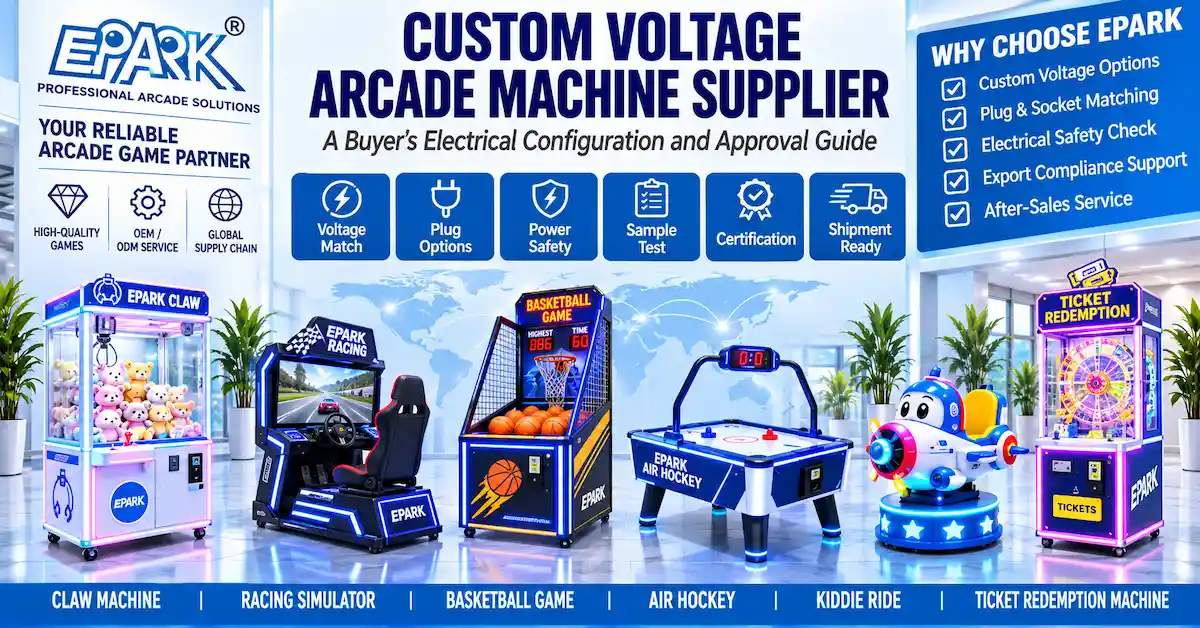
Quick answer: buy a controlled electrical configuration, not a voltage label
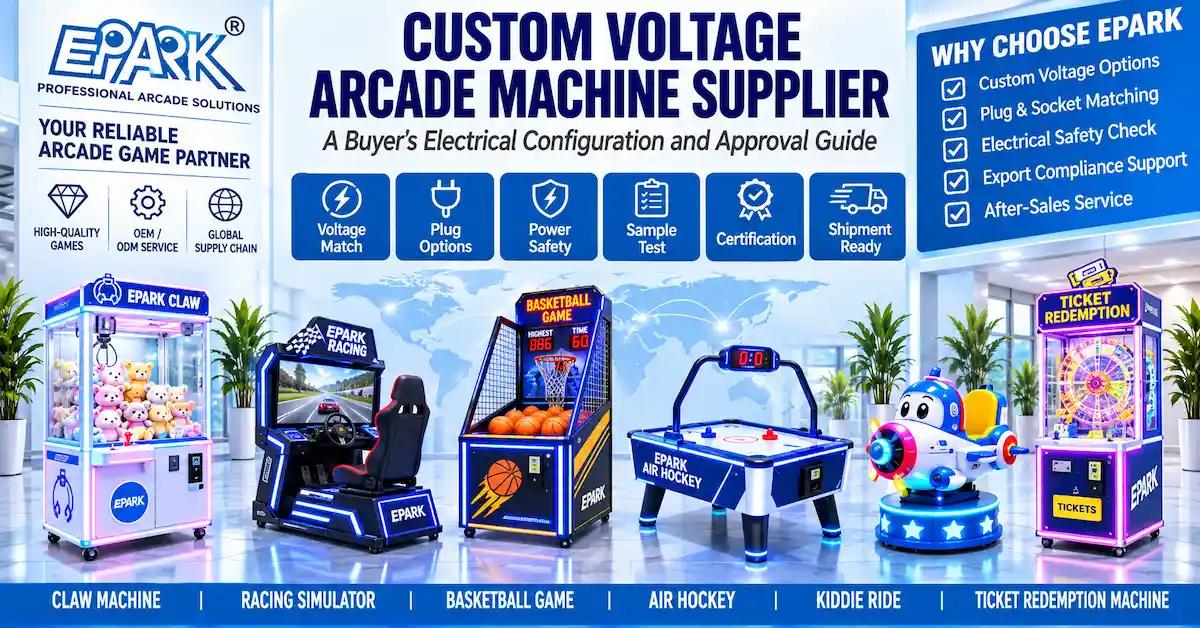
A reliable custom voltage arcade machine supplier should confirm the complete electrical configuration for every model and destination: nominal supply voltage, frequency, plug and inlet, grounding arrangement, fuse or circuit protection, power entry location, payment-system hardware, labels, manuals and the test method used on the finished machine. “220V compatible” is not a complete specification. A machine can have the right nominal voltage and still arrive with the wrong frequency assumption, plug, protective device, connector, cable rating, software setting or payment accessory. Put the configuration in a model-by-model schedule, approve a representative sample, and require the same version to be controlled across the mixed order and every repeat shipment.
EPARK presents itself publicly as a commercial arcade equipment OEM/ODM manufacturer integrating R&D, design, production and sales. Its process information describes PCB, wiring, LED, screen, control integration and final function testing. Those capabilities are relevant, but electrical suitability remains an order-level engineering question. Ask the supplier to show what will be installed in your machines, how it will be labelled, and how the final test proves the agreed configuration.
This guide is about electrical configuration control. It is not a substitute for destination-market compliance advice. EPARK's service team can coordinate customization and technical support, while the buyer remains responsible for confirming local installation rules, venue wiring and any market-specific conformity obligations with a qualified professional.
Why “custom voltage” is a system requirement
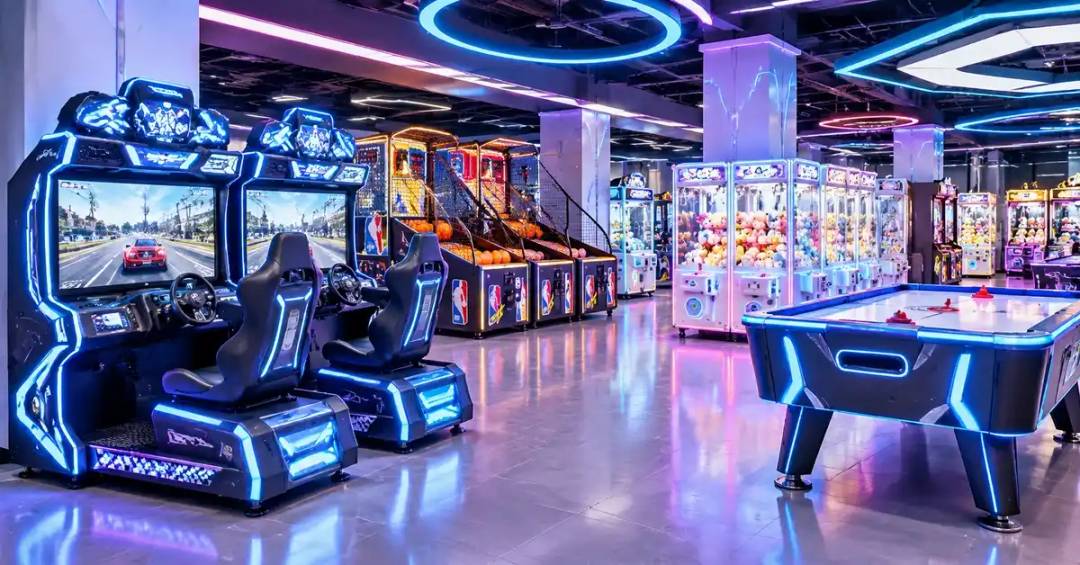
An arcade machine is a collection of loads rather than a single appliance. A cabinet may include a display, computer or game board, audio amplifier, LED lighting, motors, fans, sensors, ticket equipment, payment reader and a power supply. A racing simulator may add steering, force feedback, pedals, seat movement or a motion platform. A VR system can include a computer, headset charging, tracking equipment and network hardware. Each subsystem must receive the intended power through a safe and maintainable distribution path.
The power supply converts or distributes energy, but the machine's performance also depends on frequency-sensitive components, inrush current, grounding, heat dissipation and the quality of the site circuit. A quotation that lists only “110V/220V” leaves questions about the actual input range, frequency, plug, internal protective device, cable, connector and test conditions. Ask for a configuration sheet that distinguishes what is fixed, what is selectable and what must be changed for each destination.
Nominal voltage is not the same as site condition
Use the voltage supplied by the venue or building brief, not a country name alone. A distributor may serve several markets with different nominal systems, while one country can contain sites with different three-phase or single-phase arrangements, plug styles and local installation practices. Ask the venue electrician for the available voltage, frequency, circuit rating, earthing arrangement, socket or isolator type and any restrictions on extension leads or residual-current protection. Send that information to the supplier before the quotation is finalized.
Do not ask a factory to “make it universal” without defining what universal means. A wide input power supply may reduce variant count, but it does not automatically solve plug, fuse, cable, leakage-current, payment-reader or certification questions. The configuration must remain safe and serviceable at the intended site.
Build a destination electrical brief before requesting a quote
The most useful buyer document is a short electrical brief attached to the machine schedule. Include destination country and city, venue type, site voltage, frequency, phase, socket or plug requirement, circuit capacity, grounding information, payment system, language, required warning labels, delivery date and whether the machine will be moved between locations. For a mixed container, list each model separately rather than assuming one electrical variant fits every cabinet.
| Brief item | Example buyer input | Why the factory must confirm it |
|---|---|---|
| Nominal voltage | Site value from the venue electrician | Determines power-supply and protection configuration |
| Frequency | Recorded mains frequency | May affect motors, fans, transformers and test assumptions |
| Plug, inlet and cable | Local plug or fixed connection requirement | Prevents unusable or unsafe connection at the venue |
| Protection and grounding | Site protective-device and earthing information | Determines safe fault and service assumptions |
| Payment hardware | Coin, bill, card, QR or free-play mode | Adds load, wiring, software and service variables |
| Labels and manual | Language and required electrical markings | Keeps operation and maintenance instructions matched to the build |
Compare supplier answers model by model
Ask for an electrical configuration matrix with one row per model and variant. A single sentence in a quotation can conceal different power supplies, plugs or payment configurations across the order. Include the model code, input voltage, frequency, phase, rated or maximum power, plug or inlet, cable length, internal supply part number, fuse or breaker specification, grounding method, payment option, label version, test status and revision number.
Use the matrix to compare suppliers on evidence, not wording. One supplier may quote a lower price because its standard version has a different power supply or omits the destination plug. Another may include a tested configured sample. Normalize both offers before deciding. A low unit price that requires local rewiring, replacement readers or a delayed electrician is not the lower project cost.
Ask what can be changed safely
Some changes are straightforward component substitutions; others affect thermal design, enclosure space, protective coordination, software, testing or documentation. Ask whether the supplier changes the power supply, cord set, inlet, fuse, wiring harness, payment hardware, software parameter or only adds an adapter. An adapter may be acceptable for a temporary test, but it is not automatically a commercial installation solution.
Request the responsible engineer's review for any change that alters internal wiring, protection, motor control, high-current load or enclosure ventilation. A sales representative can collect the requirement, but the release decision should be based on an engineering-controlled drawing, bill of materials or configuration record.
Check plugs, inlets, grounding and protection together
Plug selection is visible; grounding and protection are where many practical failures hide. Confirm whether the machine uses a detachable inlet or a fixed cord, how the protective earth is connected, whether exposed conductive parts are bonded, and what service access is available. Ask which fuse or circuit-protection device is installed, its rating and replacement type, and whether the machine's inrush current has been considered. These details must be appropriate for the actual design and destination rules.
Do not specify protection by copying another model. A display-only cabinet, a motorized basketball game and a motion simulator can have different starting currents, mechanical loads and heat profiles. The supplier should identify the configuration for each model and the limits for the venue circuit. The buyer's electrician should verify the final installation and any local protective-device requirements.
Grounding is a verification step, not a checkbox
Ask for a wiring diagram or clear internal photo showing the protective-earth path, terminal identification and connection to relevant metalwork. Request continuity or safety-test evidence in the supplier's normal production record where applicable. Do not infer correct grounding from a three-pin plug in a product photograph. A plug can be correct while the internal bond is missing or the site socket is unsuitable.
For a custom brand or private-label order, keep the electrical label and manual aligned with the actual model. Changing the logo or cabinet artwork must not leave an old voltage label, an incorrect fuse statement or a manual for another variant.
Payment systems and network hardware can change the electrical design
Commercial buyers often treat payment configuration as a software option. It can also change power and wiring. Coin mechanisms, bill validators, card readers, QR scanners, ticket systems, network routers and cashless controllers may require different supplies, harnesses, mounting space and standby loads. If your project uses a regional payment system, send its model, interface, power requirement, network method and certification assumptions before the supplier freezes the machine design.
Ask whether the payment system is factory-installed, supplied loose or integrated by a third party. Define who tests it, who owns firmware and who diagnoses a fault after installation. In a mixed order, a reader that fits one cabinet may not fit another. Keep payment configuration in the same version-controlled schedule as voltage and plug details.
Voltage changes can affect gameplay configuration
A supply change may alter a motor, fan, heater, lighting driver or motion controller. Confirm that gameplay timing, fan cooling, audio and lighting are tested under the destination electrical configuration. For linked racing machines, test the whole set, including network connection and synchronized gameplay. For VR, test the computer, headset, tracking and charging arrangement together. For redemption equipment, test ticket payout and payment operation after the configured power system has been running.
Approve a sample before the mixed order
Do not approve electrical customization from a PDF alone when the change is material to the project. Request a sample or first article in the intended voltage, frequency, plug and payment configuration. Record the model code, serial number, power-supply part number, label photographs, plug, cable, internal protection, software version and test result. The sample is not only a demonstration unit; it becomes the reference against which the factory controls mass production.
Use a written approval form with “approved,” “approved with comments” or “not approved” status. List every open point and the person authorized to close it. A WhatsApp message saying “looks good” is weak evidence when a later batch contains a different connector. Ask the supplier to freeze the configuration revision after approval and to request written approval for any substitution.
| Approval item | What to record | Release question |
|---|---|---|
| Input and frequency | Measured or specified configuration and revision | Does it match the venue brief? |
| Plug, inlet and cable | Photograph, part/reference and length | Can the venue connect it without an unapproved adapter? |
| Protection and grounding | Diagram or test evidence and component reference | Has the engineer released the safety configuration? |
| Payment and software | Reader, firmware, language and operating mode | Does the complete paid-play workflow operate? |
| Labels and manual | Final photographs and file version | Could a local operator identify and service this variant? |
Test the machine under the configuration you will receive
EPARK publicly states that machines receive a 48-hour full-operation test before shipment covering gameplay functionality, electrical safety, lighting effects and mechanical durability. For a custom voltage order, ask how that test is applied to the approved variant. Was the machine powered with the specified input and frequency? Was the exact plug and internal supply installed? Was the payment reader active? Were motors, lights, fans, audio, displays and linked functions observed over the agreed period? How were failures recorded and retested?
Ask for a dated test video or test record tied to a model and serial or batch reference. A video of a standard sample is useful for understanding the product, but it is not evidence that every electrical variant was tested. For a mixed order, select samples from each voltage or payment configuration. If testing is sampled, write the sample plan and acceptance criteria into the purchase order.
Use measured data carefully
Power draw can vary with game state, screen brightness, audio, motor activity, cooling and payment hardware. Ask whether the quoted wattage is rated, typical or maximum, and under what operating condition it was measured. Use the information for venue circuit planning, not as a promise of a universal consumption figure. Your local electrical professional should size circuits and protective devices for the site installation.
For a high-traffic FEC, ask the factory how heat, dust and continuous operation are considered. A cabinet that works for a short demonstration may behave differently after hours of operation. Combine the supplier's endurance record with your own commissioning and preventive-maintenance plan.
Control voltage variants in a mixed container
A mixed container can contain several electrical configurations even when the cabinet artwork is identical. Use a variant code that is visible in the factory schedule, wiring label, package label, packing list and final inspection record. For example, the code may distinguish destination voltage/frequency, plug, payment system and language. The exact coding convention is less important than using it consistently and preventing an operator from confusing a visually identical unit.
Ask for a loading list that includes model, variant code, serial or batch, package ID and destination. Keep spare power supplies, cables, fuses and payment accessories separated by variant. A spare part that fits physically may still be wrong electrically. Label the spare-parts kit and record the approved substitute path.
| Control point | Factory record | Buyer verification |
|---|---|---|
| Configuration release | Revision-controlled matrix and approved sample | Signed approval before production |
| Assembly identification | Variant label on machine and wiring record | Photo check on selected units |
| Testing | Input, frequency, payment and test result | Match test evidence to serial or batch |
| Packing and loading | Package ID and variant on packing list | Check labels before container seal |
| Repeat order | Change log and substitution approval | Compare new sample or first article |
Documentation and compliance evidence: ask for the right file
A supplier's certificate image is not a substitute for a model-matched technical file. Ask for the data plate and label artwork, wiring diagram where appropriate, user and service manual, power-supply identification, test record, declaration or conformity documentation required for your market, and the entity responsible for the finished product. Confirm that the documents refer to the actual model and electrical variant, not a visually similar cabinet.
For EU-bound electrical equipment, the European Commission's Low Voltage Directive guidance explains that CE marking follows testing and the applicable conformity-assessment procedure, and Directive 2014/35/EU places responsibilities on manufacturers and economic operators. A buyer should therefore ask which legislation applies, who prepares the technical documentation and declaration, and how series production remains consistent. Do not present a voluntary certificate as proof of every legal obligation. Market access depends on the product, voltage range, applicable directives, harmonized standards and the economic operator's responsibilities.
Other destinations may use different rules. State the market and product scope early, then verify with a local compliance professional. Keep the supplier's document request specific: model, variant, date, revision, test scope and issuing entity.
Remote technical support after installation
Electrical configuration is not finished when the container arrives. The venue may report a tripped breaker, a dead display, a payment reader fault, overheating, a noisy fan or a motor that does not start. A remote-support process should begin with safe isolation instructions, serial and variant identification, photographs of the label and wiring area, symptom description, error code and recent changes. The supplier should not ask an unqualified operator to bypass protection or work on energized circuits.
EPARK publicly describes installation guidance, remote technical support and spare-parts supply. Before ordering, ask what information the support team needs, which parts are normally stocked, how a replacement power supply is identified, and whether the warranty terms depend on local rewiring or unauthorized changes. A distributor serving multiple locations should create a variant register and a local technician pack so the same fault is not diagnosed from scratch at every venue.
Questions to ask a custom voltage arcade machine supplier
| Buyer question | Evidence to request |
|---|---|
| What exactly changes for my destination? | Variant matrix covering supply, plug, protection, wiring and labels |
| Which engineer approves the configuration? | Named release owner and revision-controlled approval |
| Will the payment system change the power or wiring? | Reader specification, harness plan and integrated test record |
| Can I see a sample in the final configuration? | First article with label, parts, plug and test evidence |
| How is a mixed order identified? | Variant codes across machine, package, packing list and test record |
| What happens if a component is substituted? | Written engineering review, compatibility check and buyer approval |
| What support is available after installation? | Safe troubleshooting process, manuals, spare-parts route and escalation contact |
FAQ: custom voltage arcade machines
Is a 110V or 220V label enough when buying arcade machines?
No. Confirm frequency, plug or inlet, grounding, protection, cable, internal power supply, payment hardware, labels and test conditions for the exact model and destination.
Can one arcade machine support more than one voltage?
Some designs use a power supply with a defined input range, while others require a different component or configuration. The supplier must state the actual permitted input and test the delivered variant. Do not select a setting without engineering confirmation.
Should I use a plug adapter for a commercial arcade cabinet?
An adapter may be useful for a controlled temporary test, but it is not automatically an acceptable permanent installation. Confirm the venue rules, current rating, grounding, protection and local compliance with a qualified electrician and the supplier.
What should a custom voltage quotation include?
It should identify model and variant, input voltage and frequency, plug or inlet, power rating, protection, payment system, label and manual scope, sample requirement, test evidence, documentation and any assumptions or exclusions.
Do payment systems affect electrical configuration?
They can. Readers, validators, QR scanners and cashless controllers may change power, wiring, mounting, software and testing. Specify the exact payment hardware before the factory freezes the build.
How can a distributor prevent voltage variants being mixed?
Use a variant code in the approved matrix, machine label, wiring record, test record, package label and packing list. Check selected units and spare-parts kits before container sealing.
What electrical evidence should I request before paying the balance?
Request the approved configuration matrix, first-article record, label and plug photographs, test record, model-matched documents, packing-list variant IDs and a written record of approved substitutions.
Does changing voltage affect warranty?
It can if the machine is rewired locally, operated outside the specified input or fitted with unapproved components. Confirm the warranty boundary and installation requirements in writing before ordering.
Conclusion
The best custom voltage arcade machine supplier is not the one that offers the most country names in a dropdown. It is the supplier that can turn your venue's electrical brief into a controlled, tested and traceable machine variant. Require model-level data for voltage, frequency, plug, grounding, protection, payment hardware, labels and manuals; approve a first article; test the exact configuration; identify variants through packing and loading; and document the change process for repeat orders. EPARK's OEM/ODM, integration, testing and technical-support capabilities can support this workflow when they are translated into written configuration records and project-specific evidence. Send the destination, site electrical data, machine mix and payment requirements through the EPARK project contact page to request a configuration review before you release a deposit.
Disclaimer
The information provided on this website is for general informational purposes only.
While EPARK Arcade Game Machine Manufacturer strives to ensure accuracy and reliability, no warranties—express or implied—are made regarding completeness, performance, or applicability.
Product specifications, designs, and features may vary depending on usage, customization, and customer requirements.
Buyers are responsible for verifying all technical details, compliance certifications, and suitability before procurement.
EPARK shall not be held liable for any direct, indirect, incidental, or consequential damages arising from the use of this website or its content, including but not limited to business losses, data errors, or equipment misuse.
For tailored solutions or further verification, please visit our Contact Us
Intellectual Property Notice
All articles, product images, videos, catalogs, software, and related materials published on this website are the intellectual property of EPARK, unless otherwise stated.
Unauthorized reproduction, distribution, modification, or commercial use of any content is strictly prohibited without prior written consent from EPARK.
EPARK reserves the right to take legal action against any unauthorized use, including but not limited to copyright infringement, misrepresentation, or unfair competition.
Trademarks
The name EPARK, the EPARK logo, and all related brand elements displayed on this website are registered trademarks or trade names of Guangzhou EPARK Electronic Technology Co., Ltd.
Other product names, company names, or logos mentioned on this site may be trademarks of their respective owners.
Unauthorized use of EPARK's trademarks for commercial purposes, including advertising, promotions, or product packaging, is strictly prohibited.
Governing Law
These terms are governed by the laws of the People's Republic of China.