
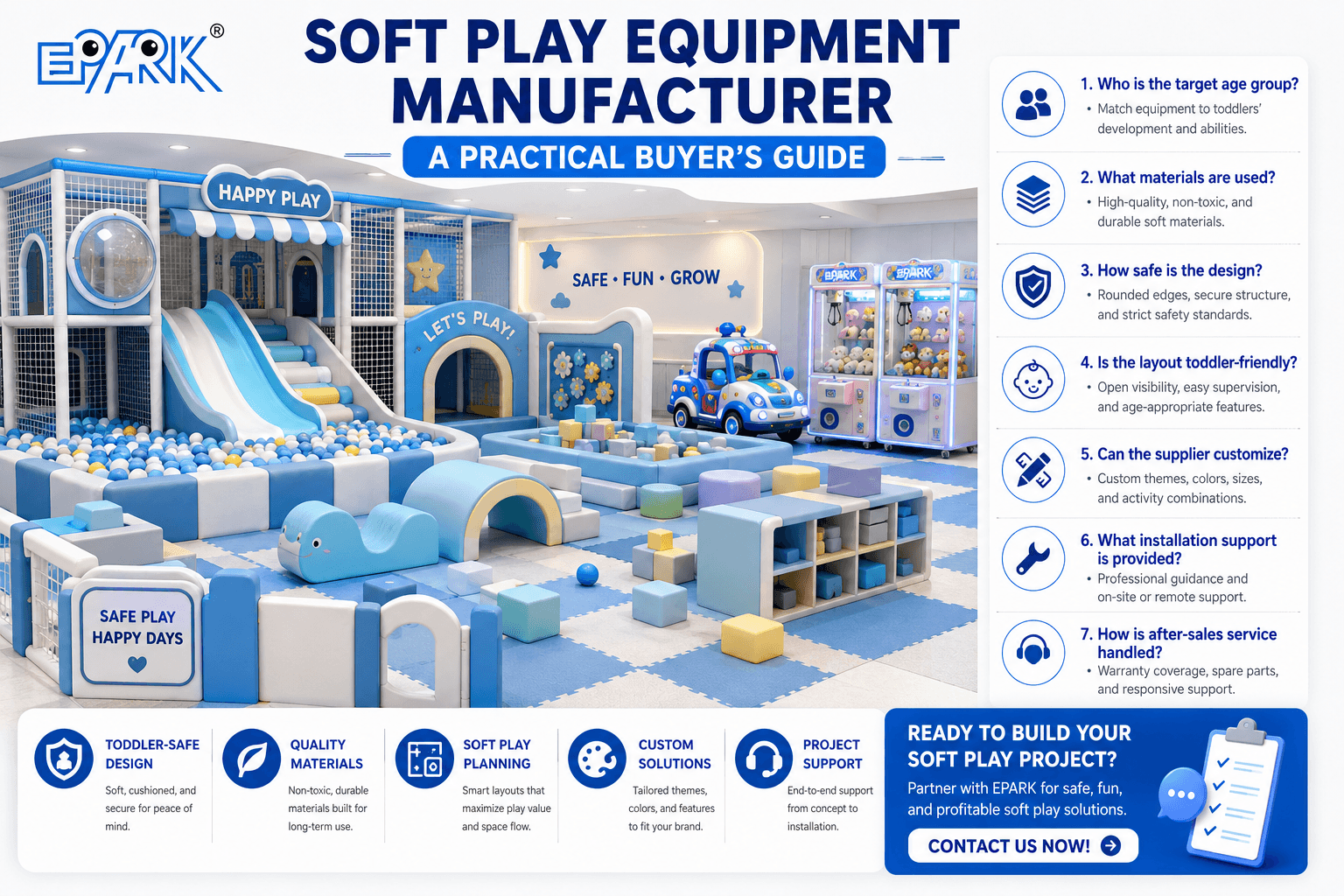
For indoor playground investors, choosing a reliable soft play equipment manufacturer is not only about buying colorful slides, foam blocks, ball pits, or climbing structures. Soft play equipment is mainly designed for toddlers and young children, so safety, material quality, layout planning, installation, and long-term durability are more important than low price.
Commercial soft play areas are widely used in:
- Indoor playgrounds
- Family entertainment centers
- Shopping mall kids zones
- Kindergarten activity areas
- Children’s party venues
- Parent-child entertainment centers
- Commercial leisure spaces
- Hotel and resort family areas
Unlike standard arcade machines, soft play equipment directly involves young children’s movement, climbing, sliding, crawling, balancing, and parent supervision. This means buyers should carefully evaluate the manufacturer’s material standards, structural design, padding quality, surface finishing, safety details, and project support before placing an order.
This guide explains how to choose a soft play equipment manufacturer for commercial venues and what buyers should check before investing.
Understand What Soft Play Equipment Includes
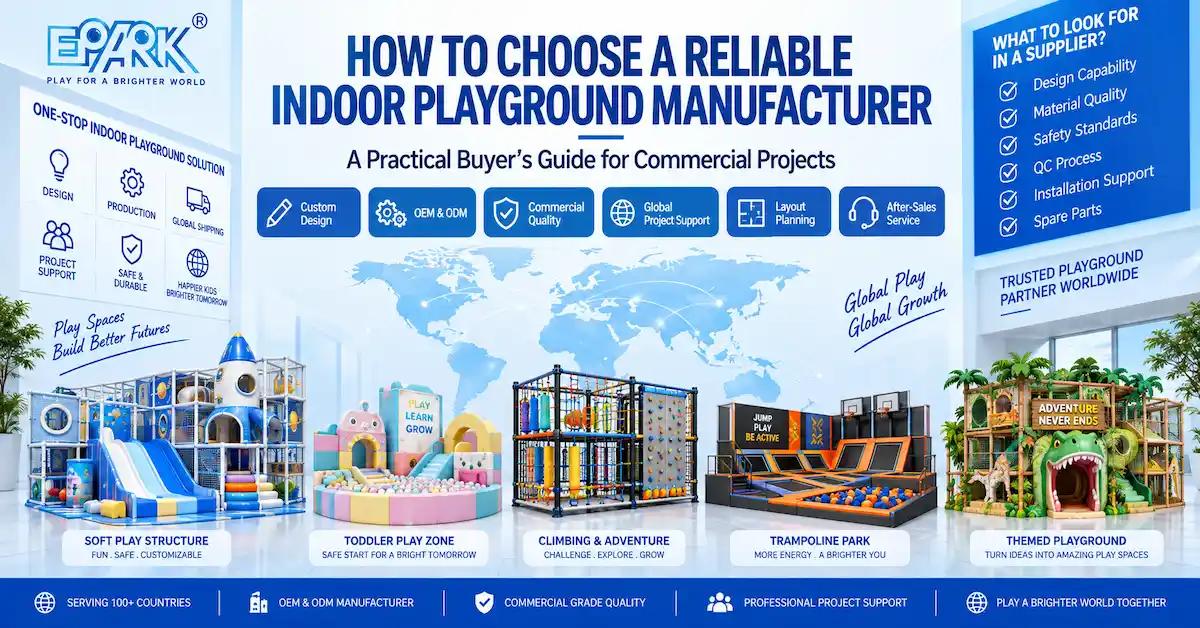
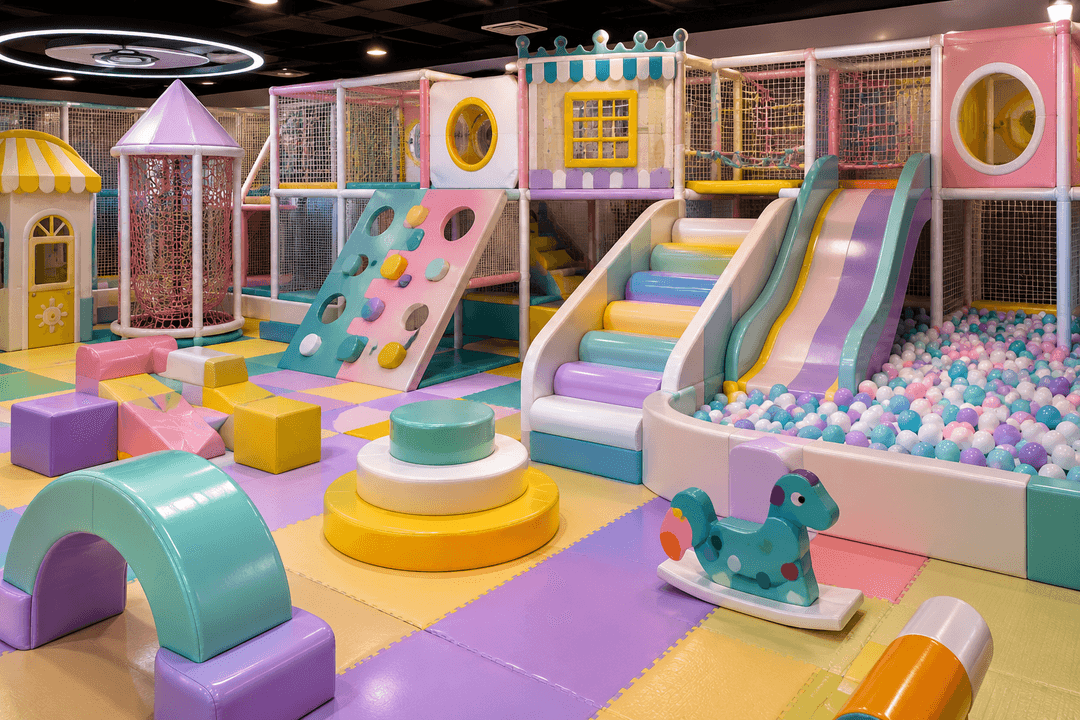
Soft play equipment refers to padded, child-friendly play structures designed for safe physical activity. It is usually made with foam, PVC or PU covering, steel or wood internal support, soft flooring, protective netting, and colorful themed components.
Common soft play equipment includes:
- Soft climbing blocks
- Foam stairs
- Soft slides
- Ball pits
- Crawl tunnels
- Mini obstacle courses
- Toddler play structures
- Soft rockers
- Balance equipment
- Interactive soft walls
- Low-height climbing areas
- Soft play houses
- Parent-child activity zones
- Foam shapes and building blocks
- Themed soft playground structures
For commercial indoor playgrounds, soft play equipment is often combined with kiddie rides, claw machines, redemption games, mini car rides, and family arcade machines to create a complete entertainment area.
A professional soft play equipment manufacturer should help buyers decide which equipment fits the venue size, target age group, safety requirements, and profit model.
Identify Your Target Age Group Before Buying
Soft play design should always start with age group planning. Equipment for toddlers is different from equipment for older children. If the play structure is too simple, older children may lose interest. If it is too complex, younger children may face safety risks.
Common Age Group Planning
| Age Group | Suitable Equipment | Design Focus |
|---|---|---|
| 1–3 years old | Soft blocks, low slides, foam steps, small ball pits | Low height, soft edges, parent visibility |
| 3–6 years old | Mini climbing, crawl tunnels, interactive soft play | Simple challenge, safe movement, bright themes |
| 6–10 years old | Larger slides, obstacle courses, climbing nets | More activity, stronger structure, wider space |
| Mixed family venue | Soft play + kiddie rides + arcade machines | Multiple zones for different ages |
For commercial venues, age separation is very important. Toddlers should not share the same high-speed slide or climbing structure with older children. A good manufacturer should help buyers divide space into toddler zones, active play zones, rest zones, and add-on arcade zones.
If your venue serves families, you may also consider adding arcade machines, kiddie rides, claw machines, or redemption games to attract older children and parents. EPARK provides arcade machines, kiddie rides, and FEC equipment that can be combined with indoor playground projects. You can explore related products on the EPARK Products page.
Check Materials Used in Soft Play Equipment
Material quality directly affects safety, appearance, cleaning, durability, and maintenance cost. A reliable soft play equipment manufacturer should clearly explain the materials used in each part of the product.
Important material details include:
- Outer covering material
- Foam density
- Internal support structure
- Flooring material
- Netting material
- Slide surface material
- Anti-slip surface
- Stitching and edge finishing
- Fire-retardant performance
- Cleaning and maintenance requirements
Key Material Checklist
| Material Area | What to Check | Why It Matters |
| Outer Covering | PVC, PU, leather-like covering, waterproof surface | Affects cleaning, durability, and appearance |
| Foam Padding | High-density foam, soft but supportive | Reduces impact and improves safety |
| Internal Frame | Steel, wood, or reinforced structure | Supports stability and long-term use |
| Flooring | EVA, foam mat, anti-slip flooring | Protects children during running and falling |
| Netting | Strong protective mesh | Prevents falls and separates play areas |
| Slide Surface | Smooth and durable surface | Improves play experience and reduces injury risk |
| Stitching | Strong seams and rounded edges | Prevents tearing and sharp contact points |
Buyers should avoid products with thin padding, weak covering, strong odor, poor stitching, or unstable structure. These issues may reduce customer trust and increase maintenance cost.
Prioritize Safety Design for Toddlers and Young Children
Safety is the most important factor when buying soft play equipment. Parents choose indoor playgrounds based on whether the space feels clean, secure, and child-friendly.
A reliable manufacturer should consider:
- Rounded corners
- Soft-padded edges
- Low-height toddler structures
- Anti-slip flooring
- Stable climbing steps
- Safe slide angles
- Age-separated zones
- Protective netting
- Clear entrance and exit paths
- Fire safety requirements
- Ventilation and lighting
- Easy supervision from parent areas
For toddler areas, equipment should stay low, soft, simple, and easy for parents to monitor. Avoid complicated structures, narrow hidden corners, or high climbing areas for very young children.
Safety Design Checklist
| Safety Item | Recommended Practice |
| Edge Protection | All edges should be padded or rounded |
| Floor Protection | Use soft, anti-slip, impact-absorbing flooring |
| Height Control | Toddler equipment should be low and easy to access |
| Visibility | Parents and staff should see children clearly |
| Zone Separation | Toddlers and older children should have separate areas |
| Netting | Climbing and elevated areas need protective mesh |
| Cleaning Access | Surfaces should be easy to wipe and disinfect |
| Emergency Access | Staff should reach all areas quickly |
A professional soft play equipment manufacturer should not only make the playground look attractive. It should design equipment with safe movement, easy supervision, and long-term commercial use in mind.
Evaluate the Manufacturer’s Project Experience
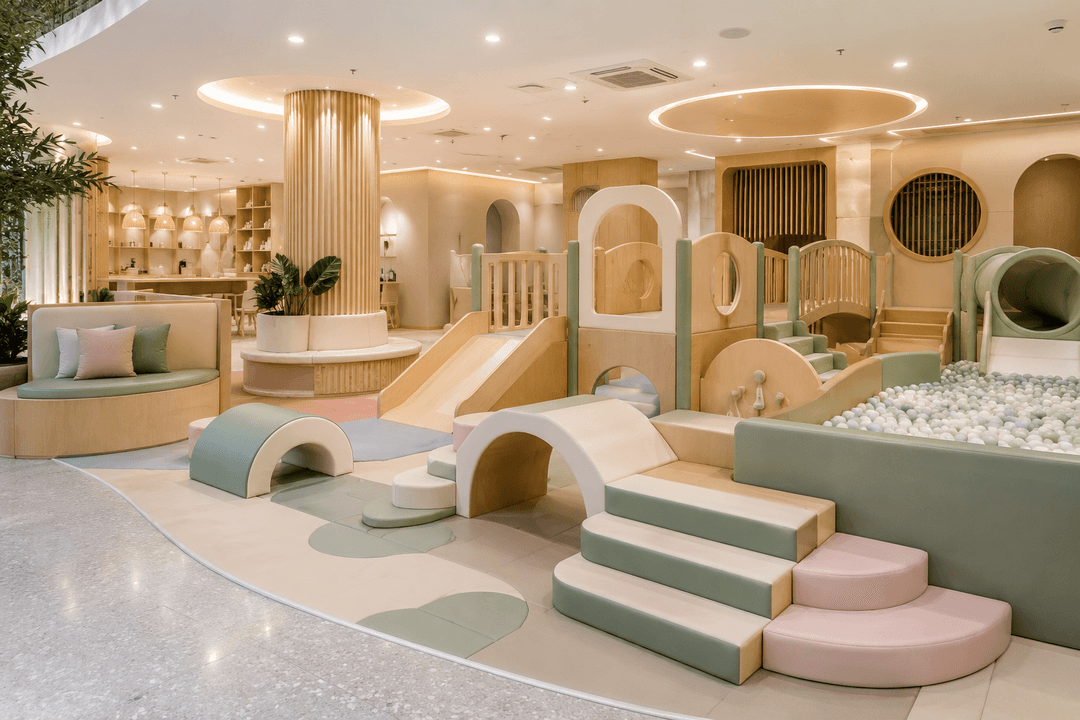
Soft play equipment is often customized according to venue size and layout. Therefore, supplier experience matters.
Before choosing a manufacturer, ask:
- Have you completed similar indoor playground projects?
- Can you provide layout suggestions?
- Can you design equipment based on my floor plan?
- What age groups do you recommend for my venue?
- Can you combine soft play with arcade machines or kiddie rides?
- Do you provide 2D or 3D layout support?
- Can you customize theme colors and appearance?
- Can you support installation guidance?
- Do you provide spare parts or maintenance advice?
A good manufacturer should understand commercial playground operation, not only product manufacturing. They should know how to plan children’s zones, parent waiting areas, ticketing areas, party rooms, and equipment placement.
For indoor playgrounds inside shopping malls, the design should be bright, open, and attractive from outside. For family entertainment centers, the layout may need to combine soft play, arcade machines, prize areas, and rest areas.
Compare Standard Products and Custom Soft Play Solutions
Some buyers choose standard soft play equipment because it is faster and usually more cost-effective. Others choose customized solutions because they need a unique theme, special layout, or brand identity.
Standard vs Custom Soft Play Equipment
| Option | Advantages | Best For |
| Standard Equipment | Faster delivery, lower cost, easier selection | Small playgrounds, budget-conscious buyers |
| Semi-Custom Design | Adjust colors, size, layout, theme details | Shopping mall kids zones, small FECs |
| Fully Customized Project | Unique theme, full layout design, brand identity | Large indoor playgrounds, destination venues |
| Soft Play + Arcade Combo | Adds extra revenue through machines | FECs, commercial family venues |
If your project is small, standard or semi-custom equipment may be enough. If you want to build a themed indoor playground or family entertainment center, custom design can help create a stronger brand experience.
Customization options may include:
- Color theme
- Brand logo
- Play structure size
- Slide design
- Ball pit shape
- Themed decoration
- Soft block design
- Age zone planning
- Flooring pattern
- Arcade zone integration
EPARK can support indoor amusement projects with arcade machines, kiddie rides, redemption machines, claw machines, and venue layout support. You can learn more about EPARK’s company and service capability on the About Us page.
Check Production Quality and Workmanship
Soft play equipment may look simple, but details matter. Poor workmanship can lead to tearing, loose seams, weak padding, unstable structures, and faster wear.
Buyers should check:
- Whether seams are strong and neat
- Whether padding thickness is enough
- Whether the surface is smooth
- Whether corners are rounded
- Whether color printing is durable
- Whether frames are stable
- Whether flooring connects smoothly
- Whether netting is tight and secure
- Whether all parts are clearly labeled
- Whether installation parts are complete
If possible, ask the manufacturer for real product photos, project photos, production videos, or sample material details.
Workmanship Evaluation Table
| Detail | Good Quality Sign | Risk If Poor |
| Stitching | Tight, clean, reinforced seams | Tearing and shorter product life |
| Padding | Thick and evenly distributed | Poor impact protection |
| Surface Covering | Smooth, waterproof, easy to clean | Difficult maintenance |
| Structure | Stable and well-supported | Safety risk |
| Netting | Strong and properly fixed | Fall risk |
| Floor Joint | Smooth connection | Tripping risk |
| Color Finish | Bright but durable | Fast fading or peeling |
A reliable soft play equipment manufacturer should provide clear production details, not only attractive renderings.
Ask About Safety Standards and Compliance
Different countries and regions may have different safety and fire protection requirements for indoor playground equipment. Buyers should confirm compliance needs before ordering.
Ask the supplier:
- What safety standards can your equipment meet?
- Are materials fire-retardant?
- Can you provide material reports if needed?
- Are products suitable for commercial indoor use?
- Can the equipment meet local venue inspection requirements?
- Do you provide installation instructions?
- Are warning signs or operation rules available?
- Can you adjust design based on local safety requirements?
For commercial venues, safety documentation may affect approval, insurance, and landlord requirements. Even if your local market does not require strict documents, safe design and good materials are still important for customer trust.
Plan Installation Before Production
Soft play equipment is often installed on-site. A smooth installation depends on accurate measurements, clear drawings, labeled parts, and supplier support.
Before production, confirm:
- Final floor plan
- Ceiling height
- Column positions
- Entrance and exit positions
- Power points
- Air conditioning location
- Fire exits
- Wall distance
- Flooring requirements
- Installation sequence
- Required tools
- Number of installers needed
Ask the manufacturer:
- Do you provide installation drawings?
- Are parts labeled clearly?
- Can you provide installation videos?
- Can your team guide installation remotely?
- Do you offer on-site installation support?
- How long does installation usually take?
Installation planning helps reduce project delays and avoids layout mistakes after equipment arrives.
Understand Maintenance and Cleaning Requirements
Soft play equipment needs regular cleaning and inspection. A clean playground improves parent trust and repeat visits.
Daily and weekly maintenance may include:
- Wiping soft surfaces
- Checking seams and corners
- Cleaning ball pits
- Inspecting nets and barriers
- Checking floor mats
- Tightening loose parts
- Replacing damaged foam pieces
- Removing broken toys or small objects
- Checking entrance gates
- Disinfecting high-touch areas
A reliable supplier should provide cleaning and maintenance suggestions. For commercial venues, this is important because equipment is used by many children every day.
Maintenance Checklist
| Frequency | Tasks |
| Daily | Clean surfaces, check visible damage, inspect floor safety |
| Weekly | Check seams, netting, ball pit cleanliness, loose parts |
| Monthly | Inspect structure, flooring joints, padding, play route safety |
| Seasonal | Replace worn parts, update decorations, refresh play experience |
Regular maintenance extends product life and protects the venue’s reputation.
Consider Adding Arcade Machines for Higher Revenue
Soft play equipment mainly serves toddlers and young children. To increase revenue and attract a wider family audience, many indoor playgrounds add arcade machines.
Suitable add-on machines include:
- Claw machines
- Kiddie rides
- Mini racing games
- Basketball arcade machines
- Small redemption games
- Prize vending machines
- Parent-child interactive machines
These machines can help:
- Create extra income beyond tickets
- Entertain older children
- Attract families near the entrance
- Increase customer stay time
- Support prize redemption
- Improve venue activity level
For example, a soft play area can be placed in the center, while claw machines and kiddie rides are placed near the entrance or parent waiting area. This makes the venue more attractive and increases spending opportunities.
EPARK provides arcade machines and FEC equipment that can support indoor playground projects. Browse the Products page to view related machine categories.
How to Choose a Reliable Soft Play Equipment Manufacturer
When comparing suppliers, do not only compare the lowest price. A reliable manufacturer should provide product quality, safety design, project support, and after-sales service.
Supplier Selection Checklist
| Evaluation Area | What to Check |
| Product Range | Soft play, toddler equipment, slides, ball pits, add-on machines |
| Material Quality | Foam, PVC/PU covering, flooring, netting, frame materials |
| Safety Design | Rounded corners, padding, age separation, anti-slip flooring |
| Customization | Theme, size, color, layout, branding |
| Project Support | Floor plan review, 2D/3D layout, installation guide |
| Workmanship | Stitching, surface finish, structure, edge protection |
| Compliance | Fire-retardant materials, safety documents if needed |
| Packaging | Safe export packaging and labeled parts |
| Installation | Drawings, videos, remote guidance, on-site options |
| After-Sales | Spare parts, maintenance advice, troubleshooting support |
A strong supplier should help you build a safe and profitable children’s play area, not just deliver products.
Why Work with EPARK for Indoor Playground and FEC Projects?
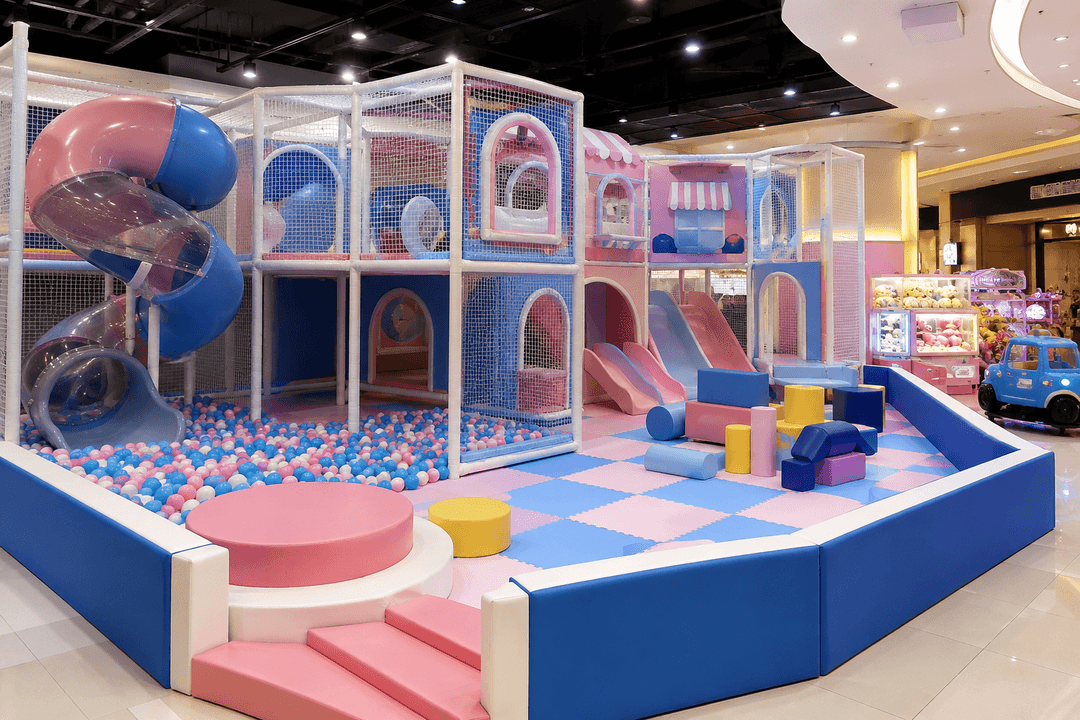
EPARK is a one-stop arcade machine manufacturer and commercial amusement solution provider based in Guangzhou, China. For indoor playground investors, EPARK can support soft play-related projects by combining children’s play zones with arcade machines, kiddie rides, redemption games, claw machines, and FEC equipment solutions.
EPARK can help buyers with:
- Indoor playground arcade zone planning
- Kiddie rides
- Claw machines
- Redemption games
- Basketball arcade machines
- Mini racing games
- Family entertainment machines
- OEM/ODM customization
- Venue layout planning
- Export packaging
- Shipping support
- Installation guidance
- Spare parts and after-sales service
For commercial venues, this combination helps investors build a more complete parent-child entertainment space. Instead of only using soft play equipment, buyers can create a mixed revenue model with tickets, memberships, arcade games, parties, prize machines, and family activities.
Learn more about EPARK on the About Us page, explore related machines on the Products page, check common questions on the FAQ page, or contact EPARK for layout support and a customized quotation.
FAQ
1. What is soft play equipment?
Soft play equipment includes padded play structures such as foam blocks, soft slides, ball pits, crawl tunnels, climbing areas, toddler play zones, and safe indoor activity equipment for young children.
2. Why is choosing a soft play equipment manufacturer important?
A reliable manufacturer helps ensure safe materials, durable workmanship, age-appropriate design, proper installation, and long-term maintenance support.
3. What materials are commonly used in soft play equipment?
Common materials include foam padding, PVC or PU covering, anti-slip flooring, protective netting, internal support structures, and soft surface materials that are easy to clean.
4. What should I check before buying soft play equipment?
You should check material quality, foam density, surface covering, safety design, age group suitability, workmanship, installation support, packaging, and after-sales service.
5. Is soft play equipment suitable for toddlers?
Yes. Soft play equipment is especially suitable for toddlers when it is low-height, padded, easy to supervise, and separated from older children’s play areas.
6. Can soft play equipment be customized?
Yes. Buyers can usually customize size, layout, colors, theme design, branding, slides, ball pits, play zones, and some structural details based on the venue.
7. How do I make a soft play area safer?
Use soft flooring, rounded edges, padded surfaces, age-separated zones, protective netting, visible play areas, safe slide angles, and regular cleaning and inspection.
8. Can arcade machines be added to a soft play area?
Yes. Claw machines, kiddie rides, mini racing games, basketball machines, and redemption games can add extra revenue and attract older children and families.
9. How often should soft play equipment be maintained?
Daily cleaning and visual checks are recommended. Weekly and monthly inspections should focus on seams, padding, netting, flooring, loose parts, and worn surfaces.
10. How can EPARK support indoor playground projects?
EPARK can support arcade machine selection, kiddie rides, claw machines, redemption games, FEC equipment planning, layout support, OEM/ODM customization, export packaging, shipping, installation guidance, and after-sales service.
Conclusion
Choosing a reliable soft play equipment manufacturer is an important step for indoor playground investors and commercial venue operators. The right supplier should understand toddler safety, material quality, age group planning, space layout, customization, installation, and long-term maintenance.
Before placing an order, buyers should check materials, padding, surface covering, safety design, production quality, compliance support, packaging, installation guidance, and after-sales service.
A well-planned soft play area can attract families, improve venue traffic, and create repeat visits. When combined with arcade machines, kiddie rides, and redemption games, it can also build a stronger profit model for commercial indoor playgrounds and FEC projects.
Contact EPARK today to get indoor playground arcade equipment recommendations, layout planning support, and a customized quotation for your commercial venue.
Disclaimer
The information provided on this website is for general informational purposes only.
While EPARK Arcade Game Machine Manufacturer strives to ensure accuracy and reliability, no warranties—express or implied—are made regarding completeness, performance, or applicability.
Product specifications, designs, and features may vary depending on usage, customization, and customer requirements.
Buyers are responsible for verifying all technical details, compliance certifications, and suitability before procurement.
EPARK shall not be held liable for any direct, indirect, incidental, or consequential damages arising from the use of this website or its content, including but not limited to business losses, data errors, or equipment misuse.
For tailored solutions or further verification, please visit our Contact Us
Intellectual Property Notice
All articles, product images, videos, catalogs, software, and related materials published on this website are the intellectual property of EPARK, unless otherwise stated.
Unauthorized reproduction, distribution, modification, or commercial use of any content is strictly prohibited without prior written consent from EPARK.
EPARK reserves the right to take legal action against any unauthorized use, including but not limited to copyright infringement, misrepresentation, or unfair competition.
Trademarks
The name EPARK, the EPARK logo, and all related brand elements displayed on this website are registered trademarks or trade names of Guangzhou EPARK Electronic Technology Co., Ltd.
Other product names, company names, or logos mentioned on this site may be trademarks of their respective owners.
Unauthorized use of EPARK's trademarks for commercial purposes, including advertising, promotions, or product packaging, is strictly prohibited.
Governing Law
These terms are governed by the laws of the People's Republic of China.