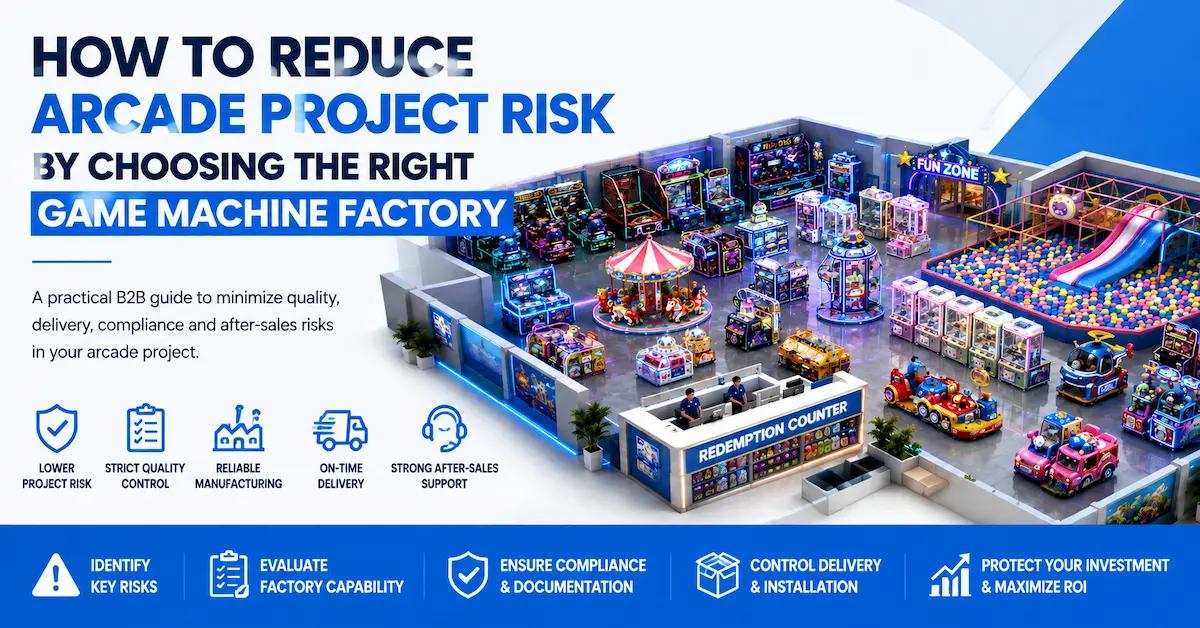

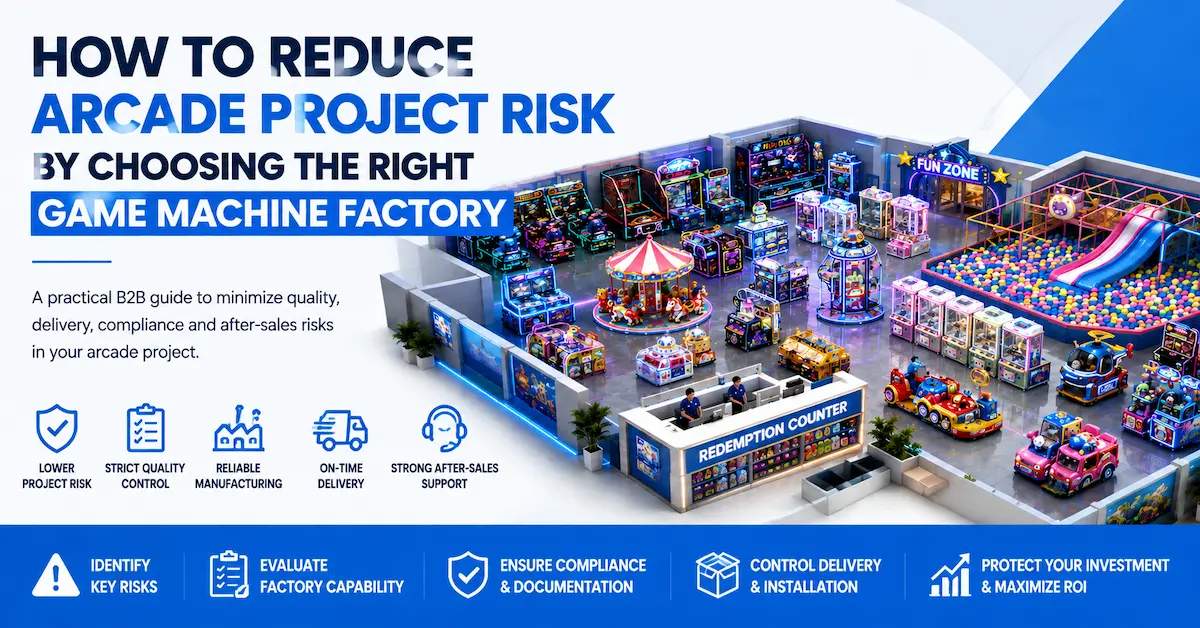
Choosing arcade machines is only one part of building a successful commercial entertainment project. The larger challenge is controlling everything that can go wrong between initial planning and daily operation.
A low quotation may look attractive at the purchasing stage, but problems with machine specifications, component quality, payment-system compatibility, production schedules, export packaging, installation, or spare parts can create much higher costs later.
For FEC investors, arcade operators, distributors, shopping mall projects, and entertainment contractors, choosing a reliable game machine factory is therefore not simply a supplier-selection decision. It is part of project risk management.
The right factory should help reduce uncertainty before production, control quality during manufacturing, verify machines before shipment, support installation, and provide technical resources after the venue opens.
This guide explains how commercial buyers can evaluate those risks systematically before placing an order.
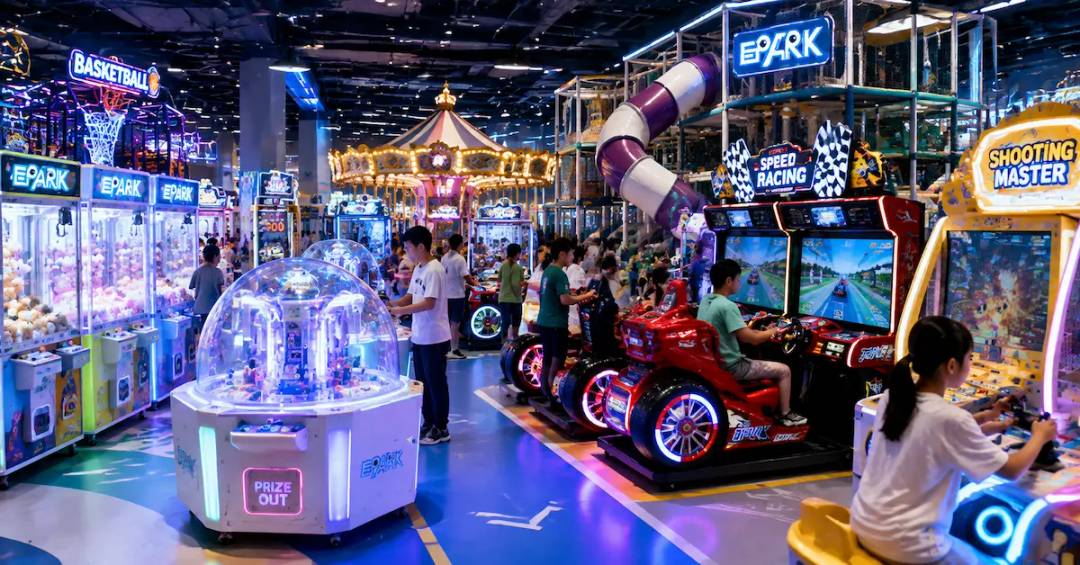
What Does Arcade Project Risk Actually Mean?
Arcade project risk is any issue that can increase cost, delay opening, reduce machine availability, or create unexpected technical work after an equipment order has been confirmed.
For commercial buyers, the main risks usually appear across the full project lifecycle.
| Risk Area | Typical Problem | Possible Business Impact |
|---|---|---|
| Equipment specification | Wrong size, voltage, payment system or configuration | Rework and installation delays |
| Machine selection | Equipment does not fit the venue or target audience | Weak space utilization and poor player mix |
| Manufacturing | Unstable components or inconsistent assembly | Frequent failures |
| Quality control | Problems not discovered before shipment | Repairs after arrival |
| Compliance | Wrong or incomplete documentation for destination market | Import or market-entry complications |
| Customization | Artwork, cabinet or software differs from approved requirements | Rework and project delays |
| Production schedule | Unrealistic manufacturing commitments | Delayed opening |
| Packaging and logistics | Screens, cabinets or components damaged in transit | Replacement cost and installation delays |
| Installation | Missing manuals, accessories or technical support | Slow commissioning |
| After-sales | Difficult troubleshooting or unavailable spare parts | Longer equipment downtime |
The objective is not to eliminate every possible risk. It is to identify which risks can be controlled before the machines leave the factory.
That is where factory selection becomes commercially important.
Start With Project Requirements Before Asking for a Price
One of the easiest ways to create project risk is to request a quotation before the project requirements are clear.
A professional factory needs more than a list of machine names.
Before comparing suppliers, buyers should define the venue type, usable floor area, target player groups, preferred machine categories, payment method, destination voltage, language requirements, branding requirements, expected opening schedule, local compliance requirements and maintenance capabilities.
For example, an FEC targeting families may need a balanced mix of redemption games, claw machines, sports games, kiddie equipment and selected simulator attractions.
A compact shopping mall arcade may place greater importance on visual impact, machine footprint and rapid player turnover.
A distributor may care more about repeatable models, component consistency, spare parts and OEM branding.
This is why a reliable game machine factory should ask questions before recommending equipment.
A supplier that immediately sends a generic price list without understanding the project may be treating the transaction as an equipment sale rather than a commercial venue project.
Verify Real Manufacturing Capability, Not Just Marketing Claims
A professional website does not automatically prove that a supplier controls production.
Buyers should understand who is responsible for cabinet construction, electrical assembly, payment-system integration, software configuration, final testing and technical support.
This does not mean that every component must be manufactured internally. Arcade equipment naturally contains purchased screens, control boards, sensors, motors, power supplies and other components.
The more important question is whether the supplier has enough production control to manage specifications and solve problems.
Useful evidence may include factory walkthrough videos, production photos, assembly procedures, testing records, sample-machine demonstrations, packaging examples and explanations of how customized requirements move from sales to engineering and production.
EPARK describes its business as integrating R&D, design, production and sales, with OEM customization, venue layout consulting and technical support as part of its service model.
https://www.eparko.com/about-us
For a project buyer, this type of integration matters because responsibility is easier to trace when technical questions arise.
Turn “Good Quality” Into Measurable Acceptance Criteria
“High quality” is too vague to use as a purchasing standard.
Before production, buyer and factory should agree on what will actually be checked.
For commercial arcade equipment, inspection normally needs to consider cabinet condition, controls, screens, lighting, wiring, electronic systems, mechanical functions, payment devices and game functions relevant to the individual machine.
For redemption equipment, ticket or point functions also need verification. For racing machines, steering controls, screens, seats and motion-related functions may require additional checks. Claw machines require different checks again.
EPARK's published quality-control process describes stages including material inspection, component checking, production monitoring, assembly inspection, functional testing and export packaging checks.
https://www.eparko.com/blog/game-machine-factory-quality-control
The important buyer lesson is not simply that testing should occur.
The buyer should establish evidence.
| QC Question | Better Buyer Requirement |
| “Do you test the machines?” | Define which functions will be tested |
| “Is the machine stable?” | Request actual operating-test evidence |
| “Is the payment system working?” | Test the exact configured payment method |
| “Is the appearance acceptable?” | Approve artwork and inspect final cabinet photos |
| “Is everything included?” | Confirm accessory and spare-parts packing list |
| “Is it ready to ship?” | Require final inspection and packaging confirmation |
Where possible, buyers should request photos, video or inspection documentation before shipment.
This creates an acceptance point while corrective work can still be performed at the factory.
Treat Compliance as a Destination-Market Requirement
Compliance is one of the areas where buyers should avoid simple assumptions.
There is no single certificate that automatically proves every arcade machine is suitable for every country.
IEC 60335-2-82:2024 covers the safety of many electric commercial amusement machines, including driving simulators, gaming machines, kiddie rides, laser shooting appliances, bowling machines and video games. The standard also notes that additional national requirements may apply, and some categories—such as certain VR systems intended for operation with a trained attendant—can fall outside its scope.
This means buyers should not simply ask:
“Do you have CE?”
A stronger question is:
“Which standards, directives and conformity documents apply to this exact machine in my destination market?”
For products placed on the European Economic Area market where CE marking is applicable, the European Commission states that manufacturers are responsible for conformity assessment, the technical file, the EU Declaration of Conformity and application of the CE marking. Importers and distributors also have compliance responsibilities.
https://single-market-economy.ec.europa.eu/single-market/goods/ce-marking_en
The EU also identifies the Low Voltage Directive 2014/35/EU and Electromagnetic Compatibility Directive 2014/30/EU as major directives applying to electrical and electronic equipment.
A reliable factory should therefore be willing to discuss compliance at model level rather than relying on generic certificate logos in marketing materials.
Control OEM and Customization Risk Before Production Starts
OEM/ODM customization can create valuable differentiation, but every customization also introduces another project variable.
Typical arcade-machine customization may involve cabinet colors, logos, artwork, interface language, payment systems, voltage, plug type, lighting, game settings and packaging.
EPARK's factory-backed service information lists options such as cabinet colors, logo printing, artwork, interface language, payment systems, voltage requirements, packaging and private-label production.
https://www.eparko.com/blog/factory-backed-game-machine-supplier
The safest approach is to freeze critical requirements before mass production.
A project approval sheet can record the approved cabinet dimensions, visual artwork, logo files, voltage, plug, payment configuration, language, accessories, spare-parts package and any project-specific software or gameplay settings.
If anything changes later, the change should be documented.
This simple change-control process reduces one of the most common international sourcing problems: the buyer believes one specification was approved while production follows another.
Make the Production Schedule a Series of Milestones
A project is not protected simply because a supplier provides a delivery date.
Commercial arcade projects often depend on several connected stages:
Design confirmation → customization approval → production → inspection → packing → international transport → customs clearance → local delivery → installation → commissioning → opening.
If one step moves, every later step may move as well.
For this reason, buyers should ask for milestone visibility rather than one final promise.
The supplier should be able to explain when specifications become fixed, when customized artwork must be approved, when production starts, when machines can be inspected and when packing can begin.
For larger FEC projects, this becomes even more important because different equipment categories may have different production requirements.
A reliable game machine factory should communicate schedule risk early rather than promise an unrealistic deadline simply to secure the order.
Treat Packaging as Part of the Machine Specification
International shipment adds risks that do not exist when a machine is tested inside the factory.
Arcade equipment can contain screens, acrylic or glass panels, lighting systems, controllers, wiring, motors, seats, sensors and decorative cabinet components.
A machine that passes factory testing can still arrive damaged if packaging is inadequate.
Therefore export packaging should be treated as a technical deliverable.
Before shipment, buyers should confirm the packing method, machine dimensions, gross weight, accessory list, spare-parts package and loading arrangement. For sensitive or unusually shaped machines, packaging photos are useful before container loading.
EPARK's existing buyer guidance highlights export packaging, packing verification and loading documentation as part of supplier evaluation.
https://www.eparko.com/blog/how-to-identify-a-reliable-game-machine-factory
This is especially relevant when multiple types of machines are shipped together for a complete arcade or FEC project.
Plan Installation Before the Machines Arrive
Installation risk is often discovered too late.
A buyer may receive the correct machine but still experience delays because power requirements were not confirmed, accessories are difficult to identify, payment-system settings are incomplete or technical documentation is insufficient.
Before shipment, buyers should know what installation work will be required locally.
For a larger project, useful support can include machine placement information, operating manuals, setup instructions, wiring information, payment-system guidance, remote technical assistance and staff training where appropriate.
EPARK states that its service model extends beyond equipment supply to venue planning and ongoing technical assistance, while its current FAQ describes warranty support covering parts and technical assistance.
https://www.eparko.com/about-us
The key purchasing principle is simple:
Installation planning should begin before shipping, not after the container arrives.
Evaluate Spare Parts Before Evaluating Warranty Language
Warranty is important, but machine availability is often more important to an operator.
Commercial machines contain components that may eventually require replacement or adjustment.
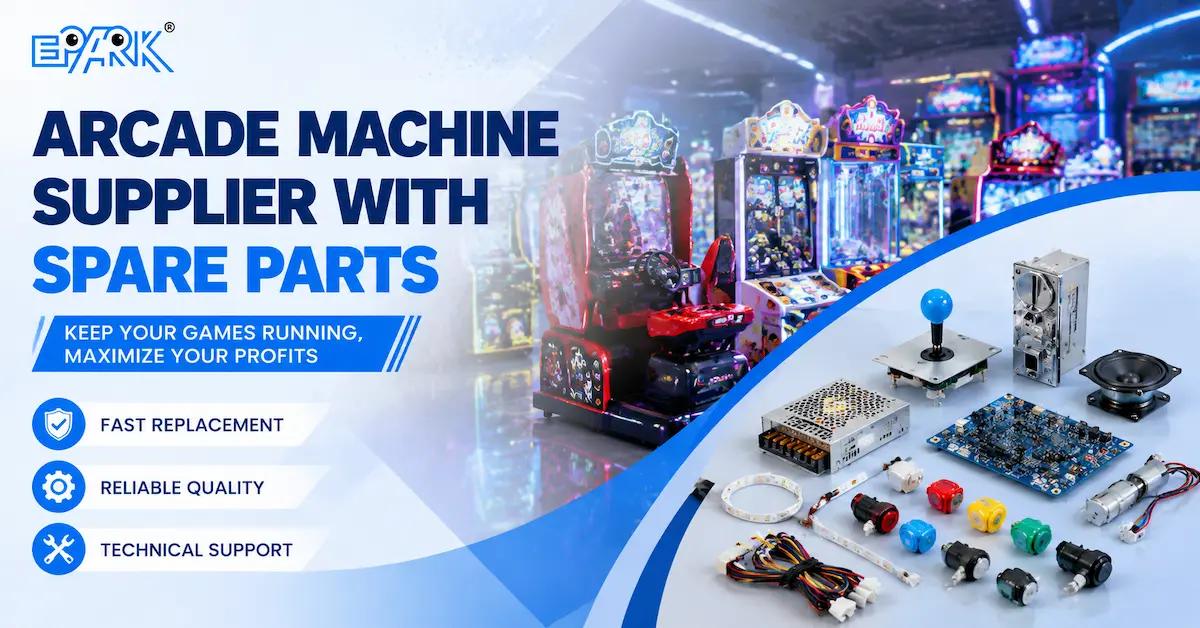
Depending on the equipment, these can include buttons, joysticks, sensors, power supplies, motors, card readers, control boards, ticket-system components and LED parts.
EPARK's factory-backed supplier guidance specifically identifies these categories as examples of parts that commercial venues may need during long-term operation.
https://www.eparko.com/blog/factory-backed-game-machine-supplier
Before purchasing, buyers should establish how replacement parts are identified, whether part compatibility can be confirmed remotely, how technical troubleshooting is handled and which critical spares should be ordered with the initial shipment.
This is particularly important for overseas projects.
A low-cost component is not inexpensive if a machine cannot operate for an extended period while the correct replacement part is being identified and shipped.
Compare Total Project Cost, Not Only Machine Price
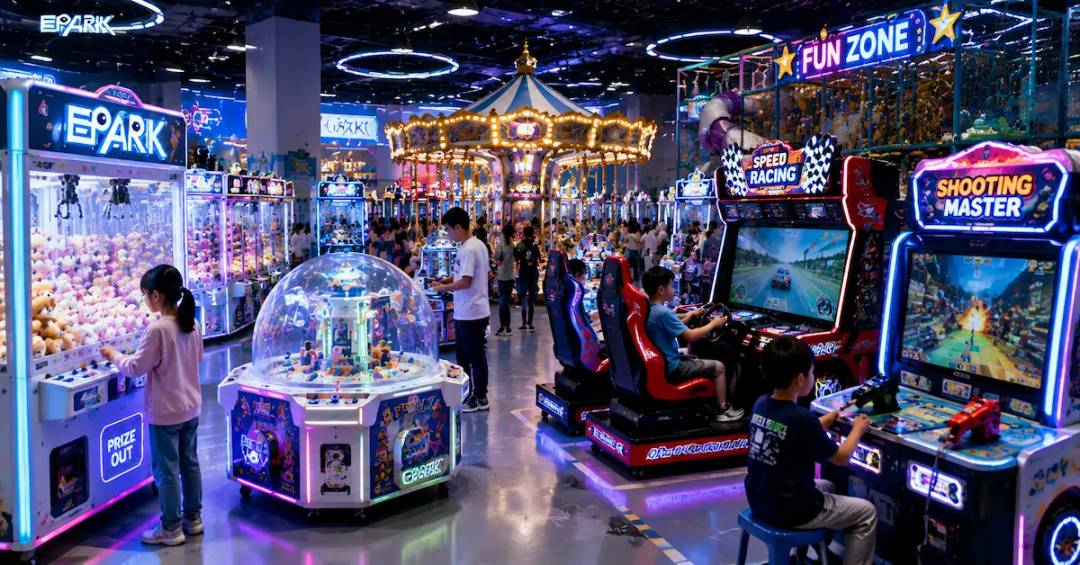
Unit price is only one component of arcade project cost.
A more useful commercial view is:
Total Project Cost = Equipment + Customization + Shipping + Import Costs + Installation + Corrective Work + Spare Parts + Maintenance + Downtime
Not every factory affects every element equally.
However, factory capability has a strong influence on corrective work, technical problems, spare-parts availability and downtime.
Consider two suppliers.
Supplier A offers a lower purchase price but provides limited testing documentation, unclear spare-parts support and weak technical communication.
Supplier B is more expensive but provides clearer specifications, pre-shipment verification, technical documentation and long-term parts support.
Supplier A may still be the right choice in some situations. But the decision should be made using total project risk rather than quotation price alone.
This is the commercial difference between buying arcade machines and sourcing equipment for an operating entertainment business.
A Practical 100-Point Factory Risk Scorecard
Buyers can make factory comparison more objective by scoring each supplier before placing a major order.
The following weighting is a practical evaluation framework rather than an industry standard and can be adjusted to individual projects.
| Evaluation Area | Suggested Weight | What to Verify |
| Technical and project fit | 20 | Venue understanding, equipment mix, specifications |
| Manufacturing and QC | 20 | Production control, testing, inspection evidence |
| Compliance and documentation | 15 | Model-specific documents and market requirements |
| Production and delivery control | 15 | Milestones, realistic schedules, packaging |
| After-sales and spare parts | 15 | Troubleshooting, parts identification and supply |
| OEM/ODM change control | 10 | Approval process, artwork, systems and configuration |
| Communication transparency | 5 | Clear answers, written confirmation, problem escalation |
| Total | 100 |
A supplier does not need a perfect score.
The purpose of the scorecard is to expose weak areas before payment and production make them more expensive to correct.
For example, if a factory performs well technically but cannot provide the documentation required for the destination market, that risk should be resolved before order confirmation.
If after-sales support is weak, the buyer may compensate by purchasing a larger initial spare-parts inventory.
Risk assessment allows the buyer to manage weaknesses instead of discovering them after installation.
Warning Signs That Project Risk May Be Too High
Some warning signs deserve additional investigation before placing a commercial order:
A supplier gives a quotation without asking about the venue or market; technical specifications remain vague; customization is promised but never documented; factory or testing evidence is difficult to obtain; delivery promises appear unrealistic; compliance questions receive only generic certificate images; payment compatibility is not confirmed; packing methods are unclear; spare-parts questions are avoided; or communication becomes less precise once the order becomes more technical.
None of these issues alone automatically proves that a supplier is unreliable.
However, several appearing together indicate that the buyer is carrying more project uncertainty.
A reliable supplier should make the project more predictable as discussions become more detailed.
How EPARK Can Support Arcade Project Risk Control
EPARK positions itself as a commercial amusement equipment manufacturer integrating R&D, design, production and sales, rather than only an equipment reseller. Its published service scope includes OEM customization, venue layout consulting, branding support and technical assistance.
Its product and project support covers buyers such as arcade operators, FEC projects, shopping mall entertainment projects and distributors, while its factory-related materials describe production inspection, functional testing, export packaging, spare-parts support and technical assistance.
For buyers planning an arcade, FEC or entertainment venue, the practical advantage of this type of one-stop model is coordination.
Machine selection affects layout.
Layout affects quantity.
Quantity affects power planning and shipping.
Customization affects production.
Production affects delivery.
Delivery affects installation.
Installation quality affects opening.
After-sales capability affects long-term machine availability.
Treating these activities as one connected project can reduce the gaps that appear when each stage is handled independently.
Final Pre-Order Risk Review
Before confirming a commercial arcade-machine order, the buyer should be able to answer one question clearly:
What important uncertainty still remains?
Machine specifications should be confirmed. Project-specific customization should be approved. Required market documentation should be understood. The quality-control process should be visible. Production milestones should be realistic. Packaging should be defined. Installation responsibilities should be clear. Spare-parts and technical-support procedures should be understood.
If several of these areas remain uncertain, the project risk has not disappeared—it has simply been postponed.
Choosing a reliable game machine factory is therefore less about finding the supplier with the strongest marketing claims and more about finding the supplier that can systematically remove uncertainty before it becomes cost.
For commercial entertainment projects, predictability is one of the most valuable services a factory can provide.
FAQ
1. What makes a reliable game machine factory?
A reliable game machine factory should demonstrate real manufacturing or production-control capability, clear specifications, structured quality control, realistic scheduling, appropriate compliance support, export packaging, spare-parts availability and technical service.
2. How can I verify whether a game machine supplier has real factory capability?
Request evidence such as factory walkthroughs, production videos, assembly information, machine testing, packaging examples and explanations of how engineering and production handle customized requirements.
3. Should I inspect arcade machines before shipment?
For commercial projects, pre-shipment verification is strongly recommended. Buyers should confirm machine functions, appearance, configured payment systems, accessories, customization and packaging before the machines leave the factory.
4. Is CE marking enough for importing arcade machines into Europe?
Not automatically. Applicable requirements depend on the exact equipment. Buyers should confirm which legislation, standards and conformity documents apply to each machine and destination market rather than relying only on a CE logo.
5. Why is IEC 60335-2-82 relevant to arcade equipment buyers?
IEC 60335-2-82:2024 addresses safety requirements for many types of electric commercial amusement machines, including gaming machines, driving simulators and kiddie rides. Its exact applicability should still be checked against the individual equipment and intended use.
6. How can OEM customization increase project risk?
Customization introduces additional variables such as cabinet design, artwork, voltage, payment systems, language and software settings. These risks can be controlled by documenting and approving specifications before production.
7. Should I choose the game machine factory with the lowest price?
Not necessarily. Compare total project cost and risk, including quality, corrective work, shipping, spare parts, maintenance and possible equipment downtime rather than unit price alone.
8. What spare parts should I discuss before ordering?
The answer depends on the machine type, but buyers should ask the factory to identify common wear or service parts and recommend a practical initial spare-parts package for the project.
9. When should installation planning begin?
Installation planning should begin before shipment. Power, machine placement, payment configuration, technical documentation, accessories and local installation responsibilities should be confirmed in advance.
10. How can EPARK help reduce arcade project procurement risk?
EPARK supports commercial buyers with arcade equipment supply, OEM/ODM customization, venue planning, production and quality control, export packaging, technical assistance and spare-parts support. Buyers can provide project information such as venue size, target market, machine requirements and customization needs so the appropriate solution can be evaluated.
Conclusion
Arcade project risk rarely comes from one major mistake. It usually comes from multiple small uncertainties that remain unresolved until production, shipping, installation or operation.
The best way to reduce those risks is to evaluate the factory as part of the entire project lifecycle.
A reliable game machine factory should help buyers turn unclear requirements into confirmed specifications, specifications into controlled production, production into verified equipment, and delivered machines into maintainable commercial assets.
Before comparing final quotations, compare how much uncertainty each factory removes from your project.
For FEC investors, arcade operators, distributors and commercial entertainment developers, that is often a better indicator of long-term value than the lowest equipment price.
Disclaimer
The information provided on this website is for general informational purposes only.
While EPARK Arcade Game Machine Manufacturer strives to ensure accuracy and reliability, no warranties—express or implied—are made regarding completeness, performance, or applicability.
Product specifications, designs, and features may vary depending on usage, customization, and customer requirements.
Buyers are responsible for verifying all technical details, compliance certifications, and suitability before procurement.
EPARK shall not be held liable for any direct, indirect, incidental, or consequential damages arising from the use of this website or its content, including but not limited to business losses, data errors, or equipment misuse.
For tailored solutions or further verification, please visit our Contact Us
Intellectual Property Notice
All articles, product images, videos, catalogs, software, and related materials published on this website are the intellectual property of EPARK, unless otherwise stated.
Unauthorized reproduction, distribution, modification, or commercial use of any content is strictly prohibited without prior written consent from EPARK.
EPARK reserves the right to take legal action against any unauthorized use, including but not limited to copyright infringement, misrepresentation, or unfair competition.
Trademarks
The name EPARK, the EPARK logo, and all related brand elements displayed on this website are registered trademarks or trade names of Guangzhou EPARK Electronic Technology Co., Ltd.
Other product names, company names, or logos mentioned on this site may be trademarks of their respective owners.
Unauthorized use of EPARK's trademarks for commercial purposes, including advertising, promotions, or product packaging, is strictly prohibited.
Governing Law
These terms are governed by the laws of the People's Republic of China.