
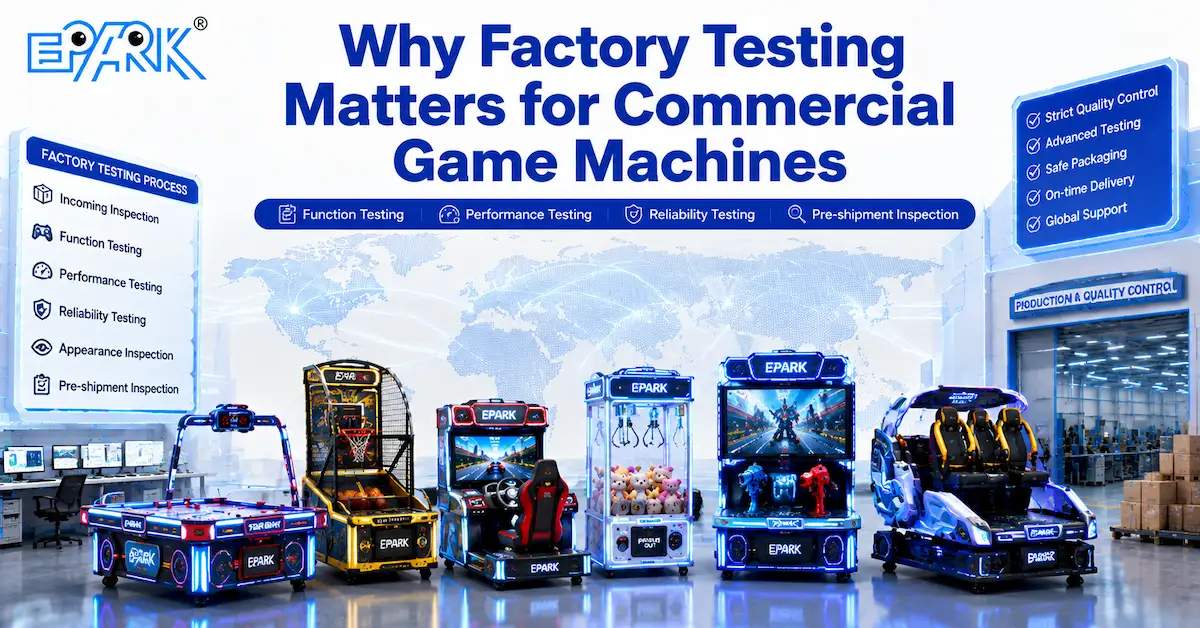
Why Is Factory Testing Important for Commercial Game Machines?
Commercial arcade equipment is designed for continuous operation in entertainment venues.
Unlike ordinary consumer products, arcade machines need to support repeated daily use from hundreds of players while maintaining stable performance, accurate controls, and reliable operation.
For this reason, a professional game machine factory should not only manufacture equipment but also verify that every machine performs correctly before international delivery.
Factory testing helps confirm:
- Hardware reliability
- Gameplay performance
- Control accuracy
- Electrical stability
- Software configuration
- Payment functions
- Commercial operation readiness
Without proper testing, even a visually perfect arcade machine may create problems after installation.
For overseas buyers, these problems can lead to:
- Installation delays
- Additional maintenance costs
- Venue downtime
- Poor customer experience
A structured factory testing process helps reduce these risks before machines leave production.
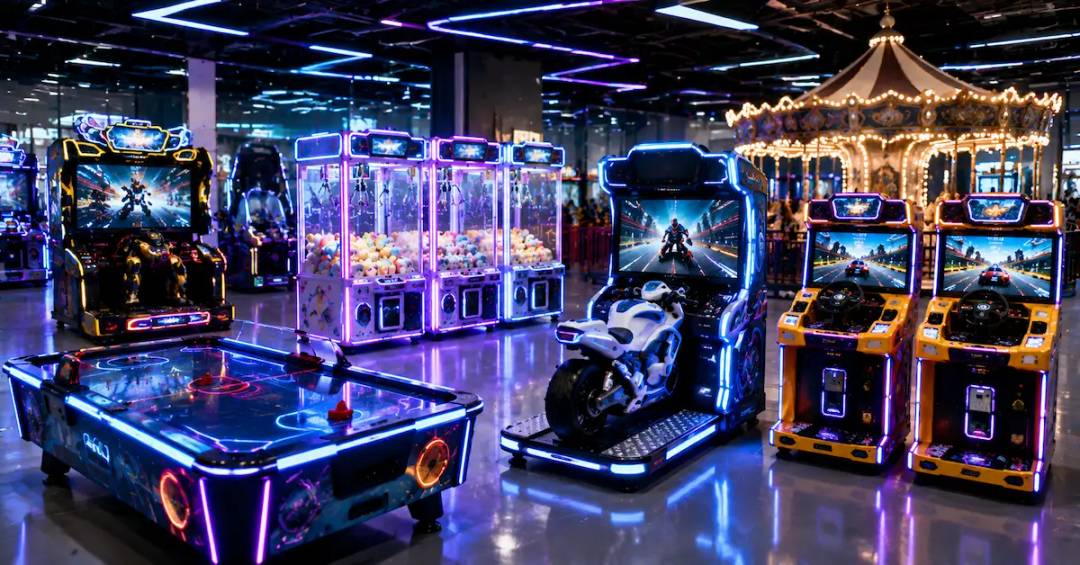
What Is Factory Testing for Commercial Game Machines?
Factory testing is the process of evaluating arcade equipment before shipment to confirm that all systems operate according to approved requirements.
A professional testing process goes beyond simply turning on the machine.
It verifies whether:
- The game functions correctly
- Controls respond properly
- Hardware components work together
- Electrical systems are stable
- Software settings match requirements
- Payment systems operate correctly
- The final product matches the approved specification
For commercial buyers, factory testing provides confidence that equipment is ready for real-world operation.
Why Commercial Arcade Machines Need More Testing
Commercial arcade machines face different challenges compared with ordinary electronic products.
They are expected to operate:
- For long hours
- In high-traffic venues
- Under repeated player interaction
- With multiple users every day
This makes testing a critical step before shipment.
Designed for High-Frequency Operation
Arcade equipment is often used continuously in:
- Family entertainment centers
- Shopping malls
- Game centers
- Theme parks
- Entertainment venues
Components such as:
- Buttons
- Steering wheels
- Sensors
- Motors
- Joysticks
- Payment systems
must maintain stable performance during repeated operation.
Factory testing helps identify potential problems before machines reach customers.
Installed in International Markets
For international buyers, solving technical issues after delivery can be more complicated.
Problems may involve:
- Different time zones
- Remote troubleshooting
- Replacement-part delivery
- Local maintenance arrangements
Testing before shipment helps reduce these overseas operation risks.
Multiple Systems Must Work Together
A commercial arcade machine is not a single component.
It combines:
- Mechanical structures
- Electronic systems
- Displays
- Controls
- Software
- Payment solutions
- Lighting and audio
Each system needs to work together to create a reliable player experience.
What Does a Game Machine Factory Test Before Shipment?
A professional game machine factory usually performs multiple testing procedures before shipment.
| Testing Area | What Factory Checks |
|---|---|
| Gameplay | Main functions and player interaction |
| Controls | Buttons, joysticks, steering systems |
| Display | Screen performance and image quality |
| Audio | Sound output and system operation |
| Electronics | Wiring and component connection |
| Payment | Coin, card or configured systems |
| Software | Settings and configuration |
| Mechanical Parts | Movement and structural functions |
The purpose is to ensure that the completed machine meets both technical requirements and commercial expectations.
Gameplay Function Testing
Gameplay testing is one of the most important stages because player experience directly affects arcade revenue.
Testing may include:
- Game startup
- Player controls
- Response speed
- Multiplayer functions
- Interactive features
A machine should provide consistent gameplay performance before shipment.
Racing Machine Testing
For racing equipment, factories may check:
- Steering response
- Pedal operation
- Seat functions
- Screen display
- Racing interaction
The goal is to ensure that players receive a smooth and responsive experience.
Shooting Game Testing
For shooting machines, testing may include:
- Gun controller response
- Sensor accuracy
- Shooting recognition
- Display feedback
Incorrect calibration can directly affect player satisfaction.
Hardware Performance Testing
Hardware testing verifies that the physical and electronic systems work correctly.
Display Testing
Factories may check:
- Screen brightness
- Image quality
- Connection stability
- Touch response where applicable
A damaged or unstable display can significantly reduce the player experience.
Control System Testing
Important control components include:
- Buttons
- Joysticks
- Steering wheels
- Pedals
- Sensors
Testing confirms:
- Correct response
- Smooth operation
- Stable connection
Mechanical System Testing
Some commercial machines include moving structures.
Testing may involve:
- Motors
- Seats
- Mechanical platforms
- Crane systems
- Interactive parts
These systems require additional verification because they involve physical movement.
Electrical and Safety Testing
Electrical reliability is especially important for international arcade shipments.
Testing may include:
- Power systems
- Wiring connections
- Internal components
- Voltage configuration
- Startup operation
For export projects, factories should confirm that the equipment matches destination requirements.
Important factors include:
- Voltage
- Frequency
- Plug type
Correct electrical configuration helps prevent installation problems after delivery.
Software and Configuration Testing
Modern arcade equipment often requires software configuration before shipment.
Testing may verify:
- Game version
- Language settings
- Operator settings
- System configuration
- User interface
For international customers, correct configuration is important because different markets may have different operating requirements.
Payment System Testing for Arcade Operations
Commercial arcade machines often depend on payment systems for business operation.
Before shipment, factories may test:
- Coin systems
- Token systems
- Card readers
- Other configured payment solutions
A machine that operates correctly but cannot process payments properly may still create business problems.
Payment testing helps confirm that the delivered equipment matches the buyer's approved setup.
Testing Customized Arcade Machines
Customized machines require additional verification.
For OEM, private-label, and ODM projects, testing should confirm that the final equipment matches the buyer-approved design.
| Custom Item | Testing Focus |
|---|---|
| Branding | Correct artwork and logo |
| Hardware | Approved configuration |
| Software | Required settings |
| Payment | Customer specification |
| Appearance | Final design approval |
Customized products should be tested against approved requirements rather than only standard factory settings.
How Factory Testing Reduces Buyer Risks
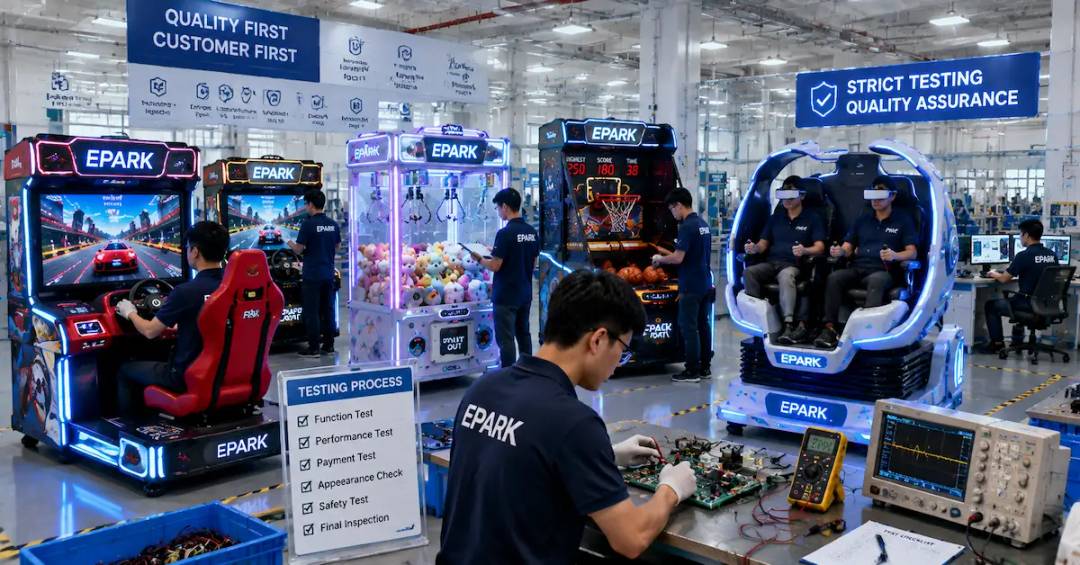
Factory testing provides several benefits for international arcade buyers.
Reduce Installation Problems
Testing helps identify:
- Incorrect configurations
- Missing functions
- Component issues
- Software problems
before shipment.
Reduce Equipment Downtime
For commercial venues, machine downtime affects revenue.
Testing helps improve:
- Reliability
- Operational stability
- Maintenance efficiency
Protect Brand Reputation
For distributors and arcade chains, equipment quality affects customer satisfaction.
Reliable machines help buyers build stronger market reputation.
Factory Testing for Bulk Arcade Machine Orders
Bulk orders require stronger consistency control.
For large projects, testing should ensure:
Every machine follows the same approved standard.
Bulk-order testing may include:
- Sample approval
- Production testing
- Batch inspection
- Final verification
This is especially important for:
- Arcade chains
- Regional distributors
- Large FEC projects
Testing Before International Shipment
A complete process usually follows:
Production Completion
↓
Functional Testing
↓
Configuration Verification
↓
Final Inspection
↓
Packaging
↓
International Shipment
Before shipment, buyers may also request:
- Product photos
- Testing videos
- Inspection confirmation
This provides additional confidence before international delivery.
How EPARK Approaches Factory Testing
EPARK supports commercial arcade buyers through structured production verification and testing procedures.
A typical process includes:
Requirement Confirmation
↓
Production
↓
Functional Testing
↓
Configuration Check
↓
Final Inspection
↓
Shipment Preparation
This approach helps ensure that commercial arcade equipment is prepared according to buyer requirements before delivery.
Buyers can explore EPARK's commercial arcade machines, learn more about its arcade machine manufacturing capabilities, review purchasing questions through the FAQ section, or contact EPARK for project discussions.
FAQ About Factory Testing for Game Machines
Why is factory testing important for arcade machines?
Factory testing helps confirm that commercial arcade machines operate correctly before shipment and reduces risks after installation.
What does a game machine factory test before delivery?
Factories typically test gameplay functions, controls, displays, electronics, software settings, payment systems, and overall machine performance.
How does factory testing improve commercial arcade reliability?
Testing helps identify potential problems before equipment reaches customers, reducing downtime and maintenance issues.
Do customized arcade machines require additional testing?
Yes. Customized machines require verification of branding, hardware configuration, software settings, and buyer-specific requirements.
Is factory testing necessary for bulk arcade orders?
Yes. Bulk orders require testing procedures to maintain consistency across multiple machines and production batches.
Can buyers request testing information before shipment?
Depending on the supplier process, buyers may request photos, videos, and shipment verification information.
What systems are tested in commercial arcade equipment?
Testing may include controls, displays, payment systems, electrical components, software, mechanical systems, and gameplay functions.
How does testing help international arcade buyers?
Testing reduces overseas repair risks, delivery problems, and unexpected installation issues.
Conclusion
Factory testing is not simply a final production step.
For commercial arcade equipment, it is a critical process that connects manufacturing quality with real-world operation.
A professional game machine factory should verify:
Gameplay → Hardware → Software → Electrical Systems → Payment Functions → Final Performance
For international arcade buyers, proper testing reduces risks, improves reliability, and helps ensure that equipment is ready for commercial operation after delivery.
The value of factory testing is simple:
A machine should not only leave the factory.
It should leave the factory ready to perform.
Disclaimer
The information provided on this website is for general informational purposes only.
While EPARK Arcade Game Machine Manufacturer strives to ensure accuracy and reliability, no warranties—express or implied—are made regarding completeness, performance, or applicability.
Product specifications, designs, and features may vary depending on usage, customization, and customer requirements.
Buyers are responsible for verifying all technical details, compliance certifications, and suitability before procurement.
EPARK shall not be held liable for any direct, indirect, incidental, or consequential damages arising from the use of this website or its content, including but not limited to business losses, data errors, or equipment misuse.
For tailored solutions or further verification, please visit our Contact Us
Intellectual Property Notice
All articles, product images, videos, catalogs, software, and related materials published on this website are the intellectual property of EPARK, unless otherwise stated.
Unauthorized reproduction, distribution, modification, or commercial use of any content is strictly prohibited without prior written consent from EPARK.
EPARK reserves the right to take legal action against any unauthorized use, including but not limited to copyright infringement, misrepresentation, or unfair competition.
Trademarks
The name EPARK, the EPARK logo, and all related brand elements displayed on this website are registered trademarks or trade names of Guangzhou EPARK Electronic Technology Co., Ltd.
Other product names, company names, or logos mentioned on this site may be trademarks of their respective owners.
Unauthorized use of EPARK's trademarks for commercial purposes, including advertising, promotions, or product packaging, is strictly prohibited.
Governing Law
These terms are governed by the laws of the People's Republic of China.