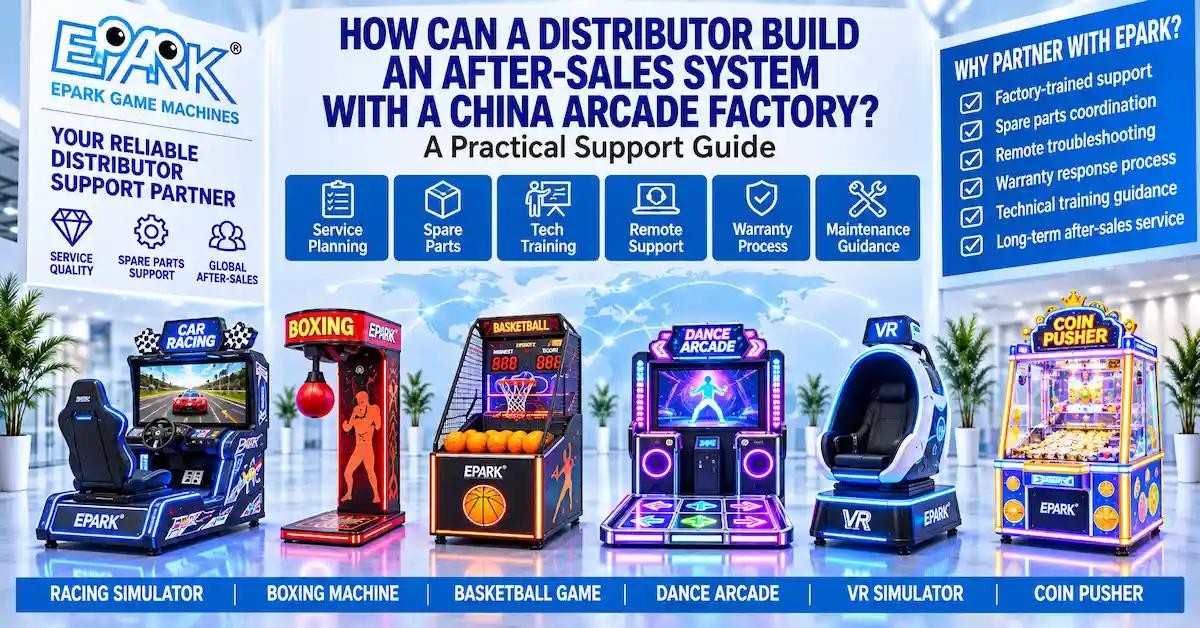


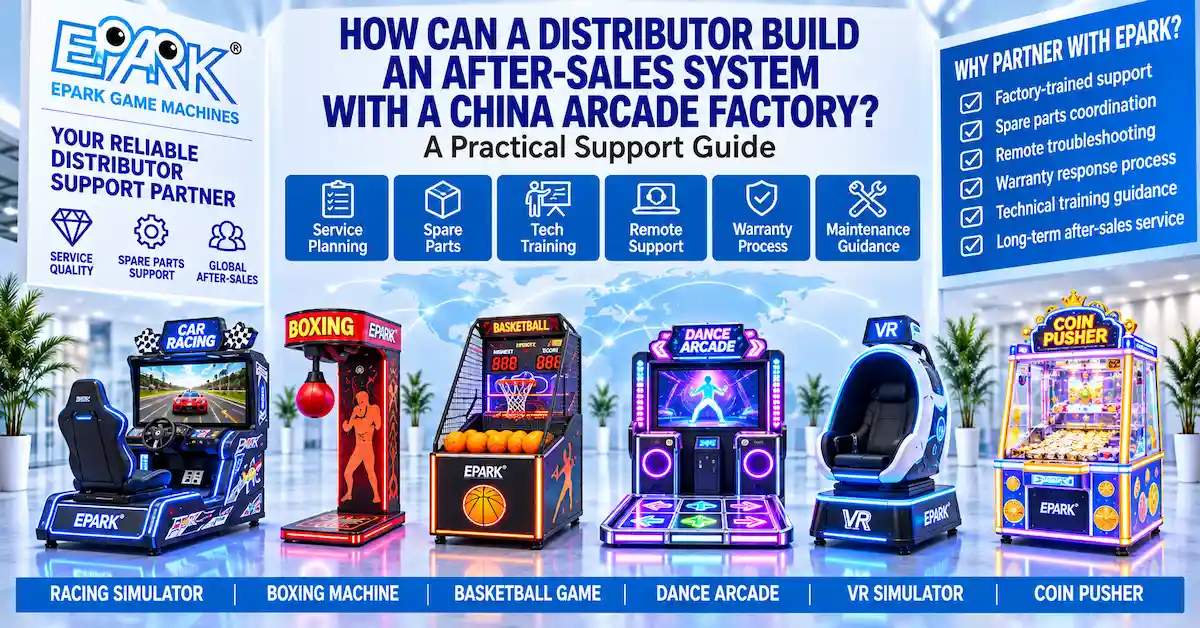
Quick answer: make the distributor the first line and the factory the technical escalation
How can a distributor build an arcade distributor after-sales system with a China arcade factory? Divide the work before the first machine ships. The distributor should own customer intake, basic diagnosis, site checks, operator guidance and local communication. The factory should own technical escalation, approved replacement decisions, configuration knowledge, parts support and the agreed warranty process. Both sides need one case record, one model-and-revision database, a defined spare-parts pool and response rules that distinguish acknowledgement, diagnosis, authorization, dispatch and repair.
This model is more practical than promising that a distant factory will solve every fault directly with the venue. A distributor is close to the customer and can see the operating environment. A manufacturer understands the cabinet, board, wiring, software and production revision. The system works when each side receives the information needed to act and when the handoff has an owner and a deadline.
EPARK's public service information describes remote technical support, installation guidance, spare-parts supply, remote diagnostics, regional support and 24/7 after-sales language. Its expanded FAQ states a two-year warranty from shipment for EPARK machines, with manufacturing-defect replacement parts included during the warranty period and consumables or misuse excluded; it also states that post-warranty parts can be purchased. These are useful public starting points, not a substitute for a distributor-specific service schedule. The selected models, territory, freight, local labor, response channel and escalation conditions should be written into the commercial agreement.
This guide focuses on the operating system between a distributor and a China arcade factory. It does not promise a universal response time, stock level or local repair service. Confirm the commercial terms for the models and market you will actually support.

Design the arcade distributor after-sales system before the first sale
After-sales confusion usually starts in the quotation. A distributor tells the operator the factory will support you, while the factory assumes the distributor will perform local triage and installation. When a screen goes dark, a ticket dispenser jams or a payment reader stops communicating, both parties may wait for the other to act.
Create a responsibility matrix for the complete customer journey: installation, operator training, preventive maintenance, first-line diagnosis, warranty classification, replacement approval, parts dispatch, local labor, freight, software support, safety incidents, misuse, transport damage and end-of-life replacement. Use named roles rather than vague departments. The factory sales contact may not be the person who approves a board replacement or understands a software revision.
| Activity | Distributor owns | Factory owns | Joint control |
|---|---|---|---|
| Customer intake | Open the case, identify venue, machine, serial and symptom | Provide required evidence fields and escalation contact | Agree acknowledgement and escalation rules |
| Basic diagnosis | Check power, connections, settings, visible damage and operating conditions | Supply manuals, diagrams and safe diagnostic steps | Stop unsafe tests and preserve evidence |
| Warranty classification | Submit photos, video, serial and purchase record | Classify manufacturing defect, consumable, misuse or further diagnosis | Record decision and cost responsibility |
| Replacement parts | Hold local critical stock and install when qualified | Confirm compatibility, approve or sell the part, provide guidance | Track revision, dispatch and case closure |
| Root-cause feedback | Report repeated field symptoms and venue conditions | Investigate pattern, change control or corrective action | Review trends and update service documentation |
The matrix should be attached to the distributor agreement or project order. If local law, a mall contract or a customer SLA requires a faster response than the factory can provide, the distributor must price and staff the gap instead of silently promising factory performance.
Build one case record that both sides can use
A remote supplier cannot diagnose a machine from the sentence it stopped working. The distributor's case form should capture the machine model, factory revision, serial number, installation date, shipment reference, venue, operating hours, recent changes, error message, power condition, visible damage, payment or ticket behavior, photographs and a short video. Ask the operator what happened immediately before the failure and whether other machines show the same symptom.
Use a case ID that connects the distributor's CRM to the factory order and machine serial. Store the approved configuration, wiring or setup document, software version, payment option, spare-parts compatibility and previous repairs. If the machine is part of a multi-location estate, add site and region so repeated failures can be compared without exposing unnecessary personal data.
Use a symptom taxonomy instead of free-text chaos
Start with practical categories: no power, intermittent power, display, control input, sound, lighting, payment, ticket or prize output, network or software, moving mechanism, cabinet or cosmetic damage, safety concern and installation question. The categories are for workflow, not for blaming the operator. A stable taxonomy lets the distributor see which failures can be solved locally and which require factory engineering.
Require a minimum evidence package before escalating, except for safety or complete shutdown cases. A useful package may include serial label, full-machine photo, affected area, power indicator, error screen, connectors, recent changes and a video of the symptom. The factory should reply if the evidence is incomplete rather than starting a long message chain with unrelated questions.
EPARK's warranty FAQ asks for the machine serial number, problem description and photographs or video when a warranty request is submitted. Build those fields into the distributor's intake form so the first escalation is usable.
Set service levels by stage, not one unrealistic promise
24/7 support can mean a message channel is monitored, not that a technician will repair a cabinet in 24 minutes. Define separate stages: acknowledgement, initial triage, technical diagnosis, warranty decision, parts quotation or authorization, dispatch preparation and case closure. The distributor can offer a local customer response target even when the factory needs more time to identify a board or approve a replacement.
EPARK's public materials use several support expressions: Service pages describe 24/7 technical support, while FAQ answers describe a reply within 24 hours for technical or warranty requests. These statements should not be converted into a guaranteed repair or parts-delivery SLA. Ask the factory which channel is monitored, what response means, which days count as working days, and how urgent safety or revenue-stop cases are escalated.
| Stage | Distributor action | Factory action | Record to close the stage |
|---|---|---|---|
| Acknowledgement | Confirm case ID and customer impact | Confirm receipt through the agreed channel | Timestamp and assigned owner |
| Initial triage | Complete safe checks and collect evidence | Identify missing information or likely subsystem | Evidence pack and provisional category |
| Diagnosis | Perform approved tests or local inspection | Interpret evidence and provide next steps | Root-cause hypothesis and test result |
| Resolution decision | Confirm site access and installation capability | Classify warranty, paid part, software or further review | Written authorization and cost owner |
| Closure | Install, test with operator and update the case | Record part, revision and corrective action | Before/after evidence and customer acceptance |
For a distributor, the important commercial question is not whether the factory uses a particular number of hours. It is whether the agreed stages are realistic for the destination, language, time zone, spare-parts route and technician skill. Put the SLA and exclusions in writing, then build local staffing around the portion that remains your responsibility.
Create a model and revision service library
A distributor cannot support a catalog that is only a collection of sales photos. Every repeatable SKU needs a service file. Record factory model and revision, cabinet drawings or photos, operating and packed dimensions, voltage and plug, power rating, payment system, software or language, wiring and setup instructions, maintenance points, common parts, compatible substitutions, test procedure, warranty route and approved configuration photograph.
When a component changes, update the service library before the new units reach customers. A different display connector, control board, sensor, power supply or software menu may change diagnosis and spare-parts compatibility even if the cabinet name remains the same. Use a change notice with old revision, new revision, reason, affected serial range, service consequence, new part number and whether old stock remains compatible.
Keep commercial and technical SKUs connected
Sales may call a product two-player racing game, while the factory has several versions. The distributor's ERP or spreadsheet should link the customer-facing SKU to the factory model, revision and option set. A replacement order should use the technical reference, not only the sales description. This prevents a compatible-looking board from being shipped for a cabinet that uses a different connector or firmware.
EPARK publicly describes multiple categories, OEM/ODM, payment integration and software or language customization. That breadth is useful for a distributor, but it increases the need for model-level documentation. Request the service file during the first order, not after the first failure.
Stock spare parts according to downtime consequence
The right parts pool is not the largest one. Rank parts by failure consequence, replacement difficulty, lead time, compatibility and installed base. A button may be inexpensive and easy to replace; a control board or display may stop a machine completely and require a configuration check. A ticket mechanism may affect revenue and customer experience even when the cabinet still powers on.
Use three stock levels: site-level consumables and simple controls; regional critical parts for machines that would otherwise remain offline; and factory-held or project-specific parts requiring engineering approval. The exact list depends on the category, revision and local technician capability. Do not assume that a spare part for one generation fits every machine with the same sales name.
Ask the factory to identify recommended parts by model family and failure consequence. Confirm whether a starter parts kit is included, optional or paid, and whether its contents are covered by the warranty. EPARK's public materials describe spare-parts supply and, on a specific FEC page, a container-order spare-parts kit with examples such as controls and power-supply items. Treat that as page-specific evidence and obtain the actual list and quantity for your order.

Make warranty administration predictable
Warranty cases become expensive when the distributor promises more than the factory terms cover. Separate manufacturing defects, consumables, misuse, transport damage, installation errors, unauthorized modification, software or content issues, and local labor. The distributor should know what evidence is required, who authorizes a replacement, who pays freight, whether the failed part must be returned, and how the customer remains operational while the case is open.
EPARK's expanded FAQ states a two-year warranty from the shipment date and includes replacement parts for manufacturing defects during that period; it excludes consumables and misuse damage, and it allows post-warranty parts to be purchased. The distributor should not convert this into a promise that all freight, local labor, installation or downtime is free. Confirm the selected model, shipment record, destination and contract wording.
Create a warranty decision form with: serial number, shipment date, customer, failure description, evidence, diagnosis, classification, approved part, freight payer, local labor payer, return requirement, installation responsibility and closure test. Require a written decision before the distributor tells the customer that a part is free or chargeable.
Use a temporary resolution path
Commercial venues care about uptime. A warranty decision may take time, while a simple local repair or temporary replacement can restore service. Agree when the distributor may use local stock, when the factory must approve the workaround, and how the temporary part is reconciled if the final claim is approved. Never bypass safety controls to get a cabinet running.
Train local technicians and sales staff together
Sales staff create service risk when they promise unsupported options. Technicians create customer frustration when they do not understand the commercial configuration. Train both groups on the approved model range. Sales needs operating dimensions, power requirements, payment scope, installation boundaries, maintenance expectations and honest warranty language. Technicians need wiring, safe isolation, diagnostics, part compatibility, software version and escalation evidence.
Ask the factory for remote training, operator videos, installation guidance and maintenance notes. EPARK's public service information describes online assistance, operational training, installation support, remote diagnostics and technical guidance. Agree what material is supplied, in which language, for which models, and whether the distributor may adapt it for local customers.
Use a practical certification checklist for a distributor technician: identify the machine and revision; isolate power safely; reproduce the symptom; inspect the correct subsystem; replace a permitted part; test gameplay, payment, ticket or motion; document the result; and escalate when the case exceeds local authority. Completion should be recorded, not assumed after a video call.
Measure support with operational KPIs
An after-sales system improves only when the distributor can see where it fails. Track the number of cases by model, category and venue; acknowledgement time; time to usable diagnosis; warranty decision time; first-time fix rate; parts fill rate; days a machine is unavailable; repeat failures; shipping damage; and cases reopened after closure. These measures do not need to be published to customers, but they should guide the supplier review.
| KPI | What it reveals | How to use it | Warning sign |
|---|---|---|---|
| Time to usable diagnosis | Whether intake evidence and factory escalation are working | Separate missing-information delay from technical delay | Cases remain in chat without an owner or next step |
| First-time fix rate | Quality of diagnosis, parts selection and technician skill | Review by model revision and failure category | Repeated parts swaps without root-cause confirmation |
| Parts fill rate | Whether the local and factory inventory matches the installed base | Rank stock by downtime consequence and lead time | Critical parts repeatedly ordered after failure |
| Days unavailable | Commercial impact of a fault and support delay | Compare categories and venues, not only case count | Small number of high-impact failures is ignored |
| Repeat failure rate | Whether a symptom is being treated rather than corrected | Open a corrective-action review with the factory | Same model and revision fails in multiple sites |
Use the data in quarterly supplier reviews. Ask the factory to identify recurring component or revision issues, document corrective actions and notify the distributor before a change reaches the field. If the factory does not provide enough information to calculate a KPI, that is itself a supplier-process finding.
Plan multi-location support and lifecycle changes
A distributor with several venues needs a central parts and knowledge system. Keep a master model list, site installed-base list, serial records, revision history, open cases, local parts, factory parts, training status and warranty dates. A new site should receive a deployment kit containing the approved configuration, manuals, installation checklist, emergency contacts, basic spares and escalation form.
When a model is revised or discontinued, communicate before the change affects customers. Define compatible substitutes, last-time-buy options, software support, spare-parts availability and customer-facing wording. The factory may be able to supply post-warranty parts, but public availability language is not a promise that every board or display will remain in stock indefinitely. A distributor should ask for a lifecycle notice process and plan its own buffer for critical parts.
For OEM or private-label lines, protect consistency across repeat orders. Keep the approved artwork, cabinet, BOM or critical component references, software version, payment system, label and packing method. A lower unit price is not useful if the next batch cannot be serviced with the parts and manuals already in the region.
Choose the right factory partnership model
There are at least three workable models. In a factory-escalation model, the distributor handles first line and the factory provides technical decisions and parts. In a regional-service model, the distributor performs installation and repairs while the factory supplies training, documents and replacement inventory. In a project-integrator model, the parties agree a site handover, commissioning and post-opening support plan for a specific FEC or mall project.
Do not select the model based on a phrase such as full after-sales. Compare the installed base, local technician skill, travel distance, language, parts budget, customer SLA and factory escalation capacity. EPARK's public service pages describe one-stop project support, installation guidance, remote diagnostics and spare-parts assistance, which can fit more than one model. The commercial agreement should state which model applies to your territory and products.
Use a quarterly review to decide whether the relationship should expand. Review service data, recurring faults, parts consumption, training gaps, documentation updates, customer satisfaction, pending engineering changes and the next shipment's configuration. A distributor should earn a larger range by demonstrating that it can support the current one.
Frequently asked questions
Should the distributor or the China factory handle the customer directly?
The distributor should normally remain the customer-facing first line in its territory, while the factory handles technical escalation and approved parts or warranty decisions. Direct factory contact can be useful for complex cases, but the case record and commercial ownership should remain clear.
What information should a distributor collect before contacting the factory?
Collect model, factory revision, serial number, shipment or warranty reference, site, symptom, recent changes, power condition, error message, photographs, video and the result of safe basic checks. Include the customer's operating impact and required response.
Does EPARK provide a two-year arcade machine warranty?
EPARK's expanded FAQ states a two-year warranty from shipment for EPARK machines and includes manufacturing-defect replacement parts during that period, while excluding consumables and misuse damage. Confirm the exact model, exclusions, freight, local labor and claim procedure in the written order terms.
What spare parts should a distributor stock locally?
Stock parts according to failure consequence, installed base, lead time and technician capability. Simple controls and consumables may belong at site level; critical boards, power supplies, displays, sensors or payment components may require regional stock. Confirm compatibility by model and revision.
Is 24/7 technical support the same as a 24-hour repair promise?
No. Public support language may describe an available channel or response target. Define acknowledgement, diagnosis, warranty decision, parts preparation, dispatch and repair separately. Do not promise the customer a repair or shipping time the factory has not agreed in writing.
How should warranty cases be divided between the distributor and factory?
The distributor should collect evidence, perform permitted local checks and communicate with the customer. The factory should classify the cause, approve the remedy, identify the part and provide technical guidance or dispatch according to the agreement. Freight and local labor need explicit allocation.
How can an arcade distributor after-sales system avoid repeated failures?
Track cases by model and revision, calculate repeat-failure and first-time-fix rates, and review recurring symptoms with the factory. Use change notices, corrective actions and updated service files rather than treating every incident as an isolated replacement.
What should be included in a factory support agreement?
Include supported models, territory, channels, service responsibilities, evidence requirements, response stages, warranty classification, parts pricing and freight, local labor, software support, training, documentation, change notification, escalation contacts, data handling and review cadence.
Conclusion
A distributor after-sales system with a China arcade factory works when it is designed as an operating process, not a sentence in a quotation. The distributor owns fast local intake and first-line help. The factory supplies model-specific technical knowledge, escalation, approved parts and warranty decisions. Shared records, revision control, service levels, parts pools and KPIs keep the relationship accountable as the installed base grows.
EPARK's public manufacturing and service information provides a reasonable starting point for this partnership model, but the distributor should convert every broad support statement into a territory- and model-specific schedule. Send your product range, installed-base plan, technician capability, target response stages and spare-parts needs through the EPARK contact page and request a written support workflow before committing to a regional program.
Disclaimer
The information provided on this website is for general informational purposes only.
While EPARK Arcade Game Machine Manufacturer strives to ensure accuracy and reliability, no warranties—express or implied—are made regarding completeness, performance, or applicability.
Product specifications, designs, and features may vary depending on usage, customization, and customer requirements.
Buyers are responsible for verifying all technical details, compliance certifications, and suitability before procurement.
EPARK shall not be held liable for any direct, indirect, incidental, or consequential damages arising from the use of this website or its content, including but not limited to business losses, data errors, or equipment misuse.
For tailored solutions or further verification, please visit our Contact Us
Intellectual Property Notice
All articles, product images, videos, catalogs, software, and related materials published on this website are the intellectual property of EPARK, unless otherwise stated.
Unauthorized reproduction, distribution, modification, or commercial use of any content is strictly prohibited without prior written consent from EPARK.
EPARK reserves the right to take legal action against any unauthorized use, including but not limited to copyright infringement, misrepresentation, or unfair competition.
Trademarks
The name EPARK, the EPARK logo, and all related brand elements displayed on this website are registered trademarks or trade names of Guangzhou EPARK Electronic Technology Co., Ltd.
Other product names, company names, or logos mentioned on this site may be trademarks of their respective owners.
Unauthorized use of EPARK's trademarks for commercial purposes, including advertising, promotions, or product packaging, is strictly prohibited.
Governing Law
These terms are governed by the laws of the People's Republic of China.