
What Should a Custom Arcade Equipment Factory China Supplier Actually Deliver?
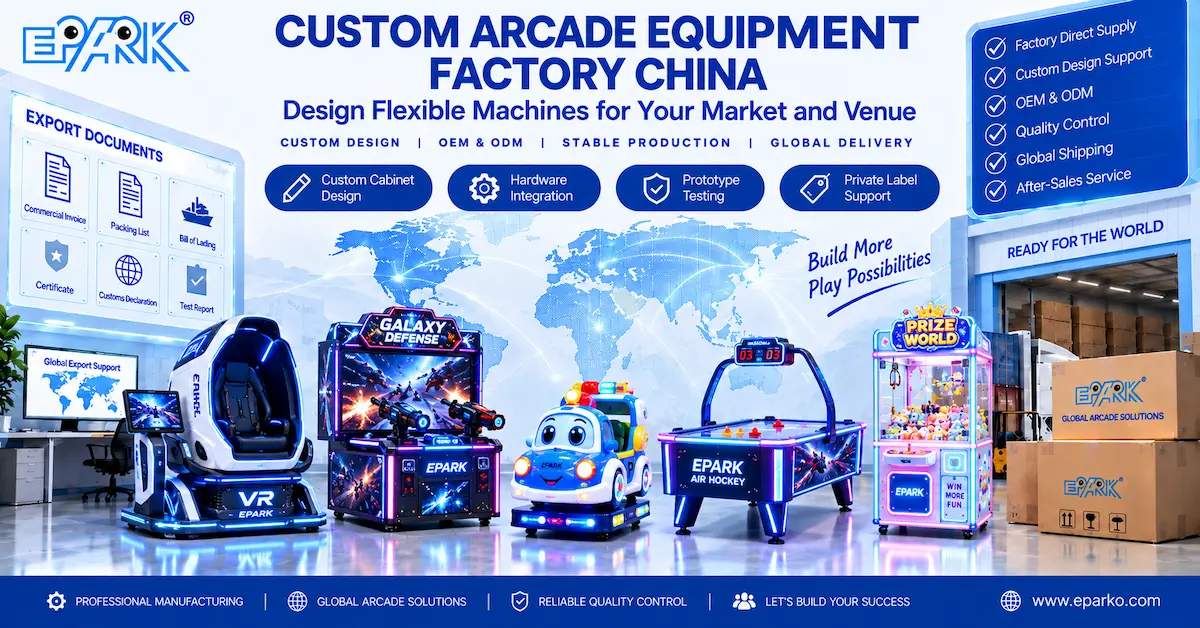
Buyers searching for a custom arcade equipment factory China supplier usually need more than a standard machine with a different logo. A useful customization project should connect the buyer’s commercial objective with cabinet appearance, dimensions, controls, payment hardware, software or operating settings, player interaction, maintenance access, packaging, and a controlled production version.
EPARK’s published customization content separates branding and appearance changes from deeper cabinet, hardware, payment, and product-development work. Its existing OEM workflow also describes requirement analysis, design, engineering, prototype development, testing, mass production, quality control, and shipment as connected stages rather than isolated services.
For commercial buyers, the key question is therefore not simply “Can you customize this machine?” It is “Which parts of this machine can change, what evidence is required before approval, and how will the approved version be reproduced later?”
Define Why You Need Customization Before Discussing the Design
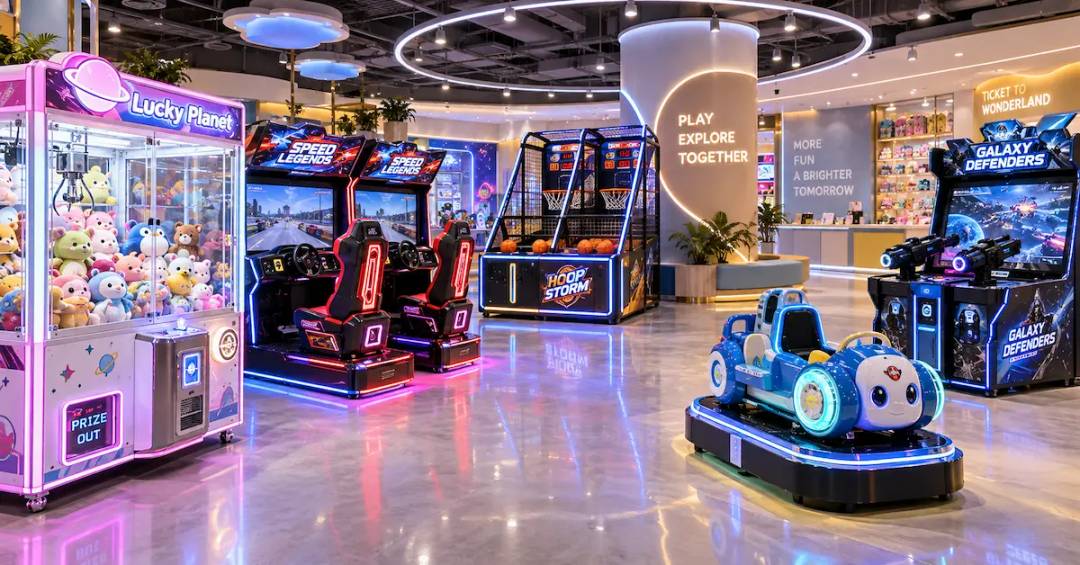
Customization should solve a business or operating problem. An FEC chain may want a common visual identity across several venues. A distributor may need private-label equipment that can be reordered consistently. A mall arcade may need equipment that fits a restricted footprint. A regional buyer may need different payment hardware, language settings, electrical configuration, or packaging. A brand developing a differentiated attraction may require deeper engineering work.
EPARK’s custom arcade machine design guidance recommends starting with venue type, target market, players, equipment categories, design objectives, dimensions, controls, displays, payment method, voltage, language, and access requirements before approving a concept.
A buyer who cannot yet define the problem should first review EPARK’s existing arcade equipment. An existing platform may already meet most requirements and can reduce unnecessary development work.
Choose the Correct Level of Arcade Equipment Customization
Not every custom project should become an ODM development project. Separating customization levels helps buyers control cost, lead time, and technical risk.
| Customization Level | Typical Changes | Suitable Buyer | Main Approval Requirement |
|---|---|---|---|
| Visual branding | Logo, cabinet graphics, colors, labels | Distributors, chains, private labels | Artwork revision approval |
| Market configuration | Language, payment hardware, approved settings | International distributors and FECs | Compatibility and functional test |
| Hardware customization | Controls, displays, accessories, selected components | Projects with defined operating needs | Technical configuration approval |
| Cabinet modification | Size, panels, control position, access, styling | Venue-specific projects | Drawings, ergonomics, service-access review |
| ODM development | New structure, interaction or deeper functionality | Differentiated product programs | Prototype, validation and production release |
EPARK’s game machine customization guide similarly describes customization as a spectrum ranging from low-risk visual changes to deeper engineering and product development.
The buyer should choose the lowest development level that solves the commercial requirement. That usually provides better control than requesting “full customization” without defining why it is needed.
Build a Controlled Custom Equipment Specification
A custom machine should be defined by one approved specification rather than scattered messages, screenshots, and verbal instructions. The document should distinguish the buyer’s requirement, the factory proposal, the approved value, and unresolved items.
The following table is a purchasing framework, not a statement that every EPARK machine uses the same specifications.
| Specification Area | Buyer Should Define or Confirm | Why It Matters |
|---|---|---|
| Base machine | Existing model or new-development reference | Establishes the design starting point |
| Application | FEC, mall, distributor, arcade chain, themed project | Guides design priorities |
| Player group | Intended users and number of players | Affects controls and ergonomics |
| Dimensions | Maximum machine footprint and height | Controls venue compatibility |
| Player clearance | Required operating area | Supports layout planning |
| Service clearance | Access for maintenance, refill and replacement | Reduces service problems |
| Cabinet appearance | Colors, graphics, logo, decorative elements | Brand consistency |
| Controls | Buttons, joystick, steering, shooting controls, sensors, etc. | Defines interaction |
| Display / audio | Approved configuration | Controls machine version |
| Payment | Coin, token, card or approved third-party system | Commercial compatibility |
| Software | Version, language and licensing where applicable | Repeat-order control |
| Electrical configuration | Destination-specific requirements | Site preparation |
| Accessories | Keys, cables, fixings, manuals | Receiving inspection |
| Packaging | Shipping configuration and brand requirements | Delivery planning |
| Spare parts | Agreed service components | Long-term maintenance |
The final approved document should follow the machine from design through production, QC, packing, and repeat orders.
Evaluate Cabinet Design as a Commercial Engineering Decision
Custom cabinet design should address more than appearance. Player reach, display visibility, controls, entry and exit, service doors, refill access, cable routing, component replacement, cleaning, and transport all affect commercial usability.
EPARK’s custom arcade cabinet guide highlights brand identity, space usage, control experience, maintenance convenience, venue appearance, and long-term operating value as cabinet-design considerations.
Player Interaction
Controls should be positioned for the intended player group. Racing equipment, shooting games, prize machines, and sports machines require different reach, viewing angles, and movement space.
Maintenance Access
Decorative panels should not block routine access to payment hardware, electronics, prize areas, ticket systems, power supplies, or serviceable controls.
Venue Integration
A visually impressive cabinet can still be unsuitable if it blocks customer flow or cannot pass through the destination entrance. Review operating dimensions, delivery routes, maintenance clearance, and layout together.
Review Customization by Product Category
A custom arcade equipment factory China project may include several equipment families, but customization requirements should be adapted to each machine rather than copied across the order.
| Equipment Category | Useful Customization Areas | Important Risk to Review |
|---|---|---|
| Claw machines | Artwork, cabinet colors, prize display, payment setup | Refill access and grab mechanism compatibility |
| Racing machines | Artwork, seats, cabinet styling, payment, linked configuration | Controls, ergonomics and service access |
| Redemption games | Artwork, payment and reward interface | Scoring and ticket/points integration |
| Basketball machines | Cabinet graphics, scoring display, branding | Sensor operation, assembly and player clearance |
| Shooting games | Artwork, display, controller styling | Calibration and controller replacement |
| VR / simulators | Exterior styling, payment, selected hardware configuration | Software, accessories and technical setup |
| Kiddie rides | Theme, colors, graphics, payment configuration | Operating cycle and serviceable mechanisms |
EPARK’s current Products page presents multiple commercial machine and venue-solution directions that can be used as development references before committing to a new design.
Separate Visual Customization From Technical Customization
One of the easiest ways to lose control of a custom project is to treat every requested change as if it has the same impact.
Changing a logo or artwork is primarily a visual approval issue. Changing the payment system may affect interfaces and testing. Moving a control panel can affect ergonomics and internal wiring. Increasing cabinet dimensions can affect packaging, shipping, venue layout, and structural requirements. Changing software or mechanisms may require deeper validation.
Create a change-impact review before approval.
| Requested Change | Potential Impact Areas | Recommended Review |
|---|---|---|
| Logo / graphics | Appearance, print files | Artwork approval |
| Cabinet color | Appearance, production finish | Sample/reference approval |
| Payment hardware | Electronics, software, operation | Compatibility and transaction test |
| Control position | Ergonomics, wiring, cabinet layout | Drawing and functional review |
| Display change | Dimensions, mounting, electronics | Technical verification |
| Cabinet size | Structure, layout, packaging, freight | Drawing and packing review |
| Game/software change | Function, licensing, configuration | Version and functional validation |
| New mechanism | Structure, sensors, maintenance, safety | Prototype and technical review |
This keeps small changes from accidentally turning into uncontrolled engineering projects.
Use Prototype or First-Unit Approval When the Change Justifies It
A simple graphic change may not require the same development process as a new cabinet or mechanism. For deeper customization, physical validation can expose issues that drawings cannot.
EPARK’s OEM workflow describes prototype production followed by functional review before mass manufacturing, while its design guidance recommends prototypes or samples for deeper structural changes.
Appearance Approval
Review cabinet shape, graphics, colors, labels, lighting, and visual consistency.
Functional Approval
Test controls, payment, gameplay, displays, sensors, reward functions, and mechanisms relevant to the product.
Serviceability Approval
Open service doors and demonstrate access to important replacement or maintenance components.
Production Approval
Record which sample or revision becomes the mass-production reference.
A prototype should not simply be described as “approved.” The approval should specify exactly what was tested and which items remain unresolved.
Control Artwork and Branding by Revision
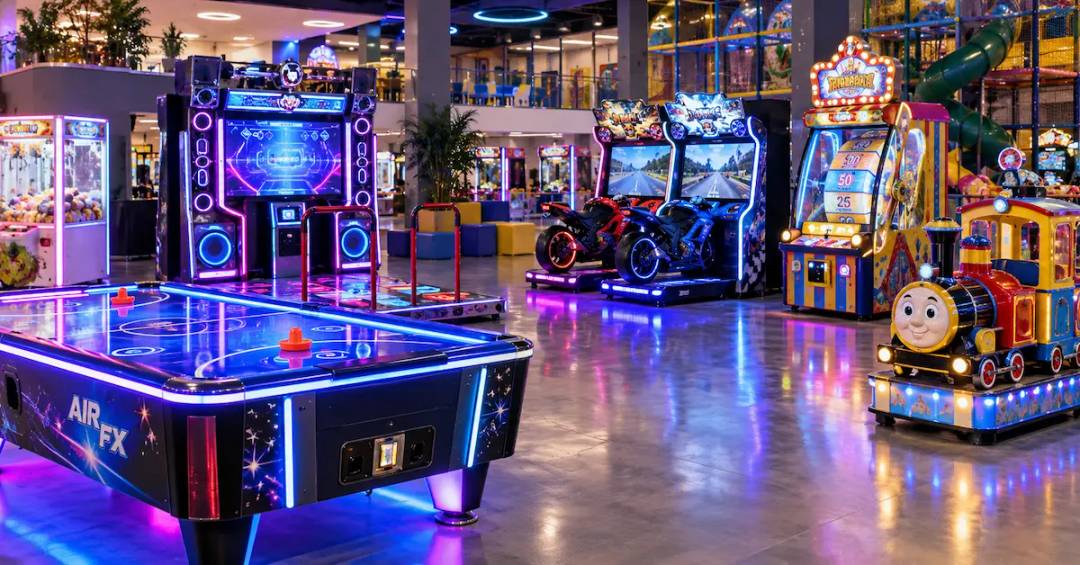
Private-label arcade projects can involve several surfaces: side panels, marquees, control areas, decorative signs, labels, screens, packaging, and product identification.
Maintain an artwork register including:
- Machine model
- Buyer product code
- Factory model
- Artwork revision
- Logo file
- Color reference
- Label content
- Approval date
- Packaging artwork where required
EPARK’s custom game machine factory content describes logo branding, cabinet design, themed appearance, payment integration, and private-label development as customization directions.
Revision control is particularly important for distributors because several machines may look similar while using different market-specific versions.
Evaluate Controls, Electronics, and Payment as One System
The external cabinet cannot be separated completely from the machine’s internal configuration.
For each custom machine, identify the important interfaces between:
- Power supply
- Control board
- Display
- Audio
- Buttons / joystick / steering
- Sensors
- Motors or mechanisms
- Payment device
- Reward system
- Software
If a custom payment system is required, name the actual provider and reader. Define who installs and configures the hardware and who handles account activation or software support.
For FEC or card-based projects, EPARK’s Why Choose Us can be used as the starting point for discussing payment and venue-system integration.
The acceptance test should verify the complete transaction:
payment recognition → credit → game start → gameplay → score/reward → reset.
Turn Custom Machine Quality Into Inspectable Criteria
Customization adds new opportunities for mistakes, so factory QC should check both normal machine function and custom requirements.
EPARK’s Design & Process describes artwork processing, electronic assembly, screen/control integration, functional testing, and shipment preparation. Buyers should create model-specific acceptance criteria around the changes actually ordered.
Cabinet and Appearance QC
Check dimensions where relevant, panel alignment, artwork, colors, logos, surface condition, labels, doors, locks, and lighting.
Hardware QC
Verify controls, display configuration, payment hardware, sensors, electronics, and requested options.
Functional QC
Test complete gameplay and any custom interactions or reward systems.
Customization QC
Compare the physical machine with the approved revision, not an earlier rendering or sample.
Packing QC
Verify model identification, accessories, separate assemblies, spare parts, and package references.
A machine can pass standard gameplay testing and still fail the customization requirement.
Control Custom Production Across a Larger Batch
A successful sample does not prove that the entire production batch is consistent.
For multiple identical units, compare:
- Artwork
- Cabinet revision
- Controls
- Payment hardware
- Software/settings
- Labels
- Accessories
- Packaging
- Service-part references
Ask how production teams receive the approved customization specification and how unauthorized substitutions are prevented or communicated.
This is particularly important for arcade chains and private-label distributors that may reorder the same design later.
Compare OEM, ODM, and Custom Factory Responsibilities
Terms such as OEM, ODM, and custom manufacturing are frequently used loosely. Buyers should define responsibilities instead of relying on labels.
| Project Route | Buyer Usually Provides | Factory Contribution | Main Approval |
|---|---|---|---|
| Standard configuration | Product selection | Existing machine | Specification |
| OEM branding | Brand requirements and artwork | Production platform and branding integration | Artwork/version |
| Configured OEM | Market and configuration requirements | Existing platform plus approved changes | Technical configuration |
| Custom cabinet | Venue/design requirements | Cabinet adaptation and integration | Drawings/sample |
| ODM development | Product concept and commercial requirement | Deeper engineering/product development | Prototype and production release |
EPARK’s ODM manufacturer guide similarly separates existing-platform customization from deeper product development and emphasizes prototype and production approval for larger changes.
Compare Customization Cost by Scope, Not by One Unit Price
When comparing a custom arcade equipment factory China quotation, separate development-related charges from recurring machine costs.
Possible project costs can include:
- Artwork work
- Cabinet modification
- Prototype
- Tooling where applicable
- Custom controls
- Payment integration
- Software work
- Additional testing
- Sample freight
- Custom packaging
- Initial spare parts
Recurring costs may include the final machine, agreed custom components, packaging, and logistics.
Request an itemized scope so that two suppliers can be compared on the same assumptions. A cheaper quotation may simply exclude development or testing work included elsewhere.
Build Lead Time Around Approval Milestones
Do not ask only “How many days does customization take?” The answer depends on the type of customization.
A practical schedule separates:
Requirement Confirmation
The buyer and factory agree on the development scope.
Design / Artwork Approval
Visual or engineering files are reviewed.
Prototype or First Unit
Used where appropriate for deeper changes.
Corrections and Retesting
Open issues are closed.
Mass Production
Production follows the approved version.
QC
The finished batch is inspected.
Packing and Shipment Readiness
Final package information and shipment preparation are completed.
EPARK’s published OEM workflow follows the same broad progression from requirement analysis through prototype, production, QC, and shipment.
Review Product Documentation Against the Custom Version
Do not assume that documentation associated with a standard machine automatically applies unchanged after technical customization.
Identify destination requirements early and ask which product documents apply to the proposed version. If the change affects a relevant electrical, structural, component, software, or other controlled area, ask whether additional review is needed.
Keep commercial shipment documents separate from product documentation. The invoice and packing list describe the shipment; technical records serve different purposes.
For international-order planning, EPARK’s international order guide describes specifications, electrical configuration, branding, payment, packing, documentation, QC, spare parts, and after-sales support as interconnected considerations.
Plan Packaging After the Custom Design Is Frozen
Custom changes can affect packed dimensions and freight. A larger header, wider control deck, different seat, custom sign, or additional accessories may alter the shipping configuration.
Before final freight planning, confirm:
- Final packed dimensions
- Gross weight
- Package count
- Removed assemblies
- Accessory location
- Package identification
- Reassembly requirements
Do not continue using a freight estimate created for the unmodified standard machine when structural changes have altered the package.
For broader logistics discussions, use EPARK’s Service page to define the factory-side and buyer-side responsibilities for the actual order.
Plan Spare Parts for the Customized Version
A custom product can become difficult to support if the service team does not know which components differ from the standard machine.
Maintain a service record showing:
- Buyer SKU
- Factory model
- Custom revision
- Payment configuration
- Important replacement components
- Software/version where relevant
- Approved substitutions
Discuss the starter spare-parts package according to the actual product configuration. Do not automatically use the same generic parts kit across unrelated machines.
The goal is for a future technician to identify the product accurately without reconstructing the entire customization project.
How Should Buyers Compare Custom Arcade Equipment Factories?
A structured comparison prevents attractive renderings from becoming the main supplier-selection criterion.
| Evaluation Area | Weak Evidence | Stronger Evidence |
|---|---|---|
| Customization | “We can customize anything” | Defined levels and technical scope |
| Design | Rendering only | Dimensions, drawings and requirements |
| Prototype | Appearance sample | Functional and serviceability review |
| Artwork | Chat attachment | Controlled revision |
| Hardware | Informal component promise | Approved configuration |
| QC | Standard gameplay check | Custom + functional acceptance |
| Production | One approved sample | Batch consistency controls |
| Changes | Factory substitutes when necessary | Buyer-facing change process |
| Spare parts | Generic parts list | Revision-linked parts |
| Repeat orders | “Same as before” | Version-controlled production record |
The strongest custom supplier is the one that converts buyer requirements into a controlled production definition.
What Should You Send EPARK for a Custom Arcade Equipment Quote?
When contacting a custom arcade equipment factory China supplier, send the destination market, buyer type, intended venue, machine categories, quantities, target players, available dimensions, payment requirements, brand files, desired visual changes, required functional changes, target schedule, and expected repeat-order volume where relevant.
For deeper cabinet development, include a floor plan, reference images, space limits, player requirements, and service-access requirements. Clearly identify which references are mandatory requirements and which are only design inspiration.
Review EPARK Products, Why Choose Us, and Design & Process, then send the project brief through Contact Us.
Frequently Asked Questions
1. What Can a Custom Arcade Equipment Factory Change?
Depending on the machine and project, customization can involve branding, artwork, cabinet appearance, colors, labels, payment systems, settings, selected hardware, packaging, or deeper product development. Confirm the feasible scope for each model.
2. Do I Need a New Cabinet for a Custom Arcade Project?
Not always. If an existing cabinet already fits the player experience, venue, controls, and service requirements, visual or configuration customization may be sufficient.
3. What Is the Difference Between OEM and ODM Arcade Equipment?
OEM generally works from an existing or buyer-defined product configuration, while ODM usually involves more manufacturer participation in product design and engineering. Define responsibilities rather than relying only on the terminology.
4. Should I Approve a Prototype Before Mass Production?
For deeper structural, functional, control, or integration changes, prototype or first-unit approval can reduce production risk. Simpler artwork changes may use a lighter approval process.
5. How Should Custom Cabinet Artwork Be Approved?
Approve artwork by machine model and revision. Keep the logo, colors, graphics, labels, and buyer product code connected to the underlying factory model.
6. Can Payment Hardware Be Customized?
Payment changes can be discussed, but buyers should provide the actual payment-system information and request compatibility confirmation and functional testing before mass production.
7. How Should Custom Arcade Machine Quality Be Inspected?
Inspect the standard machine functions and the customization separately. Verify appearance, controls, payment, gameplay, sensors, mechanisms, artwork, custom hardware, accessories, and packaging against the approved revision.
8. Does Customization Increase Production Time?
It can. The impact depends on whether the project involves artwork, market configuration, hardware changes, cabinet modification, prototypes, or deeper engineering. Request milestone-based timing for the actual scope.
9. How Can I Keep Repeat Orders Consistent?
Retain the approved factory model, buyer SKU, custom revision, artwork, hardware configuration, software/settings, QC requirements, packaging, and spare-parts records. Review changes before every new batch.
10. Where Can I Request a Custom Arcade Equipment Proposal?
Review EPARK commercial arcade equipment and submit your venue, machine, customization, quantity, payment, branding, and delivery requirements through EPARK Contact Us.
Conclusion
Choosing a custom arcade equipment factory China partner is a product-development and supply-chain decision rather than simply selecting a factory willing to change colors or print a logo. FEC operators, distributors, arcade chains, and private-label brands should define the customization objective, select the appropriate development level, control specifications and artwork, validate significant changes, inspect custom and standard functions separately, and preserve the approved revision for future production.
EPARK’s current customization content describes support ranging from branding and cabinet changes to OEM/ODM development, while the exact technical scope, prototype requirements, production configuration, pricing, documents, and support responsibilities should be confirmed for each project. Review EPARK Products or contact EPARK with your machine categories, quantities, destination, branding, cabinet requirements, payment system, and functional changes to discuss an order-specific customization plan.
Disclaimer
The information provided on this website is for general informational purposes only.
While EPARK Arcade Game Machine Manufacturer strives to ensure accuracy and reliability, no warranties—express or implied—are made regarding completeness, performance, or applicability.
Product specifications, designs, and features may vary depending on usage, customization, and customer requirements.
Buyers are responsible for verifying all technical details, compliance certifications, and suitability before procurement.
EPARK shall not be held liable for any direct, indirect, incidental, or consequential damages arising from the use of this website or its content, including but not limited to business losses, data errors, or equipment misuse.
For tailored solutions or further verification, please visit our Contact Us
Intellectual Property Notice
All articles, product images, videos, catalogs, software, and related materials published on this website are the intellectual property of EPARK, unless otherwise stated.
Unauthorized reproduction, distribution, modification, or commercial use of any content is strictly prohibited without prior written consent from EPARK.
EPARK reserves the right to take legal action against any unauthorized use, including but not limited to copyright infringement, misrepresentation, or unfair competition.
Trademarks
The name EPARK, the EPARK logo, and all related brand elements displayed on this website are registered trademarks or trade names of Guangzhou EPARK Electronic Technology Co., Ltd.
Other product names, company names, or logos mentioned on this site may be trademarks of their respective owners.
Unauthorized use of EPARK's trademarks for commercial purposes, including advertising, promotions, or product packaging, is strictly prohibited.
Governing Law
These terms are governed by the laws of the People's Republic of China.