
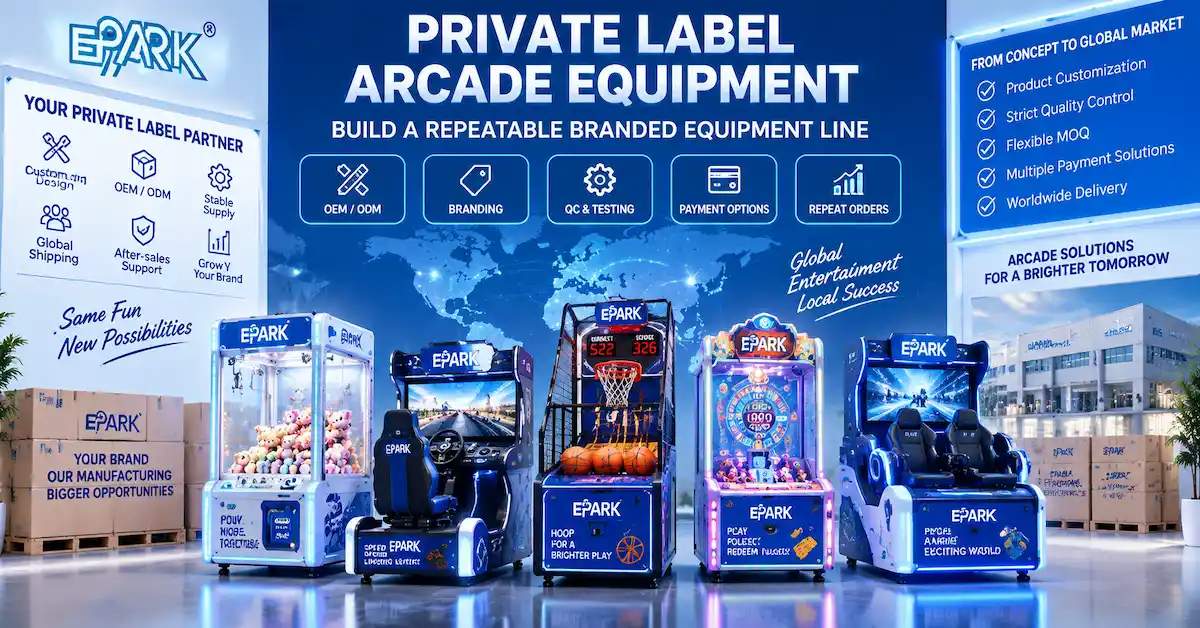
Direct answer: A capable private label arcade equipment manufacturer should do more than add a logo to an existing cabinet. For distributors, importers, arcade chains, FEC brands, and commercial entertainment project buyers, the real requirement is a controlled product program that connects the buyer's brand with a defined machine, approved configuration, artwork revision, payment setup, quality criteria, packaging, spare-parts references, and repeat-order records.
The best private label arcade machines are therefore not simply attractive machines with new graphics. They are repeatable commercial products that the buyer can identify, approve, sell, support, and reorder with less uncertainty.
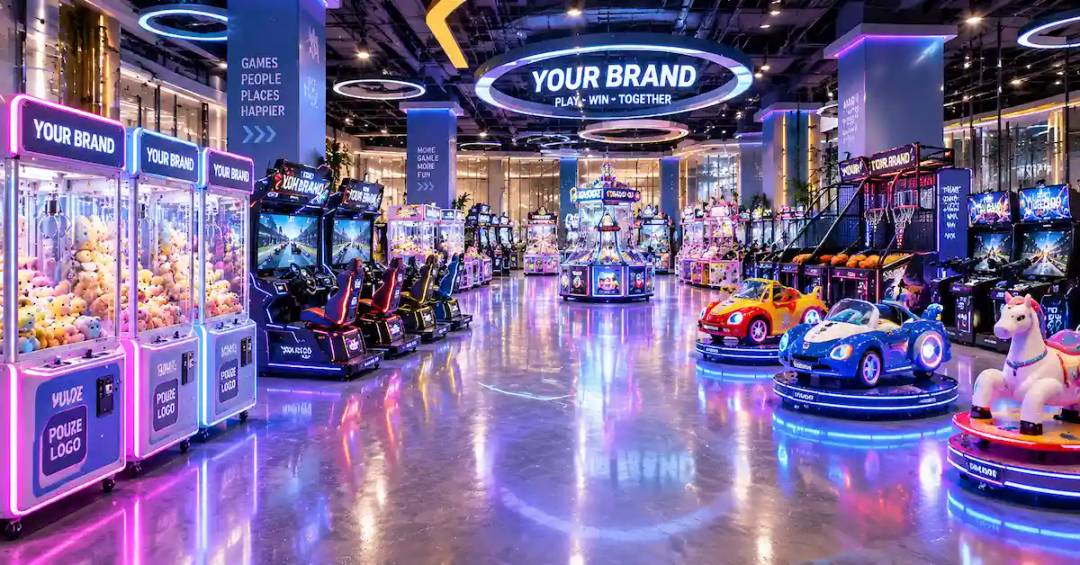
1. What Should a Private Label Arcade Equipment Manufacturer Actually Provide?
A private label arcade equipment manufacturer should be evaluated across the complete product lifecycle. The logo is only the most visible part of the project. A distributor can have perfect artwork and still receive the wrong control configuration, an undocumented payment setup, inconsistent packaging, or a machine revision that is difficult to reorder.
For procurement purposes, divide the program into five connected layers: product, brand, technical configuration, quality, and lifecycle support. This structure makes it easier to compare suppliers that use the same words—OEM, private label, customization—but provide very different levels of control.
| Layer | What should be defined | Why it matters to the buyer |
|---|---|---|
| Product | Factory model, machine category, configuration, accessories, dimensions, and buyer SKU | Creates technical traceability and prevents “same machine” ambiguity |
| Brand | Logo, colors, graphics, labels, product name, packaging identity, and artwork revision | Creates a consistent market-facing product line |
| Technical | Controls, display, audio, payment hardware, electrical setup, language, and applicable interfaces | Ensures the branded machine actually matches the operating requirement |
| Quality | Sample approval, functional checks, cosmetic criteria, configuration verification, packing inspection | Connects QC to the approved product rather than a generic factory checklist |
| Lifecycle | Documentation, spare parts, installation guidance, service route, revision history, and reorder records | Makes the product easier to support after the first shipment |
The practical standard is simple: the buyer should be able to identify what was approved, what was manufactured, what was shipped, and what should be produced next time. That is the difference between a one-off customized cabinet and a scalable private-label program.
2. Which B2B Buyers Benefit Most From Private Label Arcade Machines?
Private label arcade machines are most useful when the buyer has a sales channel, venue network, or brand concept that can benefit from a consistent equipment identity. The commercial value is higher when the buyer expects repeat orders rather than a single installation.
Arcade Equipment Distributors
Distributors can use private label arcade machines to create a recognizable local catalog. Instead of presenting a collection of unrelated factory brands, the distributor can organize claw machines, redemption games, racing products, sports games, interactive equipment, and other categories under a coherent product architecture.
The distributor still needs to keep the factory model traceable. A private brand name should not replace the manufacturing reference. The sales SKU and factory model should remain connected so that future purchasing and service teams can identify the correct machine.
Importers and Wholesale Resellers
Importers balance catalog breadth against inventory risk. A private-label model helps separate repeat-stock products from project-only products. The real question is not how many models can be branded, but how many can be sold, supported, and reordered consistently.
Arcade Chains and FEC Brands
Multi-location operators may want a consistent visual identity across different game categories. A racing cabinet, basketball machine, claw machine, and kiddie ride will not have the same physical structure, but their visible branding can still follow a common design system.
Shopping Mall and Commercial Entertainment Projects
Shopping mall entertainment zones need equipment that fits a specific footprint, theme, and operating model. A private label arcade equipment manufacturer becomes more valuable when customization is coordinated with layout planning and venue branding.
Indoor Playgrounds, Family Entertainment Centers, and Project Contractors
FEC and indoor-playground buyers may need a mixture of machines rather than one category. The buyer may combine family games, prize equipment, sports games, simulators, VR, and other attractions. In these cases, private label game machines can help create a consistent brand presentation across a mixed equipment package.
When private label may be unnecessary: If the buyer needs one standard machine, has no brand requirements, and does not expect repeat purchasing, a standard product purchase may be more efficient. Private labeling becomes more valuable when brand identity, repeat orders, regional distribution, or multi-site consistency matters.
3. Build the Product Portfolio Before Approving Artwork
One of the most expensive mistakes in private-label sourcing is starting with the logo. The first decision should be the product portfolio. A manufacturer can customize a large number of machines, but that does not mean every model should become a permanent SKU.
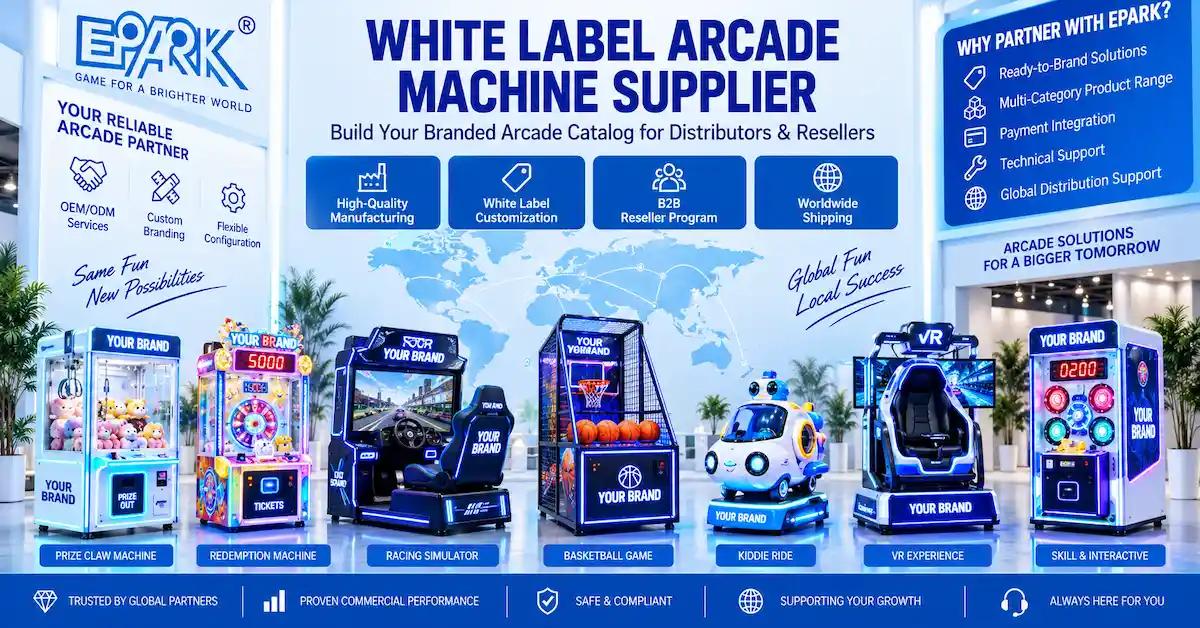
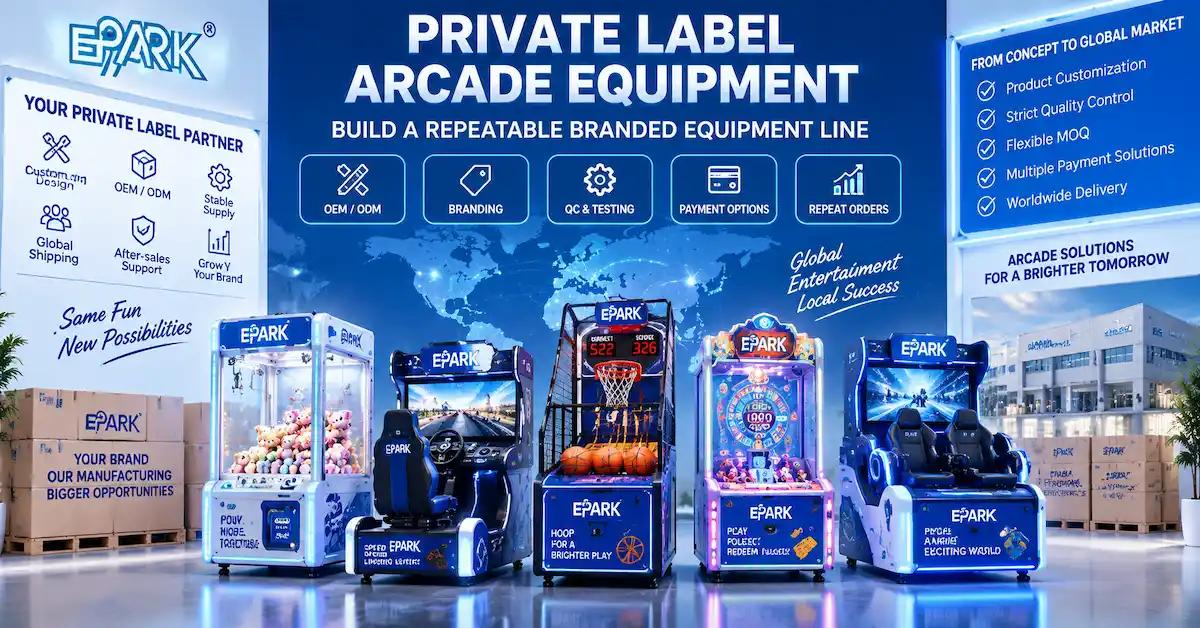
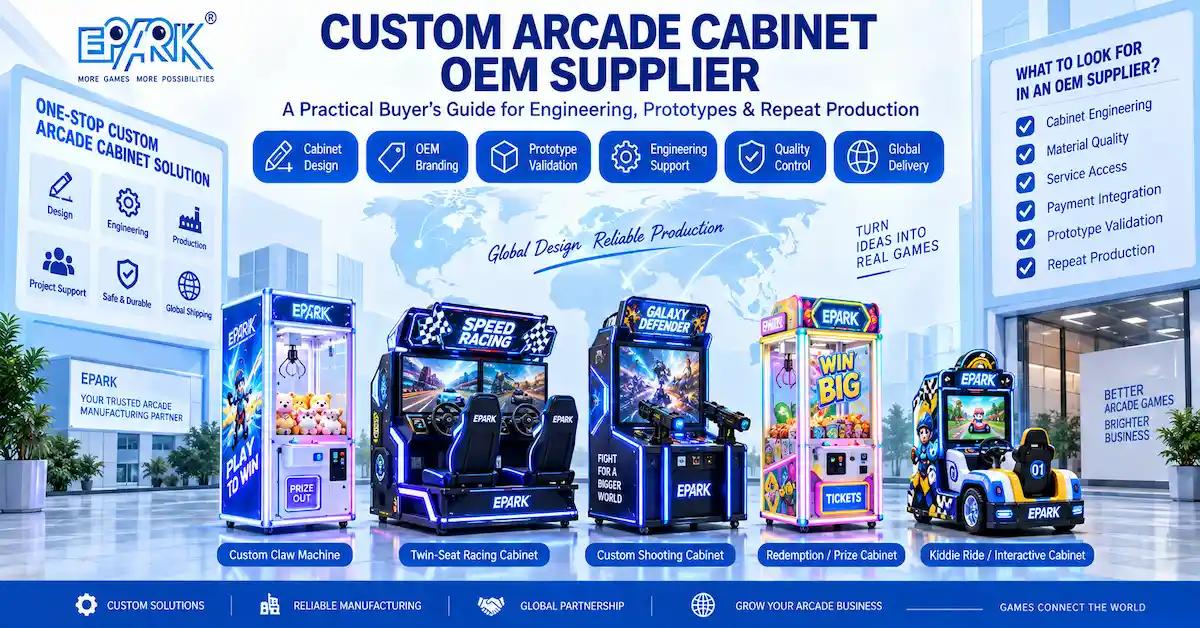
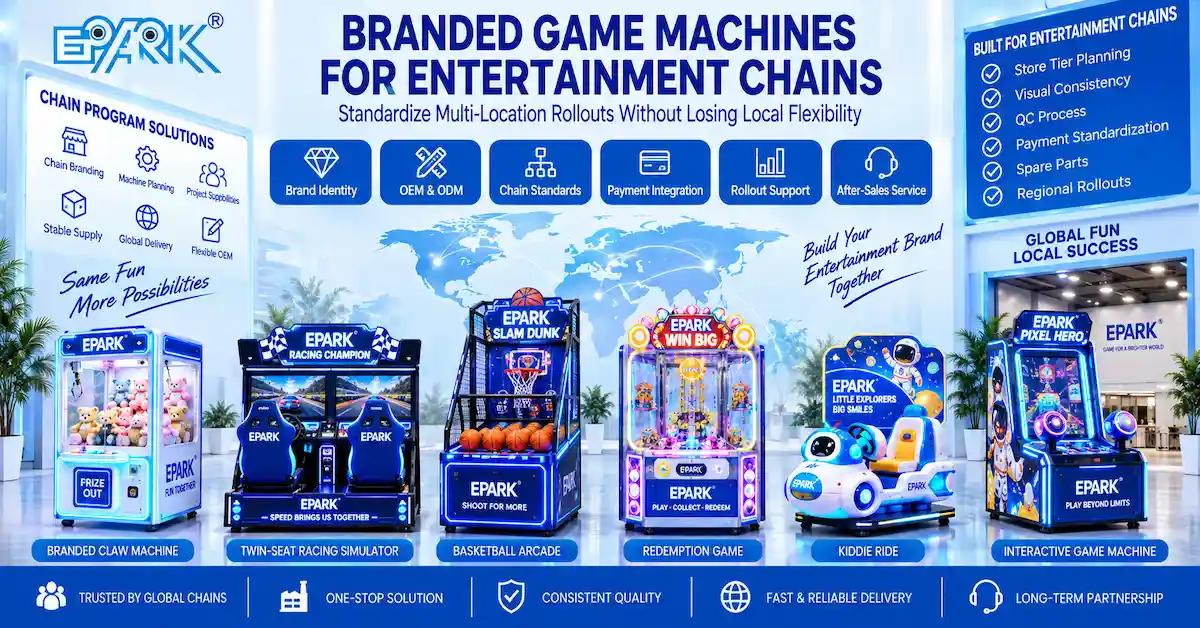
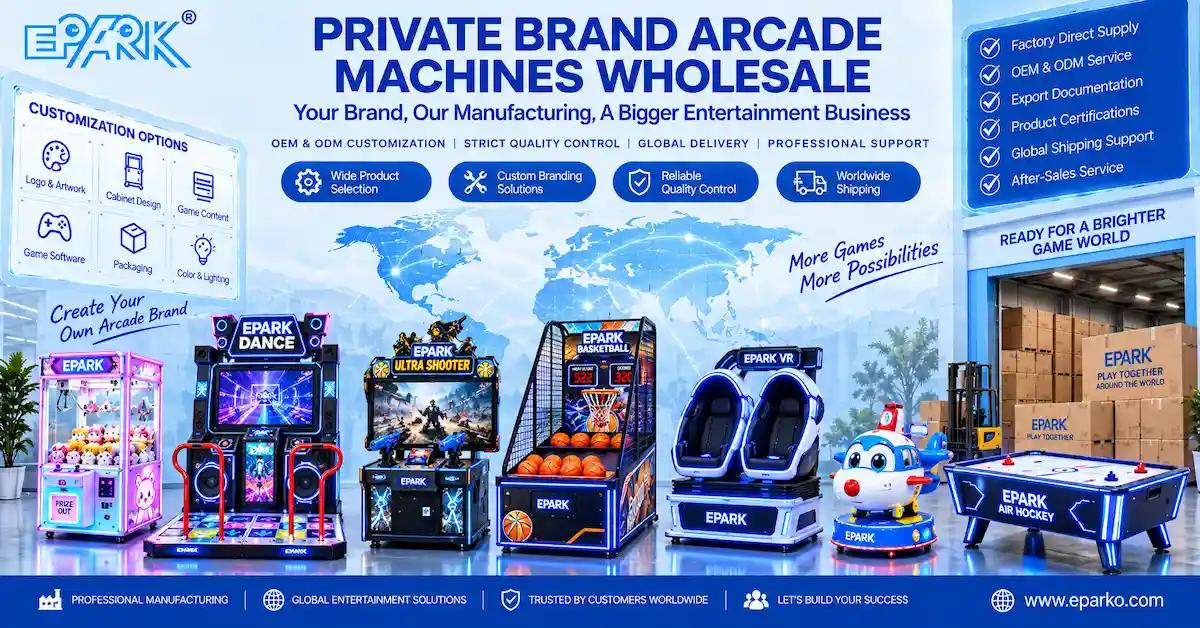
EPARK's public product information covers commercial amusement categories including claw and prize machines, redemption games, racing, basketball and other sports games, shooting and interactive games, kiddie rides, VR and simulator equipment, and broader game-center solutions. Buyers should confirm current model availability and configuration for the specific quotation rather than treating a category list as a fixed model promise.
For a distributor, a three-layer catalog is practical:
| Portfolio layer | Commercial role | Procurement priority |
|---|---|---|
| Core SKUs | Machines expected to generate repeat quotations and orders | Highest level of specification, branding, QC, spare-parts, and reorder control |
| Supporting SKUs | Products used to broaden the catalog or complete customer packages | Clear positioning and configuration, but not necessarily the same inventory depth |
| Project SKUs | Machines selected for a specific venue, theme, customer, or installation | Project-specific approval, layout coordination, and quotation control |
Claw, Prize, and Redemption Machines
These machines combine strong visual presentation with prize or reward functions. Buyers should define cabinet identity, payment method, access points, prize or ticket functions, visible controls, and service references for the selected model.
Racing, Sports, Shooting, and Interactive Games
These products can involve displays, controls, sensors, scoring, audio, lighting, software, and physical interaction. Private-label approval should therefore cover the complete configuration rather than the cabinet artwork alone.
VR, Simulator, and Kiddie Equipment
These categories may require more specific hardware, software, accessories, installation, supervision, or destination-market review. For private label game machines, ask for an itemized model configuration and avoid treating a product photograph as the specification.
Choose the Machine Platform Before the Brand Artwork
Start with the machine category, target market, venue, customer group, quantity, and operating model. Then define the branding layer around the approved platform.
Review EPARK Products Discuss Your Machine List4. Private Label Arcade Machines vs. Standard Supply, OEM, and ODM
Terms such as white label, private label, OEM, and ODM are not used consistently by every supplier. The safest procurement method is to define the actual work in the quotation and purchase documents.
| Supply route | Typical starting point | Typical buyer requirement | Main control point |
|---|---|---|---|
| Standard supply | Existing production model | Ready-to-sell or ready-to-operate equipment | Exact model and included configuration |
| Private label | Existing or established platform | Buyer-facing brand identity and agreed customization | Brand package, SKU, configuration, and repeatability |
| Configured OEM | Existing platform plus approved technical changes | Market-specific or channel-specific requirements | Compatibility, validation, and revision control |
| ODM | New or substantially modified product concept | Unique cabinet, function, or product architecture | Engineering scope, prototype, and production release |
The correct route is the least complex route that solves the commercial problem. If the buyer mainly needs brand identity, packaging, language, and selected market settings, an existing platform may be enough. If the buyer needs a substantially different cabinet or functional system, deeper OEM or ODM work may be justified.
A private label arcade equipment manufacturer should help the buyer understand this boundary rather than automatically turning every request into a new-development project. That protects both the development budget and the validation schedule.
5. How to Build a Repeatable Branding System for Private Label Game Machines
The strongest private label game machines usually share a recognizable visual language even when the underlying cabinets are different. A brand system is more efficient than redesigning every machine from zero.
A practical brand register can define:
- Primary and secondary brand colors
- Logo placement and minimum size
- Cabinet graphic style
- Header or marquee treatment where applicable
- Side-panel artwork rules
- Label hierarchy
- Product naming conventions
- Buyer-facing SKU structure
- Packaging identification
- Manual and documentation branding where agreed
The goal is to make the product recognizable while keeping the machine functional and serviceable.
Brand Consistency Is Different From Product Consistency
Brand consistency means customers recognize the equipment line. Product consistency means the same SKU is manufactured to the same approved configuration. A distributor needs both.
For example, two racing machines may use the same brand colors but different controls or software. If the buyer's sales team treats them as one SKU, service and reorder problems can follow. The brand system should therefore sit on top of a technical product record rather than replace it.
Artwork Revision Control
Every important artwork file should have a revision. Record the machine model, buyer SKU, artwork version, logo file, color references, label content, approval date, and packaging artwork where relevant.
This is especially important when the buyer operates a growing catalog. A designer may update a logo or color palette months after the first order. Without revision control, the factory may use an older file while the buyer expects the latest version.
6. Which Technical Details Must Be Controlled?
A private label arcade equipment manufacturer should not treat technical configuration as an afterthought. A cabinet is only one part of a commercial machine. Controls, display, audio, payment hardware, software, sensors, motors, wiring, power supply, and reward systems may all affect operation and maintenance.
| Technical area | Buyer should define | Procurement reason |
|---|---|---|
| Controls | Buttons, joystick, steering, pedals, sensors, or other relevant controls | Gameplay, compatibility, QC, and spare parts |
| Display and audio | Approved configuration for the selected model | Player experience and replacement matching |
| Power | Destination-market electrical requirements and plug arrangement | Installation and market suitability |
| Payment | Coin, token, card, QR, or other agreed system | Revenue collection and integration |
| Software | Language, version, settings, and licensing responsibilities where applicable | Configuration consistency and future support |
| Reward system | Tickets, points, prize output, or other applicable functions | Operational compatibility for redemption models |
| Accessories | Keys, cables, fixings, manuals, and agreed accessories | Receiving inspection and installation readiness |
For each SKU, create a single controlled specification. A simple traceability chain is:
Buyer Brand → Buyer SKU → Factory Model → Approved Revision → Production Batch
This chain becomes critical when a machine needs a replacement component. The service team should not have to identify a machine from a photograph alone.
7. Payment Systems and Destination-Market Configuration
Payment configuration is one of the most important technical areas for commercial arcade equipment. EPARK's public service information describes support for payment options such as coins, QR codes, and cards, as well as ticket, point, and redemption-system integration. The exact payment configuration should be confirmed for the selected model and destination project.
For private label arcade machines, the right question is not simply “Can the machine accept payment?” The buyer should define the complete operating chain.
| Payment route | What to define | Acceptance test |
|---|---|---|
| Coin or token | Acceptor type, operating setting, and credit logic | Payment recognition → credit → game start |
| Card | Reader/interface, provider responsibility, and integration scope | Transaction recognition → credit → game start |
| QR or cashless | Payment provider, reader, account responsibility, and interface | Payment → credit → gameplay → completion |
| Ticket or points | Output method or system connection where applicable | Gameplay → score/reward → output or account record |
The same control principle applies to voltage, plug configuration, language, labels, and other destination-specific requirements. A multi-market distributor may need different revisions of the same machine category rather than one universal SKU.
Need a Market-Specific Private-Label Configuration?
Include your destination country, machine category, payment method, electrical requirement, language, branding scope, and quantity in the inquiry.
Discuss Configuration Review Buyer FAQs8. When Should You Use a Sample or First-Unit Approval?
A logo change may only need artwork approval, but significant customization should be validated at the level that matches the technical risk. This is particularly important for private label game machines when cabinet structure, payment hardware, controls, accessories, electrical configuration, or other market-specific elements are changed.
Choose the approval level by risk
Artwork-only changes can usually be handled through controlled artwork approval. Payment, control, language, electrical, accessory, or other configuration changes deserve functional verification. Structural or deeper functional changes may justify a physical sample or first-unit approval before the bulk batch.
Do not record a sample simply as “approved.” The approval should identify the factory model, buyer SKU, revision, artwork, configuration, and acceptance date. That turns a physical sample into a controlled production reference.
9. How Should QC Be Built for Private Label Game Machines?
Generic factory QC is useful, but a private-label buyer needs a second question: Does the machine match the buyer-approved version?
A useful QC plan should cover the functions that actually exist on the selected machine.
Logo, artwork, colors, labels, cabinet finish, visible damage, and approved branding.
Controls, payment hardware, accessories, language, electrical setup, and agreed options.
Gameplay, scoring, sensors, mechanisms, reward functions, reset behavior, and relevant operating modes.
Cabinet condition, panels, doors, fasteners, access points, and other model-specific structural checks.
Power-up behavior, display, audio, lighting, wiring condition, connectors, and applicable electronic functions.
Quantity, accessories, spare parts, manuals, package identification, and shipping configuration.
For a distributor, QC should also protect the repeat order. If a machine passes the first shipment but the next batch changes without documentation, the private-label program loses consistency.
Build QC Around the Approved Product
A racing simulator, claw machine, and basketball game require different functional checks. Use a common framework, then add model-specific and market-specific checks.
This gives the buyer a scalable system:
- Common brand and packaging checks
- Common receiving and quantity checks
- Model-specific functional checks
- Market-specific payment and electrical checks
- Project-specific acceptance requirements
10. Compliance and Documentation: Verify the Model, Market, and Scope
Certification language deserves careful handling in international arcade equipment procurement. A supplier may display certification badges on its website, but a buyer still needs to understand which document applies to which product, configuration, market, and test scope.
EPARK's current public website displays quality and certification-related information including CE, RoHS, ISO, EMC, and SGS badges. The website also describes quality control, raw-material selection, and international safety standards. For a purchase decision, the buyer should request and verify the applicable documents for the actual machine and destination rather than assuming that one badge covers every model or configuration.
Procurement rule: Never treat a certification logo as a substitute for document verification. Ask for the document number, issuing organization, product/model scope, applicable market, date or validity information where relevant, and whether the approved private-label configuration falls within the documented scope.
Documentation can also include manuals, technical information, packing information, installation instructions, spare-parts references, and payment-system information. These documents may not be “certificates,” but they are essential to commercial operation.
11. Packaging, Spare Parts, Installation, and After-Sales Support
The private-label product is not complete when it leaves the production line. The buyer also needs a practical plan for receiving, installation, operation, maintenance, and customer support.
Packaging
Private-label packaging can range from shipping marks to branded cartons and manuals. Define package labels, accessory boxes, manuals, spare-parts packages, and the relationship between package numbers and the machine SKU, especially when one order contains many different private label arcade machines.
Spare Parts
Spare parts should be mapped to the actual product model. The buyer should know which parts belong to which SKU and which items are worth stocking locally.
A practical structure is:
Buyer SKU → Factory Model → Component Reference → Replacement Procedure
Installation
For venue projects, installation can involve assembly, setup, testing, and coordination with the site. EPARK's public service information describes professional installation support and one-stop project assistance. The exact scope should be confirmed for the buyer's destination and project.
After-Sales
EPARK's website describes ongoing technical assistance and 24/7 online after-sales support. Buyers should still define the practical service workflow for their project: how faults are reported, what information should be supplied, how replacement components are identified, and how remote troubleshooting is handled.
A useful service workflow is:
Fault Report → Photos/Video → Diagnosis → Component Identification → Replacement or Adjustment → Installation Guidance → Retest
12. Repeat Orders and Revision Control Are the Core of a Scalable Program
The first shipment proves that a machine can be purchased. The second shipment tests whether the private-label system is actually controlled.
For a distributor, the long-term value of a private label arcade equipment manufacturer comes from repeatability. The buyer should not have to reconstruct the previous order from old emails, chat messages, photographs, and memory.
Maintain a record for every core SKU containing:
- Buyer product code
- Factory model
- Approved product revision
- Artwork revision
- Color references
- Payment configuration
- Electrical and language configuration
- Accessory list
- Packaging specification
- QC acceptance criteria
- Spare-parts references
- Relevant product documentation
This system also protects the buyer when a component, supplier, production method, or machine revision changes. The issue is not change itself; it is undocumented change without buyer review.
Use Change Control Instead of “Same as Last Time”
The phrase “same as last time” is weak procurement language. Use the buyer SKU, factory model, approved revision, and any approved change notice.
For example:
Buyer SKU: ACR-08 → Factory Model: X-Series → Approved Revision: R3 → Current Order: 40 units → Artwork: V5 → Payment: Approved Card Configuration
The exact identifiers will vary by project, but the principle is universal: future purchasing should reference controlled data.
13. How to Compare Private-Label Quotations and Landed Cost
Price comparison becomes misleading when suppliers quote different customization scopes. One manufacturer may include branding, packaging, payment hardware, spare parts, or technical work while another lists those items separately.
Before comparing quotations, normalize the scope.
| Cost area | What to compare | Common hidden-risk question |
|---|---|---|
| Machine | Exact model and configuration | Are both suppliers quoting the same technical scope? |
| Branding | Logo, artwork, colors, labels | Is artwork setup or cabinet customization extra? |
| Payment | Reader, interface, integration, configuration | Who supplies and activates third-party payment hardware? |
| Packaging | Export protection, labels, manuals, branded packaging | Does the packing configuration change freight volume? |
| Spare parts | Initial service stock and references | Are replacement parts easy to identify later? |
| Shipping | Incoterm, packing volume, destination, logistics scope | Are freight and local charges being compared on the same basis? |
| Installation | Remote or on-site support | What work remains the buyer's responsibility? |
| Service | Technical support and warranty process | How are faults diagnosed and replacement parts supplied? |
For private-label programs, the better benchmark is cost per approved, delivered, supportable SKU, not simply the lowest factory unit price.
14. Match Private Label Game Machines to Real Applications
A branded machine should be selected according to where and how it will operate. Private label game machines can be used across different commercial environments, but the buyer's product mix should reflect the actual customer journey.
| Application | Potential equipment mix | Private-label priority |
|---|---|---|
| Arcade center | Arcade cabinets, sports, racing, redemption, claw and interactive games | Product identity, repeatability, payment, service parts |
| Family entertainment center | Family games, prizes, sports, kiddie equipment, VR and interactive attractions | Brand consistency, age-group positioning, venue flow |
| Shopping mall game zone | High-visibility prize, sports, racing, interactive and compact machines | Visual impact, footprint, payment, maintenance access |
| Indoor playground | Family games, kiddie equipment, prize machines and selected interactive attractions | Brand fit, supervision, operating simplicity, serviceability |
| Distributor catalog | Multiple categories selected for local resale | SKU control, packaging, documentation, repeat ordering |
| Themed entertainment project | Machines selected around a venue concept | Theme, cabinet design, layout, system integration |
EPARK's public project examples show different venue formats and equipment mixes, including arcade centers, VR theme parks, game zones, indoor playgrounds, gift-shop concepts, and larger arcade environments. These examples can help buyers think about equipment as part of a venue rather than as isolated products; the actual machine list should still be developed around the buyer's floor plan, target audience, and business model.
Why Venue Information Improves a Private-Label RFQ
If the buyer is developing an FEC or branded arcade, provide the venue size, floor plan, entrances and exits, target audience, preferred game categories, and budget range where available. EPARK's public service information describes customized machine planning and 2D/3D layout design, which can be used to connect equipment selection with the venue concept.
Branding works best when the equipment line also supports the customer experience. Consistent colors, machine grouping, attraction zones, prize areas, and payment methods can make the venue feel like one product system.
15. How to Qualify a Private Label Arcade Equipment Manufacturer
Supplier qualification should focus on evidence rather than adjectives. Words such as “professional,” “high quality,” and “experienced” are easy to publish. A B2B buyer needs to understand what the manufacturer can actually control.
| Evaluation area | Questions to ask | Strong evidence looks like |
|---|---|---|
| Manufacturing | Who manufactures the equipment and which processes are controlled? | Clear company identity, production information, engineering and QC communication |
| Customization | What can be changed without new development? | Defined branding and technical customization scope |
| Design | Can the supplier support layout or themed projects? | 2D/3D planning and documented approval steps where applicable |
| QC | What is inspected before shipment? | Model-specific functional, cosmetic, configuration, and packing checks |
| Documentation | Which documents apply to the selected model? | Model- and market-specific documentation rather than generic badges |
| After-sales | How are technical faults and spare parts handled? | Clear reporting, diagnosis, replacement, and support workflow |
| Repeat orders | How are previous configurations reproduced? | SKU, factory model, revision, artwork, configuration, and change control |
Separate Confirmed Capability From New Development
A reliable private label arcade equipment manufacturer should distinguish an existing capability, a feasible change requiring validation, and a new-development requirement. “We can customize it” is not enough to reveal effects on tooling, electronics, payment, software, production, packaging, or documentation.
Check Communication Before the Deposit
Customized orders require many decisions. One practical test is to ask the supplier to review a real project brief. Does the supplier ask about the market, machine categories, quantity, payment system, electrical requirements, artwork, packaging, and repeat orders? Or does it immediately send a unit price?
The better response is usually the one that identifies missing information before confirming the final scope.
16. How EPARK Fits a Private-Label Arcade Equipment Program
EPARK's public website identifies Guangzhou EPARK Electronic Technology Co., Ltd. as a commercial amusement equipment and entertainment solutions provider integrating R&D, design, production, and sales. Its published product directions include coin-operated arcade machines, VR simulators, kiddie rides, gift machines, claw and prize equipment, redemption games, sports games, and other entertainment solutions.
For buyers looking for a private label arcade equipment manufacturer, the relevant point is the combination of equipment manufacturing with customization and project support. EPARK publicly describes OEM customization, branding support, venue layout consulting, customized machine planning, theme and venue design, payment and system integration, professional installation, and ongoing technical assistance.
EPARK's current public website states that its factory is 25,000 m² and that it has served customers in more than 100 countries. Its About Us page also describes a team of 100+ specialists across five in-house departments. These are company-published figures; buyers should still verify the current model, configuration, and project scope in the quotation and purchasing documents.
The public quality information describes durable steel frames, high-grade plywood, acrylic panels, and electronic parts such as coin mechanisms, buttons, joysticks, and screens sourced from suppliers described by EPARK as reliable. The site also describes multiple inspection stages covering electronics, structural integrity, and finishing.
| Buyer need | EPARK capability published on its website | What the buyer should confirm |
|---|---|---|
| Branded equipment | OEM customization and branding support | Logo, artwork, colors, SKU, and revision |
| Mixed machine portfolio | Multiple arcade and amusement categories | Exact models, quantities, configurations, and availability |
| Venue project | Machine planning and 2D/3D layout support | Floor plan, audience, machine mix, and responsibilities |
| Payment integration | Coin, QR, card, ticket, point, and redemption integration support described publicly | Actual hardware, provider, interface, and acceptance test |
| Installation and support | Professional installation and ongoing technical assistance described publicly | Remote/on-site scope, destination, labor, spare parts, and service terms |
Before preparing an RFQ, buyers can review About EPARK, Arcade Products, Why Choose EPARK, Design & Process, FAQ, and Service.
17. Private-Label RFQ Checklist: What Should You Send a Manufacturer?
A good RFQ should contain enough information for the supplier to quote the same scope that you will later approve. “Private label arcade machines” alone is not a comparable specification.
| RFQ field | Information to provide |
|---|---|
| Target market | Country or region where the machines will be sold or operated |
| Buyer type | Distributor, importer, reseller, arcade chain, FEC, mall project, or contractor |
| Machine categories | Claw, redemption, racing, basketball, shooting, VR, kiddie, interactive, or other required categories |
| Reference models | Supplier model names, product links, reference images, or preferred designs |
| Quantity | Initial units by model and expected future purchasing |
| Branding | Logo, colors, artwork, product naming, labels, and brand guidelines |
| Payment | Coin, token, card, QR, or other required system |
| Electrical | Destination-market voltage, plug, and other applicable requirements |
| Language | User interface, labels, manuals, and packaging language |
| Packaging | Standard export packing or buyer-branded packing and shipping marks |
| Documentation | Manuals, product sheets, technical files, and applicable compliance documents |
| Spare parts | Initial service stock and future replacement requirements |
| Approval | Artwork approval, sample, first-unit inspection, or other acceptance level |
| Schedule | Target shipment window and project milestones |
Ten Questions to Ask Before Placing the Order
- Which factory model is behind each private-label SKU?
- Which branding changes are included in the quotation?
- Which requested changes require engineering or additional validation?
- Can the approved configuration be reproduced for future orders?
- What payment configuration is available for the destination market?
- What exactly is included in pre-shipment QC?
- Which compliance documents apply to the selected model and market?
- How are packaging, accessories, and spare parts identified?
- What technical support is available after delivery?
- How will component, artwork, or model changes be communicated before repeat orders?
A detailed RFQ also helps the buyer compare different private label arcade equipment manufacturer candidates on an equivalent basis. It turns vague customization language into measurable procurement requirements.
18. Frequently Asked Questions
1. What is a private label arcade equipment manufacturer?
A private label arcade equipment manufacturer produces commercial arcade or amusement equipment that can be sold or operated under the buyer's own brand identity. Depending on the project, private-label work can include logo and artwork changes, cabinet colors, packaging, product identification, language, payment configuration, and selected technical changes. The exact scope should be defined in the quotation and approved product specification.
2. What are private label arcade machines?
Private label arcade machines are arcade or amusement machines manufactured on an existing or customized platform and presented under the buyer's brand. They can range from visually branded standard platforms to more extensively configured OEM products. The key procurement issue is not the label itself but the exact machine, configuration, branding scope, QC criteria, and repeat-order reference.
3. Can private label arcade machines use my own logo and colors?
Brand customization can include logos, colors, graphics, labels, and other visible elements when the manufacturer offers that scope. The buyer should provide controlled artwork files and approve the final version before production. Logo placement alone should not be treated as proof that the complete machine configuration has been approved.
4. Do private label game machines require a completely new design?
No. A private-label project can start with an existing machine platform when that platform already satisfies the functional and commercial requirement. A deeper OEM or ODM route becomes more appropriate when the buyer needs significant cabinet, functional, control, payment, or product-architecture changes.
5. Which machine categories can be private labeled?
Potential categories include claw and prize machines, redemption games, racing and simulator equipment, basketball and sports games, shooting and interactive games, kiddie rides, VR equipment, and other commercial amusement products. Exact model availability and customization scope should be confirmed for the buyer's project.
6. What should I check before ordering private label arcade machines?
Check the exact factory model, buyer SKU, branding scope, artwork revision, controls, display and audio configuration, payment system, electrical requirements, language, accessories, packaging, QC criteria, applicable documents, spare parts, and repeat-order process. These details reduce ambiguity after the first shipment.
7. Should I request a sample for private label game machines?
A sample or first-unit review is particularly useful when the project includes cabinet changes, payment-system modifications, new controls, market-specific hardware, or other meaningful technical changes. For simple visual branding, artwork approval may be enough, but the buyer should still record the approved model and revision.
8. How do I compare private label arcade equipment manufacturers?
Compare manufacturing capability, machine categories, customization scope, technical communication, QC, documentation, payment integration, packaging, installation, spare parts, after-sales support, and repeat-order control. Price should be compared only after the quotation scope has been normalized.
9. Can EPARK support private-label arcade equipment projects?
EPARK's public website describes OEM customization, branding support, machine planning, venue layout consulting, payment and system integration, installation support, and ongoing technical assistance. Buyers should submit the actual machine list, destination market, branding scope, and project requirements to confirm the appropriate configuration and service scope.
10. What information should I send EPARK for a private-label quotation?
Provide the target market, buyer type, machine categories, preferred models, quantity by model, logo and artwork, colors, payment system, electrical requirements, language, packaging needs, sample expectations, spare-parts requirements, venue information where relevant, and target schedule. A defined brief allows the quotation to be built around an actual project rather than a generic private-label request.
Conclusion
Choosing a private label arcade equipment manufacturer is a decision about control and repeatability, not logo placement alone.
- Select the right machine platform before finalizing branding.
- Control the buyer SKU, factory model, configuration, and artwork revision.
- Validate payment, electrical, language, controls, QC, packaging, and documentation.
- Use revision control so approved private label arcade machines can be reproduced for future orders.
For distributors, FEC brands, arcade chains, importers, and commercial entertainment projects, this approach turns private label game machines into a manageable product line. Send your market, machine mix, branding requirements, quantity, and project details to EPARK for a product-specific discussion.
Ready to Build Your Private-Label Arcade Line?
Share your target market, machine categories, quantities, branding scope, payment requirements, and venue needs.
Get a Private-Label Quote Browse EPARK ProductsDisclaimer
The information provided on this website is for general informational purposes only.
While EPARK Arcade Game Machine Manufacturer strives to ensure accuracy and reliability, no warranties—express or implied—are made regarding completeness, performance, or applicability.
Product specifications, designs, and features may vary depending on usage, customization, and customer requirements.
Buyers are responsible for verifying all technical details, compliance certifications, and suitability before procurement.
EPARK shall not be held liable for any direct, indirect, incidental, or consequential damages arising from the use of this website or its content, including but not limited to business losses, data errors, or equipment misuse.
For tailored solutions or further verification, please visit our Contact Us
Intellectual Property Notice
All articles, product images, videos, catalogs, software, and related materials published on this website are the intellectual property of EPARK, unless otherwise stated.
Unauthorized reproduction, distribution, modification, or commercial use of any content is strictly prohibited without prior written consent from EPARK.
EPARK reserves the right to take legal action against any unauthorized use, including but not limited to copyright infringement, misrepresentation, or unfair competition.
Trademarks
The name EPARK, the EPARK logo, and all related brand elements displayed on this website are registered trademarks or trade names of Guangzhou EPARK Electronic Technology Co., Ltd.
Other product names, company names, or logos mentioned on this site may be trademarks of their respective owners.
Unauthorized use of EPARK's trademarks for commercial purposes, including advertising, promotions, or product packaging, is strictly prohibited.
Governing Law
These terms are governed by the laws of the People's Republic of China.