

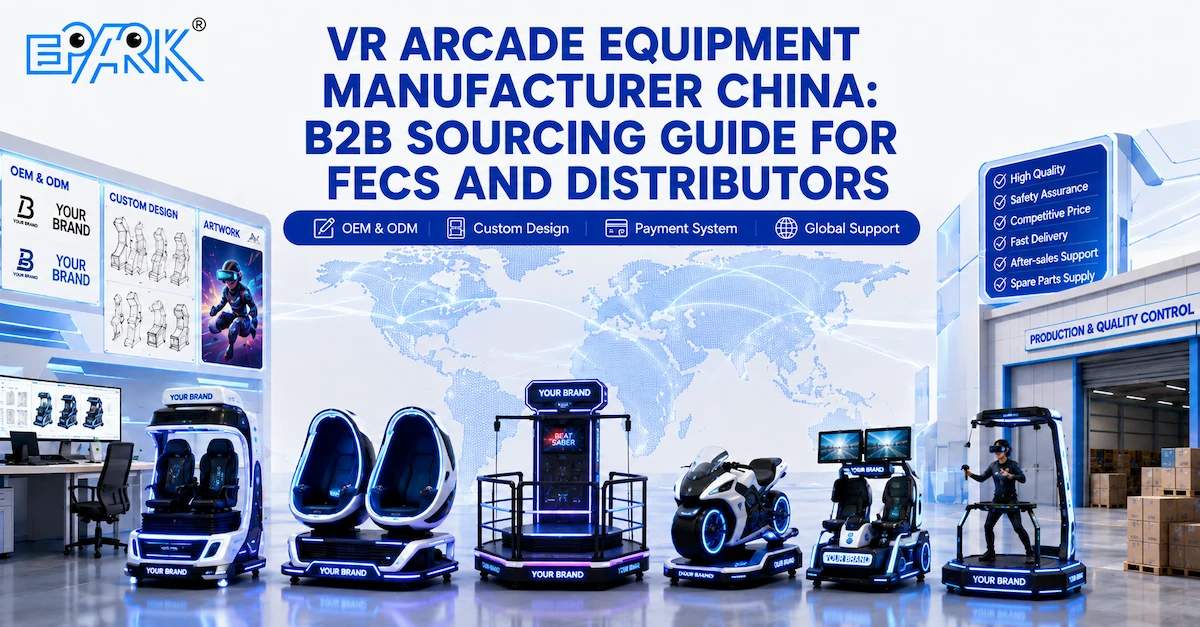
What Should Buyers Expect From a VR Arcade Equipment Manufacturer in China?
A capable VR arcade equipment manufacturer in China should do much more than assemble a VR headset onto an attractive cabinet.
Commercial buyers need a manufacturer that can coordinate the complete system:
VR Hardware + Computing + Tracking + Motion System + Cabinet + Software + Payment + Testing + Spare Parts + Technical Support
That matters because commercial VR equipment is fundamentally different from ordinary consumer VR.
In an FEC, shopping mall, game center, theme park, or VR entertainment venue, the equipment may operate repeatedly throughout the day and may be used by customers with very different levels of VR experience.
A B2B buyer therefore needs to evaluate not only how immersive the machine looks, but also:
- How quickly players can enter and exit
- How easy the equipment is to reset
- Whether components can be replaced locally
- How software and content are managed
- Whether the motion system is serviceable
- Whether payment systems can be integrated
- How technical problems are diagnosed remotely
- Whether repeat orders can maintain the same configuration
EPARK currently identifies itself as an OEM/ODM amusement equipment manufacturer integrating R&D, design, production and sales, with VR simulators among its commercial equipment categories and services including customization, venue planning and technical assistance.
Buyers can first review EPARK's commercial arcade and VR equipment range before deciding which VR format fits their project.
Who Is Actually Searching for a VR Arcade Equipment Manufacturer in China?
The keyword has strong B2B procurement intent.
Typical buyers include:
| Buyer Type | Main Goal | Key Supplier Requirement |
|---|---|---|
| FEC operator | Add immersive attractions | Throughput, reliability, support |
| VR arcade investor | Build a VR-focused venue | Equipment mix, software, layout |
| Arcade distributor | Build resale inventory | Price, OEM,repeat supply |
| Shopping mall project | Add premium attraction | Appearance, footprint, operation |
| Arcade chain | Standardize multiple locations | Components, software, spare parts |
| Theme park buyer | Add interactive experiences | Capacity, durability, project support |
| Private-label brand | Develop branded VR machines | OEM/ODM, cabinet design |
| Importer | Purchase commercial equipment | QC, documentation,packaging |
This means the strongest article and supplier evaluation should answer a purchasing question:
“Which Chinese VR arcade manufacturer can reliably support the equipment after it enters commercial operation?”
not simply:
“Which factory has the cheapest VR simulator?”
Start With the VR Business Model Before Choosing Equipment
A common procurement error is selecting a visually impressive machine first and figuring out the business model later.
Reverse that process.
FECs
A family entertainment center usually does not need every attraction to be VR.
VR may work best as a premium category alongside:
- Racing games
- Redemption machines
- Basketball
- Claw machines
- Family games
The objective is to broaden the attraction mix without creating an overly complex operation.
Dedicated VR Arcades
A VR-focused venue needs deeper equipment variety.
It may require:
- Motion simulators
- Multiplayer VR
- Standing VR
- VR racing
- Interactive shooting
- Compact VR pods
In this case, software variety and throughput become particularly important.
Shopping Malls
Mall operators often care about:
- Strong visual attraction
- Compact footprint
- Easy supervision
- Controlled sound
- Simple payment
- Fast customer turnover
A complex multi-player VR system may generate attention but require more staff.
Distributors
A distributor has another priority:
Can this machine be sold, serviced and reordered consistently?
That makes spare parts, component stability, OEM branding, documentation and remote technical support especially important.
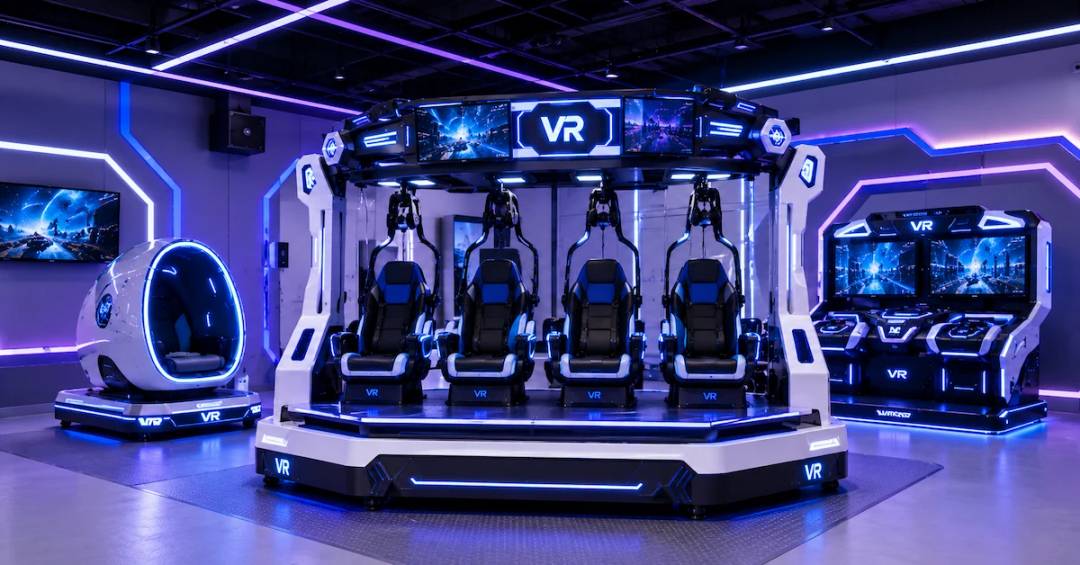
Compare the Main Types of Commercial VR Arcade Equipment
The term “VR arcade equipment” covers several very different machine architectures.
| VR Equipment Type | Main Experience | Operational Complexity | Best Fit |
|---|---|---|---|
| Fixed-seat VR | Seated immersive content | Low–Medium | Small arcade/FEC |
| Motion VR simulator | Synchronized motion + VR | Medium–High | FEC,VR arcade |
| VR racing simulator | Driving + VR | Medium | Game center/FEC |
| Standing VR station | Free body movement | Medium | VR arcade |
| Multiplayer VR | Shared experience | High | Larger venues |
| VR pod/capsule | Premium enclosed experience | Medium | Mall/FEC |
| Interactive VR shooter | VR + controller interaction | Medium–High | Arcade/VR venue |
Do not compare these machines only by price.
A six-axis motion simulator and a compact seated VR unit have fundamentally different:
- Hardware
- Maintenance
- Power demand
- Footprint
- Capacity
- Staffing
- Shipping cost
A professional manufacturer should help you choose the format based on the venue rather than simply recommend the most expensive model.
Inspect the VR Hardware Architecture Before Comparing Quotations
Two VR machines with similar exterior designs can use very different internal systems.
A commercial quotation should make the important hardware configuration clear.
VR Headset
Ask:
- Which HMD is used?
- Is it replaceable?
- Is the model region-dependent?
- Is an account required?
- What happens if the headset is discontinued?
Avoid a design where the entire commercial machine becomes unusable because one consumer headset model disappears from the market.
Computing System
Confirm:
- CPU
- GPU
- RAM
- Storage
- Operating system
- Cooling design
- Upgrade path
A strong manufacturer should be able to identify the PC specification rather than describing it only as a “high-performance computer.”
Tracking
Depending on the VR format, tracking may involve:
- Headset-integrated tracking
- External sensors
- Base stations
- Camera systems
- Position tracking
Buyers should understand how tracking is calibrated and maintained.
Controls
Controls may include:
- VR controllers
- Steering wheels
- Guns
- Hand tracking
- Buttons
- Foot controls
Ask which are standard and which are optional.
Evaluate the Motion Platform as a Commercial Component
For motion VR equipment, the mechanical system deserves as much attention as the headset.
Depending on the machine,motion may involve:
- Electric actuators
- Servo systems
- Motors
- Gear mechanisms
- Multiple-axis platforms
Ask the manufacturer:
How many motion axes does the system actually provide?
Then ask:
Which parts normally require maintenance?
Other useful questions include:
- How is motion synchronized with content?
- What happens if one actuator fails?
- Can a technician replace it on site?
- Does replacement require recalibration?
- What diagnostic information is available?
A flashy exterior does not compensate for a motion system that cannot be serviced efficiently.
Ask How the Manufacturer Designs for Commercial Maintenance
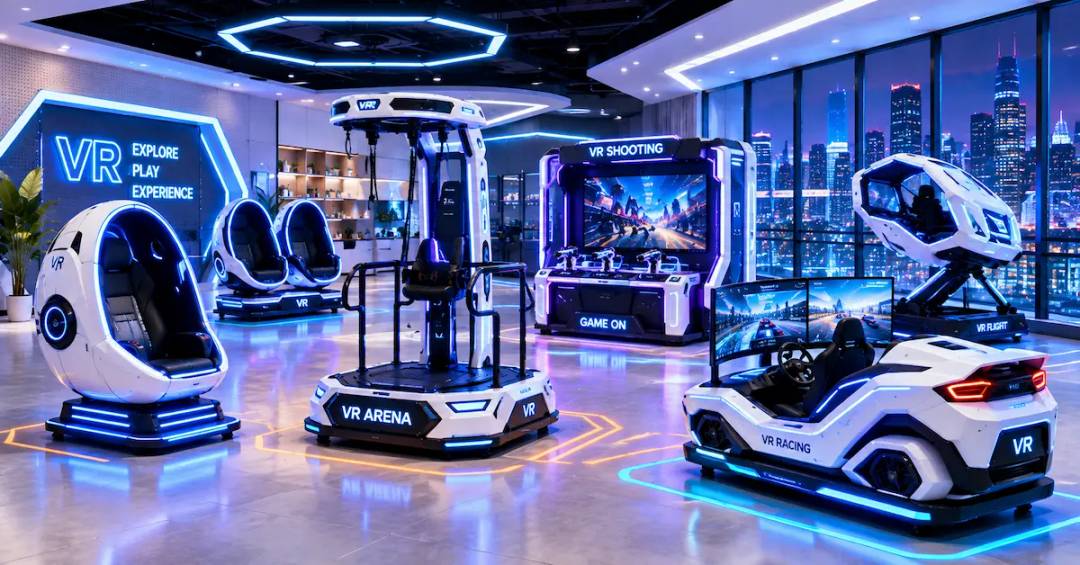
This is one of the strongest ways to distinguish a consumer-style VR product from serious commercial equipment.
Commercial machines should allow reasonable access to:
- PC
- Power supply
- Control board
- Motor or actuator
- Sensors
- Wiring
- Payment module
- Network components
Ask the supplier to show:
Where are the main service panels?
Then:
How long does it take to replace the most common components?
For overseas buyers, serviceability can have a greater financial impact than a small difference in purchase price.
Treat VR Software as Part of the Equipment Purchase
One of the biggest mistakes in VR procurement is discussing hardware in detail while treating software as an afterthought.
Before ordering, clarify:
- What content is included?
- Who owns or licenses it?
- Is there a recurring fee?
- Can content be updated?
- Is internet access required?
- Can the machine operate offline?
- Are different languages available?
- What happens if a title is discontinued?
- Can new games be added?
For a distributor, also ask whether software can legally and practically be deployed across multiple machines and customers.
Do not assume that buying a headset automatically gives a venue unrestricted commercial rights to every VR title installed on it.
The commercial content model should be clarified in writing.
Calculate Player Throughput Before Calculating ROI
A VR machine may deliver an impressive five-minute experience but still have a ten-minute effective customer cycle.
Why?
Because actual throughput also includes:
Boarding + Headset Adjustment + Tutorial + Gameplay + Exit + Cleaning + Reset
A useful operating formula is:
Effective Session Time = Setup + Gameplay + Exit + Cleaning + Reset
For example, two machines with similar game duration may generate very different throughput if one requires extensive staff setup.
Ask your VR arcade equipment manufacturer:
- Typical game duration?
- Typical setup time?
- Staff required?
- Number of players per session?
- Reset process?
- Cleaning procedure?
This is particularly important for malls and busy FECs where floor productivity matters.
Compare Revenue Potential by Floor Space, Not Machine Price Alone
Commercial entertainment venues should consider the revenue-generating value of the occupied area.
A useful buyer-side metric is:
Revenue Potential per m² = Plays × Price per Play × Utilization ÷ Operating Footprint
This is not a guaranteed ROI formula.
It is a way to compare equipment more intelligently.
A large motion simulator may justify its footprint if:
- It has premium pricing
- It attracts spectators
- It increases venue visibility
- It supports multiple players
A smaller VR pod may be more suitable when:
- Rent is high
- Space is limited
- The venue requires several attractions
The right machine depends on the venue economics.
Check Hygiene and Daily Cleaning Requirements
VR equipment has more direct face and hand contact than many traditional arcade machines.
Operators should plan for cleaning of:
- Facial interfaces
- Head straps
- Controllers
- Seats
- Handles
- Frequently touched surfaces
Ask whether:
- Facial interfaces are replaceable
- Contact materials tolerate routine cleaning
- Spare interface components are available
- Headsets are easy for staff to access
Cleaning time should also be included when calculating real session throughput.
Verify the Chinese Manufacturer, Not Just the Product
A reliable VR arcade equipment manufacturer China buyers work with should be able to show clear evidence of product engineering, assembly, system integration, quality testing, and export preparation.
For B2B sourcing, buyers should determine whether the supplier controls the manufacturing and integration process.
Ask for evidence of:
- Product engineering
- Cabinet production or assembly
- Electrical integration
- PC installation
- Motion-system installation
- Final assembly
- Software configuration
- Testing
- Packaging
A showroom proves that a supplier has machines.
It does not by itself prove manufacturing control.
A useful remote verification method is a live factory video call in which the supplier shows machines at different stages of production.
EPARK's published manufacturing information says its process includes artwork and coating, electronic-system assembly, PCB and wiring installation, screen/control integration, final assembly and functional testing.
Ask How the Factory Tests VR Equipment Before Shipment
Commercial VR quality control should be system-level.
A VR machine contains several subsystems that must operate together.
Headset and Visual System
Check:
- Display output
- Tracking
- Connection stability
- Image operation
PC and Software
Verify:
- Startup
- Game launch
- Content loading
- System recovery
- Correct language/configuration
Motion Platform
Where applicable:
- Motion direction
- Synchronization
- Repeated cycles
- Abnormal noise
- Mechanical stability
Controls
Verify:
- Buttons
- Controllers
- Steering
- Triggers
- Sensors
Payment System
Test:
- Coin
- Token
- Card
- QR or integrated system where configured
Final Configuration
Confirm:
- Voltage
- Plug
- Artwork
- Logo
- Software package
- Accessories
- Spare parts
For larger orders, buyers should agree on an acceptance checklist before production.
Do Not Use a Generic Safety Claim for VR Equipment
This is an area where purchasing teams need extra care.
IEC 60335-2-82:2024 covers certain electric commercial amusement machines, including gaming machines, driving simulators and several other categories. However, the standard specifically excludes appliances intended to be used when a trained attendant is present, giving virtual reality systems as an example.
That detail matters.
A supplier should therefore not simply claim that every VR arcade machine is covered by IEC 60335-2-82.
The correct compliance analysis depends on the exact configuration, intended use and destination market.
For a serious import project, ask:
- Which rules apply to this machine?
- What is its intended mode of operation?
- Does it require a trained attendant?
- What technical documentation is available?
- Which components have their own applicable documentation?
- Are additional local requirements relevant?
This type of specific conversation is much more useful than a generic “international standard” statement.
For EU Orders, Verify the Exact CE Compliance Route
CE marking is another area where buyers should avoid oversimplification.
Official EU guidance states that manufacturers are responsible for identifying applicable EU requirements, carrying out or arranging the required conformity assessment, preparing technical documentation, issuing the EU Declaration of Conformity and applying CE marking when the relevant legislation requires it.
The EU also states that technical documentation must describe the product's design, manufacture and operation and demonstrate compliance with applicable requirements.
Therefore, do not evaluate a Chinese VR supplier using only:
“Does the cabinet have a CE sticker?”
Ask instead:
“Which applicable EU rules have been identified for this exact VR system, and what documentation supports the finished configuration?”
That is a stronger B2B compliance question.
Confirm Destination-Market Electrical Configuration
Before production, send the factory:
- Destination country
- Voltage
- Frequency
- Plug specification
- Site power limitations
- Network requirements
VR equipment can contain several electrical loads:
- PC
- Displays
- Headset
- Motion platform
- Lighting
- Audio
- Payment system
A manufacturer should configure the complete system rather than expecting an overseas installer to resolve incompatible components after delivery.
Evaluate Payment System Integration
Commercial VR machines may need to work with:
- Coins
- Tokens
- Stored-value cards
- QR systems
- Central venue management systems
This should be discussed before production.
If you are sourcing equipment for a complete FEC, the payment strategy should ideally cover VR equipment and other arcade categories under one operating model.
EPARK currently lists payment-system integration among its project services.
For custom configurations, buyers can review EPARK's OEM and ODM arcade manufacturing options.
Evaluate OEM and ODM Capability With a Real VR Project
“Customizable” can mean anything from changing a logo to redesigning an entire machine.
Separate OEM from deeper product development.
When evaluating a VR arcade equipment manufacturer China distributors should confirm whether branding, cabinet design, payment integration, electrical configuration, and repeat production can be handled consistently.
Common OEM Requirements
Buyers may request:
- Logo
- Cabinet color
- Artwork
- Interface language
- Lighting
- Payment system
- Packaging
- Voltage
Deeper ODM Requirements
A distributor or entertainment brand may require:
- New cabinet structure
- Different seating layout
- Modified motion platform
- New exterior design
- Special player interaction
- Custom software integration
Give the manufacturer an actual requirement.
For example:
We need a branded two-seat VR motion simulator for distribution in the Middle East, with custom cabinet artwork, 220–240 V configuration, card-payment interface, English/Arabic operating instructions and a spare-parts package.
Then evaluate the questions the manufacturer asks you.
A serious engineering team should request technical information before promising that everything is possible.
Ask About Repeat-Order Configuration Control
For distributors and arcade chains, the first order is only the beginning.
Ask:
If I reorder this VR simulator in one year, can you reproduce the same configuration?
VR components evolve quickly.
Possible changes include:
- Headset model
- GPU
- PC motherboard
- Tracking hardware
- Controllers
- Motion components
- Software version
A manufacturer should have a process for handling substitutions.
Ask whether you will be notified if a key component changes.
This is crucial because a fleet becomes difficult to maintain when every production batch contains different parts.
Plan Spare Parts Before Ordering
VR equipment has several high-value components.
Do not wait for a machine failure to discover the spare-parts process.
Request a model-specific recommendation.
Potential service items may include:
- Headset accessories
- Controllers
- Cables
- Sensors
- Power supplies
- Control boards
- Actuators
- Motors
- Buttons
- Payment components
Then ask:
How will you identify the correct replacement for my machine six or twelve months later?
A useful support system should link the machine configuration to its components.
Evaluate Remote Technical Support Before Buying
Overseas venues cannot depend on factory technicians physically visiting every time a problem appears.
Ask the manufacturer to explain the actual troubleshooting process.
A useful workflow might be:
Error Description → Photos/Video → Remote Diagnosis → Component Test → Replacement/Adjustment → Verification
Evaluate whether the supplier can provide:
- Troubleshooting guides
- Wiring information
- Component identification
- Remote video support
- Replacement instructions
- Software recovery guidance
EPARK's current website describes ongoing technical assistance and after-sales service as part of its international offering.
Compare Export Packaging, Not Just Freight Price
VR machines can contain expensive and sensitive equipment.
Potentially vulnerable components include:
- HMD
- Monitor
- PC
- Motion mechanisms
- Seats
- Decorative shells
- Acrylic panels
- Electronics
Ask how each system is secured during transportation.
Also request:
- Packing dimensions
- Gross weight
- Net weight
- Number of packages
- Loading method
Shipping damage can erase the savings from choosing a slightly cheaper supplier.
Packaging therefore belongs in the purchasing evaluation.
What Does a Serious VR Arcade Equipment Quotation Need?
A useful quotation should make the configuration sufficiently clear.
| Quotation Item | What Buyer Should Confirm |
|---|---|
| VR format | Seat, pod, motion, standing,multiplayer |
| HMD | Exact model/configuration |
| Computer | CPU/GPU/RAM/storage |
| Motion system | Type and axes if applicable |
| Display | Size/configuration |
| Controls | Controllers, wheel, gun, etc. |
| Software | Included content/licensing model |
| Payment | Coin/card/other |
| Electrical | Voltage/frequency/plug |
| OEM | Logo/artwork/color |
| Spare parts | Included/recommended |
| Packaging | Export method |
| Warranty/support | Scope and process |
| Lead time | Production conditions |
Without this information, comparing supplier prices can become misleading.
Compare Total Lifecycle Cost Instead of FOB Price
The lowest factory quotation is not necessarily the lowest-cost commercial solution.
A more complete model is:
Total Cost = Equipment + Customization + Freight + Import + Installation + Maintenance + Software + Spare Parts + Downtime
For VR, software and component replacement deserve special attention.
A cheaper machine may become expensive if:
- A headset cannot be replaced
- Software becomes unavailable
- A motion actuator takes weeks to identify
- The supplier cannot diagnose failures
- Repeat orders use completely different components
Commercial buyers should therefore prioritize serviceability and supply continuity.
VR Manufacturer Evaluation Scorecard
The following is a practical buyer framework rather than an industry certification.
| Evaluation Area | Suggested Weight |
|---|---|
| VR hardware architecture | 15 |
| Manufacturing/integration capability | 15 |
| QC and system testing | 15 |
| Motion-system serviceability | 10 |
| Software/content management | 10 |
| Spare parts and after-sales | 10 |
| OEM/ODM capability | 10 |
| Compliance/documentation support | 5 |
| Export packaging | 5 |
| Repeat-order consistency | 5 |
| Total | 100 |
A procurement team can use the same scorecard across several Chinese suppliers.
This helps prevent one attractive demonstration video or low quotation from dominating the decision.
Red Flags When Sourcing VR Arcade Equipment From China
Investigate further when a supplier:
- Cannot identify the headset or PC configuration
- Cannot explain its software licensing model
- Cannot show equipment being assembled or tested
- Makes generic compliance claims for every VR machine
- Cannot explain motion-system maintenance
- Cannot recommend spare parts
- Cannot identify replacement components
- Promises deep ODM work without technical discussion
- Cannot explain payment integration
- Changes important components without buyer approval
- Provides no realistic export-packing information
- Focuses only on visual appearance and price
A serious B2B supplier should be prepared for technical questions.
What Should Distributors Prioritize?
A distributor selling VR equipment carries after-sales responsibility in its own market.
Therefore, priorities should be:
Repeatability + OEM + Documentation + Spare Parts + Remote Support
Ask whether:
- The same models can be reproduced
- Branding remains consistent
- Parts can ship independently
- Technical documents can support local technicians
- New VR products can be added to the range
The manufacturer's support capability becomes part of the distributor's reputation.
What Should FEC Operators Prioritize?
FEC buyers should focus on:
Venue Fit + Throughput + Staff Requirement + Equipment Mix + Maintenance
The “best” VR machine is not necessarily the most technologically complex.
A system requiring constant staff attention may perform poorly in a venue designed for lean operation.
Conversely, a premium multiplayer VR attraction may be appropriate for a destination FEC where experience value justifies additional staffing.
The manufacturer should understand the business model before recommending the machine.
How EPARK Supports Commercial VR Arcade Projects
EPARK's current company information describes the business as an integrated amusement equipment manufacturer covering R&D, design, production and sales, with VR simulation among its areas of experience. Its published services include OEM customization, venue-layout consulting, branding and technical support.
For a commercial VR project,cooperation can therefore be structured around:
Venue Requirements
↓
VR Format Selection
↓
Equipment Mix & Layout
↓
Hardware Configuration
↓
Payment Integration
↓
OEM/ODM Design
↓
Production & Assembly
↓
System Testing
↓
Export Packaging
↓
Spare Parts & After-Sales
This project-level approach is particularly relevant to distributors, FEC investors and operators combining VR with other arcade equipment.
Buyers can review EPARK's manufacturer and production profile or contact EPARK for a project quotation.
FAQ About VR Arcade Equipment Manufacturers in China
How do I choose a VR arcade equipment manufacturer in China?
Compare manufacturing and system-integration capability, VR hardware, motion technology, software, quality testing, OEM/ODM services, spare parts, technical support, export experience and repeat-order consistency rather than price alone.
What is the difference between a VR arcade supplier and a VR manufacturer?
A supplier may resell finished equipment, while a manufacturer typically has greater control over assembly, integration, customization, testing and technical support. Buyers should verify the exact relationship rather than relying on the company label.
What VR hardware should I check before ordering?
Confirm the headset, PC configuration, tracking system, controls, motion platform if applicable, display, payment system and replaceability of critical components.
Should commercial VR machines use consumer headsets?
Some commercial systems may integrate headset technologies also used in consumer markets, but the buyer should evaluate availability, licensing, serviceability, mounting, cleaning and long-term replacement risk within the full commercial system.
Does IEC 60335-2-82:2024 cover VR arcade machines?
Not automatically. The standard covers certain electric commercial amusement machines but specifically excludes appliances intended to be used with a trained attendant, giving virtual reality systems as an example. The exact applicable requirements must therefore be assessed for the particular VR system and market.
Do VR arcade machines from China need CE marking?
For equipment intended for the EEA, the manufacturer must identify which EU legislation applies to the exact product. CE marking is required only where applicable EU harmonization rules require it; relevant conformity assessment, technical documentation and an EU Declaration of Conformity must support the marking.
Can Chinese VR manufacturers provide OEM customization?
Many manufacturers offer OEM services such as logo, colors, artwork, language, electrical configuration and payment integration. Deeper ODM projects may involve cabinet or system development; buyers should verify the factory's engineering capability before ordering.
What spare parts should I order with commercial VR machines?
The correct list depends on the system. Ask for a model-specific spare-parts package covering critical and service-prone components such as controllers, cables, power components, sensors and motion-system parts where applicable.
How should I compare VR arcade equipment prices?
Compare the complete specification and lifecycle cost rather than headline machine price.Hardware, software, motion system, payment integration, spare parts, packaging and technical support can significantly affect the true cost.
What information should I send for a VR arcade equipment quotation?
Provide your country, buyer type, venue size, target VR format, quantity, expected player capacity, voltage, payment system, branding needs, available floor space and delivery schedule. For FEC projects, sending a floor plan can help the manufacturer recommend an equipment mix.
Conclusion
Choosing the right VR arcade equipment manufacturer China for long-term B2B cooperation is fundamentally a system-sourcing decision.
You are not buying only a headset.
You are buying an integrated commercial platform involving:
Hardware → Motion → Software → Payment → Manufacturing → QC → Installation → Maintenance → Spare Parts → Long-Term Support
FEC operators should prioritize throughput, serviceability and venue fit.
Distributors should prioritize repeat production, OEM capability and local after-sales support.
Arcade chains should prioritize component standardization.
Project investors should evaluate the entire equipment mix and operational model.
The strongest Chinese VR manufacturer is therefore not simply the factory offering the lowest quotation or the most dramatic simulator.
It is the partner that can clearly explain what is inside the machine, how it is manufactured, how it is tested, how it will be maintained, and how it will remain supportable after shipment.
If you are planning a VR arcade, FEC, mall entertainment project, distributor product line, or bulk VR equipment purchase, contact EPARK with your destination country, venue size, quantity, preferred VR format, payment system and OEM requirements to discuss equipment selection, factory configuration, layout planning, spare parts and a project-specific quotation.
Disclaimer
The information provided on this website is for general informational purposes only.
While EPARK Arcade Game Machine Manufacturer strives to ensure accuracy and reliability, no warranties—express or implied—are made regarding completeness, performance, or applicability.
Product specifications, designs, and features may vary depending on usage, customization, and customer requirements.
Buyers are responsible for verifying all technical details, compliance certifications, and suitability before procurement.
EPARK shall not be held liable for any direct, indirect, incidental, or consequential damages arising from the use of this website or its content, including but not limited to business losses, data errors, or equipment misuse.
For tailored solutions or further verification, please visit our Contact Us
Intellectual Property Notice
All articles, product images, videos, catalogs, software, and related materials published on this website are the intellectual property of EPARK, unless otherwise stated.
Unauthorized reproduction, distribution, modification, or commercial use of any content is strictly prohibited without prior written consent from EPARK.
EPARK reserves the right to take legal action against any unauthorized use, including but not limited to copyright infringement, misrepresentation, or unfair competition.
Trademarks
The name EPARK, the EPARK logo, and all related brand elements displayed on this website are registered trademarks or trade names of Guangzhou EPARK Electronic Technology Co., Ltd.
Other product names, company names, or logos mentioned on this site may be trademarks of their respective owners.
Unauthorized use of EPARK's trademarks for commercial purposes, including advertising, promotions, or product packaging, is strictly prohibited.
Governing Law
These terms are governed by the laws of the People's Republic of China.