

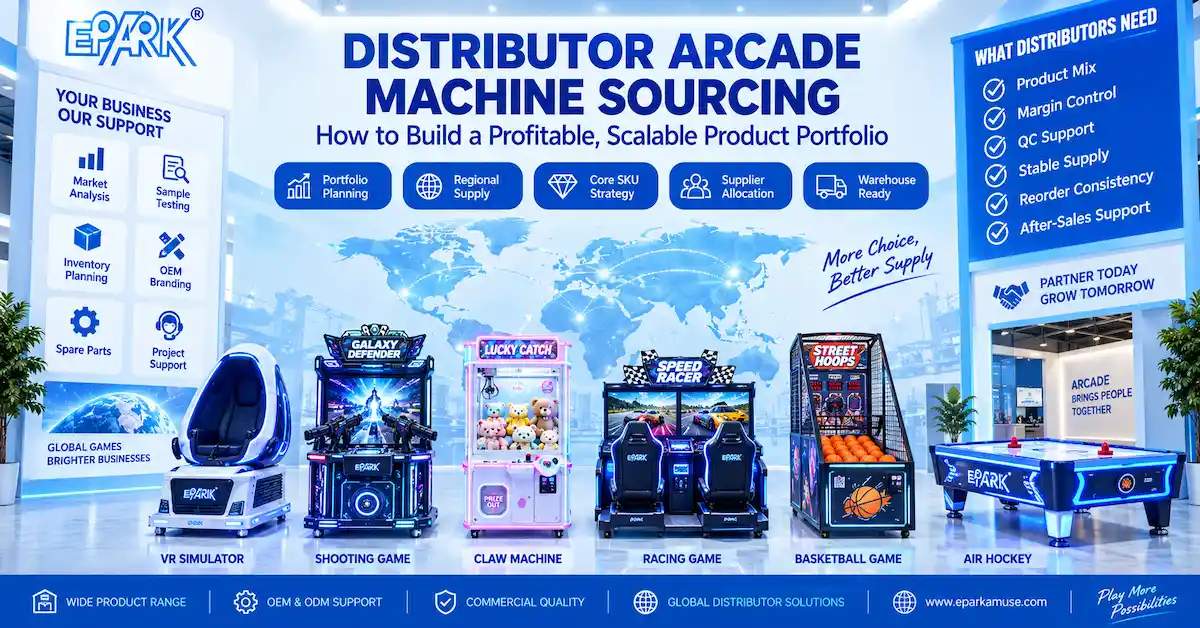
Distributor Arcade Machine Sourcing Starts With Your Market, Not the Factory Catalog
A distributor does not make money simply by buying arcade machines at wholesale prices.
The real business is selecting machines that local customers will buy, keeping the right products available, protecting enough margin to support sales and service, and knowing which models deserve repeat investment.
That makes distributor arcade machine sourcing a portfolio-management problem as much as a purchasing problem.
A factory may offer hundreds of arcade products. A distributor usually needs only a controlled subset that fits its:
- Customer base
- Regional entertainment market
- Selling price bands
- Warehouse capacity
- Technical service capability
- Cash-flow cycle
- Project pipeline
- Brand positioning
The wrong sourcing strategy often creates an impressive warehouse but a weak business: too many slow-moving machines, overlapping products, incompatible spare parts, insufficient margin, and capital locked into equipment that customers rarely request.
A better sourcing process begins downstream—with the distributor's customers—and works backward toward the factory.
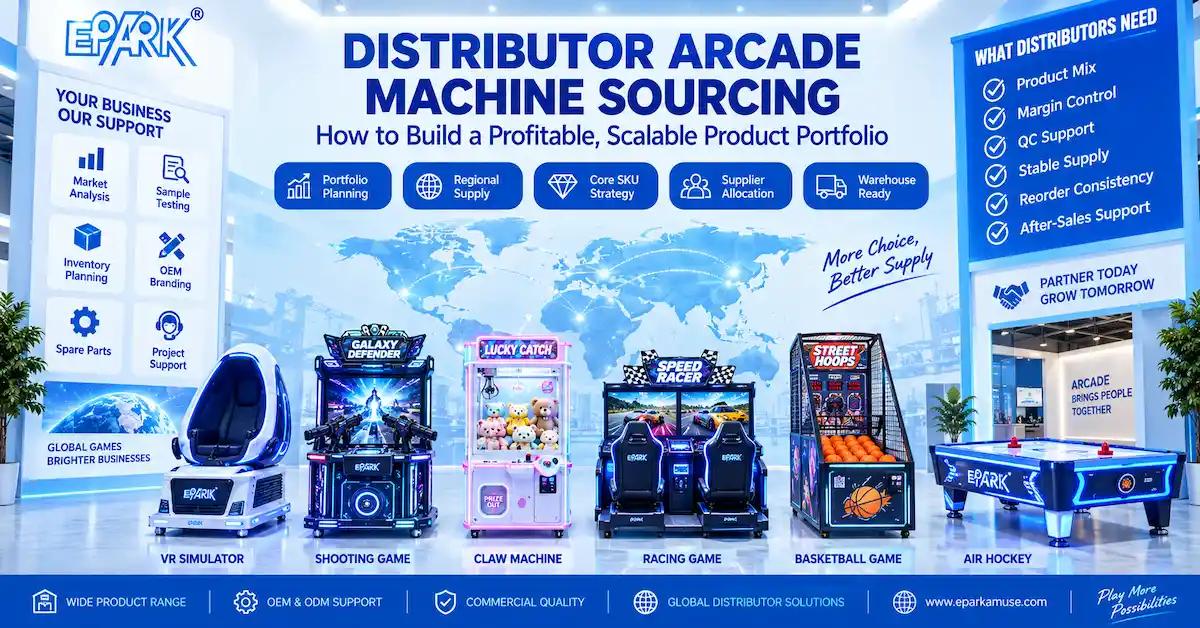
Distributors researching available commercial categories can use the EPARK Products range as a category reference before creating their own sourcing shortlist.
Why Distributor Sourcing Is Different From Ordinary Wholesale Purchasing
Wholesale purchasing answers:
How many machines can we buy, and at what price?
Distributor sourcing asks:
Which machines deserve a permanent place in our product portfolio?
That difference changes the decision process.
A Distributor Must Sell the Machine More Than Once
An arcade operator may buy a machine for one venue.
A distributor normally expects to:
- Demonstrate it
- Quote it repeatedly
- Sell it to different customers
- Stock or reorder it
- Supply replacement parts
- Troubleshoot it
- Potentially customize it
- Support it for several years
A machine that performs well in one installation can still be a poor distributor SKU if it is difficult to service, occupies too much warehouse space, or leaves insufficient margin after freight and support costs.
The Product Must Fit the Distributor's Business Model
A regional distributor supplying small shopping-mall arcades needs a different portfolio from a project company building 1,000 m² FECs.
The sourcing process should therefore begin by defining who the distributor sells to.
Map Your Customer Base Before Selecting Arcade Machines
Do not begin with machine categories.
Begin with customer segments.
Segment Buyers by Venue Type
A distributor may serve:
- Independent arcades
- Family entertainment centers
- Shopping malls
- Claw-machine stores
- Indoor playground operators
- Cinema entertainment areas
- Resorts and tourist attractions
- Arcade chains
- Event operators
- Project contractors
Each group buys differently.
A small mall operator may prioritize compact machines and manageable capital investment. A large FEC may need multiple categories and coordinated equipment planning.
Segment Buyers by Purchase Size
A useful model is:
Small accounts
Usually buy 1–5 machines.
Growth accounts
May purchase 5–20 machines during expansion.
Project accounts
Buy mixed equipment packages for new venues.
Chain accounts
Require standardization and repeatability across locations.
This segmentation helps determine which machines should be stocked and which should remain quotation-only products.
Build a Distributor SKU Architecture Before Choosing Suppliers
One of the biggest sourcing mistakes is treating every machine in the catalog as equally important.
A distributor should create different SKU roles.
| SKU Tier | Purpose | Inventory Strategy | Typical Examples |
|---|---|---|---|
| Core SKU | Regular customer demand | Keep available or reorder frequently | Claw, prize, basketball |
| Growth SKU | Expanding demand | Limited stock / monitored | Racing, shooting, sports |
| Project SKU | Large or customized orders | Order against confirmed project | VR, large simulator |
| Test SKU | New-market validation | Sample or very low quantity | New game concepts |
| Exit SKU | Declining demand | Stop replenishment | Outdated or overlapping models |
This prevents every new product from becoming permanent inventory.
Core SKUs Need Strong Repeatability
A core machine should usually offer:
- Broad customer appeal
- Predictable sourcing
- Manageable servicing
- Acceptable warehouse footprint
- Stable commercial margin
- Reasonable repeat-order lead time
Project SKUs Do Not Need Permanent Stock
Large racing systems, premium VR equipment, or specialized simulator products may make sense as project-order machines instead of warehouse inventory.
The distributor can still market them without tying up working capital.
Use a Demand Score Before Adding a New Arcade Machine
New products are easy to become excited about.
A distributor should require evidence before converting a new machine into a stocked SKU.
Create a simple scoring model.
| Evaluation Factor | Suggested Score |
|---|---|
| Customer inquiries | 0–5 |
| Existing project demand | 0–5 |
| Market differentiation | 0–5 |
| Expected margin | 0–5 |
| Warehouse efficiency | 0–5 |
| Serviceability | 0–5 |
| Spare-parts availability | 0–5 |
| Repeat-order potential | 0–5 |
A machine scoring well because it looks impressive but poorly on serviceability and actual inquiries should probably remain a project SKU.
Separate Customer Interest From Purchase Intent
Customers may say:
“That machine looks great.”
That is not the same as:
“Please quote four units for delivery next month.”
Use actual RFQs, project discussions, sales history, and customer requests as stronger sourcing signals.
Build a Product Ladder Instead of Selling Random Machines
A distributor portfolio becomes easier to sell when products form logical price and application tiers.
For example, racing machines can be structured as:
Entry-Level
Compact footprint, simpler configuration, lower investment.
Mid-Range
Better cabinet presence, larger display, stronger commercial features.
Premium
Multi-player, motion, or high-immersion configuration.
The same structure can be used for:
- Claw machines
- Basketball games
- Shooting games
- Kiddie rides
- VR equipment
- Redemption machines
This gives your sales team an easier conversation:
“Here are three options based on budget, venue size, and player experience.”
Instead of:
“Here are 27 racing machines. Which one do you want?”
Avoid Too Much Product Overlap
More products do not automatically create more sales.
If five machines serve almost the same buyer, price band, floor area, and gameplay need, the portfolio may be unnecessarily complex.
Overlapping SKUs create:
- More inventory
- More product training
- More spare parts
- More quotations
- More technical documentation
- More obsolete stock
Use the Substitution Test
Ask:
If this machine disappeared tomorrow, would another machine in our portfolio satisfy approximately the same customer need?
If yes, the new SKU needs a strong reason to exist.
That reason could be:
- Better margin
- Smaller footprint
- Stronger design
- Better serviceability
- Unique gameplay
- Different target market
- More competitive price tier
Otherwise, adding it may only fragment sales.
Create a Distributor Sourcing Brief for Every Product Family
Once the portfolio role is defined, build a sourcing brief before requesting quotations.
Commercial Requirements
Include:
- Target customer
- Expected resale range
- Desired margin
- Order quantity
- Expected annual volume
- Stock or project-order status
Product Requirements
Include:
- Machine category
- Approximate footprint
- Required functions
- Target player group
- Payment requirements
- Electrical requirements
Service Requirements
Include:
- Common replacement parts
- Technical documentation
- Remote support expectations
- Parts identification
- Expected parts lead time
Brand Requirements
If private labeling is required, add:
- Distributor SKU
- Logo
- Artwork
- Color
- Product labels
- Packaging identification
For deeper private-brand projects, use the principles in the OEM Arcade Machines for Distributors guide rather than mixing branding decisions into the basic sourcing discussion.
Single Supplier or Multiple Suppliers: Which Model Is Better for Distributors?
There is no universal answer.
The correct structure depends on portfolio breadth and purchasing scale.
One-Stop Supplier Model
A broader supplier may provide multiple categories.
Potential advantages include:
- Easier order consolidation
- Fewer commercial relationships
- Simpler logistics coordination
- More consistent communication
- Potential mixed-container purchasing
Potential disadvantage:
A single supplier may not be equally strong in every product category.
Specialist Supplier Model
A distributor may source racing equipment from one specialist and prize machines from another.
Potential benefits include:
- Deeper category expertise
- More model options
- Potentially stronger technical specialization
Potential disadvantages include:
- More POs
- More communication
- More shipments
- More parts systems
- More QC processes
Use a Hybrid Model
For many distributors, a practical approach is:
Primary supplier + selected specialist suppliers
The primary supplier covers most repeatable commercial categories.
Specialists are used where they offer a meaningful technical or commercial advantage.
Allocate Suppliers by Category, Not Emotion
Distributors often stay with a supplier because the relationship is convenient.
Relationships matter, but sourcing decisions should remain measurable.
Create a supplier allocation matrix.
| Category | Supplier A | Supplier B | Preferred Source |
|---|---|---|---|
| Claw Machines | Strong | Medium | A |
| Racing | Medium | Strong | B |
| Basketball | Strong | Strong | Dual |
| VR | Medium | Strong | B |
| Redemption | Strong | Medium | A |
This allows the distributor to maintain leverage and reduce concentration risk without creating unnecessary vendor complexity.
Use a Sample-to-Stock Gate for New Products
Do not move directly from:
“The factory sent photos”
to:
“Order 20 units.”
A better distributor sourcing process uses gates.
Gate 1: Commercial Screening
Does the machine solve a real customer need?
Gate 2: Technical Review
Can your team understand, operate, and support it?
Gate 3: Sample or First-Unit Review
Does the real machine match expectations?
Gate 4: Customer Validation
Can your sales team generate genuine interest or orders?
Gate 5: Stock Approval
Only after the first four gates should the model become a standard inventory SKU.
This process reduces speculative inventory.
Evaluate New Machines for Serviceability, Not Only Gameplay
Distributors carry after-sales responsibility in the customer's mind even when the factory manufactured the machine.
A product that is difficult to support can consume the margin earned from several successful sales.
Ask the Technical Team Before the Purchasing Team Commits
Before approving a new SKU, have technicians review:
- Access to electrical components
- Controller layout
- Common failure points
- Replaceable modules
- Wiring accessibility
- Payment-system access
- Screen replacement
- Sensors
- Motors
- Service instructions
Create a Service Complexity Score
For example:
1 — Easy
Local technician can diagnose common issues quickly.
3 — Moderate
Some machine-specific parts or knowledge required.
5 — Complex
Requires specialized factory support for common problems.
A premium machine may justify a higher complexity score.
A low-margin commodity machine usually should not.
Landed Margin Is More Important Than Factory Discount
Distributor purchasing decisions should use margin after realistic costs.
A simple framework is:
Expected Selling Price
– Factory Cost
– Freight Allocation
– Import Cost
– Warehouse Handling
– Sales Cost
– Warranty Reserve
= Contribution Margin
The factory price is only one line.
Include Freight by SKU
Large machines can consume disproportionate container space.
A machine with a low purchase price may generate a weak landed margin because of volume.
Include Warranty Reserve
A distributor should expect some after-sales activity.
That does not mean every machine will fail.
It means the commercial model should have enough margin to support the customer when service is required.
Do Not Compare Margin Percentage Alone
A smaller machine may have a high percentage margin but low absolute contribution.
A premium simulator may have a lower percentage but significantly more gross profit per sale.
A balanced portfolio needs both.
Use ABC Inventory Planning for Arcade Equipment
Not every SKU deserves the same stock level.
A-Class Products
Fast-moving, strategically important products.
These should receive:
- Frequent demand review
- Faster reorder decisions
- Higher availability targets
B-Class Products
Regular but less predictable demand.
Keep moderate stock or replenish based on pipeline.
C-Class Products
Low-frequency or project-specific machines.
Keep samples where commercially useful, but avoid unnecessary inventory.
This structure protects working capital.
Define Reorder Points Before Stock Runs Out
Do not wait until the final unit sells before ordering again.
A reorder point should consider:
Average demand during supplier lead time + safety stock
If a model sells two units per month and replenishment takes several weeks, waiting until zero inventory creates avoidable lost sales.
Use Pipeline Information
Arcade equipment distribution is often project-based.
Your CRM or sales pipeline can improve inventory planning.
A confirmed 20-machine project should influence purchasing more heavily than general website traffic.
Separate Showroom Inventory From Saleable Inventory
A distributor showroom has a different purpose from the warehouse.
Some premium machines may deserve showroom space even if they are not high-volume products.
Why?
Because they:
- Demonstrate product capability
- Help customers understand experience
- Improve showroom credibility
- Support project sales
- Upsell larger projects
Label these internally as demo assets, not ordinary stock.
Otherwise sales staff may accidentally quote equipment that cannot be delivered immediately.
Create a New Product Introduction Process
Distributors that constantly add products without a structured NPI process eventually create an unmanageable catalog.
A simple NPI process can be:
Stage 1 — Market Need
What customer problem does the machine solve?
Stage 2 — Supplier Shortlist
Which suppliers can provide it?
Stage 3 — Commercial Case
What is the expected selling price, margin, and annual demand?
Stage 4 — Technical Validation
Can your team support the machine?
Stage 5 — Sample Evaluation
Is the actual product acceptable?
Stage 6 — Launch
Prepare:
- SKU
- Pricing
- Photos
- Specifications
- Sales material
- Spare parts
- Service notes
Stage 7 — 90-Day Review
Review:
- Customer inquiries
- Quotes
- Sales
- Margin
- Technical issues
- Feedback
Then decide whether to expand, maintain, or discontinue the SKU.
Build a Sourcing Scorecard for Supplier Decisions
Supplier selection should combine commercial performance and operational support.
| Criterion | Weight Example |
|---|---|
| Product-market fit | 20% |
| Commercial competitiveness | 15% |
| Product consistency | 15% |
| Serviceability | 10% |
| Spare-parts support | 10% |
| Response quality | 10% |
| Production flexibility | 5% |
| Mixed-order capability | 5% |
| Logistics support | 5% |
| New-product support | 5% |
The exact weighting should match your business.
A distributor focused on commodity machines may weight cost more heavily.
A premium FEC supplier may prioritize technical reliability and service.
Measure Supplier Performance After the Order
Supplier qualification should not end when the purchase order is signed.
Track actual performance.
Useful KPIs include:
- On-time production
- Configuration accuracy
- Damage rate
- Missing-parts rate
- Warranty requests
- Technical response time
- Spare-parts availability
- Repeat-order consistency
This turns supplier selection into a data-based sourcing process.
Keep Sourcing and Sales Teams Connected
One of the easiest ways to create slow inventory is to separate purchasing decisions from sales feedback.
The sourcing team sees factories.
The sales team sees customers.
They need the same information.
Monthly Sourcing Review
A useful meeting can review:
- Top customer requests
- Lost sales reasons
- Fast-moving products
- Slow inventory
- New supplier models
- Upcoming projects
- Reorder requirements
- Product problems
This prevents sourcing from becoming supplier-driven rather than market-driven.
Build an Arcade Product Portfolio Around Customer Jobs
Instead of organizing only by machine type, consider what customers are trying to achieve.
“I Need Foot-Traffic Attraction”
Possible solutions:
- Large racing machines
- VR simulators
- High-visibility prize games
“I Need Compact Revenue Equipment”
Possible solutions:
- Claw machines
- Small redemption machines
- Compact skill games
“I Need Family Competition”
Possible solutions:
- Basketball
- Air hockey
- Racing
- Sports games
“I Need a Complete FEC Package”
The distributor may combine several categories and provide project-level sourcing.
This customer-job approach makes the portfolio easier to sell.
Where OEM Fits Into Distributor Sourcing
OEM should follow portfolio validation—not replace it.
Do not private-label a weak product simply because customization is available.
First prove:
- Customer demand
- Commercial margin
- Serviceability
- Supplier stability
- Repeat-order potential
Then consider brand investment.
For distributors already at that stage, the Private Brand Arcade Machines Wholesale guide covers branding and production-control issues in more detail.
Where Import and Shipping Control Fits
This article focuses on what distributors should source and how they should structure the portfolio.
Once the product has passed sourcing approval, importers still need to manage specification control, QC, packing, shipping, warehouse receiving, and repeat orders.
Those downstream controls are covered in the Arcade Machines Wholesale for Importers guide.
Keeping these topics separate creates a cleaner sourcing system:
Portfolio Decision → Supplier Selection → Product Validation → Purchase → Import Control → Distribution → Reorder
Common Distributor Arcade Machine Sourcing Mistakes
Sourcing What the Factory Wants to Sell
Factories naturally promote available or new models.
Better approach: source from customer demand backward.
Carrying Too Many Similar Machines
This fragments sales and working capital.
Better approach: give every SKU a clear role.
Buying Large Quantities Before Validation
A machine may look strong online but sell poorly locally.
Better approach: use sample-to-stock gates.
Ignoring Service Complexity
Support costs appear after the sale.
Better approach: technical team approval before permanent listing.
Evaluating Only Unit Cost
Cheap machines can create poor landed margins.
Better approach: calculate contribution margin.
Keeping Every Product Forever
A growing catalog eventually contains dead SKUs.
Better approach: perform regular portfolio reviews.
A Practical Quarterly Distributor Sourcing Review
Every quarter, classify each machine into four decisions.
Expand
Increase inventory or marketing because:
- Demand is strong
- Margin is healthy
- Service burden is acceptable
Maintain
Keep current strategy.
Correct
The machine is commercially useful but requires improvements such as:
- Better pricing
- Better parts
- Different supplier
- Improved configuration
Exit
Stop sourcing when:
- Sales remain weak
- Margin is inadequate
- Product overlap is high
- Technical problems consume too much support
This keeps the portfolio active rather than historical.
What Should a Distributor Send a Supplier Before Starting Sourcing?
A useful distributor sourcing brief should include:
- Target country or region
- Primary customer types
- Main venue applications
- Required arcade categories
- Target selling-price bands
- Expected annual volume
- Sample requirements
- Estimated first order
- Stock vs project-order strategy
- Payment-system requirements
- Technical service capability
- Spare-parts expectations
- Branding requirements if applicable
- Preferred shipping model
- Expected expansion categories
This provides much more useful information than simply requesting a complete catalog.
Distributors preparing a new sourcing program can review EPARK's commercial arcade equipment range and use the Contact Us page to submit their market, customer, category, quantity, and product-planning requirements.
Frequently Asked Questions
What Is Distributor Arcade Machine Sourcing?
Distributor arcade machine sourcing is the process of selecting, validating, purchasing, stocking, and managing commercial arcade equipment for resale or project supply. It includes portfolio planning, supplier selection, margin evaluation, serviceability, inventory policy, and repeat sourcing.
How Is Distributor Sourcing Different From Wholesale Buying?
Wholesale buying focuses mainly on purchasing quantity and commercial terms. Distributor sourcing also considers whether each product deserves a long-term place in the portfolio and can be sold, serviced, stocked, and reordered profitably.
How Many Arcade Machine Categories Should a Distributor Carry?
There is no universal number. A distributor should carry enough categories to serve its customer base without creating unnecessary inventory and service complexity. Portfolio roles are more important than catalog size.
Which Arcade Machines Should Distributors Keep in Stock?
Fast-moving, broadly applicable, serviceable machines with predictable demand are usually better stock candidates. Large specialized or customized equipment can often remain project-order products.
Should a Distributor Source From One Factory or Multiple Factories?
Either model can work. Many distributors benefit from a primary supplier for core categories combined with specialist suppliers where they provide a clear advantage.
How Should a Distributor Test a New Arcade Machine?
Use a staged process: commercial screening, technical review, sample evaluation, customer validation, and then stock approval. Avoid large first orders before the product has been validated.
How Should Distributors Calculate Arcade Machine Margin?
Calculate margin using landed cost and realistic sales/support costs rather than factory price alone. Include freight allocation, import expenses, handling, sales cost, and an appropriate service reserve.
How Often Should Arcade Distributor Inventory Be Reviewed?
Fast-moving products should be reviewed frequently. A broader formal portfolio review can be conducted quarterly to decide which products to expand, maintain, correct, or exit.
When Should a Distributor Use OEM Arcade Machines?
OEM makes the most sense after a product has demonstrated market demand and repeat-order potential. Branding an unvalidated product adds complexity without solving product-market fit.
How Can I Start a Distributor Arcade Machine Sourcing Program?
Define your target customers, venue types, preferred categories, selling-price bands, inventory model, sample requirements, expected volumes, and service capability. Review EPARK's arcade equipment portfolio, then contact EPARK with a structured distributor sourcing brief.
Conclusion
Effective distributor arcade machine sourcing is not about building the largest possible catalog. It is about creating a controlled portfolio in which every machine has a clear customer, price position, margin target, inventory role, service strategy, and sourcing path.
The strongest distributors work backward from local demand, validate new machines before stocking them, separate core SKUs from project products, calculate landed contribution margin, measure supplier performance, and remove products that no longer justify working capital or technical support. If you are building or restructuring an arcade distribution portfolio, explore the EPARK product range and contact EPARK with your target market, customer segments, product categories, expected volume, and sourcing priorities.
Disclaimer
The information provided on this website is for general informational purposes only.
While EPARK Arcade Game Machine Manufacturer strives to ensure accuracy and reliability, no warranties—express or implied—are made regarding completeness, performance, or applicability.
Product specifications, designs, and features may vary depending on usage, customization, and customer requirements.
Buyers are responsible for verifying all technical details, compliance certifications, and suitability before procurement.
EPARK shall not be held liable for any direct, indirect, incidental, or consequential damages arising from the use of this website or its content, including but not limited to business losses, data errors, or equipment misuse.
For tailored solutions or further verification, please visit our Contact Us
Intellectual Property Notice
All articles, product images, videos, catalogs, software, and related materials published on this website are the intellectual property of EPARK, unless otherwise stated.
Unauthorized reproduction, distribution, modification, or commercial use of any content is strictly prohibited without prior written consent from EPARK.
EPARK reserves the right to take legal action against any unauthorized use, including but not limited to copyright infringement, misrepresentation, or unfair competition.
Trademarks
The name EPARK, the EPARK logo, and all related brand elements displayed on this website are registered trademarks or trade names of Guangzhou EPARK Electronic Technology Co., Ltd.
Other product names, company names, or logos mentioned on this site may be trademarks of their respective owners.
Unauthorized use of EPARK's trademarks for commercial purposes, including advertising, promotions, or product packaging, is strictly prohibited.
Governing Law
These terms are governed by the laws of the People's Republic of China.