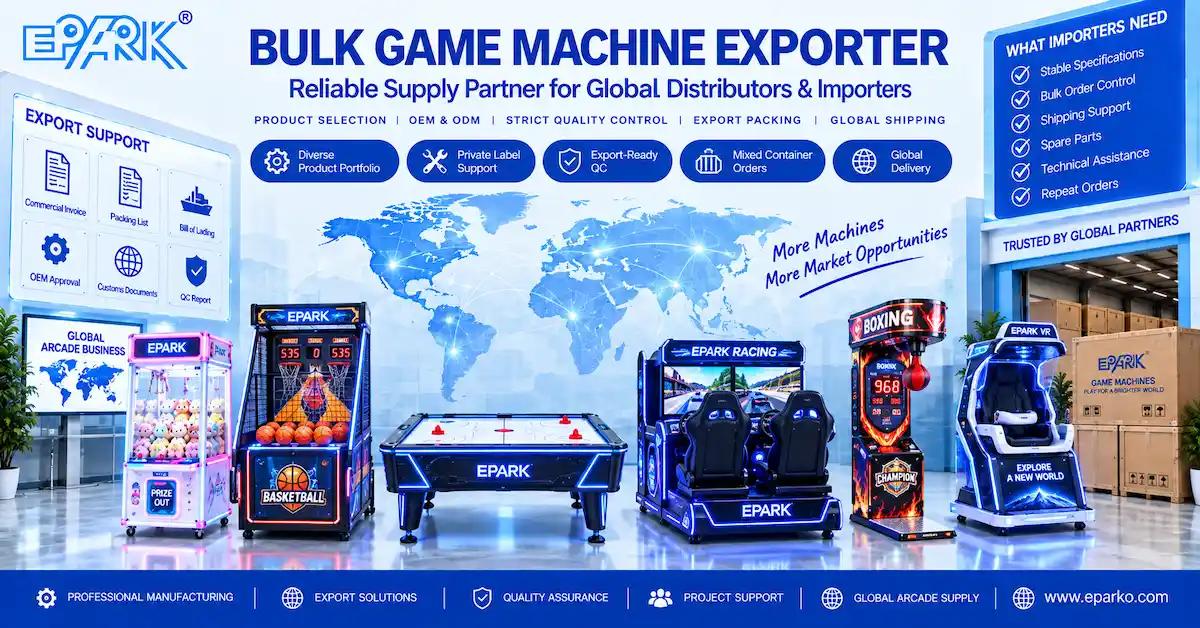


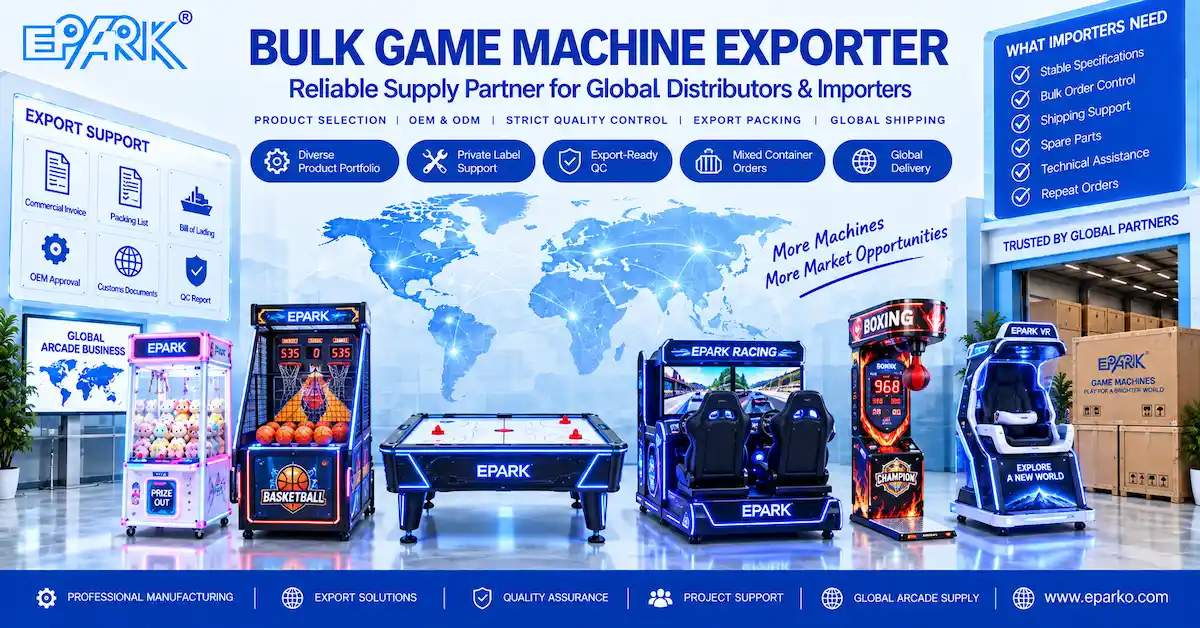
A Bulk Game Machine Exporter Should Support a Business Model, Not Just a Shipment
For a B2B buyer, the value of a bulk game machine exporter is not measured only by how many cabinets can fit into a container.
The more important question is whether those machines can become a manageable commercial product line after they arrive.
An importer may need to:
- Sell machines to multiple arcade operators
- Supply new FEC projects
- Keep selected models in stock
- Provide replacement parts
- Train local technicians
- Quote repeat customers quickly
- Reorder successful models
- Maintain a private-label product range
A shipment can therefore be technically successful—it arrives on time and without visible damage—while still being commercially difficult.
For example, an importer may discover that the order contains too many low-demand models, several incompatible payment configurations, difficult-to-stock spare parts, or machines whose landed cost leaves too little distributor margin.
That is why buyers should evaluate exporters around one central objective:
Can this supplier help us build an arcade equipment program that remains sellable, supportable, and repeatable after the first order?
Buyers can first review the available EPARK product categories and map potential machines against the customer segments they already serve.
Start With Portfolio Architecture Before Asking for a Bulk Price
Many wholesale inquiries begin with:
Send me your best price for 20 or 40 machines.
A better first step is deciding what role each machine should play in the buyer's portfolio.
Divide Machines by Commercial Function
An importer does not need twenty unrelated bestsellers.
A more controlled portfolio can be divided into several functions.
| Portfolio Role | Typical Equipment | Commercial Purpose |
|---|---|---|
| Traffic Driver | Claw, prize, visually bright machines | Attract attention |
| Competitive Play | Racing, basketball, air hockey | Group and repeat play |
| Premium Experience | VR, large simulator | Higher experience value |
| Family Product | Kiddie rides, simple games | Broader age coverage |
| Redemption Product | Ticket/prize games | Support reward systems |
| Compact Product | Smaller arcade cabinets | Small venues and dealers |
This approach helps an importer build a catalog rather than accumulate SKUs.
Match Products to Customer Channels
Different customers may need different machines.
A distributor selling mainly to shopping malls may require more claw, gift, kiddie, and compact amusement products.
A supplier serving large FEC operators may need more sports games, racing machines, redemption equipment, VR, and multiplayer attractions.
The wholesale product mix should therefore begin with:
Who buys from us? → What venue do they operate? → What machine categories solve their needs?
That sequence is more useful than ordering whatever the exporter currently promotes most heavily.
Evaluate Whether Each Machine Is Import-Friendly
A machine can be attractive inside a factory showroom but still be inefficient for international distribution.
Before adding a model to a bulk order, evaluate its importability.
Ask Five Questions for Every Model
- Is there clear demand for it?
- Is the landed cost commercially workable?
- Can it be transported efficiently?
- Can local technicians support it?
- Can the same configuration be reordered?
A model that fails several of these questions may not belong in a distributor portfolio.
Consider Warehouse Efficiency
Importers should think beyond the shipping container.
Ask:
- How much warehouse floor space does the machine occupy?
- Can it be moved with available equipment?
- Does it require partial assembly?
- Are seats or headers packed separately?
- Can accessories become separated from the cabinet?
- How easily can the machine be demonstrated before resale?
These questions affect the real operating cost of wholesale arcade equipment.
Normalize Supplier Quotations Before Comparing Prices
Bulk quotations often look comparable when they are not.
Supplier A may quote only the basic cabinet.
Supplier B may include an upgraded payment system, accessories, OEM artwork, spare parts, and stronger export packing.
Comparing only the unit-price column can therefore lead to the wrong purchasing decision.
Build a Quote Normalization Sheet
Compare the same fields for every candidate.
| Quotation Field | What to Record |
|---|---|
| Machine Model | Exact model/version |
| Quantity | Units per model |
| Electrical Setup | Voltage/frequency/plug |
| Payment Configuration | Included system |
| OEM Scope | Logo/artwork/labels |
| Accessories | Included items |
| Spare Parts | Included or additional |
| Packaging | Standard/export method |
| Packed Volume | CBM/package information |
| Commercial Term | EXW/FOB/CIF etc. |
| Documentation | Included scope |
| Service | Technical/after-sales scope |
Only after these fields are aligned should buyers compare total price.
Calculate Landed Margin, Not Factory Discount
For importers, a machine needs enough commercial room between landed cost and expected resale value.
A simplified calculation is:
**Supplier Price
- OEM Cost
- Export Packing
- Freight
- Import Charges
- Local Delivery
- Warehouse Handling
- Service Reserve
= Landed Commercial Cost**
Then compare this figure with realistic distributor or project selling prices.
A factory discount is not useful if logistics or servicing eliminate the margin.
Use Mixed Orders Strategically Instead of Maximizing SKU Count
One benefit of working with a bulk game machine exporter is the ability to combine different equipment categories.
But more variety is not always better.
First Orders Should Produce Market Data
For a new product line, the objective of the first mixed order should be to learn:
- Which models generate inquiries
- Which machines sell faster
- Which categories require more service
- Which machines customers request again
- Which products occupy too much warehouse space
- Which configurations produce the best margin
A mixed shipment should generate commercial evidence for the next purchase.
Avoid One-Unit-of-Everything Purchasing
A container containing one machine from twenty different technical platforms can create excessive service complexity.
The importer may need:
- Twenty parts lists
- Different payment configurations
- Different controllers
- Different technical instructions
- Different repair knowledge
A more scalable approach is to build several product families with some technical consistency.
Define Acceptance Criteria Before Production Finishes
Buyers often wait until pre-shipment inspection to decide what should be checked.
That is too late.
Acceptance criteria should be defined when the order is approved.
Product Acceptance
For each applicable model, define what must match:
- Approved machine identity
- Cabinet configuration
- Agreed appearance
- Payment setup
- Electrical version
- Language
- Accessories
- Branding
Functional Acceptance
Instead of simply requesting “QC,” define important operational functions.
For example:
Racing Equipment
Check steering, pedals, display, seats, game controls, audio, lighting, and applicable multiplayer functions.
Claw Equipment
Check claw movement, controls, prize mechanism, lighting, payment configuration, and cabinet operation.
Sports Machines
Check sensors, scoring, controls, ball return or related mechanisms where applicable.
Commercial Acceptance
A complete B2B inspection should also answer:
- Is the correct quantity finished?
- Does each machine match the PO?
- Are accessories accounted for?
- Are spare parts identified?
- Are OEM elements correct?
- Can packages be traced to models?
These checks reduce problems that do not appear during a simple power-on test.
Treat Export Packaging as an Inventory-Control System
Packing protects machines, but for importers it should also organize them.
This is especially important for mixed-model orders.
Every Package Should Have an Identity
A useful package identification system can connect:
Purchase Order → Importer SKU → Factory Model → Package Number
For example:
PO-026 / RAC-02 / Factory Model X / Package 1 of 2
The exact format can vary, but the principle is valuable.
Separate Machine Parts From General Spare Parts
Imagine an importer receives several containers containing racing machines, claw machines, sports games, and redemption equipment.
A box labeled:
Accessories
creates unnecessary work.
A more useful system identifies:
- Machine
- Part
- Quantity
- Package
- Destination if required
This makes receiving and installation more efficient.
Build Warehouse Receiving Into the Export Plan
International sourcing is not finished when the container leaves the port.
The next operational stage begins when the shipment reaches the buyer.
Prepare a Receiving Checklist
The warehouse team should know:
- Expected container
- Package count
- Machine list
- Package identification system
- Which machines are partially disassembled
- Where accessories are packed
- Where spare parts are packed
- What visible damage must be recorded
Photograph Before Moving Damaged Packages
If a package shows impact, punctures, water exposure, or unusual deformation, document it before removing all packing.
This creates clearer receiving records.
Reconcile Quantity Immediately
Do not wait until machines are sold to discover that a control panel, seat assembly, cable, or accessory is missing.
Compare received items with the packing information soon after arrival.
A supplier's export ability should therefore be evaluated partly by how easy the shipment is to receive and reconcile.
Serviceability Should Influence Product Selection
One of the biggest differences between a venue buyer and an importer is who receives the first service call.
For a local distributor, the customer usually calls the distributor.
That makes serviceability a purchasing factor.
Ask Whether Common Components Are Accessible
Technicians may need to access:
- Controllers
- Payment devices
- Displays
- Buttons
- Sensors
- Power components
- Lighting components
- Mechanical assemblies
Machines that are unnecessarily difficult to service can create higher after-sales costs.
Create Three Spare-Part Priorities
Priority A — Downtime-Critical
Low-cost components that can stop the machine from operating.
Priority B — Wear Items
Parts more likely to require replacement through normal commercial use.
Priority C — Low-Frequency / High-Value
More expensive parts that may not need to be stocked in high quantity.
This is more useful than purchasing one generic “free spare-parts box.”
Buyers can review common purchasing and support questions through the EPARK FAQ page.
Use OEM to Build a Product Family, Not Just Add Logos
Private labeling becomes more valuable when several machines look like they belong to the same distributor program.
Standardize Visual Elements
A distributor may standardize:
- Logo treatment
- Main colors
- Product labels
- Header styling
- Packaging marks
- SKU format
This can make a mixed product portfolio easier to market.
Separate Brand Identity From Machine Identity
A buyer might sell a machine as:
Brand Series R200
while the exporter identifies it using a different factory model.
Both references should remain connected.
This helps with:
- Reorders
- Spare parts
- Technical questions
- Warranty discussions
- Warehouse records
Maintain an OEM Master Record
For every private-label product, store:
Internal SKU + Exporter Model + Artwork Revision + Configuration
This prevents a distributor from becoming dependent on employee memory.
Evaluate Documentation as Data Consistency
Import buyers often ask:
Can you provide export documents?
The stronger question is:
Will the commercial, packing, and shipment information remain consistent across the whole order?
A document can exist and still contain incorrect or inconsistent information.
Cross-Check Key Fields
Before shipping, verify applicable:
- Buyer information
- Consignee information
- Product descriptions
- Quantities
- Package counts
- Values
- Weights
- Shipping references
The importer should also independently confirm destination-specific customs and compliance requirements.
An exporter can supply documentation, but the importer remains responsible for understanding what the destination market requires.
Measure Exporter Performance After Every Shipment
Supplier evaluation should continue after the first order.
A simple scorecard makes repeat purchasing more objective.
| KPI | Question |
|---|---|
| Specification Accuracy | Did machines match the approved configuration? |
| First-Pass QC | How many issues were found before shipment? |
| Packing Accuracy | Were packages and accessories clearly identified? |
| Document Accuracy | Were shipment records correct? |
| Delivery Reliability | Was the agreed schedule reasonably maintained? |
| Receiving Accuracy | Were quantities complete? |
| Parts Response | Could replacement parts be identified quickly? |
| Technical Response | Were service questions handled effectively? |
| Repeat Consistency | Did the next batch match the previous one? |
This turns supplier management into a measurable process.
Do Not Judge Only the First Order
Factories often give a new customer's first order significant attention.
Long-term supplier quality is better measured by what happens on:
- Order 2
- Order 3
- Product updates
- Urgent spare-parts requests
- Specification changes
- Customer complaints
Consistency is more valuable than one excellent shipment.
What Does an Export-Ready Supplier Look Like?
A strong exporter should make the buying process easier to control.
Look for evidence that the supplier can support:
- Clearly defined machine models
- Commercial product selection
- Mixed-category orders
- Destination configuration
- OEM/private label programs
- Pre-shipment acceptance
- Package identification
- Shipment data
- Spare-parts traceability
- Repeat-order records
Reviewing the supplier's company structure through About EPARK can be part of this due-diligence process.
Red Flags That Matter Specifically to Bulk Export Buyers
Some warning signs become more serious when order quantity increases.
Too Many Verbal Confirmations
If critical configurations exist only in chat history, order control is weak.
No Clear SKU or Model System
If the supplier struggles to identify which version was previously shipped, repeat orders may become difficult.
Freight Information Arrives Too Late
Importers should not discover basic package volume only after production is finished.
Spare Parts Cannot Be Linked to Models
This creates service problems as inventory grows.
Every Repeat Order Requires Full Re-Explanation
A long-term exporter should gradually accumulate usable order history.
Product Changes Are Not Communicated
Silent component or configuration changes can create multiple service versions inside one distributor's market.
What Should a Professional Bulk RFQ Contain?
A strong RFQ should describe the intended business program, not simply ask for “best price.”
Include:
Buyer Information
- Importer / distributor / operator
- Destination market
- Main customer segments
Portfolio Requirement
- Desired machine categories
- Approximate model count
- Quantity range
- Products already selling in the market
Commercial Requirements
- Target order size
- Preferred trade term
- Destination
- Expected purchasing frequency
Configuration Requirements
- Electrical configuration
- Payment preference
- Language requirements
- OEM requirements
Operational Requirements
- Spare-parts expectations
- Documentation needs
- Packaging requirements
- Warehouse constraints if important
A well-prepared RFQ allows the exporter to recommend a more commercially relevant machine mix rather than simply returning a price sheet.
Frequently Asked Questions
What Is a Bulk Game Machine Exporter?
A bulk game machine exporter supplies commercial amusement and arcade equipment for overseas importers, distributors, chains, FEC projects, and wholesale buyers, while supporting international order preparation and shipment.
How Is a Bulk Exporter Different From a Normal Arcade Supplier?
Bulk export buyers usually require more structured support around product portfolios, mixed orders, configuration records, OEM programs, shipping data, packaging, parts, and repeat orders.
Should Importers Choose the Lowest-Priced Exporter?
Not necessarily. Buyers should evaluate landed margin, product demand, shipping efficiency, serviceability, parts availability, and repeat-order consistency in addition to factory price.
Can Different Game Machines Be Combined in One Shipment?
Depending on machine dimensions, quantities, packaging, and supplier terms, mixed shipments may be possible. Buyers should evaluate whether the combination is commercially and logistically efficient.
What Information Should Appear on Export Packages?
The exact format varies, but package identification should allow the receiving team to connect packages with the relevant order, machine, accessories, or parts.
How Many Arcade Models Should a Distributor Import First?
There is no universal number. A controlled product portfolio with enough variety to test demand—but not so many models that inventory and service become difficult—is usually more useful than maximum variety.
What Is the Best Way to Compare Bulk Arcade Quotations?
Normalize model configuration, OEM scope, accessories, spare parts, packing, shipping terms, documentation, and service before comparing the final commercial cost.
Why Is Serviceability Important for Importers?
Importers or distributors often become the first point of contact for local customers. Machines that are easier to diagnose and support can reduce long-term service cost.
How Should Private-Label Arcade Machines Be Managed?
Connect every private SKU to the exporter's factory model, technical configuration, and approved artwork revision so future parts and repeat orders remain traceable.
How Can Buyers Request a Bulk Export Proposal?
Prepare your market, customer type, preferred machine categories, quantities, configuration, OEM requirements, destination, and purchasing plan, then submit the project through the EPARK contact page.
Conclusion
A dependable bulk game machine exporter should help a buyer create an import-ready product system—not simply ship more machines. Portfolio fit, landed margin, mixed-order strategy, receiving efficiency, serviceability, OEM traceability, and repeat-order consistency all affect whether the wholesale program can scale.
Before requesting final pricing, define how the machines will be sold, stocked, serviced, and reordered. Then use the EPARK products page and contact page to build a sourcing request around your actual market and distribution model.
Disclaimer
The information provided on this website is for general informational purposes only.
While EPARK Arcade Game Machine Manufacturer strives to ensure accuracy and reliability, no warranties—express or implied—are made regarding completeness, performance, or applicability.
Product specifications, designs, and features may vary depending on usage, customization, and customer requirements.
Buyers are responsible for verifying all technical details, compliance certifications, and suitability before procurement.
EPARK shall not be held liable for any direct, indirect, incidental, or consequential damages arising from the use of this website or its content, including but not limited to business losses, data errors, or equipment misuse.
For tailored solutions or further verification, please visit our Contact Us
Intellectual Property Notice
All articles, product images, videos, catalogs, software, and related materials published on this website are the intellectual property of EPARK, unless otherwise stated.
Unauthorized reproduction, distribution, modification, or commercial use of any content is strictly prohibited without prior written consent from EPARK.
EPARK reserves the right to take legal action against any unauthorized use, including but not limited to copyright infringement, misrepresentation, or unfair competition.
Trademarks
The name EPARK, the EPARK logo, and all related brand elements displayed on this website are registered trademarks or trade names of Guangzhou EPARK Electronic Technology Co., Ltd.
Other product names, company names, or logos mentioned on this site may be trademarks of their respective owners.
Unauthorized use of EPARK's trademarks for commercial purposes, including advertising, promotions, or product packaging, is strictly prohibited.
Governing Law
These terms are governed by the laws of the People's Republic of China.