
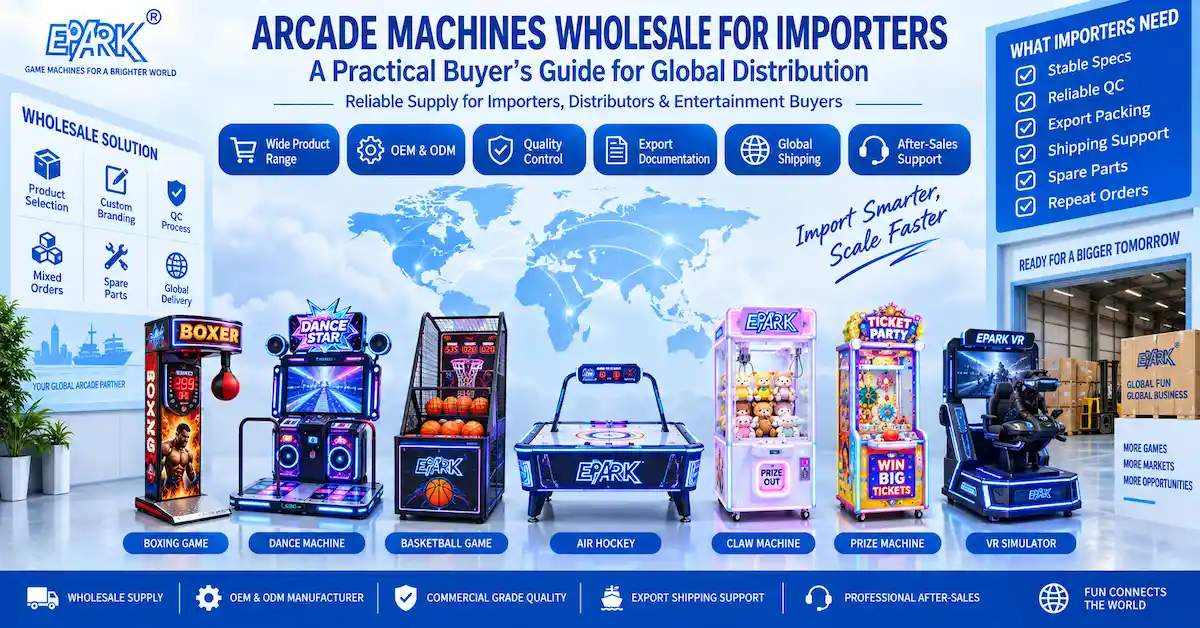
What Should Importers Know Before Buying Arcade Machines Wholesale?
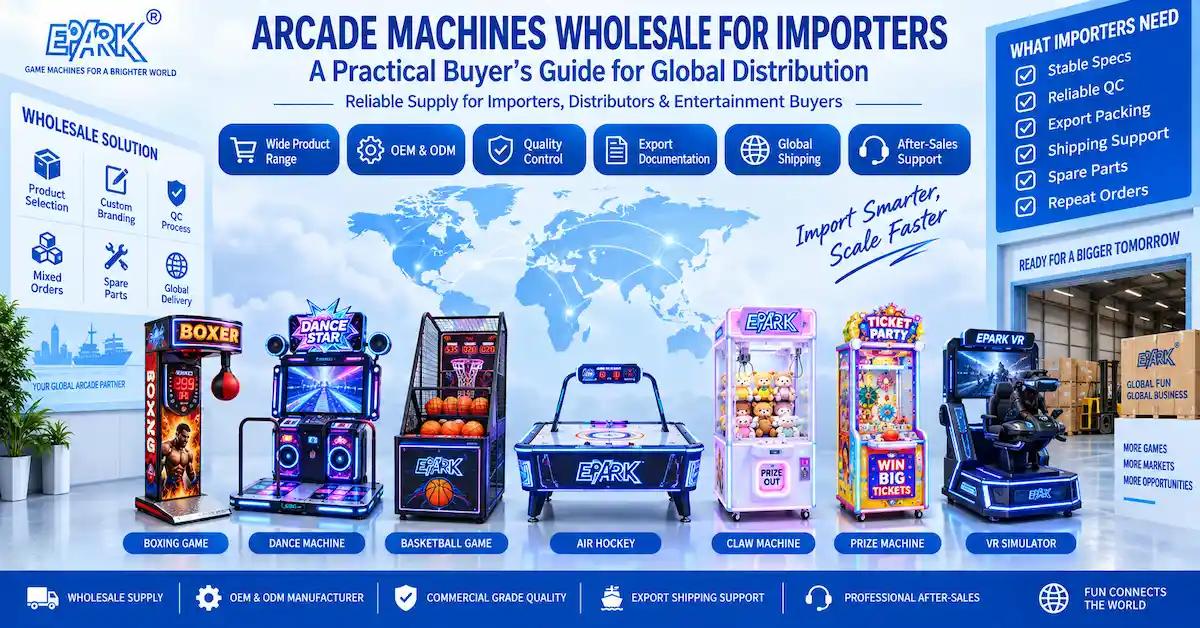
Buying arcade machines wholesale for importers is fundamentally different from purchasing several machines for one local arcade.
An importer is building a supply chain.
The equipment may arrive at a warehouse, be resold to several operators, installed in different venues, customized under a private brand, or reordered months later. That means the purchasing decision has to cover far more than cabinet appearance and initial unit price.
A reliable wholesale order should connect:
Market Demand → Machine Selection → Specification Control → Commercial Terms → Production → QC → Export Packaging → Shipping → Warehouse Receiving → Spare Parts → Repeat Orders
If any stage is poorly defined, the importer may face problems after the machines reach the destination market.
These can include incompatible voltage, incorrect payment systems, inconsistent machine revisions, damaged packaging, unidentified spare parts, missing accessories, difficult customer support, or repeat orders that no longer match the original batch.
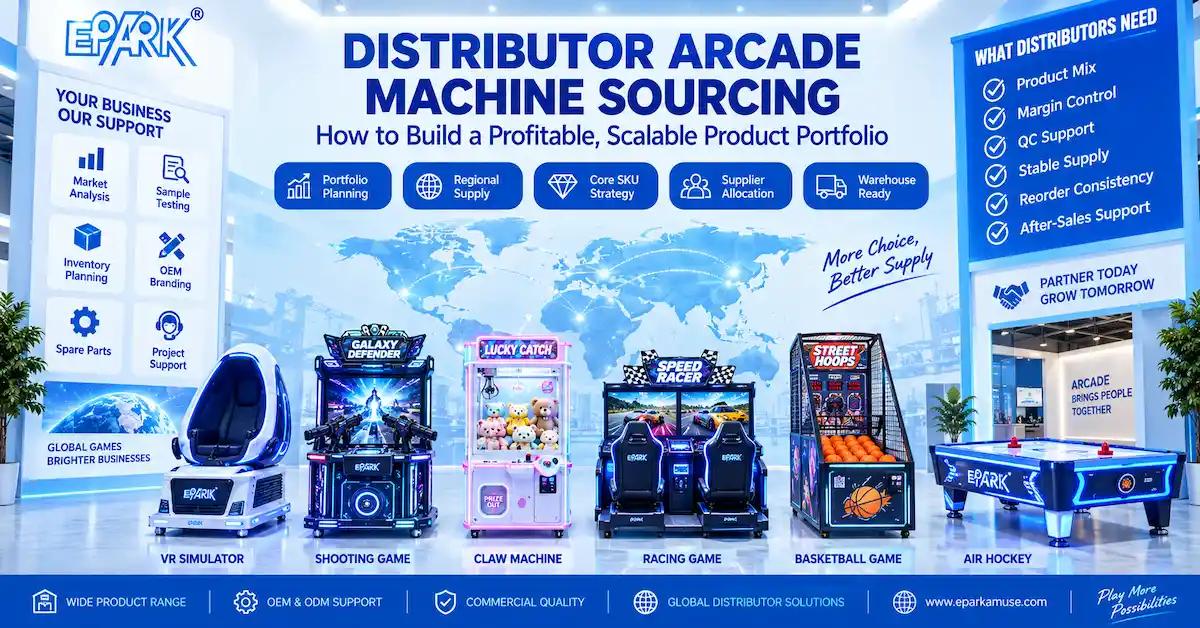
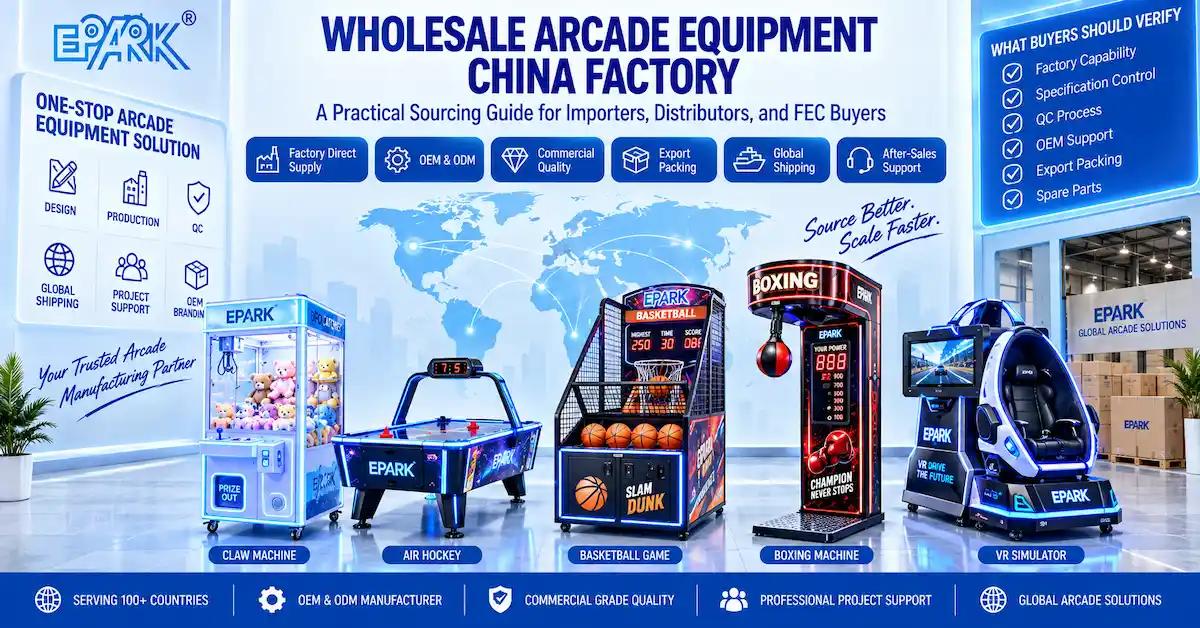
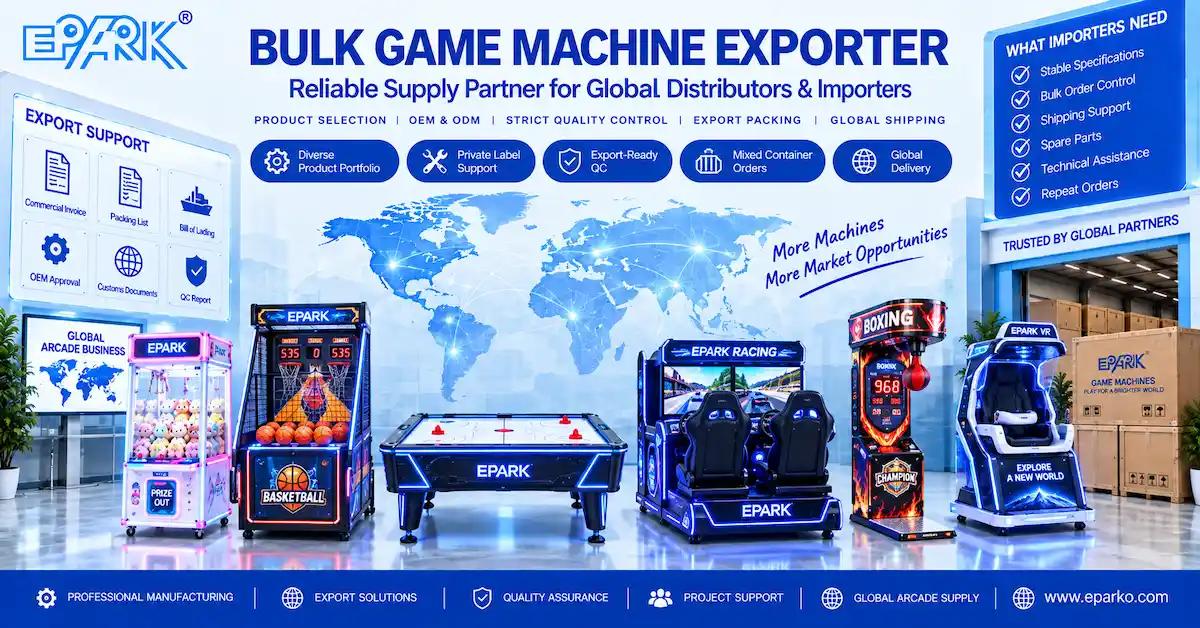
Importers can first review the current EPARK commercial arcade machine range to identify suitable equipment categories before building a wholesale purchasing plan.
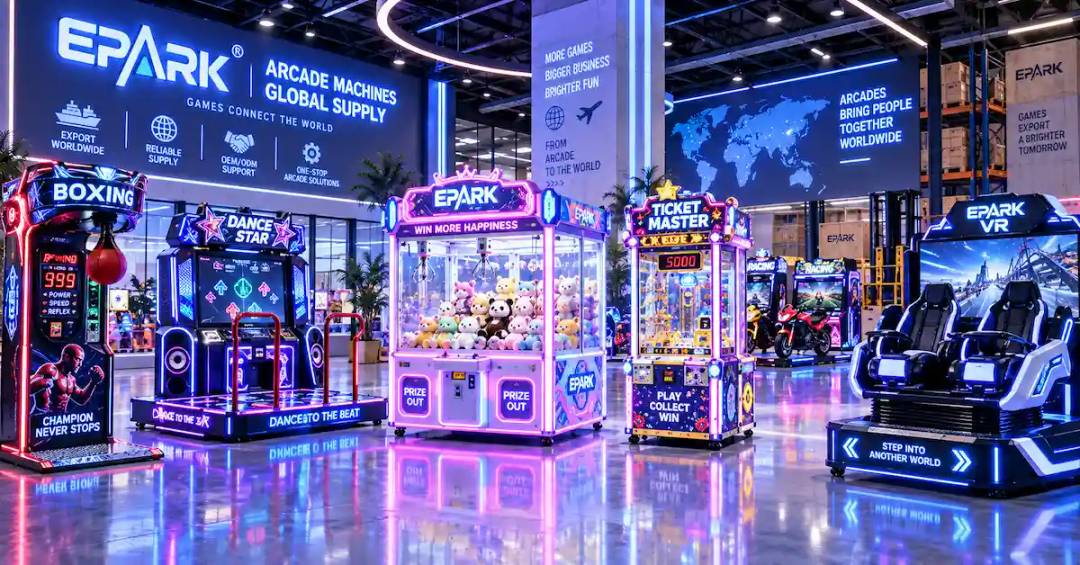
Why Importers Need a Different Arcade Machine Sourcing Strategy
A venue operator normally asks:
Which games should I put in my arcade?
An importer needs to ask a broader question:
Which machines can I repeatedly import, warehouse, sell, support, and reorder profitably in my market?
That difference changes how products should be evaluated.
Importers Need Repeatable Specifications
A machine that sells well once is useful.
A machine that can be reproduced with the same configuration across multiple shipments is much more valuable to a distributor or importer.
Important items should therefore be documented rather than remembered informally.
These may include:
- Factory model
- Cabinet revision
- Dimensions
- Voltage and frequency
- Plug type
- Payment configuration
- Display specification
- Controller configuration
- Software or game version where relevant
- Language setting
- Artwork revision
- Accessories
- Spare-parts list
- Packaging configuration
Importers Need Products They Can Support Locally
Your customer may contact you rather than the factory when a component fails.
Before importing a machine, ask whether your team can reasonably identify and replace common service parts.
A visually attractive machine can become a difficult wholesale product if every minor repair requires long troubleshooting with the manufacturer.
Importers Need a Portfolio, Not Random Bestsellers
Wholesale purchasing should build a product line around customer demand.
It should not simply copy a factory's bestseller list.
Which Arcade Machines Make Sense for an Importer Portfolio?
A balanced importer portfolio usually covers several commercial use cases.
| Machine Category | Typical Buyer Demand | Importer Consideration |
|---|---|---|
| Claw Machines | Malls, arcades, gift venues | Prize size, cabinet size, claw settings, payment |
| Redemption Games | FECs, arcade centers | Ticket/reward mechanism, spare parts |
| Racing Simulators | Teens, adults, FECs | Screen, steering, pedals, seats, linkage |
| Basketball Games | FECs, sports zones | Frame, scoring system, balls, sensors |
| Shooting Games | Arcades, FECs | Controls, sensors, display, software |
| Air Hockey | Family venues | Table size, blower/system parts, accessories |
| VR Machines | Premium entertainment areas | Hardware configuration, content, service |
| Kiddie Rides | Family and children's venues | Control system, structure, maintenance |
| Prize Machines | Malls and game centers | Prize mechanism, payment, lighting |
| Compact Games | Small venues and resellers | Warehouse efficiency and shipping volume |
Different regions require different inventory strategies.
A market dominated by shopping mall entertainment may favor claw and prize machines. An FEC-focused market may need racing, basketball, redemption, sports, and family-oriented machines.
Before building inventory, importers should map each product to a real buyer group.
How Should Importers Build the First Wholesale Order?
The first order should test both products and supplier processes.
Ordering too many models can create complexity before the importer understands local demand, service requirements, and parts usage.
Start With Core Categories
A practical initial portfolio might include several machine types with different commercial functions:
- Attraction-oriented machines
- Prize or redemption equipment
- Competitive games
- Family games
- Premium simulator products
- Compact machines
This gives the importer more information about what local operators actually request.
Avoid Too Many Unique Configurations
If every machine uses a completely different payment device, controller, monitor, power component, or spare-parts system, warehouse and after-sales management becomes unnecessarily complicated.
Where possible, standardize common configurations across the portfolio.
Review Mixed-Model Ordering Before Confirming Quantity
Ask the supplier:
- Which machines can be combined in one order?
- What is the MOQ by model?
- Can different categories share one shipment?
- How will cartons or machines be identified?
- Can spare parts be packed separately?
- What is the estimated shipping volume?
The purpose is to build an order that makes sense after it reaches your warehouse—not only at the factory.
For broader wholesale purchasing considerations, review the Arcade Game Machine Wholesale Buying Guide.
What Specifications Should Be Confirmed Before Production?
A product name alone is not a purchasing specification.
“Racing machine,” “claw machine,” or “basketball game” leaves too many variables undefined.
Importers should use a specification confirmation sheet for each model.
Basic Machine Information
Confirm:
- Product name
- Factory model number
- Quantity
- Dimensions
- Net/gross weight if available
- Power requirements
- Machine version
- Included accessories
Electrical Configuration
Confirm the requirements of your destination market.
Important fields can include:
- Voltage
- Frequency
- Plug
- Power cord
- Power supply
- Fuse or breaker specification where relevant
Do not assume the machine will automatically be configured for your country.
Payment Configuration
Commercial arcade equipment may operate with different payment methods.
Depending on the project, buyers may need to confirm:
- Coin acceptor
- Token system
- Card system
- Cashless interface
- QR-related integration
- Free-play mode
The quotation should state what is actually included.
Language and Software
For machines with software-driven content, confirm the applicable:
- Game version
- Interface language
- Settings
- Included content
- Update method where relevant
Software assumptions should be resolved before production rather than after customs clearance.
Why Configuration Control Matters for Repeat Orders
One of the most important importer risks appears on the second order, not the first.
Suppose an importer sells 30 machines successfully.
Six months later, another batch is ordered.
The cabinet looks the same—but a controller, payment module, screen, wiring arrangement, or software version has changed.
The importer may now have two visually identical products requiring different spare parts.
That increases warehouse and service complexity.
Build a Repeat-Order Record
For every private SKU or imported model, retain:
- Supplier model
- Internal importer SKU
- Approved configuration
- Artwork version
- Payment configuration
- Electrical configuration
- Spare-parts references
- Production batch
- Changes between orders
This creates traceability.
Require Change Notification
If a component or specification needs to change, the importer should know before production whenever possible.
Ask:
Has anything changed from our previous order?
That one question can prevent many downstream service problems.
EPARK's OEM Arcade Machines for Distributors guide provides additional context on linking branding, configuration, spare parts, and repeat orders.
How Should Importers Evaluate Wholesale Pricing?
Importers should not compare quotations based only on the machine unit price.
The more useful figure is landed commercial cost.
Factory Price Is Only the First Layer
Depending on the Incoterm and order structure, other costs may include:
- OEM customization
- Packaging
- Spare parts
- Inland transport
- Export-related charges
- International freight
- Insurance
- Import duties
- Taxes
- Port or terminal charges
- Customs brokerage
- Local delivery
- Warehouse handling
- Commissioning or technical work
A lower unit price can still create a higher landed cost.
Compare the Same Commercial Scope
Use a quotation comparison sheet.
| Cost Item | Supplier A | Supplier B | Supplier C |
|---|---|---|---|
| Machine configuration | Confirm | Confirm | Confirm |
| OEM artwork | Included? | Included? | Included? |
| Payment system | Confirm | Confirm | Confirm |
| Accessories | Confirm | Confirm | Confirm |
| Spare parts | Confirm | Confirm | Confirm |
| Export packing | Confirm | Confirm | Confirm |
| Freight scope | Incoterm | Incoterm | Incoterm |
| Documents | Confirm | Confirm | Confirm |
| Technical support | Confirm | Confirm | Confirm |
| Warranty/after-sales | Confirm | Confirm | Confirm |
Do not compare three prices when the suppliers are actually quoting three different products.
How Should Importers Control Quality Before Shipment?
For an importer, finding a defect after arrival is much more expensive than identifying it before loading.
A useful QC process should verify the machine against the approved specification.
Functional Checks
Depending on machine type, inspection may include:
- Power-on operation
- Display
- Audio
- Controls
- Buttons
- Joystick
- Steering
- Pedals
- Sensors
- Score system
- Lighting
- Ticket or prize mechanism
- Payment device
- Moving mechanism
- Safety-related covers
Configuration Verification
QC should also confirm that the correct version was produced.
Check:
- Voltage
- Plug
- Language
- Artwork
- Logo
- Payment system
- Accessories
- Quantity
- Spare parts
Cosmetic Inspection
Commercial machines are visual products.
Check:
- Cabinet finish
- Graphics
- Screen condition
- Lighting
- Decorative panels
- Seat surfaces
- Visible scratches or damage
Packaging Inspection
QC should not stop when the machine works.
Verify how it will arrive.
Ask for confirmation of:
- Package identification
- Protection of screens and controls
- Loose accessories
- Spare-parts packaging
- Quantity
- Shipping marks where required
Importers wanting to understand the broader factory-control process can also review the factory-direct arcade machine supplier guide.
What Export Documents Should Arcade Machine Importers Prepare For?
International orders require coordination between product purchasing and logistics.
The exact documentation depends on the shipment, destination country, product configuration, and commercial terms.
Common international shipping documents can include:
- Commercial invoice
- Packing list
- Bill of lading or airway bill
- Product details
- Customs classification information
- Certificate of origin where required
- Relevant product or compliance documentation where applicable
The key word is applicable.
An importer should never assume that every certificate shown by a supplier covers every model, configuration, or market.
Confirm Documentation Before the Machines Are Finished
Ask early:
- What documents can the supplier provide?
- What does each document cover?
- Does the destination require additional documentation?
- Who prepares customs classification information?
- Does the importer need local certification or inspection?
This is especially important for buyers entering a new country or selling through regulated commercial projects.
For more detail on the international workflow, see How a Game Machine Factory Handles International Orders.
How Can Importers Reduce International Shipping Risk?
Arcade equipment can be bulky, fragile, and electronically complex.
Shipping decisions should therefore be part of product selection.
Compare Shipping Volume, Not Only Machine Price
Two similarly priced machines may have very different freight economics.
Large cabinets, simulators, seats, basketball frames, and kiddie rides can consume significant container space.
Ask for:
- Packed dimensions
- Estimated CBM
- Package quantity
- Loading guidance
- Container recommendation for the planned order
Plan Warehouse Receiving Before Shipment
The importer should know what will happen when the shipment arrives.
Questions include:
- Can the warehouse handle the package dimensions?
- Is lifting equipment needed?
- Are machines shipped assembled or partially disassembled?
- Are accessories clearly identified?
- Can each package be matched to a specific model?
A good shipping plan should continue all the way to warehouse receiving.
How Should Importers Plan Spare Parts?
Spare parts are part of the commercial product.
They should not be an afterthought.
Divide Spare Parts Into Three Groups
Consumable or High-Wear Parts
These are components that may require more frequent replacement depending on machine use.
Critical Downtime Parts
These are relatively inexpensive components that can stop a machine from operating if they fail.
Model-Specific Parts
These may be difficult to substitute locally and therefore deserve special consideration.
Link Every Part to a Machine
A bag labeled “arcade spare parts” is not useful enough for a distributor warehouse.
A better system records:
Part → Machine Model → Revision → Quantity → Location
This becomes increasingly important as the importer carries more models.
Include Starter Spares in the First Order
For suitable components, shipping spares with the main equipment order can be more efficient than arranging urgent small shipments later.
Should Importers Use OEM or Private-Label Arcade Machines?
Private labeling can help an importer develop a more defensible product line.
But OEM should be managed as a controlled manufacturing process—not simply a logo replacement.
Potential customization can include:
- Logo
- Cabinet graphics
- Color
- Header artwork
- Lighting
- Payment configuration
- Language
- Packaging
- Product labels
- Selected external design elements
EPARK's private brand arcade machines wholesale guide explains why branding should remain connected to the original technical configuration and repeat-order records.
Create Your Own SKU System
For example:
Importer SKU → Factory Model → OEM Revision
This makes it easier for:
- Sales staff
- Warehouse teams
- Service technicians
- Customers
- Factory support
to refer to the same product accurately.
Freeze Artwork Before Production
Confirm:
- Logo position
- Artwork file
- Cabinet color
- Header design
- Label content
- Packaging requirements
before mass production.
Informal approval through scattered chat messages creates unnecessary risk.
How Can Importers Evaluate an Arcade Machine Wholesale Supplier?
A reliable supplier should be evaluated across the entire supply relationship.
| Evaluation Area | What Importers Should Verify |
|---|---|
| Product Range | Can the supplier support your target categories? |
| Specification Control | Can configurations be documented? |
| Manufacturing | Can the supplier explain production responsibility? |
| QC | Are tests connected to the actual order? |
| OEM | Can branding and configuration be controlled? |
| Packaging | Is equipment prepared for international transport? |
| Export Support | Can shipping documentation be coordinated? |
| Spare Parts | Are parts identifiable and reorderable? |
| Technical Support | Can service questions be handled after delivery? |
| Repeat Orders | Can the same approved configuration be reproduced? |
Importers can review EPARK's company background alongside the commercial product range when conducting supplier due diligence.
Red Flags Importers Should Investigate Before Ordering
Wholesale buyers should slow down when a supplier cannot answer basic configuration or export questions.
Common warning signs include:
- Quoting without confirming voltage
- No model or revision information
- Unclear payment-system configuration
- Broad certification claims without model scope
- No documented OEM approval process
- No clear QC checklist
- Unable to identify spare parts
- Packaging details unavailable before shipment
- Repeat orders handled as completely new products
- Unrealistically short lead times without reviewing quantity
- Product substitutions without approval
- No clear after-sales process
A red flag does not always mean the supplier should be rejected.
It means the issue should be resolved before money, production, or shipping creates more risk.
How Should Importers Structure a Purchase Order?
A strong PO should reduce interpretation.
Commercial Information
Include:
- Supplier
- Buyer
- Product/model
- Quantity
- Unit price
- Currency
- Payment terms
- Incoterm
- Destination
- Required delivery window
Product Configuration
Attach or reference:
- Specification sheet
- OEM artwork
- Electrical configuration
- Payment configuration
- Software/language requirements
- Accessories
- Spare-parts schedule
QC and Shipment Requirements
Confirm:
- Inspection expectations
- Required photos/videos or records
- Packaging
- Package labeling
- Shipping documents
- Change approval procedure
The clearer the purchase order, the less room there is for different interpretations.
A Practical Importer Workflow From Inquiry to Repeat Order
A disciplined purchasing process can be summarized in ten stages.
1. Define the Market
Identify who will buy the machines locally.
2. Build the Product Mix
Select categories based on real customer demand.
3. Confirm Specifications
Freeze technical and commercial requirements.
4. Review Samples or Product Evidence
Verify the applicable models and configuration before scaling quantity.
5. Confirm OEM Requirements
Approve branding and private-label details where required.
6. Confirm Commercial Terms
Define price scope, Incoterm, payment, lead time, and documentation.
7. Production and QC
Verify the machines against approved specifications.
8. Packing and Shipping Preparation
Confirm packaging, quantities, documents, and loading information.
9. Warehouse Receiving and Sales
Record models, parts, and batch information.
10. Repeat-Order Review
Before reordering, confirm whether anything has changed.
This process turns wholesale purchasing into a controlled supply chain rather than a sequence of individual transactions.
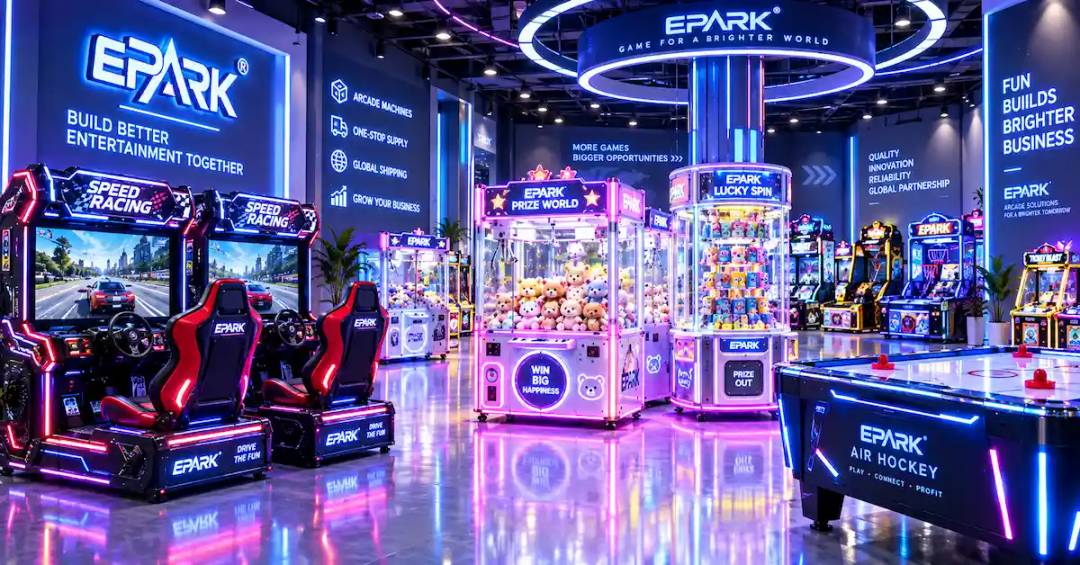
Frequently Asked Questions
What Are Arcade Machines Wholesale for Importers?
They are commercial arcade machines purchased in volume for regional resale, distribution, project supply, or warehouse inventory. Importer requirements usually include export preparation, repeatable specifications, spare parts, technical support, and repeat-order control.
What Arcade Machines Are Best for Importers?
The best portfolio depends on local market demand. Common categories include claw machines, redemption games, racing simulators, basketball games, shooting machines, VR equipment, kiddie rides, sports games, and prize machines.
Can Importers Order Different Arcade Machine Types Together?
This depends on the supplier, quantity, packaging, and commercial arrangement. Importers should ask about mixed-model orders and loading plans before confirming the PO.
What Should Importers Confirm About Voltage?
Confirm destination voltage, frequency, plug configuration, power requirements, and any other applicable electrical specifications for every model before production.
Can Wholesale Arcade Machines Be Private Labeled?
Many arcade products can support OEM customization depending on the model. Branding may include logos, artwork, cabinet colors, packaging, payment configuration, and other agreed elements.
How Should Importers Check Quality Before Shipping?
QC should cover functional operation, approved configuration, electrical settings, payment system, controls, display, audio, lighting, accessories, appearance, spare parts, quantity, and packaging as applicable.
What Documents Do Arcade Machine Importers Need?
Requirements vary by destination and shipment. Common documents may include commercial invoices, packing lists, transport documents, customs information, and relevant product documentation. Confirm market-specific requirements before ordering.
How Many Spare Parts Should an Importer Buy?
There is no universal quantity. The spare-parts plan should reflect machine quantity, component criticality, expected usage, local service ability, supplier lead time, and shipping cost.
How Can Importers Keep Repeat Orders Consistent?
Maintain a record connecting your internal SKU to the supplier's model, configuration, artwork, payment system, electrical version, parts, and previous production batch. Review changes before every reorder.
How Can I Request a Wholesale Arcade Machine Quote?
Prepare your destination market, machine categories, estimated quantities, voltage, payment system, OEM requirements, shipping destination, spare-parts needs, and expected repeat-order plan. You can then contact EPARK with these details for a project-specific wholesale discussion.
Conclusion
Sourcing arcade machines wholesale for importers is not simply a search for the lowest factory price. A strong import program connects the right product portfolio with controlled specifications, QC, OEM branding, packaging, export documentation, freight planning, spare parts, technical support, and repeat-order traceability.
For importers, distributors, and amusement equipment wholesalers, the most valuable supplier relationship is one that remains manageable after the first container arrives. Review the EPARK arcade machine range, define your market, quantities, technical configuration, branding, destination, and service requirements, and then contact EPARK to discuss a wholesale sourcing plan.
Disclaimer
The information provided on this website is for general informational purposes only.
While EPARK Arcade Game Machine Manufacturer strives to ensure accuracy and reliability, no warranties—express or implied—are made regarding completeness, performance, or applicability.
Product specifications, designs, and features may vary depending on usage, customization, and customer requirements.
Buyers are responsible for verifying all technical details, compliance certifications, and suitability before procurement.
EPARK shall not be held liable for any direct, indirect, incidental, or consequential damages arising from the use of this website or its content, including but not limited to business losses, data errors, or equipment misuse.
For tailored solutions or further verification, please visit our Contact Us
Intellectual Property Notice
All articles, product images, videos, catalogs, software, and related materials published on this website are the intellectual property of EPARK, unless otherwise stated.
Unauthorized reproduction, distribution, modification, or commercial use of any content is strictly prohibited without prior written consent from EPARK.
EPARK reserves the right to take legal action against any unauthorized use, including but not limited to copyright infringement, misrepresentation, or unfair competition.
Trademarks
The name EPARK, the EPARK logo, and all related brand elements displayed on this website are registered trademarks or trade names of Guangzhou EPARK Electronic Technology Co., Ltd.
Other product names, company names, or logos mentioned on this site may be trademarks of their respective owners.
Unauthorized use of EPARK's trademarks for commercial purposes, including advertising, promotions, or product packaging, is strictly prohibited.
Governing Law
These terms are governed by the laws of the People's Republic of China.