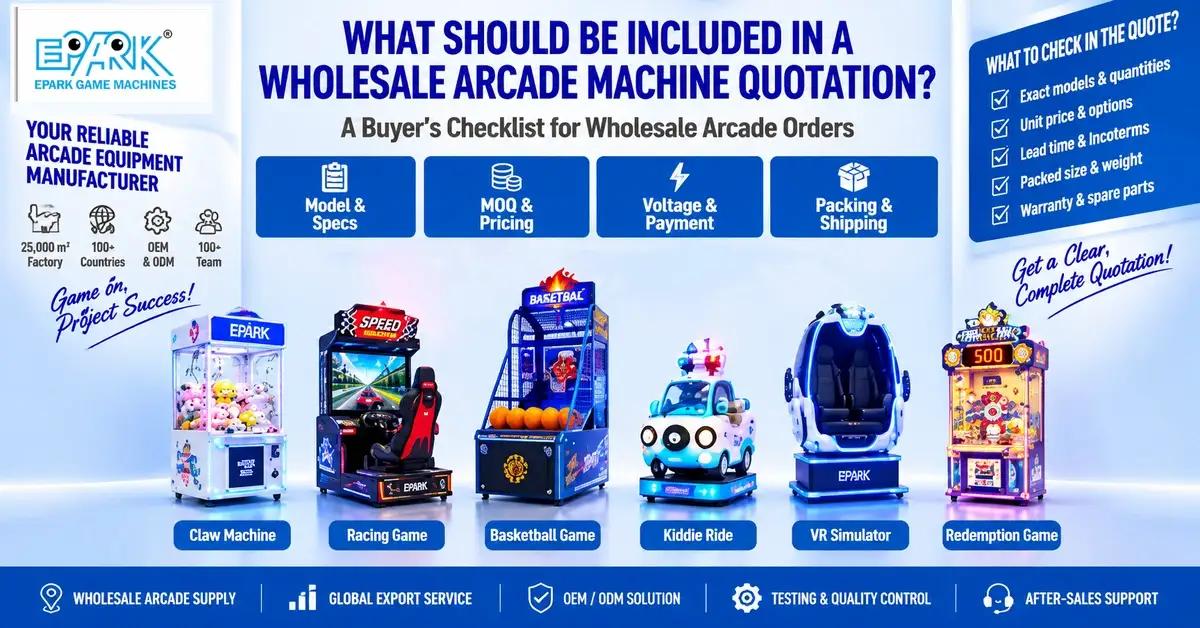


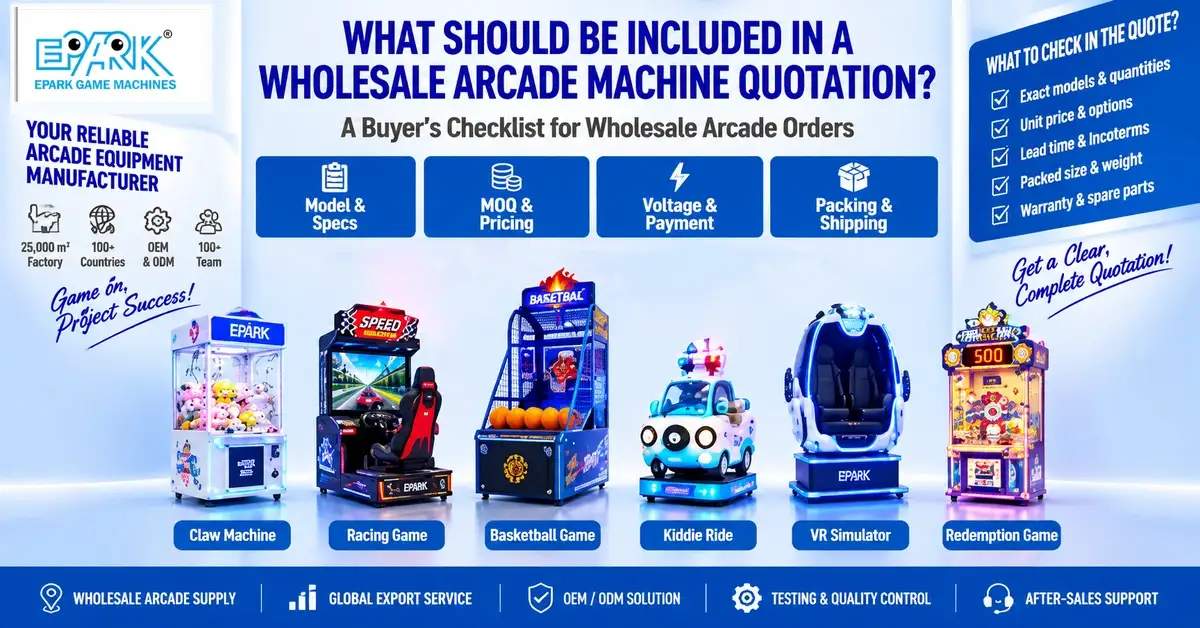
Quick answer: a wholesale arcade machine quotation should be a controlled specification, cost, delivery and service document
What should be included in a wholesale arcade machine quotation? At minimum, it should identify every machine and option, state the quantity and configuration, separate equipment from customization and logistics, define the production and inspection basis, and show what happens after delivery. A unit price without model revision, voltage, payment system, packed dimensions, warranty boundaries or acceptance criteria is not a complete quotation. It is an invitation to make assumptions after the deposit is paid.
For a distributor, the quotation becomes the reference used by sales, purchasing, finance, warehouse staff, inspectors and service technicians. For an FEC buyer, it becomes the bridge between the equipment list, floor plan, electrical design, opening schedule and operating budget. The goal is not to make a supplier use a longer form. The goal is to make two suppliers quote the same thing so the buyer can compare like with like.
Start with a quotation header that fixes the commercial identity
The first page should make the document traceable six months later. Include the supplier's legal entity, sales contact, quotation number, issue date, validity period, currency, language, buyer name, destination country, named delivery location and the intended Incoterm with its named place. If the quote is for a distributor, add the resale market and whether the request is a trial order, stock order, project order or repeat order.
Do not accept “FOB price” without a port or “CIF price” without a destination port. A trade term is incomplete when its place is missing. The same applies to “delivery time”: state whether it means production completion, factory release, port departure, arrival, customs clearance or delivery to the venue. The existing EXW, FOB and CIF comparison guide explains why the headline term changes the buyer's risk and landed-cost calculation; your quotation should carry the specific place and cost boundary.
| Field | What the quote should state | Why a buyer needs it |
|---|---|---|
| Supplier identity | Legal company name, address, contact and bank beneficiary | Links the commercial document to the responsible seller and manufacturer |
| Reference control | Quote number, issue date, revision and validity period | Prevents an old price or configuration being reused by mistake |
| Delivery basis | Incoterm, named place, destination and whether local delivery is included | Defines freight responsibility and the point where risk and cost change hands |
| Project identity | Venue, market, order type, target readiness date and buyer contact | Lets the factory quote the right voltage, documents, packing and schedule |
| Commercial assumptions | Currency, tax treatment, payment milestones and quote exclusions | Stops finance from comparing incomplete totals |
Require one line item for every machine and every meaningful option
The product table is the core of the quotation. Each row should have a factory model code, model revision or configuration ID, buyer SKU if applicable, short product description, quantity, unit price and line total. Add operating dimensions, packed dimensions, gross weight, rated power, voltage, frequency, plug, display or screen description, controls, game content, language and payment method when those features affect the purchase.
“Racing game,” “claw machine” or “basketball game” is not enough to identify an order. A two-seat racing unit with motion, a single-seat cabinet without motion and a linked racing pair can have different footprints, power, software, spare parts and freight volume. A claw cabinet with a QR reader, different prize chute or custom lighting is not the same configuration as the catalog image. A model name can be retained, but the row must expose the options that change performance, service or cost.
For a distributor, ask the supplier to provide the same model matrix for the quotation, pro forma invoice, golden sample, factory test sheet, packing list and serial record. That continuity is more valuable than an attractive PDF. If the model code changes between documents, the receiving team may not know whether a substitution occurred or whether the sales team simply used a nickname.
Spell out electrical, payment and software configuration
Electrical details belong in the quote because they affect conformity, production, installation and replacement parts. State nominal voltage, frequency, plug type, rated power and any approved regional variation. If a customer needs 110 V, 60 Hz, a different plug, a card reader or a local payment interface, that requirement should appear beside the line item instead of in a chat message.
Payment and operating systems need the same treatment. Identify coin acceptors, QR readers, bank-card terminals, arcade cards, ticket dispensers, prize systems, membership systems or network functions. State whether the hardware is supplied, integrated, configured, tested or merely compatible. Clarify who supplies the payment account, SIM card, network, software license and local integration. A supplier can build a cabinet with a payment opening without delivering a working payment program.
Record the software or content version, supported language, game list, update method and any third-party content dependency. EPARK's public service information mentions software or language customization and updates in certain contexts, but the public pages do not define every license, update cadence or game-content fee. The quotation should say what is included for the selected model and what requires a separate confirmation.
Separate standard equipment, customization and engineering charges
A complete quote distinguishes the standard machine from value-added work. Use separate lines for logo and artwork, cabinet color, marquee, lighting, screen changes, extra player positions, payment integration, language, software changes, mold or tooling, prototype work, sample freight and engineering. If a customization is included at no charge, write “included” rather than leaving the amount blank. If it is not applicable, write “not applicable.” Blank cells create uncertainty when the quote is approved by several people.
Ask which artwork files are needed, who approves them, how many revision rounds are included and whether the factory can make a pre-production visual or physical sample. For a new cabinet, request drawings or a dimensioned approval sheet before production. For an existing model with a private label, confirm where the logo appears, what information remains on the rating label and who owns the final artwork files.
The public EPARK process describes artwork printing and painting, electronic assembly, screen and control integration, final assembly and function testing. Use those steps as a practical RFQ prompt: ask which stage contains the custom work, which sample proves it, and what inspection point prevents an unapproved artwork or component from entering the batch.
Show the full price structure, not just a factory unit price
Finance needs a cost schedule that can be reconciled to the purchase order. Separate machine price, option price, customization, tooling, sample, spare-parts kit, export packing, inland transport, documentation, inspection, insurance, ocean or air freight, destination delivery, installation, training and taxes. Some lines may be buyer-arranged; they should still be identified as excluded rather than disappearing from the budget.
State whether prices are per unit, per set, per container, per project or one-time. A linked racing pair, a multi-player cabinet or a complete prize counter can be quoted as one set while containing several cabinets. Define what quantity triggers a volume price and whether the price assumes a mixed model order. A discount that applies only to 20 identical cabinets cannot be used to evaluate a 12-model distributor stock order without written confirmation.
List currency, tax, payment fees and validity. If the quote is in U.S. dollars but the supplier's bank receives another currency, explain the conversion basis. If the price is subject to material or freight changes, state the trigger, notice period and buyer approval right. Do not accept “price subject to final confirmation” as a substitute for a controlled revision process.
| Cost block | Include in the quotation | Buyer question |
|---|---|---|
| Equipment | Model, revision, quantity, unit price and line total | Does the price describe the exact approved configuration? |
| Customization | Artwork, cabinet, software, language, payment or engineering | Is this recurring per unit or a one-time development charge? |
| Readiness | Testing, inspection, export packing, manuals and spare kit | What evidence is delivered before balance payment? |
| Logistics | Inland freight, port charges, freight, insurance and named destination | Which charges are excluded and who controls the forwarder? |
| Commissioning | Installation, training, remote support and local labor | Is support remote, on-site, included or separately quoted? |
Define MOQ, mixed models and volume breaks in writing
A wholesale quotation should state the minimum order quantity by model, category and total order. If mixed models are accepted in one container, explain the minimum quantity per model, the minimum total value or volume, and how the factory allocates production and packing space. If the supplier accepts a trial order but applies different pricing, lead time or customization rules, show those rules beside the quote.
EPARK's public FAQ describes both small trial orders and large-scale production, but it does not publish one universal MOQ for every product and option. That is not a problem if the quotation is explicit. Ask for the exact rule for the requested list, including whether a sample counts toward a later bulk order, whether spare parts count toward the minimum and whether a low quantity can be combined with another buyer's production run.
Volume breaks should show the assumptions behind them. A price for 10, 20 and 50 units may depend on identical artwork, one voltage, one payment configuration and one packing method. If a distributor wants five categories with different revisions, the quote should explain whether the break is based on total units, cabinet volume or production family. This prevents a “bulk discount” from being removed after the configuration is finalized.
For mixed orders, include a load plan or estimated packed volume and a line-item accessory list. A container can be full before the unit count reaches the supplier's stated maximum if a few machines have large motion systems or reinforced crates. The mixed arcade wholesale order guide can be used as a companion when the quote includes several machine categories.
Turn delivery language into a milestone schedule
“20–40 days” is not a schedule until the starting point is defined. A useful quotation shows the planned date for specification freeze, artwork approval, deposit receipt, prototype or sample approval, production start, factory testing, inspection, packing, loading and document release. Identify which milestone moves when the buyer delays an approval.
Separate production time from transport time. EPARK's public FAQ gives general ranges for small orders and larger or custom orders, while also explaining that destination and customization affect the final arrangement. Treat those ranges as planning references, not a guaranteed arrival date. The order document should name the target factory-release date and the transport assumption used for the budget.
For an opening date, add a recovery plan. Ask what happens if a display, payment board, artwork or imported component is delayed. Can the factory ship completed standard units first? Can a model be substituted only with written approval? Who pays for a split shipment? These questions belong in the quotation because they affect the buyer's project risk, not just the factory's internal schedule.
Include testing, inspection and acceptance criteria
A quote should tell the buyer how the factory will prove that the ordered configuration is ready. State the functional test scope: power-on, game start, controls, sound, display, lighting, payment, ticket or prize output, motion, safety interlocks, network functions and burn-in where applicable. Identify whether the test is performed on every unit, a sample, or a production batch.
EPARK's public Design & Process information describes a 48-hour full-operation test before shipment and refers to game function, electrical safety, lighting and mechanical durability checks. In a purchase order, convert that public statement into project evidence: the exact models and options tested, the record format, the person approving release and the process for failed units.
Pre-shipment inspection terms should define notice, inspector access, sampling method, defect classification, rework, retest and the effect on balance payment. Attach a golden-sample photograph, approved drawing, model matrix, label image and configuration list. A buyer should be able to reject a cabinet that is attractive but does not match the agreed screen, controls, payment system, voltage or language.
Describe export packing, loading and document handover
Packaging is part of the quotation because arcade cabinets are vulnerable to vibration, moisture, impact and identification errors. State the internal protection, foam, bubble wrap, wooden frame or crate, waterproof film, corner protection, pallet rules and whether the packed dimensions are included. For glass, screens, moving mechanisms and protruding controls, specify the protection method rather than accepting “export standard” as a complete description.
Ask for the packing list format, carton or crate marks, serial-number list, accessory boxes and container loading photos. Mixed orders need a location map so the receiving team can find spare parts, manuals and small accessories without opening every crate. The quotation should also identify who prepares commercial invoice, packing list, certificate of origin, test or compliance documents and any destination-specific paperwork.
EPARK's public process material describes bubble wrap, thick foam, wooden reinforcement and waterproof film for sea shipment, plus customs, insurance and tracking support. Those are useful evidence points, but the final quote should state the packing level for the actual machine type and whether an inspection or special crate is charged separately.
Write warranty, spare parts and technical support as deliverables
A warranty line should state the start date, covered defect types, exclusions, evidence required, response channel, replacement process, freight responsibility, local labor responsibility and return requirements. EPARK's expanded FAQ states a two-year warranty from shipment for EPARK machines, includes replacement parts for manufacturing defects during that period, excludes consumables and misuse damage, and allows post-warranty parts to be purchased. The quotation must still confirm how those public terms apply to the selected model, destination and order.
List the starter spare-parts kit by part name, compatible model or revision and quantity. Do not use “free spare parts” without a packing list. For a distributor, also ask for recommended regional stock, part lead-time assumptions, installation instructions and remote diagnostic evidence. A replacement board without the correct firmware, connector or configuration can extend downtime instead of reducing it.
Support should be divided into acknowledgement, diagnosis, warranty decision, parts preparation and repair. Public language such as 24/7 support or a 24-hour reply does not automatically mean a 24-hour repair. The agreement should match the distributor's customer promise to the factory's written service scope.
Compare quotations with a weighted completeness matrix
When two quotations have different formats, score the evidence before scoring price. A low price with unknown packed volume or unpriced payment integration is not a lower total; it is an incomplete number. Mark each field as confirmed, conditional or missing, and ask the supplier to revise the quote before approval.
| Decision area | Confirmed | Conditional | Missing |
|---|---|---|---|
| Product identity | Model, revision, options and quantity match the brief | One code or option needs written clarification | Catalog name only |
| Electrical and payment | Voltage, plug, power and payment scope are named | Integration depends on local supplier confirmation | “Compatible” without hardware or test scope |
| Price basis | Equipment, customization, packing and logistics are separated | One destination charge remains estimated | Unit price with unexplained exclusions |
| Schedule | Approval, production, testing and shipment milestones are dated | Freight schedule awaits booking | Only “ready in X days” |
| Acceptance | Test, inspection, defect and rework rules are attached | Sampling plan awaits approval | No release evidence or acceptance criteria |
| Service | Warranty, parts, support channel and cost ownership are written | Territory labor or freight remains to confirm | “Full after-sales” only |
A useful internal rule is to approve a supplier only when every missing field has an owner and a deadline. Conditional fields can remain open during early budgeting, but they should block production release or balance payment when they affect safety, identity, price, delivery, compliance or serviceability.
Send a buyer-ready RFQ instead of asking for “your best price”
The quality of the quotation depends on the quality of the request. Send a line-item machine list, destination, venue type, floor plan if relevant, target readiness date, voltage and plug, payment method, language, artwork status, packaging requirement, inspection expectation, spare-parts preference and service model. State whether you need standard machines, private label, OEM development, a mixed container or a repeatable distributor catalog.
Ask the supplier to return the quote in a spreadsheet or structured table with one row per configuration. Request separate sheets or sections for equipment, customization, logistics, documents, spare parts and service. This makes it easier to compare a factory quote with a local integrator's proposal and easier to update when the quantity changes.
EPARK's complete FEC equipment page and commercial arcade wholesaler page can help a buyer identify product families before requesting the exact configuration. Use the pages for discovery, then ask sales to translate the chosen models into a controlled quotation.
Frequently asked questions
What is the most important field in a wholesale arcade machine quotation?
The exact model and configuration identity is the foundation. A price cannot be compared or inspected if the quote does not identify the model revision, quantity, options, voltage, payment system and language that the supplier is pricing.
Should freight be included in a wholesale arcade machine quote?
Freight may be included or buyer-arranged, but the quotation should state the Incoterm, named place, destination, freight basis, insurance treatment and excluded destination charges. A separate line is preferable because it keeps the equipment price comparable.
How should a supplier quote a mixed arcade machine order?
Use one line per model and configuration, show the minimum quantity rule, give packed dimensions and weight, and provide an estimated load plan. Confirm whether volume discounts apply to the total order or only to identical units.
What should be written about payment-system integration?
Name the payment hardware, software, network responsibility, currency or token logic, testing scope and local integration owner. “Card-ready” or “QR compatible” is not enough to prove that the installed system will operate at the destination.
Does a quotation need to include spare parts?
Yes, at least as a separate optional or included line. List part names, compatible models, quantities, price, packing location and whether the part is covered by warranty. Distributors should also request a recommended regional stock list.
How long should a wholesale arcade machine quotation remain valid?
The supplier should state a validity period and the conditions that can change the price, such as freight, materials, exchange rate or configuration. Do not assume an old quotation remains valid after artwork, payment or voltage changes.
What inspection evidence should be requested before balance payment?
Request the approved configuration, unit or serial list, test checklist, photographs or video, packing confirmation and any inspection report. The evidence should show that the shipped units match the quotation and approved sample.
Can EPARK provide a quotation for a complete FEC?
EPARK publicly describes equipment selection, layout, OEM/ODM, production, packing, installation guidance and support for commercial entertainment projects. Send the venue information and machine list through the contact page and confirm the exact equipment, logistics, installation and service scope in writing.
Conclusion
A wholesale arcade machine quotation is complete when another person can read it and know what will be built, what it will cost, when it should be ready, how it will be tested, how it will be packed and who will support it after delivery. The strongest quote is not necessarily the longest document. It is the one that removes hidden assumptions from model identity, options, payment, customization, MOQ, logistics, acceptance and warranty.
EPARK's public manufacturing and project information gives distributors and FEC buyers a useful starting point for product discovery and process questions. Send your model list, destination, quantity, voltage, payment requirements, artwork status and target date through the EPARK contact page and request a line-item quotation that your purchasing, inspection and service teams can all use.
Disclaimer
The information provided on this website is for general informational purposes only.
While EPARK Arcade Game Machine Manufacturer strives to ensure accuracy and reliability, no warranties—express or implied—are made regarding completeness, performance, or applicability.
Product specifications, designs, and features may vary depending on usage, customization, and customer requirements.
Buyers are responsible for verifying all technical details, compliance certifications, and suitability before procurement.
EPARK shall not be held liable for any direct, indirect, incidental, or consequential damages arising from the use of this website or its content, including but not limited to business losses, data errors, or equipment misuse.
For tailored solutions or further verification, please visit our Contact Us
Intellectual Property Notice
All articles, product images, videos, catalogs, software, and related materials published on this website are the intellectual property of EPARK, unless otherwise stated.
Unauthorized reproduction, distribution, modification, or commercial use of any content is strictly prohibited without prior written consent from EPARK.
EPARK reserves the right to take legal action against any unauthorized use, including but not limited to copyright infringement, misrepresentation, or unfair competition.
Trademarks
The name EPARK, the EPARK logo, and all related brand elements displayed on this website are registered trademarks or trade names of Guangzhou EPARK Electronic Technology Co., Ltd.
Other product names, company names, or logos mentioned on this site may be trademarks of their respective owners.
Unauthorized use of EPARK's trademarks for commercial purposes, including advertising, promotions, or product packaging, is strictly prohibited.
Governing Law
These terms are governed by the laws of the People's Republic of China.