

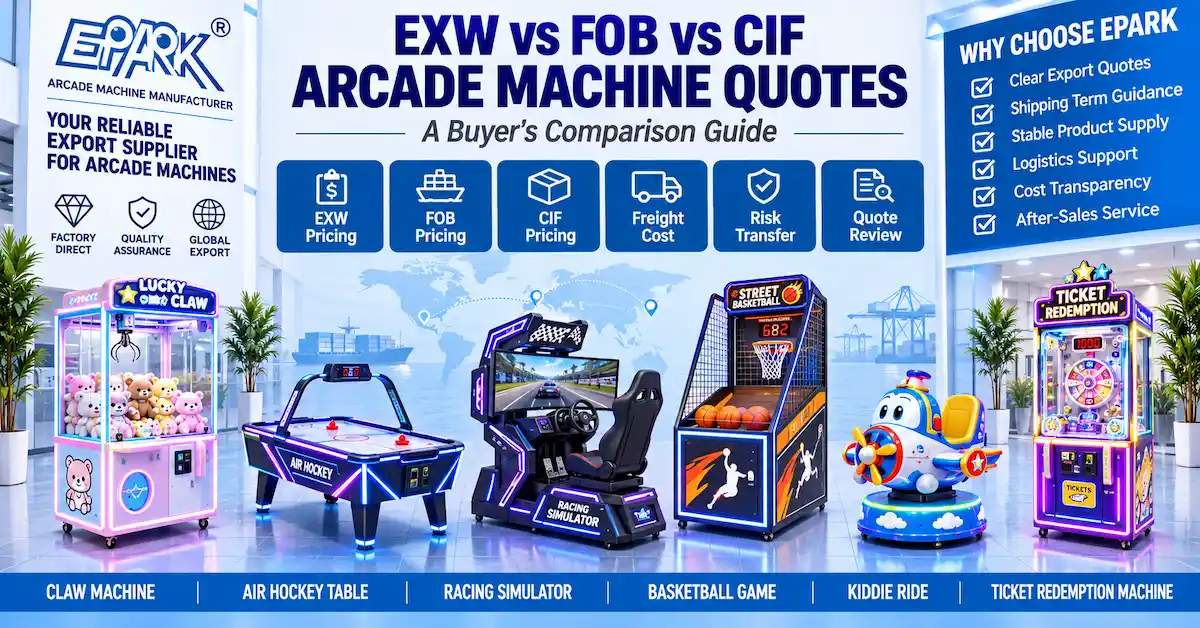
Quick answer: compare the delivered commercial scope, not the three letters
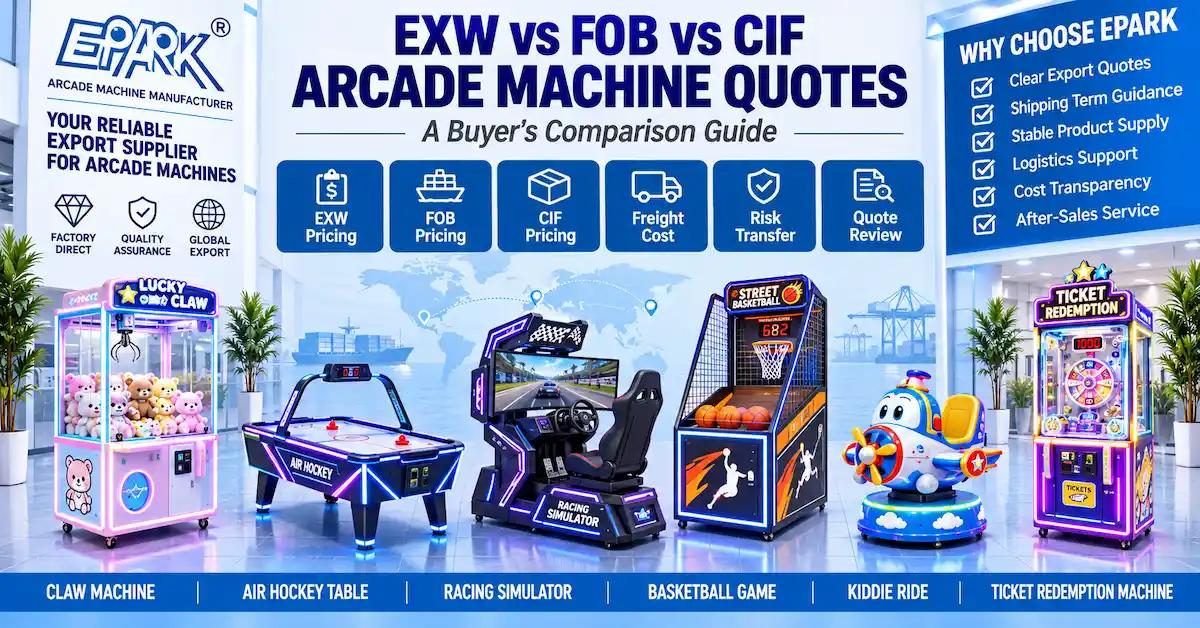
To compare EXW FOB CIF arcade machine quotes from China, first put every supplier on the same machine configuration and then rebuild each price into the same destination cost basis. EXW normally leaves the buyer responsible from the named place at the seller's premises, including the transport and export formalities that the rule assigns to the buyer. FOB places delivery and risk transfer when the goods are loaded on board the vessel at the named port, while the seller handles export clearance and the buyer takes the main sea transport and import side. CIF adds seller-arranged freight and minimum insurance to the named destination port, but risk still transfers when the goods are on board at the shipment port. The right choice is the term that gives your team a controllable cost, risk and documentation path for the actual order—not whichever quotation has the lowest unit price.

Why arcade quotations become incomparable so quickly
A factory quotation is not a complete purchasing comparison until its scope is visible. Two suppliers may quote the same cabinet name while including different displays, control panels, payment hardware, artwork, voltage, packaging, spare parts, manuals or test work. The Incoterm then adds another layer of difference: one supplier may quote at the factory, another at the export port and another with freight to the destination port. Comparing the final numbers without normalizing the scope is how buyers create false savings.
Start with a single equipment schedule. Include factory model and revision, quantity, operating dimensions, packed dimensions, voltage, frequency, plug, display, controls, payment interface, language, software or content scope, artwork, accessories, spare parts, test requirements and destination documents. EPARK's bulk arcade buying guide already recommends treating the quotation as an offer package rather than a unit price; use that principle here and add the named Incoterm and place to every line.
Separate four price layers
Keep four layers separate in your comparison sheet:
Product scope: the machine and everything required to operate the approved configuration.
Origin scope: export packing, factory loading, inland movement, export clearance, port handling and origin documentation.
Main carriage scope: international freight, booking, shipping documentation and cargo insurance where applicable.
Destination scope: terminal charges, customs brokerage, import duties and taxes, inspection, delivery, unloading, warehousing, installation, commissioning and local technical work.
Incoterms help allocate many of these responsibilities, but the quotation still needs to state what is included, excluded, estimated or left for the buyer. A supplier's freight-inclusive number is not proof that destination delivery or import tax is included.
What EXW means for an arcade machine buyer
Under EXW, the seller makes the goods available at the named place, usually its factory or warehouse. The buyer generally arranges collection, loading, export clearance, main carriage, import clearance and onward delivery. The ICC notes that EXW is primarily suited to domestic trade and can create practical difficulties in cross-border transactions because the buyer takes responsibility for export formalities in the seller's country. The rule can still appear in China factory quotations, but an international buyer should check whether its freight agent and legal structure can actually perform the required export steps.
For arcade machines, EXW can make sense when the distributor has a trusted China-based sourcing or freight team, wants to consolidate equipment from several suppliers, or needs to control the carrier and origin pickup directly. It can also be useful for a local buyer collecting from a nearby warehouse. The benefit is visibility and control over the transport chain. The cost is coordination: factory pickup, loading, export documents, inland transport, port handover, booking, damage evidence and communication are now your responsibility or your agent's.
EXW questions that affect the real price
Ask whether the factory quotation includes loading onto the collecting vehicle, export-worthy packaging, export declaration assistance, pallet or crate handling, documentation and any warehouse waiting charges. Confirm the exact pickup address, cargo availability date, package count, gross weight, dimensions, lifting requirements and whether the factory can provide the information your export agent needs. Ask who records damage if a cabinet is harmed during loading or collection. Do not assume that “EXW factory” includes the cost of moving a large cabinet from an assembly area into a container.
If your freight forwarder is not familiar with the supplier's location or product type, request a parallel FCA quotation for containerized cargo. ICC distinguishes rules for any mode of transport from the maritime rules and notes that FCA can be appropriate when goods are handed to the carrier before loading on the vessel. A buyer can compare EXW and FCA as a logistics design question rather than treating EXW as automatically cheaper.
What FOB means for an arcade machine buyer
FOB, or Free On Board, is a sea and inland-waterway rule. The seller delivers when the goods are on board the vessel nominated by the buyer at the named port of shipment. The seller handles export clearance; the buyer selects or controls the main carriage and bears risk after on-board delivery. For a containerized arcade shipment, check the physical handover point carefully. ICC explains that FOB is intended for cases where the seller places the goods on board the vessel; when the cargo is handed to a carrier at a container terminal before loading, FCA may be the more technically appropriate rule.
In industry practice, FOB is common in China export quotations and can be a practical comparison basis for distributors that already work with a freight forwarder. It gives the buyer a clear factory-to-port scope while allowing control of ocean freight, destination agent and insurance. It does not mean “everything is paid until the destination port.” The buyer still needs to budget main carriage, insurance if desired, import clearance, duty, tax, terminal charges, local delivery and unloading.
FOB questions that prevent hidden origin charges
Ask which named port is used, whether the price includes export packing, factory loading, inland transport to the port, export customs clearance, origin terminal handling, documentation and any origin security or booking fees. Ask whether the supplier is quoting a standard container, LCL or a mixed shipment. For a mixed arcade order, confirm whether every model and spare-parts carton is included in the packed volume and whether the supplier or buyer arranges container loading and lashing.
FOB can be commercially attractive when your team can buy freight competitively, but a cheap ocean rate does not remove operational risk. A missed booking, inaccurate packed data, incomplete export documents or unclear damage record can cost more than a small factory-side price difference. Link the FOB quote to the same production, inspection and packing release gates as the equipment schedule.
What CIF means for an arcade machine buyer
CIF, or Cost, Insurance and Freight, requires the seller to contract for carriage and insurance to the named destination port. Under the ICC rule, however, risk transfers when the goods are on board at the shipment port, not when they arrive at the destination. The seller's insurance obligation under CIF is minimum cover unless the parties agree otherwise. That distinction matters for arcade cabinets because a buyer may see a destination-port freight number and assume the seller remains responsible for every transit problem until unloading.
CIF can help a buyer that does not have a preferred ocean carrier or wants one factory to coordinate a mixed shipment to a named port. It can also simplify early budgeting. The trade-off is less control over the carrier, routing, local agent and insurance claim process. Ask for the carrier, sailing basis, transshipment assumptions, insurance certificate or policy terms, covered value, deductible, exclusions and claims procedure. Confirm who receives arrival notices and who pays destination terminal and handling charges.
CIF is not delivered-to-warehouse
A CIF quote normally stops at the named destination port. It may exclude destination terminal handling, port storage, customs brokerage, import duties and taxes, inspection, demurrage or detention, inland trucking, unloading, warehouse receipt, installation and commissioning. These costs can be material for tall or heavy arcade machines. Ask the supplier or forwarder for a destination-cost estimate and then validate it with your own broker or local logistics provider.
Also check whether the quoted CIF freight covers the actual equipment mix. A container of compact claw machines has a different volume and handling profile from a mixed order containing racing simulators, basketball cabinets, VR systems and spare parts. Obtain packed dimensions and gross weights by model. Do not allocate freight only by machine count.
EXW vs FOB vs CIF: compare the responsibility boundary
| Term | Seller commonly handles | Buyer commonly handles | Main arcade-order question |
|---|---|---|---|
| EXW named factory | Makes conforming goods available at named place | Collection, loading arrangement, export and import formalities, main carriage, insurance and destination work | Can the buyer legally and operationally control China pickup and export? |
| FOB named port | Export clearance and delivery on board the buyer-nominated vessel | Main freight, optional insurance, import clearance, duties/tax and destination work | Are origin charges, packed data and container handover clearly included? |
| CIF named port | Export clearance, on-board delivery, freight and minimum insurance to named port | Import clearance, duties/tax, destination charges, onward delivery and any extra cover | What remains outside the port price, and is the insurance adequate? |
The table is a commercial orientation, not a substitute for the full ICC rule or the sales contract. Write the named place, rule edition, delivery point, documents, insurance scope and exclusions in the order documents.
How to compare EXW FOB CIF arcade machine quotes
Use a quotation bridge rather than comparing the supplier totals directly. First create a product-scope column that removes differences in machine configuration. Then add or subtract every origin, main-carriage and destination line needed to reach the same point, such as “delivered to buyer warehouse, duty and tax excluded” or “ready for venue unloading, all local charges shown.” The chosen comparison point must be identical for every supplier.
| Line | Supplier quote A | Supplier quote B | Buyer normalization check |
|---|---|---|---|
| Machine scope | Model, revision, options and quantity | Model, revision, options and quantity | Same operating configuration? |
| Customization | Artwork, language, reader, voltage and software | Artwork, language, reader, voltage and software | Standard, optional or engineering scope? |
| Origin charges | Included or excluded under term | Included or excluded under term | Factory loading, inland movement, export clearance and terminal? |
| Main freight | Buyer or seller arranged | Buyer or seller arranged | Same carrier, sailing basis, container/LCL and validity? |
| Insurance | Buyer policy or not stated | CIF minimum cover or separate policy | Value, exclusions, deductible and claim owner? |
| Destination cost | Estimate from buyer broker | Estimate from buyer broker | Terminal, customs, duty, tax, delivery, unloading and storage? |
Keep unknowns visible. Use “not included,” “estimated,” “to be confirmed” and “buyer-arranged” rather than filling a blank with a guess. A transparent higher quote is often more useful than a lower quote whose missing lines appear after the goods arrive.
Calculate landed cost by SKU and by responsibility
For a mixed arcade shipment, the landed cost should be calculated at the machine or model-batch level, then reconciled to the shipment total. A practical formula is:
Landed cost = approved machine scope + customization + export packaging + origin charges + main freight allocation + insurance + import duty and tax + destination charges + local delivery/unloading + commissioning + opening spare parts.
Not every line belongs in the supplier's quote. The point is to include it in the commercial decision. Allocate shared freight and destination charges using packed cubic volume, weight or a blended method that reflects the equipment. Do not divide one container invoice equally between a compact claw cabinet and a large motion simulator. EPARK's container-order guide explains why mixed shipments should be planned by SKU and packed volume.
Use an assumptions register
Record the currency, exchange-rate date, freight validity, port, container or LCL basis, customs classification assumption, duty and tax basis, insurance basis, local delivery distance, unloading method, storage allowance and installation scope. Mark which items are confirmed by the supplier, quoted by the forwarder, estimated by the buyer or subject to local authority. This keeps the landed-cost model honest when freight or import rules change.
Do not use the model to create a guaranteed ROI. Contribution margin depends on selling price, customer demand, operating hours, payment fees, prizes, rent, marketing, maintenance and local service. A better commercial use is to test whether the same equipment mix remains viable under a range of freight and destination-cost assumptions.
Choose a term based on control, not habit
Choose EXW only when your team can manage the origin process and wants that control. Choose FOB when you want the seller to clear export and deliver on board while your forwarder controls the main carriage and destination chain, subject to the technical suitability of the rule for the cargo handover. Choose CIF when seller-arranged freight to a named port improves coordination or budgeting, and when you have checked the minimum insurance and destination exclusions. For containerized shipments handed to a carrier before vessel loading, ask whether FCA better reflects the actual handover.
A distributor with regular China freight may prefer FOB or FCA because it can consolidate orders, negotiate rates and keep a consistent destination agent. A first-time importer without an origin team may prefer a seller-coordinated basis, but it should still obtain the booking, packing, insurance and destination-cost evidence rather than treating CIF as a complete door-delivery price. An FEC project with a fixed opening date may prioritize schedule visibility, document control and damage response over a small unit-price difference.
Connect the Incoterm to the export document set
The commercial term should match the invoice, packing list, transport document, insurance record, export declaration and receiving plan. EPARK's arcade machine export documentation guide explains why model references and quantities should remain consistent across the paperwork. For a mixed order, use the approved equipment schedule as the common source for model names, quantities, package numbers, spare parts and descriptions.
Ask the supplier to state who provides the commercial invoice, packing list, certificate or test documents, export declaration information, bill of lading or equivalent transport document, insurance evidence where applicable and any model-specific compliance material. Do not confuse product compliance documents with shipping documents. The Incoterm allocates trade responsibilities; it does not prove that a particular machine meets a destination electrical or safety requirement.
Write release gates into the purchase order
Before deposit, define the approved machine scope, named Incoterm and place, production and inspection milestones, packaging, document list, payment release conditions, damage-report process, insurance responsibility and destination exclusions. Before balance or shipment release, compare the final machine matrix, test results, accessory list, package numbers and transport booking with the same schedule. A CIF quote that changes the model quantity or package volume after approval is no longer the same cost basis.
Common comparison mistakes with EXW, FOB and CIF
Comparing different machine configurations: a lower quote may omit payment hardware, artwork, controls, software, spare parts or export packing.
Assuming CIF means delivered duty paid: CIF ends at the named port, and import clearance, duty, tax and onward movement remain buyer-side unless the contract separately says otherwise.
Ignoring risk transfer: under FOB and CIF, risk transfers when the goods are on board at the shipment port even though CIF freight and insurance are seller-arranged.
Using FOB for the wrong handover: ICC reserves FOB for sea or inland-waterway delivery on board; container handover before loading may call for FCA.
Accepting minimum CIF insurance without review: check coverage, value, deductible, exclusions and claims process for fragile displays and cabinets.
Leaving destination costs blank: terminal, brokerage, duties, taxes, storage, delivery, unloading and installation can change the commercial result.
Allocating freight by unit count: large or heavy cabinets consume a different share of the container than compact units.
Letting a forwarder quote a different basis: compare the same port, package data, shipment mode, validity and service scope before ranking offers.
How EPARK buyers can request a comparable quote
EPARK's public company and service pages describe Guangzhou manufacturing, multi-category commercial amusement equipment, OEM/ODM customization, layout support, production, testing, export packing, installation guidance, technical support and spare-parts service. These capabilities are relevant when a project includes several machine categories, but the actual commercial term, freight basis, packing data and destination charges must be confirmed for the order.
Send the selected product list, quantities, destination country and port, preferred delivery term if known, voltage and payment requirements, OEM scope, spare-parts plan, target readiness date and whether you need one container or a staged shipment. Ask for EXW and FOB or CIF on the same equipment schedule where a comparison is useful. Request packed dimensions, gross weight, package count, origin charges, freight validity, insurance scope, exclusions and document responsibilities. If you need layout or installation input, describe the venue and project milestone so service scope is not hidden inside the equipment total.
Frequently asked questions
Which is cheaper for arcade machines from China: EXW, FOB or CIF?
There is no universal cheapest term. EXW may have the lowest factory number but transfer more origin work to the buyer. FOB may be efficient when the buyer controls freight. CIF may simplify coordination but still excludes destination costs and may carry minimum insurance. Compare the same delivered commercial scope.
Does CIF include import duty and tax?
Normally no. CIF covers seller-arranged freight and minimum insurance to the named destination port under the Incoterms rule. Import clearance, duties, taxes, destination charges and onward delivery must be budgeted and assigned separately unless the sales contract expressly provides another service.
Does risk transfer at the destination port under CIF?
No. Under CIF, risk transfers when the goods are on board the vessel at the shipment port, even though the seller pays freight and obtains minimum insurance to the named destination port. Review the insurance terms and claims process before accepting the quote.
Is FOB suitable for a containerized arcade machine order?
FOB is a sea and inland-waterway rule for delivery on board. If the goods are handed to a carrier at a container terminal before vessel loading, ask whether FCA better matches the actual handover. Follow the named place and the physical logistics process, not only common quotation language.
What should be included in an EXW arcade machine quotation?
Confirm the exact machine scope, packaging, factory address, collection date, package count, dimensions, weight, loading arrangement, export-document assistance, payment terms and exclusions. Also obtain your forwarder's pickup, export, freight, insurance and destination estimates so the EXW price can be converted to the comparison basis.
How should I compare CIF quotes from two arcade factories?
Check that both quotes use the same model revisions, quantities, packed data, destination port, freight validity, insurance basis, documentation and exclusions. Add destination terminal, brokerage, duty, tax, local delivery, unloading and installation costs using the same assumptions.
Should I request EXW, FOB and CIF at the same time?
Request multiple terms when your team is deciding who should control freight or when supplier quotes are hard to normalize. Ask each term on the same equipment schedule and state the purpose of the comparison. Do not create three different configurations just to obtain three numbers.
How do I allocate freight in a mixed arcade container?
Use packed cubic volume, weight or a blended method based on the equipment. Record the method and apply it consistently across models. Equal per-unit allocation can distort the landed cost of large racing, basketball or VR equipment compared with compact cabinets.
What documents should I request before approving a China arcade quotation?
Request the revised quotation, equipment schedule, packing data, commercial term and named place, payment and production milestones, test and acceptance scope, commercial invoice and packing-list basis, shipping and insurance responsibilities, compliance documents relevant to the model and destination, warranty route and spare-parts list.
Conclusion
Comparing EXW FOB CIF arcade machine quotes is a process of making responsibility visible. Normalize the machine configuration first. Then identify the delivery and risk point, origin work, main carriage, insurance, destination charges, import costs, local handling and service scope. EXW offers control only when the buyer can manage origin export work; FOB can suit a buyer with a freight program and clear port handover; CIF can simplify seller-arranged carriage to a named port but does not remove destination costs or the need to review minimum insurance.
Use one equipment schedule, one assumptions register and one landed-cost basis for every supplier. Send EPARK your model list, quantity, destination, packed-data needs and preferred comparison terms to receive an order-specific quotation that can be evaluated beyond the headline unit price.
Disclaimer
The information provided on this website is for general informational purposes only.
While EPARK Arcade Game Machine Manufacturer strives to ensure accuracy and reliability, no warranties—express or implied—are made regarding completeness, performance, or applicability.
Product specifications, designs, and features may vary depending on usage, customization, and customer requirements.
Buyers are responsible for verifying all technical details, compliance certifications, and suitability before procurement.
EPARK shall not be held liable for any direct, indirect, incidental, or consequential damages arising from the use of this website or its content, including but not limited to business losses, data errors, or equipment misuse.
For tailored solutions or further verification, please visit our Contact Us
Intellectual Property Notice
All articles, product images, videos, catalogs, software, and related materials published on this website are the intellectual property of EPARK, unless otherwise stated.
Unauthorized reproduction, distribution, modification, or commercial use of any content is strictly prohibited without prior written consent from EPARK.
EPARK reserves the right to take legal action against any unauthorized use, including but not limited to copyright infringement, misrepresentation, or unfair competition.
Trademarks
The name EPARK, the EPARK logo, and all related brand elements displayed on this website are registered trademarks or trade names of Guangzhou EPARK Electronic Technology Co., Ltd.
Other product names, company names, or logos mentioned on this site may be trademarks of their respective owners.
Unauthorized use of EPARK's trademarks for commercial purposes, including advertising, promotions, or product packaging, is strictly prohibited.
Governing Law
These terms are governed by the laws of the People's Republic of China.