

Quick answer: one factory can supply the categories only when the project is managed as a system
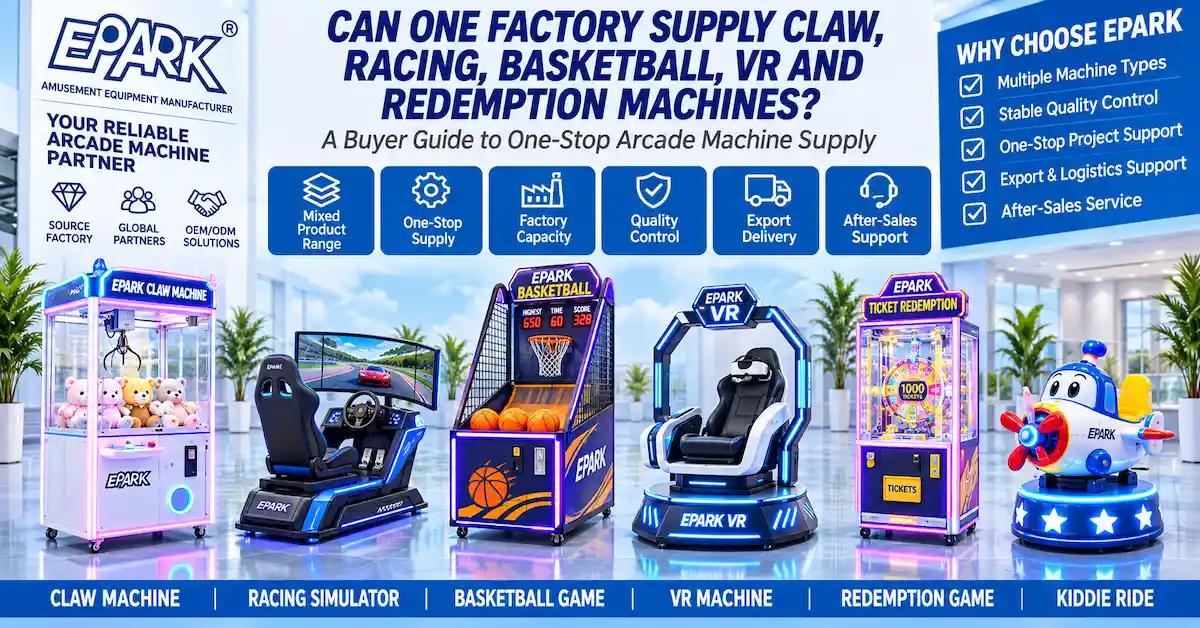
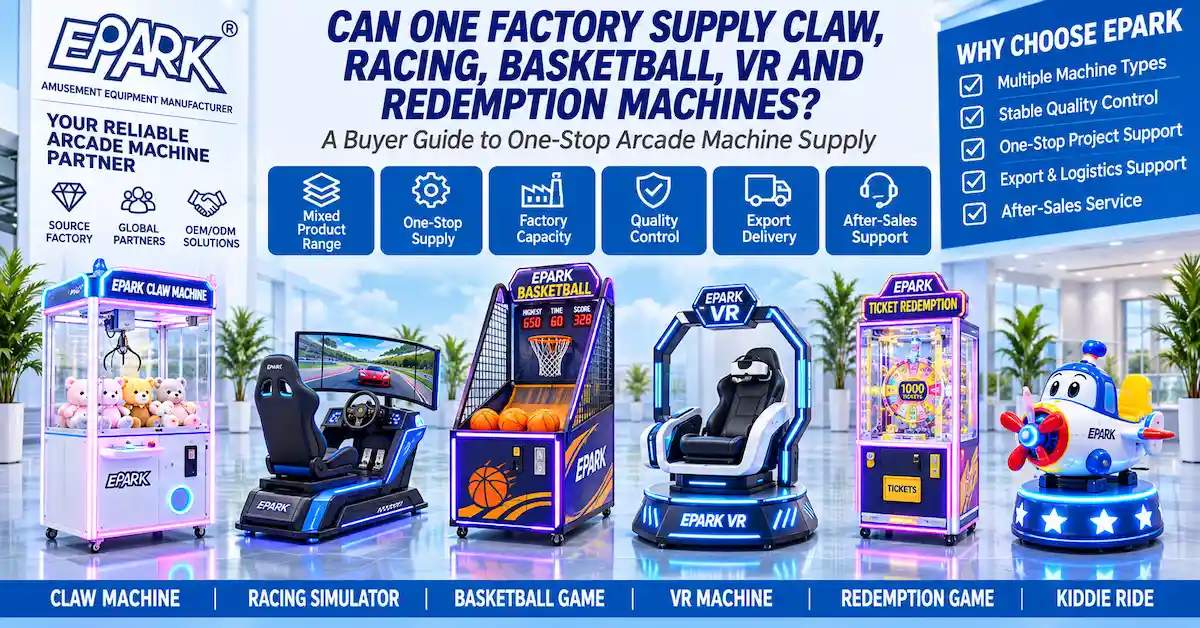
Can one factory supply claw, racing, basketball, VR and redemption machines in one project? For a buyer evaluating a one factory arcade machine supplier, the answer may be yes, but a product list is not proof of project capability. The buyer should verify one accountable configuration process, category-specific testing, compatible payment and ticket systems, packing and logistics for different cabinet types, spare-parts coverage, installation responsibility and repeat-order control. The real question is not whether one website shows five categories. It is whether one project team can deliver five different technical and operating requirements without creating hidden integration or service risk.
This guide is for FEC investors, mall operators, distributors and contractors considering a mixed arcade package. It deliberately avoids repeating the generic “one-stop supplier versus multiple vendors” debate already covered elsewhere. Instead, it defines a due-diligence test for a multi-category order: what one factory should own, what remains category-specific, what evidence to request before deposit, and when splitting the package between specialist suppliers is safer.
Define “one factory” before using the phrase in an RFQ
“One factory” can mean several different supply models. It may mean one legal manufacturer builds every cabinet. It may mean one project supplier coordinates specialist production lines. It may mean a trading company bundles products from unrelated factories. All three can produce a shipment, but they do not create the same accountability, documentation or service risk.
Ask the supplier to map each category to the party responsible for design, manufacturing, testing, packing, export documents, installation guidance, warranty and spare parts. If a third party supplies the VR hardware, payment reader or software, identify that dependency. A transparent multi-source model can still work; the red flag is when the supplier markets one factory while refusing to explain who actually controls each category.
What should a one factory arcade machine supplier prove?
Use a capability matrix, not a category logo. The supplier should identify the production or sourcing owner, model references, category-specific test scope, payment or ticket interface, packed data, service parts and warranty route for every category. This proof separates a coordinated project supplier from a catalogue that simply aggregates product images.
Build a matrix with one row for claw, racing, basketball, VR and redemption. For each row, record proposed models, internal reference, production owner, standard options, payment or ticket interface, test scope, packed data, service parts, installation needs and named contact. Ask the supplier to return the same matrix with verified, optional and pending fields.
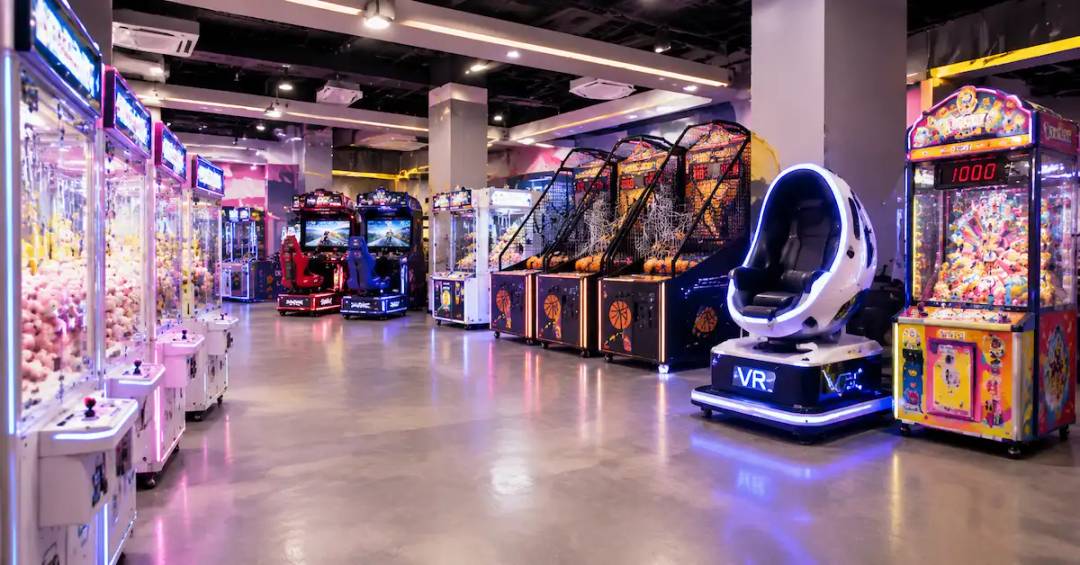
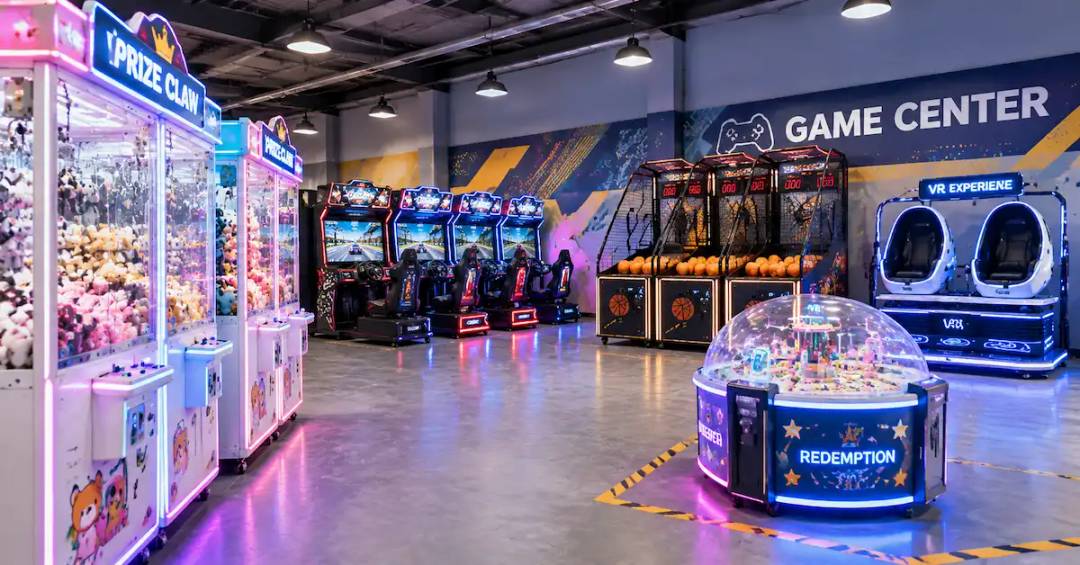
A mixed project becomes manageable when the buyer can see where the common process ends and category-specific work begins. A claw machine may require prize loading and claw mechanism service. A racing simulator may require motion, screen alignment and content configuration. A basketball machine may require ball return and sensor checks. A VR station may involve headset hygiene, tracking space and software or content dependencies. Redemption equipment may require ticket, points or prize-system integration. One factory should not pretend these are identical.
Check whether the proposed categories fit one venue brief
Before evaluating the supplier, test whether the five categories fit the venue. Give the supplier floor area, ceiling height, entrance and service route, target age groups, operating hours, payment system, noise constraints, power availability, queue expectations and opening date. A category can be technically available and still be unsuitable for the site.
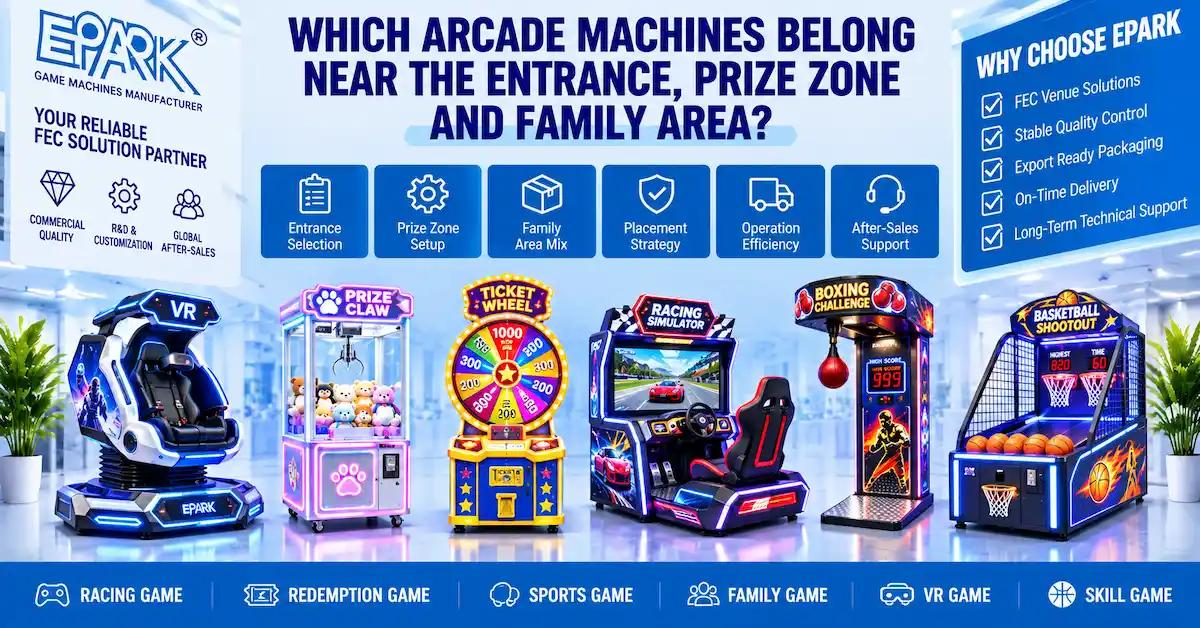
Claw machines often need strong visibility and prize access. Racing and basketball units need player clearance, queue space and a social sightline. VR requires a defined play and hygiene area, supervision and equipment storage. Redemption machines need a relationship with tickets, points or a prize counter. Map operating and service footprints, not only cabinet dimensions.
EPARK's public solution pages organize equipment by categories and venue packages, including racing, shooting, redemption, claw and VR examples. The category and square-meter quantities are project examples, not fixed rules. Ask for a project-specific layout and machine schedule based on your measured site.
| Category | Category-specific requirement | Evidence from one supplier |
|---|---|---|
| Claw | Prize loading, claw mechanism, settings and payment | Model sheet, prize limits, test flow and parts list |
| Racing | Seat, controls, screen alignment, motion and content | Footprint, power, test video and maintenance access |
| Basketball | Ball return, scoring sensors, backboard and player clearance | Cycle test, ball specification and replacement references |
| VR | Headset, tracking, hygiene, supervision and content | Hardware list, software scope and reset procedure |
| Redemption | Ticket or points output, payment and prize workflow | Interface map, output test and prize-system responsibility |
Verify the factory's production and sourcing model
Ask for a production map that distinguishes internal manufacturing from sourced components or partner-built categories. The goal is not to demand that every screw be made in one building. The goal is to know which quality system and change-control process covers each machine.
Request current factory or production evidence for representative categories: cabinet fabrication, electronics assembly, screen and control integration, motion or sensor installation, final assembly and functional testing. Ask who approves the bill of materials and who signs the test record. A supplier that can show only a showroom may still be competent, but the buyer needs another way to verify production ownership.
EPARK's Design & Process information describes artwork, cabinet production, PCB and wiring assembly, LED and screen installation, final assembly and function testing. It also describes export packing and project support. Ask the sales team to connect that general process to each quoted category and model.
Watch for category outsourcing that breaks accountability
Outsourcing is not automatically a problem. It becomes a problem when the supplier cannot state who controls a change, who tests the finished unit or who supplies a replacement part. For example, a VR headset, payment reader or game content license may come from a specialist partner. Put that dependency in the configuration and warranty record.
Ask whether the same account manager, technical team and warranty route cover all five categories. If every category has a different supplier contact and contract, the “one factory” benefit may be mostly administrative. If one project manager coordinates the interfaces and owns the escalation, the model may still reduce procurement effort without hiding technical boundaries.
Test whether one payment and management layer is realistic
Mixed equipment projects often fail at the system layer rather than the cabinet layer. Ask whether claw, racing, basketball, VR and redemption units can use the venue's coins, cards, QR codes, stored-value cards or cashless reader. Confirm which machines output tickets, points or redemption data, and whether the venue's management system receives the same information from each category.
“Supports cashless payment” is not a complete specification. Ask for reader model, mounting method, power, network dependency, tariff setting, interface, test procedure and responsibility for diagnosis. A racing simulator may use a different start signal from a redemption game. A VR station may use a software account or session controller rather than a simple pulse input. The integration map must show these differences.
EPARK's public service information references coin, QR and card payment options, tickets, points, redemption and membership systems, as well as self-developed or third-party management systems. The public material does not define every API, protocol, payment provider or data field. Request a project-specific integration statement before promising a single cashless or loyalty experience.
Compare category-specific testing, not one generic factory test
A mixed shipment needs a common quality gate and category-specific test scripts. The common gate can cover model identity, finish, serial number, accessories, power, visible damage, packing and documentation. The category scripts must cover the functions that create play or safety risk.
For claw machines, test payment, control response, claw movement, prize drop, settings and recovery after interruption. For racing, test steering, pedals, display alignment, audio, seat movement, motion limits and software start. For basketball, test ball return, scoring, hoop or sensor response, jam recovery and player clearance. For VR, test headset, tracking, play boundary, hygiene process, content launch and reset. For redemption, test payment, game logic, ticket or points output, sensors and prize-system handoff.
Ask the supplier to provide the test scope, model revision, serial record and failed-test remedy. EPARK's public process material describes full-operation testing and quality checks, but a mixed project should not rely on one generic sentence. The purchase file should contain a category-specific acceptance plan.
Use a representative sample when a full pre-shipment inspection is impractical
If the order is large, agree which units or categories receive full inspection and which receive sampling. A sample should represent the final configuration, including payment reader, artwork, language and software or content. If the factory changes a component after the sample, the test plan should be repeated or the change approved.
At receiving, photograph crates, serial labels, accessories and visible damage. Run the agreed acceptance cycle before distributing units across the venue. A mixed project is easier to troubleshoot when every category has a known baseline at opening.
Check packing and logistics for five different cabinet types
One shipment does not mean one logistics problem. Claw cabinets may contain glass or acrylic and loose prize-related accessories. Racing simulators can be long, heavy or irregular. Basketball units may include frames and balls. VR systems need protected headsets, computers or tracking equipment. Redemption machines may include ticket dispensers, counters and prize interfaces.
Ask for packed dimensions, gross weight, crate or carton type, moisture protection, lifting points, accessory labels and loading photos for each category. Request a container or truck loading plan that preserves the order in which the venue will receive and install the equipment. A consolidated packing list should identify model, serial or carton reference and loose parts.
Confirm who handles customs documents, insurance if requested, delivery booking, unloading, storage and packaging disposal. EPARK's public logistics material describes export packing, customs, insurance and tracking support, but the commercial quote should state the trade term and responsibility for local access, lifts, labor and damage reporting.
Evaluate installation and venue commissioning as one project
A mixed arcade package is not fully delivered when the cabinets arrive. The venue must connect payment, configure tickets or points, place machines according to the layout, test queues and service access, train staff and confirm opening readiness. Ask whether one project team coordinates these activities or whether each category arrives with an unrelated installer.
Create a responsibility matrix with supplier, distributor, local installer, venue, building owner and payment integrator. Assign unloading, assembly, leveling, power connection, network access, software accounts, payment test, ticket test, cleaning, training and final acceptance. Clarify whether installation guidance is remote, video-based, on-site or delivered by a local partner.
EPARK's public service descriptions include 2D/3D layout planning, installation guidance, commissioning, performance testing and operator training. These capabilities can support a mixed project, but the buyer should request the exact scope, number of days, travel or local labor assumptions and sign-off criteria.
Ask whether the spare-parts system covers every category
One supplier is valuable only if the parts system is broad enough to support the whole project. Request a category-by-category parts list with references, compatibility, opening stock recommendation, availability route and warranty treatment. Shared buttons, locks, power supplies or readers may simplify stock. Category-specific motors, sensors, displays, headsets, motion components and ticket mechanisms may require separate inventory.
Ask how a service case is opened for each category and whether one support team can triage it. A complete case should include model, serial number, order reference, symptom, photographs, video, power status, error code and recent changes. Remote diagnosis can reduce unnecessary site visits, but local technicians still need access, tools and compatible parts.
EPARK's public service and FAQ materials describe remote technical support, video guidance, spare-parts supply and warranty information, including a two-year warranty from shipment for EPARK machines with stated exclusions. Confirm whether all categories in the proposed project are covered under the same entity, warranty route and parts conditions. A third-party VR computer or payment reader may have a different warranty owner.
Do not let one warranty phrase hide five service models
Ask the supplier to separate manufacturing defects, consumables, transport damage, misuse, software or content issues, payment-provider faults and local installation. Define who pays freight and local labor. A single warranty headline is useful only when the exclusions and escalation path are visible by category.
Review repeat-order and configuration control
A mixed project may become a chain rollout. Ask for an internal SKU, model revision, artwork version, payment option, board or reader reference, software or content version, test record and parts list for each category. Store the data in the venue asset register. When the second location orders more basketball or racing units, procurement should be able to reproduce the approved configuration or approve a documented variant.
Configuration control is especially important when one factory supplies categories with different technology cycles. A claw cabinet may remain stable while VR hardware, content or tracking equipment changes more quickly. A basketball sensor or ticket board may be substituted without changing the exterior. Require change notice, compatibility information, updated testing and revised spare references.
Ask whether one account manager and technical escalation owner remains responsible for repeat orders. If the project is handed to a new category contact after the deposit, the buyer may lose the configuration history that makes the one-factory model useful.
When one factory is the better choice
One factory or factory-backed supplier can be a strong choice when the project values one quotation, one layout process, consolidated packing, one configuration register, shared payment planning, coordinated installation and a single escalation route. It is particularly useful when the supplier can show category-specific production and testing rather than relying on generic portfolio language.
The advantage is not automatically a lower price. It may be fewer coordination meetings, fewer incompatible parts, clearer acceptance, simpler training and a more consistent venue experience. Model the value using your own project labor and opening risk instead of accepting an unverified “one-stop saves money” claim.
Use the EPARK complete FEC game machine page as a starting point for a mixed equipment schedule. Ask EPARK to map the exact claw, racing, basketball, VR and redemption models to your site and identify which interfaces are common or category-specific.
When multiple specialist suppliers are safer
Splitting the order can be safer when a category has a high technical dependency that the general supplier cannot document. Examples include a VR system requiring a specific content license or tracking platform, a proprietary cashless management system, a motion simulator needing specialist commissioning, or a redemption system that must integrate with an existing prize counter.
Use multiple suppliers when the specialist provides materially better evidence, service access or compatibility and the coordination cost is understood. Assign one project integrator for layout, electrical, network, payment, delivery and acceptance. Multiple suppliers without a coordination owner creates a different risk: each party can blame another when the combined system fails.
The decision should follow the evidence matrix. One supplier with five unexplained categories is not lower risk than two specialists with clear scopes. Two specialists with no shared interface plan are not safer than one accountable supplier with category-specific proof.
Use a multi-category supplier scorecard
Score the supplier on the capabilities that actually determine project risk. Mark each item verified, partly verified or open. Do not award full points for a catalogue category. Require a model, responsible party and evidence.
| Criterion | Strong evidence | Risk if missing |
|---|---|---|
| Category ownership | Production and warranty owner named for every category | Blame shifting after delivery |
| Configuration | Versioned model, options, payment and content list | Unapproved substitutions and inconsistent reorders |
| Integration | Payment, tickets, points, network and data boundaries mapped | Machines work separately but not as a venue system |
| Testing | Common acceptance gate plus category-specific scripts | Opening defects hidden by a generic test claim |
| Logistics and install | Packed data, loading plan and responsibility matrix | Damage, missing accessories and schedule gaps |
| Lifecycle support | Parts, warranty, remote support and escalation by category | One category becomes an unsupported exception |
Send a project brief that forces a useful answer
Use this RFQ wording: “We are evaluating one factory or factory-backed supplier for claw, racing, basketball, VR and redemption equipment. For each category, identify the exact model, revision, production owner, operating and service dimensions, packed data, power, payment or ticket interface, software or content dependency, factory test scope, packing method, installation responsibility, compatible spare-parts list, warranty owner and technical-support route. Please identify common systems, category-specific systems, third-party dependencies, optional items, exclusions and any component-change process.”
Attach the floor plan, target audience, operating hours, payment environment, delivery route, quantity by category, destination and opening date. Ask for a layout, configuration matrix, itemized quotation and acceptance plan. If the supplier cannot answer this brief, it may still be able to sell individual machines, but it has not yet demonstrated the capability required for one mixed project.
Frequently asked questions
Can one factory supply claw, racing, basketball, VR and redemption machines?
Yes, a factory-backed supplier may supply all five categories, but the buyer should verify the production owner, model references, testing, integration, packing, installation, parts and warranty route for each category. A portfolio page alone is not enough.
Is one factory always better than multiple arcade suppliers?
No. One supplier can simplify coordination, but multiple specialists may be safer for technically demanding VR, motion, payment or redemption integrations. Choose the model with the clearest accountability and evidence.
What should a multi-category arcade quotation include?
Request model and revision, options, dimensions, power, payment or ticket interface, software or content dependency, packed data, freight, installation, testing, spare parts, warranty owner and exclusions for every category.
How do I know whether one supplier actually manufactures all categories?
Ask for a production and sourcing map. Identify who designs, builds, tests, packs, exports and supports each category. Outsourcing is not automatically a problem; unexplained responsibility is.
Can different arcade categories share one cashless system?
Sometimes, but the answer depends on reader interfaces, network, software and management-system compatibility. Ask for a project-specific integration map and test procedure instead of relying on “cashless compatible.”
How should the factory test five categories?
Use a common receiving gate plus category-specific scripts. Test claw movement and prize drop, racing controls and motion, basketball scoring and ball return, VR tracking and reset, and redemption payment and ticket or points output.
What are the biggest risks in a one-factory mixed order?
The main risks are hidden third-party dependencies, incompatible payment or management systems, generic testing, inconsistent revisions, category-specific parts gaps and unclear warranty ownership.
Should I request one sample for the whole project?
One sample cannot validate five categories. Approve representative samples or first articles for high-risk categories and confirm that the bulk configuration uses the same options, payment, software and components.
What support should continue after installation?
Agree commissioning, training, remote diagnosis, parts, warranty evidence, freight, local labor, software or content support and escalation by category. A single hotline is useful only when category ownership is documented.
Conclusion
One factory can supply claw, racing, basketball, VR and redemption machines in one project when a one factory arcade machine supplier can demonstrate category ownership, a versioned configuration process, compatible payment and venue systems, category-specific testing, coordinated packing and installation, and a parts and warranty route that covers the whole package. The decision should be based on evidence, not the number of icons on a supplier website.
EPARK's public equipment range and project services provide a relevant basis for evaluating a mixed arcade package. Submit your floor plan, category quantities, payment environment and opening requirements to request a model-specific matrix, integration review and scoped quotation.
Disclaimer
The information provided on this website is for general informational purposes only.
While EPARK Arcade Game Machine Manufacturer strives to ensure accuracy and reliability, no warranties—express or implied—are made regarding completeness, performance, or applicability.
Product specifications, designs, and features may vary depending on usage, customization, and customer requirements.
Buyers are responsible for verifying all technical details, compliance certifications, and suitability before procurement.
EPARK shall not be held liable for any direct, indirect, incidental, or consequential damages arising from the use of this website or its content, including but not limited to business losses, data errors, or equipment misuse.
For tailored solutions or further verification, please visit our Contact Us
Intellectual Property Notice
All articles, product images, videos, catalogs, software, and related materials published on this website are the intellectual property of EPARK, unless otherwise stated.
Unauthorized reproduction, distribution, modification, or commercial use of any content is strictly prohibited without prior written consent from EPARK.
EPARK reserves the right to take legal action against any unauthorized use, including but not limited to copyright infringement, misrepresentation, or unfair competition.
Trademarks
The name EPARK, the EPARK logo, and all related brand elements displayed on this website are registered trademarks or trade names of Guangzhou EPARK Electronic Technology Co., Ltd.
Other product names, company names, or logos mentioned on this site may be trademarks of their respective owners.
Unauthorized use of EPARK's trademarks for commercial purposes, including advertising, promotions, or product packaging, is strictly prohibited.
Governing Law
These terms are governed by the laws of the People's Republic of China.