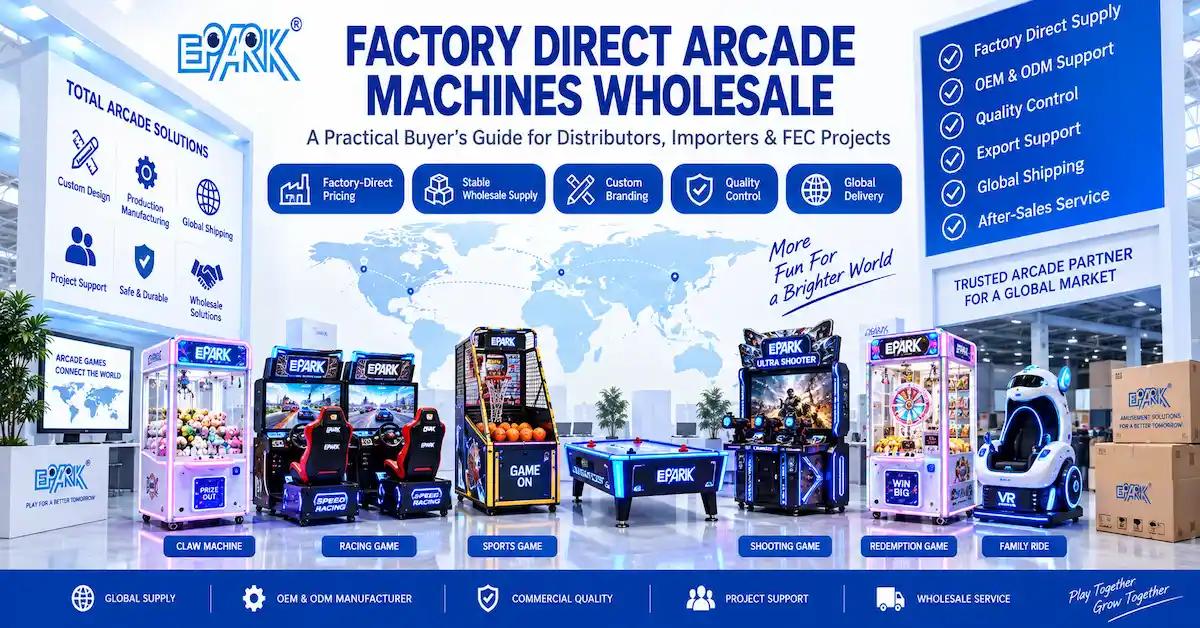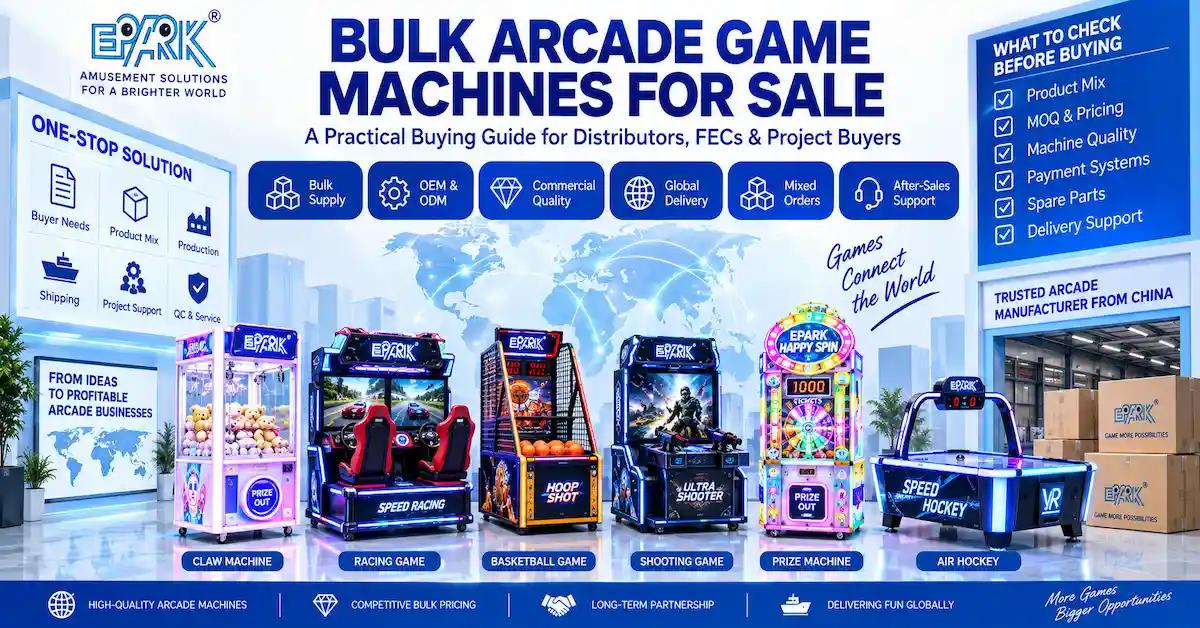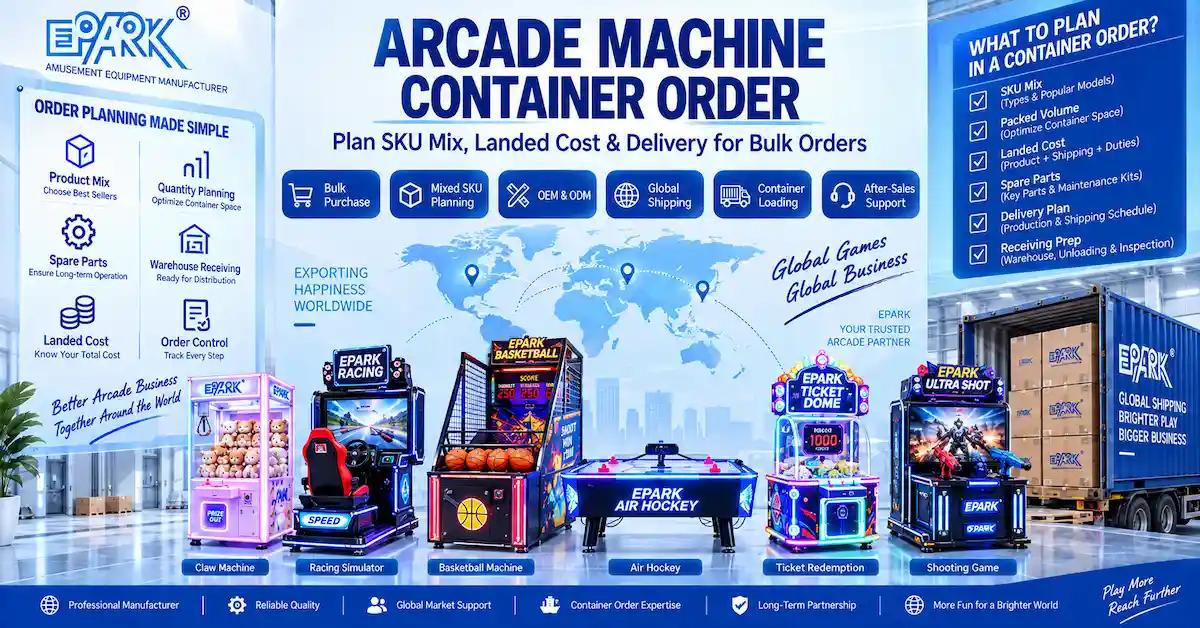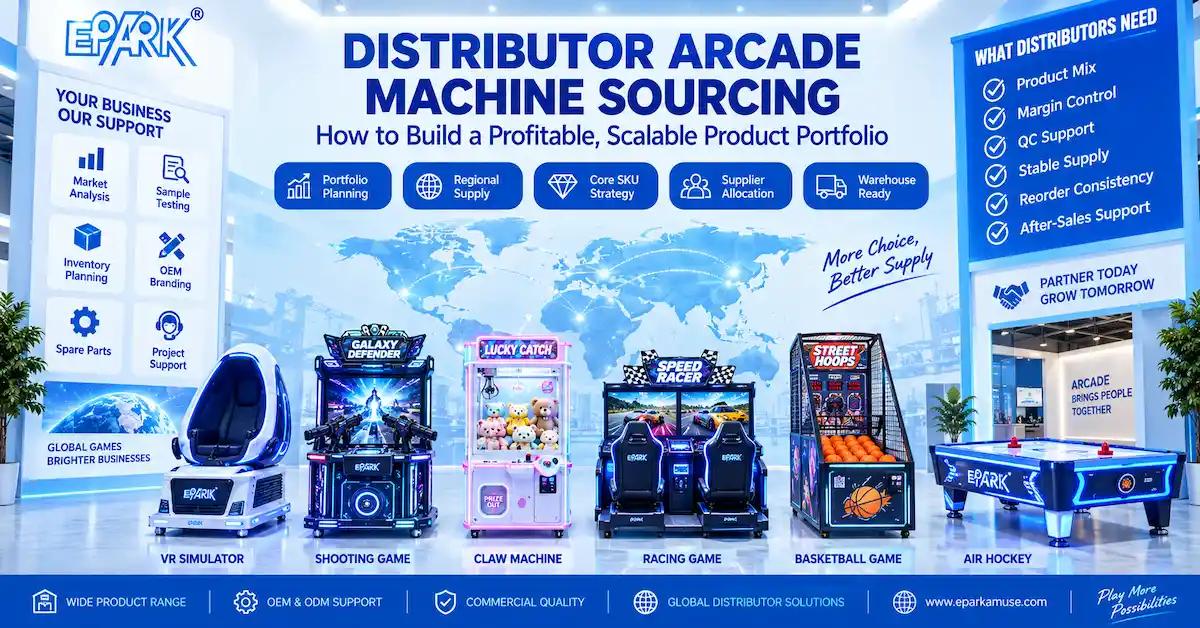


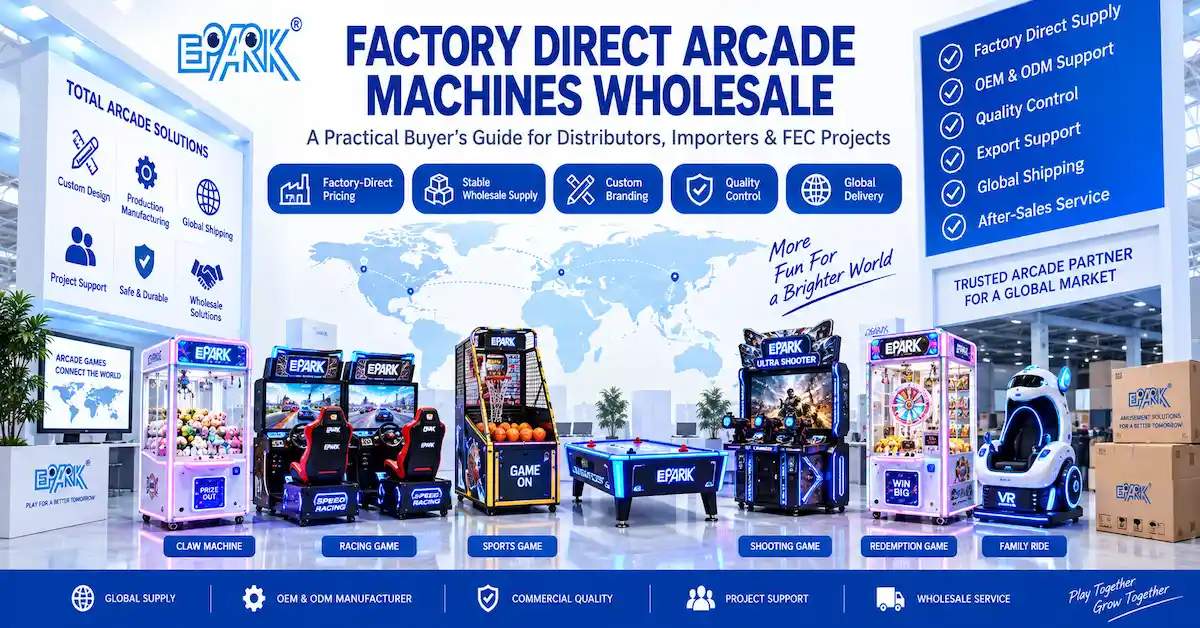
Factory Direct Arcade Machines Wholesale Is a Supply Program, Not Just a Purchase
For many B2B buyers, the phrase factory direct arcade machines wholesale immediately suggests one benefit: a lower purchase price.
Price matters, but focusing only on price misses the main commercial value of a direct manufacturing relationship.
A distributor, importer, FEC chain, entertainment project contractor, or multi-location arcade operator normally needs more than one successful shipment. The buyer needs equipment that can be quoted consistently, produced to an approved specification, inspected against the correct configuration, supported with identifiable spare parts, and reordered months or years later without restarting the entire purchasing process.
That changes the goal.
The objective is not simply:
“Can I buy this machine directly from the factory for less?”
A stronger question is:
“Can I turn this factory relationship into a repeatable wholesale supply system?”
That system should connect product selection, commercial pricing, quantity planning, technical specifications, production control, QC, packaging, after-sales support, spare parts, and future reorders.
Buyers still building their shortlist can first review the available commercial arcade equipment for wholesale purchasing and organize machines by customer type, venue application, price level, and expected order frequency.
What Does “Factory Direct” Actually Change for a Wholesale Buyer?
Buying closer to the manufacturing source can improve visibility and control, but it does not automatically make the transaction better.
The value depends on what the factory-direct relationship allows you to control.
Direct Access to Product Configuration
Wholesale buyers should be able to define the machine they are actually purchasing rather than relying only on a product photo or marketing name.
That means connecting the product to information such as:
| Control Item | What Should Be Defined |
|---|---|
| Factory model | Exact machine reference |
| Buyer SKU | Your internal commercial code |
| Machine revision | Approved production version |
| Electrical setup | Voltage, frequency, plug |
| Payment configuration | Coin, token, card, cashless interface |
| Language | Where applicable |
| Included accessories | Exact scope |
| Artwork | Standard or approved OEM version |
| Spare parts | Model-linked starter parts |
| Packaging | Approved shipping configuration |
When these fields are controlled, the factory relationship becomes much more useful for repeat purchasing.
Direct Access to Production Questions
A wholesale buyer may need answers to practical questions such as whether a component has changed, whether a particular cabinet revision remains available, whether a mixed-model order can share one production schedule, or whether a private-label version requires additional lead time.
These are production questions, not simply sales questions.
Direct Access to Change Information
One of the most important wholesale risks appears after the first successful batch.
A machine may still have the same exterior appearance while internal components have changed.
For example, a monitor, controller, power component, payment device, wiring arrangement, sensor, or other part may be replaced with a different version.
A professional factory-direct program should therefore make change visibility part of the relationship.
For buyers who want to evaluate manufacturing control itself in more detail, the direct arcade machine factory buying guide provides a useful factory-verification framework.
Factory Direct Does Not Automatically Mean the Lowest Total Cost
One of the strongest misconceptions in B2B sourcing is that eliminating a trading layer automatically produces the lowest total purchasing cost.
That is not always true.
The commercial result depends on the complete transaction.
Compare Total Commercial Scope
A lower factory quotation may exclude items another supplier includes.
The relevant comparison is not simply:
Supplier A: $X
Supplier B: $Y
Instead, normalize the scope.
| Cost / Service Area | Factory Quote A | Factory Quote B |
|---|---|---|
| Base machine | Confirm | Confirm |
| Payment hardware | Included / Extra | Included / Extra |
| OEM artwork | Included / Extra | Included / Extra |
| Accessories | Confirm | Confirm |
| Spare parts | Confirm | Confirm |
| Packing | Confirm | Confirm |
| Technical documents | Confirm | Confirm |
| QC scope | Confirm | Confirm |
| Freight support | Confirm | Confirm |
| After-sales support | Confirm | Confirm |
The lower number only has meaning after the scope is comparable.
Total Cost Includes Internal Buyer Cost
Wholesale buyers also carry their own operating costs.
A machine may create additional cost through:
- Warehouse space
- Technical training
- Slow inventory turnover
- Customer support
- Replacement freight
- Spare-parts complexity
- Warranty handling
That means a slightly higher machine price can still create a stronger wholesale margin if the product is easier to sell and support.
Build a Wholesale Program Around Approved SKU Families
A factory may offer hundreds of arcade machines.
A distributor usually should not treat all of them as permanent SKUs.
The stronger approach is to build a controlled wholesale portfolio.
Core Wholesale SKUs
Core SKUs are machines that deserve repeat purchasing because they serve broad customer demand.
Depending on your market, these may include established categories such as claw machines, basketball games, racing games, sports machines, or selected redemption equipment.
Core SKUs should receive the highest level of specification control because they are most likely to be reordered.
Project SKUs
Some machines are suitable for large FEC or entertainment projects but not for regular warehouse inventory.
Premium simulators and specialized large-format equipment can fall into this category.
The buyer can market them without permanently stocking them.
Test SKUs
New products should not automatically become core wholesale inventory.
A test SKU can be ordered in limited quantity, shown to customers, evaluated technically, and reviewed after actual sales feedback.
Exit SKUs
A professional distributor also needs a process for removing products.
A machine should not remain in the catalogue forever simply because it was purchased once.
Products may be exited because of slow demand, low margin, technical burden, component availability, or excessive overlap with stronger models.
This portfolio logic is covered from a distributor perspective in the arcade machine sourcing strategy guide, while a factory-direct program should convert the winning SKUs into stable production references.
Use a Factory SKU-to-Buyer SKU Mapping System
As the wholesale relationship grows, product naming becomes surprisingly important.
The same machine can eventually have several names:
Factory model → Buyer internal SKU → Marketing name → Customer-facing model
Without a mapping system, sales teams, warehouse staff, technicians, customers, and factory support may describe the same machine differently.
A Better Product Identity Structure
A simple controlled reference might look like:
Buyer SKU: RAC-02
Commercial Name: Twin Racing Pro
Factory Model: ABC-123
Approved Revision: Rev C
Now every department can trace the product back to the same technical reference.
Why This Matters for Spare Parts
Suppose the customer reports that a steering assembly has failed.
“Part for our racing machine” is not precise enough.
The support request should identify:
Buyer SKU → Factory Model → Revision → Required Part
This greatly reduces the chance of receiving an incompatible component.
Wholesale Pricing Should Use Quantity Logic, Not One “Best Price”
Professional wholesale pricing usually becomes more useful when buyers understand how quantity affects production and commercial terms.
The goal is not to demand the lowest possible number immediately.
It is to establish a pricing structure that supports repeat business.
Ask for Quantity Tiers
Depending on the machine and supplier, buyers can request pricing for different quantity levels.
For example:
| Quantity Scenario | Commercial Purpose |
|---|---|
| Trial quantity | Validate product and market |
| Small wholesale batch | Initial distributor stock |
| Standard repeat batch | Normal replenishment |
| Project quantity | Specific FEC / arcade build |
| Larger program quantity | Chain or distributor rollout |
Actual quantity breaks depend on product type and supplier conditions.
The important point is to understand the commercial relationship between volume and price rather than negotiating only one isolated order.
Do Not Let Quantity Discounts Create Dead Inventory
A lower unit price can encourage a buyer to increase quantity beyond realistic demand.
That can damage working capital.
The buyer should compare:
Unit savings vs inventory exposure
If buying five additional machines saves a small amount per unit but leaves those machines sitting in a warehouse for months, the “discount” may not be commercially valuable.
MOQ Should Be Defined at the Correct Level
MOQ can mean several different things.
A supplier may have:
- MOQ by model
- MOQ by artwork
- MOQ by customized cabinet color
- MOQ by component modification
- MOQ by total mixed order
These are not the same.
Standard Machine MOQ
Existing machines may allow smaller quantities because no new development is required.
OEM Artwork MOQ
A machine with customized artwork may require a different commercial threshold because artwork preparation and production setup are involved.
Customized Component MOQ
Changing a component, molded part, special cabinet structure, or other non-standard element may create a separate requirement.
Mixed Wholesale MOQ
For distributors, one of the most important questions is whether several models can be combined in one wholesale order.
This directly affects the ability to build a diversified inventory without overbuying one SKU.
Mixed-Model Factory Orders Can Improve Wholesale Flexibility
Many distributors do not need 30 units of one machine.
They may need a container or shipment containing several categories.
A mixed order might include:
- Claw machines
- Racing machines
- Basketball games
- Shooting games
- Redemption equipment
- Kiddie rides
The commercial advantage is portfolio breadth.
The operational disadvantage is complexity.
Mixed Orders Create More Control Points
Every additional model can introduce another:
- Specification
- Payment configuration
- Artwork version
- Spare-parts list
- Package type
- QC checklist
- Reorder reference
A mixed wholesale program therefore needs stronger documentation than a single-model order.
For buyers planning shipment-level assortment, the mixed arcade machine container guide can be used together with the factory-direct purchasing framework.
Separate Trial Orders From Wholesale Programs
A first purchase should answer a different question from a repeat purchase.
Trial Order Question
“Is this machine and supplier suitable for our market?”
Wholesale Program Question
“Can we repeatedly sell, support, and reorder this machine profitably?”
The buyer should not confuse these stages.
What to Validate During a Trial
A trial order can help evaluate commercial and technical factors such as machine appearance, gameplay, payment compatibility, cabinet build, operating stability, service access, component identification, and customer response.
What to Standardize After Validation
Once a product becomes a core wholesale SKU, freeze the approved configuration.
That configuration becomes the reference for later batches.
Create a Golden Wholesale Specification
For a repeat-order product, use one approved master specification.
This can be called a Golden Specification, Approved Configuration, or Master SKU Record.
The name matters less than the discipline.
The Master Record Should Cover
| Area | Controlled Information |
|---|---|
| Product identity | Factory model + buyer SKU |
| Revision | Approved hardware version |
| Electrical | Voltage / frequency / plug |
| Payment | Approved system/interface |
| Display | Approved configuration |
| Controls | Wheel, buttons, guns, sensors, etc. |
| Software | Version / language where relevant |
| Artwork | Approved file revision |
| Accessories | Included items |
| Parts | Recommended service references |
| Packing | Approved package configuration |
This document becomes the starting point for every reorder.
Do Not Use “Same as Last Time” as a Specification
Teams change.
Sales representatives change.
Factories update products.
Customers reorder months later.
A written master record is much safer than institutional memory.
Production Batches Should Remain Traceable
When wholesale volume grows, batch traceability becomes more valuable.
The buyer should be able to connect:
Purchase Order → Production Batch → Machine Version → QC Record → Shipment → Customer / Warehouse
This is particularly useful when diagnosing a technical issue.
If twenty machines from one batch share a particular component, the factory and buyer can investigate more efficiently.
Assign an Order Reference
Each purchase order should have a reference that can later be connected to the machine or production record.
Keep Revision Changes Visible
If the factory updates a component between Batch A and Batch B, record it.
The buyer can then determine whether spare parts remain interchangeable.
Component Commonality Can Improve Wholesale Economics
One of the hidden advantages of a well-designed wholesale portfolio is shared components.
Two visually different machines may be able to use common service items.
Examples could include selected:
- Buttons
- Payment readers
- Switches
- Power supplies
- Cables
- Speakers
- Locks
- Sensors
Not every product should be forced into identical hardware.
But where commonality does not reduce product performance, it can simplify service.
Fewer Spare-Part Families
A distributor supporting ten completely different technical platforms may need a much larger spare-parts inventory than one supporting ten products built around several common components.
Easier Technician Training
Common components reduce the number of unfamiliar systems technicians must learn.
Faster Local Service
A commonly stocked part is more useful than a low-cost part that takes weeks to identify and ship.
Factory-Direct Wholesale Should Include a Spare-Parts Strategy
Spare parts are not an after-sales detail.
They are part of the product's commercial viability.
Classify Parts by Business Impact
A practical spare-parts system can separate components into three groups.
Routine Wear Parts
These may be replaced more frequently due to player interaction or normal operation.
Critical Downtime Parts
A relatively inexpensive component may deserve local stock if its failure stops the entire machine.
Model-Specific Parts
Some components may be difficult to source locally and should be considered during the original purchase.
Connect Every Part to a Machine
Use a structured reference:
Part Code → Machine Model → Revision → Compatible Quantity
This is much more useful than receiving a carton labelled “free spare parts.”
The arcade equipment maintenance parts guide provides a deeper framework for model-linked replacement planning.
Direct Factory Communication Should Have a Clear Escalation Path
A factory-direct relationship is most valuable when communication becomes more efficient as the partnership grows.
If every technical question begins in a general sales chat and requires several days to reach the correct person, the relationship is not yet operationally mature.
Separate Commercial and Technical Communication
Commercial topics may include pricing, quantity, payment terms, delivery schedules, and new orders.
Technical topics may include machine configuration, components, failures, troubleshooting, and part references.
The buyer should know how each type of issue is handled.
Create a Standard Support Request
A useful technical support request should identify:
Machine model + buyer SKU + order reference + issue description + photo/video + relevant error behavior
This gives the factory a much better starting point than:
“Machine not working. Please help.”
Wholesale Buyers Should Review Factory Changes Before Reordering
Repeat ordering is where factory-direct sourcing either becomes valuable or becomes risky.
Before every new batch, ask whether the approved configuration has changed.
Review the Main Change Areas
| Area | Reorder Question |
|---|---|
| Cabinet | Same structure and dimensions? |
| Screen | Same approved configuration? |
| Controller | Same revision? |
| Payment hardware | Same interface? |
| Power system | Same approved components? |
| Software | Same version / settings? |
| Artwork | Same approved revision? |
| Accessories | Same included scope? |
| Spare parts | Still compatible? |
If changes exist, determine whether they are acceptable before production.
Not Every Change Is Bad
Factories may need to update a component because of availability, technical improvement, or supply-chain conditions.
The problem is not change itself.
The problem is uncontrolled change.
Build a Repeat-Order Review Into Every Purchase Cycle
Wholesale buyers often move quickly when replenishing successful machines.
That is understandable, but repeat orders still need review.
A useful reorder checkpoint can ask:
Demand: Is the machine still selling or performing well?
Margin: Does the latest landed cost still support the business?
Configuration: Is the approved version unchanged?
Parts: Are current service parts compatible?
Quantity: Does the next batch reflect real demand?
Market: Has a better replacement model appeared?
This prevents yesterday's bestseller from automatically consuming tomorrow's purchasing budget.
Production Capacity Should Be Evaluated by Delivery Reliability
Buyers often ask a factory:
“What is your monthly capacity?”
The number can be useful, but it does not tell the entire story.
Wholesale buyers should also ask whether the supplier can consistently meet an order-specific schedule.
Capacity Questions That Matter
The commercial issue is whether production capacity fits:
- Your quantity
- Your machine mix
- Your OEM requirements
- Your required shipment window
- Your repeat-order cadence
A mixed order of eight machine categories may create a different production schedule from one standardized 100-unit order.
Build Purchasing Forecasts
Distributors with recurring demand can improve factory planning by sharing approximate forecasts.
A forecast is not necessarily a binding PO.
It helps both sides identify likely production demand earlier.
Wholesale Ordering Cadence Can Improve Cash Flow
There are two extreme approaches to wholesale inventory.
One is constantly placing very small emergency orders.
The other is buying extremely large quantities to maximize discounts.
Neither is always optimal.
Replenishment Cadence
A distributor can build a repeat purchasing rhythm based on:
sales velocity + supplier lead time + shipping time + safety stock
This creates a more stable ordering process.
Use Different Cadence by SKU
Fast-moving claw machines may need frequent replenishment.
Large premium simulators may be ordered only against projects.
Different products should not automatically follow the same purchasing rhythm.
Factory-Direct Wholesale Pricing Should Protect Resale Margin
Wholesale buyers do not earn money when they buy.
They earn money when they sell or operate the equipment.
That means purchasing decisions should ultimately be evaluated through margin.
Use Landed Cost
A useful commercial framework is:
**Factory Price
- Customization
- Packing
- Freight Allocation
- Import-Related Cost
- Local Handling
= Landed Cost**
Then:
Selling Price
– Landed Cost
– Sales Cost
– Service Allowance
= Contribution Margin
This is more useful than focusing only on the difference between factory price and selling price.
Include Support Burden
Two machines can have similar margins on paper.
One may generate significantly more technical support calls.
That difference affects the true commercial value of the SKU.
Wholesale Product Selection Should Consider Serviceability
Product attractiveness matters.
Serviceability matters too.
A distributor or FEC chain should ask whether local technicians can access important components efficiently.
Serviceability Questions
Can the back or side panel open easily?
Can commonly serviced parts be replaced without dismantling the entire cabinet?
Are cables and connectors identifiable?
Can the payment reader be accessed?
Are service parts available?
Does the supplier maintain technical references for the machine?
A highly profitable machine during the sale can become expensive if every minor repair requires specialist intervention.
Quality Control Must Verify the Wholesale Configuration
For repeat wholesale production, QC should verify both operation and configuration.
Functional Testing
The required checks depend on machine category.
A racing machine may require steering, pedals, display, sound, seat, buttons, and multiplayer testing.
A claw machine may require claw movement, controls, prize mechanism, doors, settings, lighting, and payment testing.
A basketball game may require sensors, scoring, ball return, structure, display, and lighting checks.
A shooting machine may require controller response, calibration, display, audio, sensors, and game operation.
Configuration Verification
The inspector should also confirm:
Correct model → correct revision → correct electrical setup → correct payment system → correct artwork → correct accessories
A machine can operate perfectly and still be wrong for the buyer.
Use a Wholesale Batch Acceptance Matrix
A structured batch review can reduce misunderstandings.
| Acceptance Area | Wholesale Control |
|---|---|
| Product identity | Approved model and revision |
| Quantity | PO quantity |
| Function | Category-specific QC |
| Electrical | Buyer-approved configuration |
| Payment | Approved interface/device |
| Artwork | Correct OEM revision |
| Accessories | Complete included items |
| Spare parts | Model-linked package |
| Cosmetic quality | Commercially acceptable finish |
| Packaging | Correct package and identification |
The matrix does not need to be complicated.
It needs to match what the buyer actually purchased.
OEM Branding Should Be Built on Stable Product Platforms
Private labeling is attractive for distributors and arcade brands.
However, branding does not solve weak product selection.
Validate the machine first.
Then invest in branding.
Branded OEM
This may involve:
- Logo
- Cabinet artwork
- Color
- Header graphics
- Labels
- Packaging
Configured OEM
This can add controlled changes such as payment configuration, approved components, language, or market-specific setup.
Deeper ODM
A new structure or function requires more development, engineering, testing, and revision control.
The private brand arcade machines wholesale guide is more appropriate for detailed branding execution, while the factory-direct wholesale program should ensure the branded product remains reproducible.
Protect OEM Files With Revision Control
Bulk buyers should avoid approving artwork through scattered chat screenshots.
Create one approved artwork package.
Record:
Product SKU → Artwork File → Revision → Approval Date
If the brand later changes a logo or color, create a new revision instead of overwriting the old file without traceability.
This matters when older machines remain in the market and require replacement panels.
Packaging Should Be Reproducible Too
Wholesale standardization should not stop at the machine.
Packaging affects:
- Freight
- Damage risk
- Warehouse receiving
- Customer delivery
- Installation
A repeat-order product should ideally have a stable packing reference.
Record Package-Level Information
Depending on the product, track:
- Package quantity
- Packed dimensions
- Gross weight
- Assembly status
- Accessories location
- Spare-parts package
- Handling notes
If packaging changes significantly between orders, freight economics may also change.
A Factory-Direct Program Should Support Warehouse Receiving
For distributors, the supplier relationship continues after the shipment leaves the factory.
The destination warehouse needs enough information to identify what arrived.
The Receiving Team Should Be Able to Match
Package → Machine SKU → Quantity → Accessories → Spare Parts
This becomes especially important for mixed-model wholesale orders.
Customer-Specific Orders Should Be Identified
If some machines are already sold to customers while others are warehouse stock, identify them before shipment where practical.
That reduces handling after arrival.
Repeat-Order Data Creates Better Purchasing Decisions
A mature wholesale relationship should gradually become more data-driven.
The buyer can track metrics such as:
| Metric | What It Helps Answer |
|---|---|
| Sales velocity | Which SKUs deserve more stock? |
| Gross margin | Which machines create commercial value? |
| Support requests | Which products create technical burden? |
| Parts usage | What should be stocked locally? |
| Reorder interval | How often should inventory be replenished? |
| Damage rate | Is packaging appropriate? |
| Customer feedback | Which products should be improved or replaced? |
The factory does not need access to every internal business metric.
But the buyer should use these metrics when deciding what to reorder.
Factory Direct vs Wholesale Trader vs Local Distributor
There is no sourcing route that is automatically best for every buyer.
| Purchasing Route | Strong Fit | Potential Advantage | Main Trade-Off |
|---|---|---|---|
| Factory Direct | Repeat / bulk / OEM buyers | Configuration and production access | Buyer manages more sourcing details |
| Wholesale Trader | Multi-factory category sourcing | Broader consolidated access | Less direct production control |
| Local Distributor | Small/urgent/local purchase | Local inventory and support | Higher purchase price may apply |
| Project Integrator | Complete venue project | Coordinated implementation | Supplier choice may be bundled |
The right route depends on:
order scale + technical capability + local service + customization + purchasing frequency
Factory-direct sourcing becomes particularly attractive when the buyer benefits from long-term control rather than simply purchasing one cabinet.
Red Flags in Factory Direct Arcade Machines Wholesale
Factory-direct marketing claims should be tested against practical evidence.
A buyer should investigate further when:
- The supplier cannot identify the exact machine revision
- Pricing changes without a clear scope change
- MOQ rules are inconsistent
- OEM approval is informal
- Components change without notification
- Spare parts are not linked to models
- QC criteria are unclear
- Packaging information is unavailable
- Repeat orders are recreated from screenshots
- Production schedule changes are not communicated
- Technical questions receive only sales responses
- Different batches cannot be traced
A red flag does not automatically mean the supplier is unsuitable.
It means the issue should be clarified before scaling the relationship.
What Makes a Strong Factory-Direct Wholesale Relationship?
A strong relationship becomes easier to manage over time.
The first order may require significant communication.
The fifth order should require less uncertainty.
Strong Relationships Create Reusable Assets
These include:
- Approved SKU list
- Master specifications
- OEM artwork revisions
- QC checklists
- Spare-parts records
- Packing references
- Order history
- Change records
Each new order builds on the previous one.
Weak Relationships Restart Every Time
If every reorder requires the buyer to resend photos, explain the voltage again, rediscover the payment system, identify spare parts from scratch, and renegotiate the product configuration, the relationship is not yet scalable.
How to Structure a Factory-Direct Wholesale RFQ
A professional RFQ should give the manufacturer enough information to build a relevant commercial proposal rather than simply sending a catalog.
Use the following purchasing brief:
- Buyer type: distributor, importer, FEC operator, arcade chain, project contractor, or other business
- Target country or region
- Customer or venue type
- Required arcade categories
- Shortlisted machine models
- Estimated quantity per model
- Trial order or repeat wholesale program
- Voltage, frequency, and plug
- Payment-system requirements
- Language requirements where applicable
- OEM or private-label requirements
- Desired spare-parts support
- Delivery destination
- Target shipping period
- Expected future reorder frequency or annual demand range
A structured RFQ helps the supplier separate confirmed requirements from assumptions.
Buyers ready to evaluate specific models can browse factory-direct commercial arcade machine options and submit quantities, destination, payment configuration, OEM needs, and future purchasing plans through the arcade equipment wholesale quotation request.
A Practical Factory-Direct Wholesale Workflow
A scalable wholesale program can be organized into five commercial stages rather than treating every shipment as a new project.
Stage 1: Qualification
Define your market and shortlist products.
Evaluate both the machines and the supplier relationship.
Use samples or smaller quantities where product risk justifies it.
Stage 2: Standardization
Convert proven models into approved wholesale SKUs.
Create product mapping, specifications, spare-parts references, and artwork records.
Stage 3: Commercialization
Set pricing tiers, reorder quantities, landed-cost models, sales positioning, and inventory policy.
Stage 4: Repeat Production
Use approved specifications for production, QC, packing, and receiving.
Review changes before every new batch.
Stage 5: Portfolio Optimization
Track sales, service burden, margin, and customer feedback.
Expand strong SKUs.
Correct weak ones.
Retire products that no longer justify inventory or support resources.
This is the point where factory direct becomes more than a sourcing claim.
It becomes a repeatable business process.
Questions to Ask Before Moving From First Order to Wholesale Program
Before scaling a successful machine into a regular wholesale SKU, a buyer should be able to answer several questions.
Is Demand Proven?
Has the machine generated actual sales or strong project demand?
Is Margin Healthy?
Does the landed cost leave enough room for sales and service?
Is the Configuration Stable?
Can the same approved machine be reproduced?
Are Spare Parts Identifiable?
Can your team support customers after the sale?
Is the Product Easy to Reorder?
Does the factory maintain the relevant production reference?
Does It Fit the Portfolio?
Does it serve a unique customer need rather than duplicate another SKU?
If several answers are unclear, the machine may still belong in a test category rather than a core wholesale program.
Frequently Asked Questions
What Does Factory Direct Arcade Machines Wholesale Mean?
It refers to purchasing commercial arcade machines in wholesale quantities through a manufacturing-level relationship rather than only buying finished equipment from another resale layer. For B2B buyers, the main value should be greater control over product specifications, production communication, QC, OEM customization, spare parts, and repeat orders.
Are Factory Direct Arcade Machines Always Cheaper?
Not necessarily in total cost. Factory price is only one part of the commercial equation. Buyers should also compare configuration, payment hardware, customization, packing, freight, import costs, spare parts, warranty handling, and technical support.
Who Should Buy Arcade Machines Factory Direct?
Factory-direct wholesale is most suitable for distributors, importers, FEC operators, arcade chains, wholesalers, entertainment project contractors, private-label brands, and other buyers who purchase multiple machines or need repeatable configurations.
Can Different Arcade Machines Be Combined in One Wholesale Order?
This depends on the manufacturer's MOQ, product mix, production schedule, packing method, and commercial terms. Mixed-model ordering can be useful for distributors, but it requires stronger specification and inventory control.
What Arcade Machines Are Commonly Purchased Wholesale?
Typical categories include claw machines, racing games, basketball machines, shooting games, redemption machines, prize games, sports machines, kiddie rides, VR simulators, and other commercial entertainment equipment.
Can Factory Direct Arcade Machines Be Private Labeled?
Many machines can support some level of OEM customization, such as logos, artwork, colors, labels, payment configuration, or packaging. More significant structural or functional changes may require ODM development and additional engineering.
How Should I Compare Factory-Direct Wholesale Prices?
Compare identical machine configurations and commercial scope. Confirm payment hardware, OEM requirements, accessories, spare parts, packing, QC, freight responsibility, and support before comparing the final price.
What Should I Confirm Before a Repeat Order?
Confirm the machine model, production revision, electrical configuration, payment system, software or language where relevant, artwork, accessories, spare-parts compatibility, packaging, and any component changes since the previous batch.
Should Spare Parts Be Purchased With Wholesale Arcade Machines?
For many commercial buyers, a planned starter spare-parts package is useful. The exact parts should depend on machine quantity, expected wear, downtime impact, local technical capability, and replenishment lead time.
How Do I Request a Factory-Direct Arcade Machine Wholesale Quote?
Prepare the target market, machine categories, models, quantities, voltage, payment system, OEM requirements, spare-parts needs, delivery location, and repeat-order expectations. You can then submit these requirements through the commercial arcade machine wholesale inquiry for a project-specific discussion.
Conclusion
Factory direct arcade machines wholesale should create more value than a lower first-order price. The real advantage is building a repeatable supply program with controlled SKUs, clear quantity rules, stable specifications, traceable production batches, model-linked spare parts, documented QC, OEM revision control, and reliable repeat ordering.
For distributors, importers, FEC operators, arcade chains, and project buyers, the strongest factory relationship becomes easier—not harder—to manage as order volume grows. Buyers developing a repeat wholesale program can review commercial arcade machines for wholesale projects and submit their model list, quantities, destination, technical requirements, and OEM plans through the factory-direct arcade equipment quotation page.
Disclaimer
The information provided on this website is for general informational purposes only.
While EPARK Arcade Game Machine Manufacturer strives to ensure accuracy and reliability, no warranties—express or implied—are made regarding completeness, performance, or applicability.
Product specifications, designs, and features may vary depending on usage, customization, and customer requirements.
Buyers are responsible for verifying all technical details, compliance certifications, and suitability before procurement.
EPARK shall not be held liable for any direct, indirect, incidental, or consequential damages arising from the use of this website or its content, including but not limited to business losses, data errors, or equipment misuse.
For tailored solutions or further verification, please visit our Contact Us
Intellectual Property Notice
All articles, product images, videos, catalogs, software, and related materials published on this website are the intellectual property of EPARK, unless otherwise stated.
Unauthorized reproduction, distribution, modification, or commercial use of any content is strictly prohibited without prior written consent from EPARK.
EPARK reserves the right to take legal action against any unauthorized use, including but not limited to copyright infringement, misrepresentation, or unfair competition.
Trademarks
The name EPARK, the EPARK logo, and all related brand elements displayed on this website are registered trademarks or trade names of Guangzhou EPARK Electronic Technology Co., Ltd.
Other product names, company names, or logos mentioned on this site may be trademarks of their respective owners.
Unauthorized use of EPARK's trademarks for commercial purposes, including advertising, promotions, or product packaging, is strictly prohibited.
Governing Law
These terms are governed by the laws of the People's Republic of China.