

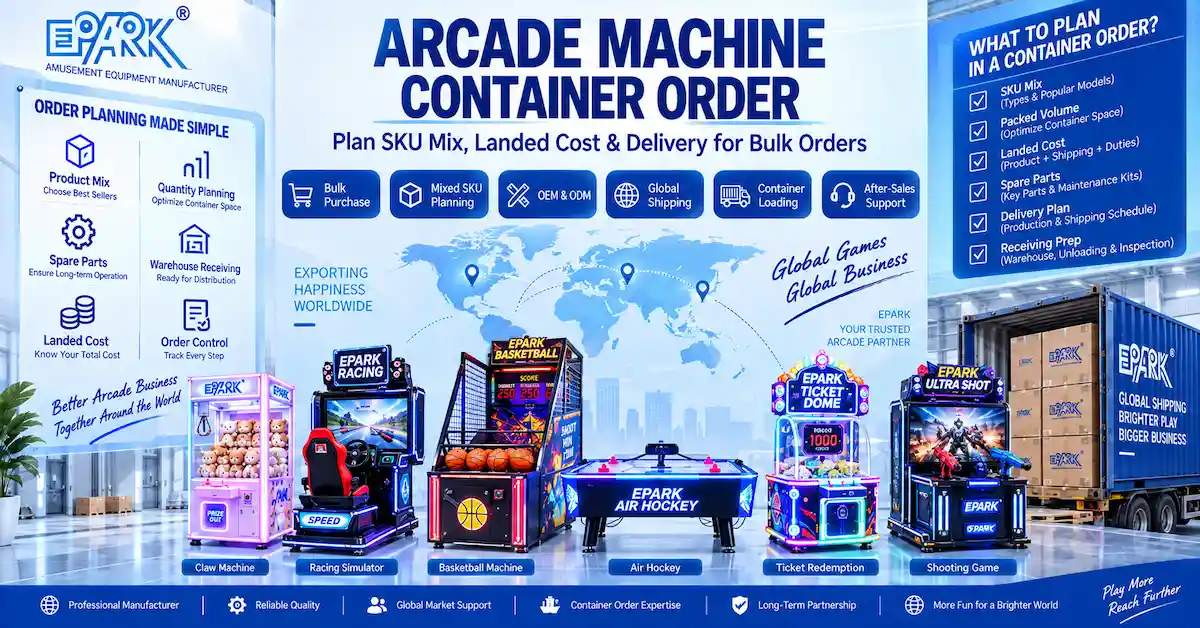
Why an Arcade Machine Container Order Is a Purchasing Decision Before It Is a Shipping Decision
An arcade machine container order is often discussed too late.
Buyers select machines, negotiate prices, approve customization, and only then ask:
“Can everything fit into one container?”
For B2B purchasing, the better approach is to reverse that sequence.
The container should be treated as one part of a broader commercial plan connecting:
Market Demand → SKU Mix → Quantity → Budget → Packed Volume → Purchase Order → Production → Shipping → Receiving → Reorder
This matters because maximizing the number of machines inside a container does not automatically maximize the commercial value of the order.
A distributor can fill every available cubic meter and still receive too many slow-moving SKUs.
An FEC investor can reduce freight per machine but create an unbalanced venue mix.
An importer can save on one shipment while tying up too much working capital in inventory that will not move for months.
The objective is therefore not:
“How do we fill the container?”
It is:
“How do we build the right commercial order, then use the container efficiently?”
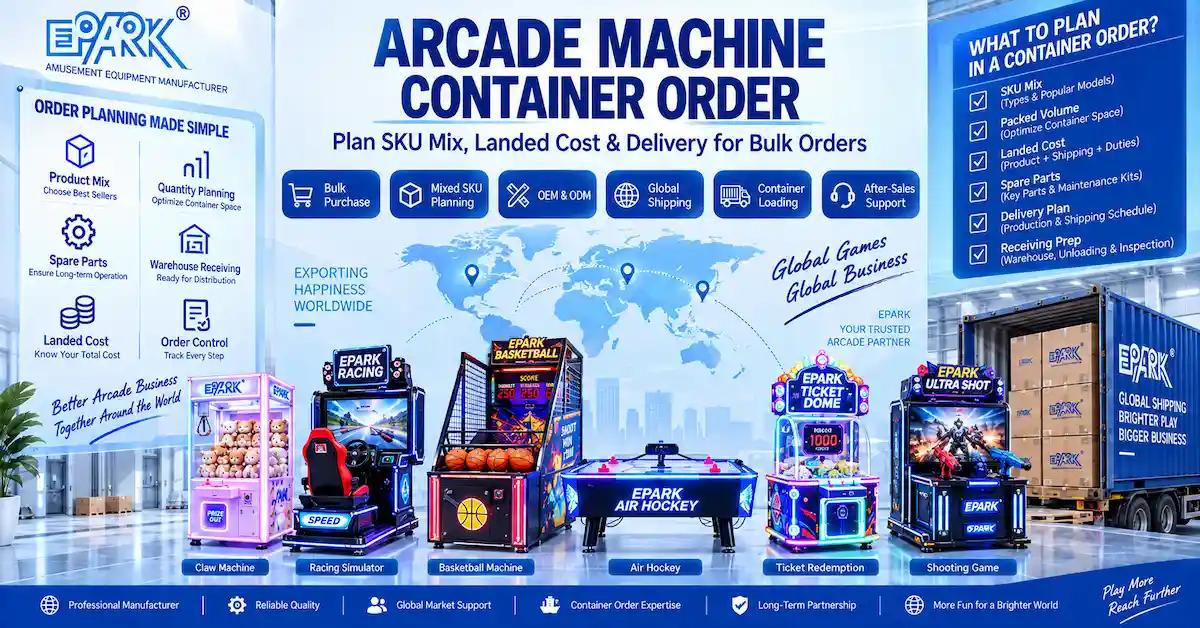
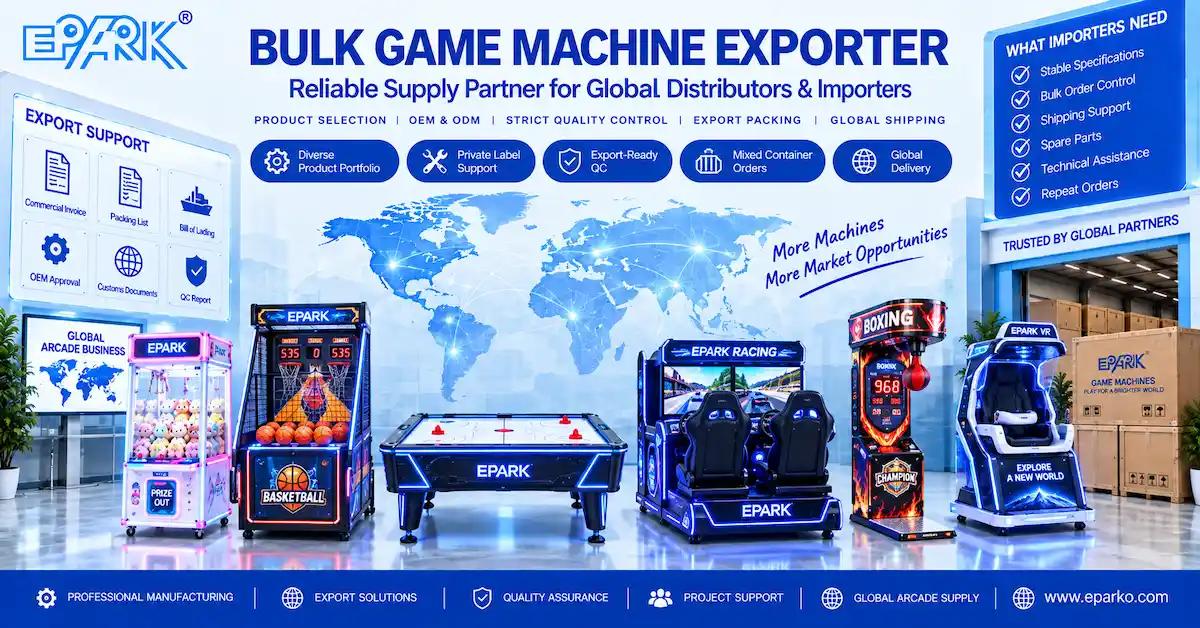
Buyers can review the current EPARK arcade equipment range first and shortlist machines according to their actual business model.
Define the Purpose of the Container Before Selecting Machines
Not every full-container purchase should be structured in the same way.
The first step is identifying what the order is supposed to achieve.
Distributor Inventory Order
A distributor is usually buying for future resale.
The container may need to balance:
- Fast-moving core machines
- Mid-volume products
- New models for market testing
- Display or showroom machines
- Spare parts
- Existing customer orders
The main risk is over-investing in products that look attractive but have weak local demand.
New FEC Project Order
An FEC container is tied to a specific venue.
The order normally needs to support:
- Venue zoning
- Target age groups
- Player capacity
- Game-category balance
- Revenue model
- Floor space
- Opening schedule
Here, commercial layout is usually more important than maximizing machine count.
Chain Expansion Order
A chain operator may be replicating an existing venue concept.
The priority becomes:
- Configuration consistency
- Repeatable machine models
- Standard payment systems
- Identical artwork or branding
- Spare-parts compatibility
Replenishment Order
A distributor or operator may already know exactly which products sell.
This order can be more concentrated around proven SKUs.
Market-Test Order
A buyer entering a new market may deliberately use a container to test multiple product families.
This produces a very different SKU mix from a mature distributor replenishment order.
Build a Container SKU Architecture Instead of Ordering Random Machines
One of the strongest ways to improve an arcade machine container order is to assign every SKU a commercial role.
Core SKUs
These are machines with proven or highly predictable demand.
Examples may include:
- Claw machines
- Basketball games
- Popular prize machines
- Selected racing machines
Core products normally deserve the largest quantity allocation.
Supporting SKUs
These widen the product offering without dominating the investment.
Examples might include:
- Air hockey
- Boxing games
- Shooting machines
- Kiddie rides
Test SKUs
These are newer models being evaluated for future growth.
A distributor may purchase one or a few units rather than immediately allocating a large share of the container.
Project-Specific SKUs
Large VR simulators, motion equipment, or specialized machines may be included because one customer has already committed to them.
They should not automatically become warehouse inventory.
| SKU Role | Primary Purpose | Typical Buying Logic |
|---|---|---|
| Core | Repeat sales | Larger quantity |
| Supporting | Broaden portfolio | Moderate quantity |
| Test | Validate demand | Limited quantity |
| Project-specific | Fulfill confirmed project | Buy to requirement |
| Demo | Showroom/sales support | Usually one unit |
This approach gives every machine a reason to occupy container space.
Start With the Commercial Budget, Not the Container Size
A common mistake is deciding:
“We are ordering a 40-foot container.”
before deciding how much working capital should actually be invested.
Container space is a logistics constraint.
Budget is a business constraint.
Separate the Budget Into Four Layers
Equipment Purchase
This includes the machines and agreed customization.
Factory-Side Extras
Depending on the order, this may include:
- OEM artwork
- Extra accessories
- Spare parts
- Special packing requirements
International Logistics
This may include freight and related shipment costs according to the agreed Incoterm and shipping arrangement.
Destination Costs
Depending on the market, buyers may also face:
- Customs-related costs
- Local handling
- Delivery
- Warehousing
- Installation
- Commissioning
The purchasing decision should remain commercially sensible after all four layers are considered.
Calculate Landed Cost by SKU, Not Only by Container
One container generates one freight invoice, but the machines inside it may have very different economic profiles.
A distributor therefore needs to allocate logistics cost back to individual products.
Why Equal Allocation Can Be Misleading
Suppose a container includes:
- Compact claw machines
- Large seated racing simulators
- Basketball machines
- One VR simulator
Dividing freight equally by machine count would distort the true cost.
The VR or racing equipment may consume much more shipping space.
Common Allocation Methods
Buyers may allocate freight using:
- Packed cubic volume
- Packed weight
- A blended volume-and-weight method
- Product value where commercially appropriate
The goal is not accounting perfection.
The goal is obtaining a realistic enough landed cost to support resale pricing and margin decisions.
Use Landed Margin for Distributor Decisions
A useful commercial formula is:
Expected Selling Price
– Landed Product Cost
– Local Handling
– Sales Cost
– Warranty / Service Allowance
= Contribution Margin
This gives the buyer more useful information than the factory price alone.
Mixed SKU Container or Concentrated SKU Container?
There are two broad container strategies.
Mixed Container Order
A mixed container includes different product families.
Advantages can include:
- Wider market coverage
- Lower inventory exposure per model
- Better suitability for new distributors
- More complete FEC project mix
Challenges include:
- More complex packing data
- More SKU management
- More spare-parts references
- More receiving complexity
EPARK already has a dedicated Mixed Container Arcade Machines guide covering the packing and freight side in more detail. Eparko
Concentrated Container Order
A concentrated order contains fewer product families and larger quantities per SKU.
This may work better when:
- Demand is proven
- The distributor has repeat customers
- The SKU is standardized
- Replenishment speed matters
The disadvantage is greater inventory exposure if demand changes.
Use Customer Demand to Decide
Do not choose mixed or concentrated simply because one looks cheaper to ship.
Choose based on:
sales velocity + inventory strategy + customer pipeline + service capability
Do Not Choose a Container Based on Generic Machine Counts
Questions such as:
“How many arcade machines fit in a 40HQ?”
sound practical but are rarely enough for purchasing.
Different equipment can have completely different shipping configurations.
A basketball machine may have detachable structures.
A racing simulator may ship with its seat separated.
A VR machine may have an irregular base.
A claw machine may be relatively rectangular and easier to plan.
Your real planning unit is therefore the packed package, not only the assembled machine.
Collect Packed Data Before Final Container Selection
For every SKU, request:
| Data | Purpose |
|---|---|
| Packed dimensions | Space planning |
| Package count | Container and receiving control |
| Gross weight | Handling and logistics |
| Shipping format | Assembly planning |
| Stack restrictions | Loading assessment |
| Accessories package | Receiving accuracy |
| Machine reference | Traceability |
Then compare FCL and other shipment options with your freight or logistics partner.
For physical loading and securing details, use the separate Arcade Machine Container Loading Service guide. Eparko
Decide Whether a Full Container Is Actually Commercially Justified
A buyer should not use an FCL simply because full-container freight appears more efficient.
A Full Container May Make Sense When
- Demand supports the inventory
- A complete venue requires the equipment
- The order has enough packed volume
- Multiple confirmed customers can share the shipment
- Replenishment quantities justify the commitment
LCL or Smaller Shipments May Be Better When
- Demand is uncertain
- The buyer is testing new products
- Cash flow is more important than freight efficiency
- Only a small number of machines are needed urgently
A cheaper freight rate per cubic meter can become expensive if it encourages unnecessary inventory.
Freeze the Commercial Order Before Production Starts
An arcade machine container order becomes difficult to control when quantities and specifications continue changing during production.
Use a formal order-freeze point.
The Order Freeze Sheet Should Confirm
- Buyer SKU
- Factory model
- Quantity
- Voltage
- Frequency
- Plug
- Payment configuration
- Language
- Artwork
- Accessories
- Spare parts
- Packaging reference
- Destination
- Required shipment window
After this point, changes should be treated as controlled revisions rather than informal requests.
Why Change Control Matters
One late quantity change can affect:
- Production
- Artwork
- Packaging
- Packed volume
- Loading arrangement
- Commercial invoice
- Packing list
- Freight booking
Small purchasing changes can create large downstream consequences.
Plan the Container Around Revenue Priority
Not every product inside the shipment contributes equally to the business.
A distributor should identify which machines generate:
- Fast turnover
- High margin
- Strong customer demand
- Strategic showroom value
- Project completion value
This helps determine where capital should be concentrated.
Example Portfolio Logic
Instead of:
10 machines because 10 machines fit
use:
Machine A: strong repeat demand
Machine B: strong margin
Machine C: needed for existing project
Machine D: one test unit
The result is a commercially designed order rather than a volume-driven order.
Reserve Space for Spare Parts and Accessories Deliberately
Spare parts should be part of the purchase plan from the beginning.
Do not wait until the machines have been packed to ask whether there is room.
Build Spare Parts by Machine Family
For each model, identify:
- High-wear parts
- Critical electronic parts
- Controls
- Sensors
- Buttons
- Payment-system components
- Special model-specific parts
Keep Spare Parts Traceable
Use references such as:
Machine Model → Part Code → Quantity
If possible, keep spare-part packages clearly separated from ordinary accessories.
Avoid “Mystery Boxes”
A carton full of unlabeled parts may save little time at the factory but create major confusion at the destination warehouse.
Use a Container Order Matrix Before Releasing the PO
A simple planning table can reveal commercial problems early.
| SKU | Role | Qty | Packed CBM | Landed Cost | Customer / Stock | Priority |
|---|---|---|---|---|---|---|
| Model A | Core | Confirm | Confirm | Calculate | Stock | High |
| Model B | Supporting | Confirm | Confirm | Calculate | Stock | Medium |
| Model C | Project | Confirm | Confirm | Calculate | Customer X | High |
| Model D | Test | Confirm | Confirm | Calculate | Market test | Low |
The exact numbers should come from the approved order.
The important point is connecting logistics data with the reason each SKU was purchased.
Plan Destination Receiving Before the Container Leaves the Factory
The container order does not end at loading.
Before shipment, determine what happens after arrival.
Confirm Warehouse Capability
Check:
- Door dimensions
- Forklift availability
- Unloading equipment
- Storage space
- Internal moving routes
- Electrical testing area
Know Which Machines Are Pre-Sold
If some machines already belong to customers, mark them before loading.
This helps the destination team separate:
- Customer orders
- Warehouse inventory
- Demo machines
- Spare parts
Prepare the Receiving List
The warehouse should receive:
- Machine list
- Package list
- Package codes
- Accessories list
- Spare-parts list
- Photos where useful
This reduces receiving errors.
Think About Unloading Sequence for Project Orders
For a distributor warehouse, exact unloading sequence may not be critical if there is enough handling space.
For an FEC project, it can matter more.
If equipment needs to be installed in phases, the buyer should discuss destination priorities early.
However, commercial preference should never override safe container loading.
The final loading arrangement must remain technically appropriate.
Align the Purchase Order, Packing List, and Physical Shipment
One of the simplest ways to improve container-order control is to maintain one source of truth.
Your approved equipment schedule should drive later documentation.
The Same References Should Flow Through
PO → Production List → QC List → Packing List → Loading Record → Warehouse Receiving
Model names and quantities should not change randomly between documents.
EPARK's Arcade Machine Export Documentation guide covers this document-control topic in more detail. Eparko
Avoid Overfilling the Container to “Save Freight”
Maximizing physical utilization is not always optimal.
Over-aggressive space use can create commercial or operational problems.
Possible risks include:
- Unnecessary inventory
- Poor product mix
- Difficult unloading
- Insufficient protection
- No room for approved spare parts
- Last-minute model substitutions
A good container plan balances:
commercial value + packing efficiency + safe handling + receiving practicality
not maximum theoretical occupancy.
Use a Pre-Shipment Commercial Review
Before the shipment is released, review the order from a purchasing perspective—not only a QC perspective.
Commercial Review Questions
- Does the final quantity match the sales plan?
- Are customer-specific machines identified?
- Are test SKUs still justified?
- Have any quantities changed?
- Are spare parts included?
- Has landed-cost calculation been updated?
- Does warehouse space still support the order?
Technical Review Questions
- Is configuration approved?
- Has QC been completed?
- Are accessories accounted for?
- Is packaging finalized?
- Are final packed dimensions available?
Logistics Review Questions
- Is shipment method confirmed?
- Is the forwarder aligned?
- Is destination receiving ready?
- Are documents being prepared from final packing data?
This three-part review catches problems that a simple “machines finished” message cannot.
A Practical Arcade Machine Container Order Workflow
A disciplined workflow can be organized into twelve stages.
1. Define the Buying Objective
Distributor stock, project supply, replenishment, or testing.
2. Build the SKU Shortlist
Choose product categories according to real demand.
3. Assign SKU Roles
Core, supporting, test, project, or demo.
4. Set the Investment Budget
Define the maximum practical commitment.
5. Request Quotations and Preliminary Packing Data
Do not wait until production is complete.
6. Estimate Landed Cost
Evaluate commercial margin before final quantity approval.
7. Select Shipment Strategy
Compare FCL/LCL or available container options based on actual order economics.
8. Freeze the Purchase Order
Confirm quantities and technical configurations.
9. Complete Production and QC
Check against the frozen specification.
10. Finalize Packed Data and Loading Plan
Move from preliminary estimates to actual information.
11. Align Documents and Destination Receiving
Prepare warehouse or project teams before arrival.
12. Review the Order After Delivery
Record:
- Actual damage
- Missing parts
- Selling velocity
- Freight allocation
- Customer feedback
- Reorder decisions
That information improves the next container.
What Should You Send a Supplier for a Container-Order Proposal?
For a serious arcade machine container order, send more than a product list.
Include:
- Destination country
- Buyer type
- Target machine categories
- Preferred models
- Proposed quantities
- Stock vs confirmed-project allocation
- Voltage and frequency
- Payment-system requirements
- OEM requirements
- Required spare parts
- Destination port or delivery location
- Preferred shipping period
- Warehouse or receiving conditions
- Current freight forwarder status
- Expected future reorder plan
If quantities are still flexible, say so.
The supplier can then provide a preliminary order and packing proposal before the final PO is frozen.
You can review EPARK's arcade equipment range and send the proposed SKU mix, quantities, destination, and shipping requirements through the EPARK contact page.
Frequently Asked Questions
What Is an Arcade Machine Container Order?
An arcade machine container order is a bulk equipment purchase planned for containerized international shipment. For B2B buyers, it should include commercial SKU planning, quantities, configurations, packing data, freight considerations, spare parts, documents, and destination receiving.
How Many Arcade Machines Fit in One Container?
There is no universal number. Machine types, packed dimensions, package quantities, weights, detachable structures, stacking restrictions, and container type all affect the final quantity. Use actual packed data and a reviewed loading plan.
Should I Order One Arcade Machine Type or Mix Several Types?
That depends on your business. Mature distributors may use concentrated replenishment orders, while new distributors and FEC projects often require mixed categories. Base the decision on demand and inventory strategy.
Is a Full Container Always Cheaper Than LCL?
Not necessarily in total business terms. FCL may reduce freight cost per unit of space, but unnecessary inventory can increase working-capital and storage costs. Compare total commercial impact.
When Should I Finalize the Container Size?
Choose the final shipment arrangement after the machine mix and preliminary packed data are sufficiently clear. Do not select a container based only on catalog dimensions.
Should Spare Parts Be Included in the Same Container?
Relevant starter spare parts can often be included with the main order, subject to the actual shipment plan. They should be clearly identified by model and part reference.
How Do I Allocate Freight Cost Across Different Machines?
B2B buyers commonly use packed volume, weight, or a blended allocation method. Choose a method that produces a useful landed-cost estimate for pricing and margin analysis.
Can Customer Orders and Distributor Inventory Share One Container?
Yes, if the commercial and logistics plan supports it. Identify customer-owned machines, inventory units, accessories, and spare parts clearly before shipment.
What Documents Should Be Checked Before Shipment?
The exact documents depend on the order and destination, but buyers should ensure commercial and packing information is consistent with the final physical shipment. Use the final approved equipment schedule as the reference.
How Do I Request a Container Quote From EPARK?
Prepare your machine list, quantities, destination, electrical and payment requirements, OEM needs, spare-parts plan, target shipping period, and receiving conditions. Then contact EPARK for an order-specific proposal.
Conclusion
A successful arcade machine container order begins with commercial planning, not with empty container space. B2B buyers should first define the order objective, build a disciplined SKU mix, calculate landed cost, set quantity priorities, and freeze the purchase specification before turning the order into a final packing and loading plan.
The best container is not necessarily the one carrying the maximum number of machines. It is the one carrying the right machines, in the right quantities, at a sustainable landed cost, with clear documentation, spare parts, and a workable receiving plan. Buyers preparing a new bulk shipment can explore EPARK's arcade equipment range and contact EPARK with their proposed product mix and destination requirements.
Disclaimer
The information provided on this website is for general informational purposes only.
While EPARK Arcade Game Machine Manufacturer strives to ensure accuracy and reliability, no warranties—express or implied—are made regarding completeness, performance, or applicability.
Product specifications, designs, and features may vary depending on usage, customization, and customer requirements.
Buyers are responsible for verifying all technical details, compliance certifications, and suitability before procurement.
EPARK shall not be held liable for any direct, indirect, incidental, or consequential damages arising from the use of this website or its content, including but not limited to business losses, data errors, or equipment misuse.
For tailored solutions or further verification, please visit our Contact Us
Intellectual Property Notice
All articles, product images, videos, catalogs, software, and related materials published on this website are the intellectual property of EPARK, unless otherwise stated.
Unauthorized reproduction, distribution, modification, or commercial use of any content is strictly prohibited without prior written consent from EPARK.
EPARK reserves the right to take legal action against any unauthorized use, including but not limited to copyright infringement, misrepresentation, or unfair competition.
Trademarks
The name EPARK, the EPARK logo, and all related brand elements displayed on this website are registered trademarks or trade names of Guangzhou EPARK Electronic Technology Co., Ltd.
Other product names, company names, or logos mentioned on this site may be trademarks of their respective owners.
Unauthorized use of EPARK's trademarks for commercial purposes, including advertising, promotions, or product packaging, is strictly prohibited.
Governing Law
These terms are governed by the laws of the People's Republic of China.