
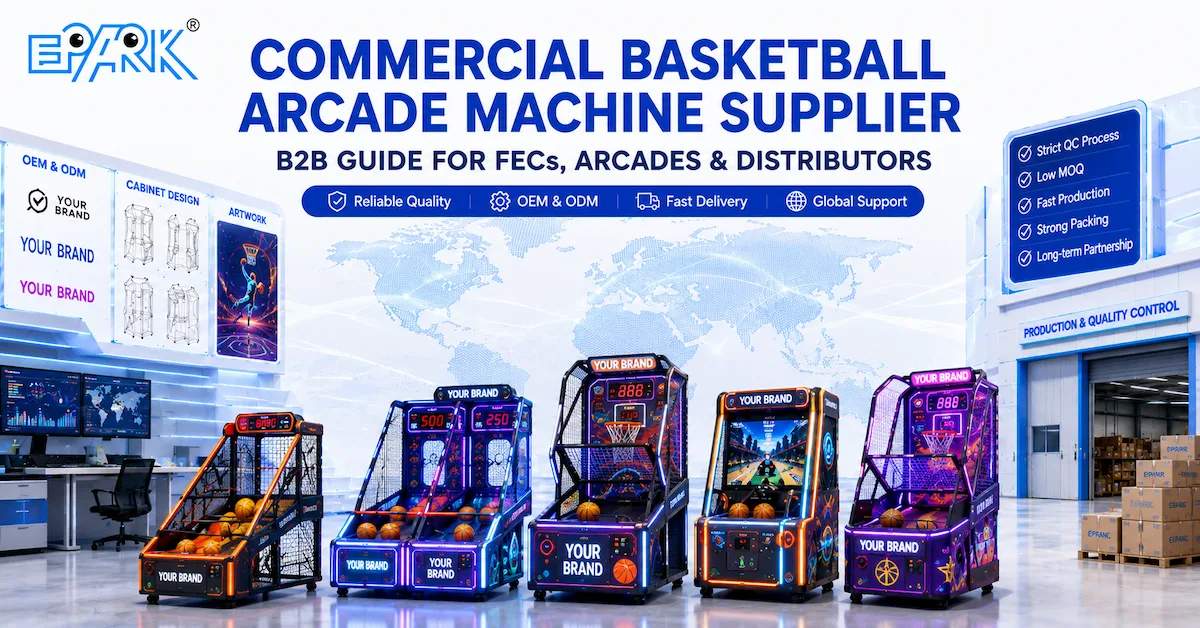
What Should a Commercial Basketball Arcade Machine Supplier Actually Provide?
Choosing a commercial basketball arcade machine supplier is not simply a matter of finding a machine with a bright scoreboard and a competitive quotation.
In a busy FEC or game center, a basketball machine takes repeated physical impact. Balls hit the rim, backboard, cage, ramp, and return channel hundreds of times. Sensors count every successful shot. Players lean against the cabinet. Payment hardware may operate throughout the day.
A serious B2B supplier therefore needs to support more than the cabinet itself.
Buyers should evaluate:
- Hoop and backboard construction
- Scoring accuracy
- Ball-return reliability
- Game timing
- Difficulty settings
- Payment-system compatibility
- Cabinet and cage structure
- Electrical configuration
- Factory testing
- Spare parts
- OEM/ODM capability
- Repeat-order consistency
Operators planning a larger arcade can also compare basketball games with other commercial arcade equipment such as racing machines, air hockey, redemption games, claw machines, VR equipment, and kiddie rides.
Who Usually Buys Commercial Basketball Arcade Machines?
The same basketball machine can serve very different commercial buyers.
| Buyer Type | Main Goal | Supplier Priority |
|---|---|---|
| FEC operator | Build competitive family play | Reliability and throughput |
| Game center | Add popular sports game | Player appeal and scoring |
| Arcade chain | Standardize multiple sites | Parts consistency |
| Distributor | Resell machines | OEM, bulk supply, support |
| Importer | Source equipment overseas | QC, packing, documentation |
| Mall entertainment project | Create high-energy attraction | Appearance and footprint |
| Private-label buyer | Build branded product line | OEM and repeatability |
| Project contractor | Supply complete venue | Delivery and equipment mix |
A distributor and a single-site operator should not evaluate suppliers in exactly the same way.
The distributor is thinking about the next 50 machines.
The operator may be thinking about whether one machine stays running through the weekend.
Decide Which Basketball Machine Format Fits the Venue
Commercial basketball arcade machines are available in several general formats.
Standard Single-Player Basketball Machines
These are familiar and easy to understand.
They work well in:
- FECs
- Arcades
- Mall game zones
- Bowling centers
Their straightforward gameplay also makes them suitable for first-time players.
Linked Competitive Basketball Machines
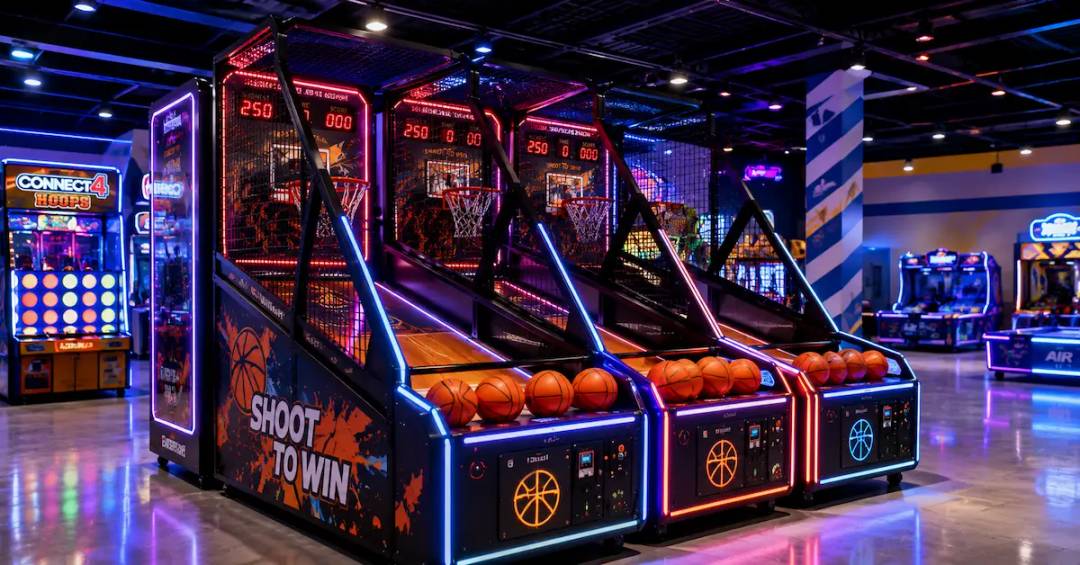
Two or more machines can be placed together so players compete side by side.
This format can create:
- Stronger group interaction
- Spectator interest
- Repeat play
- Tournament-style events
For larger FECs, paired machines often make more sense than placing individual units far apart.
Compact Basketball Machines
Where floor space is expensive, a smaller machine may be useful.
However, buyers should confirm that reduced dimensions do not compromise:
- Shooting comfort
- Ball return
- Player distance
- Maintenance access
Redemption Basketball Machines
Some basketball games can connect score performance with tickets or digital points.
These are particularly useful in FECs with a prize-redemption model.
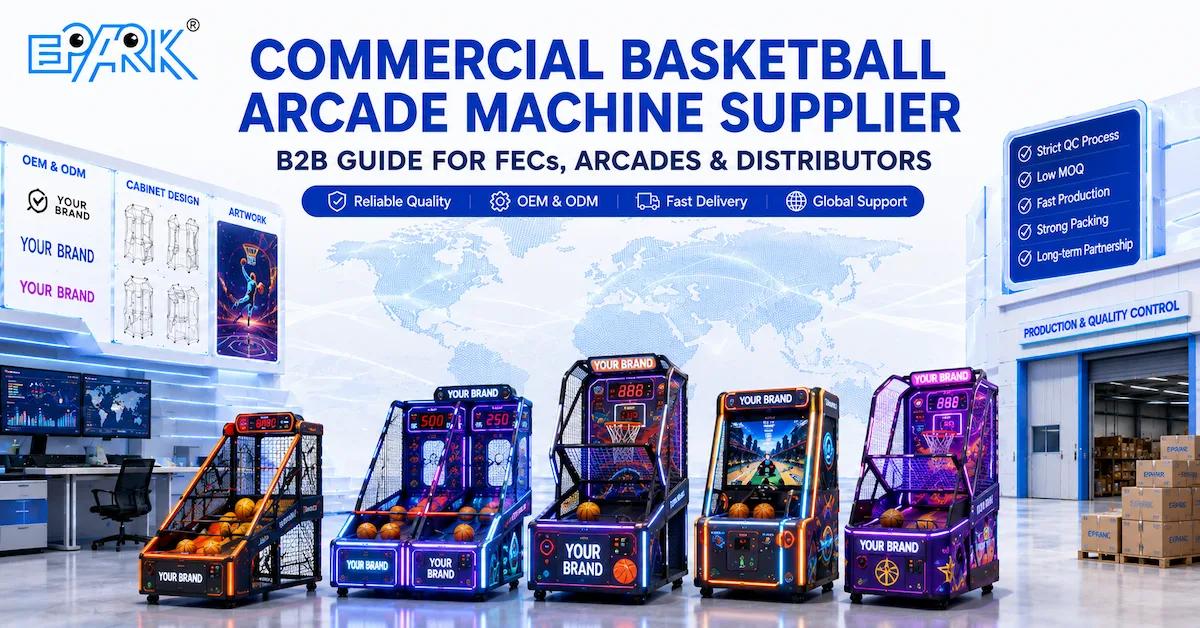
OEM or Themed Basketball Machines
Chains and distributors may want:
- Custom artwork
- Brand colors
- Logos
- Scoreboard design
- Lighting
- Payment readers
- Language changes
Buyers requiring private-label configurations can discuss these requirements through EPARK's OEM and ODM arcade solutions.
Compare Basketball Arcade Machine Formats
| Format | Main Strength | Best Venue | Buyer Consideration |
|---|---|---|---|
| Standard single unit | Simple operation | Small–medium arcade | Reliability |
| Side-by-side units | Competitive play | FEC/game center | Linking and consistency |
| Compact model | Space efficiency | Mall/small arcade | Playing distance |
| Redemption model | Reward integration | FEC | Ticket/point logic |
| Premium LED model | High visibility | Mall/FEC | Maintenance |
| OEM model | Brand differentiation | Distributor/chain | Repeatability |
The best machine is not automatically the largest or most illuminated one.
The correct choice is the configuration that fits the venue's player traffic, floor area, payment system, maintenance capability, and business model.
Inspect the Hoop and Backboard Before Looking at the LED Design
The hoop assembly receives constant impact.
That makes it one of the first mechanical areas buyers should inspect.
Ask the supplier:
- How is the hoop fixed to the structure?
- Is the rim replaceable?
- How is the backboard supported?
- Can the hoop position be adjusted?
- What happens if the rim becomes bent?
- Are replacement hoop assemblies available?
For commercial use, structural stability matters more than decorative appearance.
A visually impressive machine with a weak hoop mounting creates avoidable downtime.
Scoring Accuracy Is a Commercial Requirement
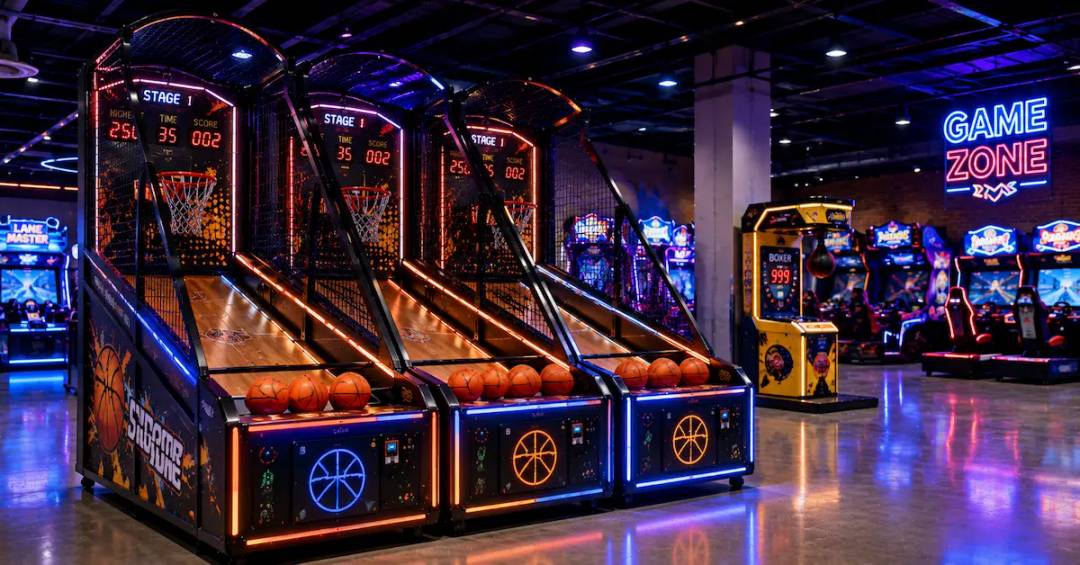
A basketball arcade machine depends on accurate score detection.
Players notice incorrect scoring immediately.
Imagine making three shots while the display counts only two.
The customer may assume the machine is unfair or malfunctioning.
That affects the experience and can create complaints.
Buyers should ask how successful baskets are detected.
Depending on the design, the system may use sensors or switches positioned around the scoring area.
The important purchasing questions are:
- How is a successful basket detected?
- Can the sensor be accessed?
- Can it be replaced separately?
- How is false scoring prevented?
- Can staff test the scoring system easily?
Scoring accuracy should be demonstrated during factory testing, not assumed from the specification sheet.
Test Scoring With Repeated Real Shots
One successful shot proves very little.
During pre-shipment inspection, run repeated tests.
Try:
- Direct shots
- Rim shots
- Backboard shots
- Rapid consecutive shots
- Shots from both sides of the hoop
The scoreboard should respond consistently.
For bulk orders, test several randomly selected machines instead of checking only one demonstration unit.
This is especially important for arcade chains and distributors.
The Ball-Return System Can Determine Daily Reliability
Basketball arcade games depend on continuous ball circulation.
After each shot, the ball needs to return quickly and predictably to the player.
A poor return design can cause:
- Balls getting trapped
- Slow gameplay
- Staff intervention
- Uneven ball distribution
- Players reaching into the machine
Ask the supplier to run a full game cycle repeatedly.
Watch how the balls move after:
- Successful shots
- Rim rebounds
- Side impacts
- Rapid shooting
A reliable commercial machine should not depend on staff fixing the ball path every few games.
Check the Ramp and Return Channel
The return ramp is another high-use component.
Inspect:
- Surface condition
- Angle
- Fastening
- Side protection
- Access for cleaning
- Replaceability
A damaged or poorly aligned ramp can affect the entire game experience.
When buying internationally, ask whether replacement ramp components can be supplied separately if needed.
Commercial Basketball Machines Need a Strong Cage
The surrounding cage or net structure keeps balls inside the machine.
It also receives repeated impact.
Ask how the cage is assembled.
Important areas include:
- Frame connections
- Side netting
- Rear protection
- Fasteners
- Upper frame
- Access doors
For export projects, also ask how the cage is packed.
Some machines may be partially disassembled for shipping.
If so, request assembly instructions before delivery.
Ask About Game Time and Difficulty Settings
Basketball arcade games often allow operators to control gameplay parameters.
Depending on the model, settings may include:
- Game duration
- Score target
- Difficulty
- Level progression
- Bonus time
- Sound
- Attract mode
For an FEC, these settings influence player throughput.
For example, a very long game cycle may produce a strong player experience but reduce the number of paid sessions possible during peak hours.
A shorter game may increase throughput but feel less satisfying.
The right setting depends on the venue.
Think About Player Throughput
Commercial operators should understand the real game cycle.
A useful approximation is:
Game Cycle = Payment + Start Delay + Gameplay + Score Display + Reset
Suppose the machine provides a 60-second game but requires another 20 seconds before the next player can start.
That machine does not actually process 60 players per hour.
Throughput matters particularly in:
- Shopping malls
- Busy FECs
- Weekend-heavy venues
- High-rent locations
Ask the supplier how quickly the machine is ready for the next game.
Payment-System Integration Should Be Confirmed Early
A basketball arcade game may operate using:
- Coins
- Tokens
- Stored-value cards
- Cashless readers
- QR payment
- Free-play mode
For a standalone arcade, coin operation may be sufficient.
For a multi-machine FEC, the basketball machine may need to operate within the same payment system as racing, redemption, air hockey, and claw machines.
Do not assume that payment integration can always be handled after delivery.
Confirm it before production.
Redemption Integration Changes the Purchasing Discussion
If the basketball machine awards tickets or digital points, ask additional questions.
You need to understand:
Score → Reward Calculation → Ticket/Point Output
Check:
- How reward levels are configured
- Whether payout is adjustable
- Whether physical tickets or digital points are used
- How the machine communicates with the venue system
- What happens if payout fails
For an FEC, reward settings should fit the wider prize economy rather than operate independently.
Check Electrical Configuration for the Destination Market
Before production, provide:
- Destination country
- Voltage
- Frequency
- Plug requirement
- Payment configuration
This should become part of the written order specification.
International buyers should avoid vague phrases such as:
“Use international voltage.”
Specify the actual requirement.
A distributor serving several regions may need separate SKUs for different electrical configurations.
How to Evaluate a Commercial Basketball Arcade Machine Supplier
A commercial basketball arcade machine supplier should be evaluated on both machine quality and its ability to support the equipment after shipment.
Start with production visibility.
Ask to see:
- Cabinet assembly
- Hoop installation
- Sensor installation
- Wiring
- Scoreboard integration
- Ball-return assembly
- Functional testing
- Finished machines
- Packing
A supplier does not necessarily need to manufacture every component internally.
What matters is whether it controls the final specification, assembly, inspection, and support process.
Buyers evaluating EPARK can review its company and manufacturing information alongside product samples and project-specific production evidence.
Factory Testing Should Simulate Actual Play
A basketball machine should not pass QC simply because the lights switch on.
A useful pre-shipment sequence should include real play.
Start and Payment Test
Verify the exact payment configuration and game start.
Ball-Return Test
Run repeated shots and watch every ball return.
Scoring Test
Make successful shots repeatedly and compare them with the scoreboard.
Timer Test
Verify the game timer behaves according to the chosen settings.
Bonus or Level Test
Where applicable, confirm bonus rounds or level progression.
Audio and Lighting Test
Check gameplay and attract-mode functions.
Reset Test
Make sure the machine returns to standby correctly after the game ends.
Physical Inspection
Check:
- Hoop
- Cage
- Ramp
- Cabinet
- Fasteners
- Display
- Artwork
- Locks
- Service doors
For OEM orders, custom artwork and branding should also be included in final inspection.
Do Not Judge QC From One Perfect Sample
Wholesale and chain buyers face batch risk.
One excellent machine does not prove that the other 29 units are identical.
Before a large shipment, consider:
- Random sampling
- Testing multiple machines
- Video evidence
- Buyer inspection
- Third-party inspection
The inspection method should reflect order value and business risk.
Define it before production begins.
Ask the Supplier About High-Wear Components
Basketball machines are physical games.
Some components naturally experience more stress than others.
Ask the factory which parts usually require service.
Depending on the design, these may include:
- Balls
- Hoop components
- Netting
- Sensors
- Buttons
- Displays
- Power supplies
- Control boards
- LED modules
- Payment components
The answer should be specific to the model.
A supplier that cannot identify service-prone components may not have much experience supporting installed machines.
Stock Spare Parts Based on Your Installed Quantity
An operator with one basketball machine and a distributor with 100 machines need different spare-parts strategies.
Ask:
“For our order quantity, which parts would you recommend keeping locally?”
A useful spare-parts package reduces downtime without forcing the buyer to stock unnecessary inventory.
For overseas buyers, small critical components can be far cheaper to ship with the original order than to send individually later.
Part Identification Matters After the Warranty Starts
Months after installation, a customer may send a photo and say:
“This scoring sensor no longer works.”
Can the supplier identify the correct replacement?
Ask whether parts can be traced using:
- Machine model
- Order number
- Production configuration
- Photos
- Component codes
This matters enormously to distributors.
Their end customer expects fast support even if the original machine was manufactured thousands of kilometers away.
Compare After-Sales Processes, Not Only Warranty Length
Warranty duration is only one piece of the support system.
Ask:
What happens after I report a fault?
A practical support workflow might be:
Fault Report → Video/Photos → Diagnosis → Component Check → Replacement Part → Installation Guidance → Retest
This is more useful than a supplier simply writing “12-month warranty” on the quotation.
You can review common ordering and support topics through EPARK's arcade equipment FAQ.
OEM Basketball Arcade Machines for Distributors and Chains
Private-label buyers often need more than a logo.
Possible customization can include:
- Cabinet colors
- Side artwork
- Header graphics
- Scoreboard appearance
- Logo placement
- Lighting
- Interface language
- Payment reader
- Voltage
- Packaging
To evaluate a commercial basketball arcade machine supplier for OEM cooperation, send a real brief.
For example:
We need 20 basketball arcade machines for our FEC brand in the Middle East. Machines must use our navy-and-orange artwork, 220–240 V configuration, centralized card payment, English/Arabic operating instructions, and branded side panels. Please confirm artwork approval, sample process, production lead time, spare parts, and repeat-order control.
A capable supplier should ask questions before confirming the project.
Repeat Orders Need Configuration Control
Imagine your first 20 machines use one scoring sensor.
The next batch uses a different sensor.
Both work.
But now your technicians need to carry two parts.
Repeat this across:
- Controller
- Power supply
- Display
- Payment reader
- LED module
and maintenance becomes much more complicated.
Ask whether the manufacturer records the important configuration for each production batch.
For arcade chains, this is one of the most valuable supplier capabilities.
Shipping Dimensions Can Change the Economics of the Order
Basketball machines can occupy significant volume because of:
- Cabinet size
- Hoop
- Cage
- Ramp
- Backboard
Ask whether the machine ships:
- Fully assembled
- Partially disassembled
- Flat-packed in sections
Then request:
- Packing dimensions
- Net weight
- Gross weight
- Package count
- Container-loading estimate
For a distributor,freight efficiency should be calculated before choosing between models.
Export Packing Should Protect More Than the Cabinet
Important areas to protect include:
- Scoreboard
- Backboard
- Hoop
- Cage components
- Electronics
- Decorative panels
- Screens
- Controls
If structural parts are removed for shipment, they should be clearly labeled.
Installation instructions should match the shipped configuration.
Poor packing can turn a perfectly tested machine into a site problem before it is ever played.
Compare Total Cost of Ownership
The purchase price is not the whole cost.
A better B2B calculation is:
Total Cost = Equipment + OEM + Freight + Import + Installation + Maintenance + Spare Parts + Downtime
Now compare two machines.
Machine A costs less but has difficult sensor access and proprietary replacement parts.
Machine B costs slightly more but is easier to service and uses readily identifiable components.
The lower quotation is not automatically the lower-cost investment.
Supplier Comparison Scorecard
The following is a practical purchasing framework rather than an official certification.
| Evaluation Area | Weight |
|---|---|
| Scoring reliability | 15 |
| Hoop,cage and cabinet durability | 15 |
| Ball-return performance | 15 |
| QC and testing | 15 |
| Spare parts and after-sales | 10 |
| Payment integration | 10 |
| OEM/ODM capability | 5 |
| Export packing | 5 |
| Repeat-order consistency | 5 |
| Communication | 5 |
| Total | 100 |
Use the same scorecard for each shortlisted supplier.
That prevents a visually attractive cabinet or low price from dominating the decision.
Warning Signs When Comparing Basketball Arcade Suppliers
Look more closely when a supplier:
- Cannot explain how scoring is detected
- Cannot demonstrate repeated score tests
- Cannot show ball-return operation
- Cannot identify commonly replaced parts
- Cannot explain service access
- Cannot confirm payment integration before production
- Promises OEM without requesting technical information
- Cannot provide packing dimensions
- Cannot explain batch QC
- Changes important components without notice
- Focuses only on machine price
A single issue may have a reasonable explanation.
Several vague answers together increase purchasing risk.
How Basketball Machines Fit Into a Commercial Arcade
Basketball machines work especially well in competitive or social gaming zones.
They can be combined with:
- Air hockey
- Racing simulators
- Boxing games
- Shooting games
- Redemption equipment
- Other sports arcade machines
This helps operators create an area based on short, visible competitions.
Basketball also has an advantage many complex machines do not have: customers usually understand what to do immediately.
That can reduce the need for staff explanation.
For project buyers, however, machine placement still matters.
Allow enough space for players, spectators, maintenance, and circulation.
What Information Should You Send Before Requesting a Quote?
Avoid sending only:
“Basketball machine price?”
A more useful inquiry might be:
We operate a 900 m² FEC in Saudi Arabia and require six commercial basketball arcade machines for a competitive sports zone. We want three paired installations, 220–240 V configuration, centralized card payment, custom branding, export packing, and a spare-parts package. Please provide recommended models, dimensions, packing data, payment compatibility, production lead time, MOQ, OEM options, and pre-shipment testing details.
That tells the supplier what business problem it needs to solve.
It also helps separate serious manufacturers from companies that simply send the same generic price list to every inquiry.
How EPARK Supports Basketball Arcade Projects
EPARK supports commercial amusement projects across basketball games and other arcade categories, making it relevant to buyers who need either individual machines or a broader FEC equipment mix.
A project can be structured around:
Venue Requirements
↓
Machine Selection
↓
Sports Zone Planning
↓
Payment Configuration
↓
OEM/ODM Design
↓
Production
↓
QC & Real Gameplay Testing
↓
Export Packing
↓
Installation Support
↓
Spare Parts & After-Sales
This approach can be particularly useful for FEC operators and distributors who are sourcing basketball machines alongside other commercial equipment rather than buying isolated products.
Buyers evaluating a larger project can combine the EPARK product range with venue planning, customization, and manufacturing discussions.
FAQ About Commercial Basketball Arcade Machine Suppliers
What should I check before choosing a commercial basketball arcade machine supplier?
Check scoring accuracy, hoop and cage construction, ball return, cabinet durability, payment compatibility, QC procedures, spare parts, OEM capability, export packing, and after-sales support.
How does a basketball arcade machine count successful shots?
The exact method depends on the model, but commercial machines typically use a scoring detection system around the basket area. Buyers should ask the supplier to explain and demonstrate the exact configuration.
How can I test scoring accuracy before shipment?
Request repeated real-game testing.Successful baskets should be compared against the displayed score across multiple game cycles rather than testing only one shot.
Why is the ball-return system important?
A reliable return system keeps gameplay continuous. Poor ball return can cause jams, slow sessions, and frequent staff intervention.
Can basketball arcade machines work with a cashless card system?
Many commercial systems can be configured for different payment methods, but compatibility should be confirmed with the exact machine and cashless platform before production.
Can basketball arcade games issue tickets or digital points?
Some models can operate as redemption games. Buyers should confirm how scores convert into tickets or digital points and whether the system integrates with the venue's reward platform.
Can basketball arcade machines be customized?
Depending on the supplier and model, OEM options may include cabinet artwork, colors, logos, interface language, lighting, payment systems, electrical configuration, and packaging.
What spare parts should I order?
The correct spare-parts list depends on the machine.Ask the manufacturer for model-specific recommendations covering critical and frequently serviced components.
Should distributors test a sample before placing a bulk order?
For a new supplier relationship, a trial order or sample evaluation can help verify quality, packing, scoring, technical support, and product-market fit before scaling.
What information is needed for an accurate quotation?
Provide destination country, quantity, venue type, preferred machine format, payment system, voltage, OEM requirements, delivery schedule, and whether spare parts or repeat orders are expected.
Conclusion
Choosing the right commercial basketball arcade machine supplier requires much more than comparing a colorful cabinet, scoreboard, and FOB price.
The machine's commercial value depends on the entire operating system:
Payment → Gameplay → Scoring → Ball Return → Reset → Maintenance
FEC operators should focus on reliable gameplay and throughput.
Distributors should pay particular attention to spare parts and repeat production.
Arcade chains need standardized configurations.
Private-label buyers need dependable OEM control.
And international importers should evaluate packing, assembly, documentation, and after-sales response before the shipment leaves the factory.
The stronger supplier is the one that can clearly explain how the machine scores, how it is tested, how it is serviced, what parts should be stocked, and how the same configuration can be supplied again later.
If you are planning a sports arcade zone, FEC expansion, arcade chain rollout, distributor order, or private-label basketball machine project, contact EPARK for a project-specific quotation. Send your destination country, quantity, payment system, branding requirements, venue type, and expected repeat-order plan so the proposal can be built around your actual commercial requirements.
Disclaimer
The information provided on this website is for general informational purposes only.
While EPARK Arcade Game Machine Manufacturer strives to ensure accuracy and reliability, no warranties—express or implied—are made regarding completeness, performance, or applicability.
Product specifications, designs, and features may vary depending on usage, customization, and customer requirements.
Buyers are responsible for verifying all technical details, compliance certifications, and suitability before procurement.
EPARK shall not be held liable for any direct, indirect, incidental, or consequential damages arising from the use of this website or its content, including but not limited to business losses, data errors, or equipment misuse.
For tailored solutions or further verification, please visit our Contact Us
Intellectual Property Notice
All articles, product images, videos, catalogs, software, and related materials published on this website are the intellectual property of EPARK, unless otherwise stated.
Unauthorized reproduction, distribution, modification, or commercial use of any content is strictly prohibited without prior written consent from EPARK.
EPARK reserves the right to take legal action against any unauthorized use, including but not limited to copyright infringement, misrepresentation, or unfair competition.
Trademarks
The name EPARK, the EPARK logo, and all related brand elements displayed on this website are registered trademarks or trade names of Guangzhou EPARK Electronic Technology Co., Ltd.
Other product names, company names, or logos mentioned on this site may be trademarks of their respective owners.
Unauthorized use of EPARK's trademarks for commercial purposes, including advertising, promotions, or product packaging, is strictly prohibited.
Governing Law
These terms are governed by the laws of the People's Republic of China.