
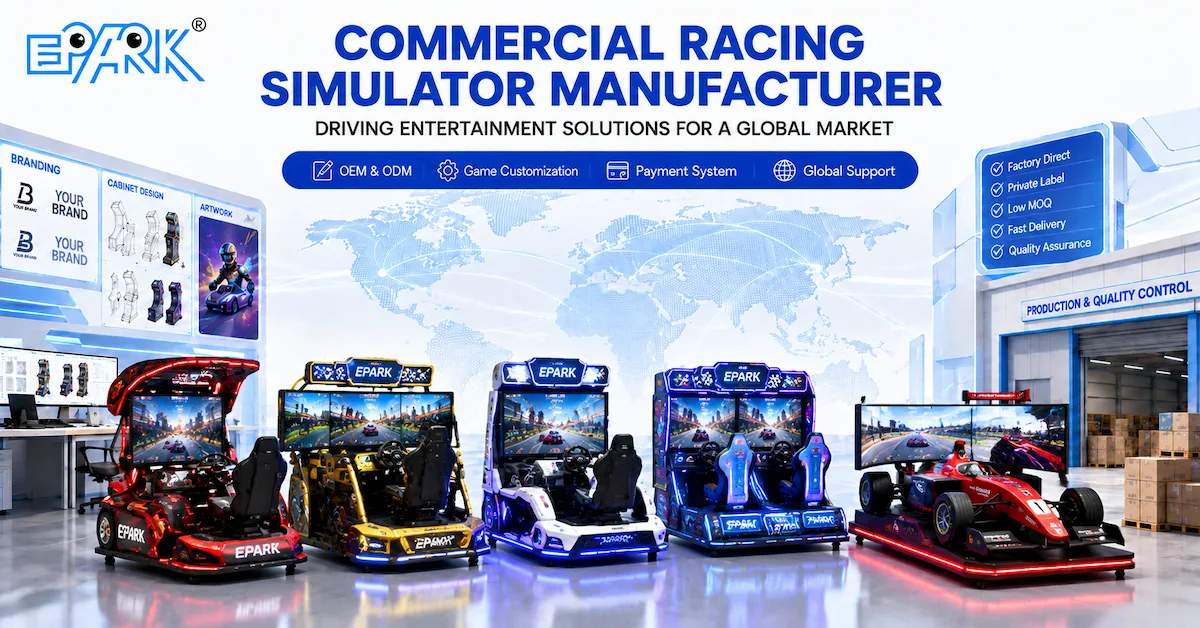
How to Choose a Commercial Racing Simulator Manufacturer for Your Entertainment Business
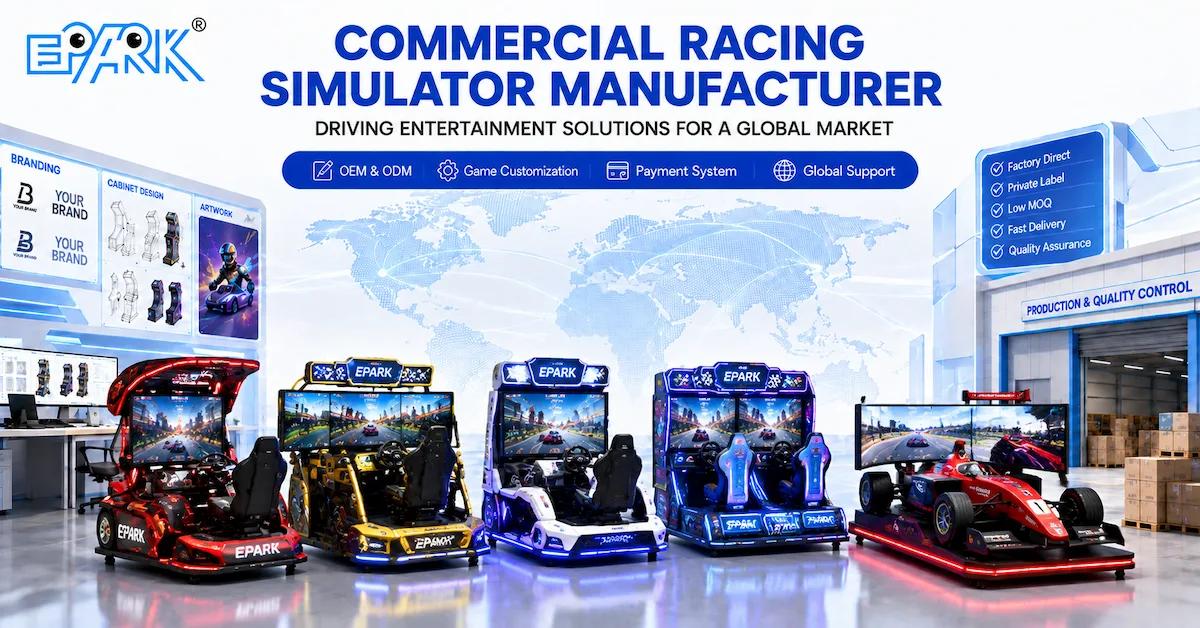
When businesses search for a commercial racing simulator manufacturer, they are usually looking for equipment that can become a major attraction inside an entertainment venue.
A commercial racing simulator is different from a standard arcade racing machine.
It combines:
- Realistic driving controls
- High-quality display systems
- Motion feedback
- Immersive sound effects
- Racing software
- Commercial-grade hardware
For FEC operators, shopping mall entertainment projects, and arcade businesses, a racing simulator is not only a game machine. It is an experience product designed to increase customer engagement.
The right supplier should provide more than equipment.
A professional manufacturer should support:
- Product development
- Hardware customization
- Software configuration
- Factory testing
- Installation guidance
- Spare parts
- Long-term technical service
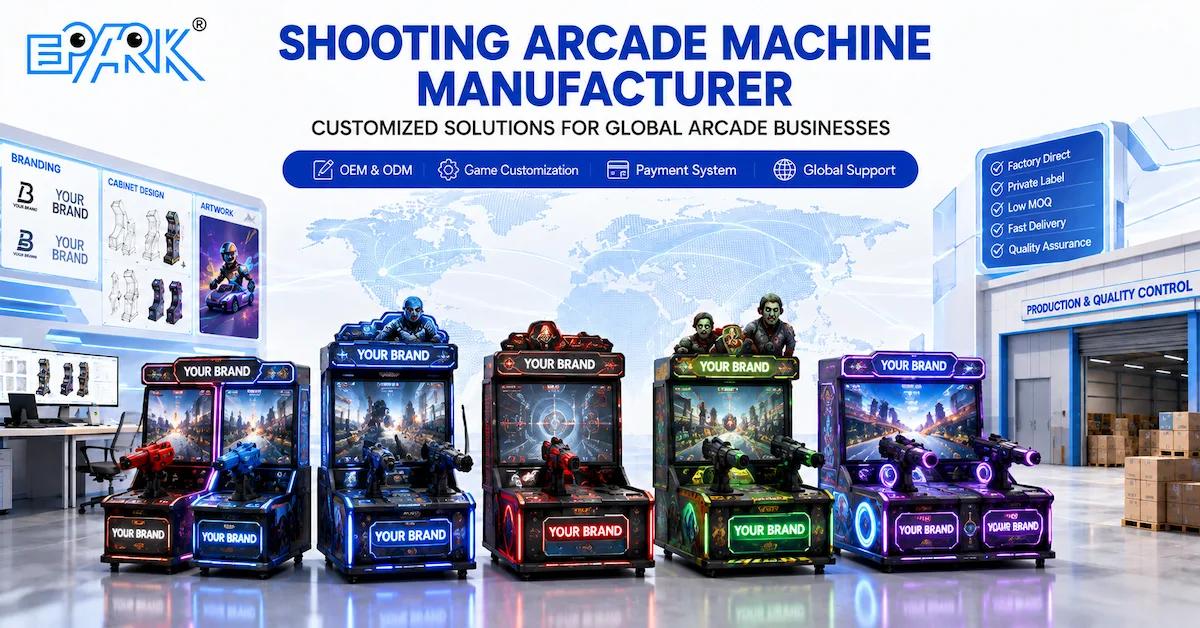
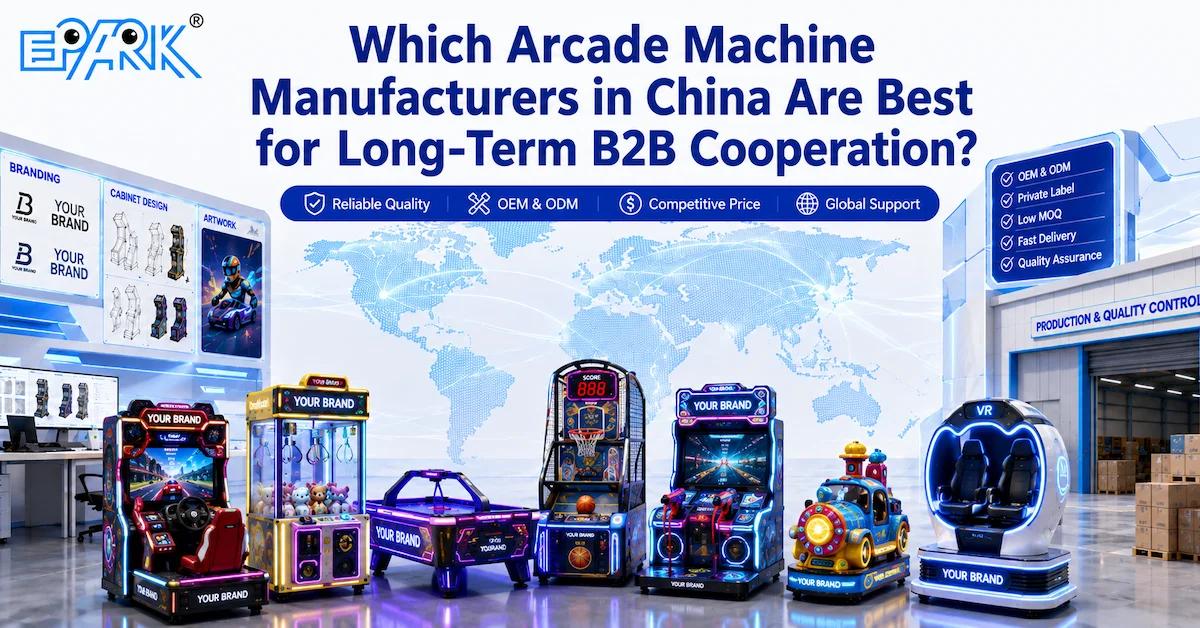
EPARK provides commercial amusement equipment solutions for global buyers, including racing games, shooting machines, redemption equipment, claw machines, and customized arcade products. Buyers can explore the complete product range through EPARK commercial arcade equipment solutions.
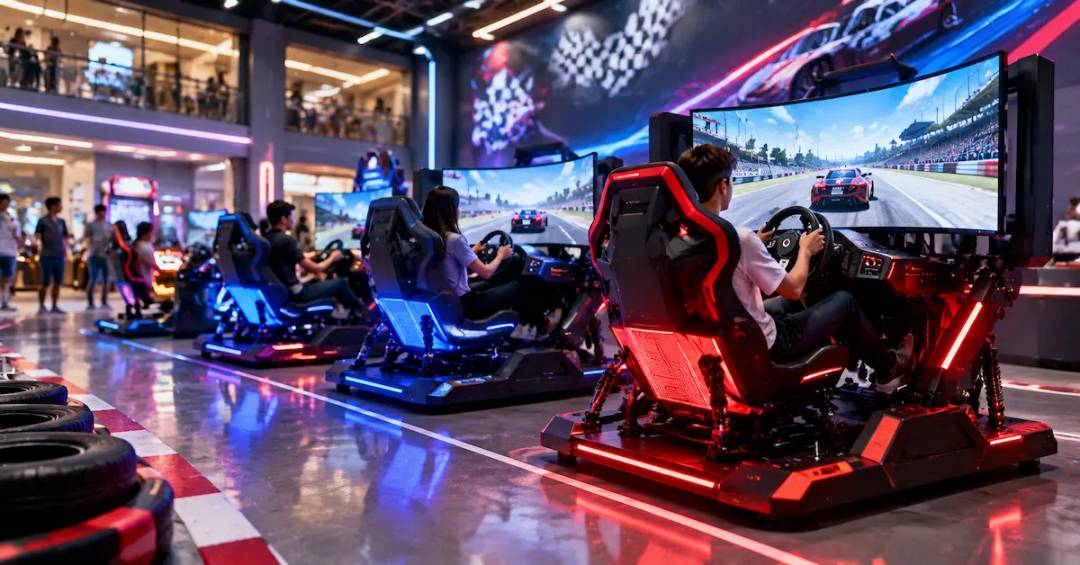
Why Commercial Racing Simulators Are Valuable for FEC and Arcade Projects
Traditional arcade machines focus mainly on gameplay.
Commercial racing simulators create a stronger immersive experience through realistic interaction.
Players can experience:
- Steering feedback
- Racing cockpit environment
- Large-screen visuals
- Dynamic sound effects
- Competitive gameplay
This makes racing simulators suitable for venues that want premium attractions.
Common applications include:
- Family entertainment centers
- Shopping mall arcades
- Theme parks
- Racing entertainment zones
- Indoor amusement parks
- Game centers
Commercial Racing Simulator Applications in Different Venues
Different venues have different requirements.
Family Entertainment Centers
FEC operators usually focus on:
- Customer attraction
- Family interaction
- Repeat visits
- Space efficiency
Commercial racing simulators can become premium attractions that increase visitor engagement.
Shopping Mall Entertainment Zones
Mall projects require equipment with strong visual appeal.
Important factors include:
- Modern appearance
- Easy operation
- Strong customer attraction
- Stable operation
Racing Theme Projects
Some entertainment projects build racing-themed areas.
They may require:
- Multiple simulator units
- Customized appearance
- Unified branding
- Premium experience design
Arcade Business Expansion
Existing arcade operators may add racing simulators to increase product variety.
They usually evaluate:
- Revenue potential
- Maintenance requirements
- Customer experience
- Equipment reliability
Commercial Racing Simulator vs Standard Racing Arcade Machine
Although both products are related to racing games, their positioning is different.
| Feature | Racing Arcade Machine | Commercial Racing Simulator |
|---|---|---|
| Main Focus | Entertainment gameplay | Immersive experience |
| Control System | Steering wheel and pedals | Professional racing controls |
| Experience Level | Standard interaction | Realistic simulation |
| Target Venue | General arcades | Premium attractions |
| Investment Level | Medium | Higher |
| Customer Appeal | Broad audience | Experience-focused users |
Choosing between them depends on:
- Venue positioning
- Budget
- Target customers
- Available space
Key Components of a Commercial Racing Simulator
A reliable commercial racing simulator manufacturer should clearly explain the technical configuration of the system.
Racing Cockpit Structure
The cockpit creates the foundation of the experience.
Important factors include:
- Seat comfort
- Frame strength
- Ergonomic design
- Long-term durability
Commercial equipment needs stronger structures compared with personal simulation setups.
Steering Wheel and Pedal System
The control system directly affects realism.
Buyers should evaluate:
- Steering response
- Pedal sensitivity
- Force feedback
- Component durability
High-frequency commercial use requires reliable mechanical components.
Motion System
Motion technology creates additional immersion.
Possible features include:
- Seat movement
- Vibration feedback
- Dynamic driving effects
For premium venues, motion systems can significantly improve customer experience.
Display and Audio System
Visual and audio performance influence overall attraction.
Important elements include:
- Screen size
- Image quality
- Viewing angle
- Sound performance
Large immersive displays can help racing simulators stand out in competitive entertainment environments.
Racing Simulator Manufacturing Process: From Concept Design to Commercial Delivery
A professional commercial racing simulator manufacturer should have a complete production workflow that ensures every unit can operate reliably in demanding commercial environments.
Unlike consumer racing setups, commercial simulators must handle:
- Long operating hours
- Frequent customer interaction
- Different venue environments
- Easy maintenance requirements
A complete manufacturing process usually includes:
- Product design
- Mechanical production
- Electronic assembly
- Software configuration
- Functional testing
- Final inspection
- Export preparation
Racing Simulator Manufacturing Process
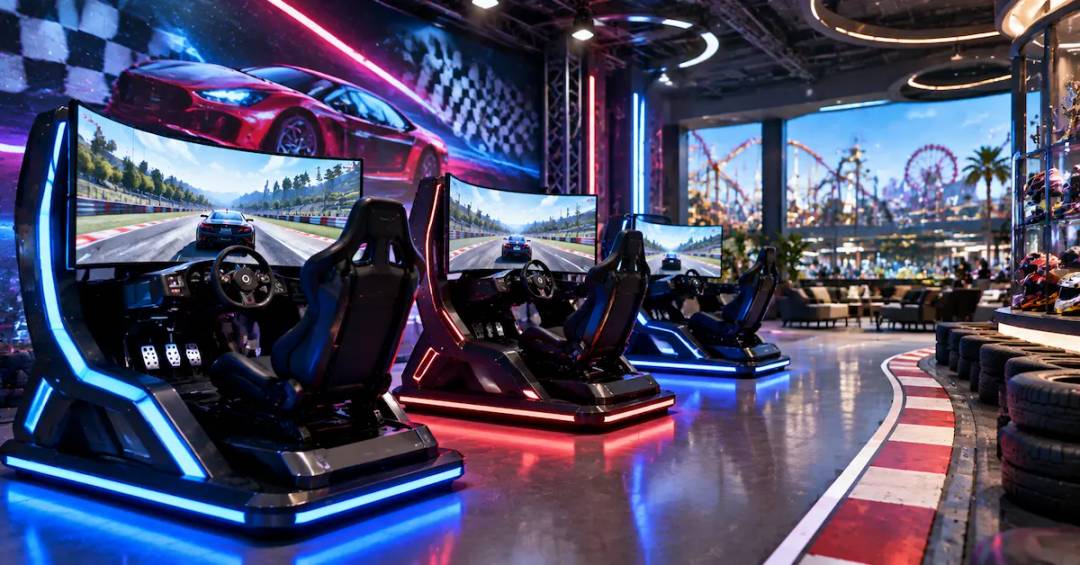
Product Design and Engineering Development
Before production begins, manufacturers analyze the project requirements.
The design stage may include:
- Simulator structure design
- Cockpit layout
- Hardware configuration
- Motion system planning
- Display installation
- Brand customization
For commercial projects, engineers need to consider:
- Space limitations
- User operation frequency
- Maintenance accessibility
- Safety requirements
A well-designed simulator improves both user experience and long-term operation efficiency.
Mechanical Structure Production
The cockpit structure is the foundation of a racing simulator.
Manufacturers typically control:
- Frame strength
- Seat installation
- Steering mounting position
- Screen support structure
- External cabinet appearance
Commercial-grade structures require stronger materials because they are used repeatedly by different customers every day.
The production process usually includes:
- Material cutting
- Welding or assembly
- Surface treatment
- Component installation
- Final adjustment
Electronic System Assembly
A commercial racing simulator combines multiple electronic systems.
Key components include:
- Main control system
- Display equipment
- Audio system
- Lighting modules
- Motion controllers
- Power management system
During assembly, manufacturers should verify:
- Wiring accuracy
- Component compatibility
- Electrical safety
- System stability
Motion System Production and Quality Control
The motion system is one of the key differences between standard racing arcade machines and premium racing simulators.
A professional manufacturer should control the complete motion integration process.
Motion Platform Design
Motion systems may include:
- Moving seats
- Vibration feedback
- Dynamic driving effects
- Mechanical actuators
The design needs to balance:
- Realistic movement
- Safety
- Durability
- Maintenance convenience
Motion System Testing
Before shipment, manufacturers should test:
- Movement accuracy
- Response speed
- Noise level
- Continuous operation stability
For commercial venues,motion systems must perform consistently during high-frequency daily use.
Reliable motion technology helps create a more immersive customer experience in:
- FECs
- Racing entertainment zones
- Theme parks
- Premium arcades
Software Customization for Racing Simulators
Software is an important part of commercial racing simulator projects.
Different markets and venues may require customized settings.
Possible customization includes:
- Language options
- User interface
- Game settings
- Payment integration
- Difficulty adjustment
- Brand display
For distributors and private-label businesses, software flexibility helps create differentiated products.
A capable manufacturer should support communication between hardware and software teams to ensure stable operation.
OEM and ODM Racing Simulator Solutions
Many buyers looking for a commercial racing simulator manufacturer require customized solutions rather than standard products.
OEM and ODM services may include:
Appearance Customization
Options include:
- Brand logo
- Cabinet design
- Color selection
- Artwork style
- Exterior theme
Hardware Customization
Possible adjustments:
- Screen configuration
- Steering system
- Motion platform
- Audio system
- Payment method
Project-Based Development
For larger entertainment projects,manufacturers may provide:
- Requirement analysis
- Product recommendation
- Design confirmation
- Prototype development
- Production
- Quality inspection
- Delivery support
EPARK provides customized arcade equipment solutions for global partners through EPARK OEM and ODM arcade solutions.
Factory Quality Control Process
Quality control directly affects the reliability of commercial racing simulators.
A professional factory should inspect products throughout production.
Incoming Material Inspection
Before assembly, manufacturers check:
- Electronic components
- Structural materials
- Displays
- Controllers
- Motion parts
This reduces quality risks before production.
Assembly Inspection
During manufacturing, quality teams inspect:
- Mechanical installation
- Wiring connections
- Hardware compatibility
- Software configuration
Final Performance Testing
Before shipment,complete simulators should be tested for:
- Power operation
- Steering response
- Pedal function
- Motion performance
- Display quality
- Audio effects
- Software stability
Aging Test
Long-duration testing helps confirm:
- System reliability
- Heat performance
- Component stability
This is especially important for equipment installed in high-traffic entertainment venues.
Installation Support for Commercial Racing Simulator Projects
Large entertainment projects may require installation guidance.
A reliable manufacturer should provide support including:
- Installation manuals
- Technical instructions
- Remote assistance
- Troubleshooting guidance
For overseas projects, clear installation support helps reduce setup time and operational risks.
Before shipment, buyers should confirm:
- Installation requirements
- Required tools
- Space preparation
- Power requirements
Spare Parts and Maintenance Support
Commercial racing simulators require long-term maintenance planning.
Common spare parts include:
- Steering wheels
- Pedals
- Displays
- Controllers
- Power supplies
- Motion components
- Wiring parts
For distributors and operators, spare parts availability helps maintain equipment uptime.
A reliable supplier should provide:
- Spare parts recommendations
- Replacement guidance
- Technical support
- Long-term cooperation service
Shipping and Export Considerations
Commercial racing simulators require professional export preparation because they contain:
- Electronic components
- Large structures
- Precision control systems
Before shipment,buyers should confirm:
- Product dimensions
- Packaging method
- Container loading plan
- Shipping documents
- Installation requirements
Professional export packaging should protect:
- Screens
- Motion systems
- External panels
- Electronic components
An experienced manufacturer can help international buyers reduce transportation risks.
Commercial Racing Simulator Manufacturer Comparison
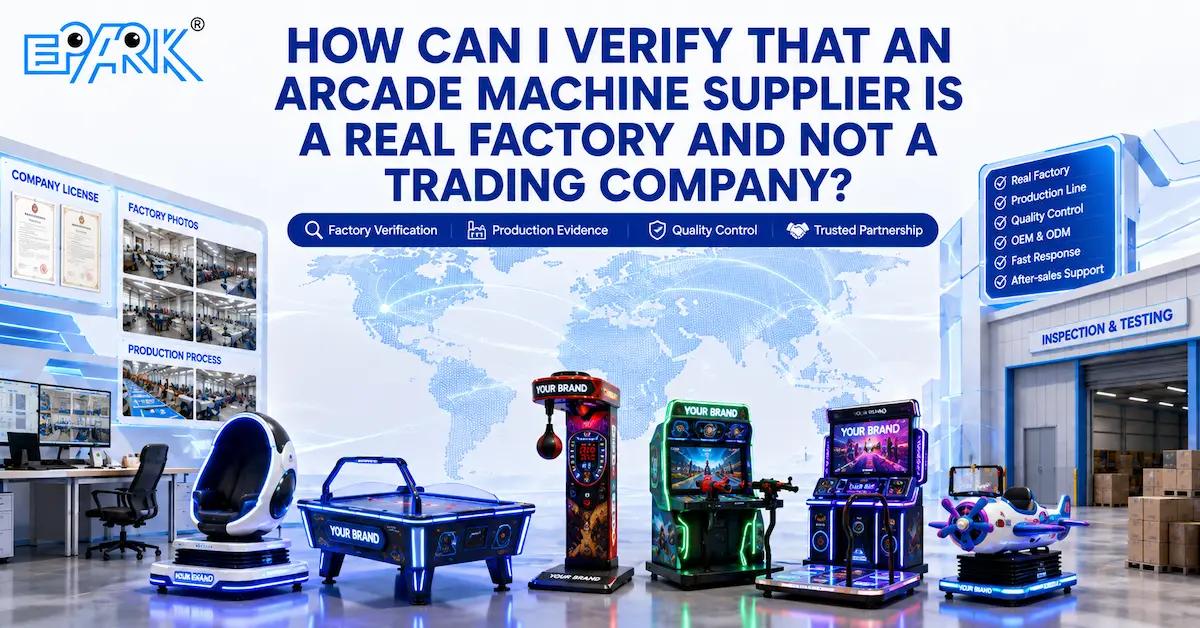
When selecting suppliers, buyers should compare overall capability instead of focusing only on initial price.
| Evaluation Factor | Direct Manufacturer | Trading Company |
|---|---|---|
| Production control | Direct factory management | Depends on supplier |
| OEM/ODM ability | Strong customization | Usually limited |
| Technical communication | Direct engineering support | Requires coordination |
| Quality control | Factory-controlled | Depends on partner |
| Product improvement | Faster adjustment | More complicated |
| Long-term supply | More stable | Depends on sourcing |
For businesses planning continuous expansion, direct cooperation with a manufacturer usually provides better control over quality and customization.
Cost Factors of Commercial Racing Simulators
The price of a commercial racing simulator depends on multiple factors.
Hardware Configuration
Higher specifications may increase investment,including:
- Advanced motion systems
- Larger displays
- Premium controllers
- Enhanced audio systems
Customization Requirements
Additional costs may come from:
- New cabinet design
- Brand customization
- Software modification
- Special functions
Order Quantity
Wholesale volume can influence:
- Unit price
- Production scheduling
- Packaging efficiency
Shipping and Installation
International projects should consider:
- Transportation costs
- Import requirements
- Installation support
A professional supplier should provide transparent quotations based on the complete project requirements.
Part 3
FAQ About Commercial Racing Simulator Manufacturers
What is a commercial racing simulator manufacturer?
A commercial racing simulator manufacturer designs and produces professional racing simulation equipment for businesses such as FECs, arcades, entertainment projects, and distributors.
These manufacturers usually provide:
- Hardware production
- Software configuration
- Customization
- Quality testing
- Technical support
What is the difference between a racing simulator and a racing arcade machine?
A racing arcade machine focuses on entertainment gameplay, while a racing simulator provides a more immersive driving experience.
Racing simulators usually include:
- Advanced controls
- Motion feedback
- Realistic cockpit design
- Premium user experience
They are commonly used in premium entertainment locations.
Are commercial racing simulators suitable for FEC projects?
Yes.
Commercial racing simulators are suitable for:
- Family entertainment centers
- Shopping malls
- Theme parks
- Racing experience zones
They can become attraction products that increase customer engagement.
Can manufacturers customize racing simulators?
Yes.
OEM and ODM customization may include:
- Exterior design
- Brand logo
- Hardware configuration
- Software settings
- Payment systems
What should I ask before choosing a racing simulator supplier?
Buyers should confirm:
- Factory capability
- Production process
- Quality inspection
- Customization ability
- Spare parts support
- Export experience
How long can a commercial racing simulator operate?
Service life depends on:
- Product quality
- Usage frequency
- Maintenance
- Operating environment
Commercial-grade equipment should be designed for repeated daily operation.
Conclusion
Choosing the right commercial racing simulator manufacturer is an important decision for businesses developing arcade projects, FEC venues, and entertainment attractions.
A reliable supplier should provide more than a racing simulator.
The manufacturer should support:
- Professional product design
- Stable production
- Motion system integration
- OEM customization
- Quality inspection
- Export service
- Long-term technical support
For operators, high-quality racing simulators improve customer experience.
For distributors, reliable manufacturing capability creates stronger market competitiveness.
For entertainment projects, customized simulation solutions help build unique attractions.
Before starting cooperation, buyers should prepare:
- Project requirements
- Target market
- Quantity
- Customization needs
- Delivery timeline
A clear project plan helps manufacturers provide better solutions.
CTA
Looking for a reliable commercial racing simulator manufacturer for your arcade, FEC, or entertainment project?
EPARK provides commercial racing simulator solutions with:
- OEM and ODM customization
- Factory production support
- Quality inspection
- Global shipping assistance
- Long-term technical service
Explore:
- EPARK commercial arcade equipment solutions
- EPARK OEM and ODM services
- EPARK manufacturer information
Contact EPARK for a customized quotation:
Please share:
- Project type
- Required quantity
- Destination market
- Customization requirements
- Expected delivery time
Disclaimer
The information provided on this website is for general informational purposes only.
While EPARK Arcade Game Machine Manufacturer strives to ensure accuracy and reliability, no warranties—express or implied—are made regarding completeness, performance, or applicability.
Product specifications, designs, and features may vary depending on usage, customization, and customer requirements.
Buyers are responsible for verifying all technical details, compliance certifications, and suitability before procurement.
EPARK shall not be held liable for any direct, indirect, incidental, or consequential damages arising from the use of this website or its content, including but not limited to business losses, data errors, or equipment misuse.
For tailored solutions or further verification, please visit our Contact Us
Intellectual Property Notice
All articles, product images, videos, catalogs, software, and related materials published on this website are the intellectual property of EPARK, unless otherwise stated.
Unauthorized reproduction, distribution, modification, or commercial use of any content is strictly prohibited without prior written consent from EPARK.
EPARK reserves the right to take legal action against any unauthorized use, including but not limited to copyright infringement, misrepresentation, or unfair competition.
Trademarks
The name EPARK, the EPARK logo, and all related brand elements displayed on this website are registered trademarks or trade names of Guangzhou EPARK Electronic Technology Co., Ltd.
Other product names, company names, or logos mentioned on this site may be trademarks of their respective owners.
Unauthorized use of EPARK's trademarks for commercial purposes, including advertising, promotions, or product packaging, is strictly prohibited.
Governing Law
These terms are governed by the laws of the People's Republic of China.