

Quick answer: choose arcade games for bowling alleys that extend the visit before and after the lane booking
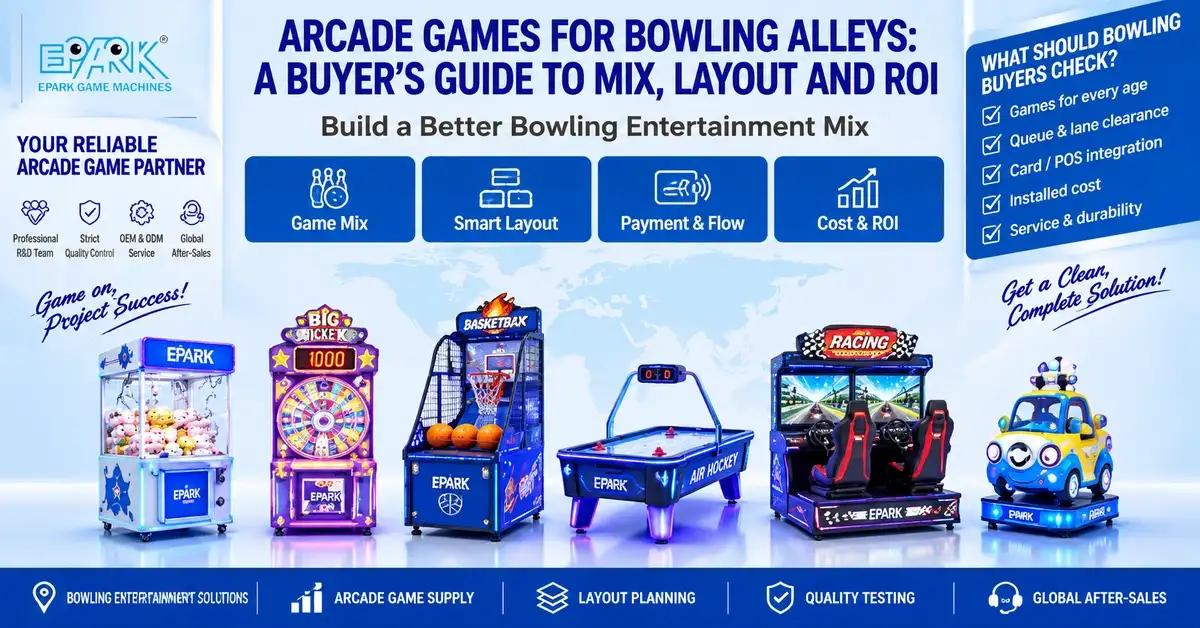
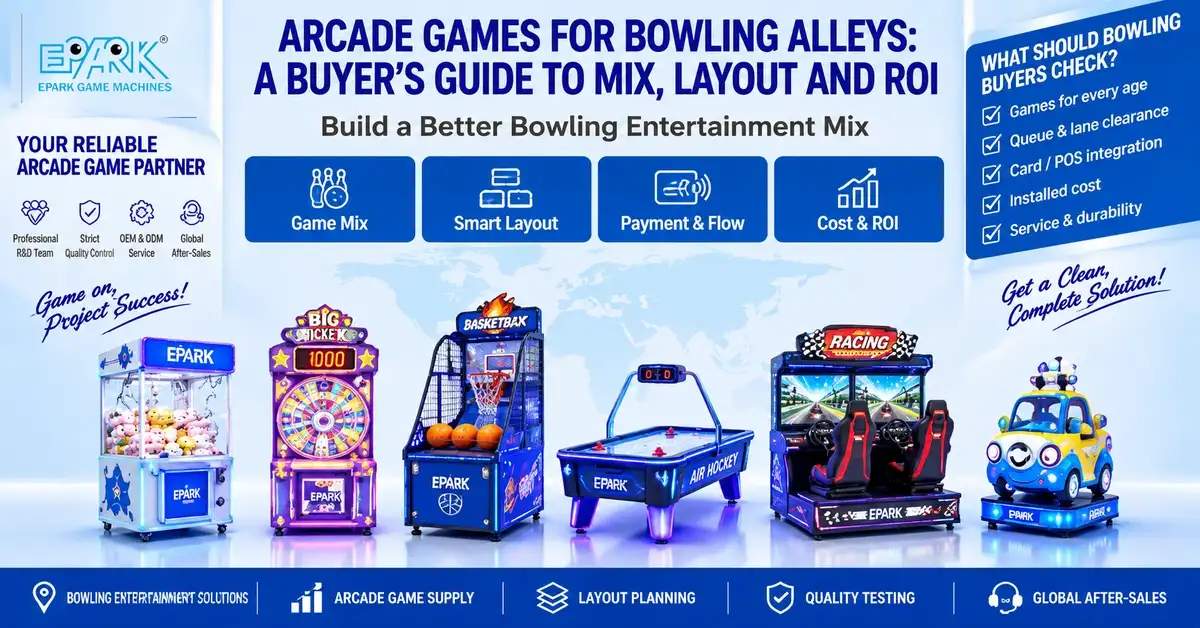
The best arcade games for bowling alleys are not simply the most visually impressive machines. They should solve a specific bowling-center problem: give children something to do while lanes are occupied, keep groups engaged when a lane is unavailable, create a reason to arrive early or stay after the game, and add revenue that can be sold through the same card, token or POS ecosystem. A practical starting mix usually includes easy-entry prize or redemption games, visible claw machines, fast social sports games, one or two premium attractions and age-appropriate options for younger children. The exact mix depends on lane count, usable floor area, customer age, price structure and staffing.
Bowling is already a social activity with natural waiting periods, celebrations and group visits. Arcade equipment should be placed where it supports those moments rather than competing with lane operations. A machine beside a foul line, a prize cabinet hidden behind the bar or a motion simulator that blocks a service route can reduce the value of an otherwise good purchase. The buying decision therefore combines category selection, layout, payment, duty cycle, safety, support and total installed cost.
Guangzhou EPARK Electronic Technology Co., Ltd. publicly identifies itself as a commercial amusement equipment manufacturer offering coin-operated arcade machines, VR simulators, kiddie rides, gift machines, redemption games, basketball games and racing simulators. Its public design process includes layout planning, production, 48-hour full-operation testing, export packing and online technical support. Those published capabilities make EPARK a possible equipment partner for a bowling-led entertainment project, but EPARK does not publish a universal bowling-alley package, price or machine mix. The buyer should request a site-specific plan and model-level evidence.
Start with the bowling center's customer journey
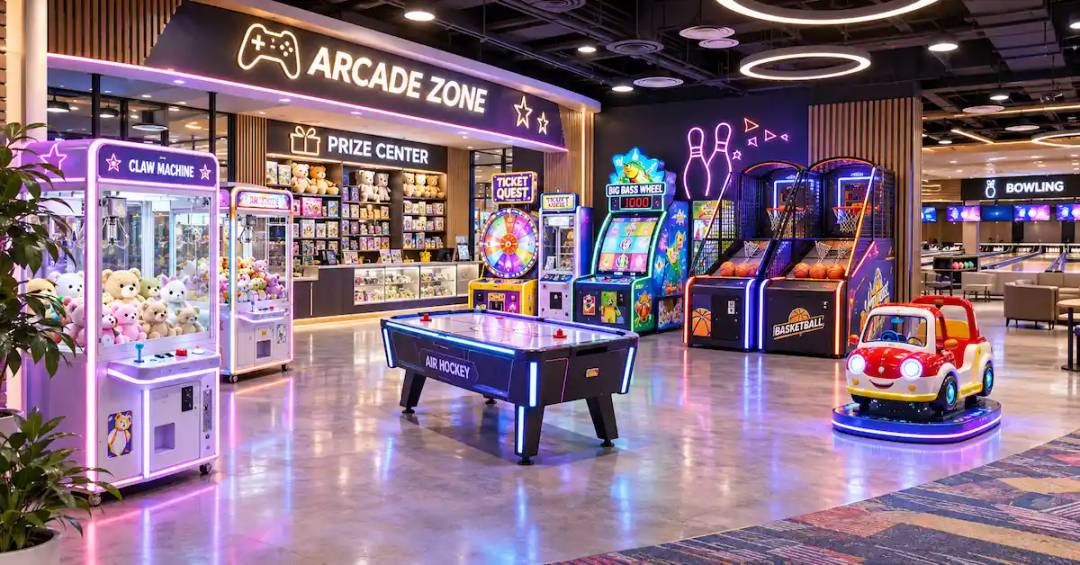
Before choosing a machine, map the moments when a bowling customer is available, bored, celebrating or waiting. The most valuable arcade position is often not the largest empty space; it is the point where a group naturally pauses. Record the customer journey from arrival to shoe rental, lane assignment, play, food, scoring, payment and departure. Then mark where a game can add value without creating a queue or safety problem.
Use arcade games to monetize waiting time
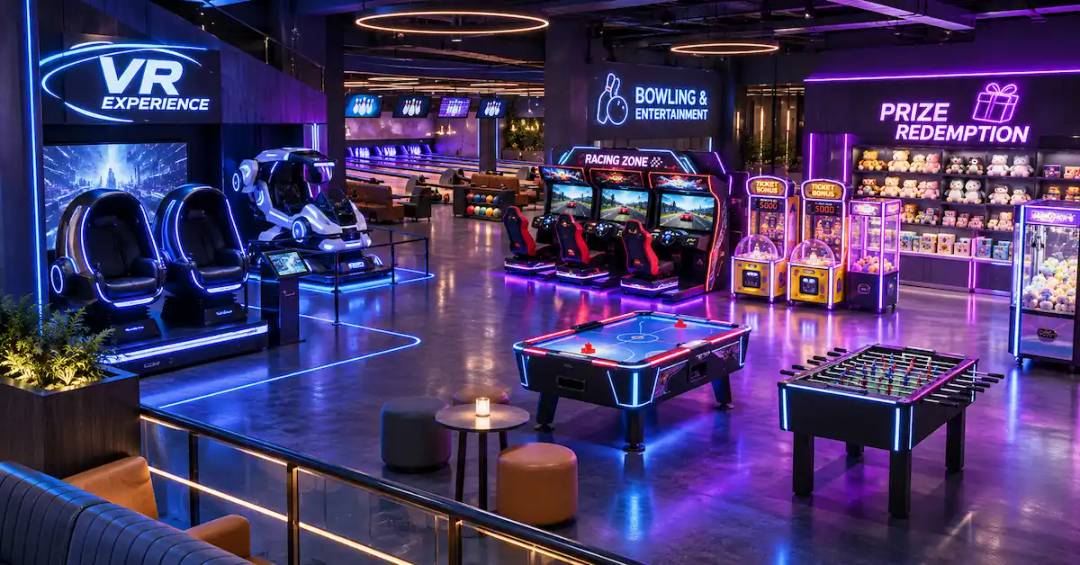
Lane customers may wait for a reservation, for friends to arrive, for food, for a lane to be cleaned or for the next frame. Easy-to-understand games can turn that idle time into a short paid interaction. Claw machines and compact redemption games work well when the player can understand the objective quickly. Basketball and air hockey can support group competition when there is enough clearance for spectators. A premium VR or racing unit may suit a longer wait, but its queue, hygiene and reset time must be planned.
Protect the core bowling experience
Arcade equipment should not block lane approaches, emergency exits, accessible routes, shoe counters, bar service or staff sightlines. Loud audio can interfere with announcements and league play. Flashing lights can be attractive near the entrance but distracting beside scoring screens. Ask the layout designer to show queue boundaries, electrical points, cleaning access and the clear path from lanes to restrooms and exits.
| Customer moment | Useful arcade role | Operational constraint |
|---|---|---|
| Arrival and check-in | Visible claw or prize attraction that explains the entertainment offer | Must not obstruct reception, reservations or accessible entry |
| Lane waiting | Fast redemption, sports or compact competitive games | Queue must not spill into lane approaches or service aisles |
| Birthday party | Family games, prize play and a simple group bundle | Staff need predictable reset, payment and prize processes |
| Food and social time | Games visible from seating and suitable for mixed ages | Noise, lighting, cleaning and table circulation matter |
| Post-game departure | Prize redemption or a final impulse play near the exit | Do not create crowding or confuse payment closure |
How to choose arcade games for bowling alleys by venue role
Category choice should follow the role each game plays in the venue. The table below is a decision framework, not a fixed purchase list. Use it to identify which categories deserve a sample, a layout position or a line item in the RFQ.
| Category | Why it fits bowling | Best placement | Checks before ordering |
|---|---|---|---|
| Claw and gift machines | Broad age appeal, visible prizes and short sessions | Entrance, party route or prize-facing area | Prize dimensions, payout settings, refill access, glass safety and service parts |
| Redemption games | Turns skill and repeat play into tickets or points | Near prize counter or family waiting zone | Ticket/point output, card or coin interface, counter integration and calibration |
| Basketball and sports | Quick group competition for teens and adults | Open wall with spectator clearance | Frame stability, ball return, scoring, noise and high-use wear parts |
| Air hockey | Simple head-to-head play that complements bowling | Social zone away from lane approaches | Playfield, blower, scoring, rails, puck supply and service access |
| Racing simulators | Premium social experience for older players | Anchor zone with power and queue space | Footprint, seat layout, motion, ventilation, safety and packed volume |
| VR and interactive machines | Distinctive attraction for premium or mixed-use centers | Controlled zone with hygiene and staff oversight | Content licence, reset time, cleaning, software updates and remote support |
| Kiddie rides | Serves younger siblings while others bowl | Visible family area with supervision | Age limits, restraint or seating, electrical safety, cleaning and access |
A compact bowling center may need only a few high-visibility units, while a large family entertainment venue can support several zones. Start with the number of simultaneous users you can serve during peak waiting periods. A single attractive machine that creates a ten-minute queue may be less valuable than several lower-cost games that distribute demand.
Design the arcade zone around lanes, parties and staff movement
Send the supplier a measured floor plan that shows lanes, approaches, seating, bar or kitchen, party rooms, restrooms, entrances, exits, columns, ceiling height, power points, fire equipment and loading access. A square-meter figure alone is not enough. Two venues with the same area can have very different usable space because of columns, low ceilings, queue routes or landlord restrictions.
Ask for a 2D layout that includes machine orientation, clearances, queue lines, service panels and electrical assumptions. EPARK's public design process begins with space size, floor plan, entrance and exit locations, target audience, preferred games and budget, then develops a 2D layout and preliminary quotation. Use that process as a practical RFQ standard, and ask the supplier to mark every assumption that still needs site confirmation.
Place high-visibility machines where they sell the concept
Claw machines, prize displays and illuminated redemption units can explain the arcade offer to a visitor before they decide to play. Put them where waiting customers can see the play and the reward, but not where they block reception or create a bottleneck. Competitive sports and air hockey need spectator clearance and a surface that can tolerate repeated contact. Racing and VR need more deliberate queue and supervision planning.
Keep service access visible in the drawing
Maintenance panels, coin or card readers, ticket dispensers, prize doors, emergency stops and power switches must remain reachable after furniture and queues are installed. Ask for operating and packed dimensions, door widths, crate dimensions and weight. A unit that fits beside a lane may still fail at the loading dock or require a lift that the building does not have.
Specify payment, pricing and player flow before production
Bowling centers often use reservations, lane charges, food and beverage POS, arcade cards or cashless systems. Decide whether the arcade uses the existing payment platform, a separate card system, coins or tokens. Ask the factory whether it supplies the reader, wiring, software settings, test account and mounting, or only the cabinet opening. A game that accepts payment but cannot be reconciled with the center's reporting system creates operational work.
Record voltage, frequency, plug type, rated power, language, game version, ticket or point settings, audio level and included accessories for each model. The same cabinet name can hide different boards, displays, payment modules or software revisions. Use a configuration ID across the quote, approved sample, factory test, packing list and service file.
For prize or redemption games, define who sets payout, prize value, ticket rate, reset and accounting. Do not assume a factory setting is legally or commercially suitable in your market. For claw machines, test the prize size, claw strength range, refill access and display visibility using the actual merchandise or a representative sample.
Evaluate commercial durability and maintenance evidence
Bowling venues combine family use, food, drinks, shoes, cleaning chemicals, high peak traffic and occasional impacts. Ask the supplier how surfaces are cleaned, which parts are wear items, how staff reach controls and what evidence is collected before shipment. A product photograph does not demonstrate commercial durability.
EPARK's public production page describes artwork printing and painting, electronic assembly with PCB installation and wiring, LED setup, screen and control integration, final assembly and function testing. It also states that each machine receives a 48-hour full-operation test covering gameplay, electrical safety, lighting and mechanical durability before packaging. Request the model-specific checklist, test duration, failed-unit process and retest evidence for your order.
| Risk area | Evidence | Buyer decision |
|---|---|---|
| High-use controls | Component references, access method and replacement instructions | Can local staff restore play without unnecessary downtime? |
| Payment and scoring | Payment test, score or ticket output and configuration record | Will revenue be recorded correctly in the venue? |
| Cleaning and finish | Material/finish description and compatible cleaning guidance | Can the venue follow its real sanitation routine? |
| Electrical and safety | Nameplate, voltage, plug, protective features and test record | Does the unit match the destination and site approval? |
| Shipping | Packed dimensions, foam, film, frame or crate and loading photos | Can the unit arrive intact and be identified at receiving? |
Compare the installed cost, not only the machine price
The installed cost for a bowling-alley arcade includes the machine, options, payment integration, freight, import charges, site preparation, electrical work, installation, signage, initial prizes, spare parts, staff training and any software or content fees. Allocate shared costs fairly when several machines share a shipment. Ask for packed dimensions and weight so freight assumptions can be checked.
Build a category-level operating model. Estimate play price, plays per open hour, peak utilization, operating hours, prize cost, payment fees, utilities, routine maintenance and expected downtime. For bowling, also consider whether the machine increases lane bookings, food sales, party spend or dwell time. A game may be valuable as part of the whole visit even when its direct play revenue is not the highest.
Do not copy generic revenue or payback claims. EPARK's public process page mentions example payback and return ranges that depend on location and operations. Treat those numbers as background, then model your own lane traffic, customer spend, rent and staffing. A conservative business case is more useful than a precise-looking forecast with unknown assumptions.
Build a bowling-alley arcade RFQ that a factory can answer
Your RFQ should describe the lane count, venue type, usable arcade area, customer ages, opening hours, party program, payment system, destination country, electrical requirements, target opening date, desired machine roles, quantity range, artwork or theme, installation expectations, inspection requirements and spare-parts plan. Ask for model-level prices and a proposed layout instead of a generic catalog.
Require the quotation to show model revision, quantity, unit and line price, customization, MOQ, mixed-model rules, Incoterm and named place, packed volume, production milestones, testing, packing, documents, warranty and technical support. The commercial arcade machines buyer checklist explains how to normalize those fields. For FEC-style bowling centers, the FEC supplier guide can support the broader project partner review.
Use a pilot order and an opening acceptance plan
A bowling operator does not need to install the entire proposed arcade mix on the first day. When demand or layout assumptions are uncertain, a pilot can test one or two categories in the real venue. Choose the pilot machines against a written question: do families use the prize zone while waiting, does a sports game attract groups without disrupting lanes, or does a premium simulator earn enough per available hour to justify its footprint? A pilot is useful only when the operator records the result and defines what would justify a second order.
Before the machines arrive, prepare an acceptance checklist that matches the quotation. Verify model code, cabinet finish, screen, controls, voltage, plug, payment reader, language, game or software version, accessories, artwork, packed condition and serial or asset references. Test the complete customer sequence: payment, game start, controls, score or ticket output, reset, refund path where applicable and safe shutdown. A unit that powers on but cannot be reconciled with the bowling center's card system is not ready for opening.
Keep a receiving map for mixed shipments. Mark which crate contains each machine, spare kit, manual and small accessory. Photograph the first opened unit, protective materials and any visible damage. Record deviations before the unit is placed in service. This evidence makes it easier to distinguish transit damage, installation error and manufacturing defects when a support request is raised.
After installation, run a soft opening with staff and invited customers before the public launch. Observe queue behavior, sightlines, noise, payment instructions, prize refilling, cleaning and emergency access. Use the first week to correct placement and signage, not to hide a configuration problem. If a game is moved, update the layout, power map and service record so the venue's documents remain accurate.
Frequently asked questions
What are the best arcade games for bowling alleys?
The best choices usually combine easy-entry prize or redemption play, visible claw machines, fast social sports games and selected premium attractions such as racing or VR. The final mix depends on lane count, usable space, age profile, payment system, staffing and local demand. Use a measured layout and a role-based business case rather than a fixed list.
Should arcade games be placed near the bowling lanes?
They can be near waiting or social areas, but should not block lane approaches, accessible routes, exits, staff sightlines or service access. Noise, lighting, queue length and food traffic must be considered. Ask the supplier to show clearances and queues on the layout.
Can a bowling alley use the same card system for lanes and arcade games?
It may be possible, but compatibility depends on the venue POS, card platform, reader, software, network and reporting requirements. Confirm whether the factory supplies integration or only the hardware opening. Test payment, refunds, free play, scoring and reporting before launch.
What evidence should a bowling alley request from a machine supplier?
Request model-linked configuration records, materials and finish details, component references, functional and safety tests, payment or ticket tests, packing specifications, manuals, spare-parts lists and warranty boundaries. EPARK publicly describes a 48-hour full-operation test and export packing; confirm how those processes apply to the ordered models.
How many arcade machines should a bowling alley buy?
There is no universal number. Start with peak waiting demand, usable arcade area, queue capacity, budget, expected play price and service resources. A pilot or staged order can reveal which categories complement lane play before a larger expansion.
Can EPARK design an arcade zone for a bowling project?
EPARK publicly describes 2D layout planning based on space, entrances, exits, audience, preferred games and budget, as well as commercial amusement equipment, testing, packaging and support. Send the measured site plan and bowling-center requirements through the EPARK contact page for a project-specific review.
Conclusion
Arcade games for bowling alleys should extend the visit, support parties and waiting time, and add revenue without damaging lane flow or service operations. Choose categories by customer role, design the zone around measured clearances, specify payment and electrical details, verify commercial testing and materials, calculate installed and lifecycle cost, and require a quotation that your operations team can actually use.
EPARK's public manufacturing and project information gives bowling operators a practical starting point for a supplier conversation, while the final decision must remain site-specific. Share the lane plan, usable arcade area, customer profile, payment environment, target opening date and preferred attraction roles to request a layout, quotation and technical evidence package.
Disclaimer
The information provided on this website is for general informational purposes only.
While EPARK Arcade Game Machine Manufacturer strives to ensure accuracy and reliability, no warranties—express or implied—are made regarding completeness, performance, or applicability.
Product specifications, designs, and features may vary depending on usage, customization, and customer requirements.
Buyers are responsible for verifying all technical details, compliance certifications, and suitability before procurement.
EPARK shall not be held liable for any direct, indirect, incidental, or consequential damages arising from the use of this website or its content, including but not limited to business losses, data errors, or equipment misuse.
For tailored solutions or further verification, please visit our Contact Us
Intellectual Property Notice
All articles, product images, videos, catalogs, software, and related materials published on this website are the intellectual property of EPARK, unless otherwise stated.
Unauthorized reproduction, distribution, modification, or commercial use of any content is strictly prohibited without prior written consent from EPARK.
EPARK reserves the right to take legal action against any unauthorized use, including but not limited to copyright infringement, misrepresentation, or unfair competition.
Trademarks
The name EPARK, the EPARK logo, and all related brand elements displayed on this website are registered trademarks or trade names of Guangzhou EPARK Electronic Technology Co., Ltd.
Other product names, company names, or logos mentioned on this site may be trademarks of their respective owners.
Unauthorized use of EPARK's trademarks for commercial purposes, including advertising, promotions, or product packaging, is strictly prohibited.
Governing Law
These terms are governed by the laws of the People's Republic of China.