

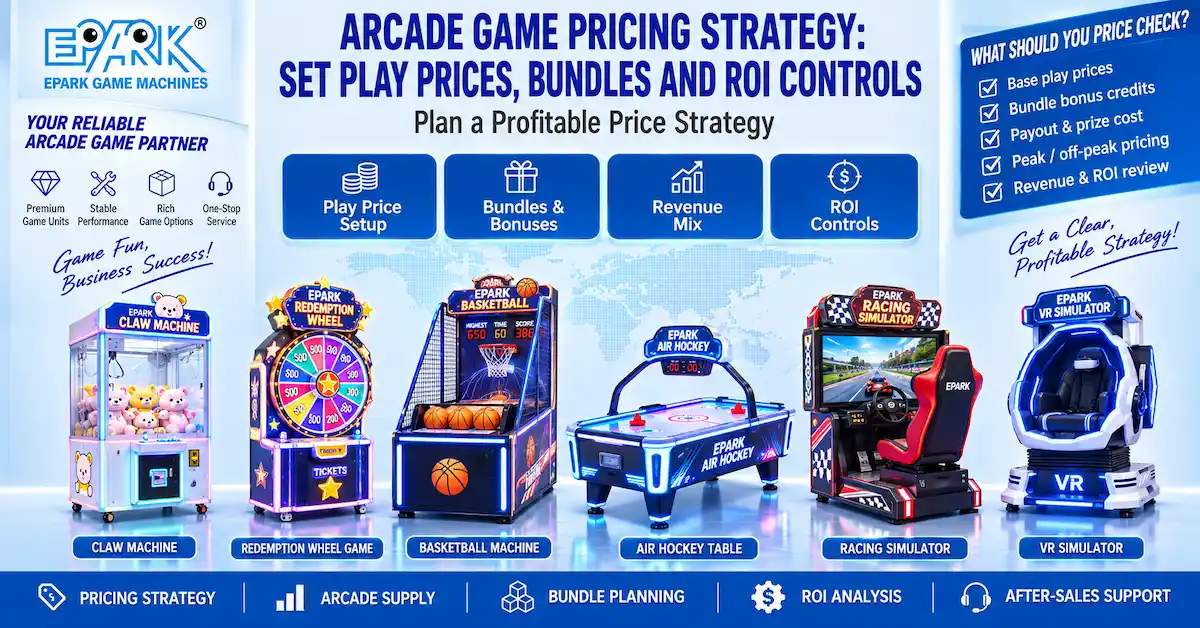
Quick answer: an arcade game pricing strategy should price the visit, not just the machine
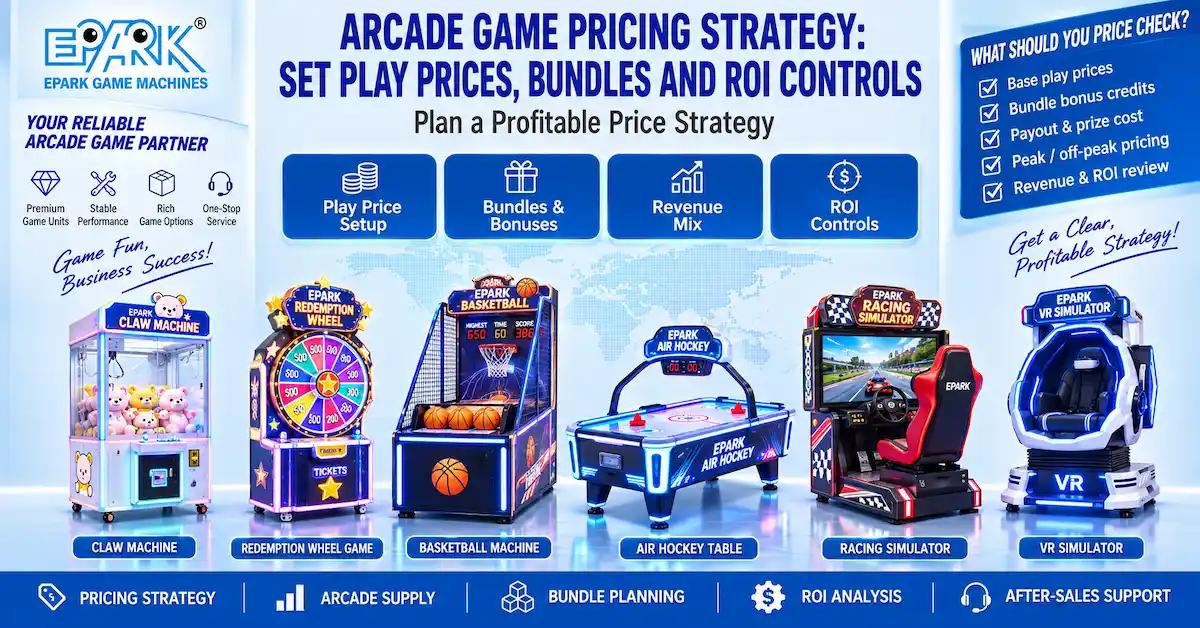
An effective arcade game pricing strategy starts with the value of the customer experience, then checks utilization, operating cost, prize cost, payment fees, downtime and the venue's wider revenue model. The goal is not to make every game cost the same. It is to create a clear price ladder that customers understand, encourages a second play or a longer visit, and leaves enough contribution to maintain and replace the equipment.
For an arcade operator, pricing decisions include the price per play, credit bundles, timed play, memberships, party packages, peak and off-peak offers, prize exchange rates and promotional rules. For a bowling alley or FEC, arcade pricing also interacts with lane bookings, food, parties and group spend. For a distributor or project buyer, pricing strategy matters earlier: the chosen machine, payment system, durability and spare-parts plan determine the cost base that the operator will need to recover.
Guangzhou EPARK Electronic Technology Co., Ltd. publicly describes commercial amusement equipment including arcade, claw, redemption, sports, racing, VR and family entertainment products. Its public process states that it provides layout planning, production, 48-hour full-operation testing, export packing, installation guidance and online technical support. Those capabilities help establish the equipment cost and service assumptions behind a pricing model, but they do not determine the local consumer price. Price must be tested against the venue, market, audience and payment environment.
Build an arcade game pricing strategy around the unit sold
Before setting a number, decide what the customer buys. A unit can be one game play, a number of credits, a timed session, a group package, a membership benefit or a prize redemption outcome. Confusion at this stage creates confusing signage and weak data. Customers should be able to understand how much they pay, what they receive and whether unused value expires.
Single-play pricing
Single-play pricing is easy to explain and useful for first-time visitors. It works best when the game has a clear start and finish, the play duration is predictable, and the customer can see the price before committing. Use it as the reference price even when you also sell bundles.
Credit and card pricing
Credit systems can increase convenience and reduce cash handling. A price ladder might offer a small reload for testing, a medium bundle for a normal visit and a larger bundle for parties or repeat customers. The display must make the conversion visible. Do not make the credit value so abstract that customers cannot judge the cost of one play.
Timed or session pricing
Timed play can suit a VR attraction, soft-play area or premium simulator where setup and reset are significant. The operator should measure actual session length, queue time, cleaning and staff involvement. A timer that starts before the player is ready creates dissatisfaction; a session that runs far beyond the modeled time can reduce throughput.
| Pricing unit | Best fit | Data to monitor | Risk to control |
|---|---|---|---|
| Single play | Claw, sports, quick redemption or simple arcade play | Plays per hour, conversion, repeat play and revenue per play | Price feels high if play duration or outcome is unclear |
| Credit bundle | Multi-game venues and family visits | Reload size, credits used, breakage, average spend and return rate | Customers cannot understand the real price of a play |
| Timed session | VR, premium simulator or supervised attraction | Session length, reset, queue, staff time and utilization | Overlong sessions reduce throughput or underdeliver value |
| Party/group package | Bowling, FEC birthdays and group events | Guests, play allocation, food, host labor and add-ons | Package margin disappears when usage is not capped or measured |
| Membership | Frequent local visitors and loyalty programs | Visits, credits, redemption, churn and peak usage | Heavy users consume capacity without sufficient contribution |
Build the cost floor before setting the market price
Pricing below the true cost base can create busy machines and a weak business. Build a cost floor that includes the installed equipment, payment system, freight, site preparation, prizes or tickets, utilities, maintenance, software or content fees, staff time, payment processing, rent allocation, marketing and downtime. Allocate shared costs consistently across machines or zones.
A simple contribution formula is: contribution per play = price collected − prize or ticket cost − payment fee − variable labor − variable operating cost. Monthly contribution then depends on plays, uptime and utilization. Use the contribution model to test whether a discount creates additional volume or merely reduces the value of plays that would have happened anyway.
For a new machine, separate supplier cost from consumer pricing. EPARK's public materials describe factory production, testing and export support, but they do not establish your local landed cost. Ask for a complete quotation with model, options, packed dimensions, shipping basis, warranty, parts and support. The game machine factory cost guide can support equipment-cost analysis, while this article owns the operator pricing decision.
Include downtime in the price model
A machine that is unavailable cannot generate play revenue, and a fault may also damage customer trust. Track uptime by machine and calculate a conservative utilization scenario. Include routine inspection, cleaning, prize replenishment, payment troubleshooting and service parts in the operating budget. A low purchase price does not create a low cost per available play if the machine is difficult to maintain.
Create a price ladder customers can understand
A price ladder helps customers choose without forcing them to perform mental arithmetic. Use a visible reference price, then offer bundles that provide a clear reason to buy more. The benefit can be a lower effective price per play, bonus credits, a party convenience, a membership privilege or a premium experience. State any expiry, restrictions and eligible machines.
Use a reference price and measured discount
Suppose one play is priced at 1.00 in the local currency. A medium reload might provide 12 plays for 10.00, and a party bundle might combine credits with food or reserved time. These numbers are illustrations, not a recommendation. Test the effective discount against the contribution floor and observe whether the bundle increases total spend, repeat visits or only shifts payment from one play to another.
Keep the price ladder consistent across categories
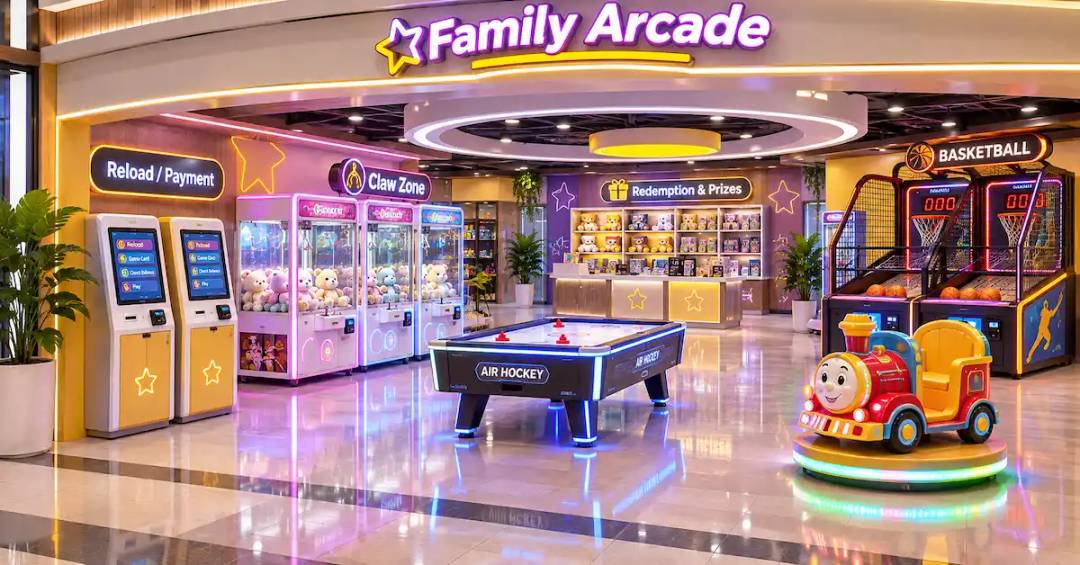
Not every game needs the same price, but large unexplained differences create friction. A premium motion or VR attraction may cost more because it uses more space, staff time or licensed content. A claw machine may have a lower play price but higher prize cost. Use signage to explain the value difference through time, experience, prize or competition rather than relying on a mysterious number.
| Offer | Customer purpose | What to measure | Guardrail |
|---|---|---|---|
| Trial reload | Lets a new visitor test the venue | Conversion to a second reload or repeat visit | Must not be so generous that it replaces normal spend |
| Standard bundle | Matches the typical family or group visit | Average spend, credits used and play mix | Keep the effective discount above the contribution floor |
| Large bundle | Serves parties and committed players | Spend per visit, breakage and capacity use | Define expiry and peak-time restrictions clearly |
| Premium session | Prices a high-cost or supervised attraction | Throughput, queue, reset, staff time and satisfaction | Price must reflect actual delivered session time |
| Member offer | Encourages local repeat visits | Visits, churn, redemption and peak utilization | Review heavy-user economics monthly |
Price by game economics, not by cabinet appearance
Two cabinets with similar size can have different economics. A claw machine's cost base includes prize inventory, refill labor and payout settings. A redemption game includes tickets or points, prize conversion and calibration. A racing or VR attraction may include higher power, space, maintenance and content costs. A basketball or air hockey game may have fast throughput but more wear on controls, sensors or mechanical parts.
Build a category scorecard using five inputs: customer value, play duration, throughput, variable cost and service burden. Add a sixth input for strategic value, such as whether the game attracts a missing age group or supports party sales. Do not use direct revenue alone to decide whether to keep a machine.
| Input | Question | Pricing implication |
|---|---|---|
| Customer value | Does the game feel understandable, social or distinctive? | Higher perceived value can support a premium only when the experience is delivered |
| Play duration | How long does a normal session last? | Longer play may need a higher price or timed capacity control |
| Throughput | How many paid sessions can the unit serve per hour? | Low throughput requires careful queue and price management |
| Variable cost | What do prizes, tickets, payment and consumables cost? | Price must preserve contribution after every play |
| Service burden | How often do staff clean, refill, reset or repair it? | Higher service burden must be included in the cost floor |
| Strategic role | Does it attract an important customer or support another sale? | Keep a whole-venue view before removing a support attraction |
Use peak, off-peak and event pricing carefully
Demand is rarely flat. Bowling centers, FECs and mall entertainment zones often have different weekday, weekend, school-holiday and party patterns. A pricing strategy can use off-peak bundles, birthday packages, league-night offers or member benefits to shift demand, but the offer must be easy for staff to explain and the payment system must record it correctly.
Off-peak pricing
Use off-peak offers when unused capacity is the problem, not when the venue is already full. Measure incremental plays and total contribution. A discount that fills quiet hours can be useful; the same discount during peak hours can lengthen queues and reduce revenue per available position.
Party and group packages
Packages should define guests, credits or timed play, food, reserved space, host labor, prize rules and add-ons. Protect the operator from unlimited usage that makes a fixed package unprofitable. At the same time, avoid making the package so restrictive that staff must negotiate every detail on the event day.
Memberships and loyalty
Memberships work when they create a predictable reason to return and do not consume more peak capacity than the contribution supports. Track active members, visits, credits used, redemption, churn and incremental spend. Review heavy-user behavior separately from average member behavior.
Make payment and signage part of the pricing product
Customers judge price through the payment experience. Show the cost of one play, bundle value, bonus credits, expiry, eligible machines and any peak restriction at the point of decision. If the venue uses a card system, confirm that the reader, balance display, refund path and reporting match the pricing model.
Ask the equipment supplier to confirm payment hardware, software settings, language, network requirements, card or QR compatibility and testing. A cabinet can be mechanically correct but commercially unusable if the reader fails, the balance does not update or the operator cannot reconcile sales by machine. Use a configuration ID for payment as well as for the cabinet.
EPARK's public design and production information mentions customization and technical support, but payment integration remains order-specific. Include payment behavior in the RFQ, sample test and acceptance checklist. The commercial arcade machines checklist provides a useful broader specification framework.
Test the pricing strategy with a controlled operating loop
Do not change every price at once. Establish a baseline period, then test one variable in one zone or customer segment. For example, compare a standard reload with a modest bonus during weekday evenings, or test a party package with defined credits. Record the offer, dates, eligible machines, customer segment, price, plays, spend, contribution, queue and complaints.
Use a simple decision rule. Keep the change when incremental contribution improves without unacceptable queue, service or customer-experience damage. Modify it when the offer increases volume but lowers contribution. Remove it when the change creates confusion, payment errors, excessive prize cost or capacity pressure. Document the result so staff do not revert to informal discounts.
Metrics that matter
- Revenue and contribution per available machine hour.
- Average spend per visitor and average spend per group.
- Plays per visitor, repeat play and reload rate.
- Peak and off-peak utilization, queue time and abandoned play.
- Prize or ticket cost as a percentage of game revenue.
- Payment errors, refunds, downtime and repair response.
Connect pricing to equipment sourcing and lifecycle cost
Pricing strategy cannot rescue equipment that is poorly selected or expensive to support. Before ordering, confirm the model, revision, options, voltage, payment system, packed dimensions, testing, warranty, spare parts and lead time. Ask whether the factory can repeat the configuration for a second venue and whether critical components are identifiable.
EPARK publicly describes a 15,000 m² factory, standardized production, 48-hour full-operation testing, export packaging and online video assistance. These published facts can support a supplier conversation, but your quotation should still state the exact machine, evidence, commercial terms and support scope. A higher-quality machine may support a stronger customer experience, yet the business case must include installed cost and local demand.
For a new arcade zone, use the game machine mix strategy guide to connect category roles with the venue. For a bowling-led project, also review the layout planning guide so pricing tests do not ignore queue capacity and customer flow.
Govern price changes so customers and staff see one rule
A pricing strategy becomes unreliable when managers give informal discounts, staff interpret bundles differently or the payment system contains outdated settings. Create a change record for every permanent or seasonal price change. Record the old price, new price, effective date, eligible machines, customer segment, reason, expected result, approval owner and signage or software updates required. Keep the record with the machine configuration and payment revision.
Train staff to explain the offer in one sentence and define what they may refund or adjust. If a customer has a payment error, the remedy should be consistent with the system record rather than an improvised free play. For multi-location operators, publish one price book with approved local variations. This allows the business to compare categories across venues without confusing a price difference with a performance difference.
Ask the equipment supplier for the data fields required to identify a payment or software issue: machine model, configuration ID, reader type, software revision, error message, transaction time and recent change. EPARK's public support information refers to online video assistance and spare-parts supply; an order-specific support plan should state what evidence the operator sends and how a pricing or payment fault is escalated.
Frequently asked questions
What is an arcade game pricing strategy?
An arcade game pricing strategy is the system used to set play prices, credits, bundles, timed sessions, memberships, party packages and promotions while protecting contribution and customer value. It connects consumer pricing with utilization, variable cost, equipment uptime, payment fees, prizes and the wider venue experience.
How much should one arcade game play cost?
There is no universal price. Set a reference price from local competition, customer value, play duration, throughput, variable costs, payment fees, rent and desired contribution. Test the number with real operating data and keep the price understandable at the point of purchase.
Are arcade bundles better than single-play pricing?
Bundles can increase convenience and average spend when the effective discount is controlled and the customer understands the value. Compare incremental contribution, reload rate, unused credits, peak capacity and repeat visits. A bundle that only discounts plays that would have happened anyway may reduce profit.
How should bowling alleys price arcade games?
Bowling alleys can connect arcade pricing to lane waiting, parties, food and group visits. Use easy-entry games near waiting zones, offer clear reload or party options, and avoid discounts that overload peak capacity. Measure arcade contribution and any effect on lane, food or event sales.
Should premium VR or racing games cost more?
They may justify a higher price when they deliver a distinctive, reliable and sufficiently long experience and require more space, staff or licensed content. Confirm session length, reset, queue, hygiene and service cost before setting the premium. A high price for a short or unreliable experience will reduce repeat play.
What equipment data is needed before setting a price?
Collect installed cost, packed and operating dimensions, power, payment system, play duration, throughput, prize or ticket cost, maintenance burden, spare-parts plan, warranty and downtime assumptions. Use the machine's configuration ID so the price model remains connected to the exact unit.
How often should an arcade pricing strategy be reviewed?
Review performance regularly and after meaningful changes in rent, competition, payment fees, prize cost, machine mix or customer behavior. Use controlled tests rather than changing every price at once. Separate seasonal promotions from permanent price decisions.
Can EPARK help configure machines for a pricing system?
EPARK publicly describes commercial arcade categories, customization, layout planning, testing, packing and technical support. Payment hardware, software, pricing settings and reporting compatibility depend on the model and project. Send the venue concept, payment environment and target machine list through the EPARK contact page for a configuration review.
Conclusion
A strong arcade game pricing strategy is a measurable operating system, not a random number on a cabinet. Define the unit sold, calculate the cost floor, create a clear price ladder, price categories by their real economics, use peak and event offers carefully, make payment and signage transparent, and test changes with contribution and capacity data.
Equipment sourcing is part of the strategy. Ask the manufacturer for a model-specific quotation, configuration record, test evidence, packed cost, payment integration, spare-parts plan and support scope. EPARK's public production and support information can provide a starting point, while your local market data should determine the final consumer price and promotion rules.
Disclaimer
The information provided on this website is for general informational purposes only.
While EPARK Arcade Game Machine Manufacturer strives to ensure accuracy and reliability, no warranties—express or implied—are made regarding completeness, performance, or applicability.
Product specifications, designs, and features may vary depending on usage, customization, and customer requirements.
Buyers are responsible for verifying all technical details, compliance certifications, and suitability before procurement.
EPARK shall not be held liable for any direct, indirect, incidental, or consequential damages arising from the use of this website or its content, including but not limited to business losses, data errors, or equipment misuse.
For tailored solutions or further verification, please visit our Contact Us
Intellectual Property Notice
All articles, product images, videos, catalogs, software, and related materials published on this website are the intellectual property of EPARK, unless otherwise stated.
Unauthorized reproduction, distribution, modification, or commercial use of any content is strictly prohibited without prior written consent from EPARK.
EPARK reserves the right to take legal action against any unauthorized use, including but not limited to copyright infringement, misrepresentation, or unfair competition.
Trademarks
The name EPARK, the EPARK logo, and all related brand elements displayed on this website are registered trademarks or trade names of Guangzhou EPARK Electronic Technology Co., Ltd.
Other product names, company names, or logos mentioned on this site may be trademarks of their respective owners.
Unauthorized use of EPARK's trademarks for commercial purposes, including advertising, promotions, or product packaging, is strictly prohibited.
Governing Law
These terms are governed by the laws of the People's Republic of China.