
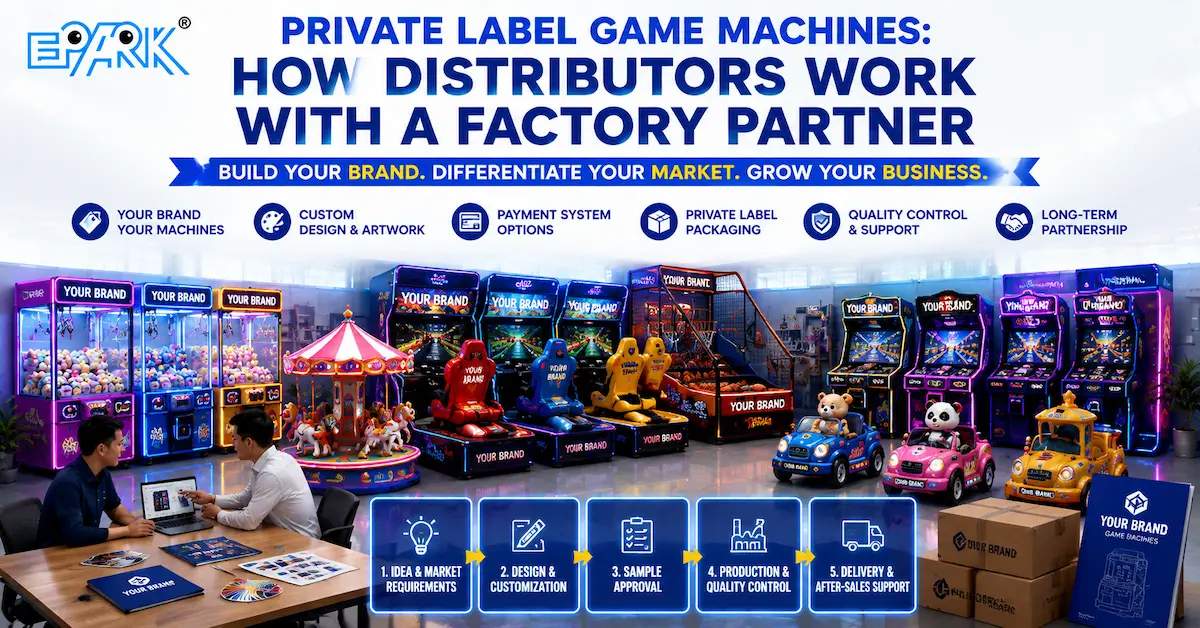
Why Private Label Game Machines Matter for Distributors
For an arcade equipment distributor, selling the same machines available from many competing suppliers creates a difficult business model. Customers can compare identical cabinets, similar specifications, and similar photos, which often pushes negotiations toward price.
Private label game machines provide another route.
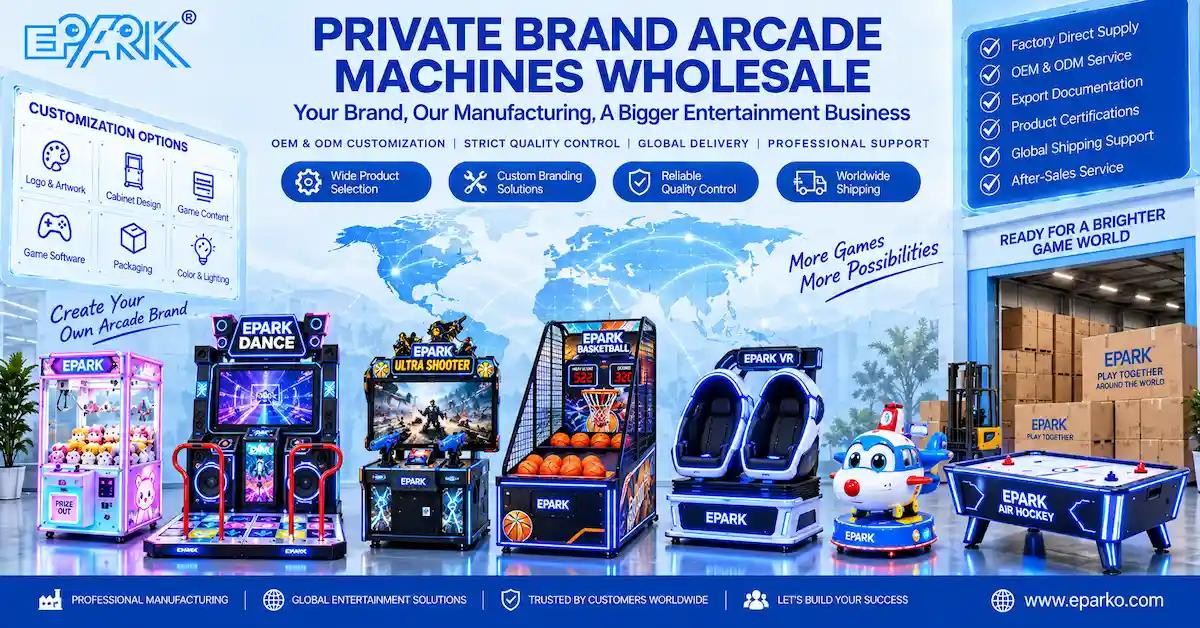
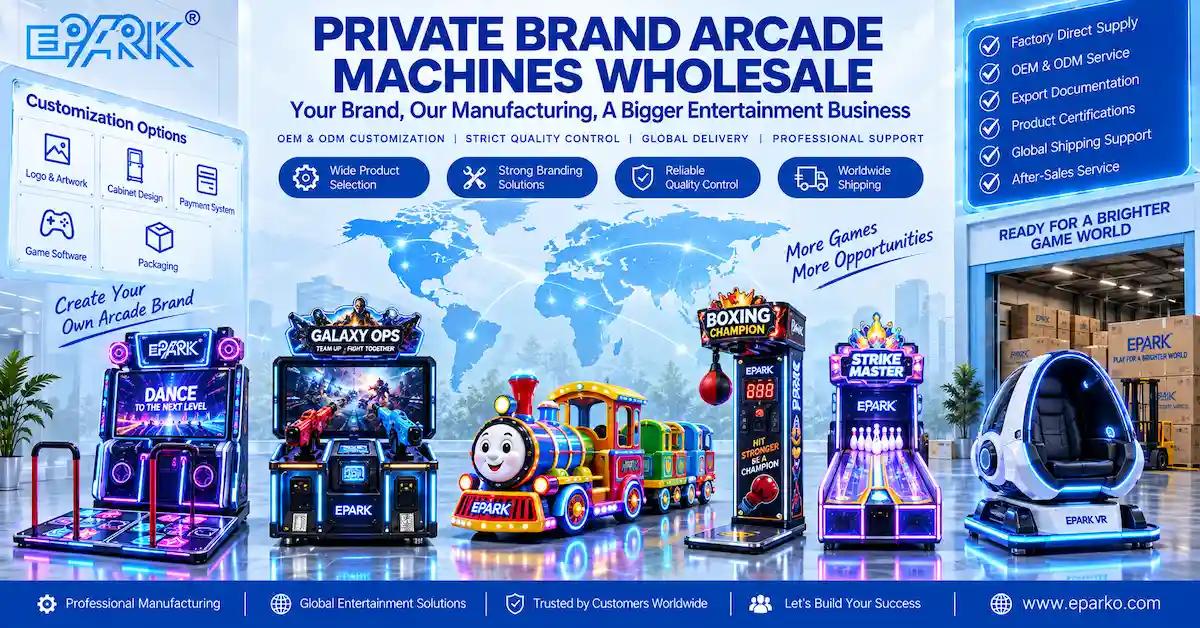
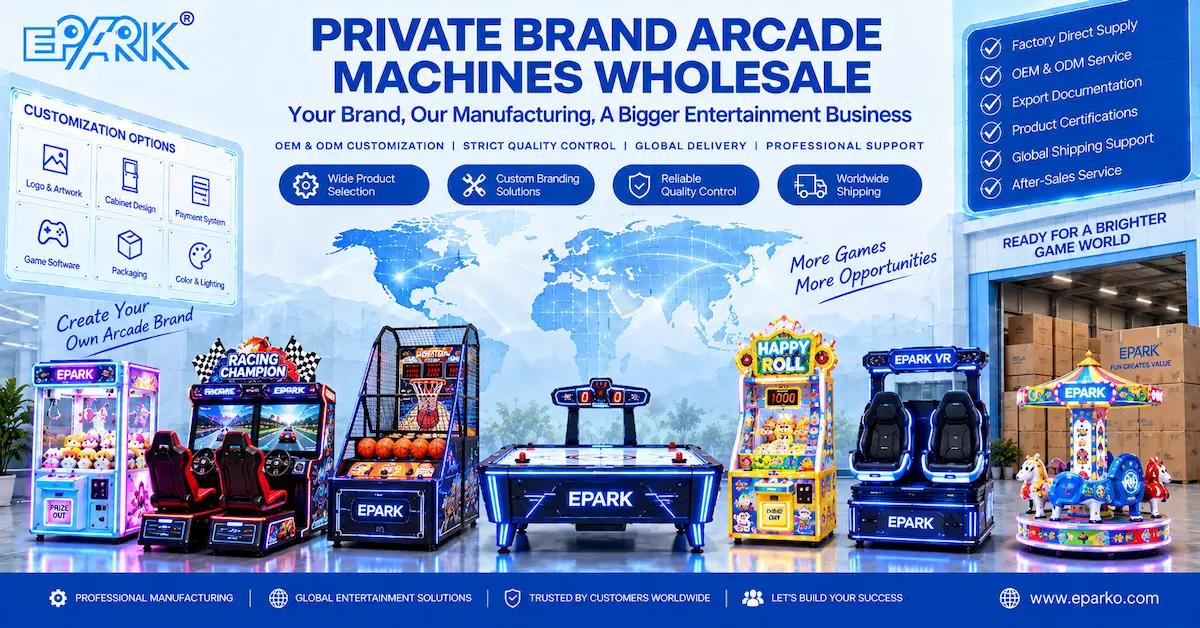
Instead of acting only as a reseller, a distributor can work with a factory to build a recognizable product line under its own brand. Depending on the cooperation model, this may include branded cabinets, customized artwork, regional configurations, packaging, payment-system options, selected components, documentation, and a consistent range of machines for the distributor's market.
The commercial value is not simply having a logo printed on a cabinet. A stronger private-label strategy connects branding with product positioning, supply stability, quality control, spare-parts planning, and long-term market development.
For distributors serving arcade operators, FECs, shopping malls, and entertainment projects, the right factory partnership can turn individual equipment orders into a more scalable product business.
Buyers evaluating manufacturing capability can learn more about EPARK through its arcade machine manufacturer profile.
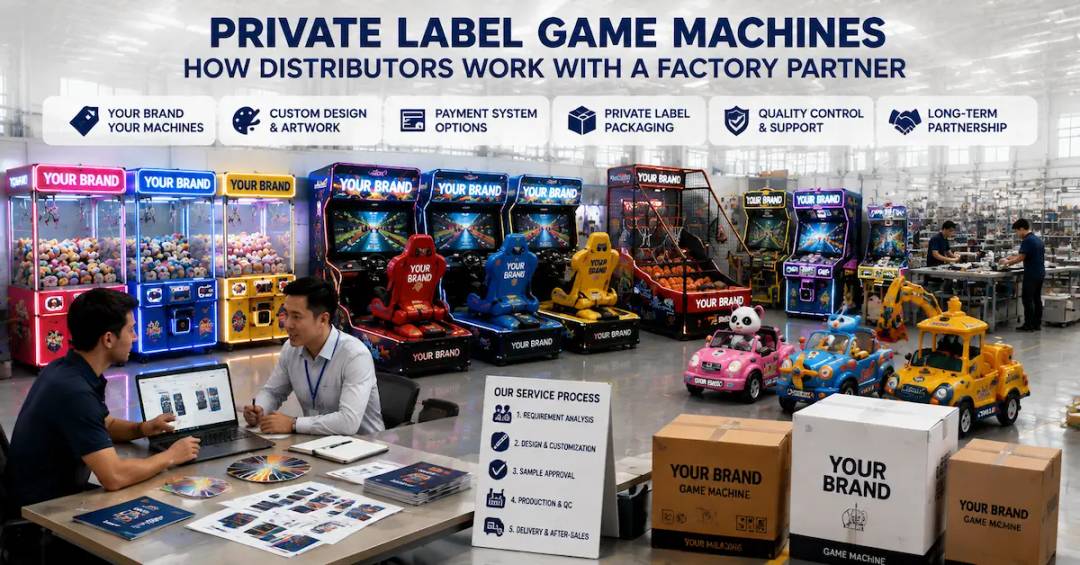
What Are Private Label Game Machines?
Private label game machines are amusement or arcade machines manufactured by a factory and marketed by a distributor or brand under its own commercial identity.
The underlying product may begin with an existing factory platform, but the distributor can specify selected branding and configuration requirements before production.
Typical private-label elements may include:
| Private Label Element | Typical Customization | Distributor Value |
|---|---|---|
| Brand identity | Logo, colors, decals, nameplates | Builds market recognition |
| Cabinet appearance | Artwork, lighting, selected finishes | Differentiates the product line |
| Product configuration | Language, settings, selected components | Fits regional requirements |
| Payment system | Coin, card or compatible cashless systems | Supports local operating models |
| Packaging | Labels, cartons, manuals | Creates a consistent brand experience |
| Documentation | Product naming, operating information | Supports dealers and end users |
| Spare parts | Defined replacement-parts package | Improves after-sales capability |
The level of customization depends on the factory, machine type, order volume, engineering requirements, and whether the distributor is using an existing platform or requesting deeper product development.
Private label should therefore be viewed as a spectrum rather than a single service.
Private Label vs OEM vs Standard Resale
These terms are often used interchangeably, but distributors should separate them when planning a product strategy.
| Cooperation Model | Standard Resale | Private Label | Deeper OEM/ODM |
|---|---|---|---|
| Brand on machine | Factory brand | Distributor brand | Distributor brand |
| Cabinet changes | Usually limited | Moderate | Can be extensive |
| Artwork | Standard | Customizable | Fully developed |
| Hardware changes | Limited | Selected options | Project-dependent |
| Software changes | Limited | Language/settings | Deeper development possible |
| Development cost | Lower | Medium | Potentially higher |
| Speed to market | Faster | Moderate | Longer |
| Best suited for | Testing demand | Building branded lines | Unique/exclusive products |
A distributor does not always need the deepest possible customization.
If the commercial objective is to establish a recognizable product range quickly, private labeling an existing proven platform may make more sense than developing an entirely new machine.
Why Distributors Build Private Label Arcade Product Lines
Move Beyond Pure Price Competition
When every supplier offers visually identical products, buyers tend to compare quotations directly.
Private-label products allow distributors to compete through other factors:
brand familiarity, local technical service, product selection, payment compatibility, warranty handling, spare-parts availability, and market-specific configuration.
That does not eliminate price competition, but it gives customers more reasons to choose the distributor beyond the lowest quotation.
Build Recognition in a Regional Market
A distributor may supply dozens of venues over several years. If every machine carries unrelated factory identities, little of that installed base strengthens the distributor's brand.
With private label game machines, every installation can reinforce the same commercial identity.
This is especially valuable for distributors serving:
- regional arcade operators,
- FEC projects,
- amusement equipment dealers,
- shopping mall contractors,
- franchise networks,
- local entertainment investors.
Create a More Structured Product Portfolio
Private label also encourages better SKU planning.
Instead of offering hundreds of unrelated machines, a distributor can organize a product line around customer needs.
For example, one branded range might contain:
claw machines for shopping malls, redemption machines for FECs, racing games for teenagers and adults, basketball machines for competitive play, and kiddie equipment for younger visitors.
EPARK's commercial arcade machine range can be used as a starting point when evaluating which product categories fit a distributor's target market.
How Distributors Should Work With a Factory Partner
A productive private-label relationship is not simply:
choose machine → add logo → ship product.
The distributor and factory need a repeatable workflow.
Step 1: Define the Market Before Selecting Machines
The distributor should first define:
target country, target customers, typical venue size, preferred machine categories, target price segment, payment method, local voltage, language, and after-sales expectations.
This determines which machines should become core SKUs.
For example, a distributor serving compact mall arcades may prioritize visually attractive claw and redemption machines with efficient footprints. A distributor serving large FEC projects may need a broader product matrix combining sports games, simulators, redemption equipment, kiddie rides, and prize machines.
The product line should follow the market rather than the factory catalogue.
Step 2: Select Products That Can Be Repeated
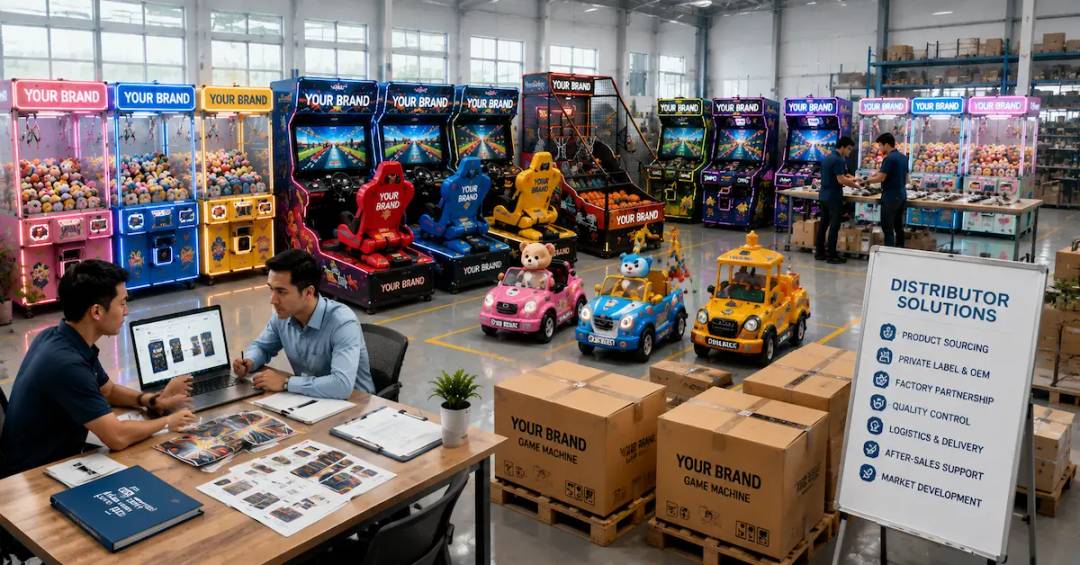
A private-label business becomes stronger when successful products can be reordered consistently.
Before selecting a machine for the branded range, distributors should ask:
Can the factory continue supplying this model?
Are key components stable?
Can replacement parts be identified later?
Can branding be repeated consistently?
Can the product configuration be documented?
A visually attractive machine that cannot be supported in future orders may be a weak foundation for a distributor's product portfolio.
Step 3: Freeze Brand and Product Specifications
Once the product range is chosen, the distributor and factory should create a specification record.
That record may include cabinet appearance, logo placement, artwork version, machine name, color, voltage, plug, payment configuration, language, accessories, packaging, labels, and spare-parts requirements.
This is particularly important for repeat orders.
The objective is to ensure that “Model A” means the same configuration six months later.
What Should Distributors Customize?
Not every possible customization creates equal commercial value.
Logo and Visual Identity
Branding normally begins with:
logo placement, cabinet graphics, nameplates, decals, startup graphics, and packaging.
Consistency matters more than simply making the logo large.
A distributor may benefit from developing a recognizable visual system across several machines rather than designing every cabinet differently.
Cabinet and Artwork
Cabinet appearance can differentiate a private-label range, but distributors should consider maintainability as well as appearance.
More complex custom structures may affect:
production time, replacement panels, packaging dimensions, serviceability, and future repeat orders.
For many distributors, modifying artwork and selected cabinet elements on a proven platform offers a practical balance between differentiation and production stability.
Payment Configuration
Payment compatibility can be commercially more important than decoration.
Depending on the venue model, distributors may need:
coin operation, token systems, card readers, or integration with a compatible cashless arcade management system.
The exact configured system should be confirmed and tested before shipment rather than assumed from generic product specifications.
Language and Operating Settings
Regional localization may include:
interface language, operating instructions, machine settings, pricing parameters, payout settings where applicable, and operator menus.
These requirements should be documented before production.
Use a Golden Sample for Repeat Orders
One of the most useful controls in private-label production is a golden sample or approved reference configuration.
The approved machine becomes the benchmark for later production.
The factory and distributor can compare future batches against the approved reference for:
appearance, artwork, control configuration, payment setup, accessories, labels, and key operating functions.
This is more reliable than instructions scattered across emails or chat messages.
For distributors planning regular purchases, controlled specifications are part of supply-chain management.
Build Quality Control Around the Distributor's Brand
When the machine carries the distributor's name, the end customer often sees the distributor—not the factory—as responsible for product quality.
That changes the commercial risk.
A private-label QC plan should cover more than cosmetic branding.
| QC Area | Distributor Should Verify |
|---|---|
| Appearance | Cabinet finish, graphics, logo placement |
| Controls | Buttons, joysticks, steering, sensors |
| Display | Screen condition and operation |
| Electrical system | Wiring and configured voltage |
| Payment | Exact payment system configuration |
| Gameplay | Core machine functions |
| Accessories | Manuals, keys, cables and required parts |
| Spare parts | Agreed service parts included |
| Packaging | Protection and identification |
| Final identity | Correct model, branding and labels |
For important orders, pre-shipment photos, videos, or inspection documentation can create a clear acceptance point before the equipment leaves the factory.
Clarify Brand, Artwork and Exclusivity Before Production
Private labeling does not automatically mean the distributor owns every part of the product design or receives market exclusivity.
These points should be discussed explicitly.
Commercial agreements may need to clarify:
who owns the distributor's logo and supplied artwork, whether custom artwork can be reused for other customers, whether tooling belongs to the distributor or factory, whether a specific cabinet or configuration is exclusive, which territory any exclusivity covers, and how long such arrangements remain valid.
For significant private-label programs, buyers should document these points in their commercial agreements and obtain appropriate professional advice where necessary.
Assumptions are a poor substitute for written terms.
MOQ, Cost and Lead Time Should Follow the Customization Level
There is no single meaningful MOQ or lead time for all private label game machines.
The commercial requirements depend on factors such as:
product category, branding complexity, cabinet modification, custom materials, packaging, software or payment changes, component sourcing, and production quantity.
A basic logo and artwork program may be operationally simpler than developing a new cabinet or introducing special hardware.
Distributors should therefore ask factories to separate costs into understandable categories rather than treating “customization” as one unexplained charge.
A useful quotation should make clear what is standard, what is customized, what requires one-time development, and what will apply again to repeat orders.
Plan Spare Parts Before the First Shipment
Private-label distributors usually become the first point of contact when an operator experiences a problem.
After-sales planning therefore needs to begin before equipment is delivered.
The distributor should understand how the factory identifies:
control boards, power supplies, sensors, buttons, joysticks, motors, card-reader interfaces, LED components, ticket-related components, and other model-specific service parts.
The factory should also be able to help determine which parts are sensible to stock locally.
For overseas distribution, a small inventory of critical parts can sometimes be more valuable than relying solely on warranty language.
Factory Partnership Should Include a Market Feedback Loop
A strong private-label relationship improves over multiple orders.
Distributors see information the factory may not see directly:
which machines sell fastest, which designs attract operators, which components require service, which payment systems customers prefer, and which configurations perform poorly in the local market.
Factories see another side:
production complexity, component availability, engineering feasibility, QC trends, and opportunities to improve manufacturability.
Sharing both sets of information creates a useful feedback loop:
Market feedback → product adjustment → repeat production → performance feedback → next-generation SKU
That is one of the main differences between a strategic factory partnership and occasional sourcing.
How to Evaluate a Factory for Private Label Cooperation
A distributor considering long-term private label cooperation should look beyond the first quotation.
Important evaluation areas include:
| Evaluation Area | Evidence to Request |
|---|---|
| Product range | Machines relevant to your market |
| Manufacturing control | Production and assembly evidence |
| Customization | Previous branding/configuration examples |
| QC | Testing process and pre-shipment verification |
| Repeatability | Stable specification management |
| Spare parts | Identification and long-term support |
| Communication | Clear technical and commercial responses |
| Export packaging | Packing and loading procedures |
| After-sales | Troubleshooting and replacement support |
A good factory partner should make repeat business easier, not more complicated.
How EPARK Supports Private Label Game Machine Projects
EPARK works with commercial amusement equipment buyers including distributors, arcade operators, and entertainment projects.
Its service model includes arcade equipment manufacturing, OEM/ODM customization, branding support, venue-related solutions, production coordination, quality control, export packaging, technical assistance, and spare-parts support.
For distributors exploring private label game machines, the practical starting point is to define the target market and the product categories they want to develop.
From there, the factory and distributor can evaluate which existing platforms can be adapted, what branding is required, which configurations need to be localized, and how repeat orders should be controlled.
Distributors can review EPARK's arcade equipment products or contact EPARK with information about market, product categories, quantities, branding requirements, and payment-system needs.
FAQ About Private Label Game Machines
What are private label game machines?
Private label game machines are arcade or amusement machines manufactured by a factory but sold under a distributor's or brand owner's commercial identity, usually with customized branding and selected configurations.
Can a distributor put its own logo on arcade machines?
Yes, subject to the factory's customization capabilities and agreed order requirements. Branding may include cabinet logos, artwork, labels, packaging, and other visual elements.
Is private label the same as OEM?
They overlap, but they are not always identical. Private label often focuses on selling an existing or adapted product under the buyer's brand, while OEM/ODM cooperation may involve deeper engineering or product development.
Which game machines are suitable for private labeling?
Suitability depends on the factory and market, but distributors may consider claw machines, redemption games, racing machines, basketball games, kiddie equipment, and other commercial arcade categories.
Do private label machines require a high MOQ?
MOQ depends on the machine, customization level, materials, packaging, and production requirements. Buyers should obtain project-specific terms instead of assuming one standard MOQ.
How should distributors control private label quality?
Use documented specifications, approved artwork, an agreed sample where appropriate, pre-shipment testing, and clear acceptance requirements for appearance, operation, payment systems, accessories, and packaging.
Can payment systems be customized?
Depending on the machine and system compatibility, factories may support different coin, card, or cashless configurations. The final system should be confirmed before production and verified before shipment.
Should distributors ask for exclusivity?
Exclusivity can be commercially useful in some markets, but it should not be assumed. Product scope, territory, duration, minimum commitments, and ownership should be defined in a written agreement.
What should distributors prepare before contacting a factory?
Prepare the target market, customer type, preferred machine categories, expected quantity, branding requirements, payment method, voltage, language, desired positioning, and after-sales expectations.
What makes a good long-term factory partner?
Look for manufacturing control, product consistency, clear customization procedures, quality verification, technical communication, spare-parts support, realistic schedules, and the ability to manage repeat orders.
Conclusion
Private label game machines can help arcade equipment distributors evolve from reselling generic products into building recognizable product portfolios.
The strongest strategy is not to customize everything. It is to identify which changes create value for the target market, standardize those configurations, protect brand consistency, control quality, and build a repeatable supply relationship.
For distributors, the factory partner affects far more than manufacturing. It influences product consistency, delivery reliability, service capability, spare-parts availability, and how easily successful machines can be reordered.
A well-managed partnership therefore combines the distributor's market knowledge with the factory's manufacturing and technical capabilities.
When those two sides work together effectively, private labeling becomes more than placing a logo on a cabinet—it becomes a practical platform for building a long-term arcade equipment brand.
Disclaimer
The information provided on this website is for general informational purposes only.
While EPARK Arcade Game Machine Manufacturer strives to ensure accuracy and reliability, no warranties—express or implied—are made regarding completeness, performance, or applicability.
Product specifications, designs, and features may vary depending on usage, customization, and customer requirements.
Buyers are responsible for verifying all technical details, compliance certifications, and suitability before procurement.
EPARK shall not be held liable for any direct, indirect, incidental, or consequential damages arising from the use of this website or its content, including but not limited to business losses, data errors, or equipment misuse.
For tailored solutions or further verification, please visit our Contact Us
Intellectual Property Notice
All articles, product images, videos, catalogs, software, and related materials published on this website are the intellectual property of EPARK, unless otherwise stated.
Unauthorized reproduction, distribution, modification, or commercial use of any content is strictly prohibited without prior written consent from EPARK.
EPARK reserves the right to take legal action against any unauthorized use, including but not limited to copyright infringement, misrepresentation, or unfair competition.
Trademarks
The name EPARK, the EPARK logo, and all related brand elements displayed on this website are registered trademarks or trade names of Guangzhou EPARK Electronic Technology Co., Ltd.
Other product names, company names, or logos mentioned on this site may be trademarks of their respective owners.
Unauthorized use of EPARK's trademarks for commercial purposes, including advertising, promotions, or product packaging, is strictly prohibited.
Governing Law
These terms are governed by the laws of the People's Republic of China.