
Why Standard Arcade Machines Can Make Venues Look Similar
Walk through several commercial arcades and you may notice the same challenge: many venues use similar cabinets, similar colors, and similar equipment categories.
Standard machines can be a practical choice because they are easier to source and usually require less development. However, when competitors buy from the same product pool, equipment alone may not create a memorable venue identity.
For arcade operators, FEC investors, shopping mall projects, and entertainment chains, custom game machine design can provide another way to differentiate.
The goal is not simply to make a cabinet look unusual. A successful custom design should connect visual identity with player experience, venue layout, operating requirements, maintenance, and the commercial purpose of the machine.
That distinction matters.
A machine that looks impressive but occupies too much space, is difficult to service, or does not fit the target player may create more operational problems than business value.
Buyers planning a customized project can first review different categories of commercial arcade machines to understand which existing equipment platforms may fit their venue before deciding how much customization is actually necessary.
What Is Custom Game Machine Design?
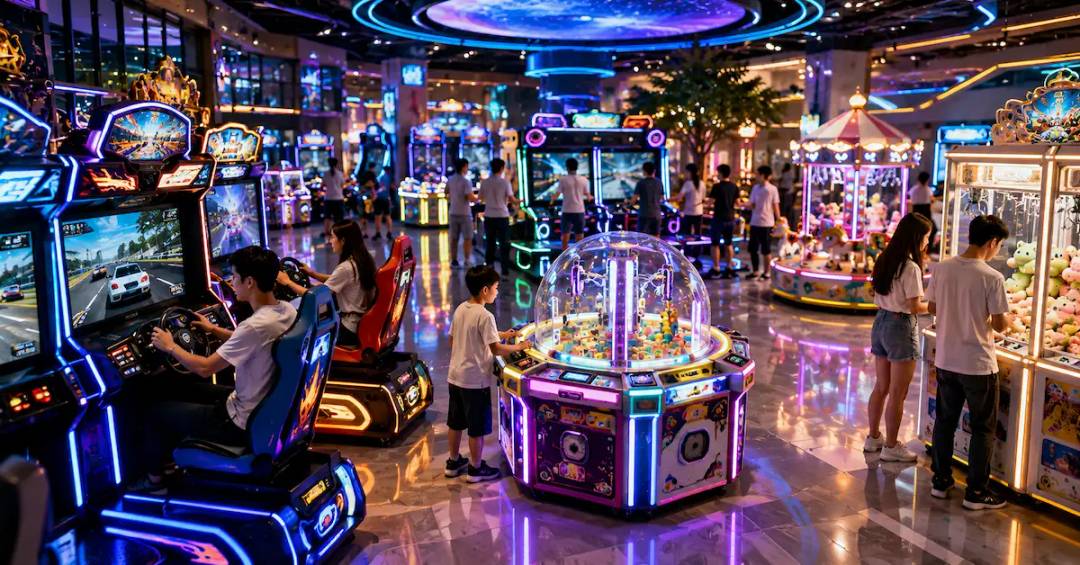
Custom game machine design is the process of adapting or developing arcade equipment around specific venue, player, branding, and operational requirements.
Depending on the project, customization may include:
- Cabinet shape and dimensions
- Color and surface finish
- Artwork and graphics
- LED lighting
- Screen size and position
- Control layout
- Seat design
- Sound configuration
- Player interaction
- Branding
- Payment-system integration
- Maintenance access
This means custom arcade machine design should be viewed as both a visual and functional process.
The strongest designs answer two questions at the same time:
Why will players notice this machine?
and
Why will operators find it practical to own and maintain?
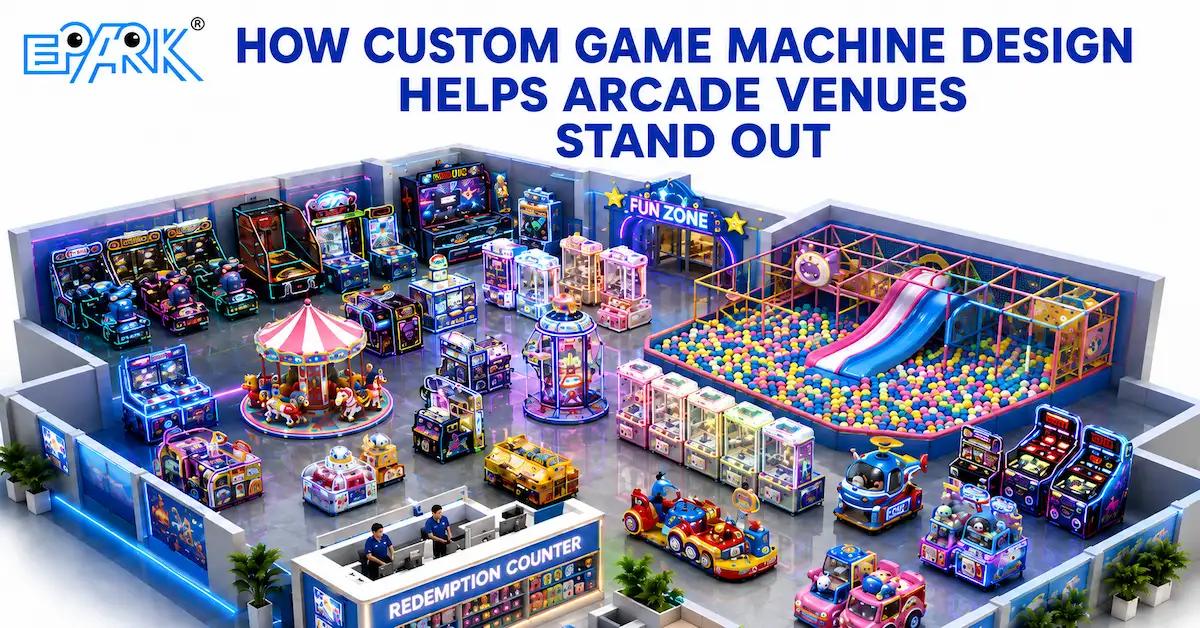
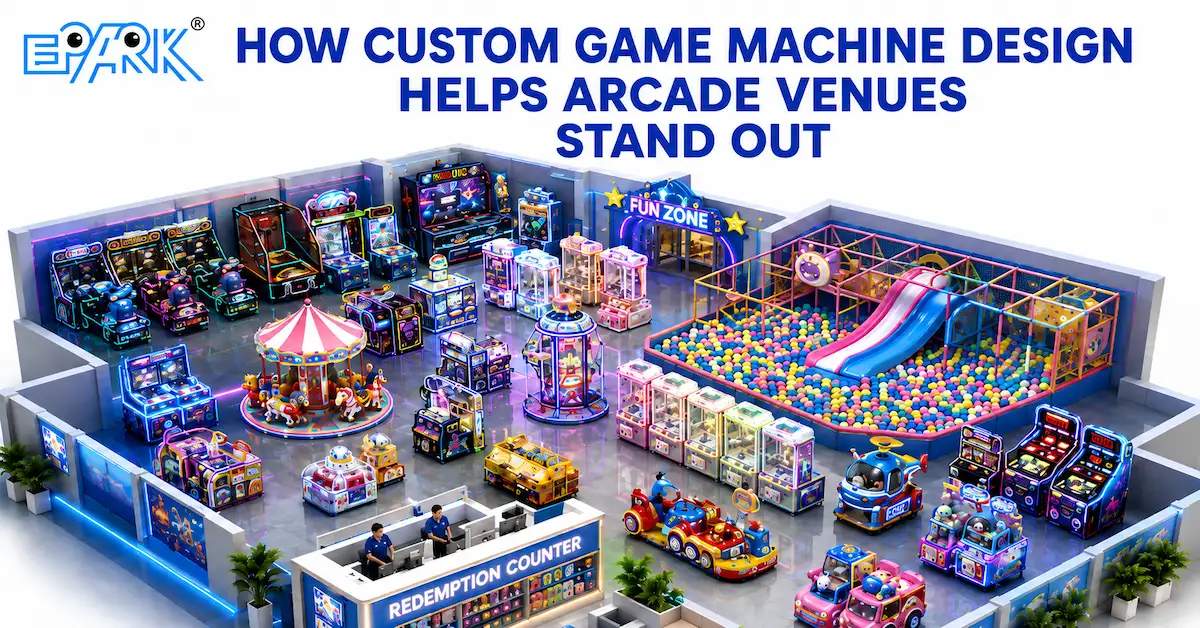
How Custom Game Machine Design Helps Arcade Venues Stand Out
Creates a Recognizable Venue Identity
A strong entertainment venue usually has a recognizable visual language.
That may include:
- Brand colors
- Interior theme
- Signage
- Lighting
- Staff presentation
- Machine appearance
If arcade machines visually conflict with the rest of the venue, the space can feel like a collection of unrelated equipment.
Custom cabinets and artwork can help connect individual machines to the wider venue concept.
For example, a family entertainment center might use a coordinated color system across claw machines, kiddie equipment, redemption games, and attraction zones.
A premium entertainment venue may prefer darker cabinets, controlled LED lighting, cleaner graphics, and more sophisticated finishes.
The purpose is consistency rather than simply adding more decoration.
Improves Visual Attraction on the Game Floor
Arcade machines compete for attention.
Players often see several attractions at the same time, so cabinet shape, lighting, artwork, screen presentation, and movement all influence which machine they notice first.
A customized design can help create stronger visual hierarchy through:
- Distinctive cabinet silhouettes
- Coordinated lighting
- Clear game displays
- High-visibility artwork
- Better sightlines
However, brighter is not automatically better.
If every machine uses maximum lighting intensity and complex graphics, the floor can become visually noisy. Effective design should help important attractions stand out without making the whole venue difficult to read.
Matches Different Player Groups
A machine designed for young children should not be approached in the same way as a competitive racing simulator.
Player characteristics influence design decisions.
For Children
Design considerations may include:
- Lower control positions
- Easy-to-understand interaction
- Friendly visual language
- Bright but readable colors
- Accessible entry and exit
- Appropriate machine height
For Teenagers and Adults
Design may focus more on:
- Competitive interaction
- Larger displays
- Immersive seating
- Steering or shooting controls
- Stronger audiovisual effects
- Social or multiplayer positioning
A good design starts with the intended player rather than copying a visual style from another product category.
Supports Themed Entertainment Experiences
Themed venues increasingly combine machines with interior design rather than treating each attraction separately.
Possible themes may include:
- Racing
- Sports
- Space
- Ocean
- Fantasy
- Adventure
- Family
- Futuristic environments
Custom artwork, cabinet styling, and lighting can help machines become part of the theme.
This can be especially useful in FECs, mall entertainment areas, and branded indoor amusement projects where the customer experience extends beyond individual gameplay.
Which Design Elements Create the Most Commercial Value?
Not every customization deserves the same investment.
| Design Element | Typical Customization | Potential Venue Value |
|---|---|---|
| Cabinet | Shape, dimensions, materials | Visual differentiation and space fit |
| Artwork | Graphics, themes, colors | Brand and theme consistency |
| Lighting | LED position and effects | Visibility and atmosphere |
| Controls | Layout, position, type | Player usability |
| Screen | Size, height, viewing angle | Better interaction and visibility |
| Seating | Shape, height, position | Comfort and immersion |
| Branding | Logo and visual identity | Brand recognition |
| Payment | Coin, card or compatible system | Operational compatibility |
| Service access | Doors and internal layout | Easier maintenance |
The best combination depends on the business objective.
A mall arcade may prioritize footprint and visual impact.
A large FEC may care more about themed integration and customer segmentation.
A distributor developing a differentiated product line may prioritize cabinet identity and repeatable branding.
Design for Player Experience, Not Just Appearance
One of the easiest mistakes in custom equipment development is focusing too heavily on exterior appearance.
Players interact with the machine physically.
That makes ergonomics part of the design.
Important questions include:
- Can the player reach the controls comfortably?
- Is the screen visible from the expected playing position?
- Is seating appropriate for the target audience?
- Can two players interact without interfering with each other?
- Are instructions easy to see?
- Can players enter and leave the machine safely and easily?
- Does the cabinet create unnecessary congestion around it?
A visually striking cabinet that creates poor interaction may attract a player once but provide a weak experience.
For commercial equipment, player experience should influence cabinet design from the beginning rather than being checked only after production.
How Game Machine Design Affects Arcade Layout
Machine design also affects the overall venue.
An arcade cabinet does not exist in isolation.
Its dimensions, player position, lighting, screen orientation, and service access influence surrounding space.
Operators should evaluate:
Machine Footprint
A larger cabinet may create stronger visual impact but reduce the number of attractions that fit in the venue.
Player Circulation
Machines should not block major walkways or create unnecessary congestion when several players gather around them.
Visibility
Some machines perform better when they can be seen from the entrance or main circulation path.
Queue and Spectator Space
Competitive racing, basketball, shooting, and multiplayer equipment may attract spectators.
That space should be considered in the layout.
Maintenance Access
Technical staff may need access to rear or side panels.
Placing a machine too close to walls or other equipment can make simple maintenance unnecessarily difficult.
This leads to an important design principle:
Machine design should be evaluated as part of the venue layout, not as an isolated product.
EPARK also supports commercial buyers with venue-oriented equipment planning alongside manufacturing. Buyers can learn more about the company's capabilities through its arcade machine manufacturer profile.
Balance Visual Impact With Maintenance
Customization can improve differentiation, but excessive complexity can increase operational risk.
Examples include:
- Decorative structures that block service panels
- Difficult-to-replace custom lighting
- Non-standard components with limited availability
- Large decorative sections that increase shipping volume
- Complex shapes that are difficult to package
- Components positioned where technicians cannot reach them easily
Good custom design should make a machine distinctive without making it unnecessarily difficult to manufacture, ship, install, or maintain.
For commercial venues, the machine must remain an operational asset after the initial visual impact has passed.
Think About Spare Parts During Design
If custom controls, lighting, sensors, or mechanical components are used, buyers should understand how replacements will be identified.
The design team should consider whether frequently serviced components can be replaced without dismantling large parts of the cabinet.
This becomes especially important for overseas projects where replacement logistics may take longer.
Standard vs Custom Game Machine Design
Custom equipment is not automatically the right solution for every project.
| Factor | Standard Machine | Custom Design |
| Purchase speed | Faster | Usually longer |
| Initial development | Lower | Higher |
| Visual differentiation | Limited | Stronger |
| Venue integration | Moderate | Can be highly coordinated |
| Brand identity | Limited | Strong |
| Prototype requirement | Usually unnecessary | May be required |
| Maintenance | More predictable | Depends on design |
| Best use | Fast deployment | Differentiated venue strategy |
Standard machines remain useful when the product already fits the market.
Custom design makes more commercial sense when differentiation creates enough value to justify the additional development work.
When Is Custom Game Machine Design Worth the Investment?
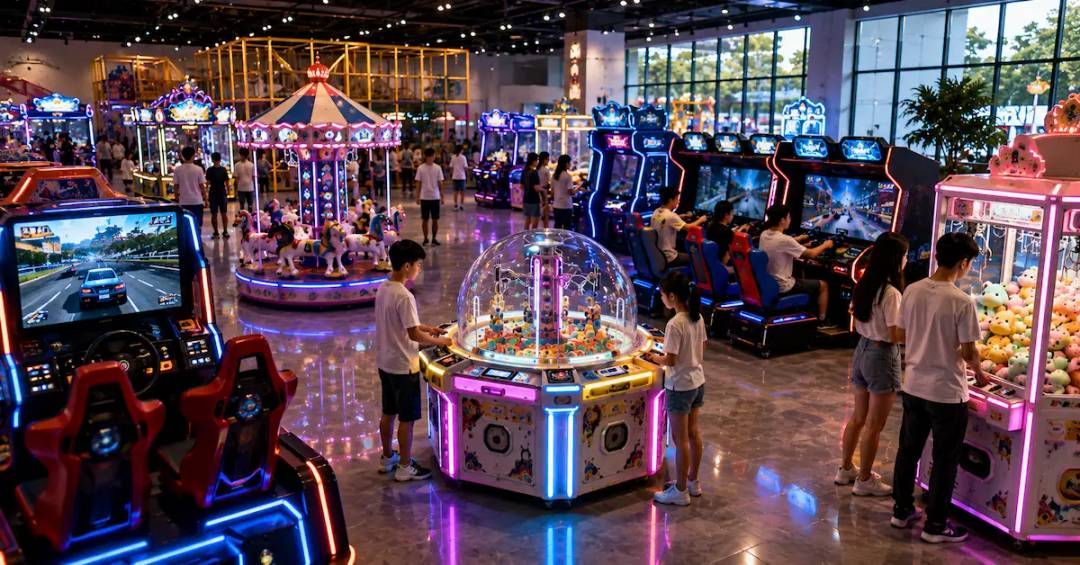
Custom design is particularly relevant when a business is developing:
- A flagship arcade venue
- A themed FEC
- A multi-location arcade chain
- A premium shopping mall project
- A private-label equipment range
- A regional distribution product line
- A venue requiring unusual dimensions or configurations
It may be less suitable when:
- The project needs equipment immediately
- Market demand has not been validated
- Quantity is very small
- Standard machines already meet the requirement
- The opening schedule leaves little development time
- The visual changes create little business differentiation
People-first purchasing decisions require acknowledging that customization is not always necessary.
Sometimes the best design decision is selecting a proven standard product and integrating it intelligently into the venue.
How to Work With a Factory on Custom Game Machine Design
A structured design brief reduces misunderstandings between the buyer and manufacturer.
Step 1: Define the Venue
Provide:
- Venue type
- Floor area
- Target market
- Target players
- Equipment categories
Step 2: Define the Design Objective
Clarify whether customization is intended to improve:
- Brand consistency
- Player attraction
- Themed experience
- Space utilization
- Product differentiation
Step 3: Confirm Functional Requirements
Document:
- Dimensions
- Controls
- Displays
- Payment method
- Voltage
- Language
- Access requirements
Step 4: Review the Concept
Evaluate both:
visual design and commercial practicality.
Step 5: Prototype or Sample When Necessary
For deeper structural changes, physical verification can reveal issues that drawings cannot.
Step 6: Approve the Final Configuration
The agreed design should become a controlled specification for production.
For projects requiring deeper product development rather than modification of an existing machine, buyers may need an ODM development approach instead of basic customization.
How EPARK Supports Custom Arcade Equipment Projects
For buyers considering custom game machine design, the first step should be defining the venue and commercial objective.
Useful information includes:
- Venue size
- Target player group
- Machine categories
- Preferred design style
- Brand colors
- Theme direction
- Payment requirements
- Destination market
- Expected quantity
These requirements can then be evaluated against existing products to determine whether the project needs simple visual adaptation, configuration changes, cabinet modification, or deeper product development.
Buyers can browse EPARK's commercial arcade equipment, review common purchasing questions through the arcade machine FAQ, or discuss a custom arcade project with specific venue and design requirements.
The most effective design solution is not necessarily the one with the most custom features.
It is the one that creates enough differentiation while remaining practical to produce, operate, maintain, and repeat.
FAQ About Custom Game Machine Design
What is custom game machine design?
Custom game machine design involves adapting or developing an arcade machine's cabinet, artwork, lighting, controls, screens, branding, configuration, or interaction around specific venue and player requirements.
How does custom arcade machine design help a venue stand out?
It can create a more consistent visual identity, improve equipment differentiation, support themed environments, and make machines better suited to the target players and venue layout.
What parts of an arcade machine can be customized?
Depending on the machine and manufacturer, customization may include cabinet shape, color, artwork, lighting, branding, controls, screens, seating, payment systems, interfaces, and packaging.
Is custom cabinet design more expensive than buying a standard machine?
It can be because additional design, engineering, prototyping, special materials, or production preparation may be required. The difference depends on the customization level.
Can game machines match a specific FEC theme?
Yes. Artwork, cabinet styling, colors, lighting, and selected visual elements can be coordinated with a venue theme when technically practical.
How does game machine design affect arcade layout?
Cabinet dimensions, player position, visibility, queue space, service access, and electrical requirements can all affect machine placement and overall venue planning.
Can payment systems be considered during custom design?
Yes. Where technically compatible, payment-system requirements should be confirmed early so the appropriate interface and hardware configuration can be evaluated before production.
Should operators choose standard or custom arcade machines?
It depends on the project. Standard machines are suitable when proven equipment already meets the requirement. Custom design is more valuable when venue identity, differentiation, or special functional needs justify development.
How can buyers avoid maintenance problems with custom machines?
Keep service access, component availability, spare parts, wiring, and replaceable modules in the design review rather than focusing only on exterior appearance.
How do I choose a supplier for custom game machine design?
Evaluate manufacturing control, design and engineering capability, prototype procedures, quality testing, component management, technical communication, after-sales support, and ability to reproduce the approved design consistently.
Conclusion
Custom game machine design can help arcade venues stand out, but its commercial value comes from much more than appearance.
Successful design connects:
Brand Identity → Player Experience → Venue Layout → Operation → Maintenance
For arcade operators and FEC investors, this means asking more useful questions than simply, “Can you change the cabinet?”
The better questions are:
Does the design fit the target player?
Does it strengthen the venue identity?
Does it use floor space effectively?
Can staff maintain it?
Can the factory reproduce it consistently?
When those factors are considered together, customized arcade equipment can become part of a broader venue strategy rather than an isolated visual upgrade.
The result should not just be a machine that looks different.
It should be equipment that has a clear reason to belong in that particular arcade venue.
Disclaimer
The information provided on this website is for general informational purposes only.
While EPARK Arcade Game Machine Manufacturer strives to ensure accuracy and reliability, no warranties—express or implied—are made regarding completeness, performance, or applicability.
Product specifications, designs, and features may vary depending on usage, customization, and customer requirements.
Buyers are responsible for verifying all technical details, compliance certifications, and suitability before procurement.
EPARK shall not be held liable for any direct, indirect, incidental, or consequential damages arising from the use of this website or its content, including but not limited to business losses, data errors, or equipment misuse.
For tailored solutions or further verification, please visit our Contact Us
Intellectual Property Notice
All articles, product images, videos, catalogs, software, and related materials published on this website are the intellectual property of EPARK, unless otherwise stated.
Unauthorized reproduction, distribution, modification, or commercial use of any content is strictly prohibited without prior written consent from EPARK.
EPARK reserves the right to take legal action against any unauthorized use, including but not limited to copyright infringement, misrepresentation, or unfair competition.
Trademarks
The name EPARK, the EPARK logo, and all related brand elements displayed on this website are registered trademarks or trade names of Guangzhou EPARK Electronic Technology Co., Ltd.
Other product names, company names, or logos mentioned on this site may be trademarks of their respective owners.
Unauthorized use of EPARK's trademarks for commercial purposes, including advertising, promotions, or product packaging, is strictly prohibited.
Governing Law
These terms are governed by the laws of the People's Republic of China.