

What quality checks should an arcade machine factory complete before shipment?
Before shipment, an arcade machine factory should verify that the finished units match the approved model and configuration, that incoming and assembled components are correct, that gameplay and payment functions work, that electrical and mechanical safety checks are complete, that the agreed endurance test has passed, and that the quantity, labels, accessories, packaging and destination documents agree with the order. A factory statement such as “100% tested” is not enough by itself; the buyer needs defined arcade machine pre-shipment quality checks and evidence tied to the actual machines.
This article addresses a pre-shipment acceptance question for distributors, FEC operators, mall projects, importers and arcade brands. It focuses on the checks that should happen before a container or export shipment is released, not on a generic explanation of quality management. The practical objective is to give the buyer a hold-point list that can be attached to an RFQ, inspection request, purchase order or factory witness plan.

Separate factory testing from buyer acceptance
Factory testing asks whether the production team has run the required checks. Buyer acceptance asks whether the delivered units match what was purchased and can be released for the next step. The two overlap, but they are not identical.
A factory may test a standard game configuration while the buyer ordered a different language, payment interface, logo package, player count or ticket setting. A machine may pass a functional run but arrive with the wrong carton label, missing manual or destination plug. A 48-hour run can reveal instability, yet it does not automatically prove that a mall's electrical requirement, local language or import document is correct. Define both the technical test and the commercial matching check.
Use three evidence levels:
- Factory record: the internal checklist, result, tester and date for each unit or defined sample.
- Order evidence: photographs, videos, serial numbers, configuration list, defect log and packing record linked to the buyer's shipment.
- Buyer or third-party acceptance: an agreed witness inspection, remote video review or independent inspection against the purchase order.
Ask the supplier to state which evidence is included and which must be arranged separately. This avoids treating a marketing photograph or a generic test certificate as an order-level release document and gives the buyer a clear record of the arcade machine pre-shipment quality checks actually completed.
Freeze the approved configuration before inspection starts
No quality check can be objective if the reference keeps changing. Before production release, create an approved configuration sheet for each model. Include the model name and revision, quantity, cabinet artwork, logo locations, dimensions, material assumptions, display and controls, PCB or game configuration, language, payment method, ticket or prize behavior, power requirements, accessories, manuals and packaging marks.
The configuration sheet should also identify what is excluded. For example, a standard cabinet may be customized with artwork while the game content remains unchanged. A payment reader may be supplied by the buyer and installed by the factory, or it may be factory-supplied with a specific interface. If those boundaries are not visible, the inspector cannot determine whether a difference is a defect, an approved variation or an unresolved commercial question.
EPARK's public materials describe multiple arcade categories including basketball, racing and simulator machines, claw and gift machines, redemption games, shooting and rhythm games, VR systems and kiddie rides. A single “arcade machine QC” form is too broad for that range. Keep a common identity and safety section, then add model-specific functional checks.
| Field | What to record | Why it matters at release |
|---|---|---|
| Identity | Model, revision, quantity and serial range | Prevents a visually similar unit from being accepted as the ordered model |
| Appearance | Artwork, logo, color, lighting and labels | Protects brand and venue approval |
| Hardware | Screen, controls, PCB, power supply, speakers and payment parts | Creates a reference for function and spare parts |
| Software | Game, language, boot screen, settings and content version | Controls the player experience and service baseline |
| Shipment | Accessories, manuals, spare parts, carton marks and destination | Links inspection to receiving and installation |
Check incoming materials and components
Incoming inspection is the first chance to prevent a finished cabinet from carrying the wrong or damaged component. The factory should check material identity and condition against the approved bill of materials or component schedule, then record deviations before assembly hides them.
EPARK's public FAQ and company pages mention metal frames, ABS plastic, tempered glass and high-quality plywood, while its production description includes PCB installation, wiring, LED setup, screen and control integration. These published categories help a buyer decide what to ask about. They do not establish the thickness, grade, supplier or exact component brand for every model. Request those details where they affect safety, appearance, service or compliance.
Incoming checks for a commercial arcade machine
- Confirm the material or component reference against the approved schedule.
- Check visible surfaces for cracks, warping, dents, corrosion, contamination or print damage.
- Check glass or acrylic for chips, scratches and correct fit before installation.
- Verify displays, controls, buttons, joysticks, sensors, speakers, lights, power supplies and payment hardware against the model list.
- Confirm connectors, cable lengths and labels are compatible with the released design.
- Quarantine and record any substitute, shortage or damaged part instead of allowing an informal swap.
For a mixed order, sample one row from every model family and every approved revision, then apply the agreed inspection level to the full shipment. If a critical part is shared across several models, identify the shared reference and verify the quantity before assembly starts. The buyer should ask how the factory controls supplier changes and how it records an approved alternative.
Use the equipment categories and published factory process as the starting point for a model-specific inspection plan.
Inspect cabinet build, assembly and service access
Assembly inspection is not only cosmetic. The cabinet must be stable, accessible for service and consistent with the approved player arrangement. Check that panels align, fasteners are present, edges are finished, doors close, hinges and locks work, feet or wheels are secure and the machine sits level. Inspect the route of cables and the strain relief around moving or frequently serviced areas.
For branded machines, compare the artwork and logo against the approved sample or artwork proof. Look for color variation, misaligned prints, bubbles, peeling edges, incorrect language, missing warnings and a logo placed on the wrong panel. Check that LED colors and light diffusion support the intended appearance without creating glare on the screen or controls.
Service access deserves its own record. Open the intended service panels and confirm that a technician can reach the power supply, PCB, display connections, controls, ticket or payment mechanism and any routine adjustment point. Photograph the internal arrangement if it will be used as the reference for future repairs. A cabinet can pass a player test and still create avoidable downtime if the service route is blocked or undocumented.
Mechanical and finish checks to record
| Area | Check | Release evidence |
|---|---|---|
| Structure | Panels, frame, feet, fasteners and joints match the approved build | Inspection marks and photographs |
| Finish | Paint, graphics, glass or acrylic and edge treatment are acceptable | Sample comparison and defect log |
| Controls | Buttons, joysticks, pedals, steering or sensors are mounted securely | Physical check and functional result |
| Access | Service doors, locks, covers and cable routes are usable | Open-close check and service photograph |
| Labels | Model, electrical, warning and brand labels are correct and legible | Label checklist and close-up image |
Run a complete functional test, not a power-on demonstration
Functional testing should follow the player journey and the operator's daily tasks. Start with power-on and boot behavior, then test the controls, game logic, display, sound, lighting, payment, scoring, ticket or prize output, settings and any connected management function included in the order. Record a pass or fail for each item rather than relying on a short video of the screen.
For a basketball game, the test may include ball detection, score display, timer, reset and ticket or payment behavior. For a racing simulator, include steering, pedals, seat or motion features included in the configuration, screen synchronization and player reset. For a claw or gift machine, include joystick movement, claw action, prize sensor, door access, lighting and payment. For a redemption or ticket machine, check the game outcome, ticket path, counter, jam response and settings. The exact list should reflect the model, not a generic claim about all arcade equipment.
Test each payment method that the order includes: coin, token, QR code, card or another interface. Confirm currency or token settings, free-play mode, credit display, refund or error behavior and the operator's reset procedure. If the payment system is supplied by a local integrator, write down which party owns the test and which interface the factory must provide.
Check language and content at the same time. A machine can be mechanically correct but commercially unusable if the boot screen, warnings, help text or prize instructions are in the wrong language. Capture the software or content version in the record and save a photograph of the relevant screen where appropriate.
Use endurance testing to find intermittent failures
Short functional checks find obvious defects; an endurance test is intended to expose instability that appears after repeated operation. EPARK's Design & Process page states that every machine goes through a 48-hour full-operation test before shipment and that the test covers gameplay functionality, electrical safety, lighting effects and mechanical durability. This is a strong published point to include in a buyer's discussion, but ask how the test is documented for the actual order.
Clarify whether the 48-hour period applies to every finished unit, a defined sample, or a project-specific method. Ask what constitutes “full operation,” how many restarts or play cycles are performed, whether payment and ticket systems are included, what environmental assumptions apply and how a failure is corrected and retested. The goal is not to challenge a factory's statement; it is to turn a duration into an inspectable procedure.
| Question | Why the buyer should record it | Example evidence |
|---|---|---|
| What units are tested? | Shows whether the test is 100% or sample-based | Serial range or sampling plan |
| What functions run? | Prevents a powered-on cabinet being called fully operational | Gameplay, payment, lighting and mechanical checklist |
| What is the duration and start condition? | Creates a repeatable release gate | Start time, end time and test operator |
| What happens after a failure? | Prevents a reset from hiding a recurring defect | Failure log, corrective action and retest result |
| What record follows the shipment? | Connects factory evidence to service and warranty questions | Signed report, photographs or video linked to the order |
For a high-risk or high-value order, ask for a remote witness session or a third-party inspection. The witness should use the approved configuration and record the serial number, not simply watch a generic demonstration unit. If a defect is found, agree whether the unit is repaired, replaced, re-tested or held from packing.
Complete electrical and safety checks for the destination
Electrical safety is both a factory and destination question. The factory should inspect wiring, grounding, protection devices, connectors, power entry, controls and any moving or illuminated assembly. The buyer must also confirm that the released configuration suits the destination market's voltage, frequency, plug, labeling and import requirements.
EPARK's public process says electrical safety is included in the full-operation test and its pages mention CE, RoHS and SGS standards or certifications. The public pages do not provide a certificate number, issuing body, validity date or universal model coverage in the text available for this article. Ask for the exact document and covered model before using a certification claim in a tender or customs file.
Use a destination checklist that covers rated input, plug and cable, fuse or protection arrangement, earthing method, accessible electrical parts, heat and ventilation, sharp edges, glass, moving mechanisms, emergency stop if applicable, warning labels and local inspection requirements. Do not add a safety feature to the acceptance record merely because it is common in another machine category; mark it as applicable, not applicable or requiring engineering confirmation.
Where the destination authority or landlord requires a specific report, certificate or inspection format, discuss it before the factory starts production. A machine that passes an internal test may still be held if the document names a different model, omits the buyer's configuration or uses the wrong consignee information.
Verify quantity, model and configuration consistency
Pre-shipment quality includes identity control. Count the machines, match each serial or carton number to the packing list, and verify that the model, revision, artwork, language, payment setup and accessories are correct. This is especially important for mixed containers where standard and customized cabinets may look similar at a distance.
Ask the factory to create a shipment matrix with one row per unit or clearly defined model batch. Include model name, internal reference, serial number, quantity, configuration, test status, carton number, spare-parts location and any approved deviation. The matrix should be consistent with the commercial invoice, packing list and any certificate or test report that names the equipment.
Check loose items separately. Manuals, remote controls, keys, cables, payment devices, tickets, tokens, spare buttons, joysticks, power supplies or other agreed accessories should have a quantity and packing location. EPARK's complete FEC solution page describes a free spare-parts kit for container orders with examples such as buttons, joysticks and power supplies. That page is a product-page statement, not proof that every order has the same kit. Record the current model-matched list in the purchase documents.
Ask the service team to map testing, installation guidance, spare parts and technical support to the models and destination in your order.
Inspect export packaging and shipment release
Packaging is the final physical quality gate before the equipment leaves the factory. EPARK's Design & Process page lists bubble wrap and thick foam, wooden frame or crate reinforcement and waterproof film for sea shipment. It also describes customs, insurance and delivery-tracking support. The buyer should confirm which method applies to each machine and whether the packed condition protects fragile screens, glass, controls, displays and loose parts.
Before loading, check carton labels, lifting or orientation marks, model references, destination, quantity, moisture protection, internal blocking, accessory cartons and any agreed photographs. Confirm that the packing list reflects what is actually loaded. If a machine is split for transport, identify the cabinet, control section, screen, accessories and assembly instructions so receiving staff can reconcile the shipment.
Ask the factory to record the container or shipment reference, loading sequence and visible condition. If shipping insurance is requested, verify the scope and documentation route. Insurance support does not replace an inspection record; a carrier claim, shortage, transit damage case and warranty request each need different evidence.
Destination documents and model consistency
Build a document pack around the actual destination. Depending on the buyer's market and contract, this may include the commercial invoice, packing list, transport document, product or model schedule, electrical or safety documents, user manuals, warranty terms, country-of-origin information and any required customs or landlord documents. The supplier should confirm which documents it provides and which the importer or local authority must obtain.
Check every document for the same legal entity, model name, revision, quantity, consignee, destination and description. A certificate that names a standard model cannot automatically be used for a customized successor. If the quotation, machine label, packing list and test report use different names, ask for a written cross-reference before loading.
Use a hold-point acceptance checklist
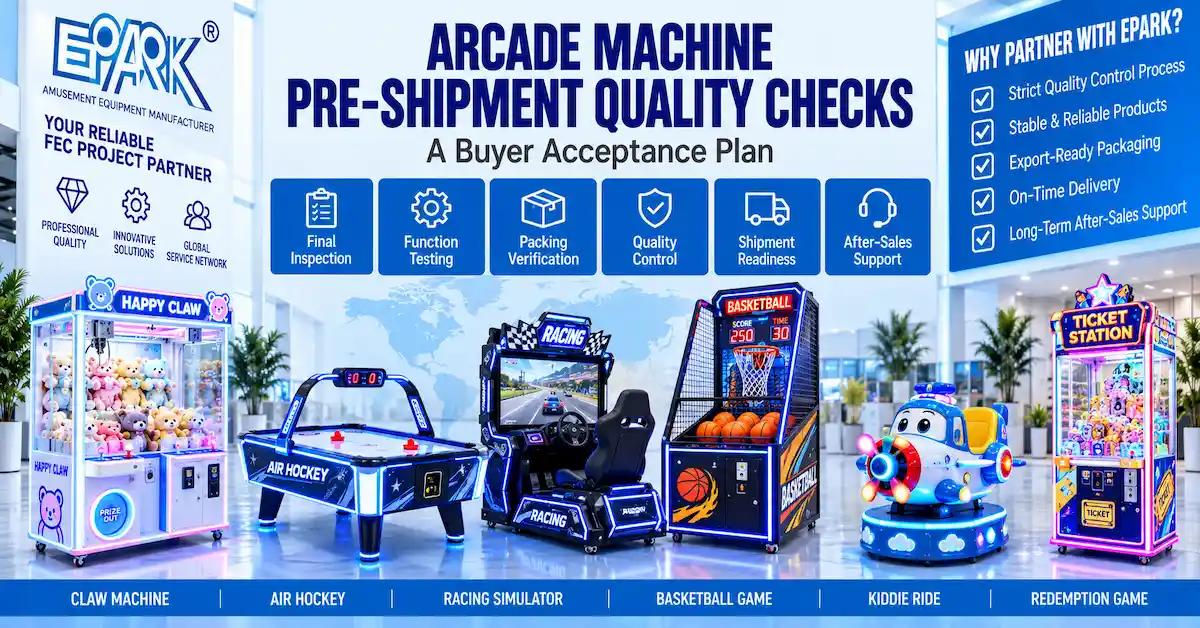
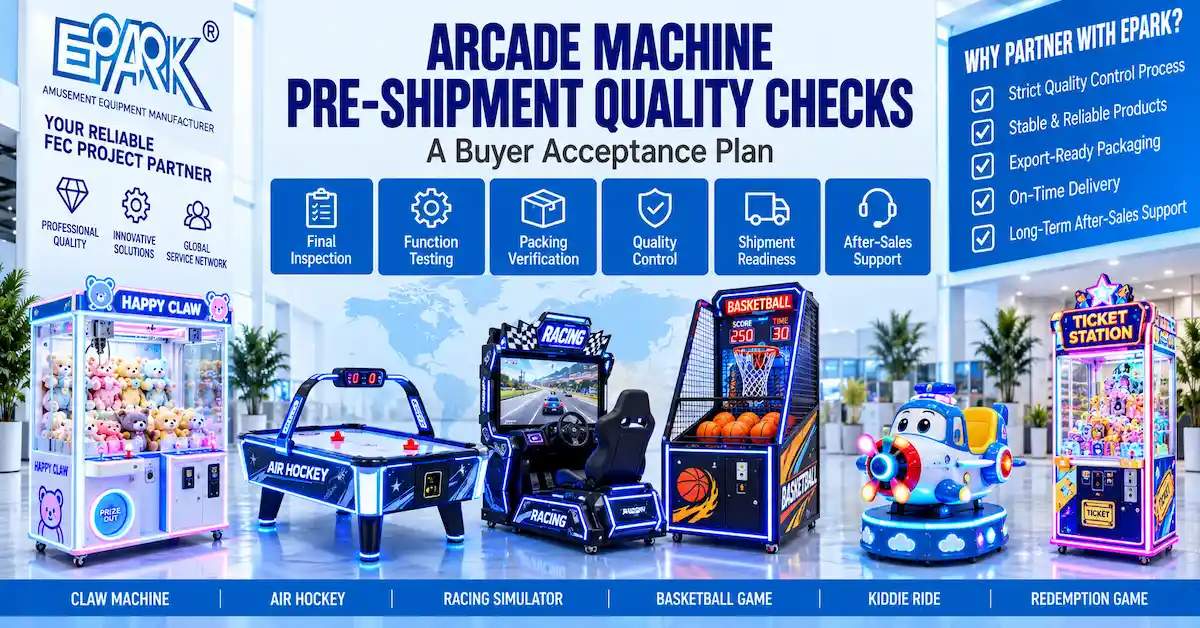
A hold point means the order cannot move to the next stage until the responsible person accepts the evidence or records a formal deviation. Use hold points at configuration freeze, incoming component release, first article, functional test, endurance test, final inspection and packing release.
| Hold point | Pass condition | Evidence to retain | If not passed |
|---|---|---|---|
| Configuration freeze | Approved model, revision, artwork and component schedule are released | Signed configuration sheet | Clarify before build |
| Incoming parts | Materials and components match the approved references | Receiving inspection and deviation log | Quarantine or approve substitute |
| Assembly | Structure, finish, labels, controls and service access pass | Inspection checklist and photographs | Repair and re-inspect |
| Function | Gameplay, display, controls, payment, sound, light and output work | Model-specific test record | Correct, then repeat test |
| Endurance | Agreed full-operation duration and failure response are complete | Time record and retest result | Hold unit or extend test |
| Final identity | Serials, quantity, accessories, manuals and labels match the shipment | Shipment matrix and packing list | Correct before loading |
| Packaging release | Protection, carton marks and destination documents are consistent | Carton photos and document pack | Repack or revise documents |
Assign an owner and date to every open item. “To be fixed” is not a release decision. Use categories such as accepted, accepted with documented deviation, rework required, retest required or rejected. A short deviation list is safer than an informal promise because it tells receiving and service teams what was actually approved. Keep the signed record with the rest of the arcade machine pre-shipment quality checks so the acceptance decision remains traceable.
Plan a remote or third-party inspection when the risk justifies it
A remote inspection can be useful when travel is impractical or the buyer needs to witness a final check. Send the approved checklist in advance, ask the factory to show the unit label and serial number, and require the camera to move from exterior condition to internal access, power-on, gameplay, payment and packing. Save the recording or screenshots with the inspection report if the parties agree.
For a third-party inspection, define the sampling method and defect classification before the inspector arrives. The inspection company should receive the purchase order, approved specification, artwork reference, model list and destination requirements. Do not ask an inspector to judge a custom feature without providing the approved reference. Clarify whether the inspection is a visual and functional check, a document review, a packing inspection or a broader compliance assessment.
EPARK's public service information describes R&D, performance and safety verification, installation support, remote diagnostics and technical assistance. Those services can help the buyer plan a release process, but the inspection authority and acceptance threshold still belong in the project documents. The buyer should state whether factory self-release is sufficient or whether a witness or independent report is required.
Record defects and corrective action instead of hiding them
A quality system is measured by how it handles a failure, not by whether a webpage says “strict QC.” When a unit fails, record the machine identity, symptom, evidence, suspected cause, correction, responsible person, retest method and final status. If the same issue appears on several units, escalate it from an individual repair to a batch or design review.
Use photographs for finish or label problems, short video for intermittent gameplay or motion issues, and a written component reference for substitutions. Keep the original failure record after the correction. A clean final test sheet without the earlier defect can make it impossible to understand why a unit was delayed or why a future service case resembles the original issue.
For a branded line, add a change-impact check. A replacement control, display, LED board or power supply may solve the immediate defect but alter the approved user experience or parts list. Ask engineering to update the revision and service documentation if the replacement is not identical. This is especially important when the same model will be ordered again.
Connect factory checks to installation and after-sales support
Pre-shipment quality is not complete if the receiving and installation teams cannot use the records. Send the final model matrix, manuals, wiring or setup references, spare-parts list, test status and approved deviations with the shipment or secure document link. Mark the units that require assembly, calibration, payment integration or local inspection after arrival.
EPARK's FAQ describes remote installation guidance through video calls and messaging, detailed setup manuals and operation guides, while its Service page describes installation, remote diagnostics, technical support and spare-parts supply. Confirm which materials apply to your exact configuration. A generic manual may not explain a custom payment interface or a revised control panel.
At arrival, the operator should photograph cartons before opening, reconcile the shipment matrix, inspect visible damage, verify labels and run a commissioning check. If a problem appears, send the model or serial number, order reference, description, photographs or video and the test result. This creates a continuous record from factory inspection to warranty or paid service request.

Send a pre-shipment quality request with the RFQ
Tell the factory what release evidence you need before the quotation is finalized. Include the machine list, destination, voltage and plug requirement, language, payment method, branding, accessories, spare-parts package, packaging, inspection method and document requirements. State whether you need a remote witness, third-party inspection, serial-number list, progress photos or a 48-hour test report.
A copy-ready request is: “Please provide the pre-shipment inspection plan for the attached arcade machine list. For each model, identify the approved revision, incoming material checks, assembly and finish checks, gameplay and payment tests, electrical and mechanical safety checks, endurance-test method, serial-number record, accessories, packing protection and destination documents. Please state whether the 48-hour full-operation test is applied to every unit or a defined sample, how failures are corrected and retested, and which evidence will be supplied before loading.”
This wording makes the buyer's acceptance criteria visible before production. It also gives the factory a chance to identify a test that is not applicable, a document that requires local support or a configuration that needs engineering confirmation.
Frequently asked questions about arcade machine pre-shipment quality checks
What are the most important checks before an arcade machine ships?
Confirm the approved configuration, incoming components, cabinet assembly, controls, gameplay, payment, electrical and mechanical safety, endurance result, quantity, serials, accessories, packaging and destination documents. Use a model-specific checklist and retain evidence tied to the shipment.
Does a factory's 48-hour test prove the shipment is acceptable?
It is important evidence, but it does not replace configuration, quantity, document, packaging or destination checks. EPARK publishes a 48-hour full-operation test covering gameplay, electrical safety, lighting and mechanical durability. Ask how the test applies to your units and request the order-level record.
Should every machine be tested or only a sample?
The answer depends on the contract, machine risk, order size and agreed inspection plan. Ask the factory to state whether the test is 100% or sample-based, identify the serial range and explain what happens when one sampled unit fails.
What should incoming inspection cover?
Check material and component identity, condition, quantity, connectors and approved substitutions before assembly. Pay particular attention to structural materials, visible panels, screens, controls, PCB, wiring, power supplies, speakers, lights and payment hardware.
How should a buyer check a customized arcade machine?
Compare the unit with the approved configuration and sample. Verify artwork, logo, colors, lighting, language, controls, payment, software, labels, dimensions and service access. Record any deviation instead of accepting a verbal explanation.
What documents should match the machine model?
The model schedule, serial list, packing list, invoice, test record, certificate or report, manual and warranty information should use consistent model and revision references. If a document names a standard model while the shipment is customized, request a written cross-reference.
What packaging does EPARK publish?
EPARK's Design & Process page describes bubble wrap and thick foam, wooden frame or crate reinforcement and waterproof film for sea shipment. Confirm the method, carton marks and protection for the exact machine, screen, glass, controls and loose accessories in your order.
Can the buyer witness testing remotely?
Yes, when the parties agree the method. The factory should show the actual model and serial number, follow the approved checklist, demonstrate the relevant functions and provide the resulting record. A generic video of another machine is not an acceptance inspection.
What happens when a unit fails before shipment?
Record the symptom and identity, correct the cause, repeat the relevant test and retain the original failure and retest evidence. If the correction changes a component, software or revision, update the configuration and service documents.
Are CE, RoHS or SGS references enough for every destination?
No. EPARK's public pages mention these standards or certifications, but the available pages do not show universal certificate coverage, numbers or validity for every model. Request the exact document and confirm the destination's requirements before relying on it.
Conclusion
The quality checks an arcade machine factory should complete before shipment form a chain: freeze the approved configuration, verify incoming materials, inspect assembly and service access, run model-specific gameplay and payment tests, complete electrical and mechanical safety checks, document the agreed endurance test, reconcile serials and accessories, and release only after packaging and destination documents match the order. Each link should have an owner, a pass condition and evidence that can be reviewed later.
EPARK's published process provides a factual starting point, including final assembly and function testing, a stated 48-hour full-operation test, export packaging, logistics support and technical assistance. Turn that public process into your own written acceptance plan for the exact models, destination and configuration. The result is a shipment that is easier to receive, install, support and repeat.
Attach the machine list, approved specifications, destination requirements, inspection method and documents needed for release.
Disclaimer
The information provided on this website is for general informational purposes only.
While EPARK Arcade Game Machine Manufacturer strives to ensure accuracy and reliability, no warranties—express or implied—are made regarding completeness, performance, or applicability.
Product specifications, designs, and features may vary depending on usage, customization, and customer requirements.
Buyers are responsible for verifying all technical details, compliance certifications, and suitability before procurement.
EPARK shall not be held liable for any direct, indirect, incidental, or consequential damages arising from the use of this website or its content, including but not limited to business losses, data errors, or equipment misuse.
For tailored solutions or further verification, please visit our Contact Us
Intellectual Property Notice
All articles, product images, videos, catalogs, software, and related materials published on this website are the intellectual property of EPARK, unless otherwise stated.
Unauthorized reproduction, distribution, modification, or commercial use of any content is strictly prohibited without prior written consent from EPARK.
EPARK reserves the right to take legal action against any unauthorized use, including but not limited to copyright infringement, misrepresentation, or unfair competition.
Trademarks
The name EPARK, the EPARK logo, and all related brand elements displayed on this website are registered trademarks or trade names of Guangzhou EPARK Electronic Technology Co., Ltd.
Other product names, company names, or logos mentioned on this site may be trademarks of their respective owners.
Unauthorized use of EPARK's trademarks for commercial purposes, including advertising, promotions, or product packaging, is strictly prohibited.
Governing Law
These terms are governed by the laws of the People's Republic of China.