
What Should an Arcade Cabinet and Game Machine Manufacturer Actually Provide?
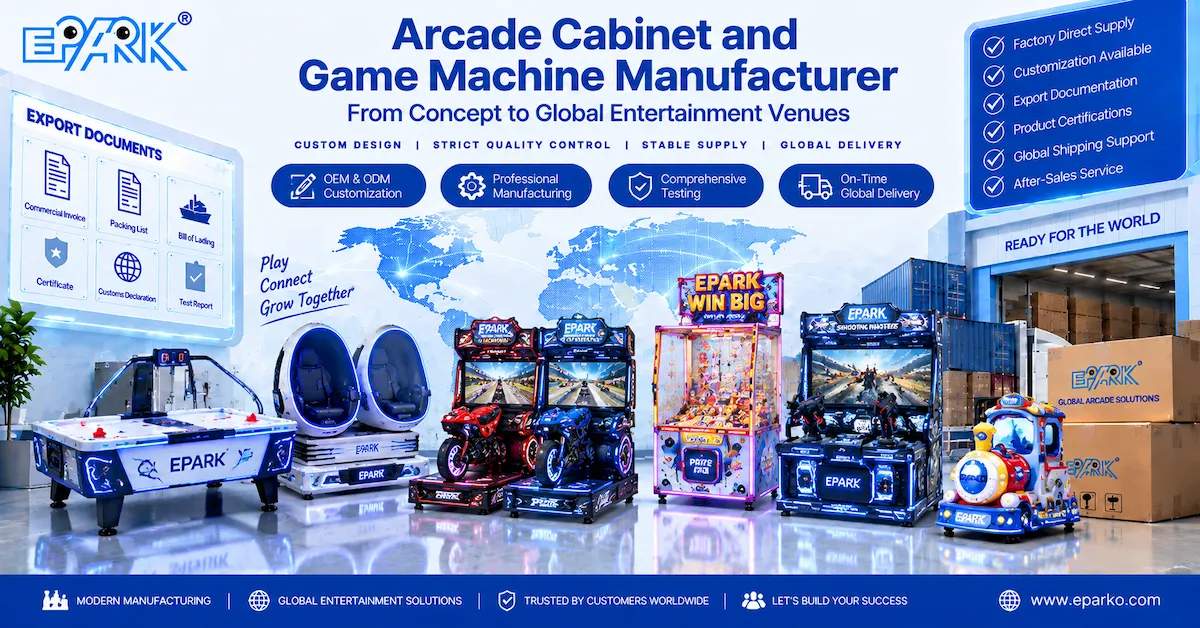
When evaluating an arcade cabinet and game machine manufacturer, commercial buyers should look beyond the external cabinet and ask how the complete machine is defined, assembled, tested, documented, and supported. A cabinet manufacturer may be able to fabricate attractive metal, wood-based, acrylic, or plastic structures, but an operational commercial machine also depends on controls, electronics, payment hardware, displays, software, sensors, mechanisms, wiring, service access, and the interaction between these systems.
For FEC operators and distributors, the purchasing objective is therefore not simply to obtain a cabinet that looks correct. The buyer needs a defined production configuration that can be inspected before shipment, maintained after installation, and reproduced for future orders. EPARK’s commercial arcade product range and Design & Process provide useful starting points for discussing equipment categories, design, manufacturing, testing, and project requirements.
Who Benefits From a Manufacturer That Controls Both Cabinet and Machine Integration?
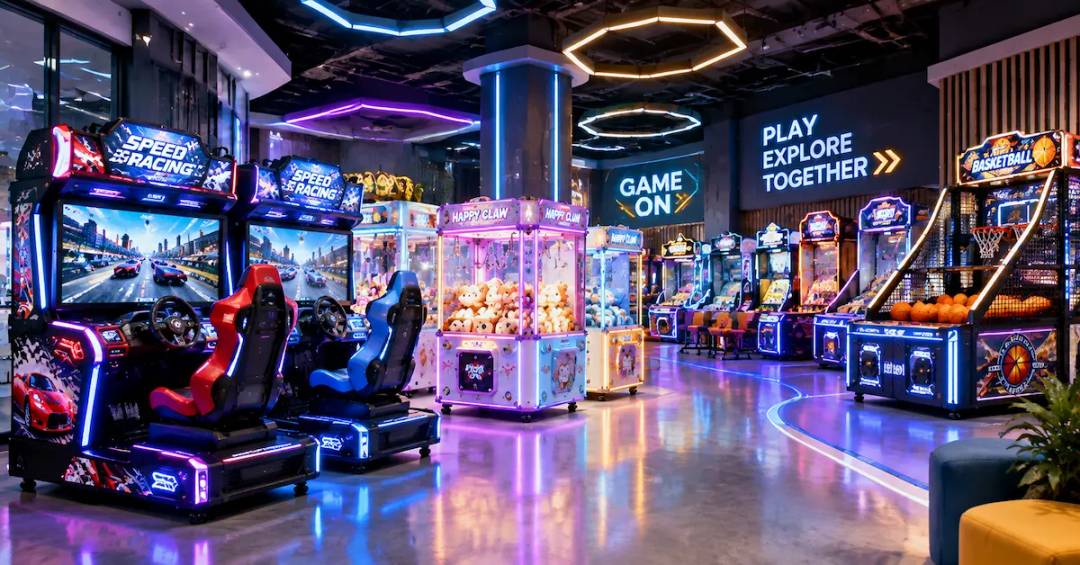
This sourcing model is especially useful for FEC operators purchasing several machine categories, distributors building long-term commercial product lines, arcade chains standardizing equipment across locations, and private-label buyers that require branded cabinets together with controlled technical configurations. These customers need the cabinet appearance and the internal operating system to remain connected throughout production.
A buyer purchasing only an empty cabinet for its own electronics integration has a different requirement and may not need a complete game-machine manufacturer. Likewise, an operator replacing one locally available machine urgently may value local stock and service more than direct manufacturing involvement. Buyers should therefore determine whether they need cabinet fabrication only, a complete operating arcade machine, OEM customization, or deeper ODM development before requesting a final quotation.
Match Cabinet Design to the Commercial Application
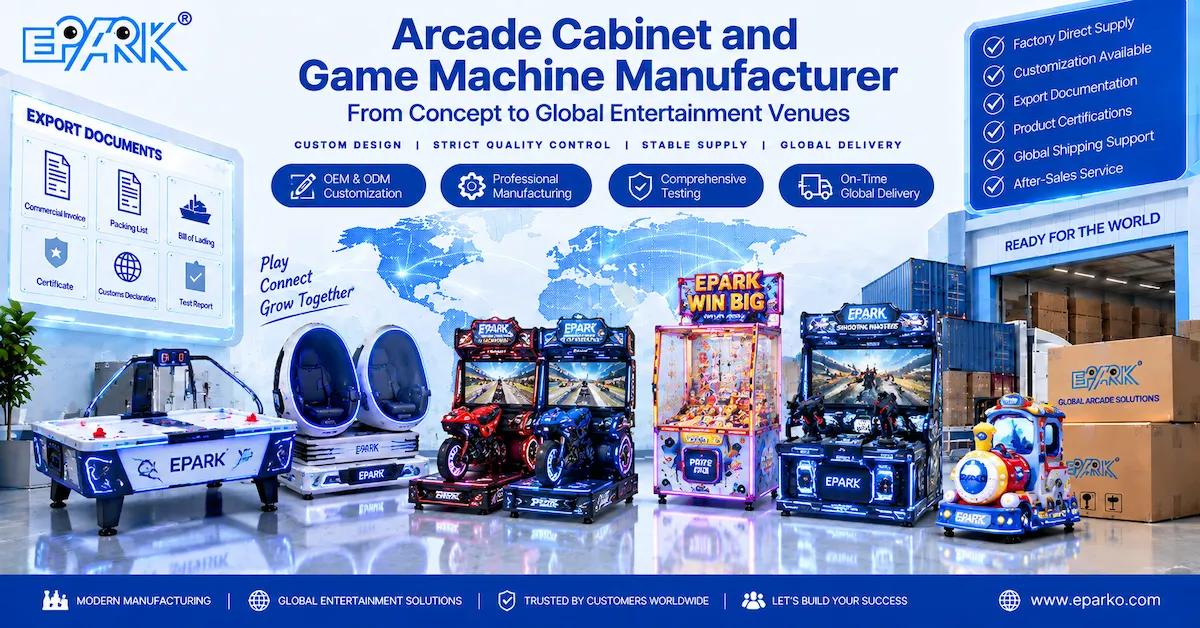
Different arcade machines impose different requirements on cabinet structure, controls, player position, access, and internal components. A racing cabinet must support seats, steering controls, pedals, displays, and service access, while a claw machine requires transparent prize visibility, refill access, a grab mechanism, and secure doors. Basketball equipment needs a larger physical structure and player clearance, while redemption machines must connect gameplay with ticket or point functions.
| Equipment Type | Cabinet / Structure Focus | Machine Integration Focus | Buyer Should Confirm |
|---|---|---|---|
| Claw machine | Prize visibility, doors, refill access | Grab mechanism, controls, payment | Service access and mechanism configuration |
| Racing machine | Seat, display position, control panel | Steering, pedals, display, game system | Player ergonomics and linked functions where applicable |
| Redemption machine | Player interface and service doors | Scoring, sensors, ticket/point output | Reward-system compatibility |
| Basketball game | Frame, ramp, backboard, operating space | Sensors, timer, scoring | Assembly and player clearance |
| Shooting game | Screen and controller mounting | Shooting controller, sensors, game system | Calibration and replaceable controls |
| VR / simulator | Seat/platform and equipment enclosure | Display/headset, controls, software, motion where applicable | Setup and technical requirements |
Buyers planning a mixed venue can review EPARK’s products and arcade solutions before creating the final machine schedule.
Build a Technical Specification Before Comparing Quotations
Two arcade cabinets can appear nearly identical while using different internal components, payment hardware, game versions, or packaging configurations. For this reason, quotations should be compared against one controlled specification rather than product photographs alone.
The following table is a purchasing checklist and does not represent universal EPARK specifications. Exact values should be confirmed for the selected machine.
| Specification Area | Information to Confirm | Why It Matters |
|---|---|---|
| Machine identity | Model, version, quantity | Production and repeat-order traceability |
| Cabinet dimensions | Final assembled L × W × H | Venue planning |
| Player space | Recommended operating clearance | Layout and traffic flow |
| Service clearance | Required access for doors and maintenance | Long-term serviceability |
| Packed dimensions | Package dimensions and package count | Freight planning |
| Weight | Net and gross packed weight | Handling and unloading |
| Electrical requirements | Model-specific voltage, frequency, power | Site preparation |
| Controls | Buttons, joystick, steering, pedals, sensors, etc. | QC and maintenance |
| Display / audio | Approved machine configuration | Product comparison |
| Payment system | Coin, token, card, or approved system | Venue compatibility |
| Software | Version, language, licenses where relevant | Repeat orders and support |
| Accessories | Keys, cables, fixings, manuals | Receiving inspection |
| Spare parts | Initial service components where agreed | Maintenance planning |
| Packaging | Shipping configuration | Delivery protection |
Keep unresolved items marked as unresolved rather than allowing the factory to select them without buyer review.
Evaluate Cabinet Materials According to the Machine Design
A professional cabinet discussion should identify the construction relevant to the selected product rather than use generic phrases such as “premium material.” EPARK’s FAQ discusses materials used across its arcade equipment, but individual machine construction should still be confirmed model by model.
Structural Frame
The structural system needs to support the machine, player interaction, internal components, and transport requirements. Large sports or simulator products may place different demands on the structure from compact prize machines.
Exterior Panels and Transparent Areas
Panels influence appearance, cleaning, access, graphics, and durability. Transparent components on prize machines or display areas also require protection during everyday use and international shipping.
Doors, Locks, and Service Openings
Operators need practical access to payment systems, internal electronics, prize areas, and other service points. Attractive styling should not make normal maintenance unnecessarily difficult.
Control Panel Construction
Buttons, joysticks, steering systems, shooting controls, and other interfaces should be mounted securely and remain accessible when replacement is required.
The best material decision is therefore one that supports the machine’s intended commercial use, not simply the material with the most impressive marketing description.
Check Internal Components and Machine Integration
Cabinet production and game-machine integration should be evaluated together. The enclosure provides the physical structure, but the commercial value depends on the integrated system functioning consistently.
Important component groups can include power supplies, control boards, displays, speakers, buttons, joysticks, sensors, motors, payment devices, wiring assemblies, lighting, switches, and machine-specific mechanisms. Not every machine uses every component category, so request information relevant to the selected models.
A distributor should also retain references for service-critical parts. Several years after purchase, a technician may need to identify a power supply, board, sensor, or control mechanism from an older production batch. Clear machine and component references make that process easier than relying on appearance alone.
Evaluate Cabinet Workmanship With Observable Criteria
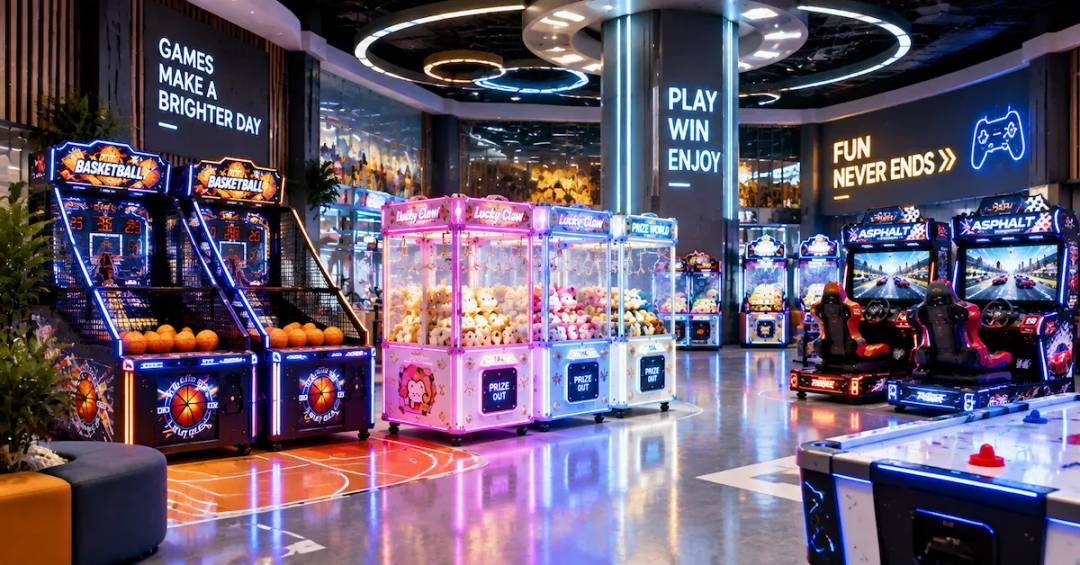
Workmanship should be translated into points that purchasing and QC personnel can inspect. Statements such as “high-end cabinet quality” do not provide an objective acceptance method.
Exterior Workmanship
Check panel alignment, surface condition, artwork position, lighting, doors, locks, transparent panels, labels, and visible fasteners.
Internal Assembly
Review wiring organization, connector security, component mounting, accessibility, and the placement of electronics inside service areas.
Control Installation
Buttons, joysticks, steering units, pedals, readers, sensors, and other interfaces should match the approved configuration and be mounted correctly.
Mechanical Operation
Where the machine includes grab mechanisms, motors, moving seats, ball-return systems, or other mechanical functions, include those elements in the acceptance checklist.
These checks become particularly important when a distributor orders multiple identical units and expects consistent production.
Use Functional QC to Verify the Complete Machine
EPARK’s Design & Process describes production and functional testing before delivery. Buyers should convert the general factory process into an order-specific acceptance plan.
The most useful test follows the complete player experience:
payment recognition → credit registration → game start → controls → gameplay → scoring or reward → reset.
Depending on the equipment category, the checklist may also cover:
- Display
- Sound
- Lighting
- Sensors
- Ticket output
- Prize mechanisms
- Steering and pedals
- Shooting controls
- Linked play
- Motion functions
- Player settings
If the machine fails a test, record the issue, corrective action, and retest. A photograph showing a powered cabinet should not replace functional acceptance.
Separate Cabinet Inspection From Machine Function Testing
One machine can have an excellent cabinet finish but a technical configuration problem. Another can play correctly while having damaged graphics, misaligned doors, or missing accessories.
For this reason, buyers should keep several inspection stages separate:
Cabinet Acceptance
Exterior condition, graphics, panels, doors, locks, and construction.
Functional Acceptance
Gameplay, controls, payment, electronics, mechanical functions, and relevant systems.
Configuration Acceptance
Software/version, payment hardware, artwork, language, accessories, and custom options.
Packing Acceptance
Package identification, manuals, keys, accessories, separated structures, and spare parts.
This makes inspection records more useful when a later problem needs to be traced.
Compare Standard Cabinets, OEM Machines, and ODM Development
Not every project requires a newly designed cabinet. Existing machine platforms can often be more efficient when they already meet the operating requirement.
| Supply Route | Typical Scope | Best Fit | Primary Buyer Control |
|---|---|---|---|
| Standard machine | Existing cabinet and system | Simple arcade purchase | Exact included configuration |
| OEM branding | Logo, graphics, colors, labels | Private-label distributors | Artwork approval |
| Configured OEM | Existing machine plus approved hardware/configuration | Regional requirements | Technical compatibility |
| ODM project | More substantial cabinet or functional development | Differentiated product programs | Prototype validation |
| FEC project supply | Multiple machine categories | Complete entertainment venues | Layout and equipment coordination |
EPARK provides customization and project-support information through Why Choose Us. Buyers should determine whether their requirement can be satisfied by an existing platform before creating unnecessary engineering work.
Control OEM Cabinet Artwork by Revision
OEM projects often begin with a simple request to “add our logo,” but cabinet graphics can involve multiple panels, headers, labels, illuminated areas, and machine-specific dimensions. Final artwork should therefore be approved by machine rather than treated as one general brand file.
Keep records of:
- Machine model
- Artwork revision
- Logo placement
- Color references
- Product labels
- Buyer model code
- Factory model reference
- Packaging artwork where applicable
Future repeat orders should reference the approved revision instead of using an informal instruction such as “same artwork as last order.”
Evaluate Production Capacity Against the Cabinet Mix
Manufacturing capacity should be discussed in relation to the actual order. A batch of standard claw machines can involve different work from customized racing cabinets, sports machines, or complex simulators.
Ask for a schedule based on:
Specification Confirmation
Technical configuration, quantity, payment system, and customization should be approved.
Cabinet Production
Structural fabrication, panels, artwork, and relevant surface processes need to be completed.
Machine Integration
Electronics, controls, payment systems, displays, lighting, and mechanisms are installed.
QC and Retesting
Allow time for testing and correction.
Packing
Final package configuration is completed after machine approval.
General ordering information is available through EPARK’s FAQ, but buyers should request an order-specific schedule.
Compare Total Machine Cost Instead of Empty Cabinet Price
When comparing an arcade cabinet and game machine manufacturer, determine whether each quotation describes an empty cabinet, partially integrated equipment, or a complete commercial machine. A low cabinet price provides little information if another quotation includes controls, electronics, software, payment hardware, packaging, and technical support.
Potential cost components include:
- Cabinet structure
- Exterior graphics
- Display
- Player controls
- Internal electronics
- Payment hardware
- Game/software system
- Mechanical assemblies
- OEM customization
- Spare parts
- Packaging
- Freight
- Installation support
Ask for an itemized commercial scope and identify exclusions before comparing final prices.
Connect Cabinet Design With Export Packaging
Cabinet design affects logistics. Large seats, frames, headers, hoops, or decorative components may need an approved disassembled shipping configuration.
Before shipment, request:
- Packed dimensions
- Gross weight
- Package quantity
- Removed assemblies
- Accessory locations
- Package references
- Reassembly information where relevant
Packaging should protect cabinet surfaces, transparent panels, displays, controls, and internal components according to the actual equipment design.
For broader project-delivery support, buyers can review EPARK’s Service page.
Plan Maintenance Access Before Approving the Cabinet
Serviceability is easier to improve during design review than after equipment has been installed in an arcade.
The buyer should understand how staff or technicians access:
- Payment device
- Main electronics
- Power supply
- Controls
- Sensors
- Prize area
- Ticket mechanism
- Motors or other serviceable assemblies
A cabinet with excellent visual design but poor service access can increase downtime during everyday operation.
For complete FEC planning, maintenance clearance should also be reflected in the floor plan rather than placing every cabinet directly against walls or neighboring equipment.
Build Spare-Parts Traceability Into the Machine Program
Spare-parts support should connect directly to the approved machine version. Generic descriptions such as “arcade controller” or “power supply” are not enough when a factory produces several equipment categories.
Keep:
- Machine model
- Production/order reference
- Component reference
- Applicable revision
- Replacement history
A supplier that preserves these relationships can support future maintenance more efficiently.
EPARK’s Service and FAQs provide starting information for technical support discussions, while the exact spare-parts arrangement should be confirmed for the actual order.
How Should Buyers Compare Arcade Cabinet Manufacturers?
Use evidence connected to the finished machine rather than cabinet appearance alone.
| Evaluation Area | Weak Evidence | Stronger Evidence |
|---|---|---|
| Cabinet | Attractive rendering | Approved dimensions and construction |
| Materials | “Premium material” | Model-specific material specification |
| Electronics | Generic component list | Approved machine configuration |
| Controls | Product photo | Tested controls and service references |
| Manufacturing | Factory photographs | Production workflow for selected machines |
| QC | “100% tested” | Order-specific acceptance criteria |
| OEM | Logo service | Revision-controlled artwork |
| Maintenance | “Easy service” | Demonstrated access and parts identification |
| Packaging | “Export standard” | Machine-specific packing information |
| Repeat order | Same product name | Version and change-control records |
This provides a more useful basis for commercial supplier selection.
What Should You Send an Arcade Cabinet and Game Machine Manufacturer for a Quote?
When contacting an arcade cabinet and game machine manufacturer, provide the destination, buyer type, machine category, quantity, venue application, available space where relevant, payment requirements, branding needs, preferred controls or functions, and target purchasing schedule.
If you are developing a custom cabinet, add reference images and explain which elements are mandatory and which are only design inspiration. If you are purchasing for an FEC, provide the floor plan so operating and maintenance space can be considered alongside the cabinet dimensions.
Review EPARK commercial arcade products and submit your requirements through Contact Us. A detailed brief makes it easier to produce a comparable quotation than simply asking for “arcade cabinet prices.”
Frequently Asked Questions
1. What Is the Difference Between an Arcade Cabinet Manufacturer and a Complete Game Machine Manufacturer?
A cabinet manufacturer may focus mainly on the physical enclosure, while a complete machine manufacturer also integrates the electronics, controls, payment system, displays, mechanisms, software, and other systems required for commercial gameplay.
2. What Should Buyers Check in an Arcade Cabinet?
Check dimensions, construction, panels, doors, locks, graphics, player controls, service access, component mounting, operating clearance, and packing requirements.
3. Can an Existing Arcade Cabinet Be Customized for My Brand?
Depending on the machine, logos, artwork, colors, labels, and packaging can often be discussed without developing a completely new cabinet. Final customization should be approved by revision.
4. When Does a Buyer Need a New Custom Cabinet?
A new cabinet may be justified when existing platforms cannot satisfy required dimensions, player interaction, equipment integration, branding, or other important project requirements. Evaluate existing products before beginning new development.
5. How Should Cabinet Quality Be Inspected?
Use objective checks covering alignment, finish, panels, doors, locks, graphics, controls, visible fasteners, service openings, and the relevant internal assembly rather than relying on general appearance alone.
6. Should the Cabinet and Game System Be Tested Separately?
Cabinet condition and functional performance should be separate inspection categories, while the final complete machine should also pass an integrated operating test.
7. How Can Distributors Control Repeat-Order Consistency?
Keep the factory model, buyer code, artwork revision, component configuration, software/version information where applicable, QC criteria, and packaging specifications for every approved product.
8. What Spare Parts Should Be Ordered With Arcade Machines?
The appropriate parts depend on the machine. Ask for model-specific recommendations covering service-critical controls, electronics, payment components, sensors, motors, or mechanisms relevant to the equipment.
9. Does Cabinet Design Affect Shipping Costs?
Yes. Machine dimensions, detachable structures, package count, gross weight, and packing method all influence logistics. Compare final packed configurations rather than only assembled dimensions.
10. Where Can I Request an Arcade Cabinet and Game Machine Quote?
Review EPARK Products and send your machine category, quantity, venue, payment, customization, and delivery requirements through EPARK Contact Us.
Conclusion
Choosing an arcade cabinet and game machine manufacturer requires evaluating the physical cabinet and the complete commercial machine as one controlled product. FEC operators, distributors, arcade chains, and private-label buyers should review cabinet materials, dimensions, service access, internal integration, workmanship, functional testing, customization, packaging, spare parts, and repeat-order consistency before approving production.
A strong manufacturing relationship makes the finished machine easier to inspect, operate, maintain, and reproduce rather than simply delivering an attractive cabinet once. Review EPARK commercial arcade equipment or contact EPARK with your cabinet requirements, machine category, quantity, payment system, branding needs, and project conditions to discuss an order-specific solution.
Disclaimer
The information provided on this website is for general informational purposes only.
While EPARK Arcade Game Machine Manufacturer strives to ensure accuracy and reliability, no warranties—express or implied—are made regarding completeness, performance, or applicability.
Product specifications, designs, and features may vary depending on usage, customization, and customer requirements.
Buyers are responsible for verifying all technical details, compliance certifications, and suitability before procurement.
EPARK shall not be held liable for any direct, indirect, incidental, or consequential damages arising from the use of this website or its content, including but not limited to business losses, data errors, or equipment misuse.
For tailored solutions or further verification, please visit our Contact Us
Intellectual Property Notice
All articles, product images, videos, catalogs, software, and related materials published on this website are the intellectual property of EPARK, unless otherwise stated.
Unauthorized reproduction, distribution, modification, or commercial use of any content is strictly prohibited without prior written consent from EPARK.
EPARK reserves the right to take legal action against any unauthorized use, including but not limited to copyright infringement, misrepresentation, or unfair competition.
Trademarks
The name EPARK, the EPARK logo, and all related brand elements displayed on this website are registered trademarks or trade names of Guangzhou EPARK Electronic Technology Co., Ltd.
Other product names, company names, or logos mentioned on this site may be trademarks of their respective owners.
Unauthorized use of EPARK's trademarks for commercial purposes, including advertising, promotions, or product packaging, is strictly prohibited.
Governing Law
These terms are governed by the laws of the People's Republic of China.