

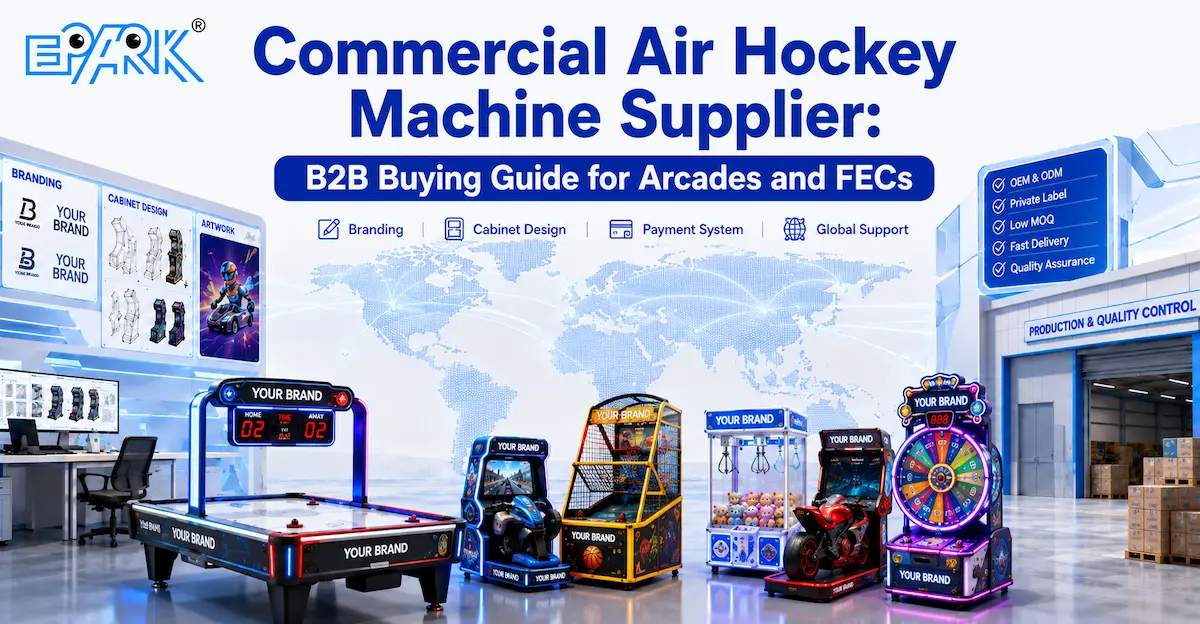
What Should a Commercial Air Hockey Machine Supplier Actually Provide?
Choosing a commercial air hockey machine supplier is not the same as buying a table for a home game room.
In a commercial venue, the table may run through hundreds of games in a busy week. Players lean against the rails. Pucks hit the sides repeatedly. The blower runs for long periods. Coins or cards are processed all day. Staff need to clear jams and replace worn parts without taking the machine out of service for days.
For a buyer, that changes the discussion.
The important questions are not only:
“What does it cost?”
and
“Does it have LED lights?”
A better supplier conversation covers:
- Airflow consistency
- Playfield construction
- Rail durability
- Electronic scoring
- Puck return
- Payment system
- Cabinet access
- Electrical configuration
- Spare parts
- Pre-shipment testing
- OEM requirements
- Repeat-order consistency
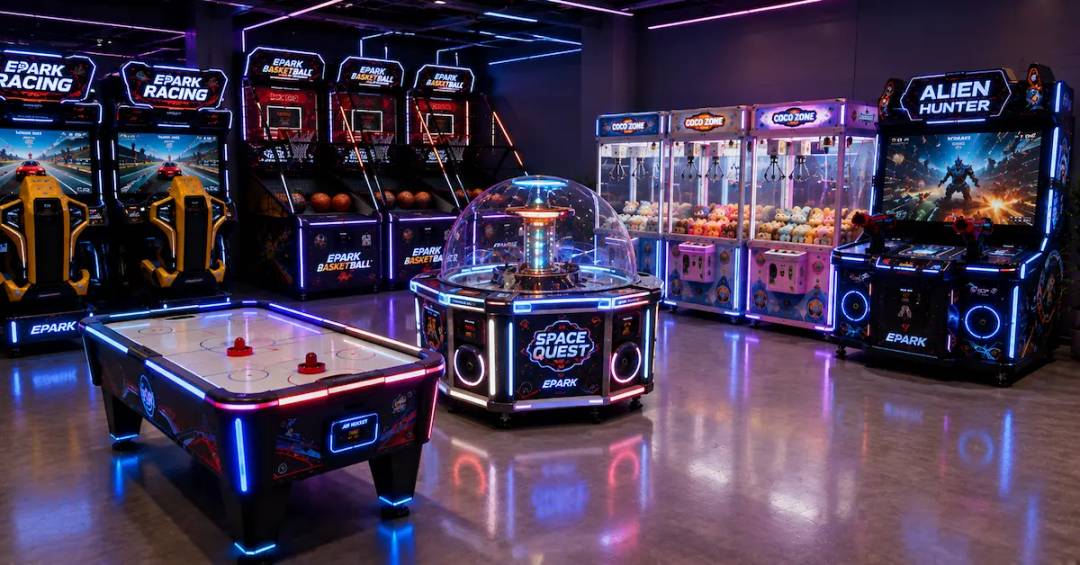
EPARK currently lists air hockey within its sports arcade equipment offering and presents its amusement equipment for FECs, arcades, shopping malls, and other commercial venues.
Who Is This Buying Guide For?
Commercial air hockey tables serve several B2B buyer groups, but their priorities are different.
| Buyer | Main Concern | What to Ask the Supplier |
|---|---|---|
| FEC operator | Reliable daily operation | Maintenance and throughput |
| Arcade owner | Player appeal | Gameplay, lighting, payment |
| Distributor | Repeat sales | OEM, parts,stable supply |
| Arcade chain | Standardization | Common parts and configuration |
| Mall project | Space efficiency | Dimensions and appearance |
| Importer | Shipment risk | Packing, documents, spare parts |
| Private-label buyer | Brand differentiation | Artwork and customization |
| Rental operator | Mobility and service | Assembly and maintenance access |
A supplier that works well for a single small arcade may not be the right partner for a distributor ordering repeated containers.
That is why supplier selection should start with the buyer's operating model.
Choose the Air Hockey Format Before Comparing Prices
Commercial air hockey machines come in several configurations.
Standard Two-Player Air Hockey
This is the familiar head-to-head format.
It suits:
- Arcades
- FECs
- Mall entertainment areas
- Indoor amusement centers
It is easy for players to understand and does not normally require staff instruction.
Compact Commercial Air Hockey
A smaller footprint can work where rent or floor space is limited.
The trade-off is obvious: a compact table may fit more venues, but buyers should check whether the playing area still suits their target users.
Four-Player or Multi-Player Air Hockey
Larger multiplayer formats can become a visual attraction.
They may make sense for:
- Large FECs
- Group entertainment venues
- Social gaming zones
But they also occupy more floor area and may cost more to ship.
Redemption-Enabled Air Hockey
Some venues want air hockey integrated into a broader ticket or points system.
Before ordering, confirm:
- Whether the machine supports redemption logic
- How scoring connects to the system
- Whether ticket or point output is configurable
- Whether the venue's existing card system can be integrated
Themed or OEM Air Hockey
Distributors and branded venues may want different:
- Cabinet colors
- Graphics
- LED effects
- Logos
- Side-panel artwork
- Payment configuration
EPARK's current OEM material specifically includes air hockey among the types of machines it discusses for customized arcade projects.
Commercial Air Hockey Table Comparison
| Configuration | Main Strength | Space Requirement | Best Fit |
|---|---|---|---|
| Compact 2-player | Efficient footprint | Low | Small arcades |
| Standard 2-player | Familiar gameplay | Medium | Most FECs |
| Large premium table | Strong visual presence | Medium–High | Mall/FEC |
| 4-player table | Social gameplay | High | Large venues |
| Redemption model | Links play to rewards | Medium | Redemption FEC |
| OEM-themed model | Brand differentiation | Varies | Distributors/chains |
Do not assume the largest table will produce the best commercial result.
Floor productivity matters.
Ask for the Exact Table Dimensions
Many buyers ask for the table price before checking whether it fits the site.
Reverse that order.
Request:
- Overall length
- Overall width
- Overall height
- Machine weight
- Packing dimensions
- Packing weight
- Recommended operating clearance
- Service-panel access requirements
Remember that the physical table is not the entire operating footprint.
Two players need space at opposite ends. Spectators may stand nearby. Staff need access around the machine.
A table placed too close to another attraction can make both machines uncomfortable to use.
The Blower System Is One of the Most Important Components
An air hockey table depends on a cushion of air under the puck.
If the airflow is weak or uneven, the game immediately feels wrong.
The puck may:
- Slow unexpectedly
- Drift differently across the table
- Catch in certain areas
- Lose the fast response players expect
This is why serious buyers should ask more than:
“Does it have a blower?”
Ask:
- What type of blower system is used?
- Can it be accessed without dismantling the entire machine?
- How is the airflow distributed?
- Can the blower be replaced?
- Are replacement parts available?
- Is the airflow tested before shipment?
For an operator, easy service access matters almost as much as blower performance.
Inspect the Playfield, Not Just the Graphics
A glossy graphic can hide a mediocre playing surface.
For commercial operation, buyers should evaluate:
- Surface smoothness
- Flatness
- Hole consistency
- Resistance to normal wear
- Cleaning requirements
- Edge finishing
The puck should move predictably across the playing area.
A useful factory test is not simply switching on the machine. Staff should actually play or move the puck across different parts of the surface and look for abnormal drag or inconsistent movement.
Rails Take More Abuse Than Buyers Expect
The puck repeatedly strikes the side rails during play.
Players also lean against the cabinet and occasionally hit it with the striker.
Ask about:
- Rail construction
- Fastening method
- Corner joints
- Impact areas
- Replaceability
A decorative side panel and the actual impact structure are not necessarily the same thing.
When comparing suppliers, ask to see the construction underneath the artwork.
Check the Puck Return Design
Puck return sounds like a small detail until the machine is in daily operation.
A poor return mechanism can result in:
- Puck jams
- Difficult access
- Staff intervention
- Slow game reset
Ask the supplier to demonstrate several consecutive games.
Watch what happens after each goal.
The puck should return consistently without requiring players to reach inside the table or staff to open the cabinet.
Electronic Scoring Needs to Work Under Real Play Conditions
Many modern commercial tables use automatic scoring.
That means buyers should understand the scoring system rather than treating it as decoration.
Ask:
- What detects a goal?
- Where are the sensors located?
- Can sensors be replaced separately?
- How is the score reset?
- What happens if one side stops detecting goals?
- Is there a diagnostic method?
A sensor failure should not require replacing an unnecessarily large electronics assembly.
Serviceability is a commercial specification.
LED Lighting Should Not Complicate Maintenance
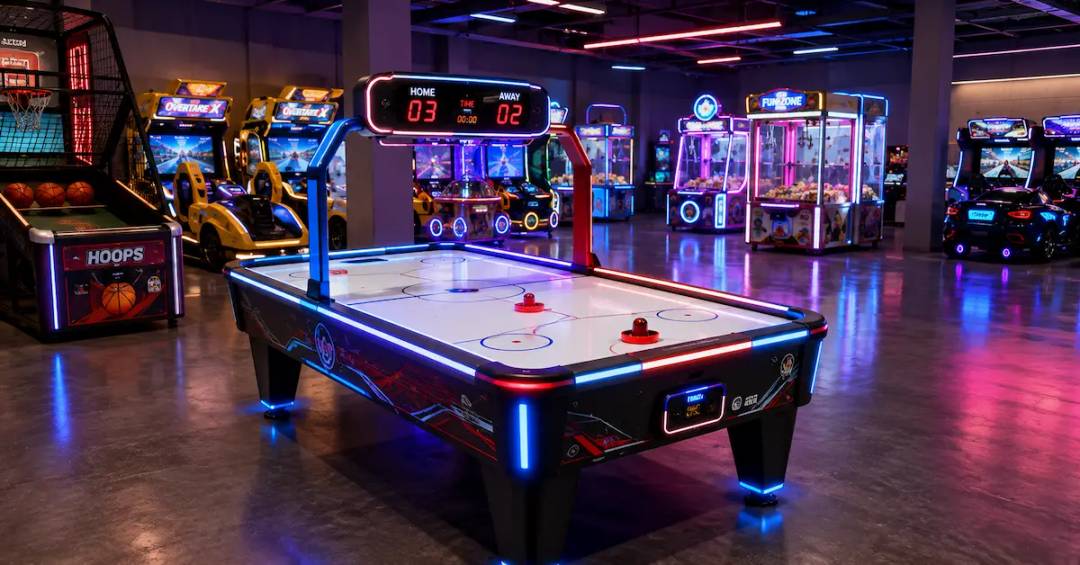
LED lighting can make an air hockey table much more visible in a dark arcade.
That helps attract attention, especially when the table sits near racing, basketball, shooting, or redemption games.
But more lighting also means more wiring and components.
Ask whether:
- LED strips are modular
- Lighting sections can be replaced
- Wiring is accessible
- Lighting faults affect gameplay
- Replacement parts can be supplied separately
Good visual design should not make routine repair difficult.
Payment Integration Should Be Confirmed Before Production
A table may be configured for different operating models.
Depending on the project, buyers may require:
- Coin operation
- Token operation
- Card payment
- Central cashless system
- QR payment
- Free-play mode
Do not assume that changing payment systems after delivery is simple.
Discuss it during order confirmation.
For an FEC using one central payment platform, send the supplier the relevant system information before production so compatibility can be checked.
EPARK markets broader arcade projects with payment-system and venue-planning support, which is relevant when air hockey is being purchased together with other game categories.
How to Compare a Commercial Air Hockey Machine Supplier
A commercial air hockey machine supplier should be evaluated on the machine and on the company's ability to support it.
For a serious B2B order, ask to see:
Production Evidence
Request:
- Current production photos
- Assembly videos
- Machines being tested
- Finished orders
- Packing area
A showroom alone does not demonstrate production control.
Technical Knowledge
Ask the sales team questions about:
- Blower system
- Sensors
- Power supply
- Control board
- Payment configuration
- Service access
If every technical question needs several days to be forwarded through unknown third parties, that tells you something about the supply chain.
Quality-Control Process
Ask:
“What exactly do you test before this table is packed?”
A vague answer such as “100% quality inspection” is less useful than a clear checklist.
A Practical Pre-Shipment Test for Commercial Air Hockey
For a buyer, the following test sequence is more useful than simply checking whether the machine turns on.
1. Power-On Test
Verify stable startup and normal electrical operation.
2. Blower Test
Check airflow across different areas of the playfield.
3. Gameplay Test
Run repeated puck movements from both sides.
4. Rail Test
Check bounce response around the perimeter.
5. Goal Detection Test
Score repeatedly on both ends.
6. Puck Return Test
Confirm reliable return after multiple goals.
7. Payment Test
Test the exact coin, token, card, or other configuration ordered.
8. Lighting and Audio Test
Verify attract-mode and gameplay functions where applicable.
9. Exterior Inspection
Check graphics, cabinet finish, seams, fasteners, and customized branding.
10. Order Verification
Confirm voltage, plug, accessories, spare parts, documentation, and packing.
For bulk orders, buyers can request a short test video showing the actual machines before shipment.
Safety and Destination-Market Requirements Should Be Model-Specific
Electrical amusement equipment should not be purchased based only on a generic statement such as “international standard.”
IEC 60335-2-82:2024 addresses safety requirements for electric commercial amusement and personal-service machines within its scope, including common hazards encountered by users and maintenance personnel. It also notes that national authorities may specify additional requirements.
For an air hockey project, buyers should therefore ask:
- Which requirements apply to this exact model?
- What is the rated electrical configuration?
- What documentation is available?
- Which destination-market requirements have been considered?
- Are there installation instructions?
- Are service areas protected appropriately?
Avoid assuming that one certificate or logo automatically settles every destination-market requirement.
Check the Cabinet From a Maintenance Perspective
A commercial table eventually needs to be opened.
Before ordering, ask:
“Show me how a technician reaches the blower, power supply, control board, sensors, and payment unit.”
That simple request reveals a lot about the design.
Good service access can reduce:
- Repair time
- Labor cost
- Venue downtime
For an arcade chain, standardized service access is especially valuable because technicians may maintain many tables across several locations.
Spare Parts Should Be Discussed Before Shipment
Do not wait for a failure.
Ask the supplier for a recommended spare-parts package.
Depending on the table design, that may include items such as:
- Pucks
- Strikers
- Sensors
- Switches
- Power components
- LED modules
- Payment components
- Control boards
- Blower-related parts
The exact list should come from the actual model configuration.
More important than receiving a long parts list is knowing whether the factory can identify the correct replacement later.
Ask:
“If I send you the machine model or production record next year, can you identify the exact part?”
For distributors, this is essential.
Their customers will contact them first, not the factory.
Test OEM Capability With a Real Request
When evaluating a commercial air hockey machine supplier for private-label or distributor cooperation, do not ask only whether OEM is available.
Give the supplier an actual brief.
For example:
We need 20 commercial air hockey tables for a regional FEC chain. The tables require our logo, black-and-orange graphics, 220–240 V configuration, card-payment compatibility, branded side panels, and a spare-parts package.
Then watch what happens.
A capable OEM team should ask about:
- Logo files
- Artwork format
- Color references
- Payment interface
- Electrical specification
- Quantity
- Approval process
- Production timing
If the only answer is “Yes, everything is possible,” more verification is needed.
Think About Repeat Orders Before the First Order
Distributors and arcade chains should ask:
“Will the next production batch use the same important components?”
Components can change over time.
The supplier should have a process for managing:
- Blower changes
- Sensor substitutions
- Control-board revisions
- Payment-system changes
- LED revisions
- Artwork updates
If a key component changes, buyers should ideally know before repeat production.
This makes future maintenance easier.
Air Hockey Works Best as Part of a Competitive Game Zone
An air hockey table is often stronger when paired with other social or competitive machines.
A venue might group it with:
- Basketball arcade machines
- Racing simulators
- Boxing or strength machines
- Shooting games
- Sports games
This creates a zone where spectators can watch and players can move between short competitive experiences.
EPARK's current project material places air hockey alongside basketball, racing, VR, prize, and other arcade equipment when discussing complete entertainment layouts.
This is important for FEC buyers: equipment should be selected as part of a floor plan, not as isolated catalog items.
Do Not Judge ROI From Purchase Price Alone
Commercial buying decisions should account for the equipment lifecycle.
A useful comparison is:
Total Cost = Machine + Customization + Freight + Import + Maintenance + Parts + Downtime
Consider two tables.
Table A costs less but requires a difficult-to-source sensor, and the blower is hard to access.
Table B costs slightly more but uses replaceable modules and comes with a clear spare-parts plan.
The cheapest initial quotation may not be the cheaper machine to operate.
Commercial Air Hockey Supplier Scorecard
Use the same criteria for every supplier.
| Evaluation Area | Suggested Weight |
|---|---|
| Airflow and gameplay | 15 |
| Cabinet/playfield construction | 15 |
| QC and testing | 15 |
| Spare parts/serviceability | 15 |
| Payment integration | 10 |
| OEM/ODM capability | 10 |
| Factory verification | 5 |
| Export packaging | 5 |
| Repeat-order consistency | 5 |
| Communication | 5 |
| Total | 100 |
This is a buyer-side evaluation framework, not an official industry certification.
Its purpose is to prevent price from becoming the only deciding factor.
Red Flags When Comparing Air Hockey Suppliers
Investigate further if a supplier:
- Cannot explain the blower configuration
- Cannot show the inside of the machine
- Does not know how scoring sensors work
- Cannot demonstrate repeated gameplay
- Has no clear spare-parts process
- Cannot confirm payment integration before production
- Makes OEM promises without requesting specifications
- Cannot provide packing dimensions
- Cannot explain pre-shipment testing
- Changes components without informing repeat buyers
- Focuses entirely on FOB price
A single issue may have a reasonable explanation.
Several together increase purchasing risk.
What Information Should You Send for a Useful Quotation?
Instead of writing:
“Air hockey price?”
send something closer to:
“We operate a 600 m² family entertainment center and need four commercial air hockey tables for a competitive sports zone. Destination is Saudi Arabia. We need 220–240 V configuration, card-payment compatibility, custom branding, spare parts, export packing, and delivery within our project schedule. Please recommend suitable models and provide dimensions, packing data, MOQ, lead time, and customization options.”
That message helps a supplier give you an actual commercial proposal.
Include:
- Buyer type
- Venue type
- Destination country
- Quantity
- Available space
Disclaimer
The information provided on this website is for general informational purposes only.
While EPARK Arcade Game Machine Manufacturer strives to ensure accuracy and reliability, no warranties—express or implied—are made regarding completeness, performance, or applicability.
Product specifications, designs, and features may vary depending on usage, customization, and customer requirements.
Buyers are responsible for verifying all technical details, compliance certifications, and suitability before procurement.
EPARK shall not be held liable for any direct, indirect, incidental, or consequential damages arising from the use of this website or its content, including but not limited to business losses, data errors, or equipment misuse.
For tailored solutions or further verification, please visit our Contact Us
Intellectual Property Notice
All articles, product images, videos, catalogs, software, and related materials published on this website are the intellectual property of EPARK, unless otherwise stated.
Unauthorized reproduction, distribution, modification, or commercial use of any content is strictly prohibited without prior written consent from EPARK.
EPARK reserves the right to take legal action against any unauthorized use, including but not limited to copyright infringement, misrepresentation, or unfair competition.
Trademarks
The name EPARK, the EPARK logo, and all related brand elements displayed on this website are registered trademarks or trade names of Guangzhou EPARK Electronic Technology Co., Ltd.
Other product names, company names, or logos mentioned on this site may be trademarks of their respective owners.
Unauthorized use of EPARK's trademarks for commercial purposes, including advertising, promotions, or product packaging, is strictly prohibited.
Governing Law
These terms are governed by the laws of the People's Republic of China.