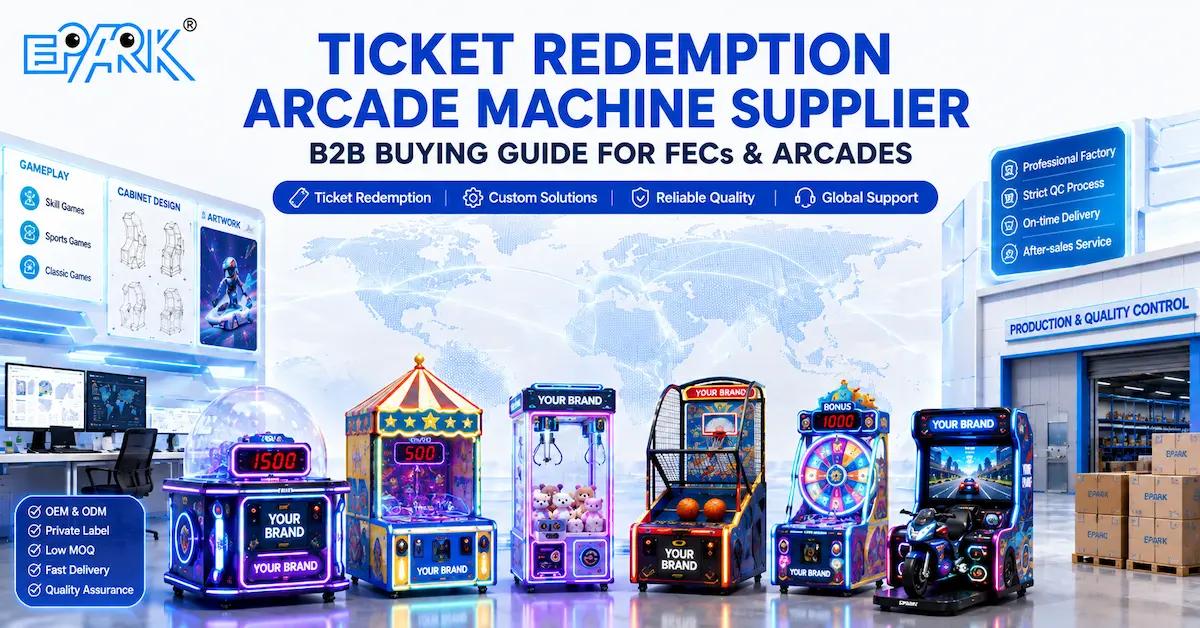

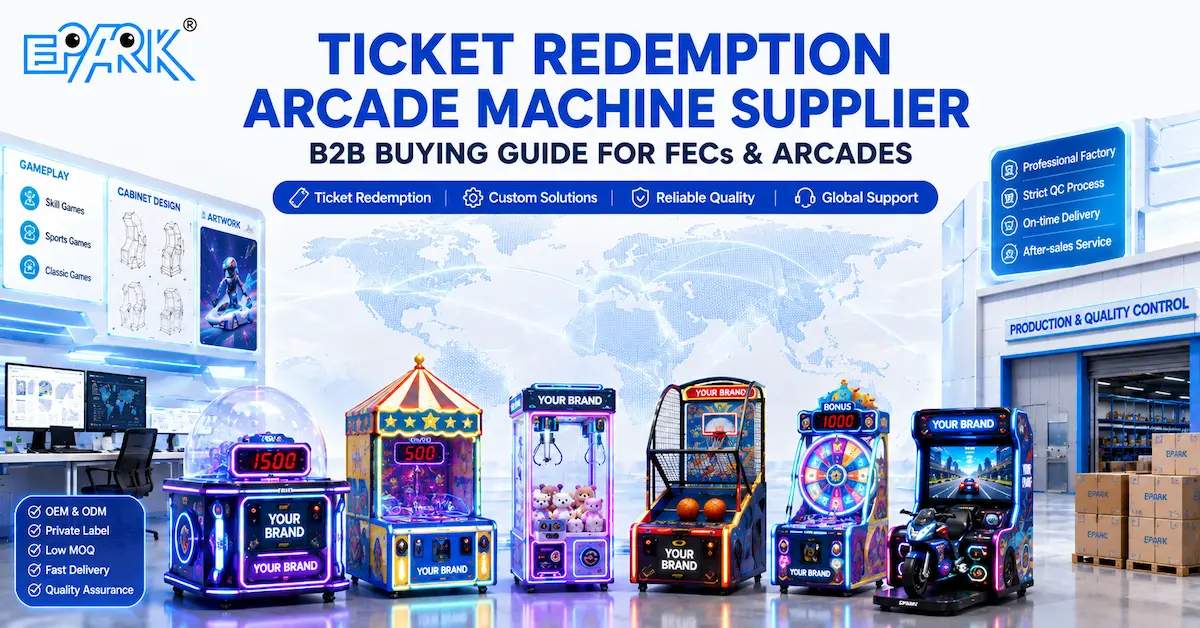
What Should a Ticket Redemption Arcade Machine Supplier Provide?
Finding a reliable ticket redemption arcade machine supplier is not simply a matter of choosing the machine with the largest jackpot display.
For an FEC or commercial arcade, redemption equipment sits inside a larger operating system:
Player Pays → Game Starts → Performance Is Measured → Tickets or Points Are Awarded → Player Redeems Rewards
If one part of that chain is unreliable, the operator feels it quickly.
A machine can look excellent on the arcade floor but still create daily problems if:
- Ticket sensors miscount
- The dispenser jams
- Digital points fail to transfer
- Payout settings are difficult to adjust
- Payment readers are incompatible
- Spare parts cannot be identified
- The supplier cannot diagnose faults remotely
That is why B2B buyers should evaluate the whole redemption system, not just the game cabinet.
Operators planning a wider venue can first compare EPARK's commercial arcade machine range, including equipment for FECs, arcades, shopping malls, and mixed entertainment projects. EPARK's current site also states that its payment integration can include ticket, point, and redemption systems.
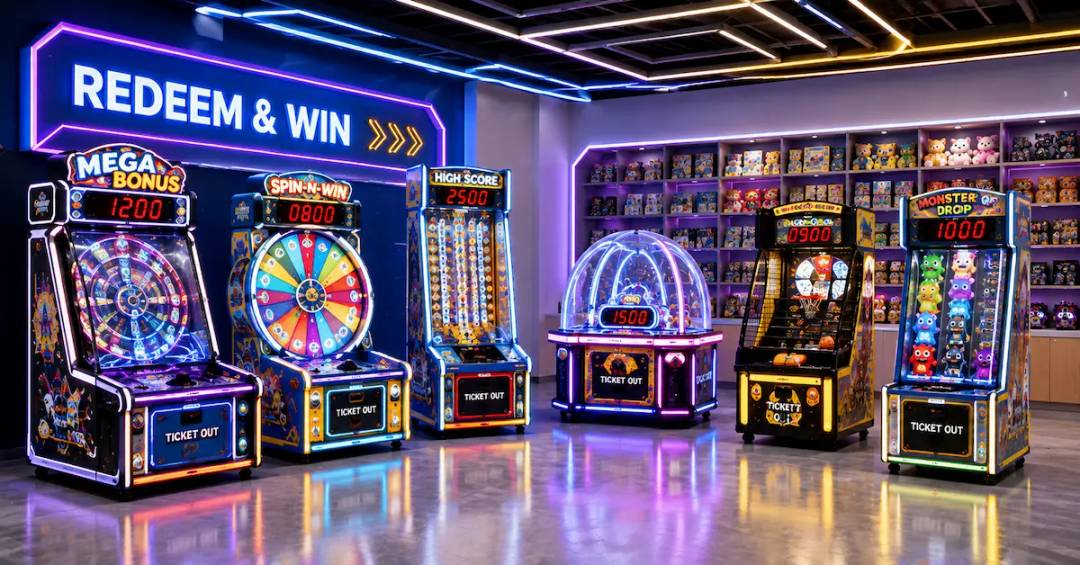
Why Redemption Games Matter in an FEC
Redemption machines give players something beyond the game itself.
They create a simple loop:
Play → Perform → Earn → Save → Redeem
A customer who is collecting points toward a prize has a reason to keep playing or return later.
That makes redemption games particularly relevant to:
- Family entertainment centers
- Children's arcades
- Shopping mall game zones
- Bowling entertainment centers
- Mixed-age amusement venues
EPARK's existing guide on why FEC operators use redemption game machines explains this distinction clearly: redemption games connect gameplay with tickets, points, or digital credits that can later be exchanged for prizes.
The important point for buyers is that the machine should fit the economics of the venue, not merely attract attention.
Decide Whether You Need Paper Tickets or Digital Points
This decision should happen early.
Traditional Paper Ticket Systems
The machine physically dispenses tickets after play.
Advantages can include:
- Very visible reward
- Familiar player experience
- Easy concept for young customers
But operators also need to manage:
- Ticket rolls
- Dispenser maintenance
- Paper loading
- Ticket jams
- Storage
Digital Ticket or Point Systems
Instead of printing paper tickets, the machine transfers credits or points to a player's card or account.
This can reduce paper handling and make centralized management easier.
However, buyers need to confirm:
- Card-system compatibility
- Data communication
- Reader interface
- Point transfer logic
- Error recovery
- Supplier support
Hybrid Configurations
Some projects may use different reward mechanisms across different locations or machine groups.
For a distributor, this makes configuration management especially important.
Do not tell the factory only:
“We need a redemption game.”
Tell them:
“We use a cashless card system and need score-based digital points sent to the player's account.”
That changes the technical conversation immediately.
Understand How the Machine Calculates Payout
The payout mechanism is one of the most commercially important parts of a redemption machine.
Different games may award rewards based on:
- Player score
- Accuracy
- Timing
- Target hit
- Number of successful actions
- Jackpot result
- Game level
Ask whether payout parameters can be adjusted.
For example:
Score 0–100 → X tickets
Score 101–200 → Y tickets
Score 201+ → Z tickets
The exact system will depend on the machine.
What matters is whether the operator can control it without replacing hardware every time the venue changes its reward strategy.
Avoid Treating “High Ticket Payout” as a Selling Point by Itself
A machine awarding large numbers of tickets is not automatically more profitable.
The operator has to fund the prize economy.
Think about:
Revenue per Play – Redemption Cost – Operating Cost
If payout values are too generous relative to game price and prize cost, the machine may generate impressive player activity without delivering the expected margin.
If payout is too low, players may lose interest.
This is why experienced FEC operators normally look at the whole redemption economy, not just a jackpot number flashing on the cabinet.
Match Redemption Machines to Different Player Behaviors
A good redemption zone should not feel like twenty versions of the same game.
Different players respond to different challenges.
Skill-Based Games
These may involve:
- Timing
- Shooting
- Throwing
- Rolling
- Aiming
- Physical control
They give players the feeling that better performance can improve rewards.
Quick-Reaction Games
Short rounds are useful in busy locations where operators want high player turnover.
Sports Redemption Games
Basketball, throwing, target, and similar games can work well with groups and competitive players.
Family-Friendly Prize Games
Simpler rules can make a machine easier for younger players and parents to understand.
Jackpot Games
Large visible jackpot displays can create spectator interest and repeat attempts.
A serious supplier should help you build variety instead of recommending machines based purely on which models it currently has in stock.
Compare Redemption Game Types Before Ordering
| Game Type | Player Appeal | Throughput | Operational Focus |
|---|---|---|---|
| Skill game | Performance challenge | Medium–High | Calibration |
| Sports redemption | Competitive | Medium | Sensors and scoring |
| Timing game | Quick and repeatable | High | Payout settings |
| Target game | Accuracy | High | Sensor reliability |
| Jackpot game | Reward-driven | Medium–High | Jackpot logic |
| Family redemption | Easy to understand | High | Simple operation |
For a larger project, combine categories.
A wall of visually different games generally creates a stronger redemption zone than repeatedly purchasing one machine design.
Check the Ticket Dispenser as a Service Component
If the model uses paper tickets, the ticket dispenser deserves careful attention.
Ask:
- What dispenser is used?
- Is it easy to access?
- How is a jam cleared?
- How does the machine detect ticket output?
- What happens when tickets run out?
- Can the dispenser be replaced separately?
- Can spare dispensers be ordered?
This may sound overly technical during the sales stage.
It will not feel overly technical when the venue is busy on Saturday evening and one machine stops paying tickets.
Ask How Ticket Counting Is Verified
Physical ticket systems need a way to determine whether the expected number of tickets was actually dispensed.
The exact architecture depends on the machine.
What buyers should avoid is a system that has no clear method for detecting:
- Missing tickets
- Dispenser jams
- Incomplete payout
Ask the supplier to demonstrate the payout process during factory testing.
Do several rounds, not one.
For Digital Redemption, Test the Whole Data Path
Cashless redemption changes the failure points.
Instead of a ticket jam, the operator may face:
- Reader communication failure
- Account update failure
- Incorrect point value
- Network issue
- Interface mismatch
Before bulk production, test:
Payment → Gameplay → Score → Point Calculation → Account Update
Do not test each device independently and assume the full system will work.
The commercial experience depends on the chain working end to end.
Confirm Payment Integration Before Production Starts
Redemption machines may use:
- Coins
- Tokens
- Rechargeable cards
- QR payments
- Centralized cashless systems
The payment method influences both electronics and operations.
For a complete FEC project, it is often better to discuss one payment architecture across the venue rather than configuring every machine independently.
EPARK's current company information lists payment-system integration among its one-stop services, alongside customization, venue planning, installation, and after-sales support.
Buyers who need customized readers, branding, or cabinet configurations can discuss these requirements through EPARK's OEM/ODM arcade machine services.
Inspect Score Sensors and High-Frequency Components
A redemption machine may process hundreds or thousands of physical actions over time.
Depending on the game, components might include:
- Optical sensors
- Limit switches
- Buttons
- Motors
- Encoders
- Ball-return mechanisms
- Targets
- Control boards
- Displays
Ask which parts directly affect scoring.
A scoring sensor should ideally be:
- Accessible
- Identifiable
- Replaceable
- Available as a spare part
A machine that cannot score accurately cannot reward accurately.
That makes sensor reliability part of the revenue system, not just an engineering detail.
Ask How Calibration Works
Certain skill-based machines require calibration.
For example, the operator may need to confirm:
- Sensor positions
- Timing
- Target recognition
- Motor movement
- Score thresholds
Ask:
Can venue staff perform normal calibration?
and
What happens if calibration is lost after transportation or component replacement?
If the answer requires a factory engineer to travel internationally for every small adjustment, the machine may not be practical for a distributor or multi-location operator.
Cabinet Construction Still Matters
Redemption games tend to attract physical interaction.
Players may:
- Throw balls
- Hit buttons
- Pull handles
- Lean on cabinets
- Repeat the same movement hundreds of times
Buyers should inspect:
- Frame stability
- Fasteners
- Moving assemblies
- Protective panels
- Service doors
- Player-contact areas
Appearance matters because arcade floors are visual environments.
But the decorative shell and the load-bearing structure are two different questions.
Ask to see both.
Consider the Machine From a Technician's View
During a sales presentation, look behind the front panel.
Ask:
How does a technician reach the power supply?
Where is the control board?
Where are the scoring sensors?
How is the ticket dispenser accessed?
Can the card reader be removed without dismantling the cabinet?
Commercial equipment eventually needs service.
Good accessibility can shorten downtime considerably.
Pre-Shipment Testing Should Include Real Gameplay
A supplier should not test a redemption machine by switching it on for thirty seconds.
A useful test sequence includes:
Startup
Check normal boot behavior.
Multiple Games
Run repeated rounds.
Score Detection
Confirm expected scoring.
Payout
Verify tickets or digital points.
Jackpot Logic
Where applicable, confirm the configured jackpot rules.
Payment
Use the actual payment configuration ordered.
Controls
Test buttons, sensors, handles, balls, targets, or other game-specific parts.
Lighting and Audio
Check attract mode and normal gameplay.
Reset
Confirm proper game recovery.
For bulk orders, request test evidence for actual ordered machines.
A factory-side problem is usually easier and cheaper to solve than a problem discovered after international delivery.
Verify the Supplier's Manufacturing Capability
The words “manufacturer” and “factory direct” are easy to place on a website.
For a meaningful B2B order, verify more.
Ask to see:
- Assembly
- Wiring
- Control-system installation
- Game testing
- Finished orders
- Packaging
- Spare-parts area
EPARK's company and manufacturing profile states that its operation integrates R&D, design, production, and sales and supports commercial amusement projects internationally.
For buyers comparing a ticket redemption arcade machine supplier, this manufacturing visibility matters because payout systems, sensors, cabinet assembly, and payment configuration need to work together.
Use Model-Specific Safety and Compliance Questions
Redemption machines are electrical commercial amusement equipment, so vague statements such as “international quality” are not enough.
IEC 60335-2-82:2024 covers the safety of certain electric commercial amusement machines and lists gaming machines and video games among its examples, subject to the scope and conditions stated by the standard. It also notes that additional national requirements may exist.
The official IEC reference is useful when discussing technical requirements:
For procurement, ask:
- Which requirements apply to this model?
- What electrical configuration is supplied?
- What documentation supports the machine?
- Are there specific requirements in the destination market?
Do not assume that a logo on a catalog automatically answers all four questions.
Plan Spare Parts Before Shipment
This is one of the best ways to judge a supplier's after-sales maturity.
Ask:
“For ten of these machines, what spare parts would you suggest keeping locally for the first year?”
The answer should be model-specific.
Possible items may include:
- Sensors
- Buttons
- Ticket dispensers
- Power supplies
- Control boards
- LED modules
- Motors
- Payment components
- Switches
You do not necessarily need large quantities of every item.
The goal is to avoid turning a minor failure into several weeks of downtime.
Distributors Need Better Parts Identification
A distributor has another problem.
Its customers may send a photo six months later and say:
“This part failed. Send me another one.”
The factory needs to identify it.
Ask whether the manufacturer can trace parts using:
- Machine model
- Serial or production information
- Order record
- Component photograph
- Part code
That support system matters much more after the initial purchase than it does during the sales presentation.
Compare Supplier Support, Not Just Warranty Length
A twelve-month warranty sounds reassuring.
But what happens when something actually fails?
Ask the supplier to describe the process.
A practical remote service workflow might look like:
Operator Sends Video → Supplier Diagnoses → Technician Tests Component → Replacement Is Confirmed → Part Ships → Installation Guidance Is Provided
A ticket redemption arcade machine supplier capable of giving clear troubleshooting instructions can be more useful than a supplier advertising a long warranty but providing weak technical response.
EPARK also maintains an arcade equipment FAQ for buyers reviewing ordering, installation, customization, and support questions.
OEM Should Go Beyond Putting a Logo on the Cabinet
For distributors and arcade chains, OEM can involve:
- Brand colors
- Side-panel graphics
- Header artwork
- Logo position
- Interface language
- Voltage
- Plug
- Payment reader
- Ticket or digital point configuration
- Packaging
Give the factory a real project brief.
For example:
We need 15 redemption machines for an FEC chain in the UAE. We use a centralized card system and digital points. Machines require our artwork, 220–240 V configuration, English interface, and a recommended spare-parts package.
The supplier should ask questions before giving a final answer.
That is usually a better sign than automatically saying “yes” to everything.
Distributors Should Ask About Repeat Orders
A successful distributor may reorder the same model several times.
Before the first bulk purchase, ask:
Which important components might change in future batches?
Possible changes include:
- Control board
- Display
- Sensor
- Power supply
- Payment interface
- Ticket dispenser
- LED controller
If substitutions are necessary, buyers should know whether the new component remains compatible with earlier machines.
Repeatability becomes more important as the installed machine base grows.
Plan the Prize Counter With the Machines
A redemption arcade does not end at the game.
The prize counter is part of the experience.
Operators should think about:
- Prize visibility
- Point tiers
- Low-, medium-, and high-value prizes
- Counter position
- Customer flow
- Staff access
- Inventory control
If the counter is hidden in the wrong corner, the reward system loses some of its visual impact.
EPARK's redemption-focused FEC guide also discusses machine mix, prize counter layout, traffic flow, and ticket/reward system matching as connected planning issues.
Balance the Redemption Zone With Other Arcade Categories
Not every machine in an FEC should issue tickets.
A balanced floor can combine redemption with:
- Racing simulators
- Basketball games
- Air hockey
- Claw machines
- Shooting games
- VR
- Kiddie rides
Redemption creates the reward loop.
Other categories add competition, immersion, spectacle, or direct prize play.
This is one reason a project buyer may benefit from working with a multi-category amusement supplier instead of sourcing every machine independently.
EPARK's redemption game machine factory guide also approaches redemption equipment from the perspective of venue size, customers, revenue model, maintenance, and repeat visits.
Compare Total Operating Cost, Not Only Factory Price
Imagine two machines.
Machine A costs less but frequently needs sensor adjustment and uses a difficult-to-source ticket dispenser.
Machine B costs slightly more but has straightforward service access and locally stockable components.
Which is actually cheaper?
A useful purchasing model is:
Total Cost = Machine + Freight + Import + Maintenance + Consumables + Spare Parts + Downtime
For paper-ticket systems, include ticket consumption.
For digital systems, include any software, card-system, or integration costs that apply.
Factory price is only the first number.
Ticket Redemption Supplier Scorecard
Use the same scoring framework when comparing suppliers.
| Evaluation Area | Suggested Weight |
|---|---|
| Gameplay and scoring reliability | 15 |
| Ticket/point payout system | 15 |
| QC and repeated testing | 15 |
| Spare parts and serviceability | 15 |
| Payment-system integration | 10 |
| Manufacturing capability | 10 |
| OEM/ODM | 5 |
| Export packaging | 5 |
| Repeat-order consistency | 5 |
| Technical communication | 5 |
| Total | 100 |
This is a procurement framework, not an official certification.
Its value is consistency: every shortlisted supplier gets evaluated using the same commercial questions.
Warning Signs When Comparing Suppliers
Pay closer attention when a supplier:
- Cannot explain how payout is calculated
- Cannot demonstrate repeated ticket dispensing
- Cannot explain score sensors
- Cannot integrate your payment system before production
- Cannot recommend spare parts
- Cannot show production or testing
- Offers OEM without requesting artwork or technical information
- Cannot explain how a digital redemption system connects
- Changes key components without notice
- Provides only machine price and no configuration details
One issue is not necessarily a reason to reject a factory.
A pattern of vague answers is more important.
What Should Be Included in a Commercial Quotation?
A serious quotation should identify enough configuration detail for buyers to compare like with like.
| Item | What to Confirm |
|---|---|
| Machine model | Exact version |
| Dimensions | Installed size |
| Weight | Machine and packing |
| Gameplay | Skill/game mechanism |
| Reward system | Ticket or digital |
| Payout | Adjustable or fixed |
| Payment | Coin/card/QR/etc. |
| Electrical | Voltage/frequency/plug |
| Display | Type and size if applicable |
| OEM | Artwork/logo/language |
| Spare parts | Included/recommended |
| Packaging | Export method |
| Lead time | Production basis |
| Support | Troubleshooting/warranty scope |
Without this information, comparing three supplier prices may tell you very little.
What Information Should You Send Before Asking for a Quote?
A strong inquiry could look like this:
We are developing a 700 m² FEC in Saudi Arabia and need 12–18 ticket redemption machines. We plan to use a centralized cashless card system with digital points rather than paper tickets. Please recommend a mix of skill, sports, timing, and jackpot games. We also need 220–240 V configuration, custom branding, spare parts, export packing, and a floor-plan recommendation.
That message tells the supplier far more than:
“Send redemption machine price.”
Better input usually produces a better proposal.
How EPARK Supports Redemption Arcade Projects
EPARK positions itself as a one-stop arcade machine manufacturer and entertainment solution provider, with services covering product supply, venue planning, OEM/ODM customization, payment integration, installation support, and after-sales service.
For a commercial redemption project,the purchasing process can therefore be structured around:
Venue & Customer Analysis
↓
Redemption Machine Mix
↓
Ticket or Digital Point Strategy
↓
Payment-System Integration
↓
Layout & Prize Counter Planning
↓
OEM/ODM Configuration
↓
Production & QC
↓
Pre-Shipment Testing
↓
Export Packing
↓
Spare Parts & Technical Support
If you are comparing multiple equipment categories, you can also use the EPARK product catalog to plan redemption machines alongside racing, sports, prize, VR, and other commercial arcade equipment.
FAQ About Ticket Redemption Arcade Machine Suppliers
What is a ticket redemption arcade machine?
It is a commercial arcade game that rewards player performance with paper tickets, digital points, or another redeemable credit. Players later exchange accumulated rewards for prizes.
How do I choose a ticket redemption arcade machine supplier?
Check gameplay reliability, scoring accuracy, payout configuration, payment-system compatibility, QC, manufacturing capability, spare parts, OEM options, and after-sales support rather than comparing only price.
Are paper tickets or digital points better?
Neither is universally better. Paper tickets create a visible physical reward, while digital systems can simplify management and integrate with cashless operations.The best option depends on the venue.
Can ticket payout be adjusted?
Many commercial redemption systems allow some form of payout configuration, but the exact method depends on the machine. Buyers should confirm adjustment options for the specific model before ordering.
Can redemption machines work with a cashless card system?
Some can. The payment and point system should be verified before production using the specific cashless platform installed in the venue.
What should be tested before shipment?
Test gameplay, scoring, sensors, payout, jackpot logic where applicable, payment system, lighting, audio, reset, electrical configuration, OEM artwork, accessories, and spare parts.
What spare parts should an FEC keep?
The answer depends on the machine, but commonly serviced components may include sensors, buttons, power supplies, ticket dispensers, control boards, motors, and payment-related parts.
Can redemption arcade machines be OEM customized?
Depending on the manufacturer and model, customization can include artwork, logo, cabinet colors, interface language, electrical configuration, payment systems, reward setup, and packaging.
How many redemption machines should an FEC buy?
There is no universal number. It depends on venue size, customer demographics, expected traffic, the overall machine mix, prize strategy, and available floor area.
What should I send a supplier to get an accurate quotation?
Send the destination country, venue size, machine quantity, preferred game types, reward system, payment platform, voltage, branding requirements, target delivery date, and whether you need layout or spare-parts support.
Conclusion
Choosing the right ticket redemption arcade machine supplier requires more than finding colorful cabinets with large jackpot displays.
The supplier has to support a complete operating chain:
Payment → Gameplay → Scoring → Reward → Redemption → Maintenance
For FEC operators, payout economics and player experience matter.
For distributors, repeat production and spare-parts identification matter.
For arcade chains, payment integration and standardized maintenance matter.
For new projects, equipment mix and prize-counter planning matter just as much as individual machine selection.
A commercially useful supplier should be able to explain how the game works, how the score is detected, how rewards are issued, how the machine is tested, and what happens when a component eventually needs replacement.
If you are planning a new redemption arcade, upgrading an FEC, developing a distributor product line, or purchasing redemption equipment in bulk, contact EPARK for a project-specific quotation. Send your venue size, destination country, quantity, payment system, ticket or digital-point requirement, and OEM needs so the team can recommend suitable machine categories and a complete redemption solution.
Disclaimer
The information provided on this website is for general informational purposes only.
While EPARK Arcade Game Machine Manufacturer strives to ensure accuracy and reliability, no warranties—express or implied—are made regarding completeness, performance, or applicability.
Product specifications, designs, and features may vary depending on usage, customization, and customer requirements.
Buyers are responsible for verifying all technical details, compliance certifications, and suitability before procurement.
EPARK shall not be held liable for any direct, indirect, incidental, or consequential damages arising from the use of this website or its content, including but not limited to business losses, data errors, or equipment misuse.
For tailored solutions or further verification, please visit our Contact Us
Intellectual Property Notice
All articles, product images, videos, catalogs, software, and related materials published on this website are the intellectual property of EPARK, unless otherwise stated.
Unauthorized reproduction, distribution, modification, or commercial use of any content is strictly prohibited without prior written consent from EPARK.
EPARK reserves the right to take legal action against any unauthorized use, including but not limited to copyright infringement, misrepresentation, or unfair competition.
Trademarks
The name EPARK, the EPARK logo, and all related brand elements displayed on this website are registered trademarks or trade names of Guangzhou EPARK Electronic Technology Co., Ltd.
Other product names, company names, or logos mentioned on this site may be trademarks of their respective owners.
Unauthorized use of EPARK's trademarks for commercial purposes, including advertising, promotions, or product packaging, is strictly prohibited.
Governing Law
These terms are governed by the laws of the People's Republic of China.