
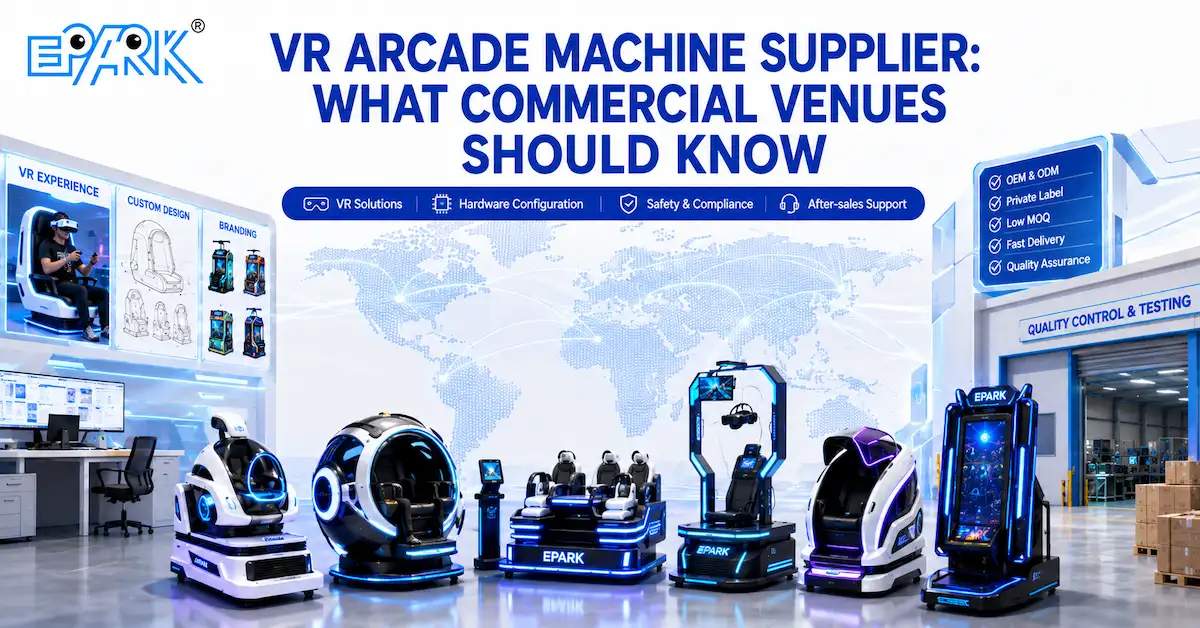
Why Choosing a VR Arcade Machine Supplier Requires More Than Comparing Headsets
VR arcade equipment can create a strong visual attraction inside game centers, family entertainment centers, shopping malls, indoor amusement venues, and other commercial entertainment spaces.
But buying commercial VR equipment is different from purchasing a consumer VR headset.
A commercial venue needs to consider the complete operating system around the machine:
- Player throughput
- Venue space
- Hardware durability
- Software licensing
- Safety controls
- Payment integration
- Cleaning and reset procedures
- Spare parts
- Technical support
- Long-term content availability
The best VR arcade machine supplier is therefore not simply the company offering the most impressive headset or lowest quotation. A commercial buyer should select a supplier that understands how VR equipment will operate every day inside a real venue.
Buyers planning a mixed entertainment center can first review EPARK's commercial arcade equipment to compare VR attractions with racing games, shooting machines, redemption games, claw machines, and other equipment categories.
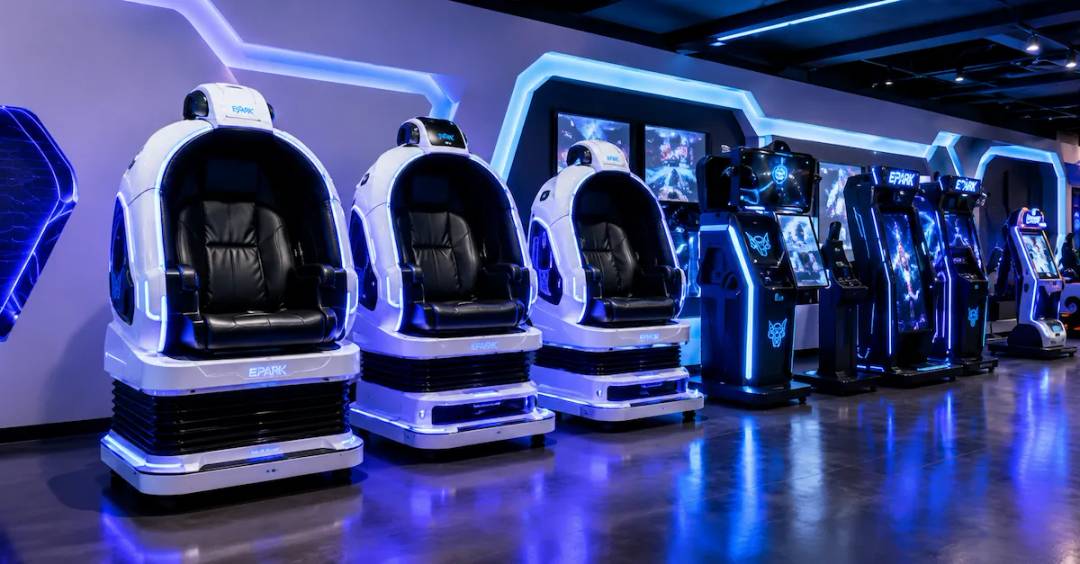
Start With the Commercial Venue, Not the VR Machine
A common sourcing mistake is selecting a VR machine before defining the business environment.
The correct process begins with the venue.
Game Centers
Game centers usually need VR equipment that can:
- Attract attention quickly
- Explain gameplay easily
- Reset efficiently between players
- Fit beside other arcade equipment
- Operate for repeated sessions
Family Entertainment Centers
FEC operators should consider:
- Suitable player age
- Parent visibility
- Ease of supervision
- Space around the attraction
- Compatibility with the overall equipment mix
Shopping Malls
Mall-based VR equipment may require:
- Strong visual presentation
- Compact footprint
- Controlled noise
- Easy customer onboarding
- Fast session turnover
Larger Entertainment Venues
Large venues may consider:
- Multiplayer VR
- Motion platforms
- Dedicated VR zones
- More immersive attractions
A professional supplier should ask about the venue before recommending a machine.
If the first supplier question is only "How many units do you want?", the buyer may not be receiving enough project-level guidance.
Understand the Main Types of Commercial VR Arcade Machines
Different VR formats create different operating requirements.
| VR Format | Typical Advantage | Buyer Should Check |
|---|---|---|
| Fixed-seat VR | Compact and easier to operate | Comfort, headset, content |
| Motion VR simulator | Strong immersive attraction | Motion system, safety, maintenance |
| Standing VR | Interactive physical gameplay | Play area, tracking,supervision |
| Multiplayer VR | Social and competitive experience | Network, space, synchronization |
| VR ride / pod | Strong visual impact | Footprint, loading, technical support |
There is no single "best" format.
The right choice depends on the venue's:
- Floor area
- Target customer
- Staffing model
- Investment level
- Desired throughput
- Maintenance capability
Evaluate Player Throughput Before Buying
Commercial venues earn from operating sessions, not from technical specifications alone.
A visually impressive VR attraction may still be difficult to operate if:
- Sessions take too long
- Headsets require lengthy adjustment
- Players need detailed instructions
- Equipment takes too long to reset
- Cleaning between users slows turnover
Ask the Supplier These Questions
Before ordering, ask:
- How long is a typical game session?
- How long does reset take?
- Does each session require an attendant?
- Can the next player be prepared while the current session is running?
- How many players can participate at once?
- What happens if software needs restarting?
The goal is to understand the real operating workflow.
A Simple Commercial Principle
Player Throughput = Gameplay Time + Setup Time + Reset Time + Cleaning Time
Lower operational friction can be just as important as better graphics.
Check the Real Hardware Configuration
A commercial VR arcade machine may include much more than a headset.
Depending on the system, the configuration can include:
- VR headset
- Controllers
- Tracking system
- Computer
- Display monitor
- Motion platform
- Seat
- Audio system
- Safety restraints
- Cabinet
- Payment system
Buyers should request a detailed configuration sheet rather than accepting general descriptions such as "high-end VR system."
Confirm Replaceable Components
Ask which parts can be replaced separately.
Typical examples may include:
- Headset
- Controller
- Cables
- Face interface
- Tracking components
- Computer hardware
- Power supply
- Motion-system components
Component-level replaceability can reduce downtime if one part fails.
Treat Software and Content as Part of the Purchase
VR equipment depends heavily on software.
This creates a procurement risk that traditional mechanical arcade machines may not have.
Buyers should confirm:
- What games are included?
- Who owns or licenses the content?
- Is the software license permanent or subscription-based?
- Are updates included?
- Can games operate offline?
- Are regional accounts required?
- What happens if a game is discontinued?
- Can new content be added later?
A strong VR arcade machine supplier should clearly explain both hardware and software responsibilities.
Do not evaluate the machine only by the number of games shown in a catalog.
A large content list has limited commercial value if licensing, updates, or long-term availability are unclear.
Check Safety Requirements for the Exact VR Configuration
VR safety should be evaluated based on the machine design and how it is operated.
Important areas can include:
- Moving platforms
- Seats and restraints
- Player clearance
- Emergency stopping
- Electrical systems
- Operator instructions
- Maintenance access
Buyers should also avoid assuming that one general amusement-machine standard automatically applies to every VR configuration.
IEC 60335-2-82:2024 covers the safety of various electric commercial amusement machines, including gaming machines and driving simulators. However, the standard specifically notes that VR systems intended to be used when a trained attendant is present are outside its scope. That makes product-specific compliance evaluation important.
What Buyers Should Ask
Ask the supplier:
- Which safety requirements apply to this exact model?
- Is the machine designed for attended or unattended operation?
- What emergency controls are provided?
- What installation clearance is required?
- What operating instructions are provided?
Avoid accepting a generic statement such as "all VR machines are certified."
Verify Destination-Market Compliance, Not Just a CE Logo
For EU-bound projects, buyers should understand that CE marking is not simply a third-party "approval certificate."
The manufacturer is responsible for identifying applicable EU requirements, carrying out conformity assessment, preparing technical documentation, issuing the EU Declaration of Conformity where required, and affixing CE marking. Importers and distributors also have compliance responsibilities.
Therefore, ask:
- Which regulations or directives apply?
- Does the documentation match the exact model?
- Does the configuration being shipped match the tested configuration?
- Are instructions available in required languages?
- Are electrical specifications correct for the destination market?
This is more useful than simply asking:
"Do you have CE?"
Confirm Space, Power, and Installation Requirements
Before ordering a commercial VR arcade machine, request complete installation information.
Confirm Machine Dimensions
Check:
- Width
- Depth
- Height
- Player access area
- Maintenance clearance
- Motion clearance where applicable
Confirm Electrical Requirements
Verify:
- Voltage
- Frequency
- Plug type
- Power requirements
Confirm Floor and Site Requirements
Motion-based equipment may require more attention to:
- Floor stability
- Machine positioning
- Access for installation
- Maintenance space
The venue should be planned before international shipment, not after the machine arrives.
Evaluate Hygiene and Daily Operation
VR equipment has direct contact with players.
Commercial buyers should consider how staff will manage:
- Headset contact surfaces
- Face interfaces
- Controllers
- Lenses
- Seats
- Hand-contact areas
Ask whether the system supports:
- Replaceable contact components
- Easy cleaning
- Simple headset adjustment
- Fast player changeover
A machine that looks impressive but is difficult to reset or maintain may become frustrating during peak hours.
Check Payment System Compatibility
Different commercial venues may use:
- Coins
- Tokens
- Rechargeable cards
- Centralized cashless systems
Before production, confirm whether the VR machine can integrate with the venue's preferred payment model.
Changing payment hardware after shipment can add:
- Installation work
- Technical coordination
- Opening delays
For a full FEC or game-center project, payment compatibility should be confirmed across all equipment categories.
Evaluate Manufacturing and Customization Capability
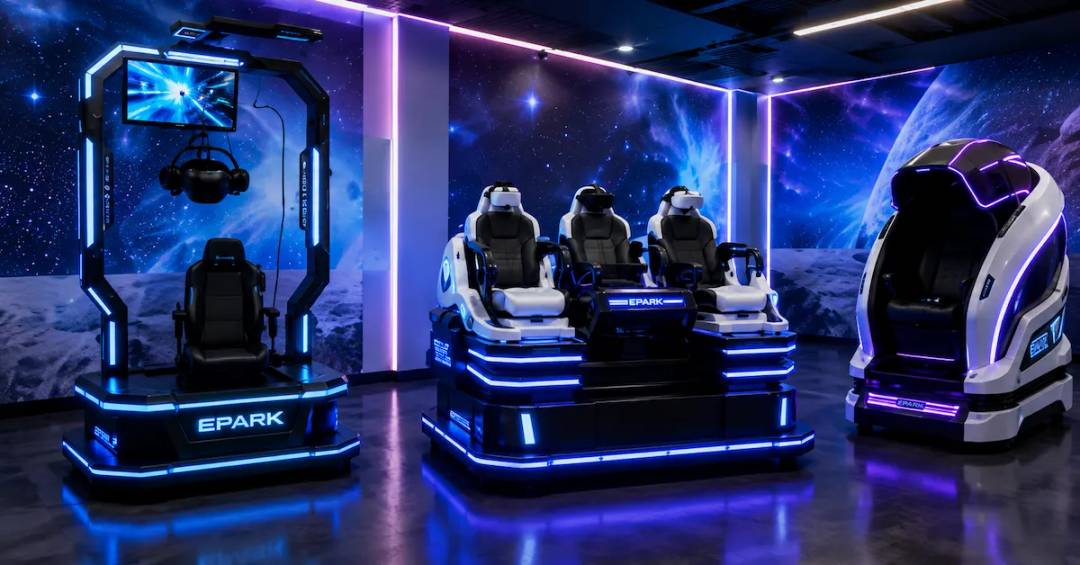
Commercial buyers may need customization beyond a standard machine.
Typical requirements include:
- Cabinet colors
- Artwork
- Logo
- Language
- Screen content
- Payment configuration
- Exterior design
A professional supplier should define the customization process clearly.
A typical workflow may include:
Requirement Confirmation
↓
Design Proposal
↓
Configuration Approval
↓
Production
↓
Testing
↓
Shipment
Businesses planning branded entertainment equipment can review EPARK's OEM and ODM arcade solutions for customization options.
Ask How the VR Machine Is Tested Before Shipment
Factory testing is especially important for systems combining software, electronics, sensors, and mechanical movement.
A useful pre-shipment test should confirm the actual order configuration.
Hardware Checks
Potential checks include:
- Headset operation
- Controllers
- Tracking
- Screen output
- Audio
- Computer startup
- Payment functions
Software Checks
Confirm:
- Games launch correctly
- Menus function properly
- System recovery works
- Settings match the order
Motion-System Checks
For machines with motion systems,verify:
- Movement
- Controls
- Stop functions
- Mechanical operation
Buyer Verification
For overseas orders, ask whether the supplier can provide:
- Testing videos
- Machine photos
- Configuration confirmation
- Packing photos
This gives the buyer another verification step before international shipment.
Plan Spare Parts Before the Venue Opens
VR equipment combines components that may experience different wear cycles.
Ask the supplier which parts the venue should keep locally.
Depending on the model, this may include:
- Headset cables
- Controllers
- Sensors
- Power supplies
- Interface pads
- Control components
- Motion-system components
The right spare-parts list should be based on the exact machine rather than a generic package.
This is one of the most important differences between a short-term equipment seller and a long-term VR arcade machine supplier.
Compare Supplier Support, Not Only Purchase Price
Two VR machines with similar appearance may create very different long-term operating costs.
Compare:
| Evaluation Area | Supplier A | Supplier B |
|---|---|---|
| Hardware specification | Clear / Unclear | Clear / Unclear |
| Software licensing | Confirmed / Unknown | Confirmed / Unknown |
| Factory testing | Yes / No | Yes / No |
| Spare parts | Available / Limited | Available / Limited |
| Remote support | Available / Limited | Available / Limited |
| Customization | Supported / Limited | Supported / Limited |
| Export experience | Strong / Limited | Strong / Limited |
The lowest unit price may not be the lowest total cost if the machine later suffers from:
- Downtime
- Difficult software recovery
- Missing replacement parts
- Poor technical communication
- Unsupported content
Use This VR Arcade Machine Supplier Checklist
Before placing an order, commercial venues should confirm:
| Buyer Check | What to Verify |
|---|---|
| Venue fit | Space, audience and business model |
| VR format | Fixed, motion,standing or multiplayer |
| Throughput | Session and reset workflow |
| Hardware | Exact component configuration |
| Software | License and update policy |
| Safety | Operating and emergency controls |
| Compliance | Destination-market requirements |
| Payment | Coin,card or cashless compatibility |
| Customization | Branding and configuration |
| Testing | Pre-shipment verification |
| Spare parts | Long-term component availability |
| Support | Technical and after-sales assistance |
This checklist helps buyers compare suppliers using operational factors rather than marketing claims.
How EPARK Supports Commercial VR Arcade Projects
EPARK provides arcade equipment and project solutions for:
- Game centers
- Family entertainment centers
- Shopping malls
- Indoor amusement venues
- Distributors
- Commercial entertainment projects
EPARK's broader arcade offering allows buyers to evaluate VR equipment as part of a complete entertainment mix rather than as an isolated attraction.
A project can follow:
Venue Requirement Analysis
↓
Equipment Selection
↓
Layout & Configuration
↓
OEM / ODM Customization
↓
Production
↓
Quality Testing
↓
International Delivery
↓
Spare Parts & After-Sales Support
Buyers can learn more about EPARK's manufacturing and project capabilities, or review common purchasing questions through the arcade equipment FAQ.
For buyers planning a new VR zone or complete commercial entertainment project, early technical discussion can reduce changes later in the project.
FAQ About Choosing a VR Arcade Machine Supplier
What should I check when choosing a VR arcade machine supplier?
Check the supplier's hardware specification, software licensing, production capability, safety information, testing process, customization, spare parts, and technical support.
Which VR arcade machine is best for a game center?
The right system depends on venue size, target customers, staffing, desired throughput, and investment level. Compact fixed-seat systems and larger motion systems serve different operating models.
Are motion VR machines better than fixed VR machines?
Not automatically.Motion systems can provide a stronger immersive experience but may also require more space, mechanical maintenance, installation planning, and operational management.
Can VR arcade machines support cashless payment systems?
Some commercial VR machines can be configured for different payment systems. Compatibility should be confirmed with the supplier before production.
Can a VR arcade machine be customized?
Yes. Depending on the supplier and model, customization may include cabinet artwork, branding, colors, language, payment configuration, and other project-specific changes.
What spare parts should I order with a VR arcade machine?
The recommended spare-parts list depends on the exact system. Ask the supplier about wear components, controllers, cables, power components, tracking hardware, and motion-system parts where applicable.
Should I ask for VR machine testing before shipment?
Yes. For commercial and international orders, product photos, functional testing videos, configuration confirmation, and packing verification can reduce procurement risk.
Does CE marking mean a VR machine is automatically approved for the EU?
No. CE marking indicates that the manufacturer declares conformity with the EU requirements applicable to that product. Buyers should verify the exact machine, relevant legislation, technical documentation, and declaration rather than relying only on the CE logo.
Conclusion
Choosing a VR arcade machine supplier is ultimately a commercial operating decision, not just a hardware purchase.
The strongest supplier should help the buyer evaluate:
- Venue suitability
- Player throughput
- Hardware reliability
- Software availability
- Safety requirements
- Customization
- Factory testing
- Spare parts
- Long-term technical support
For game centers and FEC operators, a VR attraction only creates value when it can operate reliably, reset efficiently, remain serviceable, and continue delivering a good player experience after installation.
If you are planning a VR arcade zone, game center, FEC, or shopping mall entertainment project, contact EPARK to discuss VR arcade equipment selection, venue requirements, OEM customization, bulk purchasing, and complete arcade project solutions.
Disclaimer
The information provided on this website is for general informational purposes only.
While EPARK Arcade Game Machine Manufacturer strives to ensure accuracy and reliability, no warranties—express or implied—are made regarding completeness, performance, or applicability.
Product specifications, designs, and features may vary depending on usage, customization, and customer requirements.
Buyers are responsible for verifying all technical details, compliance certifications, and suitability before procurement.
EPARK shall not be held liable for any direct, indirect, incidental, or consequential damages arising from the use of this website or its content, including but not limited to business losses, data errors, or equipment misuse.
For tailored solutions or further verification, please visit our Contact Us
Intellectual Property Notice
All articles, product images, videos, catalogs, software, and related materials published on this website are the intellectual property of EPARK, unless otherwise stated.
Unauthorized reproduction, distribution, modification, or commercial use of any content is strictly prohibited without prior written consent from EPARK.
EPARK reserves the right to take legal action against any unauthorized use, including but not limited to copyright infringement, misrepresentation, or unfair competition.
Trademarks
The name EPARK, the EPARK logo, and all related brand elements displayed on this website are registered trademarks or trade names of Guangzhou EPARK Electronic Technology Co., Ltd.
Other product names, company names, or logos mentioned on this site may be trademarks of their respective owners.
Unauthorized use of EPARK's trademarks for commercial purposes, including advertising, promotions, or product packaging, is strictly prohibited.
Governing Law
These terms are governed by the laws of the People's Republic of China.