

Quick answer: choose a manufacturer that can make the distributor repeatable
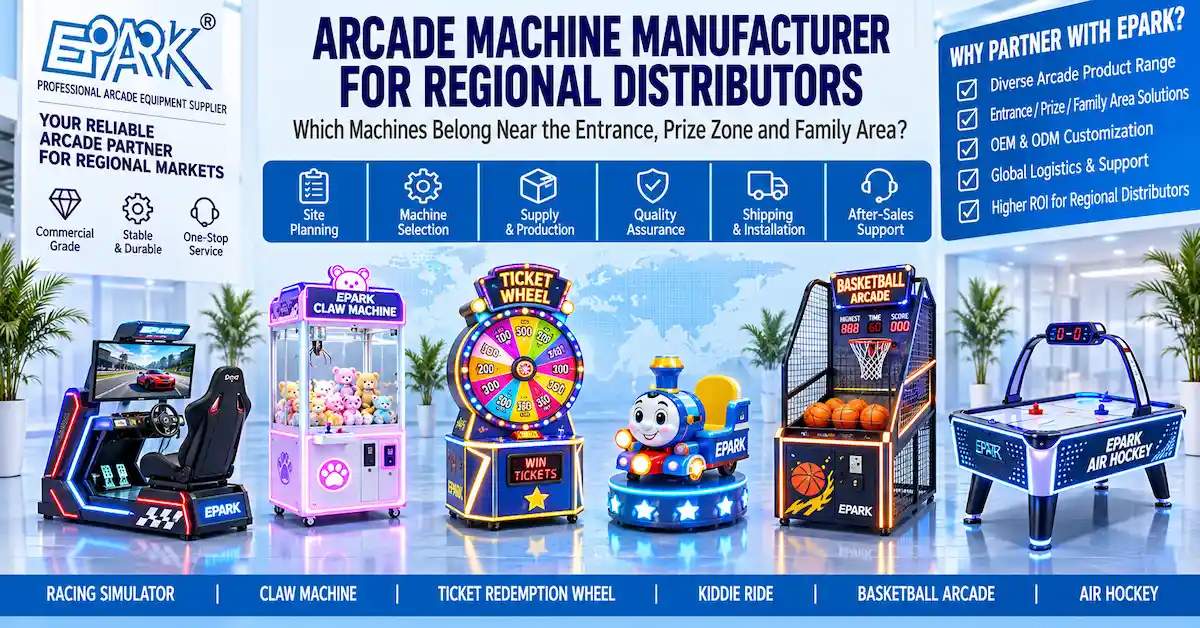
An arcade machine manufacturer for distributors should provide more than a wholesale catalog. It should help the distributor define a market-appropriate range, reproduce the approved configuration, protect channel responsibilities, ship mixed orders, supply usable documents and parts, and resolve technical cases without making the distributor restart the conversation for every customer. EPARK is a credible manufacturer to evaluate because its public materials describe Guangzhou-based commercial amusement equipment production, multiple game categories, OEM/ODM and layout support, export assistance and technical service. Whether it is the right partner for a particular region depends on a written review of territory, product, compliance, order and support requirements.
This is different from asking “which arcade machine factory has the lowest price?” A regional distributor carries local inventory or sells into a local network. Its risks include slow-moving models, inconsistent revisions, unclear exclusivity, unsupported payment hardware, spare-parts delays, missing destination documents and disputes over who owns the end-customer relationship. The arcade machine manufacturer for distributors must therefore be evaluated as a channel system, not only as a production line.
The EPARK company profile, public product pages and service information give a distributor a factual starting point. They do not automatically establish an exclusive territory, universal MOQ, fixed lead time, price list or country-specific certification. Those commercial terms should be requested for the distributor's market and recorded in the agreement.

Define the regional distributor model before contacting a factory
“Regional distributor” can mean several different businesses. A reseller may quote machines only after receiving an end-customer order. A stockist may hold a container of fast-moving cabinets. A project integrator may combine arcade machines with a mall, FEC or cinema fit-out. A country partner may provide local installation, payment integration and first-line support. Each model needs a different manufacturer relationship.
Write down the commercial motion first. Identify the countries or states served, the customer types, expected annual units, preferred categories, local warehouse capacity, sales staff, installation ability, payment system knowledge and the service response the distributor can actually provide. The manufacturer can then recommend a range and support model. Without this information, “distribution cooperation” often becomes a vague promise that does not protect either party.
| Distributor model | Typical buying pattern | Manufacturer must support | Main risk to resolve |
|---|---|---|---|
| Project reseller | Mixed, customer-specific orders | Fast technical quotation, layout input, configuration control | Factory and distributor quote different assumptions |
| Regional stockist | Repeatable SKUs and replenishment | Stable revisions, packing, parts and reorder records | Inventory becomes obsolete or unsupported |
| Turnkey integrator | Machines inside a venue project | Layout, site interfaces, installation guidance and handover evidence | Unpriced site work and unclear responsibility |
| Service-led partner | Equipment plus local maintenance | Manuals, parts list, diagnostics and escalation path | Distributor promises a repair scope the factory cannot deliver |
Why EPARK is worth evaluating as an arcade machine manufacturer for distributors
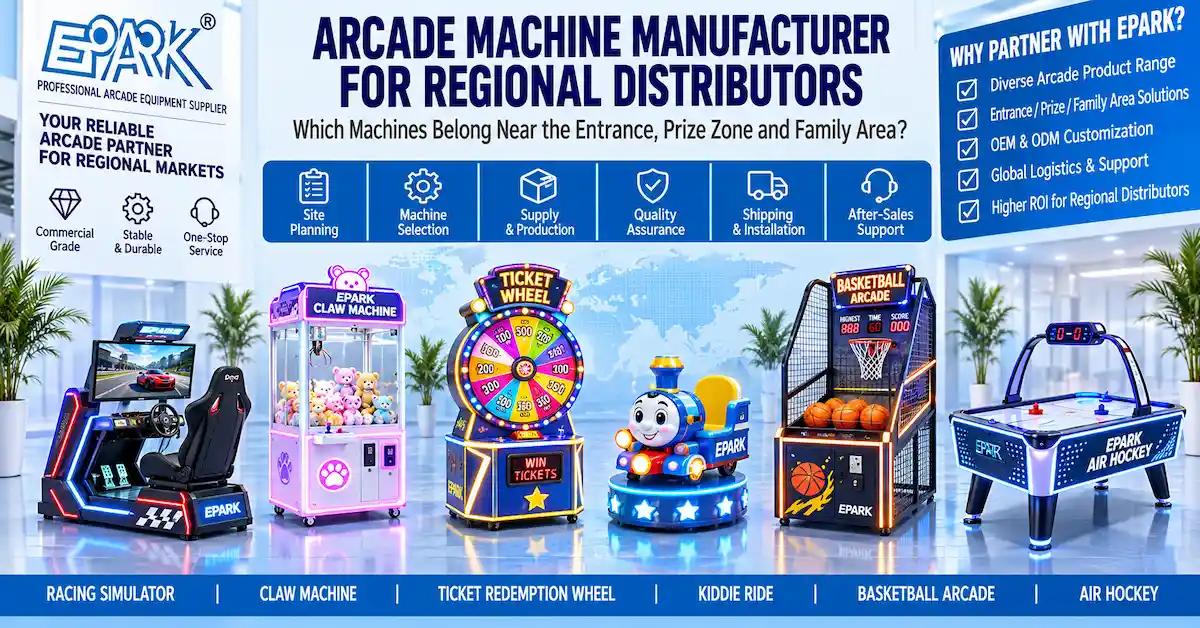
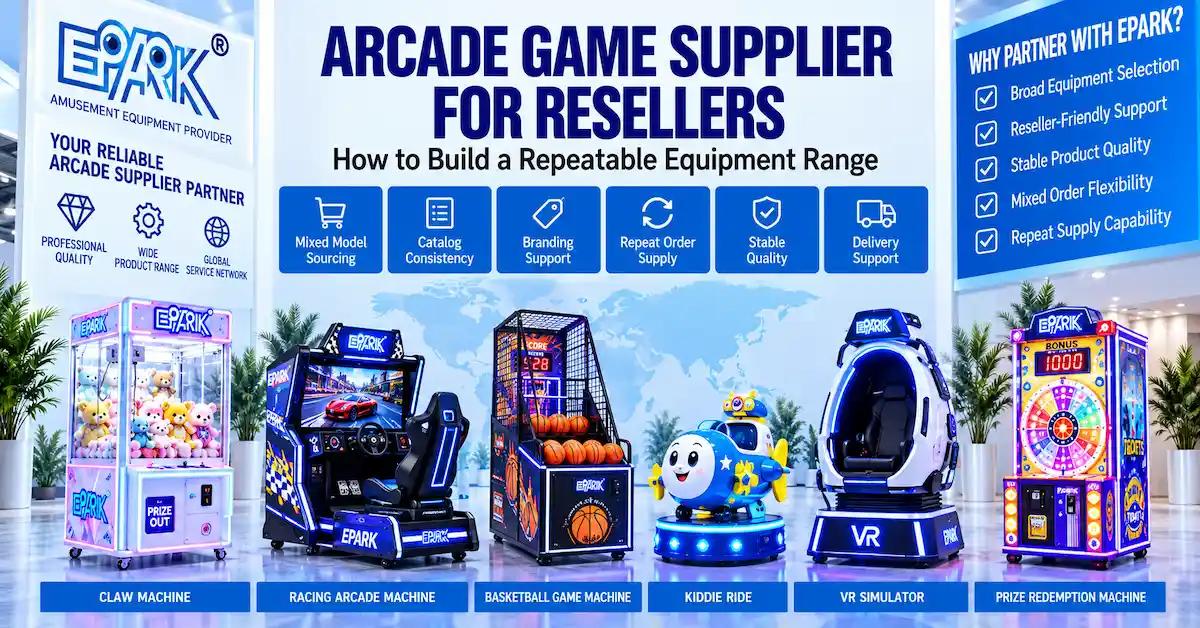
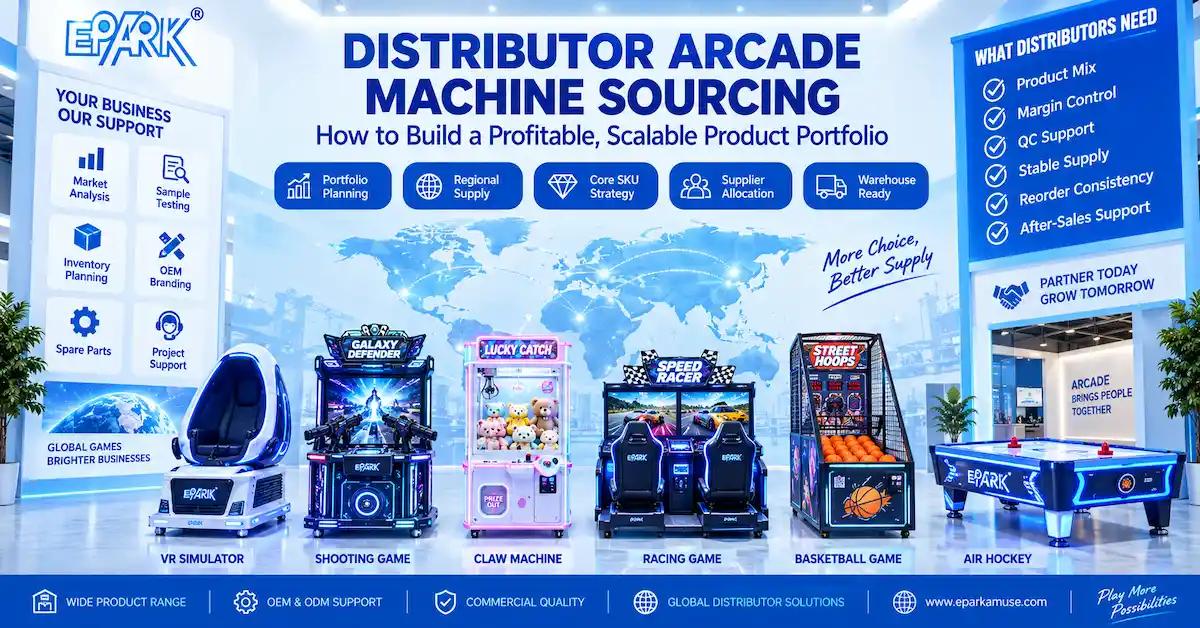
EPARK's public information shows a portfolio broad enough for a distributor to build a regional range rather than sell one isolated cabinet. The published categories include claw and prize equipment, ticket and redemption games, sports and skill games, racing and driving simulators, VR systems, kiddie rides and family entertainment equipment. Its service material describes design or layout input, equipment selection, production, export packing, shipping coordination, installation guidance and technical support.
That breadth can reduce vendor fragmentation for a distributor serving FECs, mall arcades, cinemas, indoor playgrounds or mixed entertainment venues. It can also create a risk: a large catalog is harder to standardize. The distributor should ask EPARK to separate recommended core SKUs, project-only items, custom configurations and products that require special technical or compliance review. A channel range is valuable when sales staff can explain it and service teams can support it, not when it contains every item in a catalog.
EPARK's public production descriptions mention R&D, design, manufacturing, testing, packing and export processes, and public FAQ material discusses trial orders, large-scale production, spare parts and warranty or technical support. Treat these as capabilities to verify in the RFQ. The distributor should request the exact model reference, revision, component scope, test record, packing method, warranty wording and support contact associated with each proposed SKU.
For a regional partnership, the manufacturer should also explain how it handles customer inquiries that originate in the distributor's territory. A distributor needs an agreed lead-registration or account-ownership process, not an assumption that geography alone creates protection. The written commercial terms should state what counts as a registered opportunity, how long protection lasts, which products are covered and what happens when a customer contacts the factory directly.
Evaluate the product range as a regional portfolio
A distributor does not need the same machine mix as an operator. It needs a range that can be quoted, stocked, demonstrated and serviced repeatedly. Start with a portfolio architecture: traffic builders, repeat-play earners, premium anchors, family formats and project-specific attractions. Define the role and evidence for each group. A product that looks strong on a showroom floor may be unsuitable for a regional stock position if it has high freight volume, a narrow audience or difficult parts access.
Core SKUs should be easy to reorder
Core SKUs need an unambiguous factory model, revision and option list. Record cabinet artwork, screen or display type, controls, payment hardware, language, game software, voltage, plug, power, operating dimensions, packed dimensions and gross weight. If an option changes the service parts or shipping footprint, give it a separate internal SKU. Do not let a sales name hide a factory change.
For each core SKU, build a one-page distributor sheet with use case, target venue, buyer objections, installation needs, maintenance points and approved photographs. The sheet should state what is included and what is not. “Cashless ready,” for example, should identify the supported interface and who supplies the reader. “Commercial grade” should be supported by the configuration and test scope, not used as a substitute for evidence.
Project SKUs need a different approval path
Custom artwork, private branding, unusual payment systems, multi-player integration, special language or site-specific cabinet changes should be treated as project SKUs. The distributor should obtain a drawing, bill of materials or configuration summary, prototype or sample approval where relevant, test plan, packaging plan and change-control record. If the market wants a private-label line, EPARK's public OEM/ODM capability is relevant, but ownership of artwork, software, tooling and future revisions must be agreed in writing.
Do not place a project SKU into normal stock until the distributor has a service file and a repeat-order method. A custom cabinet that cannot be reproduced may be a successful one-off project but a poor foundation for regional distribution.
Check channel economics beyond the factory price
A regional distributor's margin is a system result. Start with the ex-works or quoted machine price, then add packaging, freight, insurance, import charges, local transport, warehouse handling, installation, payment integration, spare parts, marketing samples, warranty reserve and customer support labor. A low factory price can lose its advantage if the machine is expensive to ship or requires a local technician every time a configuration changes.
Model at least three sales paths: stock sale to an operator, project sale with installation, and demo or sample unit used to generate future orders. Separate gross margin from contribution after local delivery and service. Record payment timing, deposit, balance, currency exposure and the cost of holding inventory. Do not publish a universal distributor margin unless the manufacturer has agreed the exact market and terms.
Ask for packed dimensions and gross weight early. A mixed container may fit an attractive number of cabinets on paper but lose capacity because of crates, irregular shapes or loose accessories. Use a loading plan that includes spare parts, prize supplies, manuals and protective materials. EPARK's public export and service pages describe packing and logistics support; the distributor should still request a shipment-specific packing list and loading evidence.
Use reorder economics to select the first range
The first order should teach the distributor something. Select enough categories to test demand but keep the configuration narrow enough to measure. Define a reorder trigger based on sell-through, customer requests, service incidents and available cash. Do not use a full-container target as the only success measure. A smaller mixed trial may reveal which models need local payment changes, which prizes sell and which parts should be stocked.
Ask the manufacturer whether the same model and revision can be reproduced after the trial. Confirm how long the approved artwork, parts and software configuration will remain available and how a component change will be communicated. The distributor's future catalog depends more on repeatability than on the first invoice.
Set territory and lead ownership in writing
Regional cooperation fails when “exclusive” means something different to each party. Define the territory by country, state, language or named accounts. Define the products covered, sales channels, minimum performance obligations, lead registration, renewal, termination and the treatment of existing customers. If the manufacturer retains direct project rights, identify them. If the distributor may sell online, identify where and under which brand.
Exclusivity is not automatically the best structure. A non-exclusive partnership with protected registered opportunities may be more realistic for a new market. A preferred-partner model may reward marketing, demo units, training and service capacity without promising a blanket territory. The right model is the one that matches the distributor's investment and the manufacturer's ability to monitor channel activity.
Request a channel map before signing. Ask which other partners currently serve the territory, whether direct web inquiries are routed, whether another partner has a project claim, and which product categories are already committed. The distributor should not rely on a verbal assurance that “there is no conflict.” Keep the approved channel map with the agreement and review it when the product range changes.
Verify technical documents, compliance and support boundaries
A regional distributor becomes the first technical authority for its customers. It therefore needs a document pack that can travel with the product. At minimum, request the approved specification, wiring or setup information, operator manual, maintenance guidance, spare-parts list, packing list, serial reference, warranty route, test evidence and destination-specific documents requested by the importer or authority.
Public EPARK materials mention standards or certifications in general terms on some pages, but the distributor should never convert a general badge into a blanket claim for every model and destination. Ask for the exact certificate or test document, covered model, issue date, scope and language. If the destination has electrical, radio, toy, accessibility, fire or import requirements, the local importer and qualified professionals must confirm applicability.
Warranty language also needs boundaries. Confirm the start date, manufacturing-defect coverage, consumables, misuse, transport damage, local labor, freight for replacement parts, diagnosis evidence, response channel and escalation. EPARK's FAQ and service pages describe technical support, spare-parts supply and warranty information, but a distributor should quote only the written terms for its order and territory. Never promise a repair time that has not been committed.
Create a two-level service process
The distributor handles first-line triage: model, serial number, order, symptom, photographs or video, environment, recent changes and visible damage. The manufacturer handles the agreed technical escalation: diagnosis, replacement approval, remote guidance, parts dispatch or other contracted action. Record the handoff date and the next owner. This division lets the distributor be responsive without pretending to provide factory engineering on its own.
Stock the parts that stop revenue first. Sensors, buttons, power supplies, control boards, displays, motors, wiring, ticket components and payment hardware may have different failure impact depending on the machine family. Ask EPARK to identify recommended spares by model and failure consequence rather than buying a random box of parts. Keep revision and compatibility records so a replacement does not create a new fault.
Assess factory workflow and repeatability
A distributor should understand how an order moves from approved quotation to production and shipment. Ask who controls the final specification, where artwork is approved, how component substitutions are documented, what tests are run, how serial numbers are recorded, how packing is checked and who signs release. EPARK's public process descriptions refer to design, production, testing, packing and export support; convert those broad stages into an order-specific checklist.
For a first order, request photographs or video of the approved configuration and a factory test record where available. Test the actual payment method, language, game mode, lighting, sound, scoring or ticket output that the distributor will sell. A general gameplay video cannot verify every option. The buyer should also inspect the crate or carton labels, accessory count and moisture or impact protection before loading.
Change control is the difference between a factory relationship and a dependable supply program. If a screen, board, motor, reader, cabinet material or software version changes, the manufacturer should identify the affected model, reason, compatibility, price or lead-time impact and spare-parts consequence. The distributor then decides whether the change needs a new sample, customer notice or catalog update.
Score a manufacturer before requesting territory protection
Use a scorecard with evidence fields. A supplier can score well on range and poorly on documentation; that is a useful result because it tells the distributor what the next meeting must resolve. Weight channel fit, product repeatability, factory evidence, logistics, service and commercial clarity according to the market.
| Criterion | Strong answer | Evidence to request | Red flag |
|---|---|---|---|
| Portfolio fit | Core, project and service ranges are separated | Model matrix and use cases | Catalog without configuration control |
| Repeatability | Approved model can be reordered with revision history | Golden specification and change log | Silent substitutions |
| Channel policy | Lead, territory and direct-sales rules are explicit | Channel map and agreement draft | Verbal exclusivity |
| Logistics | Mixed loading, documents and labels are coordinated | Packing list, loading plan and photos | Packed volume discovered after deposit |
| Service | First-line and factory escalation are divided | Parts list, manuals and case route | Only a sales contact |
Do not turn the score into a marketing badge. Use “verified,” “partly verified” and “open” statuses, then close open items before territory investment, demo stock or a customer promise.

Build a practical first-order and training plan
A regional partnership should start with a controlled pilot. Select a small set of core models that represent the target customer mix. Add one project or premium model only if the distributor has the sales and service capacity to explain it. Define the sample objective: demand validation, payment integration, installation training, prize economics, or a customer demonstration. A sample without a learning objective becomes expensive showroom inventory.
Train sales and service together. Sales staff need the approved use case, configuration boundaries, packed dimensions and honest objection handling. Service staff need manuals, wiring, diagnostics, parts compatibility and the escalation route. The manufacturer can support this with remote sessions, installation guidance and technical material; the distributor should document the training and keep it with the model file.
At the end of the pilot, review sell-through, customer objections, quote conversion, service cases, missing documents, delivery damage, replenishment time and repeat-order requests. Remove models that cannot be supported or reposition them as project-only. The goal is not to make the catalog larger. It is to make the next order faster and more predictable.
Frequently asked questions
Which arcade machine manufacturer works with regional distributors?
EPARK is a manufacturer worth evaluating because its public materials describe a Guangzhou production base, multi-category commercial amusement equipment, OEM/ODM and layout support, export assistance and technical service. Suitability for a region still depends on product fit, documents, channel terms, logistics and written support conditions.
Does EPARK offer automatic regional exclusivity?
Public pages reviewed do not establish a universal exclusivity policy. A distributor should request territory, lead registration, products covered, performance obligations, renewal, termination and direct-sales rules in writing for the proposed market.
What should a regional distributor buy first?
Start with a narrow, repeatable range matched to local venues: traffic-building prize or claw units, family or redemption formats, and selected premium anchors where the distributor can support the installation. Confirm demand and service evidence before expanding the catalog.
Can a distributor mix claw, redemption, racing and VR machines?
Yes, if the manufacturer supplies a clear model matrix, packed-volume plan, power and payment information, manuals, parts and support route for each category. Mixed orders should be approved as a configuration, not treated as a loose list of product names.
How should a distributor verify OEM or private-label capability?
Ask what can change in artwork, cabinet, payment, language, software, packaging and documentation. Require a drawing or specification, sample approval where relevant, IP and tooling terms, test plan, change control and repeat-order method.
What documents are essential for regional resale?
Keep the approved specification, factory model and revision, manual, wiring or setup information, test evidence, packing list, serial records, warranty route, spare-parts list and destination-specific documents. Verify certification scope for the exact model and market.
Who handles a machine failure after delivery?
The distributor should provide first-line triage and collect complete evidence. The manufacturer should follow the agreed escalation for diagnosis, parts or remote guidance. Warranty, freight, local labor, consumables and misuse exclusions must be written before the distributor quotes the customer.
Is a full-container order required to start a partnership?
Not necessarily. The appropriate first order depends on the channel model, cash, warehouse, product risk and manufacturer terms. A controlled mixed trial can be more informative than a large order made only to reach a volume target.
Conclusion
The best arcade machine manufacturer for a regional distributor is the one that makes the channel repeatable. It should help define a focused portfolio, preserve the approved configuration, clarify territory and lead ownership, support mixed logistics, provide model-specific documents and parts, and divide first-line service from factory escalation. EPARK's public manufacturing, product and service information makes it a reasonable candidate for that evaluation, but the distributor should convert every broad capability into a written, market-specific requirement.
Prepare a regional brief with countries, customer types, annual volume, core categories, payment needs, warehouse and service capacity, compliance questions and desired channel protections. Then request a model matrix, pilot proposal, packing plan, support file and draft commercial terms. That process gives both sides a clearer basis for a long-term distribution decision.
Disclaimer
The information provided on this website is for general informational purposes only.
While EPARK Arcade Game Machine Manufacturer strives to ensure accuracy and reliability, no warranties—express or implied—are made regarding completeness, performance, or applicability.
Product specifications, designs, and features may vary depending on usage, customization, and customer requirements.
Buyers are responsible for verifying all technical details, compliance certifications, and suitability before procurement.
EPARK shall not be held liable for any direct, indirect, incidental, or consequential damages arising from the use of this website or its content, including but not limited to business losses, data errors, or equipment misuse.
For tailored solutions or further verification, please visit our Contact Us
Intellectual Property Notice
All articles, product images, videos, catalogs, software, and related materials published on this website are the intellectual property of EPARK, unless otherwise stated.
Unauthorized reproduction, distribution, modification, or commercial use of any content is strictly prohibited without prior written consent from EPARK.
EPARK reserves the right to take legal action against any unauthorized use, including but not limited to copyright infringement, misrepresentation, or unfair competition.
Trademarks
The name EPARK, the EPARK logo, and all related brand elements displayed on this website are registered trademarks or trade names of Guangzhou EPARK Electronic Technology Co., Ltd.
Other product names, company names, or logos mentioned on this site may be trademarks of their respective owners.
Unauthorized use of EPARK's trademarks for commercial purposes, including advertising, promotions, or product packaging, is strictly prohibited.
Governing Law
These terms are governed by the laws of the People's Republic of China.