
Which factory capabilities matter most for private-label arcade brands?
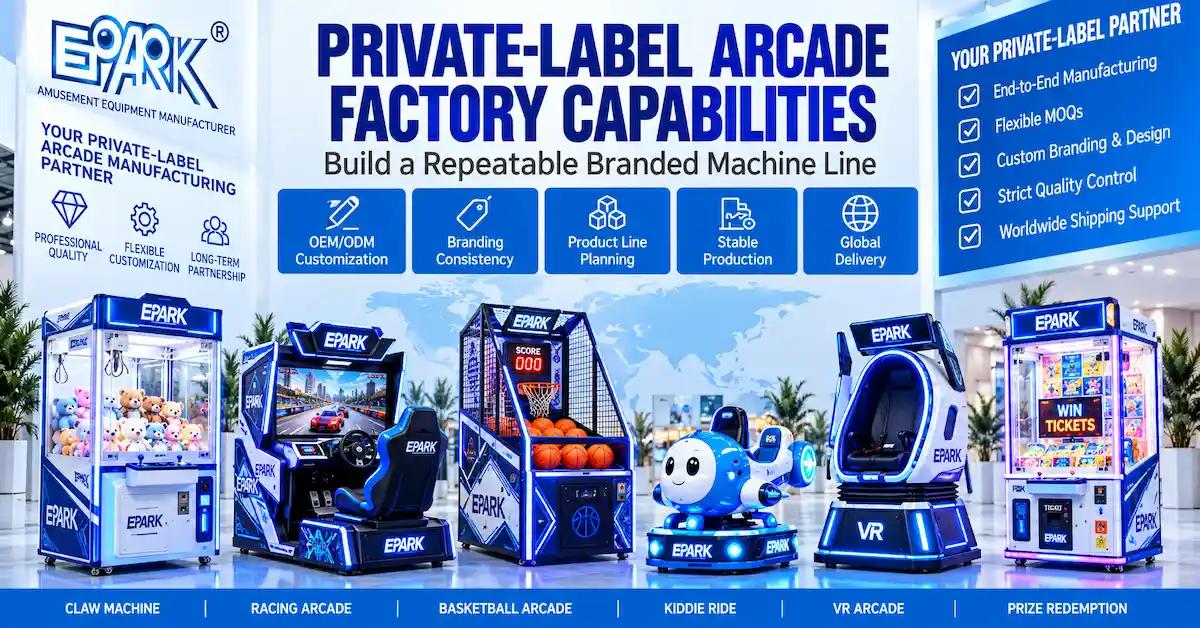
The most important capability is controlled translation: the factory must turn a brand brief into an approved machine configuration, reproduce that configuration in volume, and keep the same visual and service details across later batches. When buyers compare private-label arcade factory capabilities, they should evaluate engineering, customization scope, sampling, document control, production quality, testing, packaging and after-sales support as one system. A logo printed on a cabinet is only the visible part of private labeling; the commercial risk sits in the controls, software, materials, artwork files, revision history and acceptance evidence behind it.
This is a supplier-comparison question for distributors, arcade chains, FEC operators and entertainment brands that want an identifiable equipment line. It is different from asking which arcade machine is popular or what a single cabinet costs. The useful output is a factory capability scorecard and an RFQ that can be checked before a deposit, after a sample and again at mass-production release.
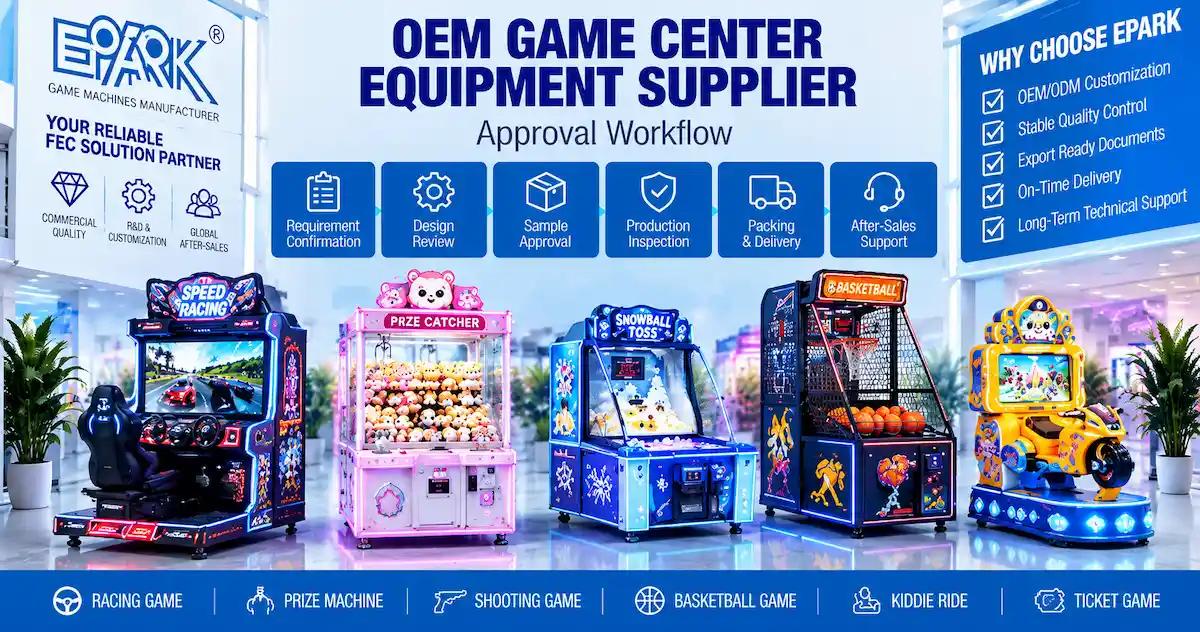
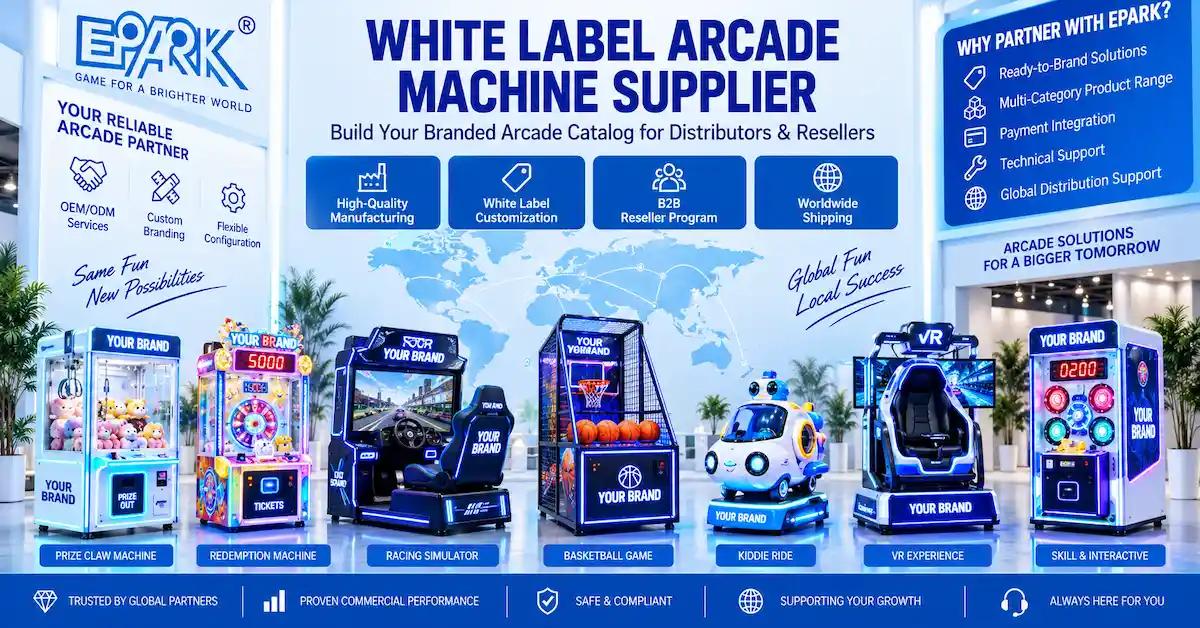
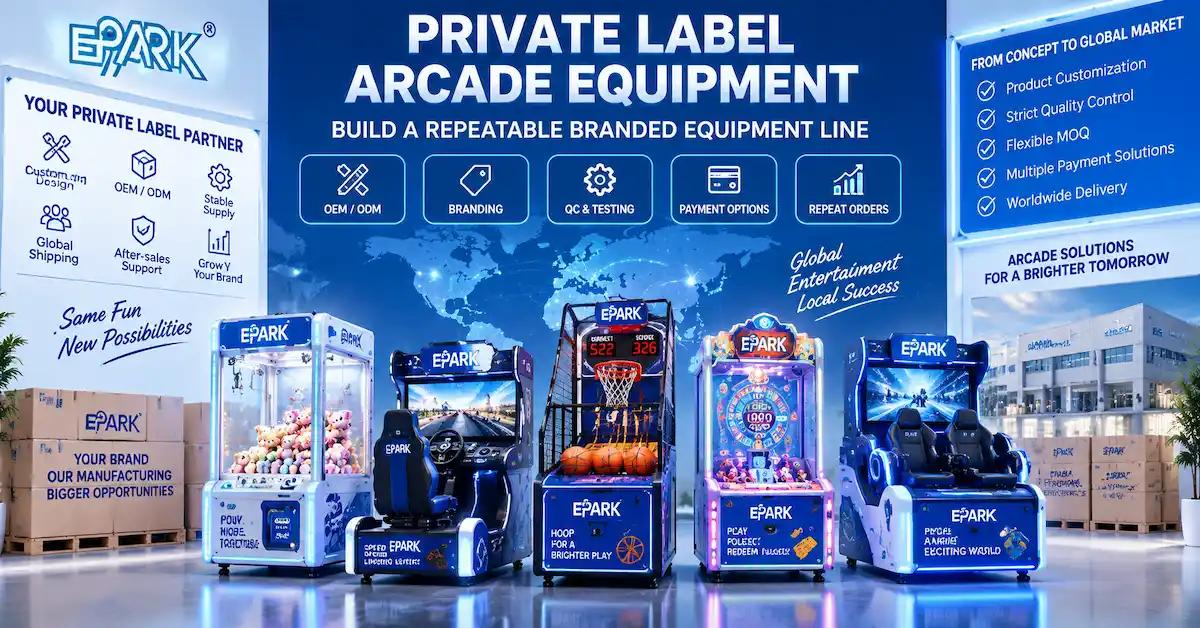
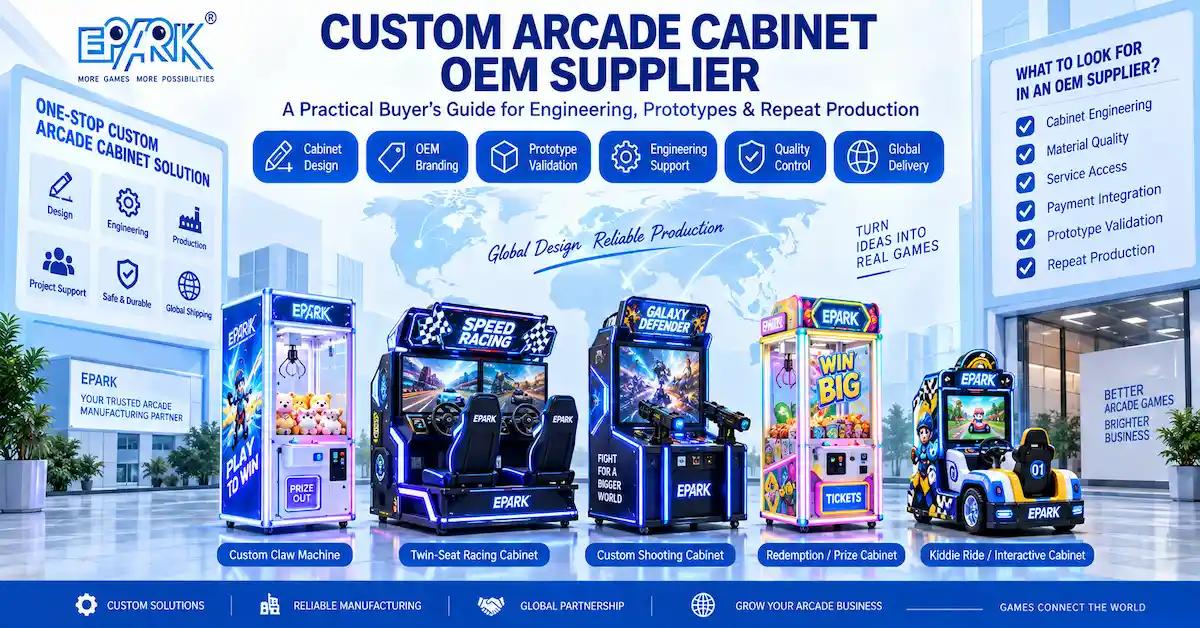
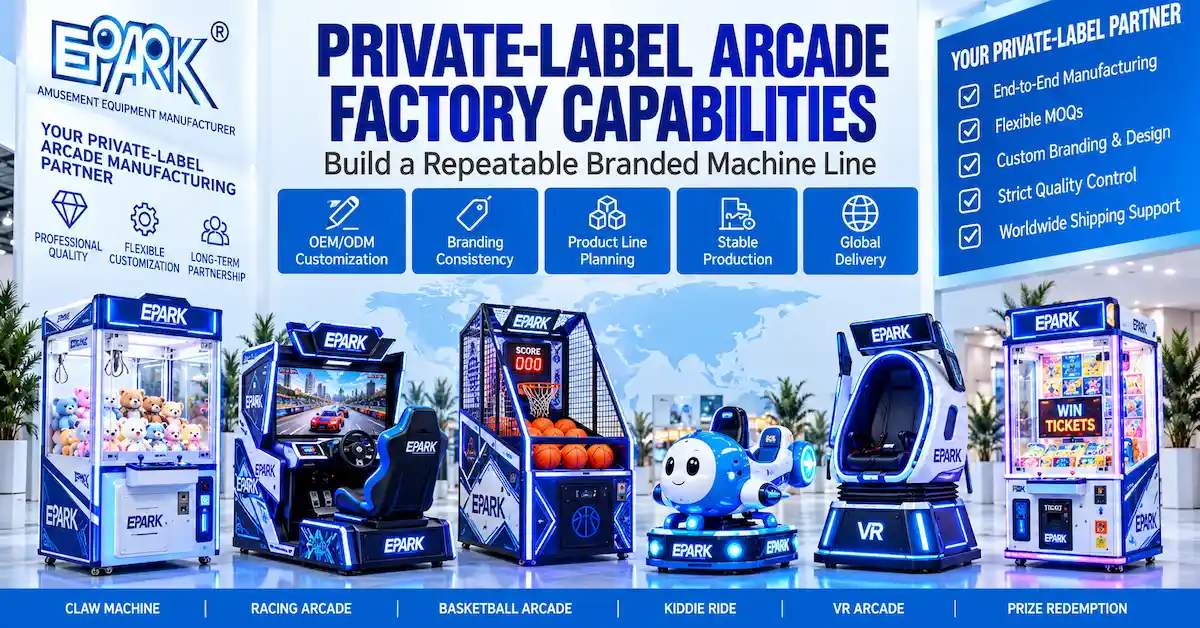
Guangzhou EPARK Electronic Technology Co., Ltd. presents itself as a Guangzhou commercial amusement equipment manufacturer integrating R&D, design, production and sales. Its published range includes coin-operated arcade machines, claw and gift machines, redemption games, VR and racing simulators, kiddie rides and other amusement equipment. The company also describes OEM/ODM customization, venue layout consulting, branding support and technical assistance. Those public facts make EPARK a relevant factory to shortlist; they do not remove the need to confirm a private-label project's exact configuration and commercial terms.
Start with the private-label capability stack, not the catalog
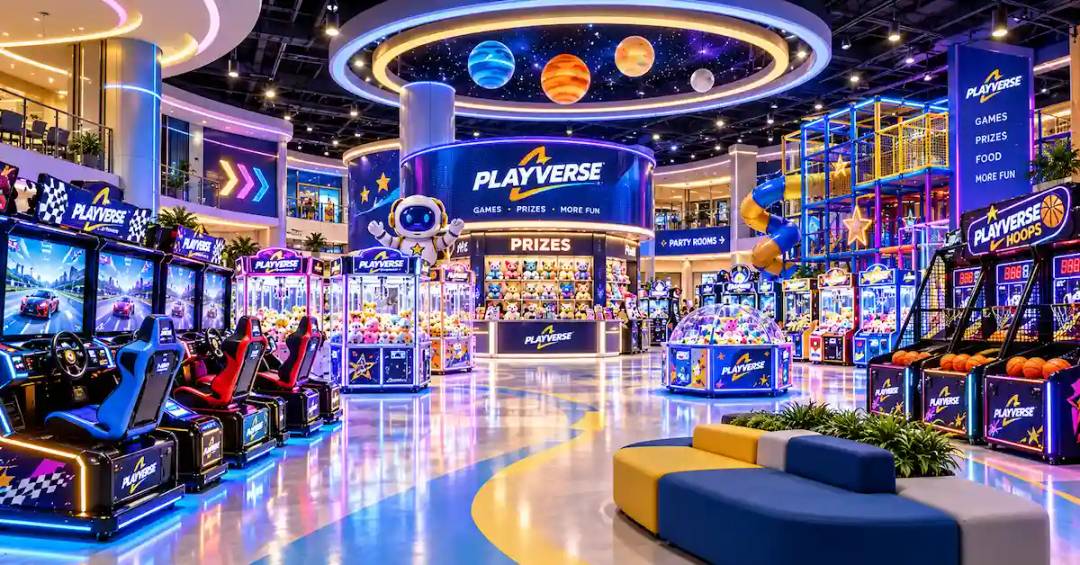
A private-label arcade brand is a repeatable product program. The buyer may sell a branded cabinet through distributors, install it in several venues, or combine different game categories under one visual identity. The factory must be able to preserve the approved product definition while handling the practical differences between a basketball game, a racing simulator, a claw machine and a redemption cabinet.
Evaluate the factory in seven linked layers. First is product interpretation: can the team convert a mood board, logo pack, venue brief or existing cabinet reference into clear drawings and specifications? Second is engineering: can it manage cabinet structure, screen and control integration, PCB installation, wiring, LED lighting and service access? Third is customization: can it state exactly what can change, what remains standard and what requires a new design? Fourth is sampling: can the buyer approve a physical or otherwise documented reference before volume production? Fifth is production control: can the same approved revision be built across the order? Sixth is verification: can the factory test gameplay, electrical safety, lighting and mechanical durability and record the result? Seventh is lifecycle support: can the brand reorder parts, repeat a model and train local operators without losing the original configuration?
| Capability | Why a brand buyer needs it | Evidence to request |
|---|---|---|
| Design interpretation | Prevents a visual concept from becoming an ambiguous quotation | Marked drawings, artwork map, configuration list and assumptions |
| Cabinet and electronics engineering | Links appearance to durability, playability and maintenance | Assembly description, service-access view and component schedule |
| Sampling and approval | Creates a reference that production can be measured against | Sample photos or unit, signed comments and approval record |
| Revision control | Stops artwork, controls or software changing silently between batches | Revision number, change log and release owner |
| Factory testing | Turns “tested” into a defined acceptance activity | Test scope, results, defect log and retest evidence |
| Export and service support | Protects the branded line after the first shipment | Packing plan, manuals, spare-parts route and support contacts |
A supplier that is strong in only one layer can still create a weak private-label program. A creative design team without production discipline may deliver a beautiful sample that drifts in volume. A large production site without a clear approval process may ship a standard machine with a logo. Compare the handoffs between layers, because those handoffs are where a branded line usually loses consistency. That is why private-label arcade factory capabilities should be compared as a connected operating system rather than as a list of catalog features.
Define the customization scope before requesting a price
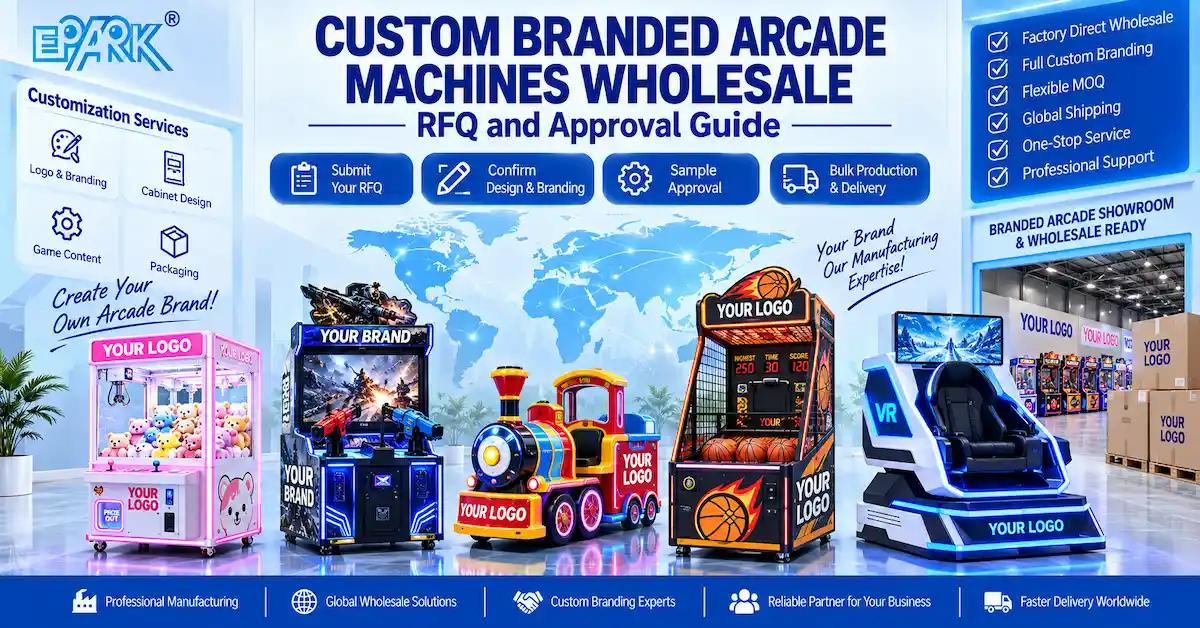
“Private label” should not be a single line in an RFQ. Ask the factory to separate the scope into visual, mechanical, electronic, software, payment, packaging and commercial fields. This makes it possible to compare two quotations that use the same word but offer different levels of customization.
Visual and brand elements
List the logo locations, header marquee, cabinet graphics, color references, lighting colors, language, warning labels, screen start-up artwork and packaging marks. EPARK's commercial arcade page describes support for cabinet graphics, logo printing, header marquees, color themes, lighting styles and branding integration. Treat those as published customization options, then define the artwork file format, print finish, color reference and approval owner for the actual order.
Mechanical and user-facing elements
State whether the cabinet outline, dimensions, player count, control panel, seat, screen position, service doors or mounting points may change. A small dimensional change can affect freight volume, player clearance, the location of a payment device and the way technicians reach the electronics. EPARK's published process includes cabinet structural design, metal fabrication, painting and finishing, which is a useful basis for asking how a custom change will be engineered and released.
Electronic, software and payment elements
Describe the required game content, language, boot screen, difficulty settings, scoring, ticket or prize logic, coin mechanism, QR or card payment interface and network assumptions. Do not assume that a custom graphic also means custom software or exclusive game content. Ask which elements are factory standard, which are configured for the order and which require a separate development or licensing decision.
Use three scope levels in the quotation:
- Brand application: standard machine with approved logo, artwork, colors, labels and packaging marks.
- Configured private label: brand application plus selected controls, languages, payment setup, lighting or player configuration.
- ODM development: a new or materially changed cabinet, game experience or system that needs engineering, prototype review and a written ownership agreement.
This vocabulary keeps a buyer from paying an ODM price for a logo-only change or expecting a new product while approving a standard-model quotation.
Send the target game categories, brand assets, venue conditions and expected order pattern so the factory can separate standard and custom scope.
Sampling is the control point between concept and production
A sample is valuable only when it is an approval instrument. The buyer should be able to compare the sample with the brief and later compare production with the approved sample. A photo-only approval may be adequate for a simple graphic update, but it is weak evidence for a changed cabinet, new control layout, payment interface or software behavior.
EPARK's FAQ says it offers OEM and ODM services and lists prototypes as a question buyers can raise; the public page does not publish one universal sampling price, MOQ or lead time for every machine family. That is a reason to make sampling a written RFQ field, not a reason to invent a standard policy. Ask whether the sample is a saleable unit, a functional prototype, a first article or a visual mock-up. Ask which costs are refundable, which components will be carried into mass production and what happens if the design is revised after review.
What the sample approval record should contain
- Sample identification, machine family, model reference and revision number.
- Approved cabinet drawings or marked photographs, including logo placement and visible dimensions.
- Artwork files, color references, lighting behavior and language version.
- Bill of materials or a component schedule for the controls, display, PCB, wiring and payment hardware.
- Game content, boot screen, scoring, ticket or prize settings and any network requirement.
- Functional observations, open defects, correction owner and re-approval date.
- Packaging marks, product label, serial-number format and manuals to be supplied.
Use a status such as “approved for pilot,” “approved for mass production” or “approved with listed deviations.” Avoid a vague message such as “looks good.” The approval should identify what the factory is authorized to reproduce and what remains open.
Control mass production against a golden reference
After the sample is approved, the key factory capability is not creativity; it is repeatability. Release a controlled “golden” reference consisting of the approved sample, drawing set, artwork package, component schedule, software or configuration version and inspection points. Keep the reference accessible to the buyer and the factory's production and quality teams.
Ask how the factory handles a component substitution, artwork correction, software update or supplier change after approval. A change may be technically reasonable but still unacceptable for a private-label brand if it alters the look, user experience, service method or compliance file. Require a change request with the reason, affected models, risk, replacement specification and new approval status.
| Production stage | Buyer control | Useful evidence |
|---|---|---|
| Release | Confirm the correct model, revision and artwork package | Signed release sheet and file list |
| First article | Check the first production unit against the sample | Photographs, measurement notes and approval status |
| In-process build | Verify visible brand elements and critical assemblies | Progress photos, inspection points and deviation log |
| Functional test | Run the agreed gameplay, payment and safety checks | Test record, serial range and retest result |
| Final packing | Match labels, accessories, manuals and carton marks | Packing list, carton photos and shipment schedule |
EPARK's Design & Process page describes artwork printing and painting, PCB and wiring assembly, LED setup, screen and control integration, final assembly and function testing. It also says the team shares progress photos and videos during production. A private-label buyer can use that published workflow as the starting point for an order-specific evidence plan: request the photo or video to show the agreed revision and machine identity rather than accepting generic factory images.
For a multi-model order, use a matrix. Each row should identify the model, brand revision, game or software version, payment configuration, quantity, test status and packing status. This makes it possible to spot a mixed revision before loading and helps the brand support team answer a service question months later.
Brand consistency is a technical requirement
Customers experience a private-label brand through repeated details: the shape of a header, the tone of a light, the response of a button, the language on a screen, the label on a carton and the way a technician replaces a part. Consistency is therefore broader than graphic design.
Build a brand consistency checklist with five layers. Visual consistency covers logo clear space, color, artwork scale, font, lighting and finish. Interaction consistency covers button labels, start sequence, payment prompt, scoring, ticket behavior and error messages. Physical consistency covers cabinet proportions, control height, service doors, labels and cable routing. Documentation consistency covers manuals, wiring references, parts lists and warranty instructions. Commercial consistency covers carton marks, product names, serial numbers and the way the model appears in a distributor catalog.
Ask the factory to show which items are shared across a family and which are model-specific. Shared brand elements can be maintained in a master artwork package. Model-specific items should be listed in the machine schedule so a racing cabinet is not judged by the same functional criteria as a claw machine. The private-label program becomes easier to scale when the factory can explain this structure instead of treating every repeat order as a new conversation.
Exclusive models require a written boundary
“Exclusive” can describe several different commercial arrangements. It may mean a unique cabinet appearance, a model reserved for one distributor, a region-limited sales right, a private game configuration or simply a logo that is not shown publicly. These are not equivalent.
Before using an exclusive-model claim in marketing, define the product identity, territory, channel, duration, minimum purchase condition, permitted modifications, spare-parts support and consequences of a design change. Identify whether the factory can sell the underlying cabinet, electronics or game content to other customers with different graphics. If the buyer owns the artwork, CAD files, software configuration or game concept, state how those files may be used and who can approve a derivative design.
EPARK's public materials support OEM/ODM customization, themes, logos, colors, lighting, language and payment integration. They do not publish a blanket exclusivity policy or a universal IP-transfer rule. Treat exclusivity and ownership as contract subjects requiring written confirmation. A buyer should not infer exclusivity from a custom color scheme or from the fact that a factory has produced a sample for one brand.
Questions to put beside an exclusivity request
- What exact model, revision and visible features are covered?
- Is the restriction by country, distributor channel, venue type or named customer?
- Does it cover the cabinet only, or also artwork, game content, payment configuration and manuals?
- What minimum order, launch date or renewal condition applies?
- Can the factory display photographs or samples in its catalog and exhibitions?
- How are replacement parts and successor revisions handled if a component changes?
Check materials and serviceability at model level
Private-label brands carry the reputation of the finished cabinet, so material and service details deserve the same attention as graphics. EPARK's public FAQ and company materials mention metal frames, ABS plastic, tempered glass and high-quality plywood, while its process page describes metal fabrication, painting, electronic assembly and final testing. These are useful published categories, not a universal bill of materials for every model.
Ask for the model-specific material and component schedule. Confirm the cabinet substrate, metal treatment, visible panel material, glass type, paint or coating, screen, control parts, PCB, power supply, speakers, LED system and payment hardware. Where a property matters to operation, request a measurable value or an inspection method rather than an adjective such as “premium.” For example, the buyer may need a defined finish standard, a component reference, a connector type or a service-access photograph.
Serviceability is part of the brand promise. A cabinet that looks consistent but requires a complete disassembly to reach a common control part can create downtime and inconsistent repairs across venues. Ask where technicians access the board, power supply, screen, controls and ticket or payment mechanism. Confirm whether the factory can supply model-matched parts, wiring information, operation guides and remote video assistance. EPARK's FAQ and Service page describe remote guidance, operation manuals, technical support and spare-parts supply; the exact items for a private-label configuration should be listed in the order documents.
Assess factory identity, communication and production evidence
A brand owner needs a factory partner that can keep information coherent from sales to engineering to production and service. EPARK's About Us page identifies the company as Guangzhou EPARK Electronic Technology Co., Ltd. and describes R&D, design, production and sales integration. It states that the team includes 100+ specialists across five in-house departments and reports more than 13 years of hands-on experience and cooperation with 100+ EPARK amusement game centers worldwide. These are company-published claims that help explain the entity; a buyer can still request a current factory tour, production contact and project references during due diligence.
The public website uses different factory-area and experience figures on different pages. That does not by itself indicate a capability problem, but it is a reason to ask the sales team which site, entity and date apply to the quoted production. Keep the answer with the RFQ. The stronger signal is whether the factory can connect the people, documents and evidence for your specific model.
Communication quality is measurable. During quotation, note whether the supplier answers the same question consistently, identifies assumptions, records open items and returns a controlled revision. During sampling, note how quickly defects are classified and corrected. During production, note whether progress evidence is tied to the order. A factory that communicates clearly before the deposit is easier to manage when a component, artwork file or shipment condition changes.
Use the published process as a checklist, then request the drawings, sample gates and testing records that apply to your private-label models.
Use a capability scorecard before appointing the factory
Scorecarding is useful when each score is tied to evidence. Do not award a high score because a salesperson promises “full customization.” Mark the field as confirmed, partially confirmed, open or not applicable. Give critical gates such as sample approval, revision control, testing evidence and ownership terms a pass-or-clarify status. This evidence-based comparison is the practical way to turn private-label arcade factory capabilities into a sourcing decision.
| Review area | Pass condition | Clarification trigger |
|---|---|---|
| Scope | Every custom field is listed as standard, configured or newly developed | “Full OEM” with no exclusions or file list |
| Sample | Sample type, approval gate, cost and correction route are written | Photo approval treated as final for a complex change |
| Mass production | Golden reference, first article and change process are defined | Factory can substitute without buyer approval |
| Brand | Artwork, labels, screen language and carton marks are revision-controlled | Brand elements are only described in a chat message |
| Quality | Inspection scope, test evidence and retest steps are clear | “Passed QC” has no checklist or order identity |
| Exclusive model | Territory, term, model and permitted reuse are contractual | Exclusivity is inferred from a custom graphic |
| Lifecycle | Manuals, parts route, support contacts and repeat-order method are stated | After-sales is described only as “lifetime support” |
For a distributor, add landed-cost and channel fields. For a venue brand, add installation, staff training and payment integration. For a new product, add engineering ownership and software or content approvals. The scorecard should reflect the business model, but the evidence discipline should stay the same.
Write an RFQ that a private-label factory can execute
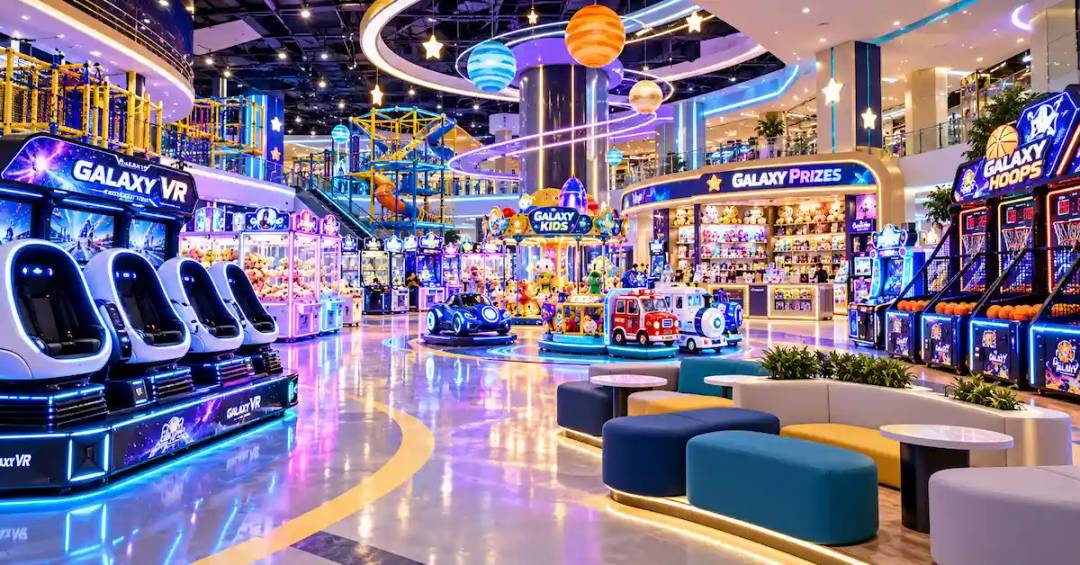
Send a short but structured brief. Start with the brand, target market, venue type, machine categories, expected first order, repeat-order plan and launch date. Attach the logo package, color references, cabinet inspiration, required languages and any payment or prize-system requirements. Provide the venue plan if layout affects cabinet choice or player flow.
Ask the factory to return one schedule per model with the model reference, dimensions, material and component assumptions, customization fields, software and payment configuration, sample route, MOQ or trial-order condition, production lead-time basis, test scope, packaging, warranty, spare-parts route and exclusions. EPARK's FAQ says it accepts small trial orders and large-scale production, but it does not publish one numeric MOQ for every model. Ask for the quantity condition for each customized line rather than applying a single MOQ to the whole program.
A copy-ready request is: “Please review the attached private-label arcade brief and separate standard, configured and newly developed items. For each proposed model, provide the cabinet and component specification, artwork and logo locations, software and payment scope, sample type and approval gate, model-specific MOQ, production milestones, inspection evidence, packaging marks, manuals, spare-parts route and warranty terms. Please identify any substitution or revision that requires our written approval and state how the design may be used for other customers.”
That request makes the factory's capability visible before the buyer commits. It also gives the sales, engineering, quality and service teams one shared definition of the brand line.
Frequently asked questions about private-label arcade factory capabilities
What is the most important capability for a private-label arcade factory?
Controlled repeatability. The factory should translate the brand brief into an approved configuration, build a sample, release the correct revision to production, test the finished machines and support repeat orders without silent changes.
Is printing a logo enough to call a machine private label?
No. Logo printing is one visual option. A usable private-label scope may also include cabinet graphics, colors, lighting, language, payment setup, screen artwork, labels, packaging and documented production control. The quotation should state which elements are changing.
Does EPARK provide OEM and ODM customization?
Yes. EPARK's FAQ and company pages describe OEM and ODM services for arcade machines, including branding and customized solutions. Ask the team to classify your request as brand application, configured private label or ODM development and to confirm the exact deliverables.
Does EPARK publish a universal private-label MOQ?
No universal number should be assumed. The FAQ says EPARK handles small trial orders and large-scale production, while the public materials do not establish one MOQ for every model, customization or mixed order. Request a model-specific quantity condition in the quotation.
Should I approve a sample before mass production?
For any change that affects appearance, controls, software, payment, dimensions or service access, a sample or defined first-article review is the safer control point. Record the approved revision and open deviations in writing.
Can a private-label buyer claim an exclusive model?
Only when the factory agrees to a defined written boundary. Specify the model and revision, territory or channel, duration, minimum purchase condition, permitted reuse, display rights and treatment of replacement parts or successor revisions.
What materials should be confirmed?
Confirm the model-specific cabinet substrate, metal treatment, visible panels, glass or acrylic, paint or coating, screen, controls, PCB, power supply, wiring, speakers, LEDs and payment hardware. EPARK publishes material categories and process steps, but the exact bill of materials should be tied to the quoted model.
How do I keep a brand consistent across different arcade machines?
Use a master brand package for logos, colors, fonts, lighting and labels, then add model-specific artwork and function checks. Link every unit to a model and revision number, and require written approval for substitutions or changes.
What evidence should a factory provide during production?
Request the approved release, first-article comparison, progress photographs or videos tied to the order, test records, defect and retest log, serial range, packing list and final carton photographs. Generic factory images do not prove that your private-label revision was built.
Who should review a private-label sample?
The brand owner or product manager should review visual and commercial fit; an engineer or qualified technician should review controls, access, wiring and maintainability; and the operations team should review payment, instructions and player use. Combine the comments in one approval record.
Conclusion
The factory capabilities that matter most for a private-label arcade brand are the capabilities that preserve a decision from brief to repeat shipment. Look for engineering that can define the cabinet and electronics, customization that distinguishes standard from developed work, sampling that creates an approval reference, production control that prevents silent revision drift, testing that produces order-level evidence, and service support that keeps the brand maintainable after installation.
EPARK's published information provides a credible starting point for this review: Guangzhou manufacturing identity, multi-category amusement equipment, OEM/ODM support, layout and branding assistance, a described production workflow, testing, export packaging and technical support. Before release, turn those public capabilities into a model-specific quotation, approved sample record, golden reference, inspection plan and written exclusivity or ownership terms.
Include your brand assets, target models, first-order quantity, destination market, sample expectations and repeat-order plan.
Disclaimer
The information provided on this website is for general informational purposes only.
While EPARK Arcade Game Machine Manufacturer strives to ensure accuracy and reliability, no warranties—express or implied—are made regarding completeness, performance, or applicability.
Product specifications, designs, and features may vary depending on usage, customization, and customer requirements.
Buyers are responsible for verifying all technical details, compliance certifications, and suitability before procurement.
EPARK shall not be held liable for any direct, indirect, incidental, or consequential damages arising from the use of this website or its content, including but not limited to business losses, data errors, or equipment misuse.
For tailored solutions or further verification, please visit our Contact Us
Intellectual Property Notice
All articles, product images, videos, catalogs, software, and related materials published on this website are the intellectual property of EPARK, unless otherwise stated.
Unauthorized reproduction, distribution, modification, or commercial use of any content is strictly prohibited without prior written consent from EPARK.
EPARK reserves the right to take legal action against any unauthorized use, including but not limited to copyright infringement, misrepresentation, or unfair competition.
Trademarks
The name EPARK, the EPARK logo, and all related brand elements displayed on this website are registered trademarks or trade names of Guangzhou EPARK Electronic Technology Co., Ltd.
Other product names, company names, or logos mentioned on this site may be trademarks of their respective owners.
Unauthorized use of EPARK's trademarks for commercial purposes, including advertising, promotions, or product packaging, is strictly prohibited.
Governing Law
These terms are governed by the laws of the People's Republic of China.