
Why ODM Matters When Standard Arcade Machines Do Not Fit Your Market
For many arcade equipment distributors and entertainment businesses, the sourcing problem eventually changes.
At the beginning, the priority may be finding proven commercial arcade machines at the right price. As the business develops, however, standard products may no longer provide enough differentiation.
Competitors may sell similar cabinets. Local operators may request features that existing machines do not offer. A distributor may identify a gap in its regional market but have no finished mechanical drawings, electronics plan, cabinet structure, or production system to turn the idea into a commercial product.
This is where an ODM game machine factory can provide a different type of value.
Instead of manufacturing only from a buyer's completed specification, an ODM partner can participate in product definition, cabinet design, configuration, prototype development, engineering validation, production preparation, and manufacturing.
The objective is not customization for its own sake.
A useful ODM project should solve a defined market problem and create equipment that can be manufactured repeatedly, serviced commercially, and positioned clearly for the intended customer.
For distributors, FEC chains, arcade brands, and entertainment project companies, that makes ODM a product-development decision rather than a simple purchasing decision.
Buyers who first want to understand the manufacturer's broader capabilities can review EPARK's arcade machine manufacturer information before discussing a development project.
What Is an ODM Game Machine Factory?
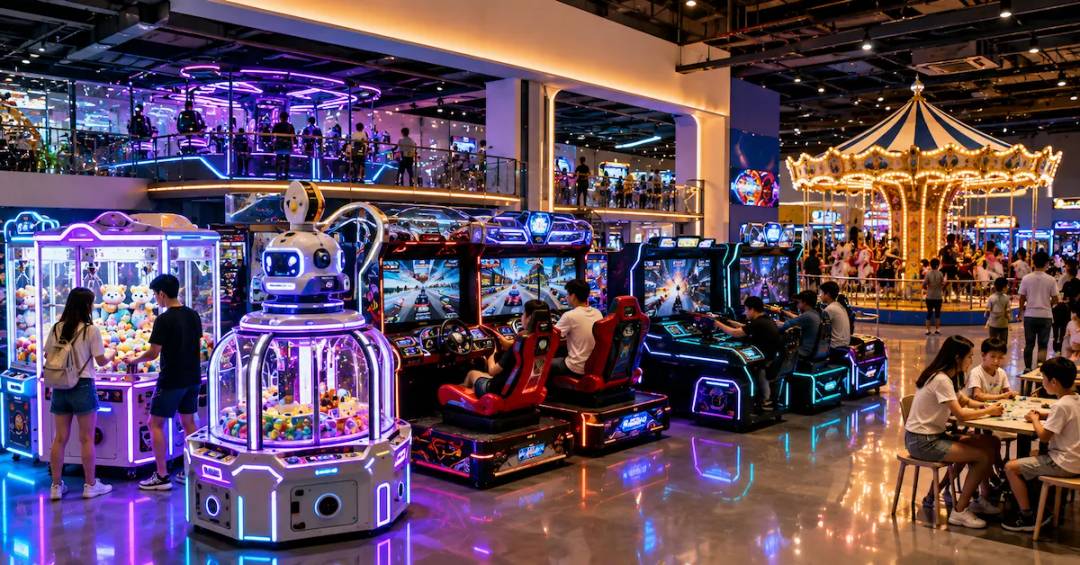
An ODM game machine factory is a manufacturer that participates in both the design and manufacturing of arcade or amusement equipment.
The buyer may begin with a market opportunity, functional requirement, reference concept, target player group, or commercial objective rather than a complete production-ready design.
The factory then evaluates how that requirement can be transformed into a manufacturable product.
Depending on the project, ODM work may involve:
- Product concept development
- Cabinet and structural design
- Artwork and visual development
- Electronics integration
- Control-system configuration
- Payment-system integration
- Software or interface configuration
- Prototype manufacturing
- Functional testing
- Design revisions
- Production preparation
- Mass manufacturing
- Packaging and technical support
The deeper the development, the more important it becomes to distinguish genuine ODM capability from basic visual customization.
Changing a cabinet color or printing a logo is customization.
Developing a new structure, interaction concept, control arrangement, or commercial product platform requires a different level of engineering and project management.
ODM vs OEM vs Private Label Game Machines
Buyers often use ODM, OEM, private label, and customization interchangeably. For sourcing decisions, separating them helps clarify responsibilities.
| Cooperation Model | Buyer Usually Provides | Factory Usually Provides | Best Fit |
|---|---|---|---|
| Standard purchase | Model selection and quantity | Existing finished product | Fast sourcing and market testing |
| Private label | Brand and selected configurations | Existing platform plus branding | Distributors building their own brand |
| OEM | Detailed design or clear specifications | Manufacturing and agreed modifications | Buyers with established product requirements |
| ODM | Market need, concept or functional brief | Design, engineering, prototype and production | New or differentiated product development |
The distinction is not always absolute. A project can move between these models.
For example, a distributor may begin with an existing commercial arcade machine, modify the cabinet and payment system, then later develop a more exclusive version based on market feedback.
What matters is defining clearly which development tasks belong to the buyer and which belong to the factory.
Start With the Market Problem, Not the Cabinet Drawing
One of the most expensive ODM mistakes is designing a machine before defining why the market needs it.
A successful arcade product should begin with a commercial requirement.
Define the Target Buyer
Is the final customer:
- An FEC operator?
- A compact shopping mall arcade?
- A distributor?
- A theme entertainment center?
- A children's venue?
- A chain operator?
- A tourist attraction?
Different buyers value different features.
Define the Target Player
A game designed for young children requires different ergonomics, controls, visual language, cabinet height, and gameplay from a competitive racing game intended for teenagers or adults.
Define the Operating Environment
The development brief should consider:
- Available floor area
- Expected machine footprint
- Power requirements
- Payment method
- Staff availability
- Maintenance capability
- Operating hours
- Intended player throughput
- Destination market
Define the Business Objective
A new product may be developed to:
- Fill a missing category in a distributor portfolio
- Create a unique visual attraction
- Improve space efficiency
- Support a regional payment system
- Serve a specific age group
- Build a private-label product family
- Reduce dependence on widely available models
A strong ODM brief explains the commercial problem before specifying the solution.
Good ODM development begins with a market requirement, not simply a cabinet sketch.
What Information Should Buyers Prepare Before ODM Development?
The factory cannot develop a useful commercial machine from a vague request such as “make something unique.”
A better project brief includes enough information to guide engineering decisions.
| Requirement Area | Information to Prepare |
| Target market | Country, region and buyer type |
| Venue | FEC, mall arcade, distributor market or other scenario |
| Target players | Age group and expected user profile |
| Product concept | Game category and intended experience |
| Commercial target | Positioning, target price level, differentiation goal |
| Dimensions | Preferred footprint or space limits |
| Branding | Logo, colors, artwork direction |
| Payment | Coin, card or compatible cashless requirement |
| Electrical | Destination voltage and plug requirements |
| Language | Interface and operating language |
| Quantity | Initial order and expected repeat demand |
| Timeline | Target launch or venue-opening schedule |
| Support | Spare parts, documentation and training expectations |
The clearer this information is, the easier it becomes to distinguish essential requirements from optional ideas.
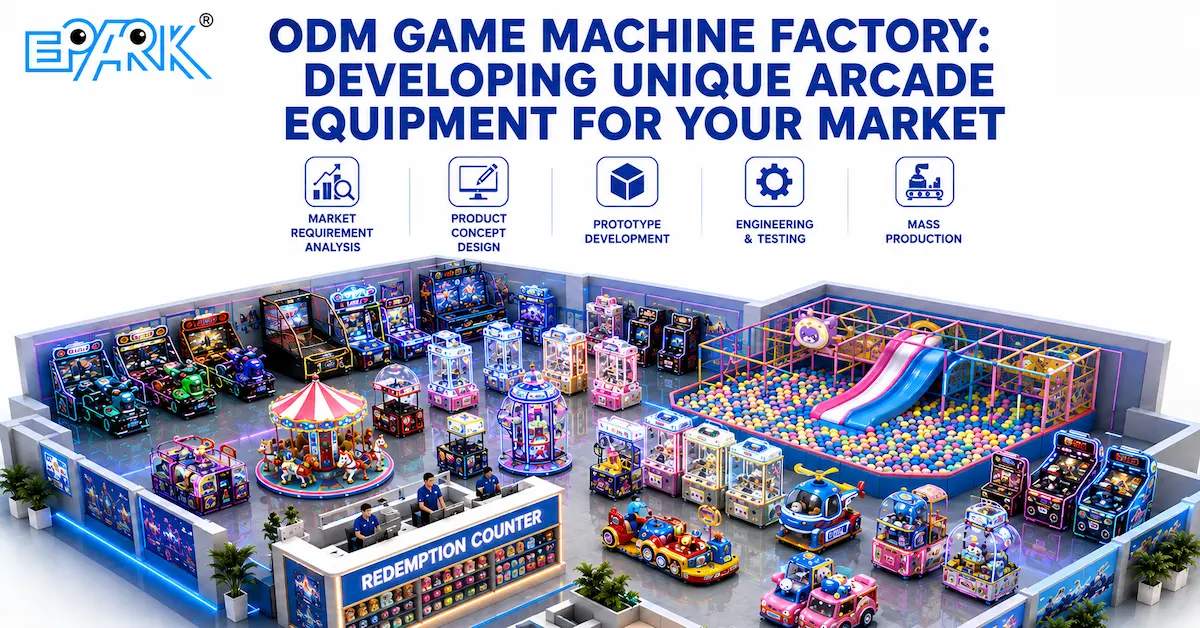
How an ODM Game Machine Factory Develops a New Arcade Product
ODM development is best managed as a series of controlled decisions rather than one large design task.
Step 1: Market and Requirement Analysis
The factory and buyer first determine what the product must accomplish.
Questions may include:
- Who will buy it?
- Who will play it?
- Where will it operate?
- Why would an operator choose it?
- What existing machines compete with it?
- What must be different?
- What must remain simple?
This stage should result in a product requirement document or similar agreed brief.
Step 2: Product Concept Development
The concept translates market requirements into a practical machine idea.
At this stage, the team may consider:
- Game format
- Player position
- Cabinet layout
- Screen arrangement
- Controls
- Lighting
- Prize or redemption mechanics where relevant
- Payment method
- Maintenance access
Several concepts may need to be evaluated before one is selected.
Step 3: Cabinet and Mechanical Design
The cabinet must do more than look attractive.
A commercial structure should consider:
- Player ergonomics
- Equipment weight
- Structural stability
- Access for servicing
- Internal component placement
- Screen protection
- Control placement
- Transport dimensions
- Packaging requirements
A visually impressive structure that is difficult to maintain or ship may become an operational problem.
Step 4: Electronics and Control Integration
Once the mechanical concept is defined, the internal systems must work together.
Depending on the equipment, this may involve:
- Power supplies
- Displays
- Control boards
- Buttons
- Joysticks
- Steering systems
- Sensors
- Motors
- Audio
- Lighting
- Card readers
- Payment interfaces
Component selection should consider not only initial function but also availability, replacement, and repeat production.
Step 5: Software, Interface and Game Configuration
Where applicable, development may also include:
- Interface language
- Operator settings
- Gameplay parameters
- Display content
- Payment configuration
- Scoring
- Difficulty settings
- Redemption settings
The buyer should define which settings are fixed and which operators can adjust later.
Step 6: Prototype Development
The prototype is where the product moves from concept to physical reality.
Its purpose is not simply to produce a machine that turns on.
It is to expose problems while changes are still manageable.
Step 7: Testing and Design Revision
Prototype testing may reveal issues related to:
- Player position
- Control reach
- Cabinet vibration
- Sensor response
- Screen viewing angle
- Payment compatibility
- Lighting
- Heat management
- Service access
- Packaging dimensions
The design should be revised when testing reveals meaningful weaknesses.
Step 8: Sample Approval
After major issues are resolved, the buyer approves the product configuration.
The approved sample can become a golden sample for mass production.
It should represent the agreed:
- Appearance
- Components
- Controls
- Artwork
- Payment configuration
- Software settings
- Accessories
Step 9: Production and Quality Control
Mass production should reproduce the approved design rather than introduce uncontrolled changes.
Final QC should verify both standard machine functions and ODM-specific requirements.
Step 10: Market Feedback and Product Improvement
Development should not end when the first shipment leaves the factory.
Distributors and operators can collect information about:
- Player response
- Operator feedback
- Component failures
- Service requirements
- Payment performance
- Artwork response
- Sales performance
The next production batch can then incorporate justified improvements.
Why Prototype Testing Is Critical in ODM Arcade Projects
A prototype protects both buyer and manufacturer from scaling an unverified design.
It allows the project team to test questions that drawings cannot fully answer.
Player Experience
Can the player understand how to interact with the machine?
Are the controls comfortable?
Is the screen visible at the expected operating position?
Commercial Operation
Can staff access important components without dismantling the entire cabinet?
Are consumables or prize areas easy to refill?
Can payment equipment be serviced?
Technical Performance
Does the machine operate consistently under realistic use?
Are sensors and controls responding correctly?
Does the configured payment method work as intended?
Logistics
Can the machine be packed efficiently?
Will the dimensions create unnecessary shipping cost?
Are fragile elements protected?
Prototype validation is therefore a commercial control, not merely an engineering formality.
Use a Development Risk Matrix Before Mass Production
ODM introduces more variables than purchasing an existing model.
A simple risk matrix makes those variables visible.
| Development Risk | When It Appears | Practical Control |
| Product does not fit local demand | Concept stage | Validate buyer and player requirements |
| Cabinet is difficult to service | Mechanical design | Maintenance-access review |
| Controls feel uncomfortable | Prototype | Real player interaction testing |
| Payment system is incompatible | Integration stage | Test exact configured system |
| Components become difficult to source | Engineering/production | Approved component list |
| Production differs from sample | Mass production | Golden sample and QC checklist |
| Packaging causes damage risk | Pre-shipment | Packing validation |
| Product cannot be repeated consistently | Repeat order | Controlled drawings and specifications |
The goal is not to eliminate every uncertainty.
It is to identify risks early enough that corrective action remains inexpensive.
How ODM Development Affects Cost and Lead Time
There is no responsible way to quote one universal ODM development cost or lead time.
The project depends on how much new development is actually required.
Factors Affecting Development Cost
These may include:
- New cabinet structure
- Tooling
- Prototype quantity
- Custom mechanical parts
- Electronics changes
- Control systems
- Software development
- Artwork
- Payment integration
- Testing
- Packaging design
Factors Affecting Lead Time
These may include:
- Requirement clarity
- Concept revisions
- Engineering complexity
- Component sourcing
- Prototype iterations
- Buyer approval speed
- Testing results
- Production quantity
This is why buyers should ask the factory to separate the project into milestones rather than requesting only one final delivery date.
A realistic schedule is more valuable than an aggressive date that does not account for prototype revisions.
Component Strategy Matters for Long-Term Product Success
A new machine is not commercially successful simply because the first sample works.
The product must also be repeatable.
When evaluating components, buyers and factories should consider:
- Availability
- Stable specifications
- Replacement options
- Supplier continuity
- Serviceability
- Spare-parts requirements
For a distributor planning a multi-year product line, component stability can be more important than achieving the lowest possible initial unit cost.
The factory should document critical parts so future service teams can identify replacements accurately.
Clarify Design Ownership, Tooling and Exclusivity Early
ODM projects can involve greater investment in design and development than standard orders.
This makes commercial ownership questions important.
Before development progresses too far, the parties should clarify in writing:
- Who owns artwork supplied by the buyer?
- Who owns newly developed cabinet designs?
- Who pays for and owns tooling?
- Can the factory sell the same design to other customers?
- Is exclusivity available?
- Which country or region would exclusivity cover?
- Does exclusivity depend on order commitments?
- Who controls future design revisions?
There is no single answer that applies to every project.
These are commercial and contractual matters that should be explicitly agreed rather than assumed. For substantial projects, buyers should obtain appropriate professional advice on contracts and intellectual-property arrangements.
How to Evaluate a Real ODM Game Machine Factory
A factory that can print custom artwork is not automatically an ODM partner.
Buyers should evaluate four layers of capability.
1. Product Development Capability
Ask whether the supplier can explain:
- Requirement analysis
- Concept design
- Cabinet development
- Component integration
- Prototype process
- Revision process
2. Manufacturing Capability
Verify how the product moves into:
- Assembly
- Wiring
- Configuration
- Testing
- Packaging
Photos, videos, samples, and production explanations are more useful than general claims.
3. Quality-Control Capability
The factory should be able to explain what is checked at:
- Prototype stage
- Production stage
- Final inspection
- Pre-shipment stage
The QC process should reflect the specific machine rather than use one generic checklist for every product.
4. Long-Term Support Capability
For distributors and commercial operators, evaluate:
- Spare parts
- Troubleshooting
- Product documentation
- Repeat production
- Engineering revisions
- Technical communication
A successful ODM product may remain in the market for years, so the relationship should be designed for repeat business.
When ODM Is the Right Choice—and When It Is Not
ODM is valuable, but deeper development is not automatically better.
ODM Is More Suitable When:
- Existing products do not fit a clear market need
- The buyer wants meaningful differentiation
- A distributor expects repeat sales
- The product concept has commercial potential
- The buyer can participate in testing and approvals
- Longer development is acceptable
Standard or Private Label May Be Better When:
- The project needs machines quickly
- Demand has not yet been validated
- Order quantity is small
- Branding is the main requirement
- Existing products already meet the market need
- Development cost would not create enough commercial value
One of the best product-development decisions can be deciding not to develop a new machine when an existing platform already solves the problem.
How EPARK Can Support ODM Arcade Equipment Development
EPARK works with commercial arcade operators, distributors, FEC projects, and other entertainment equipment buyers.
For an ODM project, the most useful starting point is not simply asking for a catalogue.
Buyers can provide:
- Target country
- Customer type
- Venue scenario
- Player profile
- Product category
- Desired functions
- Branding requirements
- Payment requirements
- Expected quantity
- Commercial objective
EPARK can then evaluate which needs may be met through an existing platform and which may require deeper customization or development.
Buyers can first explore EPARK's commercial arcade machines to identify relevant categories, review common purchasing information through the arcade machine FAQ, or discuss an ODM arcade project directly with project requirements.
The objective should be to choose the lowest-risk development path that still creates meaningful value for the target market.
FAQ About ODM Game Machine Factory Services
What is an ODM game machine factory?
An ODM game machine factory participates in designing and manufacturing arcade equipment. Buyers may provide a market requirement or product concept, while the factory supports development, engineering, prototype testing, and production.
What is the difference between OEM and ODM game machines?
OEM generally starts with clearer buyer-controlled specifications, while ODM usually gives the manufacturer a larger role in product design and engineering. The exact division of responsibility should be defined for each project.
Can an ODM factory develop an arcade machine from an idea?
Potentially, yes, but a business idea still needs to be converted into clear market, functional, technical, and commercial requirements before development can begin effectively.
What information should I provide for an ODM project?
Provide the target market, venue type, player profile, desired game category, required functions, size constraints, payment system, branding, quantity, budget positioning, and target schedule.
Is prototype development necessary?
For significant new development, prototype validation is highly valuable because it allows the buyer and factory to identify design, usability, technical, maintenance, and packaging issues before mass production.
What should be tested on an arcade machine prototype?
Testing should reflect the equipment type but may include controls, screens, sensors, payment systems, gameplay, cabinet structure, player ergonomics, service access, lighting, mechanical functions, and packaging feasibility.
What affects ODM game machine development cost?
Development scope, cabinet design, tooling, electronics, software, prototype iterations, custom components, payment integration, testing, and order quantity can all affect cost.
Can distributors request exclusive arcade machine designs?
Exclusivity may be negotiable, but it should never be assumed. The agreement should define the product, territory, duration, ownership, order commitments, and any limitations.
Who owns the design in an ODM project?
Ownership depends on the commercial agreement between buyer and manufacturer. Artwork, tooling, structural designs, software, and other intellectual property should be addressed explicitly in writing.
How do I choose a reliable ODM game machine factory?
Evaluate actual product-development capability, manufacturing control, prototype procedures, quality verification, communication, component management, spare-parts support, and ability to reproduce the approved product consistently.
Conclusion
Working with an ODM game machine factory can help distributors and arcade businesses move beyond existing catalogue products and develop equipment around genuine market opportunities.
But ODM success does not begin with asking a factory to “make something different.”
It begins by defining the buyer, player, venue, business objective, operating requirements, and product problem clearly enough that design decisions can be measured against them.
The most effective development process then moves through controlled stages:
Market Requirement → Product Concept → Engineering → Prototype → Testing → Approval → Production → Market Feedback
For distributors, private-label brands, FEC chains, and entertainment businesses, this approach reduces the risk of investing in a visually attractive machine that does not perform commercially.
A capable factory partner should help turn uncertainty into documented requirements, prototypes into validated products, and validated products into repeatable commercial equipment.
That is the real value of ODM: not simply creating a different cabinet, but developing an arcade product that has a clear reason to exist in its target market.
Disclaimer
The information provided on this website is for general informational purposes only.
While EPARK Arcade Game Machine Manufacturer strives to ensure accuracy and reliability, no warranties—express or implied—are made regarding completeness, performance, or applicability.
Product specifications, designs, and features may vary depending on usage, customization, and customer requirements.
Buyers are responsible for verifying all technical details, compliance certifications, and suitability before procurement.
EPARK shall not be held liable for any direct, indirect, incidental, or consequential damages arising from the use of this website or its content, including but not limited to business losses, data errors, or equipment misuse.
For tailored solutions or further verification, please visit our Contact Us
Intellectual Property Notice
All articles, product images, videos, catalogs, software, and related materials published on this website are the intellectual property of EPARK, unless otherwise stated.
Unauthorized reproduction, distribution, modification, or commercial use of any content is strictly prohibited without prior written consent from EPARK.
EPARK reserves the right to take legal action against any unauthorized use, including but not limited to copyright infringement, misrepresentation, or unfair competition.
Trademarks
The name EPARK, the EPARK logo, and all related brand elements displayed on this website are registered trademarks or trade names of Guangzhou EPARK Electronic Technology Co., Ltd.
Other product names, company names, or logos mentioned on this site may be trademarks of their respective owners.
Unauthorized use of EPARK's trademarks for commercial purposes, including advertising, promotions, or product packaging, is strictly prohibited.
Governing Law
These terms are governed by the laws of the People's Republic of China.