
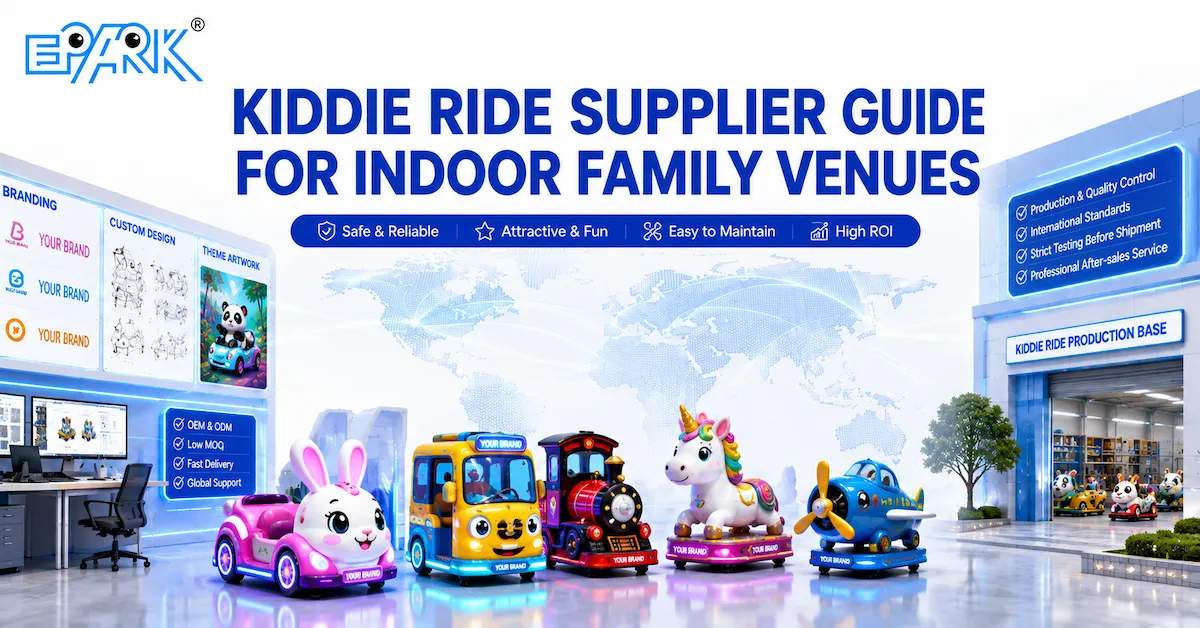
Why Indoor Family Venues Should Evaluate More Than Ride Appearance
For family entertainment centers, shopping malls, indoor playgrounds, game centers, and other child-focused venues, kiddie rides can add an important entertainment layer between larger arcade attractions and passive play areas.
They are visually attractive, relatively easy for families to understand, and can be placed in locations where larger amusement equipment may not fit.
But choosing a kiddie ride supplier based only on colorful cabinet design or purchase price can create problems later.
Commercial operators also need to consider:
- Target age group
- Ride dimensions
- Passenger capacity
- Parent visibility
- Entry and exit
- Daily operating cycles
- Electrical requirements
- Payment system
- Cleaning access
- Maintenance
- Spare parts
- Technical support
The better purchasing question is not simply:
Which kiddie ride looks the most attractive?
It is:
Which ride can operate safely, reliably,and efficiently in my specific family venue?
Operators planning a broader entertainment mix can review EPARK's commercial arcade equipment to compare kiddie rides with claw machines, basketball games, racing machines, redemption equipment, and other venue attractions.
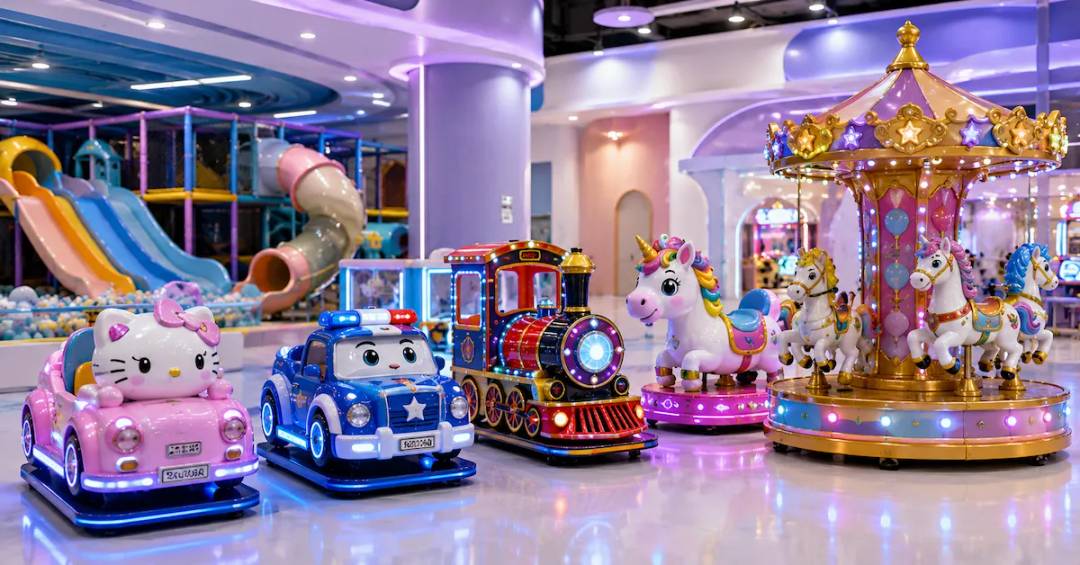
Start With the Venue Before Selecting a Kiddie Ride
A professional supplier should understand the commercial environment before recommending a model.
Family Entertainment Centers
FEC operators usually need kiddie rides that integrate with several other entertainment categories.
The ride should complement rather than compete with:
- Redemption games
- Claw machines
- Family games
- Children's play areas
- Sports arcade machines
The goal is to create a balanced experience across different age groups.
Shopping Malls
Shopping mall installations often require additional attention to:
- Footprint
- Appearance
- Customer traffic
- Noise
- Visibility
- Easy supervision
A compact ride may be commercially stronger than a larger attraction if it fits naturally into a high-traffic family area.
Indoor Playgrounds
Indoor playground operators may prioritize:
- Younger children
- Parent supervision
- Simple controls
- Easy cleaning
- Integration with soft-play zones
Game Centers
Game centers may use kiddie rides to expand their customer base beyond teenagers and older players.
The key is to position the ride where families can easily see and access it without blocking the main arcade traffic.
Match the Kiddie Ride to the Target Age Group
One of the first questions a buyer should ask a kiddie ride supplier is:
Which age group is this exact model designed for?
Do not assume that every kiddie ride is suitable for every child.
Age suitability can affect:
- Seat dimensions
- Entry height
- Restraints where applicable
- Control complexity
- Ride motion
- Parent assistance
For commercial purchasing, request the supplier's recommended age range and operating instructions for the exact model.
Why This Matters Commercially
A ride that does not match the venue's customer demographics may have poor utilization even if the equipment itself is reliable.
For example, a venue dominated by very young children may need simpler interaction than a family entertainment center serving older children.
Product selection should therefore begin with customer fit, not catalog popularity.
Compare the Main Types of Commercial Kiddie Rides
Different ride types support different venue strategies.
| Ride Type | Main Advantage | Best Fit |
|---|---|---|
| Single-seat ride | Compact footprint | Small family zones |
| Two-seat ride | Parent/child or sibling interaction | FECs and malls |
| Vehicle-themed ride | Familiar visual attraction | Young children |
| Animal-themed ride | Strong child appeal | Indoor playgrounds |
| Interactive ride | Adds buttons/screens/gameplay | Arcade-oriented venues |
| Larger themed ride | Strong visual centerpiece | High-traffic family zones |
There is no universal best option.
A buyer should compare:
Footprint + Customer Fit + Ride Experience + Maintenance + Cost
rather than appearance alone.
Calculate the Real Space Requirement
Machine dimensions alone do not represent the full operating footprint.
Buyers should also consider:
- Entry space
- Exit space
- Parent standing area
- Maintenance access
- Movement clearance
- Nearby traffic flow
Ask for a Complete Dimension Drawing
Before ordering, request:
- Width
- Depth
- Height
- Base dimensions
- Required operating clearance
- Access-panel locations
This is particularly important for overseas projects where changing the venue layout after delivery can be expensive.
EPARK can support venue-level planning for buyers who need to combine multiple amusement categories rather than purchasing machines one by one.
Evaluate Parent Visibility and Child Access
Indoor family venues have a different operating environment from adult-oriented arcades.
Parents may want to:
- Watch the child
- Help with entry
- Assist with payment
- Stay nearby during operation
A ride positioned against a wall, behind other equipment, or in a congested area may create unnecessary operating friction.
When discussing a project with a supplier, evaluate whether the ride design allows:
- Clear visibility
- Easy boarding
- Convenient parent access
- Straightforward staff supervision
This is a practical venue issue that product catalogs often do not explain.
Check the Ride Structure and High-Wear Components
A commercial kiddie ride can experience repeated daily use.
Buyers should therefore evaluate components that affect long-term reliability.
Cabinet and Exterior
Check:
- Surface finish
- Structural stability
- Accessible edges
- Fasteners
- Service panels
Seat and Passenger Area
Evaluate:
- Seat construction
- Contact surfaces
- Ease of cleaning
- Entry and exit
Motion System
Depending on the model,this may include:
- Motors
- Gearboxes
- Actuators
- Bearings
- Moving mechanisms
Ask which components are considered wear parts and how they are replaced.
Electrical Components
Important items may include:
- Power supply
- Control board
- Wiring
- Buttons
- Displays
- Lighting
The best supplier comparison is not based on whether components exist, but whether the factory can clearly explain how the system is maintained.
Treat Safety as a Model-Specific Requirement
Safety claims should be specific rather than generic.
IEC 60335-2-82:2024 covers the safety of electric commercial amusement machines and explicitly lists kiddie rides among the examples within its scope, subject to the standard's voltage and application conditions.
This does not mean buyers should assume that one standard automatically resolves every local requirement.
Before ordering, ask:
- Which safety requirements apply to this model?
- What is the intended operating environment?
- What passenger limitations apply?
- What electrical requirements apply?
- What emergency or stop controls are provided?
- What installation instructions are required?
For EU projects, buyers should also verify which product rules apply to the exact equipment. EU guidance makes clear that manufacturers are responsible for identifying applicable rules, carrying out conformity assessment where required, preparing technical documentation and the Declaration of Conformity, and affixing CE marking when applicable.
The practical lesson for buyers is simple:
Ask for documentation that matches the exact ride and destination market, not just a generic CE logo.
Confirm Electrical and Site Requirements Before Production
Before purchasing a commercial kiddie ride, confirm:
- Voltage
- Frequency
- Plug type
- Power consumption
- Connection method
- Installation environment
This information should be finalized before the factory configures the equipment.
If the ride arrives with the wrong electrical setup, the buyer may face:
- Rewiring
- Replacement components
- Installation delays
- Additional technician costs
For international projects, destination-market configuration should be part of the purchase specification.
Check Payment System Compatibility
Indoor family venues may use different payment models:
- Coins
- Tokens
- Rechargeable cards
- Central cashless systems
A kiddie ride supplier should clarify what payment options can be integrated with the exact model.
This is especially important for FEC projects where operators want several machine categories connected to one payment system.
Payment configuration should be discussed before production instead of treated as an installation-stage modification.
Evaluate the Ride Cycle and Commercial Throughput
Commercial buyers should understand how many customers a ride can realistically serve.
Important questions include:
- How long is one ride cycle?
- How quickly can the next customer board?
- Does the system require staff intervention?
- How many passengers can ride at once?
- How long does cleaning or reset take?
A machine with a visually impressive ride cycle may still create low throughput if every session requires lengthy loading or resetting.
A Better Way to Think About Capacity
Commercial throughput depends on:
Boarding Time + Ride Time + Exit Time + Reset Time
This is especially important in high-traffic indoor family venues.
Consider Noise and Motion in the Venue Mix
Indoor environments have limited acoustic separation.
A kiddie ride positioned next to:
- Restaurants
- Seating zones
- Retail areas
- Quiet children's activities
may need different sound settings from a ride positioned inside a busy arcade.
Ask whether the machine allows adjustment of:
- Music volume
- Sound effects
- Attract-mode audio
Motion should also match the intended audience and operating environment.
These details can materially affect the real venue experience even though they rarely appear in basic supplier quotations.
Plan Cleaning and Daily Maintenance
Children's entertainment equipment needs practical cleaning access.
Operators should evaluate:
- Seat surfaces
- Handles
- Buttons
- Decorative areas
- Floor-level components
Avoid designs where commonly touched areas are difficult for staff to reach.
Daily maintenance procedures should also be straightforward enough for venue staff to perform without specialized technicians.
Ask the supplier whether it can provide:
- Maintenance instructions
- Cleaning guidance
- Troubleshooting documents
- Component diagrams
Ask How the Kiddie Ride Is Tested Before Shipment
A professional supplier should test the actual ordered configuration rather than simply confirm that the machine powers on.
Functional Checks
Useful checks include:
- Startup
- Ride cycle
- Controls
- Sound
- Lighting
- Payment system
Mechanical Checks
Depending on the ride:
- Motion consistency
- Fasteners
- Moving components
- Abnormal noise
Order Verification
International buyers can request:
- Finished product photos
- Testing videos
- Configuration confirmation
- Packing photos
For first-time cooperation or larger orders, clearly defined acceptance criteria can reduce disputes before shipment.
Evaluate Packaging for International Delivery
Kiddie rides can include:
- Decorative fiberglass or molded shells
- Electronic systems
- Screens
- Moving mechanisms
- External lighting
Damage during shipment can turn a good product into a difficult installation.
Before ordering, confirm how the supplier protects:
- Exterior surfaces
- Screens
- Moving parts
- Decorative components
- Accessories
Export packaging should be included in supplier evaluation rather than discussed only after the machine is finished.
Check Spare Parts Before Checking the Warranty Length
Buyers often ask:
How long is the warranty?
A more useful operational question is:
If this machine stops, how quickly can I get the part needed to repair it?
Ask the supplier about:
- Spare-part availability
- Recommended spare-part kits
- Motors
- Sensors
- Control boards
- Power components
- Payment parts
- Decorative replacement parts where relevant
A longer warranty has limited operational value if parts take months to identify or replace.
For international operators, selected critical spare parts may be worth shipping together with the initial order.
Compare Total Lifecycle Cost, Not Just Purchase Price
The quotation price is only one component of the commercial investment.
| Cost Area | What Buyers Should Consider |
|---|---|
| Purchase | Machine price |
| Customization | Branding and configuration |
| Shipping | Packaging and freight |
| Installation | Site preparation |
| Operation | Electricity and staffing |
| Maintenance | Wear components |
| Downtime | Lost operating time |
| Spare parts | Replacement availability |
A cheaper ride may become more expensive if it creates repeated maintenance or long downtime.
For commercial venues, supplier responsiveness and component availability can influence lifecycle cost as much as the initial price.
Evaluate OEM and Theme Customization Carefully
Indoor family venues often use themes to create a consistent customer experience.
Possible customization may include:
- Colors
- Artwork
- Logos
- Exterior styling
- Language
- Lighting
- Payment configuration
But customization should have a commercial purpose.
For example:
- Aligning rides with an FEC brand
- Creating a themed children's area
- Supporting a mall campaign
- Developing private-label equipment for distributors
Businesses that require customized amusement equipment can review EPARK's OEM and ODM arcade solutions.
Use This Kiddie Ride Supplier Evaluation Checklist
| Evaluation Area | What to Confirm |
|---|---|
| Target age | Suitable passenger range |
| Venue fit | Indoor use and audience |
| Dimensions | Machine plus operating clearance |
| Structure | Commercial-use durability |
| Motion system | Reliability and serviceability |
| Safety | Model-specific requirements |
| Electrical | Destination configuration |
| Payment | Venue-system compatibility |
| Throughput | Ride and reset cycle |
| Cleaning | Daily staff access |
| Quality testing | Pre-shipment verification |
| Packaging | Export protection |
| Spare parts | Long-term availability |
| OEM | Branding and theme support |
| Support | Technical response after delivery |
This kind of checklist allows buyers to compare suppliers on actual operating risk instead of brochure appearance.
How EPARK Supports Indoor Family Entertainment Projects
For indoor family venues, kiddie rides work best when they are planned as part of the total entertainment mix.
EPARK supports commercial entertainment buyers with equipment selection across multiple arcade and family amusement categories.
Depending on the project, cooperation can cover:
Venue Requirements
↓
Equipment Mix
↓
2D / 3D Layout Planning
↓
Configuration & Payment
↓
OEM / ODM Design
↓
Manufacturing & Testing
↓
International Delivery
↓
Installation Guidance
↓
Spare Parts & After-Sales Support
Buyers can learn more about EPARK's company and manufacturing capabilities and review common purchasing questions through the arcade equipment FAQ.
For FECs and indoor family venues, this project-level approach can be more useful than sourcing unrelated machines from several vendors.
FAQ About Choosing a Kiddie Ride Supplier
What should I check when choosing a kiddie ride supplier?
Evaluate ride suitability, target age group, dimensions, manufacturing quality, safety information, electrical configuration, payment options, testing, spare parts, and after-sales support.
What type of kiddie ride is best for an indoor family venue?
The best model depends on the venue size, customer age, traffic level, entertainment mix, and available operating space. Compact single- or two-seat rides may suit smaller venues, while themed rides can work as stronger visual attractions.
How much space does a commercial kiddie ride need?
Buyers should consider both machine dimensions and operating clearance for boarding, parents, customer traffic, maintenance, and any ride movement.
Are kiddie rides suitable for shopping malls?
They can be suitable for shopping malls when the model fits the venue's space, target audience, electrical setup, traffic flow, and applicable operating requirements.
Can commercial kiddie rides use cashless payment?
Some models can be configured for different payment systems. Buyers should confirm compatibility with the exact ride and venue system before production.
Can kiddie rides be customized with our brand?
Depending on the model and supplier capability, customization may include colors, artwork, logos, themes, language, and payment configuration.
What quality tests should a supplier perform?
Buyers should ask about functional testing, ride-cycle testing, control checks, electrical configuration, mechanical operation, and final order verification before shipment.
What spare parts should be ordered with kiddie rides?
The answer depends on the exact design. Buyers should ask the supplier to recommend frequently replaced or critical components based on the model being purchased.
How should overseas buyers verify rides before shipment?
Request final photos, testing videos, configuration confirmation, accessory verification, and packing evidence. Larger orders may justify more formal pre-shipment inspection.
What information should I send a supplier to get an accurate quotation?
Provide venue type, target age group, required quantity, destination country, payment system, customization needs, preferred models, and available floor space. This allows the supplier to provide a more relevant proposal instead of a generic price list.
Conclusion
Choosing the right kiddie ride supplier for an indoor family venue requires more than finding a colorful machine at an attractive price.
Commercial buyers should evaluate whether the ride fits the real operating environment:
- Is it appropriate for the target customer?
- Does it fit the available space?
- Is the configuration suitable for the destination?
- Can the equipment be maintained efficiently?
- Are replacement parts available?
- Can the supplier support the venue after delivery?
The stronger purchasing decision is the one that reduces operational uncertainty over the entire life of the equipment.
If you are planning an FEC, indoor playground, shopping mall family zone, or game center, contact EPARK to discuss kiddie ride selection, equipment mix, layout planning, OEM customization, bulk purchasing, and complete indoor entertainment solutions.
Disclaimer
The information provided on this website is for general informational purposes only.
While EPARK Arcade Game Machine Manufacturer strives to ensure accuracy and reliability, no warranties—express or implied—are made regarding completeness, performance, or applicability.
Product specifications, designs, and features may vary depending on usage, customization, and customer requirements.
Buyers are responsible for verifying all technical details, compliance certifications, and suitability before procurement.
EPARK shall not be held liable for any direct, indirect, incidental, or consequential damages arising from the use of this website or its content, including but not limited to business losses, data errors, or equipment misuse.
For tailored solutions or further verification, please visit our Contact Us
Intellectual Property Notice
All articles, product images, videos, catalogs, software, and related materials published on this website are the intellectual property of EPARK, unless otherwise stated.
Unauthorized reproduction, distribution, modification, or commercial use of any content is strictly prohibited without prior written consent from EPARK.
EPARK reserves the right to take legal action against any unauthorized use, including but not limited to copyright infringement, misrepresentation, or unfair competition.
Trademarks
The name EPARK, the EPARK logo, and all related brand elements displayed on this website are registered trademarks or trade names of Guangzhou EPARK Electronic Technology Co., Ltd.
Other product names, company names, or logos mentioned on this site may be trademarks of their respective owners.
Unauthorized use of EPARK's trademarks for commercial purposes, including advertising, promotions, or product packaging, is strictly prohibited.
Governing Law
These terms are governed by the laws of the People's Republic of China.