
How International Arcade Equipment Orders Differ From Domestic Purchases
Buying arcade equipment internationally involves more than selecting machines and arranging transportation.
For an overseas distributor, FEC operator, arcade chain, or entertainment project buyer, one order may involve product specifications, electrical configuration, branding, payment systems, packaging, shipping documents, quality inspection, spare parts, and after-sales support.
That makes the order process more complex than a simple local purchase.
A professional game machine factory should therefore manage an international order as a sequence of controlled stages rather than treating it as:
Inquiry → Payment → Shipment
A more reliable process is:
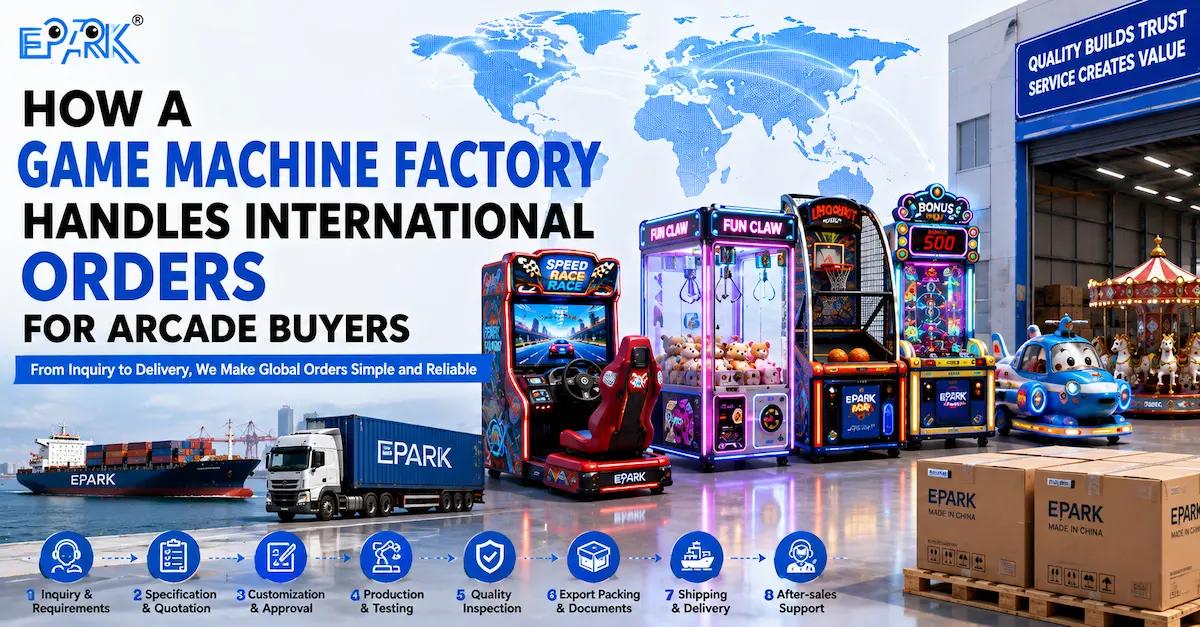
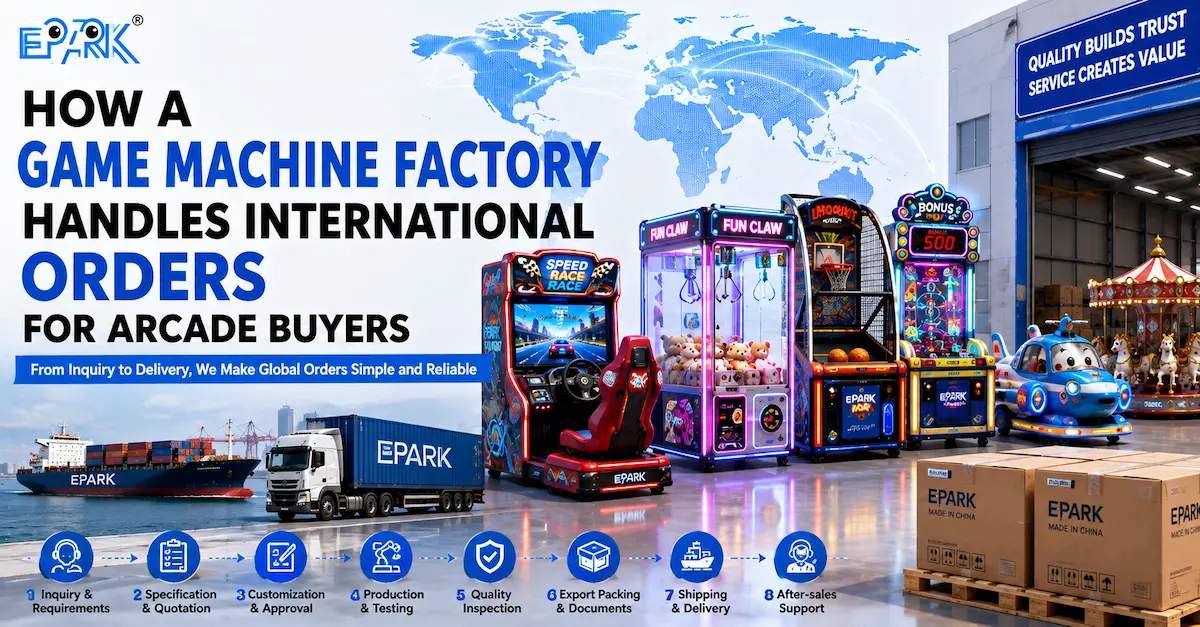
Project Requirements → Specification Confirmation → Customization Approval → Production → Quality Inspection → Export Packaging → Shipment Preparation → Delivery Support → After-sales
Each stage has a different purpose.
If specifications are unclear, the wrong configuration may be produced.
If customization is not approved correctly, branding or payment systems may differ from expectations.
If export packaging is inadequate, equipment that passed factory testing may still arrive damaged.
If spare-parts planning is ignored, a small component failure can create unnecessary downtime after installation.
For international buyers, understanding this workflow makes it easier to evaluate suppliers and control the order before problems become expensive.
Buyers can begin by reviewing EPARK's commercial arcade machine range to identify suitable equipment categories before discussing project-specific configurations.
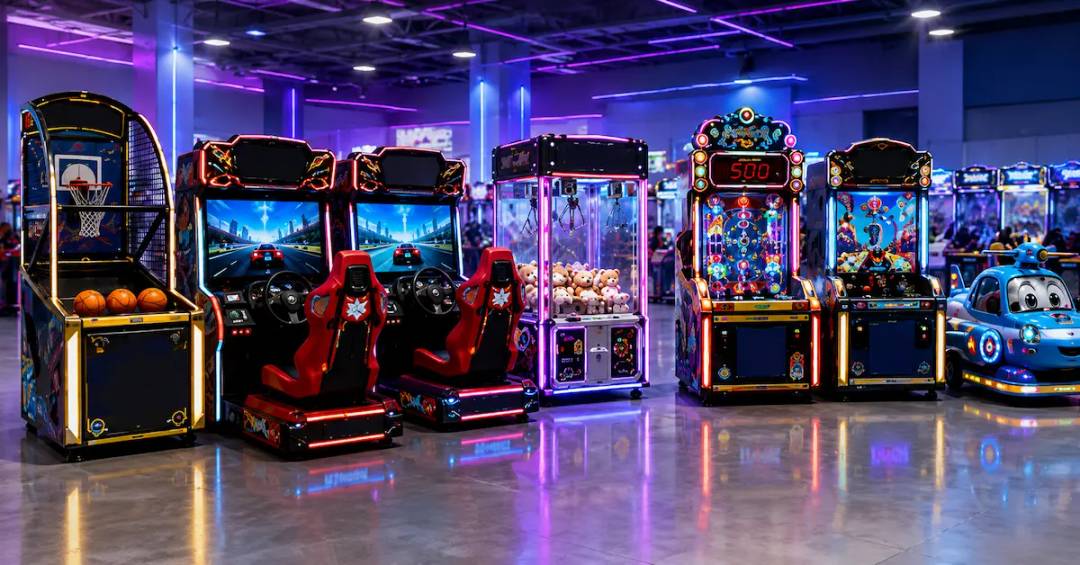
Step 1: Confirm the Destination Market and Project Requirements
A factory should first understand where and how the equipment will operate.
This information affects decisions throughout the order.
Important project details include:
- Destination country
- Venue type
- Target player group
- Equipment categories
- Quantity
- Opening or delivery schedule
- Branding requirements
- Payment method
- Electrical requirements
- Language requirements
- Spare-parts expectations
Why the Destination Market Matters
The same arcade machine may require different configurations for different countries.
International buyers may need to confirm:
- Voltage
- Frequency
- Plug type
- Interface language
- Payment configuration
- User instructions
- Packaging requirements
These should be discussed before production rather than corrected after machines are completed.
Define the Venue Scenario
The factory should also know whether the machines are intended for:
- Family entertainment centers
- Shopping mall arcades
- Indoor amusement centers
- Hotels or resorts
- Tourist attractions
- Distribution inventory
- Multi-location arcade chains
A distributor ordering machines for resale may need different product configurations from an operator developing one large FEC project.
Step 2: Confirm Exact Machine Specifications Before Quotation
One of the most common international purchasing risks is specification ambiguity.
“10 racing machines” is not a complete order specification.
The buyer and factory should confirm the exact version and configuration of each model.
| Specification Item | Buyer Should Confirm |
|---|---|
| Product model | Exact machine and version |
| Quantity | Units required for each model |
| Dimensions | Machine and packed dimensions where available |
| Voltage | Destination electrical requirement |
| Plug | Required plug configuration |
| Language | Interface or manual requirement |
| Payment | Coin, card, token or compatible system |
| Branding | Logo, artwork or private label |
| Accessories | Keys, cables and included items |
| Spare parts | Initial replacement-parts package |
A structured specification process reduces the risk that the buyer and factory are discussing visually similar but technically different machines.
Step 3: Select the Right Customization Level
International buyers frequently require some degree of customization.
However, not every order needs deep product development.
A game machine factory should help distinguish between simple market adaptation and more complex customization.
Branding Customization
Common requirements include:
- Company logo
- Brand colors
- Cabinet graphics
- Machine labels
- Packaging identity
This is particularly useful for:
- Arcade chains
- Regional distributors
- Private-label brands
Market Configuration
International orders may also require:
- Voltage changes
- Plug configuration
- Interface language
- Operator settings
- Payment-system adaptation
These changes are usually operational rather than cosmetic.
Cabinet or Product Customization
More advanced projects may involve:
- Cabinet dimensions
- Lighting
- Control layout
- Screen configuration
- Structural modifications
Deeper changes require stronger engineering review and may influence cost, lead time, packaging, and testing.
Buyers considering wider customization can also review EPARK's solutions through its arcade machine manufacturer information.
Step 4: Approve Artwork and Technical Configuration Before Production
Customization should be approved before production begins.
International orders often involve several people:
- Buyer
- Sales team
- Designer
- Engineer
- Production staff
- Quality-control team
If approval exists only in scattered email or chat messages, mistakes become more likely.
A useful approval sheet can record:
| Approval Area | Example |
| Product model | Final approved version |
| Artwork | File name/revision |
| Logo | Position and size |
| Cabinet color | Approved appearance |
| Voltage | Destination configuration |
| Payment | Exact system |
| Language | Required interface |
| Accessories | Final list |
| Packaging | Required method |
The buyer should know which version is final.
This becomes especially important if requirements change during negotiation.
Step 5: Prepare a Clear Commercial Order
After specifications are confirmed, the commercial order should clearly connect the machine configuration with the agreed purchase conditions.
Depending on the project, the quotation or order documentation may identify:
- Product model
- Quantity
- Unit configuration
- Customization
- Packaging
- Spare parts
- Delivery arrangement
- Production schedule
For international buyers, a detailed commercial document is valuable because it connects sales discussions with the production order.
The objective is simple:
The factory should manufacture what the buyer approved, not what someone remembers from an earlier conversation.
Step 6: Move the International Order Through Production Milestones
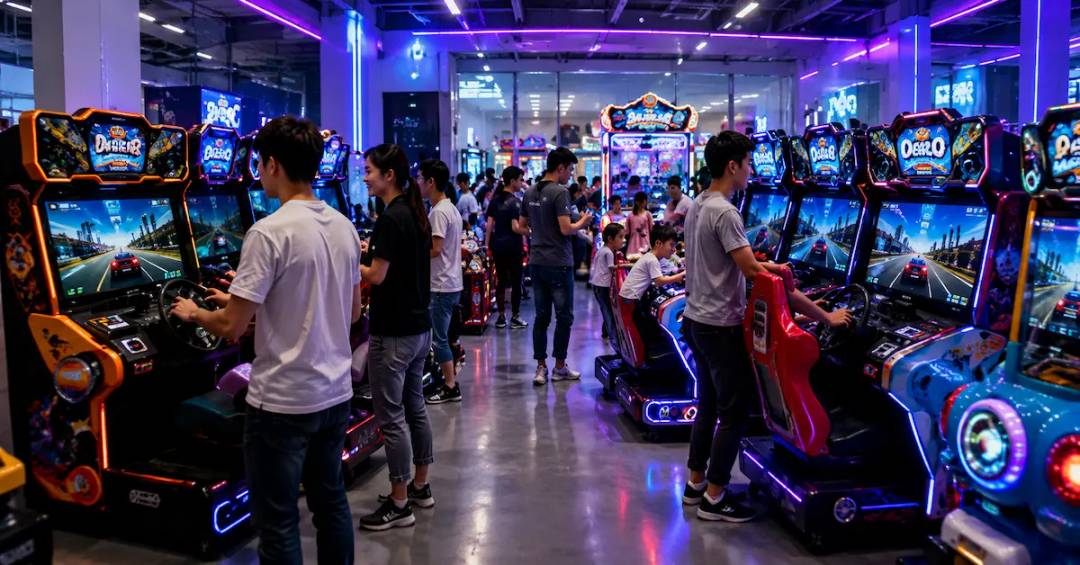
After order confirmation, buyers should understand how production progresses.
A typical manufacturing workflow may include:
Material Preparation → Cabinet/Component Preparation → Assembly → Configuration → Functional Testing → Final Inspection
Different machines may require different processes, but international buyers benefit from having identifiable milestones.
Material and Component Preparation
The factory prepares components and materials according to the approved configuration.
For customized machines, this may include:
- Custom artwork
- Special payment hardware
- Different electrical components
- Market-specific accessories
Assembly
Machines are assembled according to the approved specification.
Important production controls may include:
- Cabinet assembly
- Wiring
- Controls
- Displays
- Sensors
- Lighting
- Electronics
Configuration
Configuration may include:
- Language
- Payment settings
- Operator settings
- Software version
- Voltage-related components
Production Updates
For larger orders, progress visibility can help buyers coordinate:
- Venue construction
- Freight planning
- Import preparation
- Installation scheduling
A realistic schedule is generally more useful than an aggressive date that ignores testing and customization.
Step 7: Inspect Customized Machines Before Shipment
Quality inspection is particularly important for international orders because correcting problems after shipment is more difficult.
Sending a defective machine thousands of kilometers is usually more costly than identifying the problem before it leaves the factory.
International-order QC should verify both general operation and buyer-specific configuration.
| Inspection Area | What Should Be Checked |
| Appearance | Cabinet finish and condition |
| Branding | Correct artwork and logo |
| Controls | Buttons, steering, guns, sensors, etc. |
| Display | Screen function and visibility |
| Electrical | Approved voltage/configuration |
| Payment | Exact configured system |
| Software | Correct language and settings |
| Gameplay | Core machine functions |
| Accessories | Required items included |
| Packaging | Appropriate protection |
For customized orders, the QC team should compare the finished machine with the approved specification rather than only checking whether it powers on.
Step 8: Use Pre-Shipment Verification as a Buyer Control Point
Before shipment, overseas buyers may request appropriate verification of completed machines.
Depending on the order and supplier process, this could include:
- Final product photos
- Functional videos
- Configuration confirmation
- Packing photos
- Inspection information
This provides a useful point for detecting visible problems before the machines enter international logistics.
For new suppliers, new models, or heavily customized equipment, the buyer may also consider whether a sample or other verification step is appropriate before a large-volume order.
Step 9: Prepare Arcade Machines for Long-Distance Shipping
Export packaging is not only a logistics issue.
It is part of protecting the product.
International arcade machines may pass through multiple handling stages:
Factory → Warehouse → Container Loading → Port → International Transport → Destination Handling → Venue
The packaging should consider the equipment's specific vulnerabilities.
Important areas may include:
- Screen protection
- Cabinet corners
- Glass or acrylic surfaces
- Movable components
- Controls
- Decorative structures
- Internal parts
- Moisture exposure during transport
- Package identification
Large or unusually shaped machines may require additional planning.
A machine can leave the factory working perfectly and still arrive with damage if the packaging does not match the transportation risk.
Step 10: Plan Container Loading Before the Shipment Date
Bulk arcade machine orders often involve products with very different shapes.
For example:
- Racing simulators
- Basketball machines
- Claw machines
- Redemption equipment
- Kiddie rides
Their dimensions and packed volumes can vary significantly.
Container planning should therefore consider:
- Packaged dimensions
- Quantity
- Loading order
- Fragile equipment
- Weight distribution
- Installation or unloading sequence where relevant
Efficient loading can improve logistics planning while better protecting the equipment.
For buyers ordering multiple product categories, packaging information should be confirmed early rather than waiting until production is complete.
Step 11: Prepare International Shipping Documentation
The exact documents required depend on the shipment method, destination, products, and applicable import requirements.
International arcade equipment orders may involve documentation such as:
- Commercial invoice
- Packing list
- Transport or shipping documents
- Product-related technical documentation where applicable
Buyers should confirm destination-specific import and compliance requirements with the appropriate local professionals, authorities, customs brokers, or logistics partners.
A responsible factory should avoid assuming that requirements are identical for every country.
Step 12: Confirm Electrical and Market Requirements Before Dispatch
One of the most expensive international-order mistakes is discovering market compatibility problems after machines arrive.
Before dispatch, buyers should reconfirm important market-specific details such as:
Electrical Configuration
Confirm:
- Voltage
- Frequency where relevant
- Plug configuration
Language
Confirm:
- User interface
- Operator interface
- Manuals or instructions where required
Payment Configuration
Confirm the actual system installed on the final machine.
Possible operating models may include:
- Coins
- Tokens
- Card readers
- Compatible cashless systems
The important point is not whether the factory generally supports a technology.
The important point is whether the exact delivered machine has been configured and tested as approved.
Step 13: Prepare Spare Parts Before the Machines Arrive
International after-sales support should begin before shipment arrives.
Overseas buyers should identify components that may require replacement during operation.
Examples can include:
- Buttons
- Joysticks
- Sensors
- Power supplies
- LED components
- Motors
- Control boards
- Payment components
The required spare-parts strategy depends on the machine category, installed quantity, and operating environment.
A distributor operating many machines may need more local spare-parts inventory than a venue purchasing only a few units.
The factory should be able to identify parts according to the correct model and configuration.
Step 14: Prepare Installation and Technical Information
Before machines reach the venue, the operator should know what will be needed for installation.
Depending on the product, useful information may include:
- Machine dimensions
- Power requirements
- Assembly information
- Operating instructions
- Basic troubleshooting guidance
- Technical contact information
For large FEC projects, installation preparation should also consider venue access.
Questions include:
- Can the packaged machine fit through doors?
- Does the machine require partial assembly?
- Is sufficient power available?
- Is maintenance access available after placement?
These issues are easier to solve before the equipment arrives.
Step 15: Support the Buyer After Delivery
International cooperation does not end when equipment leaves the factory.
For commercial buyers, after-sales capability can determine whether a supplier is suitable for repeat orders.
Support may include:
- Technical troubleshooting
- Replacement-part identification
- Remote guidance
- Configuration support
- Product documentation
- Repeat-order assistance
A professional game machine factory should also maintain enough product information to identify which configuration the customer purchased.
This becomes increasingly important when the buyer places multiple orders over several years.
How International Buyers Can Manage Repeat Orders
The first order establishes the production standard.
Repeat orders should become easier, not more uncertain.
Buyers and factories should maintain controlled information for:
- Machine model
- Artwork
- Software version
- Payment system
- Electrical configuration
- Accessories
- Packaging
- Spare parts
If the buyer changes a specification, the revision should be recorded rather than silently replacing the previous version.
For distributors and arcade chains, this helps maintain consistency across multiple shipments and locations.
International Arcade Order Workflow
A complete international order can be summarized as follows:
| Stage | Factory Responsibility | Buyer Responsibility |
| Inquiry | Understand project needs | Provide project information |
| Specification | Confirm technical configuration | Approve requirements |
| Customization | Prepare artwork/configuration | Approve final version |
| Production | Manufacture according to specification | Monitor key milestones |
| QC | Test and inspect equipment | Review agreed verification |
| Packaging | Protect equipment for transport | Confirm logistics requirements |
| Shipment | Prepare agreed shipment information | Coordinate freight/import needs |
| Installation | Provide relevant support | Prepare venue and utilities |
| After-sales | Provide technical and parts support | Maintain machines and report issues |
| Repeat order | Reproduce controlled configuration | Confirm changes or new requirements |
Three International Order Risks Buyers Should Control
Specification Risk
The buyer expects one configuration while the factory produces another.
Control it with:
- Detailed specifications
- Written approval
- Revision control
Shipping Risk
The machine works at the factory but arrives damaged.
Control it with:
- Appropriate export packaging
- Packing verification
- Logistics planning
After-Sales Risk
The equipment arrives successfully but replacement parts or technical information are unavailable.
Control it with:
- Spare-parts planning
- Product documentation
- Technical support arrangements
A well-managed international order addresses all three risks before shipment.
How EPARK Supports International Arcade Equipment Buyers
EPARK works with overseas arcade operators, distributors, FEC projects, and entertainment equipment buyers requiring commercial arcade equipment and customization support.
International buyers can begin by providing:
- Destination market
- Venue type
- Product categories
- Quantity
- Branding requirements
- Voltage and plug requirements
- Payment configuration
- Language needs
- Project schedule
- Spare-parts expectations
The project can then move through:
Product Selection → Specification Confirmation → Customization Approval → Production → Quality Inspection → Packing → Shipment Preparation → After-Sales Support
Buyers can explore EPARK's commercial arcade machines, learn more through the EPARK company profile, review common purchasing topics in the arcade machine FAQ, or contact EPARK to discuss an international arcade equipment order.
FAQ About International Arcade Machine Orders
How does a game machine factory handle international orders?
A professional factory normally confirms the buyer's market and specifications, completes customization approvals, schedules production, performs quality checks, prepares export packaging and shipment information, and provides after-sales support.
What information should overseas arcade buyers provide?
Buyers should provide the destination market, machine categories, quantities, venue type, required configurations, voltage, plug type, language, payment system, branding needs, and expected schedule.
Can voltage and plugs be customized for international arcade machines?
Market-specific electrical configurations may be available depending on the machine. Buyers should confirm exact requirements before production.
Can arcade machines support different payment systems?
Depending on machine and system compatibility, different payment configurations may be possible. Buyers should confirm and test the exact system required for their project.
How are arcade machines inspected before international shipment?
Inspection may include cabinet appearance, controls, displays, electronics, payment functions, software configuration, gameplay, accessories, branding, and packaging.
How should arcade machines be packed for export?
Packaging should protect vulnerable areas such as screens, controls, corners, glass, decorative elements, and movable components during long-distance handling and transportation.
What documents may be used for international arcade equipment orders?
Depending on destination and shipment requirements, documentation may include commercial invoices, packing lists, shipping documents, and product-related information. Buyers should verify exact import requirements for their market.
Should buyers order spare parts with their first shipment?
For many commercial operations, preparing commonly needed spare parts with the initial order can reduce future downtime. The appropriate spare-parts package depends on machine type and installed quantity.
How does overseas after-sales support work?
Support may involve remote troubleshooting, technical guidance, replacement-part identification, configuration assistance, and documentation, depending on the supplier and project.
How can distributors manage repeat international orders?
Maintain controlled product specifications, artwork versions, payment configurations, electrical requirements, spare-parts information, and revision records so future production can reproduce the approved machines consistently.
Conclusion
International arcade equipment purchasing is not simply a shipping transaction.
A reliable game machine factory should manage the order as a complete process:
Requirements → Specifications → Customization → Production → QC → Export Packaging → Shipment Preparation → Installation Support → After-Sales
For international arcade buyers, the most important control points are clear specifications, verified configurations, pre-shipment quality inspection, suitable packaging, and long-term technical support.
These controls help reduce the three major international procurement risks:
Specification Errors → Shipping Damage → After-Sales Downtime
For distributors, FEC operators, arcade chains, and entertainment project companies, understanding this workflow makes it easier to communicate with suppliers, manage project schedules, and build repeatable international purchasing processes.
The strongest international factory relationship is therefore not defined only by whether machines arrive.
It is defined by whether the correct machines arrive in the agreed configuration, can be installed efficiently, remain supportable after delivery, and can be reproduced consistently when the buyer places the next order.
Disclaimer
The information provided on this website is for general informational purposes only.
While EPARK Arcade Game Machine Manufacturer strives to ensure accuracy and reliability, no warranties—express or implied—are made regarding completeness, performance, or applicability.
Product specifications, designs, and features may vary depending on usage, customization, and customer requirements.
Buyers are responsible for verifying all technical details, compliance certifications, and suitability before procurement.
EPARK shall not be held liable for any direct, indirect, incidental, or consequential damages arising from the use of this website or its content, including but not limited to business losses, data errors, or equipment misuse.
For tailored solutions or further verification, please visit our Contact Us
Intellectual Property Notice
All articles, product images, videos, catalogs, software, and related materials published on this website are the intellectual property of EPARK, unless otherwise stated.
Unauthorized reproduction, distribution, modification, or commercial use of any content is strictly prohibited without prior written consent from EPARK.
EPARK reserves the right to take legal action against any unauthorized use, including but not limited to copyright infringement, misrepresentation, or unfair competition.
Trademarks
The name EPARK, the EPARK logo, and all related brand elements displayed on this website are registered trademarks or trade names of Guangzhou EPARK Electronic Technology Co., Ltd.
Other product names, company names, or logos mentioned on this site may be trademarks of their respective owners.
Unauthorized use of EPARK's trademarks for commercial purposes, including advertising, promotions, or product packaging, is strictly prohibited.
Governing Law
These terms are governed by the laws of the People's Republic of China.