

What Should an International Arcade Machine Shipping Supplier Actually Manage?
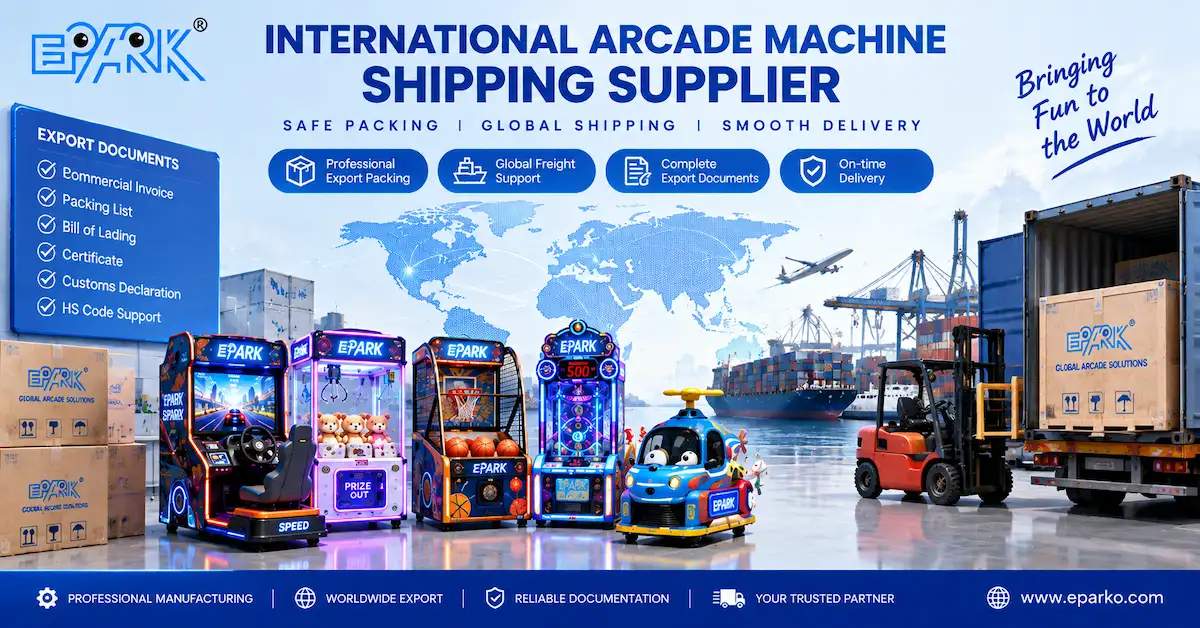
An international arcade machine shipping supplier should connect the approved machine order with export packing, packed-equipment data, container or freight planning, shipment documentation, loading coordination, and destination handover. For an overseas buyer, “we can ship worldwide” is not enough because a successful shipment depends on knowing exactly what is being packed, how many packages each machine creates, who books transportation, who checks the documents, and what the receiving team needs when the equipment arrives. EPARK’s international arcade order process treats export preparation as part of a wider sequence that includes specification confirmation, production, quality inspection, packing, shipment preparation, and after-sales support rather than reducing an international order to payment and dispatch.
The buyer should therefore evaluate shipping capability as part of the equipment supply chain.A supplier that understands the dimensions, construction, removable sections, electronic components, and service requirements of the machines can prepare more useful shipping information than a logistics provider working only from a product name. At the same time, the arcade factory should not be assumed to perform every logistics task. Freight booking, carrier documentation, cargo insurance, destination customs processing, inland delivery, unloading, and venue installation may involve different parties. The quotation should clearly define who handles each stage.

Which Overseas Buyers Need a Structured Shipping Plan?
An FEC opening with racing machines, claw machines, basketball equipment, redemption games, VR products, and kiddie rides needs a different shipping plan from a distributor importing twenty identical cabinets. Arcade chains may need equipment separated by store destination, while a regional distributor may prefer consolidated inventory for later customer delivery. A mall project may need delivery coordinated with restricted loading hours or limited access to the entertainment floor. These situations make the international arcade machine shipping supplier part of the procurement decision rather than an afterthought.
Buyers should first finalize the equipment mix through EPARK’s commercial arcade product and solution range, then build the logistics requirement around the selected machines. Where the equipment list is still changing, request only a preliminary freight estimate and update it after the final configuration and packed dimensions are confirmed. EPARK’s FEC purchasing guidance also emphasizes export packaging, shipping coordination, freight-forwarder cooperation, and installation information as important considerations for international projects.
Start Shipping Planning With Packed Specifications, Not Machine Count
One of the most common mistakes in commercial arcade shipping is asking, “How many machines fit in a container?” before the shipping configurations are known. A cabinet’s operating dimensions do not necessarily equal its packed dimensions. Seats, scoreboards, basketball cages, headers, controllers, accessories, and other approved assemblies may be packaged separately. Different packaging methods also change volume and weight.
Use the following worksheet before requesting a final freight plan. These are information fields buyers should obtain for their actual order, not universal EPARK specifications.
| Shipping Specification | What Should Be Confirmed | Why It Matters |
|---|---|---|
| Machine reference | Exact model, version,quantity and configuration | Connects logistics data to the approved order |
| Operating dimensions | Final assembled L × W × H | Venue planning |
| Packed dimensions | External dimensions of each package | Freight and loading calculations |
| Package count | Number of packages for each machine | Receiving and reconciliation |
| Net weight | Machine weight before export packaging | Equipment handling reference |
| Gross weight | Finished packed weight | Freight and unloading planning |
| Shipping configuration | Fully assembled or approved separated sections | Destination assembly requirements |
| Handling requirements | Permitted lifting and support information | Reduces handling improvisation |
| Orientation | Approved shipping position | Loading and storage planning |
| Accessories | Cables, keys, hardware,manuals and separately packed items | Prevents missing-item disputes |
| Package identification | Order and machine-linked labels | Easier warehouse receiving |
| Destination | Port, warehouse, project location or distributor hub | Determines logistics planning context |
EPARK’s container loading service guide similarly recommends using packed dimensions, weight, package count, handling information, and actual machine configuration to plan mixed arcade shipments rather than relying on a generic machine quantity.
Different Arcade Machines Create Different Shipping Requirements
Claw Machines and Prize Equipment
Claw machines often include transparent display surfaces, lighting, doors, control areas, prize mechanisms, and internal assemblies that should be prepared according to the model-specific packing procedure. Overseas buyers should confirm whether internal moving components require transport preparation, how cabinet corners and transparent panels are protected, where keys and accessories are stored, and how separate prize or spare-parts cartons are identified. Do not assume that every claw machine uses the same package simply because the cabinet dimensions appear similar.
Racing and Driving Simulators
Racing equipment may combine a display cabinet, steering controls, pedals, seat assemblies, lighting, and optional linked or simulator functions. Shipping planning should identify which assemblies remain attached and which are separately packed. If a seat, platform, or decorative structure is detached for transport, its package must be connected to the parent machine on the packing list.Destination staff should receive the appropriate assembly and test information before the shipment arrives.
Basketball and Sports Machines
Basketball machines can include upper frames, nets, scoreboards, ramps, ball-return structures, sensors, and multiple basketballs. Their assembled footprint may therefore differ substantially from the shipping configuration. Buyers should obtain package counts, assembly requirements, and accessory information before accepting a container estimate. Similar checks apply to other larger sports machines and air-hockey equipment.
VR and Motion Equipment
VR equipment requires particular attention to displays, headsets, controllers, seats, and motion-related assemblies where fitted. Do not assume every VR machine uses the same transportation method. Confirm which electronic and mechanical parts need special protection, which accessories travel separately, and whether installation or configuration support is required at the destination. EPARK’s broader international arcade machine buying guidance recommends matching packing, shipping, installation, and spare-parts planning to the exact equipment configuration rather than treating all commercial arcade machines alike.
Review Export Packaging Before Freight Is Booked
An international arcade machine shipping supplier should be able to explain how the selected equipment will be protected for the planned transport route. EPARK’s design and production process describes protective materials and export packing as part of the production-to-delivery workflow. Buyers should ask which packaging method applies to each actual machine and whether any additional reinforcement is proposed for specific equipment. The presence of foam, film, a carton, wooden reinforcement, or another material is not enough by itself; how those materials are applied to the selected machine is what matters.
Inspect packing workmanship as a separate acceptance stage. Ask for photographs that show the machine before the outer packaging is closed, protection around vulnerable areas, package identification, and any separate assemblies.If the order includes several customized machines that look similar from the outside, package labels should distinguish them by order or model reference. A good shipping record should allow the receiving team to identify the machine without opening every package.
Separate Packaging Protection From Container Securing
Packaging protects the equipment itself, while container loading and cargo securing address how the packages behave during transportation. They are related but not identical responsibilities. Buyers should ask competent logistics personnel to determine how packages are positioned and secured for the actual container, package weights, shapes, and route conditions. Do not specify a fixed number of straps, braces, or other securing materials from a generic blog because actual requirements depend on the shipment.
EPARK’s arcade machine container loading guide recommends defining loading arrangements, handling responsibilities, shipment records, and destination unloading requirements as part of the project. This is particularly important for mixed FEC containers where large racing or sports equipment, compact prize machines, and accessory cartons may all share the same shipment.
Compare International Shipping Arrangements by Responsibility
A strong supplier quotation should tell the buyer who controls each stage rather than simply presenting one freight number. The comparison below is a purchasing framework, not a list of fixed EPARK shipping packages.
| Shipping Arrangement | Buyer Situation | What Must Be Clarified | Main Risk to Control |
|---|---|---|---|
| Buyer-appointed forwarder | Importer already has a logistics partner | Factory handover, booking data,loading schedule and documents | Gaps between supplier and forwarder responsibilities |
| Supplier-coordinated freight | Buyer wants factory-side logistics assistance | Freight scope, route, included charges and destination responsibility | Assuming the quote covers services it does not include |
| Full-container shipment | Larger or mixed FEC equipment order | Container type, packed equipment plan, loading records | Poor package allocation or unrealistic machine count |
| Consolidated shipment | Smaller order shares freight capacity | Handling stages,consolidation warehouse and package protection | More transfers and less direct control |
| Multi-container project | Large FEC or distributor shipment | Which machines and packages enter each container | Difficult destination reconciliation |
| Phased project shipment | Venue equipment arrives in stages | Installation sequence and equipment dependencies | Receiving machines before required related components |
The best option depends on volume, destination, project schedule, existing forwarder relationships, receiving resources, and installation sequence. A full container is not automatically the best choice for every buyer, and a lower freight quote should not be evaluated without understanding what services are excluded.
Coordinate Shipping Documents With the Physical Cargo

International shipping becomes more manageable when the commercial documents describe the equipment actually packed. EPARK’s arcade machine export documentation guide emphasizes matching order information, commercial invoices, packing lists, package references, loading records, and shipment data. Buyers should review final packed dimensions, quantities, model names, gross weights, and package counts before the logistics documents are finalized.
A commercial invoice and packing list are supplier-side commercial records, while carrier documents, customs processing, insurance documentation, and other records may involve the forwarder, carrier, broker, insurer, importer, or authorized organization. Do not assume that choosing an international arcade machine shipping supplier means the factory becomes responsible for every document required at destination.Before dispatch, create a responsibility matrix showing who prepares, reviews, and receives each document.
Quality Control Should Be Completed Before Machines Enter International Logistics
International transportation should begin only after the approved equipment configuration has passed the agreed pre-shipment checks. EPARK’s international-order process places quality inspection before export packaging and shipment preparation, which is useful because configuration problems are generally easier to address before equipment enters international transit.
For each machine, connect the QC record to the same model or order reference used in the packing and shipping records. Check relevant gameplay functions, controls, display and audio, payment configuration, customization, supplied accessories, and applicable machine-specific functions. After the machine is packed, conduct a separate packaging inspection. After loading, create a loading record. This produces three distinct control points: machine acceptance → packing acceptance → shipment handover.
Plan Container Loading Around Destination Unloading
A loading arrangement that works well at the factory may still cause problems if the destination team cannot unload or identify the equipment efficiently. Before shipment, provide receiving information such as dock or street access, unloading equipment, door dimensions, elevators where relevant, temporary storage space, and the route from the delivery point to the final arcade location. The receiving contractor should review package dimensions and gross weights before confirming its handling plan.
For a new FEC, consider installation sequence as well. If some machines require assembly, payment-system configuration, or technical testing before other areas can open, the receiving plan should identify those dependencies. Do not demand a particular container arrangement if it conflicts with safe and competent loading practice; instead, share the desired installation sequence with the shipping team early enough for it to be considered.
Keep Production Lead Time, Freight Time, and Opening Date Separate
One of the biggest scheduling mistakes overseas arcade buyers make is treating the factory dispatch date as the project completion date.Production preparation, final inspection, packaging, freight booking, loading, international transit, port processing, destination procedures, inland delivery, unloading, installation, testing, and staff preparation are separate activities.
EPARK’s overseas arcade machine guide similarly advises buyers to separate manufacturing and shipment preparation from international transit, customs, local delivery, installation, and opening preparation. Build the schedule backward from the intended venue opening and identify which dates are confirmed, estimated, or dependent on another party. This gives buyers a more realistic project plan than asking a supplier to guarantee an opening date based only on factory production time.
Compare Total Delivered Cost, Not Only Sea Freight
The freight rate is only one element of international equipment delivery. Depending on the agreed scope, buyers may also need to consider export packing, special reinforcement, factory-to-port transport, loading labor, freight-forwarder charges, documentation, cargo insurance if selected, destination handling, customs-related costs, local taxes and duties where applicable, inland delivery, unloading, storage, and installation labor.
Request quotations that clearly identify what is included and excluded. If one supplier's freight quotation appears significantly cheaper, determine whether both quotations cover the same route, container type, services, and destination responsibilities. A professional international arcade machine shipping supplier should make the commercial boundary understandable enough for the buyer to compare proposals on the same basis rather than hiding differences behind one “shipping cost” figure.
Include OEM/ODM Changes in the Shipping Review
Customization can change the logistics plan. An enlarged cabinet header, revised seat assembly, different display structure, branded accessory carton, payment-system hardware, or other modification may alter packed dimensions, package counts, gross weights, and assembly requirements. EPARK supports OEM/ODM and customization for commercial arcade projects through its company and manufacturing services, so private-label and distributor orders should connect final design approval with shipping approval.
After customization is frozen, update the specification sheet and ask whether any packing data changed.Do not use an early standard-product freight estimate as the final shipping figure after substantial structural modifications. The approved machine revision, packing list, QC record, and spare-parts references should remain traceable to the same order.
Prepare Spare Parts Before the Machines Reach the Destination
Shipping strategy should include after-sales preparation. A remote venue waiting for one small critical part after opening can face more disruption than a buyer who planned a model-specific maintenance kit with the original shipment. Ask which approved replacement components are appropriate for the final equipment mix, which parts can be replaced by trained local technicians, and how future parts inquiries will be connected to machine versions.
EPARK provides technical and after-sales information through its service page and FAQ. For an international order, confirm the exact spare-parts and support arrangement rather than assuming every machine receives the same kit. Keep separately packed spare parts identified on the packing list so they can be located quickly after unloading.
Define Installation Support Before Shipment
An international arcade machine shipping supplier should help the buyer understand what happens after the equipment arrives, but shipping and installation remain different project stages. EPARK’s FEC buying guidance discusses installation manuals, videos, shipping coordination, and technical support for overseas projects.
Before dispatch, identify who unloads the machines, who assembles approved separated sections, who completes local electrical work, who configures payment systems, and who performs commissioning. Make manuals and installation information available to the local team before the container arrives. If remote technical support is planned, confirm communication channels and time arrangements. If on-site assistance is being considered, establish its availability and commercial scope separately instead of assuming that freight automatically includes installation labor.
How Should Buyers Evaluate an International Arcade Machine Shipping Supplier?
A buyer should evaluate shipping capability by asking for evidence and process details rather than relying on broad statements about worldwide exports.
| Evaluation Area | Basic Question | Better Buyer Requirement |
|---|---|---|
| Packing | “Do you export pack machines?” | Show the proposed packing method for each selected machine |
| Packed data | “How big is it?” | Provide package-level dimensions,weights and package counts |
| Freight | “Can you ship to my country?” | Define route, booking responsibility and quotation scope |
| Container planning | “How many machines fit?” | Build a plan from final packed configurations |
| QC | “Do you test before shipping?” | Connect inspection evidence to actual machine references |
| Documents | “Can you provide documents?” | Define supplier,carrier and buyer document responsibilities |
| Loading | “Can you load the container?” | Identify packages and retain appropriate loading records |
| Destination | “Will it arrive safely?” | Plan receiving, unloading and discrepancy reporting |
| Installation | “Do you provide support?” | Define remote/on-site scope and local responsibilities |
| After-sales | “Do you supply spare parts?” | Link replacement support to machine model and version |
This is what turns international shipping from a final administrative task into a controlled procurement stage.
What Should You Send EPARK for an International Shipping Quote?
To request a practical shipping proposal, provide the destination country and port or delivery location, buyer type, machine models, quantities, requested customization, preferred shipping window, and whether a freight forwarder has already been appointed. For an FEC project, also provide the floor plan, project schedule, installation location, and receiving conditions where available. For distributor purchases, explain whether the shipment serves one customer, several destinations, or warehouse inventory.
Review EPARK’s arcade machines and solutions, then use the Contact Us page to send the equipment list and logistics requirements. Request that the quotation distinguish equipment cost, packing, shipping scope, included services, exclusions, and any information that still requires confirmation.
Frequently Asked Questions
1.What Does an International Arcade Machine Shipping Supplier Provide?
The scope can include export packing, packed-machine data, freight coordination, container-loading preparation, commercial shipping information, and technical handover. The exact responsibilities should be confirmed for the individual order because freight, customs, insurance, destination delivery, unloading, and installation may involve other parties.
2. What Is the Best Shipping Method for Commercial Arcade Machines?
There is no single best method for every order. The suitable arrangement depends on machine quantity, packed size and weight, destination, timing, freight availability, equipment value, handling requirements, and whether the buyer is shipping a complete FEC or a smaller equipment order.
3. How Many Arcade Machines Fit in a 40HQ Container?
Do not use a universal machine count. Calculate from the final packed dimensions, package weights, shipping configurations, container constraints, and competent loading assessment. Mixed claw machines, racing cabinets, basketball equipment, and VR machines can produce very different loading arrangements.
4. Can EPARK Ship a Mixed FEC Equipment Order?
EPARK publishes information covering mixed-equipment container planning and international FEC orders. Buyers should provide the final models and quantities so packing data and shipment planning can be based on the actual order rather than a generic FEC estimate.
5. What Packaging Information Should I Request?
Request final packed dimensions, gross weight, package count, shipping configuration, handling information, package identification, separately packed accessories, and the proposed protective method. Ask for order-specific packing records where appropriate.
6. Does International Shipping Include Customs Clearance?
Do not assume that it does. Ask the quotation to state clearly who handles export procedures, freight, cargo insurance if required, destination customs processing, taxes or duties, port charges, inland delivery, and unloading. Your customs broker or logistics provider should confirm destination requirements.
7.Can I Use My Own Freight Forwarder?
Discuss this during the quotation stage. If you appoint your own forwarder, define who supplies packed cargo information, books container delivery, coordinates loading, prepares commercial documents, and reviews transport-document drafts.
8. Should Spare Parts Ship With the Arcade Machines?
For many overseas FEC and distributor orders, discussing a model-specific spare-parts kit before shipment can simplify future maintenance. The list should reflect the actual machine mix and local technical capability rather than using the same generic parts package for every customer.
9. Does EPARK Provide Installation Support After International Shipping?
EPARK publishes installation guidance and technical-support information for overseas buyers. The buyer should confirm the exact remote or on-site support scope, responsibilities, availability, and any additional costs for the actual project before shipment.
10.What Information Is Needed for an Accurate Arcade Shipping Quote?
Provide the destination, selected models, quantities, final or requested customization, target shipping period, preferred delivery arrangement, and existing freight-forwarder information. Final freight and loading planning should be updated once packed dimensions, gross weights, and package counts are confirmed.
Conclusion
Choosing an international arcade machine shipping supplier is ultimately about controlling the transition from finished equipment at the factory to usable machines at the overseas venue. FEC operators, distributors, arcade chains, and project buyers should connect machine specifications, quality inspection, export packaging, packed data, freight responsibilities, documents, container loading, destination unloading, spare parts, and installation preparation instead of treating shipping as a single freight quotation. EPARK supports international commercial arcade projects across equipment selection, manufacturing, packing, shipment preparation, and after-sales processes, but the exact responsibilities and costs should always be confirmed against the individual order. Contact EPARK with your destination, machine list, quantities, customization requirements, shipping window, and receiving conditions to discuss an order-specific international arcade shipping plan.
Disclaimer
The information provided on this website is for general informational purposes only.
While EPARK Arcade Game Machine Manufacturer strives to ensure accuracy and reliability, no warranties—express or implied—are made regarding completeness, performance, or applicability.
Product specifications, designs, and features may vary depending on usage, customization, and customer requirements.
Buyers are responsible for verifying all technical details, compliance certifications, and suitability before procurement.
EPARK shall not be held liable for any direct, indirect, incidental, or consequential damages arising from the use of this website or its content, including but not limited to business losses, data errors, or equipment misuse.
For tailored solutions or further verification, please visit our Contact Us
Intellectual Property Notice
All articles, product images, videos, catalogs, software, and related materials published on this website are the intellectual property of EPARK, unless otherwise stated.
Unauthorized reproduction, distribution, modification, or commercial use of any content is strictly prohibited without prior written consent from EPARK.
EPARK reserves the right to take legal action against any unauthorized use, including but not limited to copyright infringement, misrepresentation, or unfair competition.
Trademarks
The name EPARK, the EPARK logo, and all related brand elements displayed on this website are registered trademarks or trade names of Guangzhou EPARK Electronic Technology Co., Ltd.
Other product names, company names, or logos mentioned on this site may be trademarks of their respective owners.
Unauthorized use of EPARK's trademarks for commercial purposes, including advertising, promotions, or product packaging, is strictly prohibited.
Governing Law
These terms are governed by the laws of the People's Republic of China.