
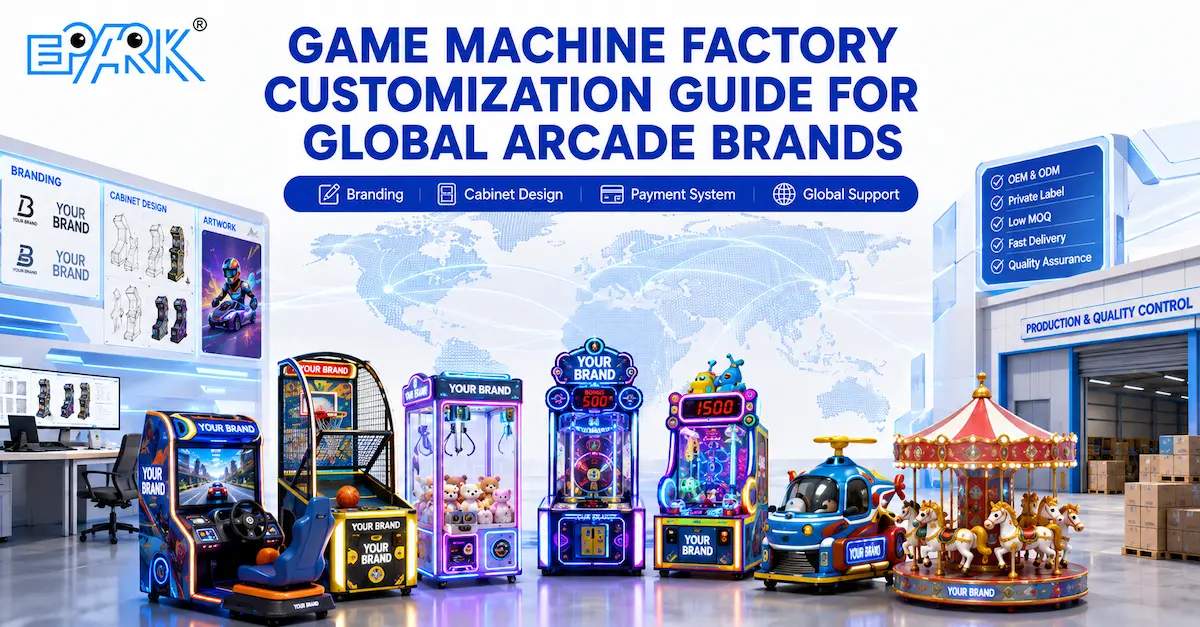
What Does Game Machine Customization Actually Include?
For global arcade brands, FEC chains, distributors, and entertainment operators, customization can mean very different things.
One buyer may only need a company logo and branded artwork applied to an existing machine. Another may require different voltage, language, payment hardware, and operating settings for a new country. A larger distributor may want a redesigned cabinet, while a strategic brand may need a completely new product developed through OEM or ODM cooperation.
That is why game machine customization should not be treated as one service.
It is better understood as a range of customization levels, from low-risk visual changes to deeper engineering and product development.
Choosing the correct level matters because every additional modification affects some combination of:
- Cost
- Development time
- Production complexity
- Quality control
- Spare-parts management
- Shipping
- Repeatability
- After-sales service
A global buyer should therefore begin with one question:
Which customization creates real value for my market, and which changes are unnecessary?
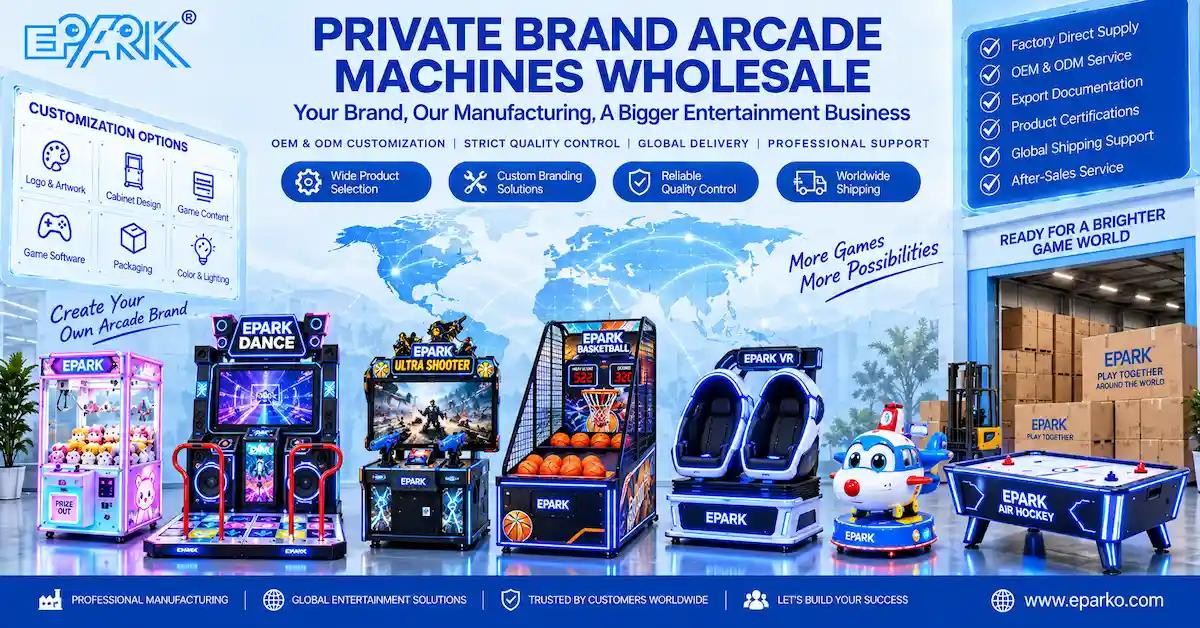
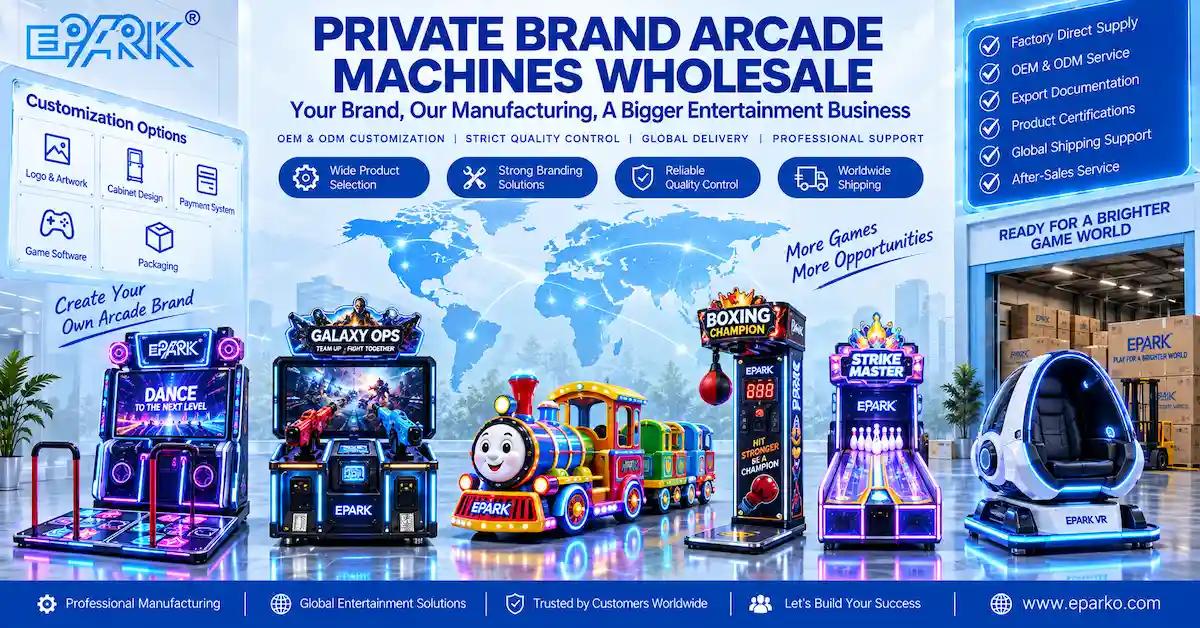
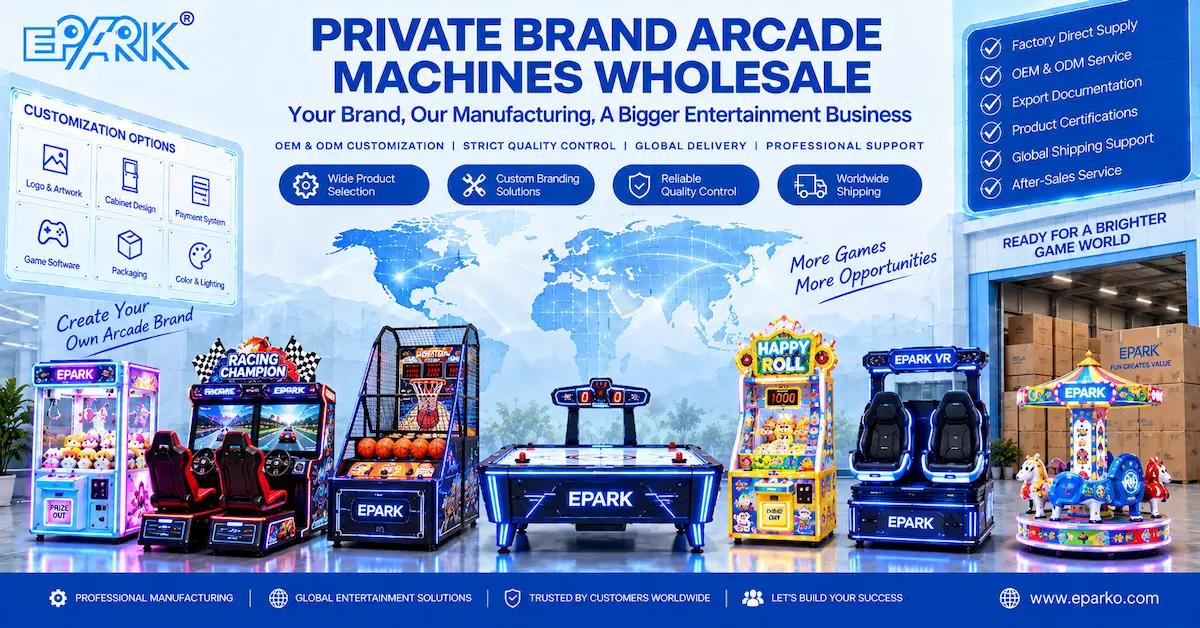
Buyers can first review EPARK's commercial arcade machines to identify existing equipment platforms before deciding how much customization is actually required.
Four Levels of Game Machine Customization
A useful way to evaluate customization is to divide it into four levels.
| Customization Level | Typical Changes | Best For | Development Complexity |
|---|---|---|---|
| Branding | Logo, colors, artwork, labels | Operators and distributors | Low |
| Configuration | Payment, voltage, language, settings | Global markets | Low–Medium |
| Product | Cabinet, controls, lighting, screens | Differentiated venues and brands | Medium–High |
| OEM/ODM | New product concept and development | Strategic brands and distributors | High |
The correct level depends on the buyer's business model.
A single arcade operator does not necessarily need a new cabinet structure.
A regional distributor building its own product line may need much more than logo printing.
Level 1: Branding Customization
Branding is usually the simplest form of arcade machine customization.
Typical options include:
- Logo placement
- Brand colors
- Cabinet decals
- Artwork
- Product labels
- Startup graphics
- Branded packaging
This level is useful when an existing machine already fits the target market technically and commercially.
When Branding Customization Makes Sense
It is particularly suitable for:
- Arcade chains wanting consistent visual identity
- Distributors building a private-label range
- FECs matching equipment to venue colors
- Operators wanting recognizable branded machines
The important point is consistency.
Adding a logo to every available surface does not automatically create a professional brand identity. Buyers should consider how machine artwork, signage, interior design, and other equipment work together.
For global brands, standardized artwork files and approved logo positions also make future repeat orders easier to control.
Level 2: Configuration Customization
For international buyers, configuration changes are often more important than visual changes.
A machine that looks correct but does not match the local electrical or payment environment can create installation problems after arrival.
Voltage and Plug Configuration
Buyers should confirm:
- Required voltage
- Frequency
- Plug type
- Destination market
- Any project-specific electrical requirements
These details should be documented before production.
Language and Interface Settings
Depending on the machine, localization may include:
- User interface language
- Operator menus
- Instructions
- Game settings
- Pricing parameters
- Redemption settings
Localization helps reduce the amount of modification required after shipment.
Payment System Configuration
Commercial venues may use:
- Coins
- Tokens
- Card readers
- RFID systems
- Compatible cashless management systems
The exact payment configuration should be confirmed on the individual machine rather than assumed from a general supplier statement.
A buyer should ask:
Has this exact payment setup been integrated and tested on this exact machine configuration?
That is more useful than asking whether the factory “supports card systems.”
Level 3: Cabinet and Product Customization
Deeper game machine customization changes the physical equipment itself.
Typical requirements include:
- Cabinet dimensions
- Cabinet shape
- Materials
- Control layout
- Screen position
- Seat configuration
- Decorative structures
- LED lighting
- Internal component positioning
This level can create stronger market differentiation but also introduces more development variables.
Custom Cabinet Design Should Solve a Business Problem
A custom cabinet should have a clear purpose.
For example:
A shopping mall operator may need a smaller footprint.
A children's FEC may require lower controls.
A premium venue may need a stronger visual identity.
A distributor may want a recognizable cabinet family that competitors cannot easily compare directly.
The commercial requirement should come before the design.
A cabinet that looks unique but is difficult to manufacture, ship, install, or repair may reduce rather than increase long-term value.
Artwork and Theme Customization
Artwork can help equipment match:
- Venue themes
- Target age groups
- Brand identity
- Seasonal programs
- Regional visual preferences
Possible themes may include:
- Racing
- Sports
- Space
- Fantasy
- Ocean
- Adventure
- Family entertainment
However, themed artwork should not compromise readability.
Players still need to identify the machine, understand how to interact with it, and locate important controls.
Control and Screen Configuration
Changes to controls or screens should consider player ergonomics.
Useful questions include:
- Can the target player reach the controls comfortably?
- Is the display visible at the expected playing position?
- Does the control arrangement support multiplayer use?
- Will spectators block surrounding circulation?
- Can technicians access the controls for service?
Custom product design should improve usability rather than simply create a different appearance.
Level 4: OEM and ODM Product Development
The deepest customization level involves new product development.
This may be appropriate when existing arcade machines do not solve the buyer's market requirement.
OEM Development
OEM cooperation is commonly used when the buyer already has relatively clear specifications or product requirements and needs a manufacturer to produce or modify the equipment accordingly.
ODM Development
ODM cooperation may involve more factory participation in:
- Concept development
- Cabinet engineering
- Component integration
- Prototype development
- Testing
- Revision
- Production preparation
For distributors developing differentiated products, ODM can provide more flexibility, but it also requires stronger project management.
The buyer should not choose deeper development simply because it sounds more advanced.
If an existing platform can meet the commercial need with branding or configuration changes, that may be the lower-risk option.
Which Customization Level Fits Your Business?
Different buyer types usually need different levels of customization.
| Buyer Type | Most Relevant Customization | Main Objective |
| Single arcade operator | Branding + configuration | Venue identity and compatibility |
| FEC chain | Branding + cabinet consistency | Multi-location standardization |
| Distributor | Private label + configuration | Regional product portfolio |
| Regional arcade brand | Cabinet + branding + payment | Market differentiation |
| Strategic product owner | OEM/ODM | Unique product development |
This framework helps prevent unnecessary development.
The key principle is:
Customize only what creates measurable commercial or operational value.
How Game Machine Customization Affects Cost
There is no single customization price because the cost depends on the depth of the changes.
Factors may include:
- Artwork preparation
- Special cabinet materials
- Cabinet structural changes
- New tooling
- Lighting modifications
- Custom controls
- Different electronics
- Payment integration
- Software changes
- Prototype requirements
- Special packaging
- Order quantity
Simple branding normally requires less development than modifying mechanical structures or creating a new product platform.
Buyers should therefore ask factories to separate:
standard machine cost
from
customization cost
from
one-time development cost
This makes quotations easier to compare and repeat-order costs easier to understand.
How Customization Affects MOQ and Lead Time
MOQ and lead time also depend on customization depth.
A simple artwork change does not create the same production requirements as a new cabinet structure.
Factors influencing order requirements and schedule may include:
- Custom material sourcing
- Artwork confirmation
- Tooling
- Prototype development
- New components
- Engineering revisions
- Software testing
- Production quantity
Instead of asking only:
“How long will customization take?”
A better approach is to ask for milestones:
Requirement Confirmation → Design Approval → Sample/Prototype → Testing → Production → Final Inspection → Packing
Milestone visibility makes schedule risk easier to manage.
Why Global Arcade Brands Need a Golden Sample
For repeat orders, one of the most useful tools is a golden sample.
A golden sample is the approved reference machine used to define what future production should reproduce.
It may confirm:
- Cabinet appearance
- Logo position
- Artwork
- Colors
- Lighting
- Controls
- Payment system
- Language
- Game settings
- Accessories
- Packaging
Without an approved reference, customization can remain scattered across emails, artwork files, chat conversations, and verbal instructions.
A golden sample turns customization from a conversation into a controlled production standard.
That is especially important for distributors and arcade chains placing repeat orders across multiple markets.
Use a Customization Approval Sheet
A golden sample should be supported by documented specifications.
A useful customization approval sheet can include:
| Item | Confirmation |
| Product model | Approved model/version |
| Cabinet | Dimensions and structure |
| Artwork | File/version number |
| Logo | Position and size |
| Colors | Approved reference |
| Voltage | Destination requirement |
| Plug | Approved type |
| Payment | Exact configured system |
| Language | Approved interface |
| Software/settings | Approved configuration |
| Accessories | Packing list |
| Spare parts | Agreed package |
| Packaging | Packing method |
| Approval | Buyer/date/version |
This becomes particularly valuable when several departments are involved.
Sales may discuss the order, design may prepare artwork, engineering may configure the machine, production may assemble it, and QC may inspect it.
A common approved document reduces interpretation between departments.
Use Change Control Before Mass Production
Customization projects often change during discussion.
A buyer may approve one artwork file, then request a new logo position. Payment requirements may change. A voltage specification may be corrected. An accessory package may be updated.
The problem is not that changes occur.
The problem is when nobody can identify which version is final.
A simple change-control process should track:
- Revision number
- Change description
- Updated artwork
- Updated technical specification
- Approval date
- Responsible contact
Mass production should begin from one clearly approved version.
This reduces one of the most common customization risks: production follows an older specification while the buyer expects the latest one.
Quality Control for Customized Game Machines
Customized machines require two types of inspection.
The first checks whether the machine works.
The second checks whether the machine matches the approved customization.
| QC Area | Buyer Should Confirm |
| Branding | Correct logo and artwork |
| Cabinet | Approved dimensions and appearance |
| Lighting | Correct effect and function |
| Controls | Correct type and layout |
| Electrical | Correct voltage and wiring |
| Payment | Exact configured system |
| Language | Correct interface |
| Software | Approved settings |
| Gameplay | Core functions operate correctly |
| Accessories | Required items included |
| Packaging | Correct protection and identification |
For important commercial orders, final photos, videos, or inspection documentation can create a useful acceptance point before shipment.
Customization Must Consider Compliance
Global brands should avoid assuming that one machine specification or certificate automatically applies to every destination market.
IEC 60335-2-82:2024 covers the safety of many types of electric commercial amusement machines, including gaming machines, driving simulators, kiddie rides, laser shooting appliances, and video games. The exact applicability still depends on the equipment and intended use.
For products requiring CE marking in the European Economic Area, EU guidance states that manufacturers are responsible for ensuring applicable requirements are met, including conformity assessment, technical documentation, the EU Declaration of Conformity, and affixing the CE mark; importers and distributors also have compliance responsibilities.
Customization can affect the final configuration, so compliance questions should be considered at model level.
For example, changing electrical components, power systems, or other technical configurations should not be treated only as a cosmetic customization decision.
Plan Spare Parts Around the Final Configuration
A customized machine can become difficult to support if the final configuration is not documented.
Buyers should identify components that may require service, including:
- Buttons
- Joysticks
- Sensors
- Power supplies
- Motors
- LED components
- Control boards
- Payment-system components
- Display-related parts
For global distributors, spare-parts planning should reflect the exact customized configuration.
A replacement part that fits the standard version may not necessarily match a modified machine.
The factory should therefore be able to connect replacement parts with the approved product version.
Keep Repeat Production in Mind During the First Order
Global arcade brands often think about the first order, while the stronger commercial question is:
Can this configuration be reproduced six months or two years later?
Repeatability requires:
- Controlled artwork
- Stable specifications
- Identifiable components
- Golden sample
- Revision records
- Reliable packaging
- Spare-parts documentation
This is one reason excessive customization can sometimes be counterproductive.
A design that depends on difficult-to-source components or highly complex production methods may become harder to repeat.
Good customization creates differentiation without destroying supply stability.
When Standard Game Machines May Be the Better Choice
Customization is not always the best purchasing strategy.
Standard arcade machines may be more appropriate when:
- Testing a new market
- Opening on a very short schedule
- Purchasing a small quantity
- Demand is still uncertain
- Existing machines already fit the venue
- Customization adds little customer value
- The buyer has limited technical maintenance capacity
A buyer can also begin with standard equipment and deepen customization after collecting real market feedback.
That approach may reduce development risk.
A Practical Customization Decision Checklist
Before approving a custom arcade project, ask:
Market
- Who will buy or operate the machine?
- Who will play it?
- What market requirement does customization solve?
Branding
- Is the visual identity finalized?
- Are artwork files controlled?
- Are logo positions approved?
Technical
- Are voltage, plug, language, and payment requirements confirmed?
- Are custom components necessary?
- Can replacement parts be supplied?
Operation
- Is the machine easy to install?
- Can staff maintain it?
- Does the design fit the venue layout?
Production
- Is there a final approved specification?
- Is a sample or golden sample required?
- How will changes be controlled?
Quality
- What will be inspected before shipment?
- How will customized elements be verified?
Repeat Orders
- Can the same configuration be reproduced?
- Are components and artwork documented?
If several of these answers remain unclear, the customization specification is probably not ready for mass production.
How EPARK Supports Game Machine Customization
EPARK works with arcade operators, FEC projects, distributors, and commercial entertainment buyers requiring different levels of equipment customization.
A useful starting point is for buyers to provide:
- Target market
- Venue type
- Target players
- Preferred machine category
- Quantity
- Brand requirements
- Cabinet requirements
- Payment system
- Voltage and plug
- Language
- Project schedule
The project can then be evaluated at the appropriate level:
Standard Product → Branding → Configuration → Cabinet Customization → OEM/ODM Development
This avoids unnecessary development while identifying areas where customization creates meaningful value.
Buyers can review EPARK's commercial arcade equipment, learn more about its arcade manufacturing capabilities, review common questions through the arcade machine FAQ, or discuss game machine customization with specific project requirements.
FAQ About Game Machine Customization
What is game machine customization?
Game machine customization involves adapting existing arcade equipment or developing new equipment according to buyer requirements. It can include branding, cabinet design, artwork, payment systems, voltage, language, controls, software settings, packaging, and deeper OEM/ODM development.
What parts of an arcade machine can be customized?
Depending on the product and factory capability, buyers may customize logos, graphics, cabinet appearance, lighting, controls, screens, payment systems, electrical configurations, language, software settings, packaging, and selected internal components.
Can I put my own logo on arcade machines?
Yes, branding is one of the most common customization options. Buyers should provide approved logo files and confirm placement, size, colors, and artwork before production.
Can arcade cabinet size and design be customized?
Some cabinets can be modified or newly developed, depending on engineering feasibility. Structural changes should also consider player ergonomics, shipping, service access, and repeat production.
Can payment systems be customized?
Depending on the machine and system compatibility, coin, token, card, RFID, or compatible cashless configurations may be possible. The exact setup should be confirmed and tested before shipment.
Can voltage and language be changed for different countries?
Many international projects require market-specific voltage, plug, and language configurations. Requirements should be confirmed before production because compatibility depends on the individual machine.
What is the difference between customization, OEM and ODM?
Customization can range from branding to technical configuration. OEM generally involves production based on clearer buyer requirements, while ODM can involve deeper factory participation in product design, engineering, prototyping, and development.
Does customization increase MOQ and lead time?
It can. The impact depends on the level of customization, component sourcing, tooling, artwork, prototype requirements, software changes, and production quantity.
Why is a golden sample important?
A golden sample provides a physical reference for future production. It helps buyers and factories control artwork, cabinet appearance, payment configuration, components, software settings, accessories, and other customized details.
How do I choose a factory for game machine customization?
Evaluate manufacturing capability, customization experience, engineering support, quality control, specification management, component availability, spare-parts support, communication, and the ability to reproduce customized products consistently.
Conclusion
For global arcade brands, game machine customization should not begin with the question:
“What can the factory change?”
The better question is:
“Which changes create meaningful value for our customers and market?”
Customization can range from simple branding to market-specific configuration, cabinet modification, private-label development, or full OEM/ODM product development.
The deeper the customization becomes, the more important disciplined project control becomes.
Successful projects connect:
Market Requirement → Customization Level → Approved Specification → Sample → Quality Control → Production → Repeat Orders
For arcade operators, FEC chains, distributors, and global entertainment brands, this approach creates a more practical balance between differentiation and operational reliability.
The strongest custom product is not necessarily the machine with the most changes.
It is the machine that fits its market, supports the brand, works reliably, can be maintained efficiently, and can be reproduced consistently when the business needs the next order.
Disclaimer
The information provided on this website is for general informational purposes only.
While EPARK Arcade Game Machine Manufacturer strives to ensure accuracy and reliability, no warranties—express or implied—are made regarding completeness, performance, or applicability.
Product specifications, designs, and features may vary depending on usage, customization, and customer requirements.
Buyers are responsible for verifying all technical details, compliance certifications, and suitability before procurement.
EPARK shall not be held liable for any direct, indirect, incidental, or consequential damages arising from the use of this website or its content, including but not limited to business losses, data errors, or equipment misuse.
For tailored solutions or further verification, please visit our Contact Us
Intellectual Property Notice
All articles, product images, videos, catalogs, software, and related materials published on this website are the intellectual property of EPARK, unless otherwise stated.
Unauthorized reproduction, distribution, modification, or commercial use of any content is strictly prohibited without prior written consent from EPARK.
EPARK reserves the right to take legal action against any unauthorized use, including but not limited to copyright infringement, misrepresentation, or unfair competition.
Trademarks
The name EPARK, the EPARK logo, and all related brand elements displayed on this website are registered trademarks or trade names of Guangzhou EPARK Electronic Technology Co., Ltd.
Other product names, company names, or logos mentioned on this site may be trademarks of their respective owners.
Unauthorized use of EPARK's trademarks for commercial purposes, including advertising, promotions, or product packaging, is strictly prohibited.
Governing Law
These terms are governed by the laws of the People's Republic of China.