
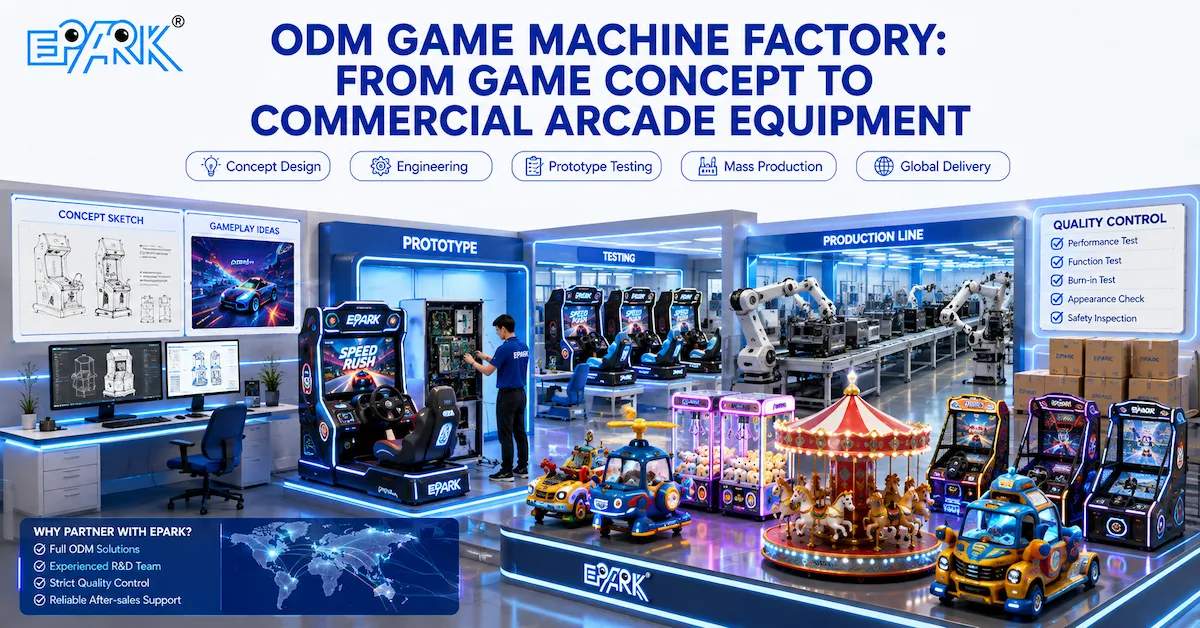
A Game Concept Is Not Yet a Commercial Arcade Product
A new arcade idea can begin with something simple: a different player interaction, a market gap identified by a distributor, a new cabinet concept, or a gameplay experience that existing machines do not provide.
But an idea is not yet a commercial product.
Before an arcade machine can be manufactured and installed in an operating venue, the concept must become a product that can be built consistently, tested objectively, shipped safely, installed efficiently, maintained by technicians, and reproduced for future orders.
This is where an ODM game machine factory plays a different role from a supplier selling finished equipment.
The factory may need to help convert a commercial idea into:
- Defined product requirements
- A feasible mechanical structure
- Player controls and interaction
- Electronic systems
- Payment configuration
- Prototype hardware
- Testing procedures
- Production specifications
- Quality-control criteria
- Packaging
- Spare-parts documentation
For distributors, private-label brands, FEC chains, and arcade operators developing exclusive products, the key question is not simply:
“Can this idea be built?”
The more useful question is:
“Can this idea become reliable, repeatable commercial arcade equipment?”
Buyers can first review EPARK's existing commercial arcade equipment to determine whether the concept requires a completely new product or whether an existing platform can be adapted.
What Does an ODM Game Machine Factory Do During Development?
In a concept-to-commercial development project, the factory's role extends beyond manufacturing.
Depending on the scope, an ODM partner may participate in:
- Requirement analysis
- Product feasibility evaluation
- Cabinet engineering
- Mechanical structure development
- Controls and electronics integration
- Payment-system configuration
- Software or interface setup
- Prototype manufacturing
- Functional testing
- Product revisions
- Production preparation
- Pilot manufacturing
- Final quality control
- Packaging and after-sales preparation
The goal is to gradually remove uncertainty.
At the beginning, the project may contain many unanswered questions.
By the time mass production begins, those questions should have become controlled specifications.
That transition can be represented as:
Game Concept → Product Brief → Feasibility → Engineering → Prototype → Validation → Design Freeze → Pilot Production → Mass Production
Step 1: Turn the Game Concept Into a Product Brief
A factory cannot engineer a reliable arcade machine from a vague request such as:
“Make a new racing game.”
The first useful document is a product brief describing what the machine must achieve.
Define the Target Player
The project should identify:
- Age range
- Number of players
- Playing position
- Expected session behavior
- Skill level
- Social or competitive interaction
A children's machine requires a different design approach from a racing simulator intended for teenagers and adults.
Define the Venue
The same game concept may need different product configurations for:
- Family entertainment centers
- Shopping mall arcades
- Tourist attractions
- Indoor amusement centers
- Arcade chains
- Distributor markets
Venue type influences machine footprint, visual impact, maintenance access, payment method, and player circulation.
Define the Commercial Purpose
The buyer should explain why the product needs to exist.
Possible objectives include:
- Fill a missing category in a distributor portfolio
- Create an exclusive SKU
- Serve a specific player group
- Improve space utilization
- Support a regional operating model
- Build a private-label product family
- Create a stronger visual attraction
The first engineering document should describe what the machine must achieve, not only how the cabinet should look.
Step 2: Conduct a Feasibility Review Before Detailed Engineering
Not every attractive concept should move directly into product development.
A feasibility review allows the buyer and factory to identify unrealistic requirements before engineering costs increase.
| Concept Requirement | Factory Feasibility Question |
|---|---|
| Large display | Can the cabinet remain stable and serviceable? |
| Motion function | What mechanism and controls are required? |
| Unique cabinet | Can it be manufactured and shipped efficiently? |
| Special controls | Are components available for future replacement? |
| Cashless payment | Can the exact system integrate with the machine? |
| Compact footprint | Can internal components still be serviced? |
| Complex lighting | Will maintenance remain practical? |
The review should consider more than technical possibility.
A feature may be technically achievable but commercially impractical because it creates excessive cost, shipping volume, service complexity, or component dependency.
A capable ODM game machine factory should be willing to simplify a concept when simplification makes the final product stronger.
Step 3: Develop the Cabinet Around Gameplay
One common mistake is designing a visually impressive cabinet before defining how players will interact with it.
The better approach is:
Gameplay and player interaction first; cabinet design second.
Important engineering questions include:
- Where does the player stand or sit?
- What is the correct screen viewing angle?
- How far should controls be from the player?
- How many players interact simultaneously?
- Will spectators gather around the machine?
- How will players enter and exit?
- Where are the service doors?
- How will air circulate through the cabinet?
- Can major components be accessed without dismantling the entire machine?
The physical structure should support the intended experience while remaining practical for commercial operation.
For deeper manufacturing information, buyers can review EPARK's arcade machine manufacturer profile.
Step 4: Integrate Hardware, Controls and Payment as One System
A commercial arcade machine contains multiple systems that must work together.
Depending on the product, these may include:
- Displays
- Buttons
- Joysticks
- Steering controls
- Sensors
- Motors
- Control boards
- Power supplies
- Speakers
- LED lighting
- Card readers
- Coin acceptors
- Ticket or redemption functions
These systems should not be approved independently without considering their interaction.
For example, a new control arrangement may require a different internal structure. A payment device may require additional space and wiring. A larger display may affect cabinet balance, heat management, shipping protection, and maintenance access.
The ODM development team should evaluate the machine as one integrated product.
Step 5: Build a Functional Prototype
The prototype is one of the most important stages in turning a concept into commercial equipment.
Its purpose is not to prove that the project looks attractive.
Its purpose is to discover problems.
A functional arcade machine prototype can help verify:
- Cabinet proportions
- Player ergonomics
- Controls
- Display position
- Sensors
- Electronics
- Lighting
- Payment systems
- Gameplay
- Service access
- Internal component arrangement
The prototype should be viewed as a risk-control tool.
A prototype is valuable because mistakes discovered before mass production are usually easier to correct.
Step 6: Test the Prototype Like a Commercial Machine
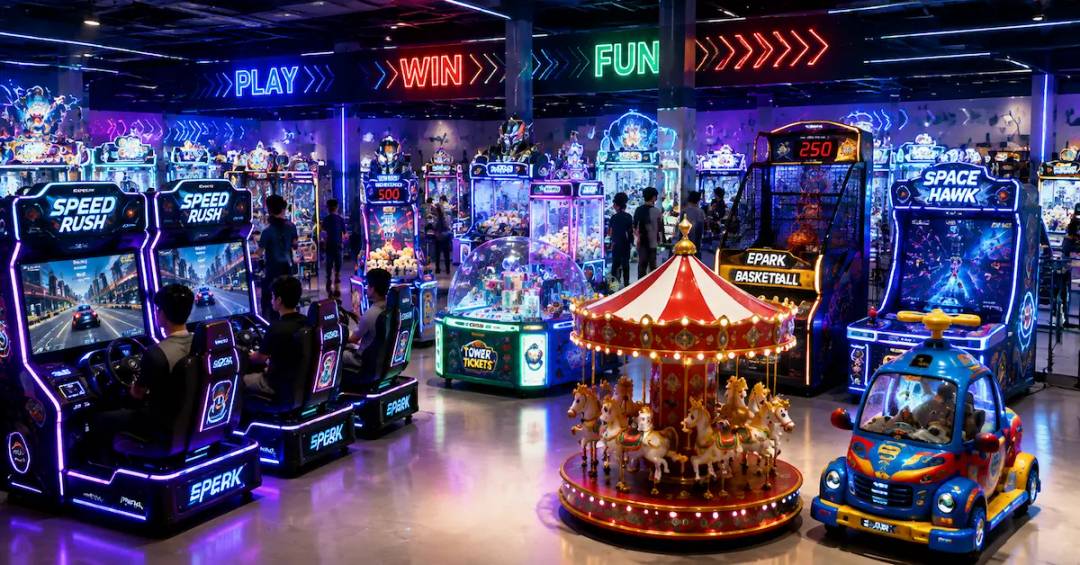
Prototype testing should reflect how the machine will actually be used.
Player Testing
Review:
- Control reach
- Seating or standing position
- Instructions
- Screen visibility
- Interaction flow
- Multiplayer spacing
- Gameplay clarity
The development team should observe how real users interact with the equipment rather than assume the design works based only on drawings.
Technical Testing
Verify:
- Displays
- Controls
- Sensors
- Motors
- Power systems
- Lighting
- Audio
- Software functions
- Payment configuration
Testing should focus on the functions relevant to the specific product.
Operator Testing
The venue operator experiences the machine differently from the player.
Check:
- Startup and shutdown
- Operator settings
- Payment management
- Prize or consumable refill where applicable
- Reset procedures
- Service access
- Routine maintenance
A machine can provide good gameplay and still create operational problems if service tasks are unnecessarily difficult.
Logistics Review
Prototype validation should also consider:
- Machine dimensions
- Weight
- Disassembly requirements
- Packaging
- Container loading
- Installation
- Access through venue doors
A design that cannot be shipped efficiently is not yet commercially optimized.
Step 7: Revise the Product Before Design Freeze
The first prototype should not automatically become the final machine.
Testing may identify the need to adjust:
- Cabinet height
- Control position
- Screen angle
- Lighting
- Sensor sensitivity
- Internal wiring
- Payment hardware
- Software settings
- Service panels
- Component layout
Each meaningful change should be documented.
Once the major technical and commercial issues are resolved, the project can move toward design freeze.
Design freeze means the production configuration is no longer changing casually.
This is critical because continuous changes during production can create inconsistent machines, incorrect components, artwork errors, and difficult QC.
Step 8: Create a Golden Sample and Production Specification
After the design is approved, the project needs a production reference.
The golden sample represents the physical machine that mass production should reproduce.
But a physical sample alone is not enough.
The project should also control documentation such as:
| Production Element | What Should Be Controlled |
| Cabinet | Dimensions, structure and materials |
| Artwork | Approved files and revision number |
| Controls | Type, position and configuration |
| Electronics | Approved components |
| Software | Approved version and settings |
| Payment | Exact configured system |
| Wiring | Final electrical layout |
| Accessories | Standard packing list |
| Spare parts | Agreed service package |
| Packaging | Approved packing method |
A useful principle is:
A golden sample tells the factory what to reproduce; controlled specifications explain how to reproduce it.
This becomes especially important when the machine moves from development engineers to mass-production teams.
Step 9: Use Pilot Production Before Full-Scale Manufacturing
A successful prototype proves that one machine can work.
It does not automatically prove that dozens or hundreds can be produced consistently.
For deeper ODM projects, a pilot production stage can reduce this risk.
A pilot batch allows the factory to evaluate:
- Assembly consistency
- Wiring consistency
- Component fit
- Production efficiency
- QC procedures
- Artwork application
- Packaging
- Worker instructions
Problems that do not appear on one prototype may become obvious when several units are assembled.
For example:
A component may require too much manual adjustment.
A wiring route may be difficult to reproduce.
Artwork may be difficult to position consistently.
Packaging may take too long.
These are production-engineering problems rather than concept problems.
Pilot production helps identify them before scale increases their cost.
Step 10: Define Quality Control for the New Product
A newly developed machine cannot rely only on a generic statement such as “all machines are tested.”
The QC process should reflect the specific product.
| QC Area | Typical Verification |
| Cabinet | Dimensions, finish and assembly |
| Controls | Buttons, steering, sensors or special controls |
| Display | Screen operation and visibility |
| Electronics | Wiring, power and system operation |
| Payment | Exact configured payment method |
| Software | Approved version and settings |
| Gameplay | Core functional performance |
| Artwork | Correct graphics and placement |
| Accessories | Required items included |
| Packaging | Protection and identification |
Buyers should define which acceptance criteria matter before production rather than after shipment.
Where appropriate, final photos, videos, or inspection documentation can provide an additional approval point.
Step 11: Prepare Spare Parts and Service Information Before Launch
Commercialization is incomplete if the product can be sold but cannot be supported.
Before the first commercial shipment, the factory and buyer should identify:
- Critical spare parts
- Wear components
- Component references
- Control boards
- Sensors
- Power supplies
- Motors
- Buttons and controls
- Payment components
- Software versions
- Troubleshooting procedures
This information is especially important for distributors supporting customers in other countries.
A low-cost component can create expensive downtime if nobody can identify the correct replacement.
The first production order should therefore include after-sales planning, not only machines.
Step 12: Use Market Feedback to Improve the Product
The first commercial version should provide real operating data.
Distributors and operators can collect feedback about:
- Player response
- Gameplay
- Machine visibility
- Component reliability
- Maintenance requirements
- Payment performance
- Operator complaints
- Service frequency
The factory can combine this information with production and QC data.
This creates a development loop:
Commercial Launch → Market Feedback → Technical Review → Controlled Revision → Improved Version
A successful ODM relationship therefore continues after the first production run.
Concept-to-Commercialization Development Framework
The entire process can be summarized as follows:
| Stage | Main Output | Buyer Should Approve |
| Concept | Product brief | Market and functional objectives |
| Feasibility | Development direction | Scope and major risks |
| Engineering | Technical design | Cabinet and system configuration |
| Prototype | Functional machine | Usability and functions |
| Validation | Test results | Required revisions |
| Design Freeze | Final specification | Approved configuration |
| Golden Sample | Production reference | Appearance and operation |
| Pilot Production | Small production batch | Manufacturing consistency |
| Mass Production | Commercial equipment | QC requirements |
| Launch | Installed product | Service and spare-parts support |
This framework prevents the project from jumping directly from idea to production.
Where ODM Development Cost Actually Accumulates
Instead of asking only for the final machine price, buyers should understand where development work occurs.
Possible development costs include:
- Engineering
- Cabinet development
- Mechanical parts
- Electronics integration
- Prototype manufacturing
- Tooling
- Software work
- Testing
- Prototype revisions
- Pilot production
- Special packaging
The costliest problem is often not making an engineering change during prototype development.
It is discovering that the same problem exists across a completed production batch.
This is why prototype testing and pilot manufacturing should be viewed as risk-management stages rather than unnecessary delays.
Know When to Simplify or Stop an ODM Project
Not every concept should reach mass production.
A People-first development strategy should include a go / no-go decision.
The project may need simplification or redesign if:
- Manufacturing cost becomes commercially unrealistic
- The cabinet is too complex
- Gameplay does not provide enough differentiation
- Service access is poor
- Components are difficult to source
- Shipping becomes inefficient
- Market demand is unclear
In some cases, the better decision may be to adapt an existing machine instead of continuing full ODM development.
Stopping an unsuitable project before mass production can be a successful commercial decision.
How EPARK Can Support Concept-to-Commercial Arcade Development
For buyers approaching EPARK with a new arcade equipment concept, useful starting information includes:
- Target market
- Target player
- Venue type
- Game concept
- Core interaction
- Preferred dimensions
- Payment requirements
- Branding requirements
- Quantity expectations
- Commercial objective
The project can then be evaluated to determine whether the best route is:
Existing Product → Configuration Modification → Cabinet Customization → Deeper ODM Development
This helps avoid developing a completely new product when an existing platform already solves most of the commercial requirement.
Buyers can browse EPARK's commercial arcade equipment, review common purchasing questions through the arcade machine FAQ, or discuss an ODM game machine project with specific development requirements.
FAQ About ODM Game Machine Development
What does an ODM game machine factory do?
An ODM game machine factory can participate in product design, engineering, prototype development, testing, production preparation, manufacturing, and product improvement rather than only producing an existing design.
Can I develop an arcade machine from only a game concept?
A concept can be the starting point, but it needs to be converted into defined market, player, functional, technical, and commercial requirements before effective engineering can begin.
What information should I prepare before contacting an ODM factory?
Prepare the target market, venue, player profile, game concept, required functions, preferred machine size, payment system, expected quantity, budget positioning, and launch objectives.
How does a factory evaluate whether a game concept is feasible?
The factory may evaluate technical complexity, cabinet structure, component availability, cost, serviceability, payment integration, shipping requirements, and production repeatability.
Why is an arcade machine prototype necessary?
A prototype helps identify problems in controls, ergonomics, electronics, gameplay, service access, payment systems, structure, and logistics before those problems enter mass production.
What should be tested before mass production?
Testing should reflect the machine type and may include gameplay, controls, displays, sensors, electrical systems, payment functions, software, player interaction, operator access, and packaging.
What is a golden sample?
A golden sample is the approved physical reference machine that future production should reproduce. It is normally supported by controlled drawings, component lists, artwork, software versions, and other specifications.
What is pilot production?
Pilot production is a limited manufacturing run performed before larger-scale production. It helps verify whether the approved product can be assembled, tested, and packaged consistently.
When is an arcade machine ready for commercial production?
A machine is closer to production readiness when the design is frozen, required functions are validated, the golden sample is approved, production specifications are controlled, QC requirements are defined, and after-sales preparation is complete.
How do I choose an ODM factory for a new arcade game concept?
Evaluate product-development capability, engineering communication, prototype procedures, manufacturing control, QC, component management, repeat-production capability, spare-parts support, and long-term technical service.
Conclusion
Turning an arcade game idea into commercial equipment requires much more than creating a visually attractive cabinet.
A capable ODM game machine factory should help move the project through a controlled development path:
Concept → Requirements → Feasibility → Engineering → Prototype → Testing → Design Freeze → Pilot Production → Mass Production
For distributors, arcade brands, FEC operators, and entertainment project companies, each stage answers a different question.
Does the market need the product?
Can it be engineered?
Does the prototype work?
Can operators maintain it?
Can the factory manufacture it consistently?
Can the product be supported after sale?
Only when these questions are addressed does a game concept become commercially meaningful arcade equipment.
The goal of ODM development is therefore not simply to manufacture something new.
It is to create a product that is distinctive enough to justify its existence, practical enough to operate, reliable enough to support, and controlled enough to reproduce when the market asks for the next order.
Disclaimer
The information provided on this website is for general informational purposes only.
While EPARK Arcade Game Machine Manufacturer strives to ensure accuracy and reliability, no warranties—express or implied—are made regarding completeness, performance, or applicability.
Product specifications, designs, and features may vary depending on usage, customization, and customer requirements.
Buyers are responsible for verifying all technical details, compliance certifications, and suitability before procurement.
EPARK shall not be held liable for any direct, indirect, incidental, or consequential damages arising from the use of this website or its content, including but not limited to business losses, data errors, or equipment misuse.
For tailored solutions or further verification, please visit our Contact Us
Intellectual Property Notice
All articles, product images, videos, catalogs, software, and related materials published on this website are the intellectual property of EPARK, unless otherwise stated.
Unauthorized reproduction, distribution, modification, or commercial use of any content is strictly prohibited without prior written consent from EPARK.
EPARK reserves the right to take legal action against any unauthorized use, including but not limited to copyright infringement, misrepresentation, or unfair competition.
Trademarks
The name EPARK, the EPARK logo, and all related brand elements displayed on this website are registered trademarks or trade names of Guangzhou EPARK Electronic Technology Co., Ltd.
Other product names, company names, or logos mentioned on this site may be trademarks of their respective owners.
Unauthorized use of EPARK's trademarks for commercial purposes, including advertising, promotions, or product packaging, is strictly prohibited.
Governing Law
These terms are governed by the laws of the People's Republic of China.