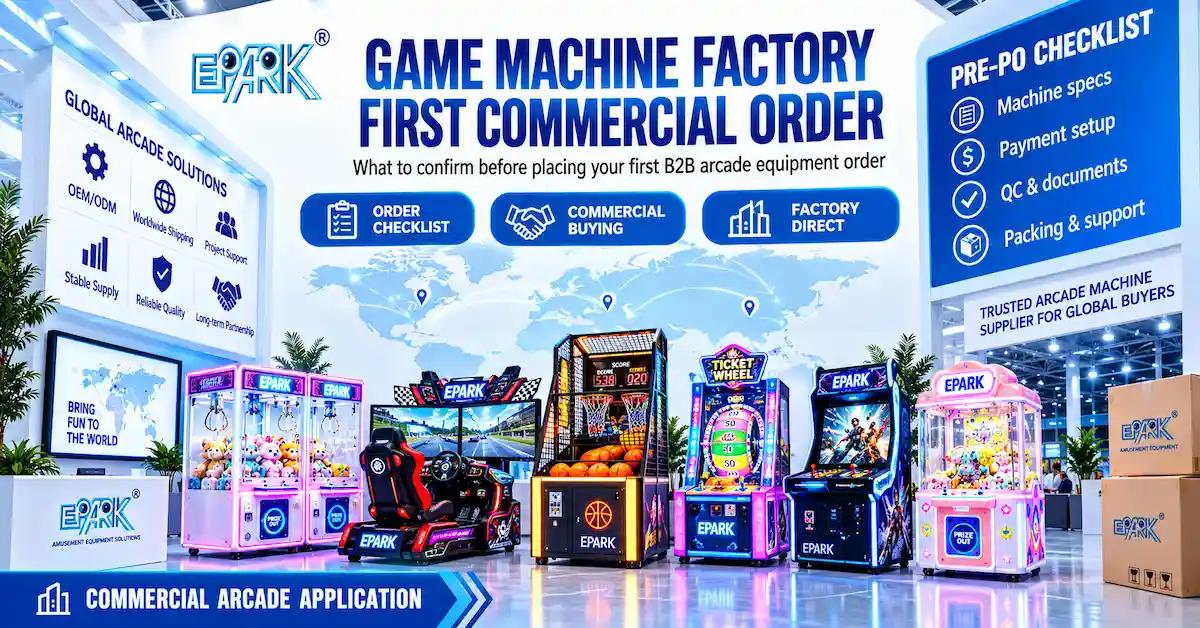


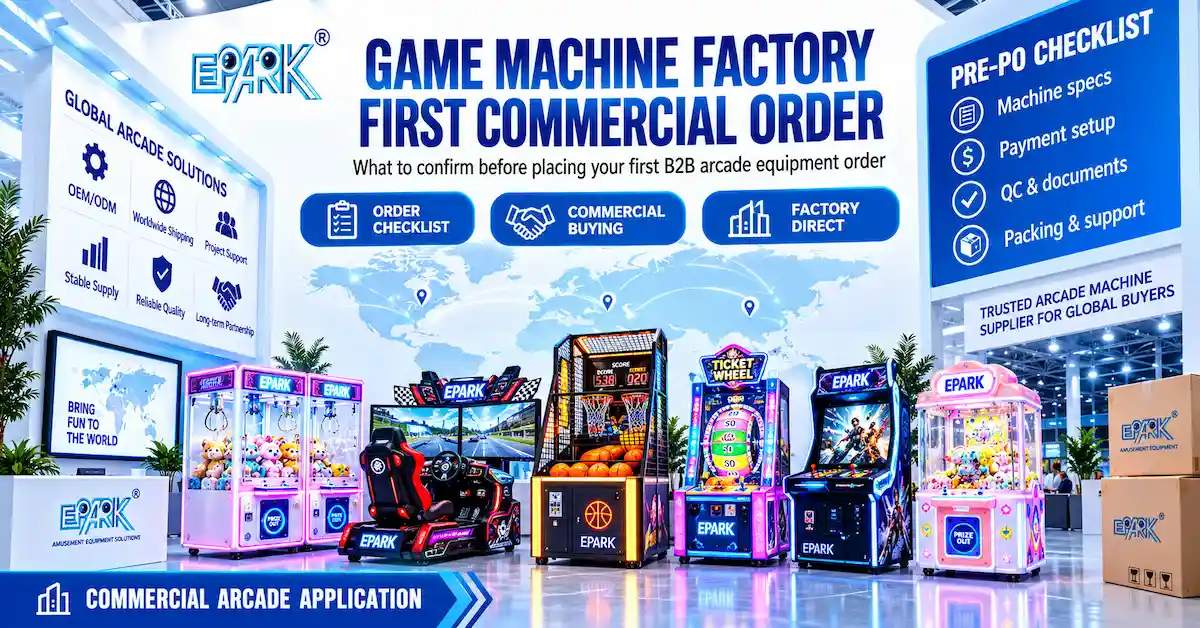
What Should I Ask a Game Machine Factory Before Placing My First Commercial Order?
Direct answer: Before placing your first commercial order with a game machine factory, do not stop at price, model name, and delivery date. You need written answers covering the exact machine configuration, destination-market setup, sample or first-unit approval, payment hardware, quality-control method, applicable documents, packaging, spare parts, warranty process, shipping responsibility, and what happens if the factory changes a component after you approve the order.
The goal is to create a purchase order that leaves as little room for interpretation as possible. For first-time buyers of commercial arcade machines, a useful rule is: if a requirement could affect installation, operation, compliance, service, or repeat purchasing, it should be confirmed before the deposit or explicitly listed as an unresolved item with an owner and deadline.
1. First Question: What Exactly Am I Buying?
The first question to an arcade machine factory should sound almost too basic: “What exact configuration is included in this quotation?”
A product name is not a specification. Two cabinets with the same marketing name can differ in screen configuration, controls, payment hardware, game version, accessories, artwork, voltage, packaging, or internal components. If you are buying several commercial arcade machines, these small differences multiply quickly.
Ask the factory to create one controlled product reference
For every model, request a sheet or order schedule that identifies:
- Factory model name or model code.
- Your buyer SKU, if you use one.
- Quantity.
- Overall machine dimensions.
- Packed dimensions and package count.
- Voltage, frequency, and plug or connection requirement.
- Display and audio configuration where relevant.
- Controls, sensors, steering, pedals, buttons, or other player interfaces.
- Payment configuration.
- Language and software settings where relevant.
- Included accessories.
- Branding or artwork revision.
- Required spare parts.
- Applicable manuals and documents.
Anything not yet confirmed should say “to be confirmed”. Silence is dangerous because the game machine factory may reasonably use its standard configuration while the buyer assumes something else.
Release Gate 1: Do not pay a deposit for a model that cannot be described clearly enough for another employee—someone who was not part of the sales discussion—to understand what is being purchased.
2. Which Machines Does the Factory Actually Manufacture or Control?
A broad catalog is useful, but your first commercial order should be tied to manufacturing responsibility. Ask which machines are manufactured or assembled by the seller, which systems are integrated in-house, which specialist components come from external vendors, and who is responsible for the finished machine.
This question is more useful than simply asking, “Are you a factory?” A legitimate arcade machine factory can still use upstream suppliers for displays, controls, PCBs, payment readers, sensors, seats, or other components. What matters is who controls the final configuration, testing, corrective action, and technical support.
Ask these follow-up questions
- Where will my exact models be assembled and tested?
- Who approves component substitutions?
- Which technical questions are handled by engineering rather than sales?
- Can the factory show the selected model during production or testing?
- If one category is supplied by a partner factory, who owns final QC and warranty responsibility?
EPARK's public company profile describes Guangzhou EPARK Electronic Technology Co., Ltd. as integrating R&D, design, production, and sales. That is a useful company-level starting point, but a first-order buyer should still ask for model-level confirmation for the machines being purchased.
3. Which Product Claims Are Verified for My Exact Machine?
Commercial sourcing becomes risky when catalog language is copied into the purchase order without verification. “Heavy duty,” “high quality,” “commercial grade,” “CE certified,” “stable,” and “high traffic” can all sound reassuring while remaining too vague for acceptance.
Ask the game machine factory to separate three types of information:
| Information type | Example | Buyer action |
|---|---|---|
| Confirmed specification | Model, dimensions, voltage, payment hardware, controls | Put it in the order schedule |
| Factory or website statement | General QC process, company certifications, service capability | Ask how it applies to the selected model |
| Unresolved claim | Specific compliance, performance, lifetime, ROI, or market suitability | Request evidence or remove the claim from the PO |
For commercial arcade machines, the safest procurement language is specific. Instead of “high-quality screen,” record the actual approved display configuration where that detail matters. Instead of “international certification,” request the document that applies to the selected product and destination.
4. Is the Machine Suitable for My Venue and Customer Group?
A first commercial order is often where buyers overbuy. They choose machines because the showroom looks exciting or because the supplier calls a model “popular.” A better question is: “Why does this machine belong in my venue or catalog?”
Tell the arcade machine factory whether you are buying for an FEC, shopping mall game zone, arcade center, indoor playground, cinema lobby, distributor warehouse, or another commercial environment.
For venue buyers, provide
- Measured floor plan.
- Entrances and exits.
- Usable machine area.
- Target age groups.
- Expected customer mix.
- Preferred categories.
- Prize/redemption concept.
- Payment system.
- Local service capability.
- Target opening date.
EPARK's published Design & Process starts project planning with space size, floor plan, entrance and exit locations, target audience, preferred games, and budget range. If you are buying commercial arcade machines for a real venue, use those inputs before locking quantity.
Have a Shortlist but Not a Final Machine Mix?
Review the current commercial equipment range, then send your venue or distribution requirements before releasing the first order.
Review EPARK Products5. What Payment System Will Be Installed and Who Owns the Integration?
Payment is one of the most common areas where a first order can become ambiguous. “Card compatible” or “supports QR” is not a complete specification.
Ask your game machine factory:
- Which payment reader or acceptor is included?
- Who supplies it?
- Who installs it?
- Who configures machine credits?
- Does the machine require a dry-contact, pulse, serial, network, or another interface?
- Who owns the payment account or software?
- Can the payment flow be tested before shipment?
- Which replacement part should be ordered later?
EPARK's website describes support for coins, QR codes, cards, ticket, point, and redemption-system integration. For a first order, convert that general capability into a machine-by-machine configuration schedule.
Test the full operating sequence
For a paid-play machine, acceptance should follow the actual user flow:
Payment recognized → credit registered → game starts → controls respond → result is recorded → ticket/point/prize output works where applicable → machine resets correctly.
A machine can power on perfectly and still fail the commercial payment workflow.
6. Are Voltage, Plug, Language, and Network Requirements Frozen?
International buyers should settle destination-market configuration before production. Corrections are far more expensive after shipment.
Ask the arcade machine factory to confirm the following for every applicable model:
| Configuration area | What to confirm | Why it matters |
|---|---|---|
| Electrical | Voltage, frequency, rated power, connection or plug | Site preparation and safe installation |
| Language | Interface, labels, instructions, manuals | Local operation and staff training |
| Payment | Reader, currency/token logic, third-party integration | Revenue collection |
| Network | Internet, LAN, account, server, or software needs where applicable | Installation and ongoing operation |
| Accessories | Keys, cables, adapters, separated assemblies, manuals | Receiving and commissioning |
If you are purchasing a mixed order of commercial arcade machines, do not assume one standard applies to the entire shipment. A VR simulator, basketball machine, claw machine, and simple game cabinet can have different installation requirements.
7. Do I Need a Sample, First-Unit Approval, or Trial Order?
The answer depends on risk, not habit.
Ask the game machine factory whether the machine you want is a standard production model, a configured standard model, or a newly customized product. Then choose an approval level that matches the change.
| Order condition | Suggested approval | What to verify |
|---|---|---|
| Known standard model | Current product evidence + order-specific QC | Exact configuration and condition |
| New supplier / familiar model type | Sample or small trial order | Quality, packing, communication, support |
| Branding or language changes | Artwork/configuration approval | Revision, placement, translation, interface |
| Payment/control changes | First-unit functional approval | Complete operating flow |
| Structural or deep OEM changes | Prototype or engineering validation | Function, access, reliability, production readiness |
A first commercial order is often valuable as a supplier test. Observe not only whether the machine works, but how the factory responds when you find a legitimate issue. Problem-solving quality is part of supplier quality.
8. What Will Be Tested Before Shipment, and Can I See the Record?
“Every machine is tested” is a useful starting statement, but not enough for a commercial purchase. Ask what is tested, for how long, by whom, and how results are tied to your order.
EPARK's Design & Process states that machines receive a 48-hour full-operation test before shipment, covering gameplay functionality, electrical safety, lighting effects, and mechanical durability. A first-order buyer should ask how that process will apply to the selected models and whether photos, videos, inspection records, or other evidence can be provided for the order.
Build the QC checklist around machine function
Different commercial arcade machines require different acceptance checks:
- Claw/prize machines: claw movement, controls, prize mechanism, doors, locks, lighting, payment.
- Racing machines: steering, pedals, display, audio, seat, controls, linked function where applicable.
- Basketball games: sensors, scoring, ball return, display, structure, lighting.
- Shooting games: controllers, calibration, sensors, display, audio, software operation.
- Redemption games: scoring, sensors, ticket/point output, payment and reward workflow.
Also inspect appearance, labels, accessories, artwork, package identity, and any buyer-specific configuration.
Ask what happens after a failure
The most useful QC question may be: “If one unit fails, what happens next?” The answer should cover corrective action, retest, record update, and how the factory prevents the same issue from being repeated across the batch.
9. Which Compliance Documents Apply to My Exact Model and Market?
Do not ask only, “Do you have CE?” or “Are your machines certified?” Ask for the document-to-product relationship.
EPARK's website displays or references CE, RoHS, ISO, EMC, SGS, UL, and other compliance-related terms across different pages. Because the combinations vary, a buyer should avoid turning those badges into a universal claim for all machines.
Ask the arcade machine factory to identify:
- Document or certificate name.
- Issuing or testing organization.
- Certificate/report number.
- Product or model scope.
- Configuration covered.
- Applicable standard or market.
- Date or validity information where relevant.
- Whether your requested customization changes the scope.
Pre-PO rule: If a compliance document is necessary for import, installation, tendering, insurance, mall approval, or resale, do not leave it as “factory will provide later.” Put the required document and responsible party into the commercial agreement.
10. What Is the Real MOQ and What Does It Apply To?
MOQ can be more complicated than a single number. A game machine factory may have one minimum for the standard machine, another for a custom cabinet color, another for printed artwork, and another for a special payment component.
Ask separately:
- MOQ per machine model.
- MOQ per color or visual variant.
- MOQ for custom artwork or packaging.
- MOQ for special components.
- Whether sample or trial quantities are accepted.
- Whether mixed-SKU orders are possible.
EPARK's FAQ says buyers can order a sample machine first, but the exact terms still need order-specific confirmation. Do not build your cash-flow plan around a universal MOQ if the selected machines and customization are different.
11. What Does the Quotation Include—and What Is Missing?
Before your first commercial order, force the quotation to become itemized. A low price is meaningless if one supplier includes payment hardware, accessories, packing, and spare parts while another does not.
| Quotation item | Question to ask | Why it matters |
|---|---|---|
| Machine | Which exact configuration is priced? | Prevents incomplete comparisons |
| Customization | Are artwork, colors, language, or technical changes included? | Controls one-time and recurring costs |
| Payment hardware | Included, buyer-supplied, or third-party? | Affects operating readiness |
| Packaging | What protection and package structure are included? | Affects damage risk and freight volume |
| Spare parts | Which items are included or recommended? | Affects post-opening downtime |
| Documents | Which manuals and compliance files are included? | Affects import and commissioning |
| Shipping | What Incoterm or logistics scope is quoted? | Clarifies cost responsibility |
| Installation/support | Remote, on-site, or not included? | Prevents commissioning surprises |
For commercial arcade machines, compare the cost of an approved, delivered, supportable configuration—not just the factory unit price.
12. What Is the Production Schedule After I Pay the Deposit?
A single “30-day lead time” can hide several separate stages. Ask the game machine factory to map the actual sequence for your order.
A useful schedule can include:
- Deposit received.
- Technical configuration frozen.
- Artwork or branding approved.
- Components prepared.
- Production started.
- First-unit or sample review where required.
- Bulk assembly completed.
- QC and running test completed.
- Corrections and retest completed.
- Packing completed.
- Balance-payment evidence supplied where agreed.
- Goods released for shipment.
EPARK's FAQ publishes general guidance of 7–15 days for small orders and 20–40 days for large or customized orders. Treat those figures as website guidance, not your project schedule. Ask what milestone starts the clock and which buyer approvals can stop it.
Release Gate 2: Do not schedule your opening date from “production days” alone. Add artwork approval, inspection, packing, freight, customs, local delivery, installation, payment integration, commissioning, and contingency.
13. How Will the Machines Be Packaged and Identified?
Packaging is part of the product because it affects whether the machine that passed QC arrives in the same condition.
EPARK's published process describes bubble wrap, thick foam, wooden frame or crate reinforcement, and waterproof film for sea shipment. Your first order should go further and identify the actual package structure for each model.
Ask the arcade machine factory:
- How many packages per machine?
- What are the final packed dimensions and gross weight?
- Which parts are removed for shipping?
- How are accessories packed?
- Are screens, acrylic, glass, seats, or controls protected separately where needed?
- What package labels identify the model and quantity?
- Will spare parts be in a clearly marked carton?
- What needs to be reassembled at destination?
- Can packing photos be supplied before loading?
This information affects freight quotations, warehouse receiving, unloading equipment, local labor, and commissioning.
14. Who Is Responsible for Freight, Customs, Unloading, Installation, and Commissioning?
“Can you ship to my country?” is not specific enough. Split the post-production process into separate responsibilities.
| Stage | Question to resolve |
|---|---|
| Factory dispatch | Who moves the goods from factory to port/forwarder? |
| Export | Who handles export documentation and booking? |
| International freight | Who books and pays freight and insurance where applicable? |
| Import | Who is importer of record and handles local customs? |
| Destination delivery | Does the quote stop at port, warehouse, or venue? |
| Unloading | What forklift, pallet jack, labor, or access is required? |
| Assembly | Which machines arrive partly disassembled? |
| Electrical/network | Who prepares power, network, and local connections? |
| Payment integration | Who configures and tests the venue payment system? |
| Commissioning | Who signs off that each machine is operational? |
A professional game machine factory can support some of these tasks, but your PO should not assume all of them are included.
Review the Manufacturing, Testing, Packing, and Installation Workflow
Use EPARK's published process as a starting point, then turn every applicable stage into an order-specific responsibility and approval.
Review Design & Process15. What Spare Parts Should I Buy With the First Order?
Spare parts should be planned before the machines leave the factory. The correct starter kit depends on the machine family, installed quantity, local service capability, and replacement lead time.
Ask the arcade machine factory to recommend parts by model, not as one anonymous “spare-parts box.”
For each part, record
- Machine model or compatible family.
- Part name and part code if available.
- Quantity supplied.
- Whether programming, calibration, or special setup is required.
- Replacement instructions.
- Warranty status.
- Future reorder method.
For a mixed order of commercial arcade machines, ask whether several models share common controls, sensors, buttons, payment components, or power-related parts. Component commonality can simplify inventory—but only when compatibility is documented.
16. What Does the Warranty Actually Cover?
“One-year warranty” or “warranty included” is not enough if the process is unclear. Ask what the warranty covers, what it excludes, how claims are opened, who pays freight on replacement parts, whether labor is included, and how software or third-party components are handled.
EPARK's FAQ states that it offers warranty support covering parts and technical support, but it does not provide a universal warranty duration in the public answer. That is exactly why the first-order buyer should request written, order-specific warranty terms.
Ask for a claim workflow
Machine ID → Order Reference → Fault Description → Photos/Video → Remote Diagnosis → Part Identification → Replacement/Adjustment → Installation Guidance → Retest
If your local technician will perform the repair, confirm whether the game machine factory can provide wiring information, part references, or remote guidance for the selected model.
17. How Will You Control Changes After I Approve the Order?
This is one of the most important questions for buyers planning future orders.
A supplier may need to change a component because of availability, discontinuation, engineering improvement, or cost. A change is not automatically a problem. An undocumented change is.
Ask the arcade machine factory to tell you which changes require buyer notification. At minimum, discuss major controls, payment hardware, display, power components, software/version where applicable, cabinet structure, artwork, and service-critical parts.
Use a simple change-control process
Factory Change Proposal → Reason → Affected Models → Technical Impact → Buyer Review → New Sample/Test if Required → Revision Update → Production Approval
This makes repeat purchasing more stable and helps the service team know whether parts remain interchangeable between batches.
18. What Should Be Written Into the Purchase Order?
Your PO should be the commercial summary of the approved deal, not a vague instruction to “produce according to our chats.”
For the first order, include or reference:
- Seller and buyer legal names.
- PO number.
- Factory model and buyer SKU.
- Quantity by model.
- Unit price and currency.
- Customization/artwork revision.
- Technical configuration schedule.
- Payment configuration.
- Electrical/language requirements.
- Accessories and spare parts.
- Packaging requirements.
- Required documentation.
- Inspection or test requirements.
- Payment terms.
- Trade/shipping term.
- Production or readiness milestone.
- Warranty/support reference.
- Change-approval requirement.
The purchase order does not need to reproduce every technical detail if it clearly references an approved specification, artwork file, machine schedule, or sample. The important point is that there is one traceable set of documents.
Avoid this first-order pattern: quotation in one spreadsheet, artwork in a messaging app, payment configuration in a voice call, voltage in an email, spare-parts request in another chat, and final quantity changed verbally. That makes later inspection and dispute resolution unnecessarily difficult.
19. What Should I Ask Before Paying the Balance?
The first commercial order has a second decision point: release of the balance payment or shipment, depending on the agreed terms.
Before that stage, request the evidence you agreed on before production. For commercial arcade machines, this may include:
- Final quantity confirmation.
- Machine/model identification.
- Artwork and visible configuration confirmation.
- Functional test evidence.
- Payment-system test where applicable.
- Accessory and spare-parts checklist.
- Correction/retest status for open issues.
- Packing photos or packing data.
- Applicable documents agreed in the PO.
- Final packing list.
If you have agreed to an independent pre-shipment inspection, schedule it before the goods are irreversibly packed or loaded.
Release Gate 3: Do not let “production finished” automatically become “shipment approved.” Production completion and buyer acceptance are separate events.
20. A First Commercial Order Should Also Test the Supplier Relationship
The first order is not only about the machines. It tests whether the game machine factory communicates clearly, records changes, solves problems, and supports the buyer when something is inconvenient.
During the first order, observe:
- Does the factory answer technical questions directly?
- Does it flag unresolved issues before production?
- Are changes documented?
- Are progress updates consistent with the agreed schedule?
- Does the QC evidence match the ordered configuration?
- Are packing details accurate?
- Does the factory respond constructively when the buyer identifies a problem?
If the first order works, future orders should become easier because the approved model, configuration, packing, parts, and support process have already been defined. If every repeat order starts from zero, the relationship is not yet controlled.
21. How EPARK Fits a First Commercial Arcade Order
EPARK's public website identifies Guangzhou EPARK Electronic Technology Co., Ltd. as a commercial amusement equipment provider integrating R&D, design, production, and sales. Its product directions include arcade machines, claw and prize machines, VR simulators, kiddie rides, racing, basketball, redemption, and other amusement equipment.
For a first-time buyer evaluating EPARK as a game machine factory, the relevant published capabilities include OEM customization, venue layout consulting, branding support, payment/system integration, production testing, export packaging, installation guidance, operation training, spare-parts supply, and after-sales assistance.
These capabilities are useful starting points, but the purchase decision should still be model-specific. The website does not replace your approved quotation, configuration sheet, QC checklist, document list, packing schedule, and warranty terms.
Use EPARK's public pages in this order
- Review the current product range and shortlist relevant machines.
- Review EPARK's company profile for manufacturer and service background.
- Use the Design & Process page to understand the published planning, production, testing, packing, and support workflow.
- Review the FAQ for buyer-facing information on ordering, delivery, compliance, and after-sales.
- Send an itemized project brief through Contact Us.
The aim is to turn website-level capability into an order-level commitment.
22. Copy-Ready First Commercial Order RFQ
Subject: First Commercial Arcade Machine Order – Configuration and Quotation Request
We are preparing our first commercial order for [venue / distribution business] in [country]. Our target customers are [audience], and we are interested in [machine categories / model links].
Please quote [quantity by model] and provide the exact factory model, overall and packed dimensions, electrical configuration, payment hardware, language/settings, controls, accessories, packaging, recommended spare parts, and applicable product documentation.
Please also confirm: whether a sample or first-unit approval is recommended; what is included in pre-shipment testing; how the 48-hour operation test will apply to our machines; what QC evidence can be provided; the MOQ by model/customization; the production schedule after deposit; warranty terms; spare-parts support; trade/shipping terms; and installation/remote support scope.
If any requirement is unresolved, please list it separately rather than assuming the factory-standard configuration. We would also like to know how component or configuration changes will be communicated before production and repeat orders.
This RFQ gives an arcade machine factory enough information to identify technical gaps before producing the quotation. It also gives you a consistent basis for comparing different suppliers.
23. Frequently Asked Questions
What should I ask a game machine factory before my first commercial order?
Ask about the exact machine configuration, manufacturing responsibility, destination-market setup, payment system, sample or first-unit approval, quality-control method, applicable documents, MOQ, quotation scope, production milestones, packaging, shipping responsibilities, spare parts, warranty, and change control. Put critical answers in the PO or an approved specification rather than relying on informal messages.
Should I place a sample order before buying commercial arcade machines in bulk?
A sample or small trial order is useful when the supplier is new to you, the machine category is unfamiliar, or important customization is involved. Direct bulk ordering may be reasonable when the model and supplier have already been validated and the technical configuration is controlled.
How do I verify that the arcade machine factory will deliver the same specification I approved?
Use a factory model, buyer SKU, revision-controlled specification, artwork version, payment configuration, accessory list, QC checklist, and packing record. Ask the factory to notify you before significant component or configuration changes.
What should be included in a game machine factory quotation?
The quotation should identify the model, quantity, unit price, currency, configuration, customization, payment hardware, packaging, spare parts, documentation, payment terms, production schedule, and shipping basis. Ask the supplier to state exclusions and unresolved items clearly.
What QC should I request for commercial arcade machines?
Use model-specific checks covering gameplay, controls, display/audio, payment, sensors or mechanisms, reward functions where applicable, electrical configuration, artwork, accessories, appearance, and packing. Ask what happens when a unit fails and how the correction is retested.
How should I verify CE, RoHS, UL, or other compliance claims?
Request the document applicable to the exact machine and destination market. Verify the report or certificate number, issuing organization, product scope, standard, date or validity information where relevant, and whether your customized configuration remains within scope.
What spare parts should I buy with my first order?
Build the starter list by machine family and installed quantity. Prioritize service-critical or higher-wear parts, long-lead replacements, and items that your local team can realistically replace. Keep every spare-part reference linked to the corresponding model and revision.
Should my first PO include the payment configuration and voltage?
Yes. Payment system, voltage, frequency, plug or connection requirement, language, and other destination-specific settings should be written into or referenced by the purchase order so the factory can verify them during final inspection.
Can EPARK support a first commercial arcade order?
EPARK's website describes OEM/ODM customization, product selection, venue planning, payment-system integration, testing, export packaging, installation guidance, spare-parts supply, and after-sales support. Buyers should still confirm the exact model, commercial terms, configuration, documents, and service scope for their specific order.
Conclusion
Before placing your first commercial order with a game machine factory, make the purchase decision about evidence and control—not just price. Confirm the exact machine, destination configuration, payment setup, approval method, QC, documents, packaging, spare parts, schedule, warranty, and change-control process in writing.
For commercial arcade machines, the best first order creates a reusable purchasing standard. If the approved configuration can be inspected, serviced, and reordered without reconstructing old conversations, you have built the foundation for a scalable supplier relationship.
Ready to Prepare Your First Commercial Order?
Send EPARK your destination market, selected models, quantity, payment requirements, branding, venue information, spare-parts needs, and target schedule for an order-specific quotation.
Send Your First Order RFQDisclaimer
The information provided on this website is for general informational purposes only.
While EPARK Arcade Game Machine Manufacturer strives to ensure accuracy and reliability, no warranties—express or implied—are made regarding completeness, performance, or applicability.
Product specifications, designs, and features may vary depending on usage, customization, and customer requirements.
Buyers are responsible for verifying all technical details, compliance certifications, and suitability before procurement.
EPARK shall not be held liable for any direct, indirect, incidental, or consequential damages arising from the use of this website or its content, including but not limited to business losses, data errors, or equipment misuse.
For tailored solutions or further verification, please visit our Contact Us
Intellectual Property Notice
All articles, product images, videos, catalogs, software, and related materials published on this website are the intellectual property of EPARK, unless otherwise stated.
Unauthorized reproduction, distribution, modification, or commercial use of any content is strictly prohibited without prior written consent from EPARK.
EPARK reserves the right to take legal action against any unauthorized use, including but not limited to copyright infringement, misrepresentation, or unfair competition.
Trademarks
The name EPARK, the EPARK logo, and all related brand elements displayed on this website are registered trademarks or trade names of Guangzhou EPARK Electronic Technology Co., Ltd.
Other product names, company names, or logos mentioned on this site may be trademarks of their respective owners.
Unauthorized use of EPARK's trademarks for commercial purposes, including advertising, promotions, or product packaging, is strictly prohibited.
Governing Law
These terms are governed by the laws of the People's Republic of China.