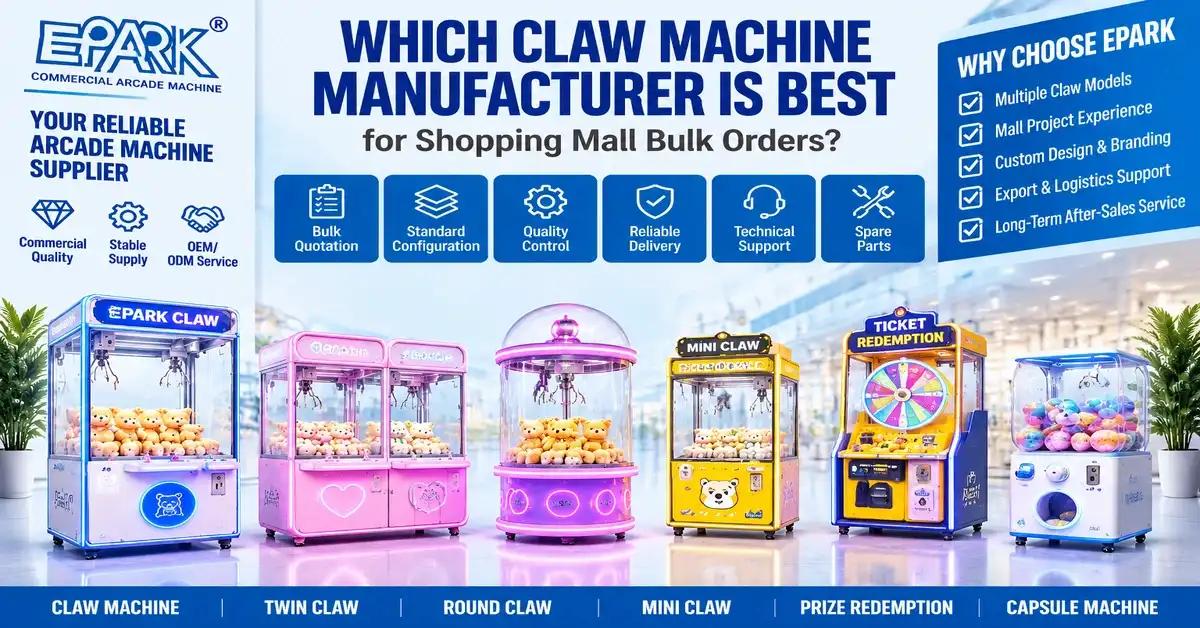


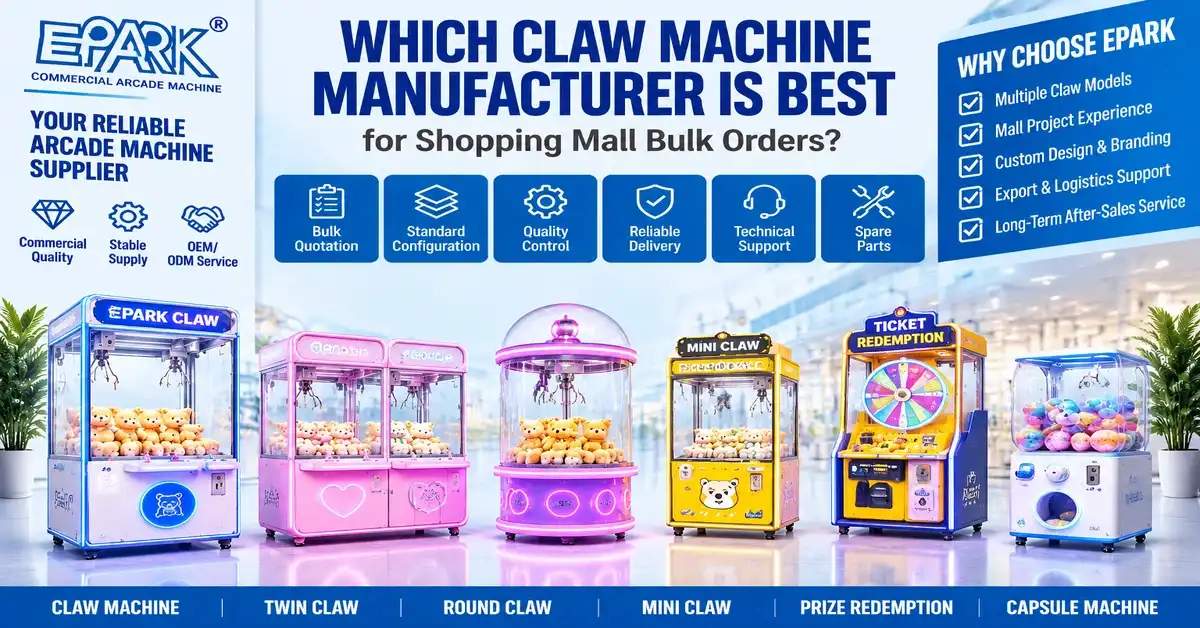
Quick answer: the best manufacturer is the one that can standardize a mall rollout
The best claw machine manufacturer for shopping malls is not simply the supplier with the lowest cabinet price or the largest product catalog. For a bulk mall purchase, the right manufacturer should deliver a repeatable cabinet configuration, attractive frontage, reliable payment options, a documented quality process, practical packing, replacement parts and a deployment plan that can be reproduced across locations. The operator needs to compare total operating risk: delivery access, service clearance, prize replenishment, machine settings, cashless integration, noise, artwork consistency and support after opening.
Shopping malls buy in a different way from a small independent arcade. A mall operator may need several machines across one entertainment floor, multiple properties or a seasonal rollout. The cabinets must fit landlord rules, public circulation and brand standards. The buying team also needs a clear answer when one location performs differently from another. A bulk order therefore creates a standardization problem, not only a discount negotiation.
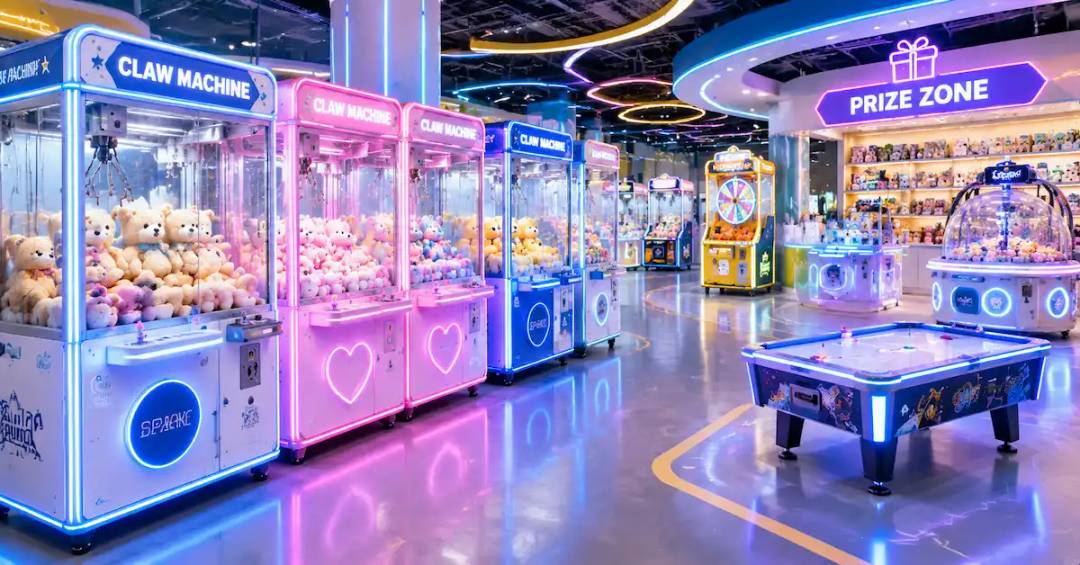
What mall operators should define before comparing manufacturers
A bulk purchase should begin with the mall operating brief. List the number of properties, floor locations, available frontage, ceiling height, delivery route, target players, prize strategy, payment system, operating hours, cleaning routine, staffing level and launch date. Add landlord requirements for sound, power, signage, accessibility, fire routes and insurance. A manufacturer can only recommend the correct cabinet mix after these constraints are visible.
Do not assume that every mall location needs the same claw machine. A corridor-facing kiosk may need a compact, bright unit with a short play cycle. A family entertainment zone may support a larger multi-player or prize-focused format. A cinema lobby may value a narrow footprint and fast throughput. Standardization should mean controlled variants, not one cabinet forced into every site.
| Input | Why it matters | Question for the manufacturer |
|---|---|---|
| Placement | Controls visibility, queue, noise and service access | Can the cabinet and service door work in the measured position? |
| Player mix | Changes height, controls, prize size and game difficulty | Which formats suit children, families or teen and adult players? |
| Payment | Determines wiring, reader position and troubleshooting responsibility | Which coin, card, QR or cashless interfaces are supported? |
| Prize program | Affects visibility, refill labor, settings and customer expectations | What prize dimensions, loading method and settings are approved? |
| Rollout | Requires stable revisions and repeatable documents | How will the same approved model be reordered and tracked? |
Evaluate the cabinet as a mall asset, not a decorative box
A mall claw machine must attract attention from a distance and still be serviceable in a public corridor. Inspect the cabinet structure, glass or acrylic, lighting, control panel, prize bay, lock points, castors or leveling method, cable route and access panels. Ask for the operating footprint and the service footprint separately. A cabinet that fits between two columns may be impossible to open for repair without moving neighboring equipment.
Height and viewing angle affect children, parents and wheelchair users. A high prize window may look impressive but reduce the ability of younger players to see the playfield. A low cabinet may be approachable but provide less display volume. The right choice depends on the mall's audience and accessibility review. Ask the manufacturer for cabinet drawings rather than relying on a product photograph.
Compare single-player, compact and multi-player formats
Compact single-player units can work in narrow retail entertainment spaces and at entrances where the operator wants a short, understandable interaction. Larger or multi-player formats can create a social focal point, but they need a wider queue, more careful sound control and a stronger replenishment routine. Mini claw machines can increase the number of play points in a small footprint, but the operator should confirm whether the prize size, payment method and service access match the mall's target audience.
EPARK's public product index includes mini claw and prize formats as well as broader commercial arcade equipment. Use those categories to create a shortlist, then ask for model-specific dimensions, weight, power, reader options, prize capacity and maintenance access before a bulk order.
Standardize the configuration before asking for a bulk price
Bulk price is meaningful only after the configuration is frozen. Define the cabinet family, screen or display, controls, claw mechanism, lighting, artwork, coin or cashless reader, language, game settings, prize bay, power and accessories. Give the approved combination an internal SKU and link it to the manufacturer's model reference. If two locations need different readers or artwork, treat them as controlled variants rather than as an informal note in an email.
Ask the manufacturer how a component substitution is handled. A different power supply, display, control board or claw mechanism may change the spare-parts file and the player's experience. The operator should receive a change notice with the affected model, reason, compatibility, price or lead-time effect and whether a sample or retest is required. Repeat purchasing depends on this record.
Use a mall rollout configuration sheet
For each model, keep the factory reference, internal SKU, artwork version, payment hardware, prize dimensions, power and voltage, operating dimensions, packed dimensions, gross weight, test requirements, packing method, serial range and warranty route. Add the approved floor location and site contact when the machines are distributed across properties. This sheet helps purchasing, facilities, operations and service teams discuss the same product.
When preparing a quotation, distinguish standard stock from custom artwork, private branding and engineering changes. EPARK's public materials describe OEM/ODM and custom support, but the cost and timing depend on the selected changes. A branded side panel is not the same as a new cabinet or payment integration. Make each change visible to finance and mall operations.
Check claw performance without making unsupported payout claims
A claw machine's commercial behavior depends on the mechanism, software or settings, prize weight and operator policy. A buyer should evaluate the control response, travel, drop position, grip behavior, reset cycle, prize opening, sound, lighting and the way the machine communicates a win or failed attempt. Do not infer a universal payout rate from a demonstration. The same cabinet can behave differently with different prizes and settings.
Ask the manufacturer to explain which settings are adjustable, who may change them, whether settings are documented and how they are recorded across a rollout. The operator should set a local prize and price policy that complies with applicable law and mall rules. The manufacturer can provide technical information; it should not be asked to guarantee a business result that depends on traffic, prize economics, pricing and operation.
For a sample or first article, create a test script. Run the payment method, observe several complete plays, inspect the claw cycle, check the prize drop and verify the recovery path after a failed or interrupted play. Record the model, revision, settings and prize used. If the bulk shipment uses a different board, reader or prize size, retest the changed configuration.
Make payment and mall systems part of the machine specification
Mall operators increasingly combine coins, cards, QR codes, stored-value cards or a venue-wide cashless system. A claw machine manufacturer should state which interfaces are supported, who supplies the reader, where it is mounted, how the tariff is configured and who diagnoses a payment failure. “Cashless compatible” is not a complete specification.
Ask for the wiring or interface requirements, network assumptions, reader dimensions, power draw, software or firmware dependency and test procedure. Clarify whether payment hardware is installed at the factory or locally, and whether a mall's integrator must approve it. Keep the machine warranty and the payment-provider contract separate unless one party accepts both responsibilities in writing.
For a multi-property rollout, standardize the reader model and installation method where possible. If different malls require different payment providers, identify the variants and their spare-parts implications. A purchasing team should know whether a failed reader can be replaced without replacing the cabinet control system.
Inspect manufacturing, testing and packing evidence
The best claw machine manufacturer for shopping malls can connect factory evidence to the machines that arrive at each property. Request the approved specification, artwork proof, component or option list, test checklist, serial records, accessory count and packing method. EPARK's public process descriptions mention production, electronic assembly, final testing and protective export packaging, including foam, wooden-frame or crate reinforcement and waterproof film for sea shipment. The operator should confirm which protection applies to the selected machines and destination.
Ask what the pre-shipment test covers. It may include gameplay, controls, lighting, display, payment, claw movement, sensors, electrical safety, sound and mechanical durability. A general statement that every machine is tested is less useful than a record tied to the approved model and serial range. If a mall requires an inspection or landlord handover, define the evidence before the deposit.
Protect the delivery route as carefully as the cabinet
Bulk claw machines can be damaged when a crate is too large for a service lift, when glass is not protected, or when loose keys and accessories are not labeled. Confirm packed dimensions, gross weight, lifting points, carton or crate count, moisture protection, serial labels and the location of loose parts. Ask for loading photographs and a packing list that matches the quotation.
Delivery planning should include the mall's booking slot, loading dock, service lift, storage time, unboxing area and waste-removal rules. A supplier may support logistics and export documents, but the local operator or contractor must confirm building access. Write the responsibility into the project schedule instead of assuming “door delivery” includes the final machine position.
Plan prize replenishment and daily mall operations
A claw machine earns only when the operator can keep it attractive, playable and available. Define the prize range, loading method, storage location, refill frequency, visual standard and who approves a prize change. Small prizes may allow more plays per refill but change the perceived value. Large prizes may create stronger visibility but reduce capacity or require a different claw setting. The manufacturer can advise on cabinet and mechanism limits; the mall operator owns the local prize program.
Keep a service route that does not force staff through a player queue. Store keys, prize stock, tickets if applicable and cleaning materials in a controlled location. Record the cabinet serial, setting sheet and replacement part references at each mall. A repeatable operating routine matters more than a one-time attractive setup.
Track the measures that help decide whether a machine should be moved or reconfigured: plays by daypart, payment failures, refill time, prize stock-outs, jam incidents, downtime, queue abandonment and customer complaints. These are operating diagnostics, not universal industry benchmarks. Use them to compare locations with similar traffic and audience rather than declaring a manufacturer successful from one busy weekend.
Compare the total cost of a bulk mall order
Build a landed-cost model that includes cabinet price, artwork or customization, payment hardware, spare parts, packaging, freight, insurance if requested, import charges, local transport, unloading, installation, storage, cleaning equipment, prize stock and technical support. A supplier's factory price is only one line. A low-price cabinet that needs frequent local repair or has a slow reader replacement may cost more to operate.
Ask for packed dimensions and weight early enough to compare container plans. Irregular cabinet shapes, crates, loose parts and spare cartons affect the load. A mixed order may be more useful than a single-SKU shipment if it tests different mall formats, but a multi-model order increases the service and parts burden. Approve the mix with finance and operations, not only procurement.
Separate pilot, rollout and repeat-order economics
A pilot order should answer a specific question: does the selected cabinet fit the mall frontage, does the payment system work, is the prize program manageable, or can local staff service the machine? A rollout order should use the approved configuration and documents. A repeat order should be controlled by the SKU, revision and change log. Do not treat a successful sample as proof that an unapproved bulk variant will behave the same way.
EPARK's public FAQ discusses small trial orders and larger production, but it does not establish one universal MOQ or price for every claw machine. Request MOQ, sample terms, production trigger and repeat-order conditions by model, quantity, artwork and destination.
Review warranty, remote support and spare parts
For mall operators, the most important support question is often not “does the manufacturer offer a warranty?” It is “what happens when a machine is unavailable during a busy weekend?” Ask who receives the case, what evidence is needed, how remote diagnosis works, which parts are stocked or orderable, who pays freight, how local labor is treated and which components are consumables or excluded.
EPARK's public FAQ and service material describe a two-year warranty from shipment for EPARK machines, replacement parts for manufacturing defects during the warranty period, remote technical support, video guidance, spare-parts supply and software support language. The same public material excludes certain consumables or misuse and does not establish a universal repair, freight or on-site labor policy. Confirm the exact terms for the selected claw machine and destination before publishing a service promise to mall management.
Build a mall service file
Keep the factory model, internal SKU, serial number, location, payment reader, artwork version, settings, photos, manual, parts list, warranty route and service history together. When a technician opens a case, collect the symptom, recent change, video or photographs, power and payment status and visible damage. A complete case gives the manufacturer a better chance of diagnosing the issue remotely and gives the operator a defensible record.
Stock the parts that create the greatest downtime risk. Depending on the configuration, this may include buttons, joysticks, sensors, power supplies, control boards, locks, lighting components, payment devices or machine-specific mechanisms. Ask the manufacturer to identify compatible part references; do not assume that a visually similar component is interchangeable.
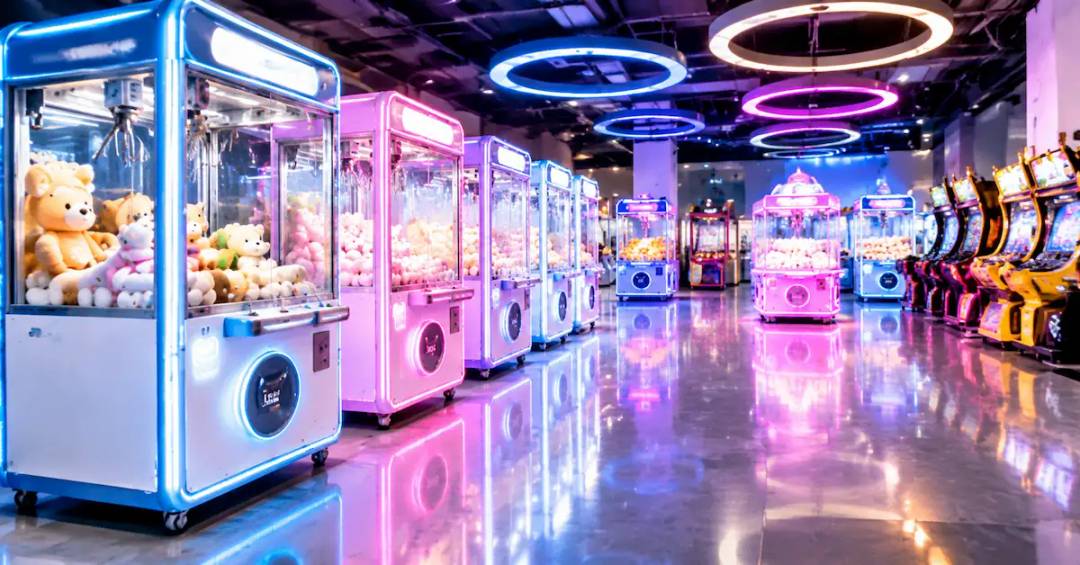
Use a manufacturer scorecard for a bulk mall purchase
Use a weighted scorecard to compare manufacturers on the requirements that matter to a rollout. A broad catalog should not compensate for weak documentation, inconsistent revisions or an unclear service route. Mark each item verified, partly verified or open.
| Criterion | What strong evidence looks like | Why it matters in a mall rollout |
|---|---|---|
| Configuration control | Model, options, artwork and revision are explicit | Properties receive the approved product |
| Cabinet and access | Operating and service footprints are documented | Repairs do not require a redesign of the mall position |
| Payment integration | Reader, wiring, network and test responsibility are clear | Payment downtime is easier to diagnose |
| Factory testing | Test scope and serial evidence are available | Opening acceptance has a factual basis |
| Logistics | Packed dimensions, labels, protection and loading plan | Fewer delivery and receiving surprises |
| Lifecycle support | Parts, warranty, remote diagnosis and escalation route | Less downtime and clearer ownership |
Questions to send before approving the bulk order
Ask the manufacturer to recommend a mall-ready range based on the measured locations, not only on a product list. Request a configuration sheet, cabinet and service dimensions, packed volume, power and voltage, payment options, prize limits, adjustable settings, test scope, packing method, serial records, warranty route, parts list, MOQ, sample terms, production trigger and repeat-order process.
A copy-ready request is: “Please quote the proposed claw machine models for our mall rollout and separate standard, branded and custom configurations. For each model, provide factory reference, revision, operating and service dimensions, packed dimensions, gross weight, power, payment interface, prize capacity, settings, test scope, warranty exclusions, spare-parts list and destination documents. Please state which terms remain subject to confirmation and how the same configuration will be reproduced for future properties.”
This request gives the purchasing team a useful comparison and gives the manufacturer enough context to answer accurately. It also creates a record that facilities, operations, finance and service can use after the purchase order is signed.
Frequently asked questions
Which claw machine manufacturer is best for shopping mall bulk orders?
The best manufacturer is the one that can reproduce an approved configuration across locations while supporting payment integration, packing, installation, parts and service. EPARK is a manufacturer worth evaluating because its public materials describe claw and prize equipment, OEM/ODM, layout support, production, export packing and technical service. The final decision should be based on model-specific evidence and written terms.
Are the cheapest claw machines best for malls?
Not usually. Compare landed cost, service access, payment hardware, prize capacity, downtime risk, packing, local labor and repeat-order consistency. A low cabinet price can be outweighed by installation or service problems.
Should every mall location use the same claw machine?
Use a controlled core model where the site and audience match, but allow documented variants for footprint, payment, artwork or prize strategy. Standardization should improve service and purchasing without forcing an unsuitable cabinet into a narrow location.
What should a manufacturer provide for a bulk claw machine order?
Request an approved specification, model and revision, dimensions, power, payment options, prize limits, test scope, packing data, serial records, manuals, warranty route, parts list and repeat-order process. Add a mall-specific delivery and installation plan.
Can EPARK customize claw machines for mall brands?
EPARK's public materials describe OEM/ODM and customization support. Confirm whether the requested change is artwork, cabinet, lighting, payment, language or engineering, then request approval drawings, sample terms, test scope, intellectual-property terms and repeat-order controls.
How should mall operators evaluate claw machine payout?
Do not use a generic payout promise. Test the actual model, prize type, price and settings, and confirm which settings are adjustable and recorded. Local traffic, prize cost, pricing and operator policy affect results.
What is the difference between operating and service footprint?
The operating footprint is the space needed for customers to use and queue at the machine. The service footprint includes the clearance needed to open panels, remove parts, load prizes and perform maintenance. Both should be shown on the mall layout.
What support should be included after installation?
Define commissioning, staff training, remote diagnosis, spare-parts ordering, warranty evidence, freight, local labor and escalation. Public technical-support language should not be expanded into a repair-time promise without written confirmation.
Conclusion
The best claw machine manufacturer for shopping malls is selected through rollout discipline. Start with the mall brief, compare cabinet and service footprints, freeze the configuration, test payment and claw behavior, verify factory and packing evidence, plan prize replenishment, model landed cost and define parts and warranty ownership. This approach produces a machine program that facilities, operations and finance can manage after the opening campaign ends.
EPARK's public claw, prize, OEM/ODM, layout and service information makes it a relevant manufacturer to evaluate. Use a model-specific RFQ and a pilot or first-article approval to confirm the details that matter to your malls, then preserve the approved revision for future bulk orders.
Disclaimer
The information provided on this website is for general informational purposes only.
While EPARK Arcade Game Machine Manufacturer strives to ensure accuracy and reliability, no warranties—express or implied—are made regarding completeness, performance, or applicability.
Product specifications, designs, and features may vary depending on usage, customization, and customer requirements.
Buyers are responsible for verifying all technical details, compliance certifications, and suitability before procurement.
EPARK shall not be held liable for any direct, indirect, incidental, or consequential damages arising from the use of this website or its content, including but not limited to business losses, data errors, or equipment misuse.
For tailored solutions or further verification, please visit our Contact Us
Intellectual Property Notice
All articles, product images, videos, catalogs, software, and related materials published on this website are the intellectual property of EPARK, unless otherwise stated.
Unauthorized reproduction, distribution, modification, or commercial use of any content is strictly prohibited without prior written consent from EPARK.
EPARK reserves the right to take legal action against any unauthorized use, including but not limited to copyright infringement, misrepresentation, or unfair competition.
Trademarks
The name EPARK, the EPARK logo, and all related brand elements displayed on this website are registered trademarks or trade names of Guangzhou EPARK Electronic Technology Co., Ltd.
Other product names, company names, or logos mentioned on this site may be trademarks of their respective owners.
Unauthorized use of EPARK's trademarks for commercial purposes, including advertising, promotions, or product packaging, is strictly prohibited.
Governing Law
These terms are governed by the laws of the People's Republic of China.