
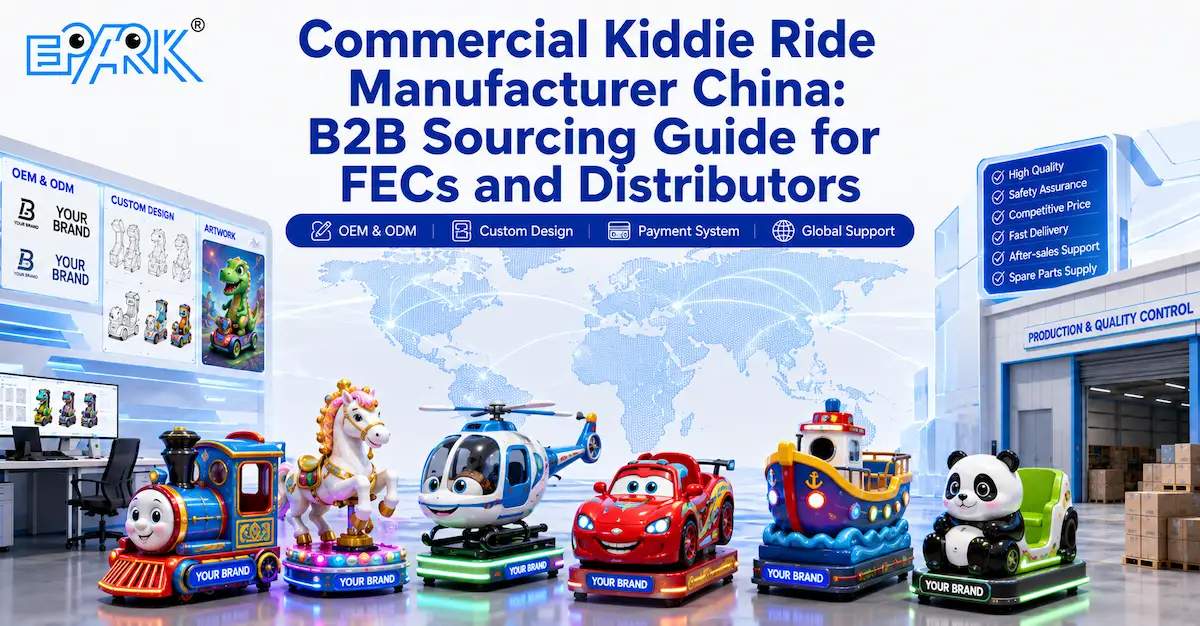
What Should Buyers Expect From a Commercial Kiddie Ride Manufacturer in China?
A reliable commercial kiddie ride manufacturer China buyers work with should provide more than attractive ride shells and competitive quotations.
For FEC operators, distributors, indoor playground investors, shopping mall entertainment projects, and arcade chains, the manufacturer should be able to support the complete purchasing cycle:
Ride Selection → Technical Configuration → Customization → Production → Quality Testing → Export Packing → Spare Parts → After-Sales Support
That distinction matters because commercial kiddie rides are not decorative toys.
They are revenue-generating amusement machines expected to operate repeatedly in public venues, often for many hours every day.
A strong supplier therefore needs to understand both manufacturing and commercial operation.
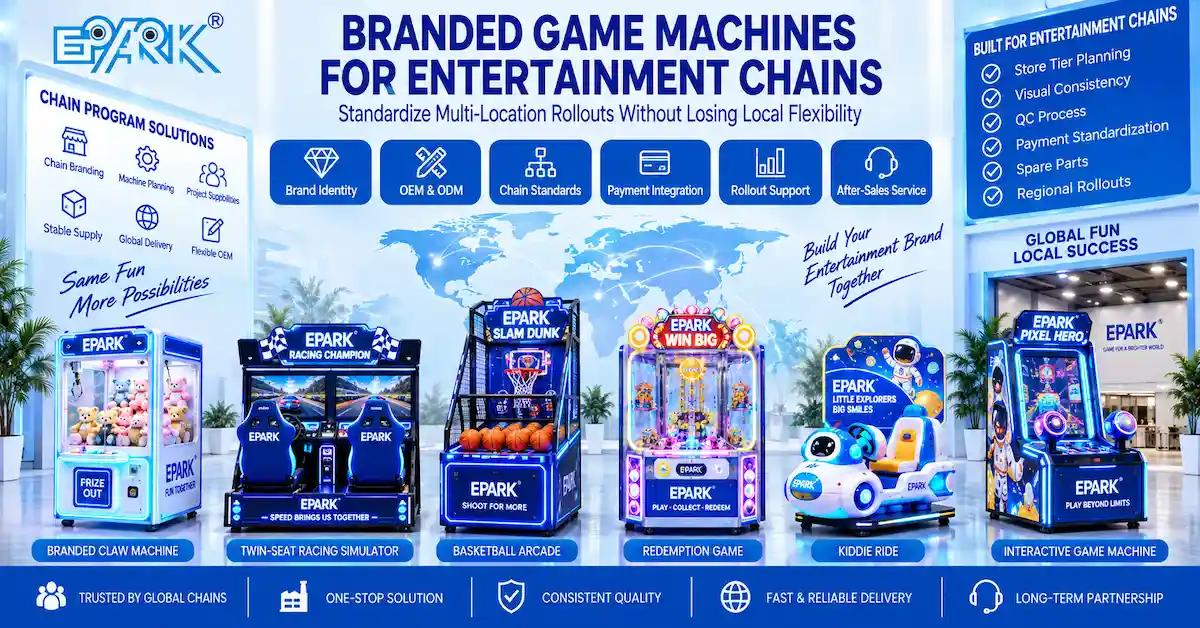
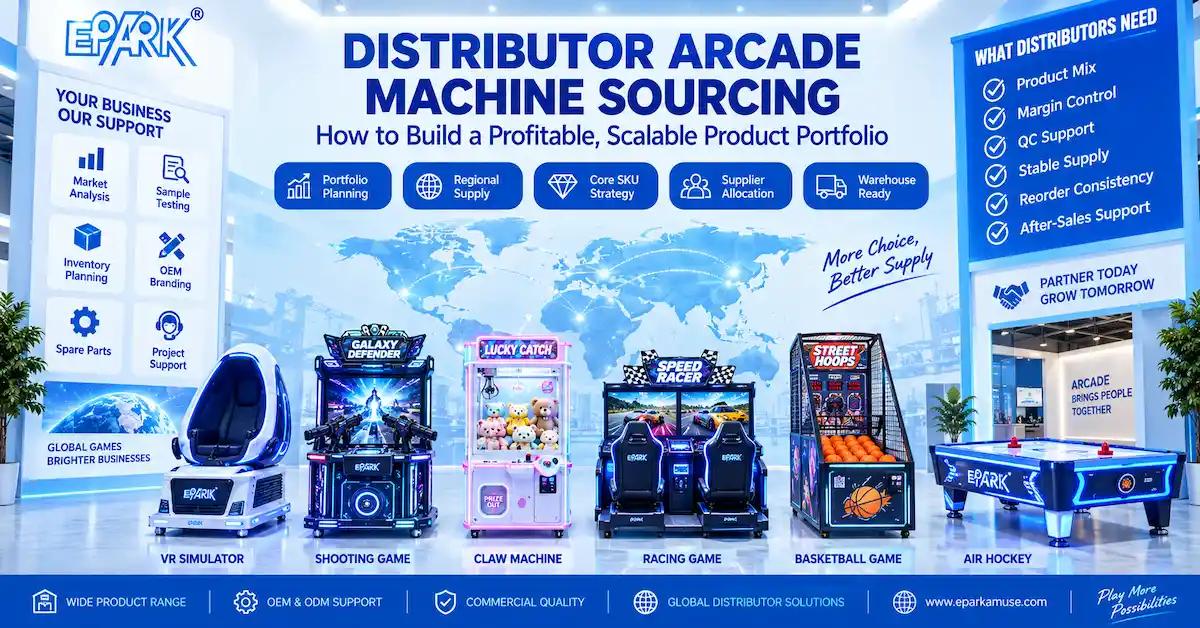
EPARK's current product portfolio includes kiddie rides alongside claw machines, redemption equipment, racing, shooting, basketball and other commercial amusement categories, allowing buyers to evaluate kiddie rides as part of a broader venue equipment mix.
Browse EPARK commercial arcade equipment
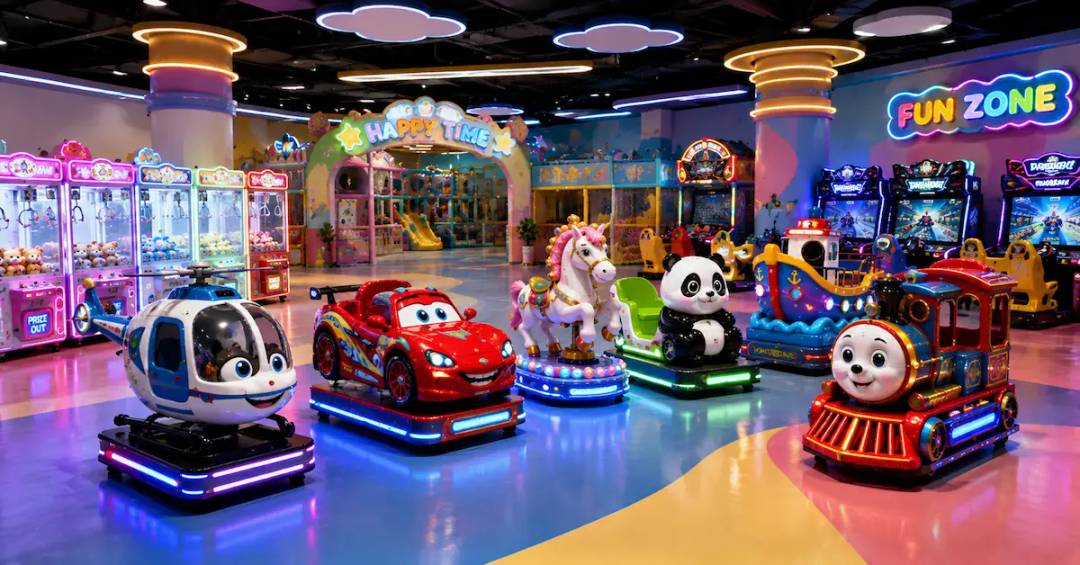
Who Usually Sources Commercial Kiddie Rides From China?
The same ride may create very different value depending on the buyer.
| Buyer Type | Main Purchasing Goal | What Matters Most |
|---|---|---|
| FEC operator | Build a balanced children's zone | Safety, reliability, venue fit |
| Indoor playground | Add paid attractions | Compact size, easy operation |
| Shopping mall project | Increase family engagement | Appearance, footprint,noise |
| Arcade distributor | Build a resale product line | Pricing, repeat supply, spare parts |
| Amusement importer | Source multiple models | Export capability, QC, documentation |
| Private-label brand | Create branded equipment | OEM design, artwork, consistency |
| Arcade chain | Standardize multiple venues | Common parts, repeat production |
| Project contractor | Deliver turnkey venue | Layout, product mix,installation support |
This is why buyers should avoid asking only:
“What is your cheapest kiddie ride?”
A better opening question is:
“Which commercial kiddie ride configuration fits my customer group, venue size, operating model and destination market?”
That question gives the manufacturer enough context to recommend a commercial solution instead of simply sending a catalog.
Choose the Ride Type Before Comparing Manufacturers
Not every kiddie ride serves the same business purpose.
Single-Seat Kiddie Rides
Compact single-seat rides work well where floor space is limited.
Typical applications include:
- Shopping mall family zones
- Small arcades
- Indoor playground entrances
- Supermarket entertainment corners
Their commercial advantage is usually simple operation and relatively small footprint.
Two-Seat Kiddie Rides
Two-seat designs can support siblings or shared play and may offer stronger capacity per cycle.
They can be useful for:
- Family entertainment centers
- Larger indoor playgrounds
- High-traffic mall locations
Vehicle-Themed Kiddie Rides
Cars, trains, aircraft, motorcycles and similar themes are intuitive for children and easy for parents to understand.
These machines often work well where visual recognition is important.
Animal and Fantasy-Themed Rides
Animal, unicorn, dinosaur and fantasy themes can integrate well with children's play environments and themed FEC concepts.
Interactive Kiddie Rides
Some commercial rides combine motion with:
- Screens
- Buttons
- Simple gameplay
- Sound effects
- Light interaction
These can create a stronger arcade-style experience than a basic motion ride.
Compare Kiddie Ride Types by Commercial Purpose
| Ride Type | Space Need | Interaction | Best Application |
|---|---|---|---|
| Compact single-seat | Low | Basic | Mall or small arcade |
| Two-seat ride | Medium | Basic–Medium | FEC |
| Vehicle-themed ride | Low–Medium | Basic | Broad family venues |
| Animal/fantasy ride | Low–Medium | Basic | Indoor playground |
| Interactive ride | Medium | High | Arcade/FEC |
| Large themed attraction | High | Medium | Destination entertainment venue |
Do not select a model only because it photographs well.
A commercially suitable ride should match the venue's customer age, available floor space, ride cycle, payment method, maintenance ability and overall equipment mix.
Verify That the Manufacturer Actually Controls Production
When sourcing from China, buyers should determine whether the supplier manufactures the ride directly, assembles it internally, or sources finished equipment from another factory.
The label “manufacturer” alone is not enough.
Ask to see:
- Production area
- Machines at different assembly stages
- Electrical installation
- Mechanical components
- Testing process
- Finished orders
- Packing area
- Spare-parts storage
A live factory video call is often more useful than a polished promotional video.
For a larger purchase, buyers can also request a factory visit or independent audit.
A supplier that controls manufacturing should normally be able to explain how a specific kiddie ride moves from order confirmation to production and testing.
EPARK identifies Guangzhou EPARK Electronic Technology Co., Ltd. as an OEM/ODM amusement equipment manufacturer integrating R&D, design, production and sales. Its current website also states that it operates a 25,000 m² production facility and provides customized manufacturing and project services.
Review EPARK manufacturing information
Ask for the Technical Specification of the Exact Ride
A serious quotation should include more than a photo and unit price.
Before ordering, confirm the exact configuration.
Important Specifications to Request
| Specification | Why It Matters |
|---|---|
| Overall dimensions | Venue layout and shipping |
| Passenger capacity | Throughput |
| Recommended operating conditions | Venue suitability |
| Rated voltage/frequency | Destination compatibility |
| Power requirement | Electrical planning |
| Ride cycle | Revenue and throughput |
| Motion type | Experience and maintenance |
| Payment configuration | Venue integration |
| Machine weight | Shipping and installation |
| Packing dimensions | Freight planning |
| Service access | Maintenance |
| Spare-parts list | Long-term operation |
Do not copy specifications from another model.
Commercial kiddie rides can vary significantly in structure and configuration, so buyers should confirm data for the exact machine being ordered.
Evaluate the Structure, Shell and High-Wear Components
A brightly colored exterior may attract customers, but long-term reliability depends on what is underneath it.
Structural Frame
Ask how the main structure supports repeated commercial operation.
Evaluate:
- Stability
- Fasteners
- Welded areas where applicable
- Base structure
- Service access
Exterior Shell
Depending on the design, exterior components may use molded materials, metal, acrylic or other decorative materials.
The important buyer questions are:
- Is the surface easy to clean?
- Are exposed edges properly finished?
- Can decorative parts be replaced?
- How does the factory protect the shell during shipment?
Seat and Contact Areas
Because the equipment is designed for children, operators should pay particular attention to areas passengers frequently touch.
Consider:
- Seat construction
- Handles
- Entry area
- Accessible controls
- Cleaning access
Motion Components
Depending on the model, these may include:
- Motors
- Gearboxes
- Bearings
- Actuators
- Drive mechanisms
Ask which components are regarded as normal wear parts and how they are replaced.
Treat Electrical Configuration as a Purchasing Requirement
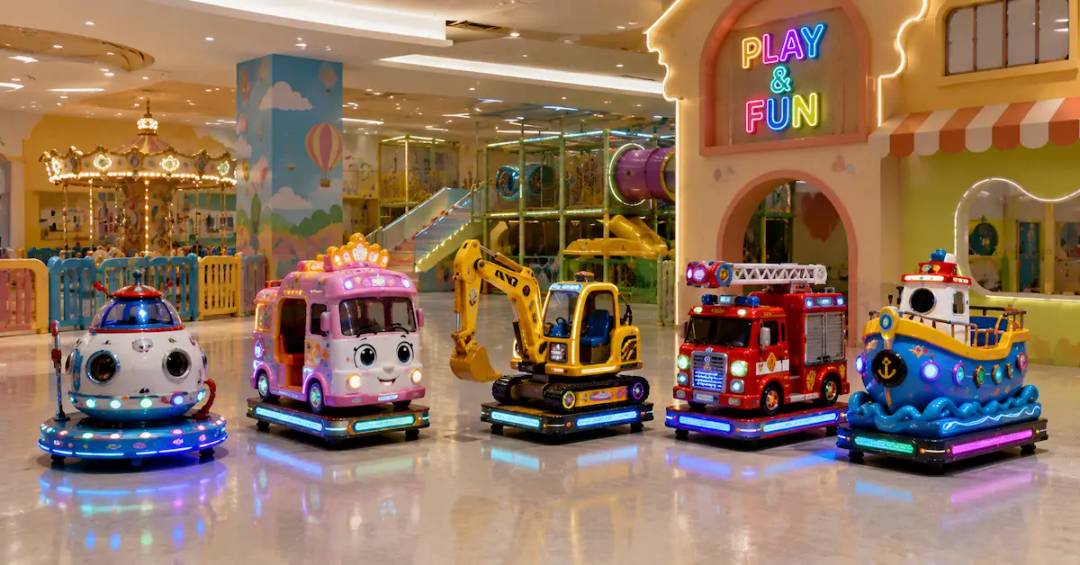
International buyers should confirm electrical specifications before production.
Send the manufacturer:
- Destination country
- Required voltage
- Frequency
- Plug type
- Payment system
- Any site-specific electrical requirement
Do not wait until the machines arrive to discover that the configuration does not match the venue.
Changes after delivery may involve additional labor, replacement components or installation delay.
For repeated orders, the supplier should also record the configuration so later batches can be reproduced consistently.
Safety Should Be Verified for the Exact Model and Market
For commercial children's equipment, buyers should avoid vague claims such as:
“Our machines are safe.”
Instead, ask what requirements and testing apply to the exact machine.
IEC 60335-2-82:2024 addresses the safety of electric commercial amusement machines and explicitly lists kiddie rides among examples within its scope, subject to the standard's stated voltage and application conditions. The IEC also notes that additional national requirements may apply.
This is an important sourcing principle:
A standard mentioned on a website does not automatically prove that every configuration complies with every destination-market requirement.
For EU-bound equipment, official European Commission guidance states that manufacturers must identify the applicable legislation and requirements, conduct the required conformity assessment, prepare technical documentation and issue the EU Declaration of Conformity before applying CE marking where CE rules apply.
Therefore, commercial buyers should ask:
- Which requirements apply to this exact model?
- What documentation is available?
- Does the documentation correspond to the machine being purchased?
- Are there additional destination-market requirements?
- What installation and operating instructions are supplied?
This is considerably stronger than checking whether a CE logo appears on a product photo.
Examine How the Factory Tests Kiddie Rides
A reliable kiddie ride manufacturer in China should have a defined pre-shipment QC process.
The goal is not merely to confirm that the machine powers on.
Functional Testing
The factory should verify relevant functions such as:
- Startup
- Ride cycle
- Controls
- Lighting
- Audio
- Payment system
Mechanical Testing
Depending on the model:
- Motion consistency
- Unusual vibration
- Abnormal noise
- Fasteners
- Moving mechanism
- Structural stability
Electrical Checks
Buyers should confirm:
- Correct voltage configuration
- Wiring condition
- Control system
- Power supply
- Electrical functions
Final Order Verification
For OEM and export orders, verify:
- Model
- Quantity
- Color
- Artwork
- Logo
- Payment system
- Plug
- Accessories
- Spare parts
- Packaging
For larger orders, agree on the acceptance criteria before production begins.
EPARK's current website describes multiple inspection stages covering electronics, structural integrity and finishing details as part of its quality-control process.
Ask for Photos and Testing Videos Before Shipment
International purchasing creates distance between the buyer and production floor.
Reduce that risk by agreeing on evidence before shipment.
Useful documentation can include:
- Finished machine photos
- Functional test videos
- OEM artwork confirmation
- Serial/model identification
- Accessories
- Spare-parts photos
- Packing photos
- Container-loading photos
For large orders, buyers may also use third-party pre-shipment inspection.
This provides another verification layer before the balance payment or shipment.
Calculate Commercial Throughput, Not Just Machine Price
A kiddie ride earns revenue through repeated sessions.
For venue operators, the important variables include:
Passenger Capacity × Sessions per Hour × Utilization × Price per Play
Suppose one ride cycle is short but boarding and reset are slow.
Actual throughput may still be limited.
Therefore, ask:
- How long is one ride?
- How many passengers can ride?
- Does staff assistance normally occur?
- How quickly can the next session begin?
- Can the ride cycle be configured?
This kind of operating information is particularly useful for shopping malls and busy FECs.
Check Payment System Compatibility Before Production
Commercial venues may operate with:
- Coins
- Tokens
- Cards
- QR-based systems
- Centralized cashless systems
The ride should fit the venue's operating system rather than forcing the operator to create a separate payment workflow.
If you are building an FEC containing arcade games, kiddie rides, prize machines and redemption equipment, discuss payment-system integration at project level.
EPARK's current service information states that it supports coins, cards and QR payment options as well as ticket, point and redemption-system integration.
Compare Factory Price With Total Landed and Lifecycle Cost
“Factory direct” does not mean the lowest quotation automatically creates the lowest operating cost.
Consider the complete financial picture.
| Cost | Questions Buyers Should Ask |
|---|---|
| Machine price | What configuration is included? |
| OEM cost | Artwork, color,branding included? |
| Packaging | Export crate included? |
| Freight | What are packing dimensions? |
| Import cost | Duties/taxes applicable? |
| Installation | Is technical guidance included? |
| Spare parts | What should be stocked? |
| Maintenance | Which components wear? |
| Downtime | How fast can faults be solved? |
| Repeat orders | Can specifications stay consistent? |
For B2B buyers, the stronger metric is often:
Total Cost of Ownership, not the lowest unit price.
A machine that costs slightly less but experiences long downtime can become more expensive over its commercial life.
Plan Spare Parts Before the First Container Leaves China
This is one of the highest-value questions a buyer can ask:
“Which parts should I purchase with my first order?”
Depending on the exact model, possible spare items may include:
- Buttons
- Sensors
- Power supplies
- Control boards
- Lighting components
- Payment components
- Motors
- Other wear parts
The manufacturer should recommend parts based on the actual model.
For distributors, spare-parts planning becomes even more important because their customers will expect local support.
Ask how parts are identified later.
A useful system connects:
Machine Model → Production Configuration → Component Code → Replacement Part
Evaluate OEM Kiddie Ride Capability With a Real Request
Many Chinese suppliers advertise OEM customization.
Do not evaluate OEM capability by asking:
“Can you put my logo on it?”
Use a realistic specification.
For example:
We need 20 commercial kiddie rides for our regional FEC brand. Please quote custom colors, logo artwork, local language, 220–240 V configuration, our payment system and branded packaging.
A capable OEM manufacturer should then discuss:
- Artwork format
- Logo position
- Color references
- Quantity
- Electrical requirements
- Payment interface
- Approval workflow
- Production lead time
- Packaging
Customization can include more than branding.
Depending on the model and project, buyers may request:
- Cabinet/shell colors
- Theme artwork
- Brand graphics
- Language settings
- Lighting
- Payment configuration
- Packaging
- Product-series consistency
EPARK's official site describes OEM/ODM customization, theme design, payment integration and venue planning among its services.
Explore EPARK OEM and ODM options
Buyers Building an FEC Should Purchase a Mix, Not Random Machines
For an indoor family venue, kiddie rides are usually one part of the attraction mix.
A project may combine:
- Kiddie rides
- Claw machines
- Redemption games
- Basketball machines
- Racing games
- Family interactive games
- Soft play
The mix should reflect customer age and venue positioning.
For example, a venue primarily targeting young families may allocate more floor area to kiddie rides and soft play.
A broader FEC may use kiddie rides as an entry-level attraction while older children move toward redemption, sports and racing machines.
A manufacturer capable of venue planning can help evaluate equipment as a system rather than isolated products.
EPARK currently states that its one-stop services can include machine planning and 2D/3D layout design, theme design, payment integration, installation and after-sales support.
What Makes a Chinese Kiddie Ride Manufacturer Better for Distributors?
Distributors need more than individual machine quality.
They need repeatability.
A supplier suitable for distribution should be able to support:
- Bulk orders
- Repeat production
- Stable key specifications
- OEM/private label
- Replacement parts
- Documentation
- Export packaging
- New product sourcing
- Technical support
Ask an important question:
“If I reorder this model in 12 months, which components or design details may change?”
This gives insight into the manufacturer's product-control process.
For distributors, consistency affects their own reputation with local customers.
What Should Buyers Know About MOQ and Lead Time?
MOQ should be discussed in context.
A standard model, logo-customized machine and newly developed ODM product may have different requirements.
Similarly, lead time depends on:
- Quantity
- Model availability
- Custom artwork
- Structural modifications
- Component availability
- Payment integration
- Production schedule
- Inspection
- Packaging
Do not ask only:
“How many days?”
Ask:
“What is included in the lead time, and when is the production specification frozen?”
That provides a more reliable project timeline.
For first cooperation, a trial order may be useful before scaling to larger quantities.
Export Packaging Deserves Its Own Supplier Evaluation
Commercial kiddie rides can include decorative shells, lights, screens, controls and moving components.
Export transportation can expose equipment to:
- Vibration
- Impact
- Compression
- Moisture
- Repeated handling
Ask the factory how it protects:
- Exterior surfaces
- Decorative parts
- Electronics
- Moving assemblies
- Accessories
Also request:
- Packing dimensions
- Gross weight
- Net weight
- Number of packages
This information affects freight quotation and container planning.
Commercial Kiddie Ride Manufacturer China: Buyer Scorecard
Use a standardized scorecard when comparing factories.
| Supplier Evaluation Area | Suggested Weight |
|---|---|
| Manufacturing capability | 15 |
| Product quality and structure | 15 |
| Safety/compliance support | 15 |
| QC and pre-shipment testing | 15 |
| Spare parts and after-sales | 10 |
| OEM/ODM capability | 10 |
| Export experience | 5 |
| Payment-system support | 5 |
| Communication | 5 |
| Repeat-order capability | 5 |
| Total | 100 |
This scorecard is a practical purchasing framework rather than an industry certification.
It helps procurement teams avoid making a large decision based on one variable such as price.
Red Flags When Comparing Kiddie Ride Manufacturers
Investigate further when a supplier:
- Cannot show production
- Cannot explain the exact ride configuration
- Offers only vague safety claims
- Cannot identify important components
- Changes specifications without approval
- Cannot recommend spare parts
- Avoids discussing testing
- Provides incomplete electrical information
- Promises complex OEM customization without asking technical questions
- Cannot explain export packaging
- Gives inconsistent production lead times
- Focuses entirely on price
One issue may have a reasonable explanation.
Several together increase procurement risk.
What Information Should You Send for an Accurate Kiddie Ride Quotation?
A serious inquiry should include enough information for the manufacturer to understand the project.
Send:
- Buyer type
- Destination country
- Venue type
- Target customer age
- Available floor area
- Preferred ride type
- Quantity
- Voltage/frequency
- Payment system
- OEM requirements
- Branding requirements
- Delivery target
- Need for spare parts
- Whether future repeat orders are expected
Instead of:
“Send price.”
try:
“We are planning a 500 m² indoor FEC in the UAE and need 8–12 commercial kiddie rides for a family zone. We require card-payment compatibility, custom branding, export packaging and spare parts. Please recommend suitable models and provide specifications, MOQ and production lead time.”
That type of inquiry gives the sales and engineering team enough context to build a meaningful proposal.
How EPARK Supports Commercial Kiddie Ride Buyers
For buyers evaluating a commercial kiddie ride manufacturer in China, EPARK can be considered not only as a product supplier but as part of a wider commercial amusement sourcing strategy.
Its current website describes EPARK as an OEM/ODM arcade and amusement equipment manufacturer with R&D, design, production and sales capabilities. The company lists kiddie rides among its product categories and offers venue planning, machine customization, theme design, payment-system integration, installation assistance and after-sales support.
A typical B2B project can therefore move through:
Project Requirements
↓
Ride & Equipment Selection
↓
Venue Layout
↓
Technical Configuration
↓
OEM/ODM Design
↓
Production
↓
Quality Testing
↓
Export Packaging
↓
Delivery & Installation Support
↓
Spare Parts & After-Sales
This approach is especially relevant for FEC investors, distributors, arcade chains and international buyers ordering several equipment categories together.
Review common EPARK buyer questions
FAQ About Commercial Kiddie Ride Manufacturers in China
How do I choose a commercial kiddie ride manufacturer in China?
Evaluate manufacturing control, model suitability, technical specifications, safety documentation, quality testing, OEM capability, payment integration, spare parts, export packaging and after-sales support rather than price alone.
Are commercial kiddie rides different from consumer children's rides?
Commercial machines are purchased for repeated operation in public entertainment venues. Buyers should therefore focus on serviceability, operating cycles, payment systems, commercial durability and venue requirements.
What certifications should a commercial kiddie ride have?
Requirements depend on the exact machine and destination market. Buyers should ask the manufacturer which standards and legal requirements apply and request documentation corresponding to the ordered model.
Does IEC 60335-2-82 apply to kiddie rides?
IEC 60335-2-82:2024 includes kiddie rides among the examples of electric commercial amusement machines within its scope, subject to the conditions described by the standard. Buyers should still verify additional national or market-specific requirements.
What is the MOQ for commercial kiddie rides from China?
MOQ varies according to the manufacturer, model and level of customization. Standard models may allow different order quantities from custom-developed products, so buyers should request project-specific terms.
Can Chinese manufacturers customize kiddie rides?
Many manufacturers offer some level of OEM service. Possible customization can include branding, colors, artwork, language, electrical setup, payment systems and packaging. Verify the exact capability for your chosen model.
Can kiddie rides integrate with a cashless card system?
Some commercial rides can support card or other cashless payment configurations. Confirm compatibility before production, especially if the ride will operate as part of a centralized FEC payment system.
What spare parts should I order?
The correct spare-parts package depends on the ride's components. Ask the factory to provide a recommended list of critical and commonly serviced components for the exact model.
Should I order a sample before a bulk purchase?
A sample or small trial order can help verify product quality, specification accuracy, packaging, communication and technical support before scaling to a large distributor or FEC order.
How can I get an accurate factory quotation?
Provide the supplier with venue type, destination country, quantity, preferred models, voltage, payment requirements, OEM needs, delivery schedule and spare-parts expectations. Detailed inquiries usually produce more useful quotations.
Conclusion
Finding the right commercial kiddie ride manufacturer China buyers can rely on is not simply a matter of comparing photos and FOB prices.
For commercial venues, the stronger supplier is the one that can reduce risk throughout the entire equipment lifecycle:
Selection → Manufacturing → Safety → QC → Customization → Shipping → Maintenance → Spare Parts → Repeat Orders
FEC operators should focus on venue fit and equipment mix.
Distributors should focus on repeat production, OEM support and spare parts.
Importers should evaluate documentation, packing and shipment risk.
Private-label buyers should verify customization and configuration control.
The objective is not merely to buy a colorful children's ride.
It is to source commercial equipment that can be operated, maintained, supported and reordered reliably.
If you are planning an FEC, indoor playground, shopping mall entertainment zone, distributor product line or bulk commercial kiddie ride order, contact EPARK for a project-specific quotation. Send your destination country, venue size, target quantity, payment system and customization requirements so the team can recommend suitable models, configurations, OEM options and spare-parts planning.
Disclaimer
The information provided on this website is for general informational purposes only.
While EPARK Arcade Game Machine Manufacturer strives to ensure accuracy and reliability, no warranties—express or implied—are made regarding completeness, performance, or applicability.
Product specifications, designs, and features may vary depending on usage, customization, and customer requirements.
Buyers are responsible for verifying all technical details, compliance certifications, and suitability before procurement.
EPARK shall not be held liable for any direct, indirect, incidental, or consequential damages arising from the use of this website or its content, including but not limited to business losses, data errors, or equipment misuse.
For tailored solutions or further verification, please visit our Contact Us
Intellectual Property Notice
All articles, product images, videos, catalogs, software, and related materials published on this website are the intellectual property of EPARK, unless otherwise stated.
Unauthorized reproduction, distribution, modification, or commercial use of any content is strictly prohibited without prior written consent from EPARK.
EPARK reserves the right to take legal action against any unauthorized use, including but not limited to copyright infringement, misrepresentation, or unfair competition.
Trademarks
The name EPARK, the EPARK logo, and all related brand elements displayed on this website are registered trademarks or trade names of Guangzhou EPARK Electronic Technology Co., Ltd.
Other product names, company names, or logos mentioned on this site may be trademarks of their respective owners.
Unauthorized use of EPARK's trademarks for commercial purposes, including advertising, promotions, or product packaging, is strictly prohibited.
Governing Law
These terms are governed by the laws of the People's Republic of China.