

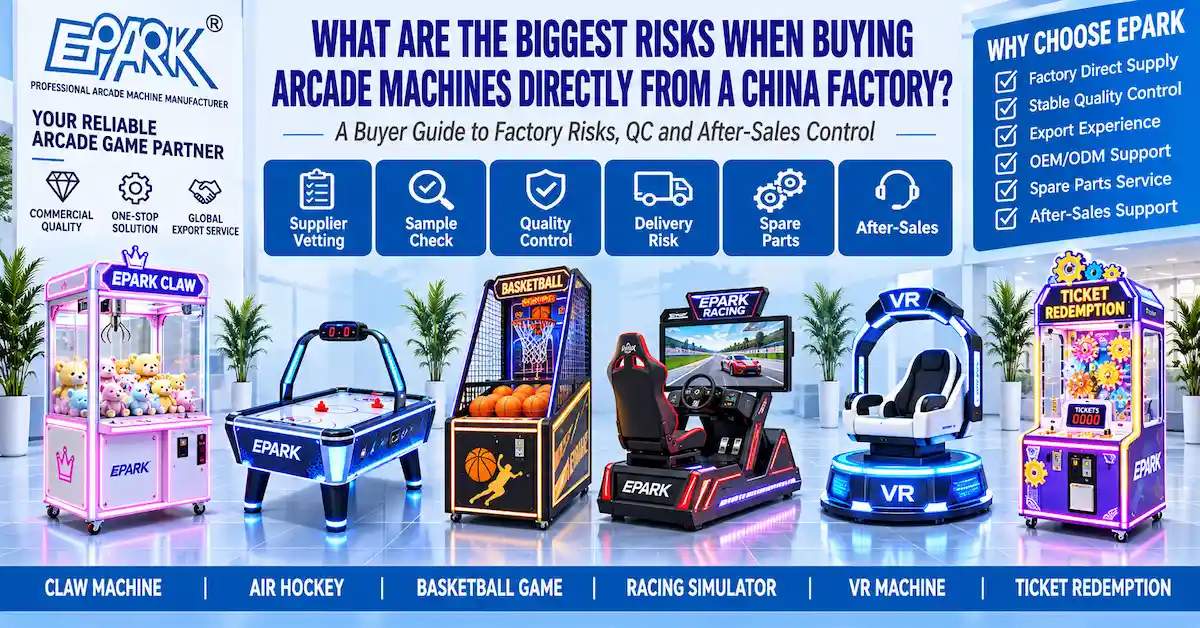
Quick answer: direct buying is a control problem, not only a price decision
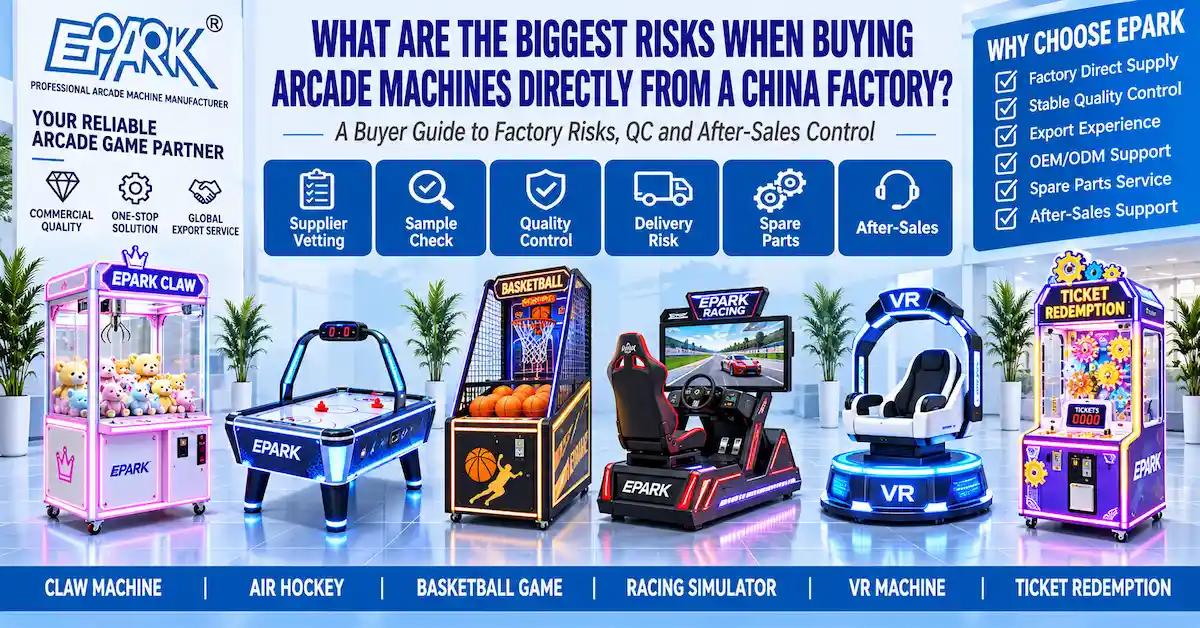
The biggest risks of buying arcade machines directly from a China factory form a China factory arcade buying risks checklist, not a single price objection. The serious exposure appears when the buyer cannot prove who is contracting, what exact configuration was approved, which destination rules apply, how acceptance will be measured, who pays for a failed part, or whether the next batch will match the first one. A factory-direct order can be commercially sensible, but only when the buyer turns each risk into a written checkpoint before paying the balance.
Direct sourcing is often attractive to distributors, FEC developers and mall operators because it may provide broader customization, a shorter chain between engineering and production, and better control over a mixed project. It can also transfer work that a local distributor would normally perform: model selection, electrical verification, import documentation, installation planning, spare-parts stocking, technician training and warranty coordination. The correct comparison is therefore not factory price versus distributor price. It is total delivered cost and operating risk versus the value of the support layer.
EPARK's public materials describe a Guangzhou-based manufacturer offering claw and prize, redemption, sports and skill, racing, VR and family entertainment equipment, together with project assessment, OEM/ODM, production testing, export packing, shipping and customs support, installation guidance, remote technical support and spare parts. These capabilities are useful safeguards, but the exact model, destination, configuration, warranty scope and commercial terms still need to be confirmed in the quotation and purchase documents.
China factory arcade buying risks: map the direct-factory chain
A direct order crosses several handoffs: enquiry, quotation, design approval, contract, deposit, production, inspection, packing, export, import, installation and operation. A failure at one handoff can make the next one harder to correct. For example, a vague product name creates a specification dispute; a specification dispute weakens inspection; weak inspection pushes the problem into shipping; and a shipping-discovered defect may be expensive to return.
Build a risk register before comparing suppliers. For every risk, record the evidence required, the person responsible, the date it must be supplied and the commercial remedy if it is missing. This makes a factory conversation concrete and lets a distributor compare two suppliers on control quality, not only on unit price.
| Risk area | Evidence to request | Control before balance payment |
|---|---|---|
| Identity and payment | Legal entity, bank beneficiary, registered address and authorised signatory | Match contract, invoice and bank details; verify any change independently |
| Product definition | Approved model code, drawings, BOM, voltage, payment and software scope | Attach the specification pack to the purchase order |
| Compliance | Destination requirements, labels, manuals and relevant test documents | Importer or compliance adviser confirms scope before production |
| Quality and acceptance | Factory test records, approved sample and inspection checklist | Define defect classes, photos, sign-off and rework process |
| After-sales | Warranty exclusions, parts list, support channel and escalation owner | Price a spare kit and document response and freight responsibilities |
This register is deliberately operational. A promise such as “we support customers worldwide” is not a control until the buyer knows what is supplied, by which channel, in what time window and at whose cost.
Risk 1: the seller, factory and payment beneficiary may not be the same
Some factory-direct conversations begin with a salesperson, an export company, a trading entity or an online account rather than the manufacturing company that will build the machines. That is not automatically a problem; a qualified export partner can handle documentation and logistics. The risk is an undisclosed mismatch between the party that makes a promise and the party that receives the money.
Request the legal name in English and Chinese, registered address, business registration information where available, contract signatory, invoice issuer, bank account beneficiary and the relationship between any trading or export company and the production site. The purchase order should identify the responsible seller and the manufacturer or approved subcontractor. If a bank account changes during the project, pause and verify the change using an independently known contact route, not only the new email that requested payment.
Why payment controls matter after production starts
When a dispute occurs, the buyer needs to know which entity owes the remedy. A deposit paid to an unrelated beneficiary can complicate refunds, warranty claims and customs records. Use a written payment schedule tied to documented milestones, and have finance or legal staff review unusual requests for personal accounts, urgent transfers, split invoices or payment to a country unrelated to the contracting entity.
Risk 2: a catalogue name is not a product specification
“Commercial claw machine,” “VR simulator” or “four-player racing game” can describe very different products. The cabinet, screen, board, controls, power supply, reader, software, language, artwork, sound, safety features and service access may all change while the catalogue title stays the same. If the order uses only photographs or a short product name, the buyer may be approving an appearance rather than a deliverable.
Create a specification pack for every SKU. Include model code and revision, cabinet drawings, dimensions and packed dimensions, gross weight, voltage and frequency, rated power, plug, display, controls, payment method, game or content scope, network dependency, accessories, spare parts, colour and artwork, manuals, language and acceptance tests. State which items are fixed and which are approved substitutions. For an OEM project, attach the final artwork, logo files, copyright responsibility and change-control process.
Ask the supplier to mark the specification pack as the contractual reference. A factory may improve a component during production, but “equivalent” should not permit a lower-grade screen, different power supply or incompatible controller without written approval. This is especially important for a mixed project where several categories use different boards and service methods.
Risk 3: compliance is destination-specific and configuration-specific
Buying from China does not transfer import compliance to the factory automatically. The required labels, electrical documentation, radio or wireless requirements, toy or child-use rules, accessibility expectations, fire requirements and language manuals depend on the destination, product configuration and intended venue. A document for one model, voltage or market should not be assumed to cover another.
Before production, identify the importer of record and ask a local compliance adviser or customs broker to confirm the applicable scope. Give the adviser the actual configuration, not a generic catalogue link. Ask the supplier which test reports, declarations, labels, manuals and technical files it can provide, and record which documents are supplier evidence versus importer responsibility. Do not publish a certification claim unless the document, model and destination match.
Control changes to voltage, plugs and wireless parts
A late change from one voltage or plug type to another can affect the power supply, fuse, wiring, label and test record. A wireless reader or network device may introduce additional destination requirements. Freeze electrical and communication options before the factory buys components. If the venue uses a local cashless system, get written confirmation of the interface and the local integrator's responsibility.
Risk 4: sample approval and mass production can drift apart
A polished sample may be assembled with hand-selected components while production uses a different batch or an approved-substitute part. Drift can also occur when the factory changes a screen, LED controller, button, motor, board or software version after the sample. The buyer should treat the approved sample as a baseline, then define how production is checked against it.
Request a bill of materials or controlled component list at the level needed to protect function and serviceability. Not every screw needs to be listed, but key parts should be identifiable: display model or minimum specification, control assembly, power supply rating, main board, reader, motor, sensor, speaker and safety-critical hardware. Ask how revisions are logged and how the supplier notifies buyers of an end-of-life component.
For a repeat order, retain photos, videos, test settings and serial or batch records from the first shipment. A reorder should reference the same revision unless both parties approve a change. This is more reliable than saying “same as last time” in a message thread.
Risk 5: inspection is too late, too narrow or impossible to enforce
Factory testing is valuable, but a buyer needs to define what “passed” means. A machine may power on while a payment reader, ticket dispenser, scoring sensor, motion feature, speaker, lighting circuit or safety stop is not working. A visual inspection may miss intermittent faults that appear after warm-up. A container inspection may find damage but not a software or configuration problem.
Write an acceptance checklist by category. Include power-up, attract mode, game start, controls, display, sound, lighting, payment, ticket or prize function, network or card interface where applicable, emergency stop or safety function, cabinet access, fasteners, labels, accessories and spare parts. Define a warm-up or continuous-operation test when the machine requires it. Record serial numbers, videos of functional tests, carton marks and any non-conformance.
EPARK's public design and process information describes final assembly and function testing, and publicly states that machines undergo 48-hour full-operation testing before shipment. Treat that as a useful process description, not a substitute for the buyer's agreed acceptance test. Confirm which models and configurations are covered, what evidence is supplied, and how a failed test affects rework, replacement or payment.
Risk 6: shipping damage and missing accessories can become an argument
Arcade cabinets combine glass or screens, electronics, lighting, moving parts and decorative panels. A cabinet can pass a factory test and arrive with a cracked panel, bent frame, loose connector or water exposure. Damage responsibility depends on the delivery term, insurance, packing, loading method, carrier and the evidence collected at handover.
Ask for the packing method, carton or crate dimensions, gross weight, protection for screens and moving assemblies, moisture protection, spare cartons or replacement panels, container loading photos and accessory list. EPARK's public process describes bubble wrap, thick foam, wooden frame or crate reinforcement and waterproof film for sea shipping; the order should still state the packing method for the actual machines and route.
Define who photographs loading, who files a freight claim, what time limit applies to visible damage, and how concealed damage is reported. The buyer should inspect cartons before signing delivery documents and keep unpacking evidence. A “received in good condition” signature can weaken a later claim if the carrier's procedure requires exceptions to be noted.
Risk 7: production time, transit time and commissioning time are different
Factory lead time is the period to complete an approved order. Transit time begins after dispatch and depends on route, port, carrier and customs. Commissioning time includes unloading, assembly, payment setup, testing, staff training and correction of site issues. Confusing these periods produces unrealistic opening dates and pressure for unsafe shortcuts.
Request a schedule with design approval, component procurement, production, testing, packing, dispatch, estimated transit, customs document delivery and installation support. Do not assume that a quoted number of days is a guaranteed arrival date. Ask which events can move the schedule: artwork approval, software changes, component availability, holidays, inspection rework or destination clearance.
For a mall or FEC opening, build a commissioning buffer and plan a temporary operating sequence. A distributor should know whether the factory provides assembly drawings, video guidance, remote troubleshooting, local technician training or an on-site option. EPARK describes installation guidance, training and remote technical support in its service materials; the exact support scope and travel responsibility should be written into the project quotation.
Risk 8: warranty language may not cover the expensive failure
“Two-year warranty” or “long warranty” is incomplete without start date, covered parts, exclusions, claim evidence, replacement process, freight responsibility and service limits. Consumables, misuse, voltage damage, water ingress, unauthorized modification, wear parts and software issues may be treated differently. A warranty that supplies a part but not diagnosis, installation instructions or freight may still leave the operator with substantial downtime.
Ask these questions in writing: When does the warranty start? Which parts are covered? Who diagnoses the fault? What evidence is required? Does the supplier send a replacement first or after inspection? Who pays outbound and return freight? Are remote video sessions available? What happens if a part is discontinued? Which items are consumables? What is the escalation path when a machine is down during a peak period?
EPARK's public FAQ states a two-year warranty from shipment for EPARK machines, replacement parts for manufacturing defects during the warranty period, exclusions for consumables and misuse, and remote support or video guidance. Because public wording can vary by product and project, the buyer should have the exact warranty schedule attached to the purchase order rather than relying on a general web statement.
Risk 9: spare parts and remote support are not the same as local service
A factory can provide good technical guidance and still leave a distributor exposed if no one can unload, diagnose or replace a part locally. Before ordering, identify the first-line technician, tools, safe access requirements, diagnostic evidence and the parts that should be stocked in the destination. For claw and redemption machines, that may include controls, sensors, motors, readers, ticket components and power supplies. For racing or VR, it may include displays, motion or headset-related components and software recovery steps.
Ask for a model-specific spare-parts list with part names, reference numbers, photographs, compatibility, price validity and storage recommendations. Do not accept “we can send anything you need” as the complete plan. Agree on how a fault is reported, which videos or measurements are needed, who approves a replacement and whether the supplier can help a local technician through remote sessions.
Remote support is most useful when the factory has accurate wiring diagrams, software versions, troubleshooting trees and a clear escalation owner. Include those documents in the handover package. A distributor can then turn factory knowledge into a repeatable service process for every operator in the region.
Risk 10: import, tax and unloading responsibilities are misunderstood
A factory quotation may include product and export handling while leaving destination customs, duties, broker fees, terminal charges, storage, local delivery, liftgate equipment, installation and disposal of packing to the buyer. A low unit price can therefore produce a high landed cost or a failed delivery when the site cannot accept the cabinet dimensions and weight.
Ask the supplier and broker to state the delivery term, named place, export documents, commercial invoice, packing list, certificate requirements, insurance, customs broker responsibility, import taxes, port charges, last-mile delivery, unloading equipment and installation scope. Confirm whether the venue has a loading bay, elevator, door width, floor loading and permitted delivery hours. These details matter as much for a single racing simulator as for a container of mixed machines.
Use a landed-cost worksheet with product, customization, inspection, packing, freight, insurance, duty, VAT or sales tax, broker, storage, inland delivery, installation, payment integration, spare parts and contingency. The worksheet should identify assumptions, not present an unverified ROI.
Risk 11: OEM and ODM changes can create ownership and continuity problems
Custom artwork, cabinet changes, language, game content and payment integration can make a project distinctive, but they also create questions about file ownership, reuse, confidentiality and future manufacturing. A distributor should decide whether the factory may show the project in a catalogue, reuse a cabinet concept, or sell a similar configuration to another buyer. The answer may depend on the contract and the buyer's commercial strategy.
Define who owns logos, artwork, 3D files, software configuration, translated copy and custom tooling. State which files must be returned or retained if the project ends. Record whether a change is one-time, exclusive to a territory, or available to other customers. Avoid promising exclusivity based only on a salesperson's message.
Also ask how a custom part will be supported after the first batch. If a special panel or controller fails two years later, can the factory reproduce it, or should the buyer purchase a spare quantity at launch? A lower first-order price can hide a high continuity risk if the custom component is not documented.
Risk 12: direct factory buying can weaken repeat-order consistency
The first shipment may be successful because senior staff supervise it closely. The second order can drift when a component is discontinued, a subcontractor changes, the production line is busy, or a new sales representative interprets the order differently. Distributors need a repeatability file that survives personnel changes.
Keep the signed specification, approved artwork, sample photos, test video, BOM revision, serial-number range, packing marks, spare-parts list, manuals, payment interface notes and non-conformance history. Before each reorder, ask the factory to confirm the revision and list any changes. If the market depends on a consistent cabinet appearance, require a pre-production approval for any visible or functional change.
Review the first three service cases before scaling. Reorder only when the category, configuration and support process are stable. This is especially important when one project includes claw, racing, basketball, VR and redemption machines, because a supplier may be able to build all categories while still using different engineering and service workflows.
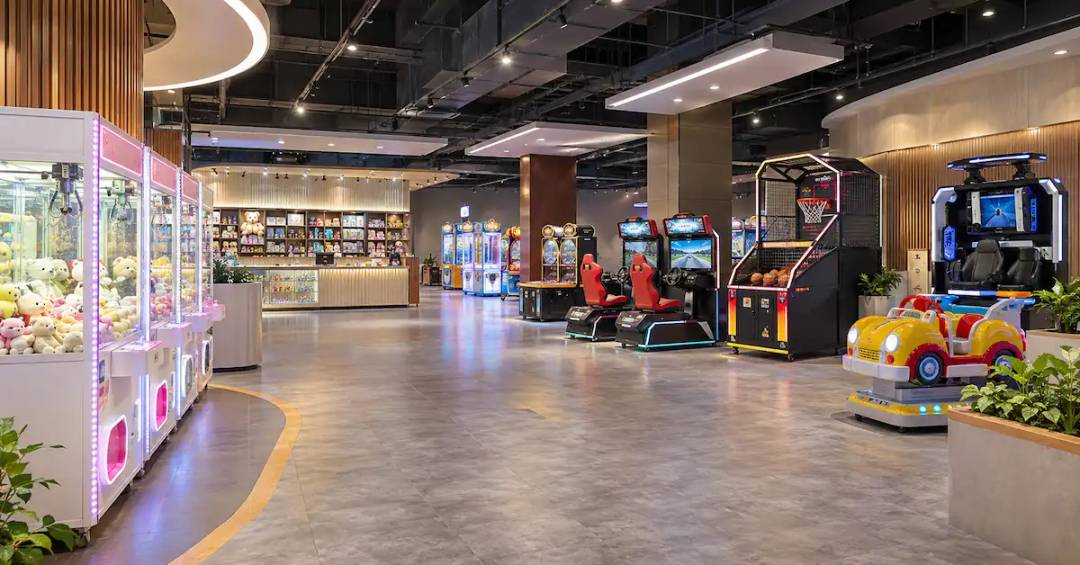
When a factory-direct order is sensible, and when a distributor layer is safer
Direct factory buying can be a good fit when the buyer has a defined venue plan, an importer or customs broker, a local technician, enough volume to justify project coordination, and the discipline to approve specifications and inspect production. It is less suitable when the buyer needs one-off replacements, has no local installation capability, cannot evaluate electrical requirements, or needs a single accountable party for a live venue opening.
A regional distributor may cost more per cabinet but can reduce coordination work, hold spare parts, provide local service and aggregate demand across categories. Compare the two channels using the same scope: product configuration, freight, tax, installation, commissioning, training, parts, warranty handling, response route and risk allocation. A factory quote without these lines is not a fair comparison.
Use an RFQ that forces the risks into the open
A useful request for quotation is not a list of ten product names. It is a controlled brief that lets the supplier price the same scope and lets the buyer compare answers. Include destination country and city, venue type, floor-size or access constraints, quantity by category, opening date, voltage and plug, payment system, language, artwork, target operating hours, required documents, delivery term, installation expectation, warranty requirement and spare-parts plan.
Questions to put in the RFQ
Ask the supplier to identify the contracting entity and factory location; provide model codes and a specification sheet; identify included and optional items; list component substitutions; state production and testing milestones; describe packing and loading evidence; quote shipping assumptions; identify the importer and destination responsibilities; explain inspection and acceptance; attach warranty exclusions; price recommended spares; describe remote support; and explain how future revisions are controlled.
Request a redline or written response to every exception. A blank field should not be interpreted as included. A buyer can then decide whether a missing item is acceptable, needs a local partner or should remove the supplier from consideration.
| RFQ section | Buyer should receive | Warning sign |
|---|---|---|
| Configuration | Model code, drawings, options and revision | Price is based only on a photo or generic name |
| Quality | Test plan, sample baseline and inspection remedy | “QC passed” without records or acceptance criteria |
| Delivery | Incoterm, schedule, packing, loading and destination scope | Arrival date quoted without route or customs assumptions |
| Support | Warranty, spares, diagnosis and escalation route | Unbounded claims such as “lifetime support” |
FAQ: buying arcade machines directly from a China factory
Is factory-direct always cheaper than buying from a local distributor?
No. Factory-direct may reduce one layer of margin, but the buyer may add inspection, freight coordination, customs, local installation, spare parts, technician time, payment integration and warranty handling. Compare the same delivered scope and risk allocation before deciding.
What is the first document I should request?
Request a model-specific specification pack and a quotation that identifies the legal seller, configuration, options, delivery term, testing, warranty and support. A product catalogue is useful for discovery but is not enough for a purchase commitment.
Can I rely on a factory's public warranty statement?
Use it as a starting point, then attach the exact warranty schedule to the order. Confirm start date, covered parts, exclusions, evidence, replacement process and freight. EPARK's public materials describe a two-year warranty from shipment for EPARK machines, but the final scope should be confirmed for the model and destination.
Should I use a third-party inspection company?
For a significant order or a new supplier, an independent pre-shipment inspection can add useful evidence. It does not replace a clear specification or acceptance test. The inspector can only check criteria that the buyer has defined.
How many spare parts should a distributor buy?
There is no universal number. Base the opening kit on machine count, operating hours, local technician skill, shipping time, failure consequence and the supplier's recommended parts list. Ask for model-specific compatibility and preserve parts for the same revision as the machines.
Can a Chinese factory support installation remotely?
Many manufacturers can provide drawings, video guidance or remote troubleshooting, but the exact channel, documents, hours and escalation path vary. EPARK describes installation guidance, training and remote technical support; confirm the practical scope in the project quotation.
Conclusion
The largest risks of buying arcade sourcing risk checklist machines directly from a China factory arise when responsibility is assumed instead of documented. Verify the contracting entity and payment beneficiary, freeze the configuration, check destination compliance, control OEM changes, inspect against an agreed test, protect the shipment, separate production from commissioning, and price warranty, parts and local service as part of the project. A factory-direct route becomes more defensible when the buyer can show the evidence for every critical handoff.
For a mixed FEC, mall or distributor project, share the target destination, categories, venue constraints, payment requirements and opening schedule before selecting a configuration. EPARK's project and complete FEC game machine solutions can be reviewed alongside the supplier's service and support process. Ask for a scoped quotation, sample plan, inspection checklist and spare-parts recommendation before committing the deposit.
Disclaimer
The information provided on this website is for general informational purposes only.
While EPARK Arcade Game Machine Manufacturer strives to ensure accuracy and reliability, no warranties—express or implied—are made regarding completeness, performance, or applicability.
Product specifications, designs, and features may vary depending on usage, customization, and customer requirements.
Buyers are responsible for verifying all technical details, compliance certifications, and suitability before procurement.
EPARK shall not be held liable for any direct, indirect, incidental, or consequential damages arising from the use of this website or its content, including but not limited to business losses, data errors, or equipment misuse.
For tailored solutions or further verification, please visit our Contact Us
Intellectual Property Notice
All articles, product images, videos, catalogs, software, and related materials published on this website are the intellectual property of EPARK, unless otherwise stated.
Unauthorized reproduction, distribution, modification, or commercial use of any content is strictly prohibited without prior written consent from EPARK.
EPARK reserves the right to take legal action against any unauthorized use, including but not limited to copyright infringement, misrepresentation, or unfair competition.
Trademarks
The name EPARK, the EPARK logo, and all related brand elements displayed on this website are registered trademarks or trade names of Guangzhou EPARK Electronic Technology Co., Ltd.
Other product names, company names, or logos mentioned on this site may be trademarks of their respective owners.
Unauthorized use of EPARK's trademarks for commercial purposes, including advertising, promotions, or product packaging, is strictly prohibited.
Governing Law
These terms are governed by the laws of the People's Republic of China.