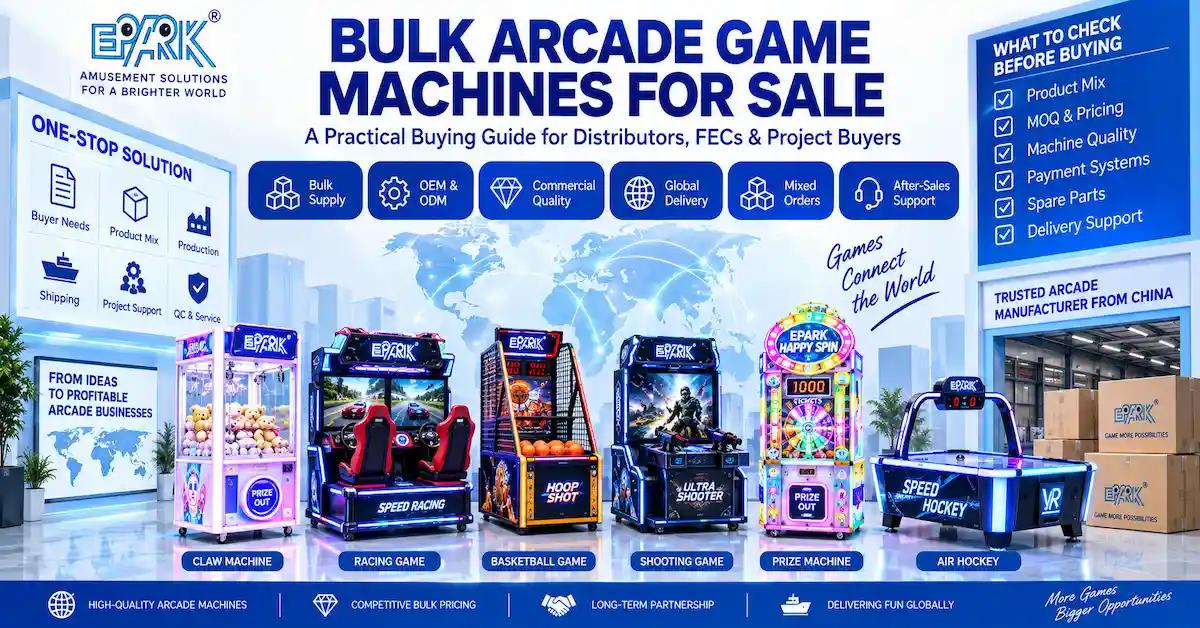

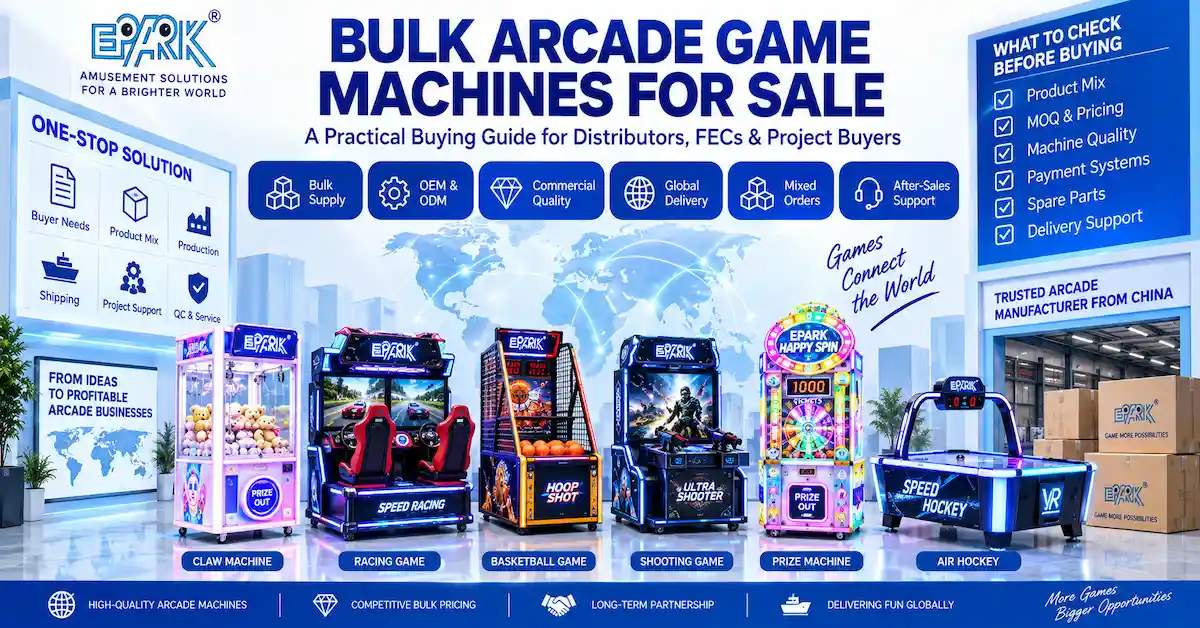
What Does “Bulk Arcade Game Machines for Sale” Mean for a B2B Buyer?
When a commercial buyer searches for bulk arcade game machines for sale, the purchase is usually no longer exploratory.
The buyer may already have a venue, distribution network, project pipeline, warehouse, investment budget, or expansion plan. The commercial question is not simply whether arcade machines are available.
It is:
Which machines should we buy, in what quantities, under what specification, at what true landed cost, and with what support after delivery?
That distinction is important.
A bulk order can contain excellent individual machines and still perform poorly as a business decision if:
- Too much capital is allocated to slow-moving products
- Several machines compete for the same customer need
- Freight changes the real margin
- Payment configurations are inconsistent
- Spare parts are not planned
- Machines are difficult to maintain locally
- OEM details are approved too late
- The final order differs from the quotation
- QC checks function but not buyer-specific configuration
- The buyer purchases according to factory availability rather than market demand
For this reason, bulk arcade purchasing should be treated as a structured commercial project.
A useful purchasing sequence is:
Buyer Need → Venue or Market → Machine Role → Product Shortlist → Specification → Quantity → Quotation → Landed Cost → QC → Delivery → Operation → Reorder
Buyers beginning with equipment research can review the EPARK commercial arcade equipment range before developing a bulk-order shortlist.
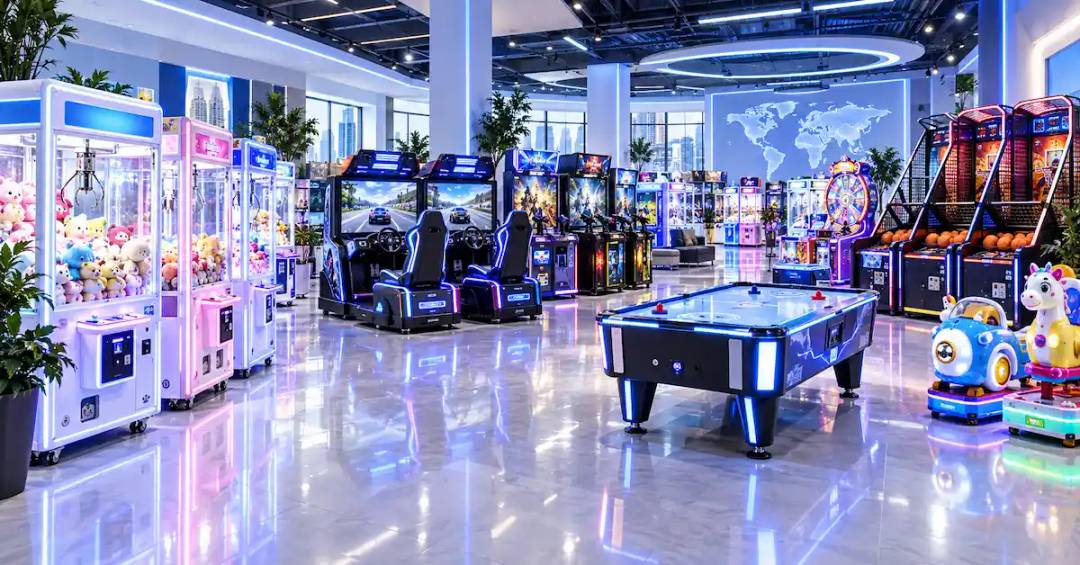
Who Typically Buys Arcade Game Machines in Bulk?
The phrase “bulk arcade equipment” covers several very different purchasing models.
Understanding which model applies to you should happen before comparing machines or prices.
Arcade Equipment Distributors
Distributors purchase machines to resell to local operators, FECs, malls, hotels, project contractors, and entertainment businesses.
Their priorities typically include:
- Broad customer applicability
- Resale margin
- Stable product availability
- Warehouse efficiency
- Model consistency
- Spare-parts availability
- Repeat-order capability
- Marketing and sales support
A distributor may prefer five proven products with strong repeat demand over twenty visually impressive products that rarely sell.
FEC Operators
A family entertainment center purchases machines to operate them directly.
The equipment must work as a venue portfolio, not simply as individual games.
The buyer must consider:
- Target age groups
- Venue size
- Competitive vs prize-based experiences
- Player circulation
- Attraction zones
- Dwell time
- Payment system
- Maintenance workload
- Prize and redemption strategy
Arcade Chains
Chains need repeatable configurations across different branches.
They often place greater emphasis on:
- Approved machine families
- Brand consistency
- Standard payment integration
- Stable spare parts
- Repeat-order specifications
- Centralized purchasing
- Multi-location rollout
Importers and Wholesalers
Importers need machines that remain commercially manageable after entering the destination country.
Their order must consider:
- Freight
- Customs preparation
- Warehouse handling
- Local service
- Resale packaging
- Technical documentation
- Spare-parts inventory
- Reorder planning
Entertainment Project Buyers
Project contractors may be supplying one complete arcade, shopping mall game zone, indoor amusement project, or entertainment center.
Their main challenge is often machine mix + project completion, rather than long-term inventory.
The same keyword therefore represents several buying journeys. Your bulk-order strategy should match your own.
Build the Machine Mix Around Commercial Roles
One of the weakest ways to build a bulk order is to choose products simply because they look popular in a supplier catalog.
A stronger approach is to assign every machine a commercial role.
Traffic-Attraction Machines
These are visually strong machines that help draw attention from a distance.
Possible categories include:
- Large racing games
- Premium simulators
- VR attractions
- Large shooting games
- Visually distinctive redemption machines
These products can create a strong entrance or centerpiece, but may also require more floor space, higher investment, and more technical support.
Revenue-Dense Machines
These machines use commercial space efficiently.
Depending on the business model, examples may include:
- Claw machines
- Compact prize machines
- Small redemption games
- Skill games
For distributors, compact products can also improve warehouse utilization and freight economics.
Social and Competitive Games
These encourage players to challenge each other.
Examples include:
- Basketball
- Air hockey
- Racing
- Shooting
- Boxing
- Other sports games
They can be useful for teens, adults, groups, and family entertainment areas.
Prize and Redemption Machines
These support reward-based entertainment.
Buyers should consider:
- Prize strategy
- Ticket or reward system
- Redemption counter
- Operating settings
- Replacement components
Family and Children’s Machines
Kiddie rides and simpler interactive equipment help broaden the customer age range.
They may be useful in:
- Family entertainment centers
- Shopping malls
- Family-oriented arcades
- Resorts
- Mixed-use leisure venues
Premium Experience Machines
VR, motion simulators, and other immersive products may help differentiate larger venues.
However, they should be selected only when the venue, target player, technical team, and budget justify their additional complexity.
Match Bulk Arcade Equipment to the Business Model
There is no universal “best bulk order.”
The correct mix depends on what the machines are expected to do commercially.
| Buyer / Venue | Higher Priority | Supporting Categories | Main Buying Concern |
|---|---|---|---|
| Distributor | Broad-demand SKUs | Test models | Resale margin and stock turnover |
| FEC | Mixed categories | Premium attractions | Player mix and venue balance |
| Shopping Mall Arcade | High-visibility machines | Compact games | Attraction and space efficiency |
| Arcade Chain | Standard machine families | Local flex SKUs | Repeatability |
| Claw / Prize Store | Prize equipment | Selected interactive games | Prize model and density |
| Resort / Hotel | Family-friendly games | Compact sports games | Appearance and maintenance |
| Project Contractor | Complete category mix | Customized machines | Project delivery |
| Importer | Resellable commercial products | Market-test units | Landed margin and support |
This table should be treated as a planning framework, not a fixed equipment formula.
A mall entertainment operator and regional distributor may buy the same racing machine for completely different reasons.
That difference affects how many units should be ordered.
Build an Approved Shortlist Before Asking for the “Best Price”
Price discussions are more productive when the buyer has already narrowed the product range.
Requesting:
“Send your wholesale catalog and best price.”
usually produces too much information.
A better RFQ might say:
“We are evaluating 4 claw models, 2 basketball models, 2 twin-seat racing machines, 1 shooting platform, and 2 redemption machines for a mixed bulk order.”
Now the supplier can respond to a real project.
Compare Products Within the Same Role
If you need a racing machine, shortlist racing options.
If you need compact prize machines, compare compact prize products.
Do not compare unrelated products simply because their prices are similar.
Create a Product Approval Matrix
For every shortlisted machine, record:
| Item | What to Confirm |
|---|---|
| Model | Factory model / buyer SKU |
| Product role | Attraction, prize, sports, family, etc. |
| Dimensions | Installed size |
| Packed size | Logistics planning |
| Power | Commercial electrical planning |
| Payment | Coin, token, card, cashless, etc. |
| Player capacity | Single / multiplayer |
| Controls | Buttons, wheel, guns, sensors, etc. |
| Language | Where applicable |
| Accessories | Included items |
| Spare parts | Recommended initial parts |
| OEM | Artwork, logo, colors |
| Lead time | Order-specific estimate |
| Service | Technical support scope |
This prevents the purchasing team from approving a machine based only on pictures and price.
Treat “For Sale” as an Offer Package, Not a Unit Price
Transactional searches naturally focus on price.
But when buying commercial game equipment in bulk, the headline unit price may represent only part of the offer.
A Supplier Quote May or May Not Include
- Machine
- Standard accessories
- Coin acceptor
- Payment device
- Extra controllers
- Spare parts
- OEM artwork
- Packaging
- Export preparation
- Technical documentation
- Installation support
- Freight
If two suppliers quote the same-looking racing machine at different prices, first verify whether they are quoting the same scope.
Normalize Quotations Before Comparing Them
Use a comparison sheet.
| Quote Item | Supplier A | Supplier B | Supplier C |
|---|---|---|---|
| Exact model | Confirm | Confirm | Confirm |
| Quantity | Confirm | Confirm | Confirm |
| Electrical setup | Confirm | Confirm | Confirm |
| Payment system | Included? | Included? | Included? |
| OEM artwork | Included? | Included? | Included? |
| Accessories | List | List | List |
| Spare parts | List | List | List |
| Packaging | Confirm | Confirm | Confirm |
| Freight scope | Confirm | Confirm | Confirm |
| Technical support | Confirm | Confirm | Confirm |
| After-sales scope | Confirm | Confirm | Confirm |
Only then compare the price.
A quotation that is 5% lower but excludes key components is not necessarily cheaper.
How Should You Decide Bulk Order Quantity?
Bulk buying creates price leverage, but quantity should still be based on commercial logic.
Buying more solely to obtain a lower unit price can increase:
- Inventory exposure
- Warehouse cost
- Cash tied up in stock
- Product-obsolescence risk
- Maintenance complexity
Use Four Quantity Categories
Proven Core Products
These already have strong demand or a clear role in the venue.
They can justify higher quantities.
Supporting Products
Useful products that broaden the offer but do not drive most sales.
Use moderate quantities.
Test Products
New models or categories with uncertain local demand.
Order cautiously.
Confirmed Project Products
These are already allocated to specific customers or venues.
Buy according to project requirement rather than speculative stock.
Distributor Example
Instead of purchasing:
10 units of every model
a distributor might structure the order as:
- Higher quantity of proven claw machines
- Moderate quantity of common sports games
- Several racing units
- One or two premium test models
- Customer-specific project equipment
The correct quantities depend on actual demand.
The key idea is to differentiate quantity by confidence level.
Bulk Orders Should Balance Variety and Standardization
Variety helps serve more customers.
Too much variety creates operational complexity.
Benefits of a Broader Product Mix
A diversified bulk order can help:
- Serve different venue types
- Reach multiple customer groups
- Test new categories
- Build a stronger showroom
- Reduce dependence on one product type
Costs of Too Much Variety
Every additional model may introduce:
- Another spare-parts list
- Another set of controls
- Another manual
- Different payment hardware
- Different dimensions
- Different technical questions
- Another SKU to market
- Another reorder specification
This becomes important for distributors.
A showroom with 50 models can look impressive while the service department struggles to support them.
Standardize Where Customers Do Not See the Difference
Buyers can often reduce complexity by standardizing:
- Payment readers
- Power configuration
- Common button types
- Selected controllers
- Spare components
- Product labels
- Internal SKU format
This creates operational efficiency without reducing visible product variety.
Calculate Landed Cost Before Approving the Bulk Purchase
Factory price and commercial cost are different numbers.
A professional bulk buyer should calculate landed cost before final quantity approval.
Landed Cost Can Include
**Machine Cost
- Customization
- Spare Parts
- Packing
- International Freight
- Import-Related Charges
- Local Delivery
- Warehouse Handling**
The exact cost structure depends on the transaction and destination.
Why Packed Volume Matters
A large simulator may consume much more shipping capacity than several compact machines.
If freight is allocated equally per unit, the buyer may incorrectly calculate the profit of each SKU.
A more practical allocation can use:
- Packed CBM
- Weight
- A blended method
- Another consistent internal costing rule
Distributor Contribution Margin
A useful internal formula is:
Selling Price
– Landed Cost
– Sales Expense
– Warehouse Handling
– Service / Warranty Allowance
= Contribution Margin
That number tells you much more than supplier discount percentage.
Use Margin and Turnover Together
A machine should not be judged on gross margin alone.
Consider two simplified examples.
Machine A
- Strong percentage margin
- Very slow demand
- Large warehouse footprint
Machine B
- Slightly lower percentage margin
- Consistent customer demand
- Fast inventory turnover
Machine B may be the better bulk purchase.
This is why professional purchasing teams evaluate:
margin × demand × capital cycle × support burden
rather than unit discount alone.
Technical Configuration Must Be Locked Before Bulk Production
A bulk order magnifies small specification mistakes.
If one machine has the wrong voltage, that is a problem.
If fifty machines have the wrong voltage, it becomes a project-level problem.
Confirm Electrical Requirements
Record:
- Voltage
- Frequency
- Plug
- Power requirement
- Relevant power components
Do not rely on destination-country assumptions alone.
Confirm Payment Configuration
Possible operating methods can include:
- Coins
- Tokens
- Cards
- Cashless systems
- QR-related integrations
- Free play for selected projects
The exact included hardware should be written into the quotation or specification.
Confirm Language and Software
For machines with digital interfaces, clarify:
- Interface language
- Game version where relevant
- Configuration settings
- Update responsibility where applicable
Confirm Machine Revision
Two cabinets may look identical externally while using different internal components.
Record the approved version.
Quality Control for Bulk Arcade Game Machines
The larger the order, the more important it becomes to define acceptance criteria before shipment.
“QC passed” is not enough.
The buyer should understand what was checked.
Pre-Production Verification
Before production, confirm:
- Models
- Quantities
- Configuration
- OEM artwork
- Electrical requirements
- Payment requirements
- Accessories
- Spare parts
Functional Inspection
The exact test depends on the machine category.
Racing Machine Checks
May include:
- Screen
- Steering
- Pedals
- Buttons
- Audio
- Seat condition
- Game operation
- Multiplayer connection where applicable
Basketball Game Checks
May include:
- Sensors
- Score display
- Buttons
- Ball return
- Lighting
- Structural assembly
Claw Machine Checks
May include:
- Claw movement
- Joystick
- Prize mechanism
- Lighting
- Settings
- Payment system
- Doors and locks
Shooting Game Checks
May include:
- Controller response
- Display
- Sensors
- Audio
- Calibration
- Software operation
Configuration Inspection
A functioning machine can still be wrong for the buyer.
Check:
- Correct voltage
- Correct payment interface
- Correct logo
- Correct artwork
- Correct language
- Correct accessories
- Correct machine revision
Cosmetic Inspection
Commercial entertainment equipment is highly visible.
Check:
- Cabinet finish
- Scratches
- Artwork application
- Lighting
- Screen appearance
- Decorative panels
- Seat surfaces
Build a Clear Bulk Order Acceptance Table
A simple acceptance framework makes QC easier.
| Area | Acceptance Question |
|---|---|
| Product | Is this the approved model? |
| Quantity | Is the order quantity correct? |
| Function | Does the machine operate normally? |
| Electrical | Is the required configuration correct? |
| Payment | Is the approved system installed? |
| Artwork | Is the correct OEM version applied? |
| Accessories | Are all agreed items present? |
| Spare parts | Are they identified and complete? |
| Appearance | Is the machine commercially presentable? |
| Packaging | Is it ready for the agreed shipment method? |
For large orders, the buyer can define more detailed category-specific checklists before production.
OEM Branding Should Support Sales, Not Add Complexity
OEM customization is attractive for distributors, arcade chains, and entertainment brands.
But it should be commercially intentional.
Useful OEM Options Can Include
- Logo
- Cabinet artwork
- Color scheme
- Header graphics
- Product labels
- Selected lighting
- Language
- Payment configuration
- Packaging identity
Do Not Redesign Everything
For many bulk buyers, proven machine platforms with controlled branding are more scalable than completely unique structures.
Why?
Because existing platforms can be easier to:
- Reorder
- Maintain
- Document
- Stock parts for
- Deploy across multiple venues
Freeze Artwork Before Mass Production
The approval process should identify:
- Final artwork file
- Revision number
- Logo position
- Cabinet color
- Header
- Side graphics
- Labels
Avoid design changes after manufacturing has already started.
For project-level OEM and customization discussions, buyers can use EPARK Products to identify suitable base machine categories before requesting branded configurations.
Spare Parts Are Part of the Bulk Product Offer
Spare parts should be discussed during purchasing—not after a failure.
Build Three Spare-Part Groups
High-Wear Parts
Parts likely to see frequent physical use.
Critical Parts
Components that may stop the machine from operating if unavailable.
Model-Specific Parts
Components that are difficult to obtain locally.
Link Parts to the Product Model
The warehouse should be able to answer:
Which machine does this part belong to?
A better system records:
Part Code → Machine Model → Revision → Quantity
rather than storing an unidentified box labeled “arcade spare parts.”
After-Sales Support Should Be Designed Before Delivery
Ask how technical problems will be handled.
Useful questions include:
- Who receives support requests?
- What information should the buyer provide?
- Are videos or photos used for diagnosis?
- Are manuals available?
- Are wiring or component references available where applicable?
- How are replacement parts identified?
- What happens if a model changes?
For distributors, after-sales capability directly influences reputation.
Your customer bought the machine from you.
They may never communicate directly with the manufacturer.
That means supplier support becomes part of your own service capability.
You can review the broader support structure through EPARK Service.
Shipping Should Follow the Commercial Order, Not Drive It
Bulk purchasing and international logistics are closely related, but freight should not determine the entire product strategy.
A buyer should first create the correct commercial order.
Then optimize shipping around it.
Before Shipment, Confirm
- Final machine quantity
- Packed dimensions
- Package count
- Gross weight
- Spare-parts packages
- Accessories
- Shipping marks
- Destination
- Freight arrangement
Do not add unnecessary machines simply because some container space remains.
Empty space costs money.
Unsold inventory can cost more.
Full Container vs Smaller Shipment
A full container may make sense when:
- The project requires enough equipment
- Distributor demand supports the quantity
- Multiple customer orders can be consolidated
- Replenishment volume is predictable
A smaller shipment may make more sense when:
- Products are still being tested
- Cash flow is limited
- Only a few machines are urgently required
- Demand is uncertain
The correct answer is commercial, not purely logistical.
What Makes a Bulk Arcade Offer Easy to Buy?
At the transaction stage, buyer confidence often depends on clarity.
A professional offer should make it easy to understand:
- What machine is being offered
- What is included
- What is optional
- How much is being purchased
- What configuration will be produced
- How long production is expected to take
- How the product will be inspected
- What happens after delivery
A Strong Bulk Quotation Should Identify
- Model
- Machine image/reference
- Unit quantity
- Unit price
- Included configuration
- Payment system
- Voltage
- OEM scope
- Accessories
- Spare parts
- Packing information
- Lead-time estimate
- Commercial term
- After-sales scope
If several of these areas are unclear, the quotation is not yet ready for a final purchasing decision.
Do Not Negotiate Only the Unit Price
Negotiation should focus on the complete commercial package.
Possible discussion points include:
- Quantity structure
- Mixed-model order
- OEM charges
- Spare-parts package
- Payment terms
- Production schedule
- Technical documentation
- Packing
- Repeat-order pricing framework
- Sample cost treatment where applicable
The lowest possible unit price is not always the most valuable outcome.
For a distributor, an extra spare-parts kit or better repeat-order consistency may be commercially worth more than a small cabinet discount.
Sample Orders vs Direct Bulk Orders
Some buyers should validate products before scaling.
Sample or Small Trial Orders Are Useful When
- Entering a new market
- Testing a new game category
- Evaluating an unfamiliar supplier
- Introducing a complex simulator
- Building a new distributor portfolio
Direct Bulk Ordering May Be Appropriate When
- The model has already been validated
- It is a repeat order
- The buyer has operated the same platform
- The project has an approved specification
The decision should reflect product risk, not purchasing habit.
Build a Purchase Order That Reduces Interpretation
The final PO should not simply say:
20 arcade machines.
It should connect the commercial agreement with the approved product.
Commercial Details
Include:
- Model
- Buyer SKU
- Quantity
- Price
- Currency
- Payment terms
- Delivery term
- Destination
- Required production window
Technical Details
Include or reference:
- Voltage
- Frequency
- Plug
- Payment system
- Language
- Approved options
- Accessories
OEM Details
Include:
- Artwork revision
- Logo
- Colors
- Product labels
- Packaging requirements
QC Details
Define:
- Required checks
- Photos/videos where agreed
- Configuration confirmation
- Final accessory check
Spare Parts
Attach the agreed list.
The PO should make it difficult for two parties to interpret the order differently.
Common Mistakes When Buying Bulk Arcade Game Machines
Mistake 1: Buying Only by Lowest Price
This can hide differences in configuration, accessories, service, and packaging.
Better: normalize quotation scope.
Mistake 2: Buying Too Many New Models
This increases stock and technical complexity.
Better: divide products into core, support, test, and project SKUs.
Mistake 3: No Landed-Cost Calculation
The buyer discovers true margin only after arrival.
Better: estimate landed cost before confirming quantity.
Mistake 4: Choosing Machines Without a Commercial Role
The venue becomes a collection of products rather than a designed entertainment mix.
Better: classify machines by attraction, social play, prize, family, and premium roles.
Mistake 5: OEM Approved Informally
Artwork changes get lost between sales and production.
Better: freeze one approved revision.
Mistake 6: No Spare-Parts Strategy
A small failure creates long downtime.
Better: create model-linked starter spares.
Mistake 7: Treating QC as “Power On”
A machine may work but still have the wrong configuration.
Better: inspect function + specification + appearance.
Mistake 8: Filling a Container Just Because Space Exists
Inventory grows faster than demand.
Better: let commercial demand drive quantity.
A Practical Bulk Arcade Buying Workflow
A structured bulk-purchase process can follow these stages.
Step 1 — Define the Buyer Objective
Are the machines for:
- Resale
- One FEC
- Chain expansion
- Mall project
- Existing-customer orders
- New-market testing
Step 2 — Define the Player and Venue
Clarify:
- Age group
- Venue size
- Business model
- Payment method
- Competitive environment
Step 3 — Build Machine Roles
Divide requirements into:
- Attraction
- Revenue-dense
- Competitive
- Prize/redemption
- Family
- Premium
Step 4 — Shortlist Products
Choose a manageable number of models.
Step 5 — Confirm Specifications
Do not request final pricing until the main configurations are understood.
Step 6 — Request an Itemized Bulk Quotation
Ask for:
- Machine
- Quantity
- Options
- OEM
- Parts
- Packaging
- Commercial terms
Step 7 — Normalize the Offers
Compare like with like.
Step 8 — Calculate Landed Cost and Margin
Check whether the purchase still makes commercial sense after logistics and local costs.
Step 9 — Approve Quantity
Allocate more capital to proven products and less to uncertain models.
Step 10 — Freeze OEM and Technical Requirements
Create a final approved order specification.
Step 11 — Complete Production and QC
Inspect against that specification.
Step 12 — Prepare Spare Parts and Documentation
Do this before shipment.
Step 13 — Prepare Receiving
The warehouse or project team should know what is arriving.
Step 14 — Review Commercial Performance
After operation or resale, track:
- Fast sellers
- Slow products
- Technical problems
- Parts consumption
- Margin
- Reorder demand
Step 15 — Improve the Next Order
The best bulk purchase process becomes more accurate every cycle.
How to Prepare an RFQ for Bulk Arcade Game Machines for Sale
A detailed RFQ helps both buyer and supplier.
Prepare the following information:
-
Buyer type
Distributor, importer, FEC operator, chain, project contractor, etc. -
Destination country
Important for electrical and logistics planning. -
Target venue or customer
Mall, FEC, arcade, hotel, distributor inventory, etc. -
Machine categories
Claw, racing, shooting, basketball, redemption, VR, sports, kiddie rides. -
Preferred models
If already selected. -
Quantity range
Per model or overall. -
Budget framework
If available. -
Electrical requirements
-
Payment-system requirements
-
Language requirements
-
OEM requirements
-
Spare-parts expectations
-
Shipping destination
-
Target delivery period
-
Whether this is a one-time or repeat purchasing program
A supplier can provide a much more relevant proposal when this information is clear.
Buyers preparing an active project can review EPARK Products and submit quantities, destination, machine categories, and project requirements through EPARK Contact Us.
How to Evaluate Whether a Bulk Offer Is Ready for Approval
Before paying a deposit, ask five final questions.
1. Do We Know Exactly What We Are Buying?
If the product configuration remains vague, do not finalize the order.
2. Does Every SKU Have a Commercial Purpose?
Remove unnecessary duplication.
3. Does the Landed Cost Support the Business?
Factory price alone is not enough.
4. Can We Maintain the Machines After Delivery?
Check spare parts and technical support.
5. Can We Repeat the Successful Products?
Bulk buying becomes much more valuable when proven products can be reordered consistently.
Frequently Asked Questions
What Are Bulk Arcade Game Machines for Sale?
Bulk arcade game machines for sale are commercial arcade products purchased in multiple units or mixed categories for business use. Typical buyers include distributors, importers, FEC operators, arcade chains, shopping mall projects, entertainment contractors, and other commercial venue operators.
Which Arcade Machines Are Best for Bulk Purchase?
There is no universal best machine. Suitable products depend on the buyer's market, venue, player profile, budget, maintenance capability, and commercial goals. Common categories include claw machines, racing games, basketball games, shooting games, redemption machines, sports games, kiddie rides, VR equipment, and prize machines.
Can I Buy Different Arcade Machine Types in One Bulk Order?
Mixed orders may be possible depending on the supplier, product selection, MOQ, production schedule, and shipping arrangement. For distributors and new projects, a mixed order can help create a broader commercial portfolio, but each model should still have a clear business role.
What Is the MOQ for Bulk Arcade Machines?
MOQ varies by product, supplier, customization level, and production conditions.Buyers should confirm whether MOQ applies by model, color, artwork, customized component, or total order. Avoid assuming one MOQ applies to an entire catalog.
How Much Do Bulk Arcade Game Machines Cost?
There is no reliable universal price because different categories have very different cabinets, displays, controllers, electronics, mechanical systems, and customization levels. Buyers should compare itemized quotations for the exact models and configurations they need.
Does Buying Arcade Machines in Bulk Always Reduce Cost?
Bulk purchasing can improve unit economics in some cases, but buying unnecessary inventory can offset purchasing savings. Evaluate quantity using demand, landed cost, stock turnover, warehouse space, and working capital rather than discount percentage alone.
Can Bulk Arcade Machines Be Customized With My Brand?
Depending on the product and supplier, OEM options may include logos, artwork, colors, header graphics, selected labels, payment configuration, language, and packaging. More extensive structural or functional customization requires deeper engineering review.
What Should Be Checked Before Mass Production?
Confirm models, quantities, voltage, frequency, plug, payment configuration, language, artwork, accessories, spare parts, packaging requirements, and delivery expectations. Use one approved specification as the reference for production and QC.
What Spare Parts Should Be Included With a Bulk Order?
The correct spare-parts package depends on the selected models and local service capability. Focus on high-wear parts, critical downtime components, and model-specific items that may be difficult to source locally. Parts should be clearly linked to each machine model.
How Can I Request a Bulk Arcade Machine Quotation?
Prepare your buyer type, target market, machine categories, preferred models, quantities, destination, electrical requirements, payment system, OEM needs, spare-parts requirements, and target schedule. Then send the project information through EPARK Contact Us for an order-specific discussion.
Conclusion
Buying bulk arcade game machines for sale should be treated as a commercial purchasing project rather than a search for the lowest unit price. The strongest bulk orders combine the right machine roles, realistic quantities, clear specifications, landed-cost analysis, QC, spare-parts planning, OEM control, and dependable after-sales support.
For distributors, FEC operators, chains, importers, and entertainment project buyers, the goal is not simply to buy more machines—it is to buy the right machines in the right quantities with a configuration that can be operated, supported, and reordered profitably. Review the EPARK product range and use EPARK Contact Us to submit your bulk purchasing requirements.
Disclaimer
The information provided on this website is for general informational purposes only.
While EPARK Arcade Game Machine Manufacturer strives to ensure accuracy and reliability, no warranties—express or implied—are made regarding completeness, performance, or applicability.
Product specifications, designs, and features may vary depending on usage, customization, and customer requirements.
Buyers are responsible for verifying all technical details, compliance certifications, and suitability before procurement.
EPARK shall not be held liable for any direct, indirect, incidental, or consequential damages arising from the use of this website or its content, including but not limited to business losses, data errors, or equipment misuse.
For tailored solutions or further verification, please visit our Contact Us
Intellectual Property Notice
All articles, product images, videos, catalogs, software, and related materials published on this website are the intellectual property of EPARK, unless otherwise stated.
Unauthorized reproduction, distribution, modification, or commercial use of any content is strictly prohibited without prior written consent from EPARK.
EPARK reserves the right to take legal action against any unauthorized use, including but not limited to copyright infringement, misrepresentation, or unfair competition.
Trademarks
The name EPARK, the EPARK logo, and all related brand elements displayed on this website are registered trademarks or trade names of Guangzhou EPARK Electronic Technology Co., Ltd.
Other product names, company names, or logos mentioned on this site may be trademarks of their respective owners.
Unauthorized use of EPARK's trademarks for commercial purposes, including advertising, promotions, or product packaging, is strictly prohibited.
Governing Law
These terms are governed by the laws of the People's Republic of China.