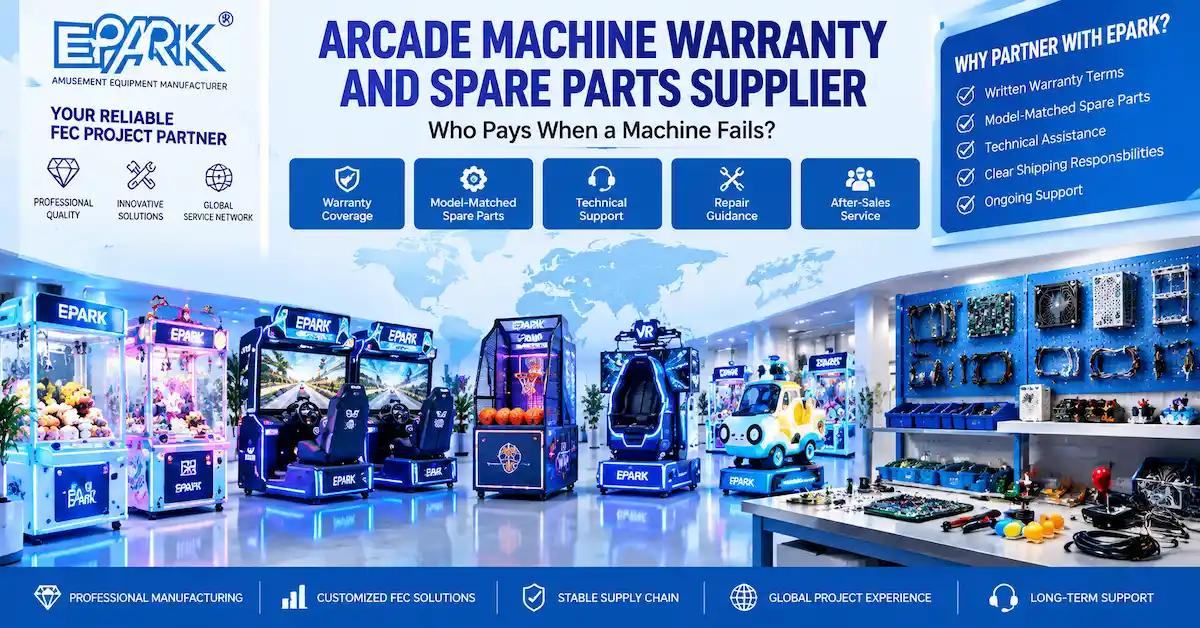


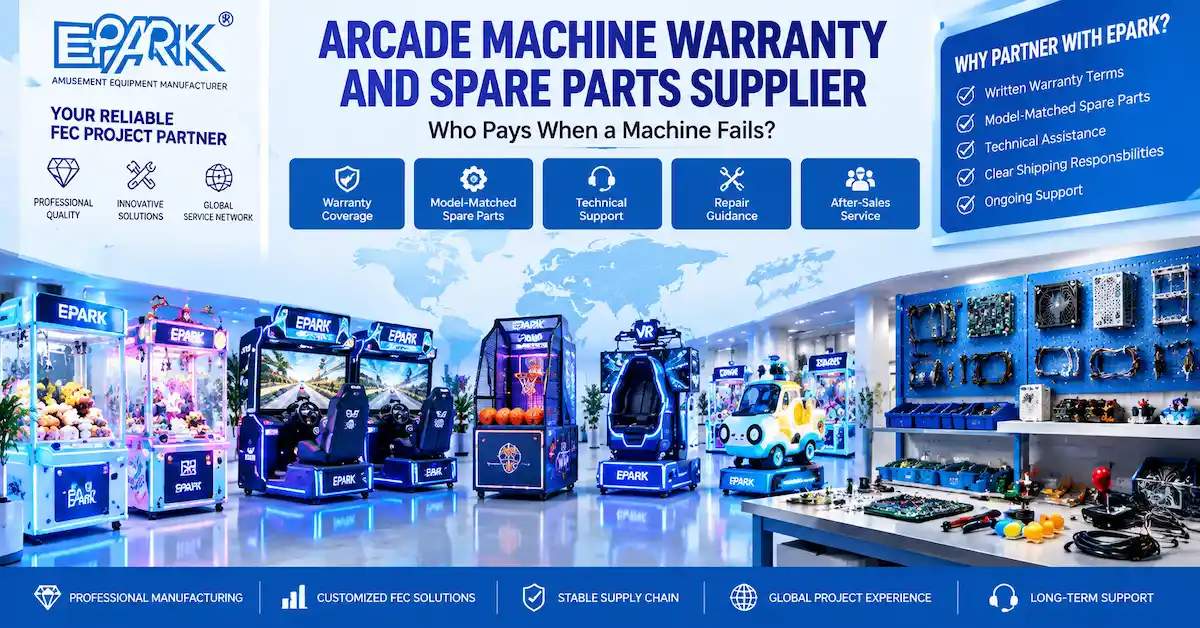
Who pays when a commercial arcade machine needs a replacement part?
An arcade machine warranty and spare parts supplier should identify whether the reported failure is covered, which replacement is approved, and who pays for freight, return shipping, local labor and setup. Confirm these items separately before ordering. A warranty duration does not, on its own, define the complete cost or timing of putting the machine back into service.
EPARK's expanded warranty FAQ states a two-year warranty from the shipment date, with extended options available on request. Its replacement-parts answer includes manufacturing-defect replacements during that period and excludes consumables and misuse damage. Those published answers are useful starting evidence; buyers should still request the written terms for their models, order and destination.
This guide focuses on the decision before the purchase order: how to document service responsibility when a future fault becomes a warranty claim, a paid replacement order or a third-party support issue. It is for FEC operators, overseas distributors, arcade chains and venue purchasing teams. It does not replace the applicable agreement or mandatory requirements in the destination market.

Keep warranty entitlement separate from replacement availability
A component can be available without being free. A manufacturing defect may be covered even if the replacement requires configuration before dispatch. A machine can also remain under warranty while the failed item falls into an excluded category. Treating all three questions as “Do you provide parts?” produces avoidable misunderstandings.
Use three separate records: the warranty decision, the approved replacement reference and the logistics instruction. The warranty record states how the case will be handled financially. The technical record identifies what can be installed. The logistics record states where the item will go, how it is packed and which party authorizes the shipment.
Ask for an explicit case classification
Request a written classification such as covered replacement, paid service part, consumable purchase, shipping-damage review or further diagnosis required. These are suggested workflow labels, not EPARK's published case categories. The purpose is to prevent purchasing staff from paying for an item that has an unresolved warranty decision, or waiting for a free replacement that has not been authorized.
The right arcade machine warranty and spare parts supplier should make that distinction clear enough for both the venue manager and the accounts team to follow.
Confirm what starts the warranty clock
EPARK's FAQ uses the shipment date as the starting point for its stated two-year period. Do not silently substitute the venue opening date. Transport, site preparation and delayed commissioning can create a gap between dispatch and the first paid game.
Ask which shipment record identifies the start date and how the date will be recorded against each machine. For a phased project, different batches may need separate records. If the buyer wants a different commencement basis, raise it before order approval rather than assume it will be accepted after equipment arrives.
Record the machine identity, shipment reference, applicable period and agreed exceptions in one warranty schedule. Where a separately purchased component has its own warranty, obtain that term independently. Do not assume a paid replacement automatically starts a new two-year warranty for the whole cabinet.
Distinguish warranty length from operating support
Technical assistance, paid spares and software support may continue under different conditions after the warranty expires. EPARK's FAQ says post-warranty parts can be purchased. Confirm current availability, pricing and the support route for the actual model; a general availability statement is not an unlimited stock commitment.
Build a component-level coverage matrix
A whole-machine warranty statement is not a substitute for component classification. Ask the supplier to identify how controls, displays, boards, motors, payment devices, decorative panels and other service items are treated. The answer may depend on the failure cause as well as the component.
EPARK's consumables FAQ lists tickets, tokens, bulbs and sensors among items outside warranty. That detail deserves model-level clarification: do not assume that a sensor appearing in a technical spare list is automatically a covered part. Ask how the relevant sensor and reported failure would be classified in the written schedule.
| Item or event | Question for the supplier | Record to retain |
|---|---|---|
| Manufacturing-related failure | What evidence is needed to approve a replacement? | Applicable warranty terms and case authorization |
| Consumable or wear item | Which exact components are excluded for these models? | Component classification list |
| Display, board or motor | Is coverage repair, exchange, replacement or another route? | Service method and commercial conditions |
| Payment hardware | Does the machine supplier or payment provider handle the claim? | Hardware ownership and support responsibility |
| Customized assembly | Does a bespoke configuration change the replacement process? | Approved version, drawings and service references |
| Transport or installation damage | What evidence and reporting route apply? | Receipt inspection, shipping records and authorization |
| Post-warranty replacement | What are the part price, availability and separate part terms? | Approved paid quotation |
Avoid writing “all electronics covered” unless the applicable agreement actually says that. Equally, do not infer that every sensor or switch is excluded in every possible circumstance. Ask the supplier to resolve the classification for the purchased equipment.
Separate the free part from the cost of restoring operation
An approved warranty replacement may leave other expenses unanswered. Request a responsibility schedule covering outbound transport, customs-related handling, failed-part returns, local technician work, travel and configuration support. Mark each cost included, excluded, separately quoted or pending clarification.
This is especially important for cross-border buyers. A small component can involve several handovers before a qualified person installs it. An offer describing “warranty parts” does not establish who manages those handovers. Neither should a buyer assume that an urgent shipment automatically includes destination charges.
| Expense or task | What must be agreed | Why it cannot be assumed |
|---|---|---|
| Replacement item | Covered item, condition and included accessories | A component and a complete assembly are different supplies |
| Outbound freight | Who selects, authorizes and pays the transport | Free parts do not necessarily mean free express shipping |
| Destination processing | Consignee, broker arrangements and cost allocation | The final delivery route varies by destination |
| Failed-part return | Whether a return is required and who pays | Some service routes depend on inspection or exchange |
| Local installation | Approved technician and labor allocation | Remote guidance is not local labor |
| Configuration and testing | Who supplies settings and approves return to service | Installation alone may not complete the repair |
For an arcade machine warranty and spare parts supplier comparison, this matrix is more informative than comparing warranty years alone. Two offers with the same duration may allocate service work very differently.
Define the claim evidence before a machine stops
EPARK's warranty-request FAQ asks for the serial number, a problem description and photographs or video through its after-sales contact channels. Prepare a service record that links those items to the order, machine configuration and date the issue was observed.
A useful report describes what the operator saw rather than declaring a component defective without diagnosis. “The game accepts credit but does not start” gives the technical team a sequence to investigate. “Send a new board” can skip the actual fault and create an unnecessary shipment.
Record recent authorized changes, the displayed error if present and checks already requested by support. Keep photographs of labels and accessible component references, but do not ask untrained staff to open energized equipment to obtain them. Electrical, motion and stored-energy work belongs to qualified personnel following the machine instructions.
Keep evidence in one case thread
Assign a buyer case number and retain the supplier reference. Purchasing staff, venue managers and technicians should use the same record. Fragmented messages can leave one person arranging a paid order while another is still waiting for a warranty answer.
Read response claims as response claims, not repair deadlines
EPARK's service page advertises 24/7 technical support, while its detailed FAQ describes replies within 24 hours on working days. These statements do not establish that every case will be diagnosed, dispatched and repaired within a day. Confirm the contact channel, working calendar, escalation route and agreed response expectation for your project.
Track the stages separately: case received, evidence complete, technical review, warranty decision, replacement identified, item prepared, dispatch and local repair. A fast acknowledgment is useful, but it is not the same event as an approved replacement leaving the factory.
Ask what happens when more evidence is needed, a part requires programming or a local technician must attend. For an urgent case, confirm the available service route rather than extrapolate a turnaround from the complete-machine production schedule.
An arcade machine warranty and spare parts supplier should be evaluated on how clearly these stages are managed. A credible stage-by-stage answer is more useful than an unexplained promise of “immediate support.”
Use factory evidence without overstating what it proves
EPARK's manufacturing and support workflow shows production photographs and describes a 48-hour full-operation test before shipment. That evidence explains the published factory process. It does not prove a particular failure rate, rule out every future defect or establish the outcome of a warranty claim.
Before dispatch, request the agreed configuration and relevant inspection records for the machines supplied. At receipt, record condition, package identities and missing or damaged items. These records can help distinguish a configuration issue, transport problem or later service fault without guessing from memory.
The process page also describes protective packing. For a replacement shipment, ask what packing is appropriate to the particular item. Do not assume that a control board, a display and a mechanical assembly should all use the complete-machine export packing method.
Approve the replacement reference and installation scope before dispatch
Once a case is classified, request a short replacement approval: the failed reference, proposed reference, compatible machine version, supplied condition and required setup. A warranty approval does not remove the need to identify the correct item.
If a successor assembly is proposed, ask the supplier to describe any adapter, mounting or configuration changes. Do not authorize an unreviewed substitution simply because it is available sooner. Have qualified technical personnel approve safety-related or motion-system changes.
For detailed component matching, use EPARK's existing replacement-parts compatibility guide. The commercial decision here is narrower: which approved replacement is supplied under this case, under which terms, and with which remaining responsibilities?
Record the installed replacement reference and retain the old reference in the machine history. That record helps distinguish a later repeat fault from a different failure, and gives the supplier a usable starting point if the case needs to be reopened.
Plan for an urgent paid part while coverage is unresolved
An operator may decide that waiting for a coverage review is not practical. If a paid replacement is available, separate the urgent purchasing decision from the open warranty decision. Request written confirmation of whether any credit or reimbursement would be considered if the original failure is later accepted. Do not assume it will be automatic.
A hypothetical case: one machine, two decisions
Imagine a venue reports a failed game shortly before a busy weekend. The supplier needs additional evidence to classify the fault, while an approved replacement assembly can be quoted separately. This is an illustrative scenario, not an EPARK customer case or dispatch promise.
The buyer can ask four questions: Is the quoted assembly approved for this machine? What is its actual preparation status? Does buying it affect the open claim? What written process applies to any later credit? Those answers allow an informed commercial choice without forcing a premature diagnosis.
The same discipline applies when another technician proposes a local repair. Seek approval before modifications that could affect the evidence or the agreed service terms. The purpose is to preserve a clear record, not to delay necessary safety action.
Keep opening spare kits outside the warranty balance
A starter kit is opening inventory; a warranty replacement is a response to an eligible failure. Those are different supplies. Ask whether using an included spare changes the claim process and whether the supplier will replenish it after an approved case.
EPARK's complete FEC solution page mentions a spare kit with container orders, including controls and power-supply items. Confirm the actual included list and conditions in the quotation. Do not expand that page-specific statement into free parts for every order or unlimited replenishment.
For a distributor, keep customer warranty stock separate from general resale stock in the records, even if compatible items share a storage location. Record the case allocation when an item leaves inventory. Otherwise, the service team may promise a spare that purchasing has already allocated elsewhere.
Discuss the replenishment route before opening. The question for an arcade machine warranty and spare parts supplier is not just whether a kit exists, but how included stock, purchased stock and authorized warranty supply remain traceable.
Clarify software, third-party hardware and on-site work
EPARK's FAQ describes software updates and bug fixes as free during the warranty period, with an upgrade when available. Confirm the supported software, machine version, availability and installation process for your equipment. That statement should not be expanded into a promise of every future game, third-party license or hardware upgrade.
Payment readers and venue systems deserve a separate responsibility line. Identify who supplied the device, who controls its account or software and which party handles support. A machine-side issue, a reader fault and a payment-provider account issue can look similar to an operator but follow different service routes.
The FAQ also describes remote guidance as the normal support route, with on-site repair possible for larger projects or through partners. Request the actual location coverage, personnel, travel cost and local work arrangement. Do not book an opening date on the assumption that a technician is already committed to attend.
These boundaries become more important for private-label or customized machines. Keep both your internal equipment code and the factory reference so a branded cabinet can still be matched to the correct service records.
Prepare a support schedule for each installation
A single mall arcade, a regional distributor and a multi-location FEC chain have different service resources. A venue without a technician needs a clear local installation route. A distributor needs a claim-submission process that preserves the machine identity across customers. A chain may need permission to use approved shared stock between locations.
EPARK's general materials FAQ names metal, ABS and tempered glass, but warranty treatment still depends on the selected equipment and reported cause. Public-facing panels, moving assemblies and electronic parts need their own references. Avoid using the showroom photograph as evidence that all these components are interchangeable or covered on identical terms.
Give the service schedule an owner on each side. Record primary contact, escalation route, local technical resource and the process for updating machine records. Keep sensitive payment credentials out of ordinary claim messages; use the authorized provider's process if account access is required.
For distributors, identify both sides of the service relationship
A distributor may promise local assistance to its customer while receiving parts and remote guidance from the factory. Those commitments should be recorded separately. Ask who can authorize a factory claim, who communicates with the venue and who approves local work before it is charged. Do not copy a customer-facing service promise into a factory purchase order and assume the factory has accepted it.
Ask the arcade machine warranty and spare parts supplier whether a machine moved to another venue needs an updated service record and what happens if ownership changes. These are clarification questions, not published EPARK transfer rules. The objective is to preserve the machine identity, shipment date and authorized contact as the equipment moves through the distribution chain.
After an authorized replacement, record the work performed, the relevant operating check and any remaining fault. Have the responsible technician confirm the return-to-service decision. Close the commercial case only when the agreed invoices, returns or credits are also resolved. A repaired machine and a settled warranty account are related outcomes, but one does not automatically complete the other.

What should an arcade machine warranty and spare parts supplier put in writing?
Send the selected models, quantities, destination, payment arrangement and local service capability. Ask the supplier to return a coverage schedule rather than another general after-sales brochure. Identify whether the request concerns a new project, distributor stock or support for existing EPARK equipment.
Request the warranty period and start record; component exclusions; replacement or repair route; claim evidence; response arrangements; freight and local-labor allocation; failed-part returns; starter-kit contents; paid-parts route; software scope; and any optional extended coverage.
A practical message is: “Please confirm the after-sales terms for the attached equipment list. Separate covered parts from consumables and paid replacements, identify who pays transport and local work, and state the evidence and authorization needed for a claim. Please also confirm software support, starter spares and the service route after expiry.”
That request gives an arcade machine warranty and spare parts supplier a specific response to prepare. Keep the agreed revision with the quotation and machine schedule. Do not rely on a screenshot of a promotional banner as the only record of what was purchased.
Frequently asked questions about arcade warranty responsibility
What should an arcade machine warranty and spare parts supplier confirm?
The supplier should confirm coverage, duration, the starting record, excluded components, claim evidence, approved replacements and service responsibilities. Freight, returns, local labor, configuration and paid post-warranty support should be addressed separately.
What warranty period does EPARK publish?
EPARK's expanded FAQ states two years from the shipment date and mentions extended options on request. Obtain the written schedule for the selected machines and order, including how the shipment date and any agreed exceptions are recorded.
Does a covered part mean free international delivery?
Not automatically. Request the applicable freight and destination-processing terms. The public warranty answers should not be used to infer expense allocations that they do not specify.
Are sensors and consumables covered?
EPARK's consumables answer lists tickets, tokens, bulbs and sensors as excluded. Ask for component-level classification for your models and the actual failure. Do not infer warranty status solely from a component appearing in a spare-parts catalog.
Is 24-hour support the same as repair within 24 hours?
No. EPARK's detailed FAQ describes replies within 24 hours on working days. Diagnosis, coverage review, preparation, dispatch, transport and local repair are separate stages. Agree the relevant response and escalation arrangements for the project.
Can I use an opening spare while a claim is reviewed?
Ask the technical team to approve the replacement and clarify how use of the spare will be recorded. Obtain the policy for replenishing that inventory after an accepted claim instead of assuming an automatic replacement.
What happens after the machine warranty expires?
EPARK's FAQ describes paid spare-parts supply after expiry. Request the current reference, availability, price, preparation requirements and separate replacement-part terms. Technical compatibility and current stock still need confirmation.
What should I send with an actual service request?
Provide the machine serial number or order reference, observed problem and clear photographs or video. Add the relevant configuration and authorized checks already completed. Follow the supplier's diagnostic instructions and use qualified personnel for technical work.
Conclusion
Choose an arcade machine warranty and spare parts supplier by the clarity of the complete service arrangement, not the warranty duration alone. EPARK publishes a two-year period and specific FAQ answers, but the purchasing decision still needs an order-level record of coverage, costs, evidence, approved replacements and local work. Keep warranty authorization separate from parts availability, and distinguish a response target from a repair deadline.
Before placing the order, ask EPARK to review the selected machines and return the applicable after-sales schedule. A clear answer now gives operators, technicians and purchasing teams a usable process when a real service issue occurs.
Disclaimer
The information provided on this website is for general informational purposes only.
While EPARK Arcade Game Machine Manufacturer strives to ensure accuracy and reliability, no warranties—express or implied—are made regarding completeness, performance, or applicability.
Product specifications, designs, and features may vary depending on usage, customization, and customer requirements.
Buyers are responsible for verifying all technical details, compliance certifications, and suitability before procurement.
EPARK shall not be held liable for any direct, indirect, incidental, or consequential damages arising from the use of this website or its content, including but not limited to business losses, data errors, or equipment misuse.
For tailored solutions or further verification, please visit our Contact Us
Intellectual Property Notice
All articles, product images, videos, catalogs, software, and related materials published on this website are the intellectual property of EPARK, unless otherwise stated.
Unauthorized reproduction, distribution, modification, or commercial use of any content is strictly prohibited without prior written consent from EPARK.
EPARK reserves the right to take legal action against any unauthorized use, including but not limited to copyright infringement, misrepresentation, or unfair competition.
Trademarks
The name EPARK, the EPARK logo, and all related brand elements displayed on this website are registered trademarks or trade names of Guangzhou EPARK Electronic Technology Co., Ltd.
Other product names, company names, or logos mentioned on this site may be trademarks of their respective owners.
Unauthorized use of EPARK's trademarks for commercial purposes, including advertising, promotions, or product packaging, is strictly prohibited.
Governing Law
These terms are governed by the laws of the People's Republic of China.