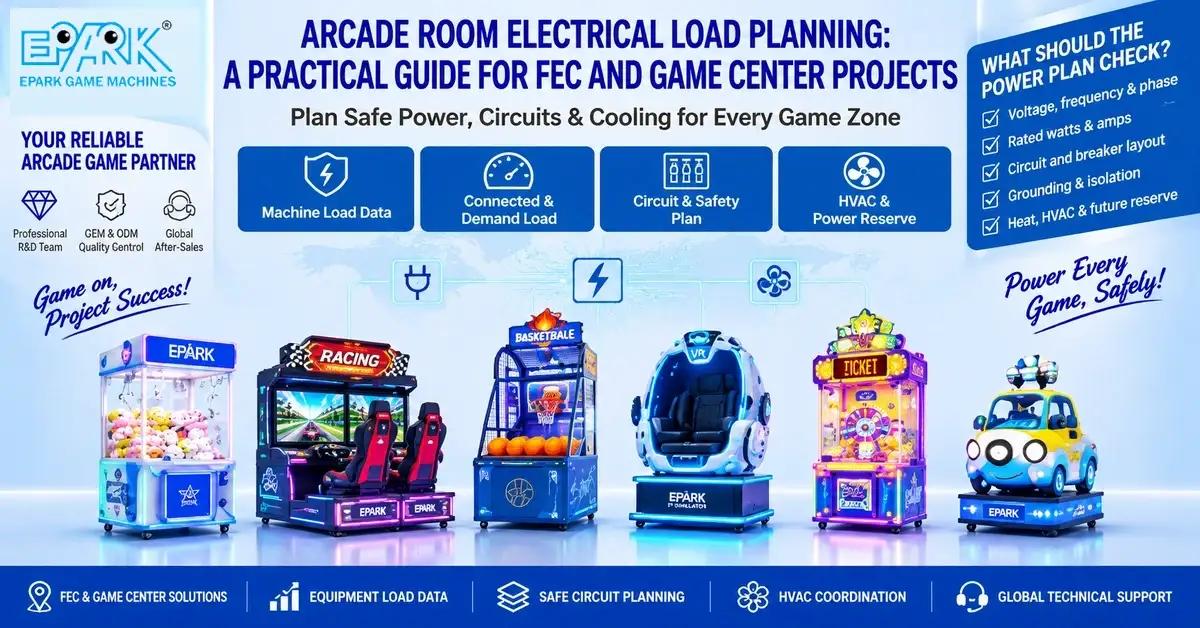


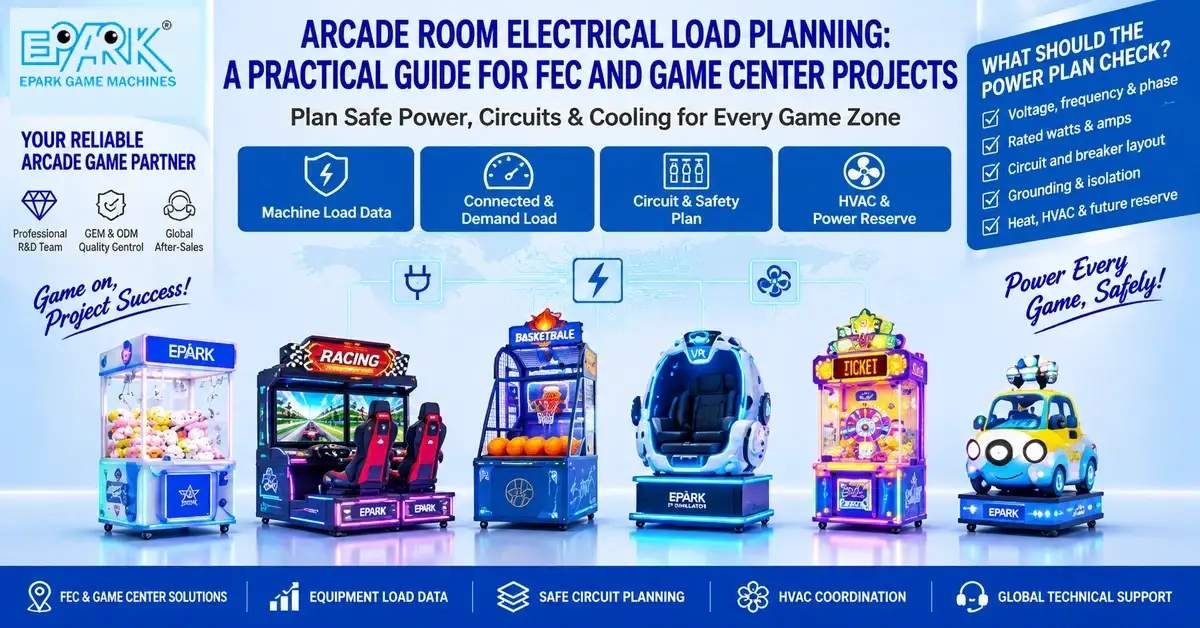
Quick answer: electrical load planning starts with the exact machine list, not a square-meter rule
Arcade room electrical load planning should begin with a model-by-model equipment schedule that records rated voltage, frequency, power, phase, payment hardware, network equipment and any motor or compressor load. Add the connected load, apply a documented demand assumption, reserve capacity for startup and future additions, then have a licensed local electrician verify breaker, cable, protection, grounding, emergency isolation and building-code requirements. A room that is large enough for twenty machines may still have an undersized supply, poorly distributed circuits or insufficient cooling.
The practical purpose is not to produce one impressive kilowatt number. It is to prevent four common failures: machines that trip a shared breaker during peak play, voltage that falls at the end of a long branch circuit, heat that shortens electronics life, and a layout that leaves no safe service path to the distribution board. Electrical planning also affects quotation accuracy. A factory cannot confirm a suitable power configuration if the buyer has not stated the destination voltage, frequency, plug, payment system and site constraints.
Define the electrical scope before requesting an arcade quotation
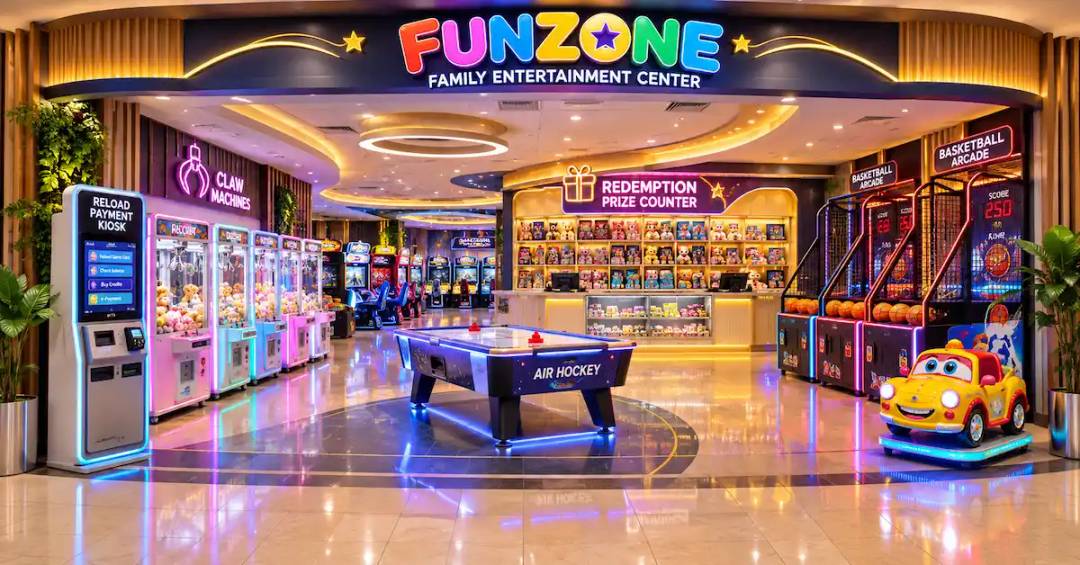
A supplier quote should not be the first place where electrical requirements appear. Before asking for a price, prepare a one-page project brief with the destination country, site address, utility service, room dimensions, opening date, machine categories, estimated quantities, payment system, HVAC approach and any landlord or contractor standards. This allows the supplier to identify what it knows, what it assumes and what still needs a site decision.
Record the room and building inputs
Record the available service voltage and frequency, phase arrangement, main breaker rating, spare ways in the distribution board, cable route length, floor and ceiling construction, fire compartments, emergency exits, wet areas, loading access and the location of the proposed arcade room. Note whether the room shares power with food equipment, lighting, HVAC, lifts, kitchen appliances or other tenants. Shared services are a major reason a simple machine total fails in practice.
Separate machine loads from building loads
Arcade cabinets are only one part of the electrical brief. Add display signage, card readers, network switches, routers, prize counters, ticket dispensers, refrigeration for a snack zone, cleaning equipment, CCTV, audio, lighting and ventilation controls. HVAC is often the largest operational load and is also the system that removes heat from screens, power supplies, LED drivers and motion equipment. Ask the contractor to model it separately, then review the combined demand at the main service.
| Input | Why it matters | Evidence to request |
|---|---|---|
| Utility voltage, frequency and phase | Determines whether the ordered power supplies and plugs are compatible | Landlord or utility confirmation, plus factory nameplate data |
| Machine list and quantity | Creates the connected-load schedule and circuit grouping | Model codes, revisions and options in the quotation |
| Payment and network equipment | Adds outlets, low-voltage power and data points | Reader, router, switch and system integration requirements |
| HVAC and room ventilation | Controls heat, humidity and electronics reliability | Mechanical contractor load schedule and air-flow assumptions |
| Landlord and local code rules | May impose breaker, RCD/GFCI, emergency isolation or inspection requirements | Approved drawings and licensed electrician review |
Build a model-level connected-load schedule
The connected load is the sum of the rated electrical input for the equipment that could be energized. It is a starting point, not the expected operating demand. Use the exact model and option set. A two-player racing cabinet, a motion simulator and a compact claw machine may all be described casually as “one machine,” while their displays, motors, amplifiers and control systems create very different loads.
Use nameplate data and configuration IDs
Request a data row for each model containing model code, cabinet revision, input voltage range, frequency, rated power or current, phase, plug, breaker recommendation if supplied, payment hardware, network requirement and included accessories. Give the row a configuration ID that appears in the quotation, approved sample, test record, packing list and installation file. If a model is offered in multiple screen sizes or motion options, create separate rows rather than averaging them.
Do not convert a marketing category into a power assumption
Terms such as “VR,” “sports,” “redemption” and “premium” describe the experience, not a reliable electrical value. A VR unit may include a PC, headset charging, fans and motion; a redemption machine may include a display, lighting, sensors and ticket mechanism; a racing simulator may add motion actuators. Ask for the value at the wall plug for the final configuration, not only the DC output of an internal power supply.
Use a spreadsheet with a conservative unknown flag. If the factory has not confirmed a value, write “pending model confirmation” rather than inserting a typical number. Unknowns should trigger a sales or engineering question before deposit, because the electrical contractor may need to reserve capacity, conduits or transformer space.
| Field | Example format | Buyer control |
|---|---|---|
| Configuration ID | RACING-02 / REV-B | Must match quote, sample, test and packing records |
| Input supply | Voltage range, Hz, single or three phase | Confirm against destination utility and plug standard |
| Rated input | Watts or amps at the wall plug | Request factory evidence for the ordered option set |
| Quantity and simultaneity | Number installed and number energized together | Identify peak operating scenario, not only average day |
| Auxiliary loads | Payment reader, network, ticket unit, amplifier or motor | State whether included or supplied by another contractor |
| Location and circuit | Zone, outlet ID and branch circuit reference | Coordinate with layout, service access and emergency isolation |
Calculate connected load, demand load and practical reserve
Use three separate numbers in the project discussion. Connected load is what the equipment could draw if every listed load runs at its rated input. Demand load is the design estimate for the operating scenario after reasonable diversity assumptions. Reserve is capacity intentionally held for startup, measurement uncertainty, future machines and changes to the room. Mixing these numbers is a common source of overconfidence.
Start with a transparent formula
A simple worksheet can calculate connected load as: sum of (rated input per machine x quantity) + fixed auxiliary loads. For an illustrative example, assume a room has ten machines with a documented 500 W input, six machines with 800 W input and two machines with 1,500 W input. The machine connected load would be 5,000 W + 4,800 W + 3,000 W = 12,800 W before lighting, networking, payment and HVAC. These figures are examples only; they are not EPARK specifications or a recommendation for a particular venue.
Demand load can be lower than connected load when not every game runs at maximum input continuously, but the factor must be documented by the designer and accepted by the local authority or electrician. A motion system, compressor, heater or large amplifier can create a short-duration peak that is not visible in an average-power estimate. Use measured commissioning data to refine the model after installation, never to justify ignoring a required protective device.
Use reserve as a decision, not a hidden multiplier
Reserve should be visible in the schedule. Explain whether it covers future machines, design uncertainty, voltage drop, startup or a landlord requirement. A buyer may decide to leave spare ways in the panel even when the first order uses only part of the available capacity. A distributor planning a second phase should tell the electrician which categories may be added, because a future motion or racing zone may have a different electrical profile from a compact cabinet wall.
Group machines into circuits that are serviceable and measurable
A total load can still be badly designed if all machines share one long branch circuit. Circuit grouping should support safe isolation, troubleshooting, balanced distribution and useful measurement. Group by zone or operating function where practical: prize and redemption, sports and racing, VR or motion, payment and network, lighting and signage. Keep equipment that needs a dedicated supply separate from small cabinets and avoid hiding a critical machine behind a room-wide shutdown.
Keep high-starting or sensitive loads visible
Motors, compressors, motion actuators and some power supplies can draw a short startup current. Ask the supplier to identify equipment with a motor, compressor or other non-linear or inrush-sensitive input. Ask the electrician how those loads affect breaker selection, voltage drop and nuisance tripping. Do not assume that a machine with a low average wattage can share any outlet.
Plan isolation, RCD/GFCI and emergency access locally
Protection requirements vary by country and building. The local electrician should determine breaker type, residual-current protection, grounding, bonding, surge protection, emergency isolation and inspection. The supplier can provide input data, plug and nameplate information, wiring diagrams where available and the location of the machine switch. It should not replace the licensed person who signs the electrical design.
Label each outlet and circuit in the layout. Include a small panel schedule that links circuit ID to zone, machine configuration, rated load, test date and responsible contractor. When a machine is moved, update the record. This turns an electrical plan into a maintainable operating document rather than a drawing that becomes obsolete on opening day.
Check voltage, frequency, plug and payment-system compatibility
Voltage is not a cosmetic selection. A cabinet designed for one input range may need a different power supply, plug, fuse, internal wiring or certification path for another market. State the destination at the beginning of the RFQ and repeat it on the purchase order. Confirm the operating frequency and whether the supplier is quoting a machine-side value or a site-side service value.
Make the quotation electrically specific
Require the quotation to show the voltage and frequency for each configuration, the plug type, whether a transformer or converter is included, the rated input, the payment device, the network requirement and any special installation condition. If a card or QR system is customer-supplied, define the interface, mounting, cable route and test responsibility. Do not accept “standard voltage” as a complete specification.
Coordinate cards, coins, tickets and network devices
A cashless arcade can add readers, local controllers, switches, access points and charging stations. Redemption equipment may add ticket or point hardware. Ask whether each device is powered from the machine, a separate outlet or low-voltage infrastructure. Confirm who supplies the cable, who configures the software, who tests reporting and who owns the fault when the game works but the payment event is not recorded.
EPARK's public service information describes support for coins, QR codes, cards, tickets, points, redemption and membership systems, but it does not publish one universal network architecture or API. Treat system integration as a project-specific scope. Put the responsibility matrix in the quote and acceptance checklist.
Include heat, ventilation and acoustics in the electrical brief
Electrical input becomes heat in the room. A cabinet wall with bright displays, LED lighting, amplifiers, PCs and motion equipment can raise the cooling requirement even when player traffic is modest. High temperature and dust can shorten the life of power supplies, screens and control electronics. Ask the mechanical contractor to review the room after the machine positions and access paths are known.
Keep air paths and service panels clear
Show rear and side clearances on the layout, not only the cabinet footprint. A machine may need airflow behind a PC, access to a fuse or room for a service technician. Do not place a heat-producing cabinet against a return-air obstruction or in a sealed storage enclosure. If a machine uses a fan or compressor, document the expected noise and maintenance access.
Separate operational load from comfort load
Lighting, signage and HVAC may run before the arcade is open and after the last player leaves. A daily energy model should distinguish base load, open-hours load, peak event load and cleaning or maintenance load. This helps the operator decide whether a machine can be shut down safely, whether signage needs a timer and whether the electrical contractor should install a separate control zone.
Use the supplier's production and testing evidence correctly
Electrical planning becomes more reliable when supplier evidence is tied to the exact configuration. EPARK's public production description mentions PCB installation and wiring, LED setup, screen and control integration, final assembly and function testing. The same public process states that machines receive a 48-hour full-operation test covering gameplay, electrical safety, lighting and mechanical durability before packing. Ask for the order-specific test record or a sample record with the model code, input condition, measured result, date and inspector field.
Request photos or video of the nameplate, power inlet, fuse or breaker label, internal power supply identification, grounding point and payment wiring. If the machine has a motion platform or compressor, request a startup and steady-state test. This is not a substitute for local certification or site inspection, but it can catch a mismatch before the shipment is released.
| Evidence | What it should identify | Why the buyer needs it |
|---|---|---|
| Model nameplate photo | Input voltage, frequency, current or power, model and serial area | Lets the electrician compare the ordered unit with the schedule |
| Configuration sheet | Screen, motion, payment, lighting, software and accessory options | Prevents a different revision from entering the load calculation |
| Functional test record | Test date, duration, gameplay and electrical checks | Connects factory testing to the acceptance plan |
| Wiring or service information | Power inlet, switch, fuse, grounding and access points | Supports safe installation and local troubleshooting |
| Packing and shipping record | Crate identity, accessories and protection method | Ensures the electrical kit and manuals arrive with the machine |
Commission the room in a controlled sequence
Commissioning should prove the installation, not just show that screens turn on. Start with the empty room and panel labels, then energize one circuit at a time. Check polarity, grounding, protection and outlet identification through the local electrician. After that, connect machines by configuration ID and record the nameplate, serial number, location and circuit.
Test normal, peak and recovery conditions
Run the room under a realistic peak scenario: multiple screens, audio, lighting, payment readers, ticket dispensers and motion devices operating together. Observe breaker behavior, voltage stability, heat, network interruptions and nuisance resets. If a circuit trips, record what was running rather than repeatedly resetting it. The cause may be capacity, wiring, a faulty device or an incorrect setting; only the responsible technical professional should decide the remedy.
Record what changes after opening
Soft-opening data can improve the design record. Note measured current where the electrician approves it, room temperature, machine uptime, payment faults and the time required to isolate a unit. Update the circuit schedule when a machine is moved or a new cabinet is added. A distributor with multiple venues should keep a standard template but retain site-specific values.
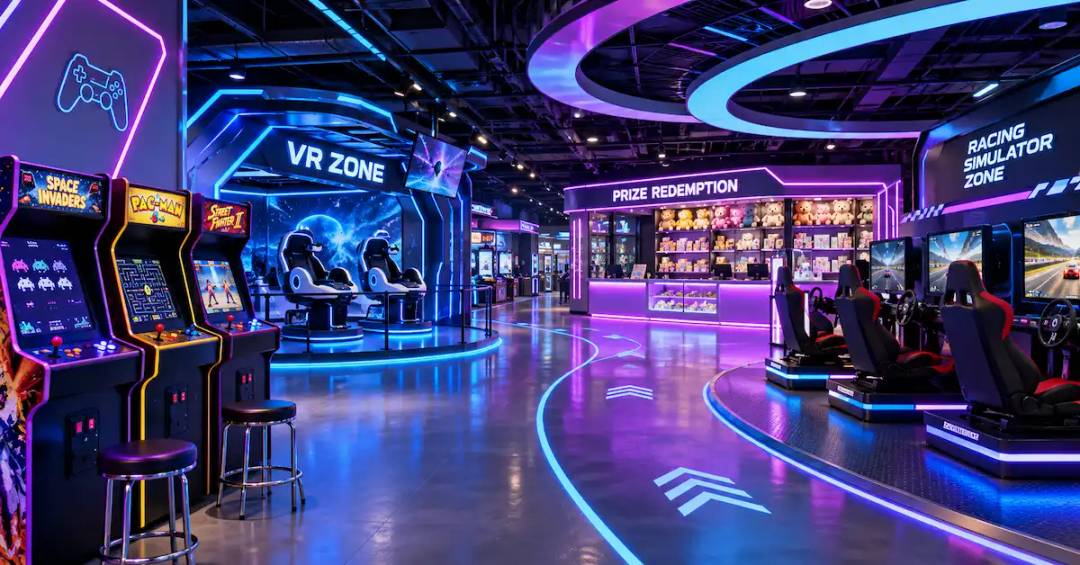
Build the electrical section of the RFQ and purchase order
Write the electrical requirements as acceptance criteria. Include destination voltage and frequency, plug, rated input, model revision, payment and network scope, accessories, nameplate, wiring documents, test evidence, packing identification, spare fuses or approved parts where appropriate, and the process for approving any substitution. State that changes to the power supply, screen, motor, payment module or cabinet revision require buyer approval before production.
Link the electrical schedule to the broader commercial arcade machine buyer checklist. The checklist should also cover dimensions, packed volume, inspection, spare parts, warranty, export documents and support. For a project requiring layout coordination, use the arcade layout design service guide and ask the supplier to place outlet and service assumptions on the same drawing as the machines.
Before paying the balance, compare the approved configuration with the final test video, nameplate photos, packing list and serial records. If the destination electrician cannot verify the model, voltage or protection requirements, pause the release and obtain written clarification. A short delay before loading is cheaper than rebuilding a panel after the room is open.
Frequently asked questions
What is arcade room electrical load planning?
It is the process of converting a proposed arcade equipment mix into a documented connected-load, demand-load and circuit plan, then checking voltage, protection, grounding, ventilation, payment and service access with qualified local professionals. It is more specific than multiplying a room area by a generic wattage.
Can I estimate power from the number of arcade machines?
Only as an early feasibility screen. Final planning needs model-level rated input and the exact options, because racing, VR, motion, redemption and compact cabinets can have different loads. Request nameplate or engineering data for every ordered configuration.
Should every arcade machine have its own circuit?
Not necessarily. Circuit grouping should be designed by a licensed electrician using the machine data, protection rules, service access, voltage drop and operating scenario. High-starting or sensitive loads may need separate treatment, while small cabinets may be grouped if the design permits.
What electrical information should I request from a factory?
Request the model code and revision, input voltage and frequency, rated power or current, phase, plug, power inlet, fuse or switch information, payment and network requirements, wiring or service notes, and an order-specific test record. Ask the supplier to identify any value that is still pending.
Does a factory electrical test replace local approval?
No. Factory testing can demonstrate that the ordered machine was operated and checked before shipment, but local code, inspection, grounding, protective devices, emergency isolation and building conditions must be reviewed by the responsible local professionals.
How does HVAC affect arcade electrical planning?
Most electrical input becomes heat, so the machine schedule affects cooling demand and operating cost. Include HVAC, lighting, signage, network equipment and food-service loads in the building-level review, and keep cabinet ventilation and service clearances visible on the layout.
Can the payment system change the electrical plan?
Yes. Card readers, QR devices, ticket systems, controllers, switches and charging equipment may require separate power, data or mounting. Confirm whether the factory supplies and tests the integration or only provides a cabinet opening and wiring point.
What should I do if the supplier has not confirmed wattage?
Mark the field as pending, ask for model-specific evidence and tell the electrician that the schedule is provisional. Do not replace missing data with a category average when the value affects breaker, cable, transformer or HVAC decisions.
Conclusion
Reliable arcade room electrical load planning connects four records: the site utility, the exact machine configuration, the circuit and HVAC design, and the factory test and packing evidence. Start with model-level data, show assumptions, reserve capacity deliberately and obtain local professional approval. When you request a layout, quotation or mixed equipment package from EPARK, send the floor plan, destination electrical standard, machine roles, payment requirements and opening schedule together. That gives the project team the information needed to propose a workable configuration and identify unknowns before production.
Disclaimer
The information provided on this website is for general informational purposes only.
While EPARK Arcade Game Machine Manufacturer strives to ensure accuracy and reliability, no warranties—express or implied—are made regarding completeness, performance, or applicability.
Product specifications, designs, and features may vary depending on usage, customization, and customer requirements.
Buyers are responsible for verifying all technical details, compliance certifications, and suitability before procurement.
EPARK shall not be held liable for any direct, indirect, incidental, or consequential damages arising from the use of this website or its content, including but not limited to business losses, data errors, or equipment misuse.
For tailored solutions or further verification, please visit our Contact Us
Intellectual Property Notice
All articles, product images, videos, catalogs, software, and related materials published on this website are the intellectual property of EPARK, unless otherwise stated.
Unauthorized reproduction, distribution, modification, or commercial use of any content is strictly prohibited without prior written consent from EPARK.
EPARK reserves the right to take legal action against any unauthorized use, including but not limited to copyright infringement, misrepresentation, or unfair competition.
Trademarks
The name EPARK, the EPARK logo, and all related brand elements displayed on this website are registered trademarks or trade names of Guangzhou EPARK Electronic Technology Co., Ltd.
Other product names, company names, or logos mentioned on this site may be trademarks of their respective owners.
Unauthorized use of EPARK's trademarks for commercial purposes, including advertising, promotions, or product packaging, is strictly prohibited.
Governing Law
These terms are governed by the laws of the People's Republic of China.