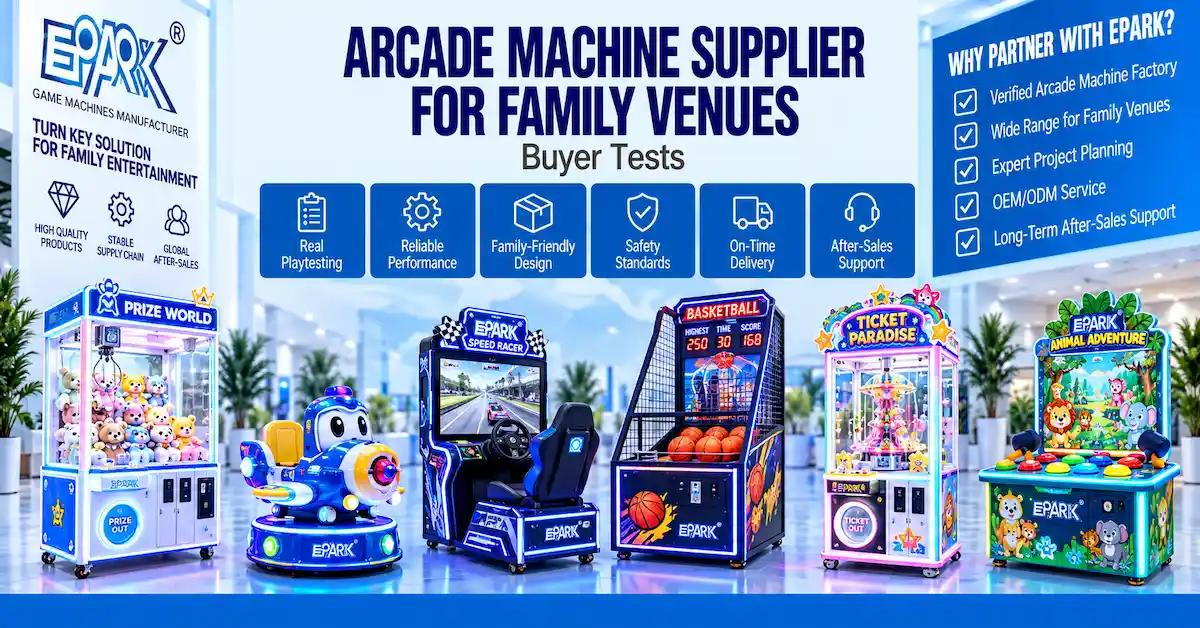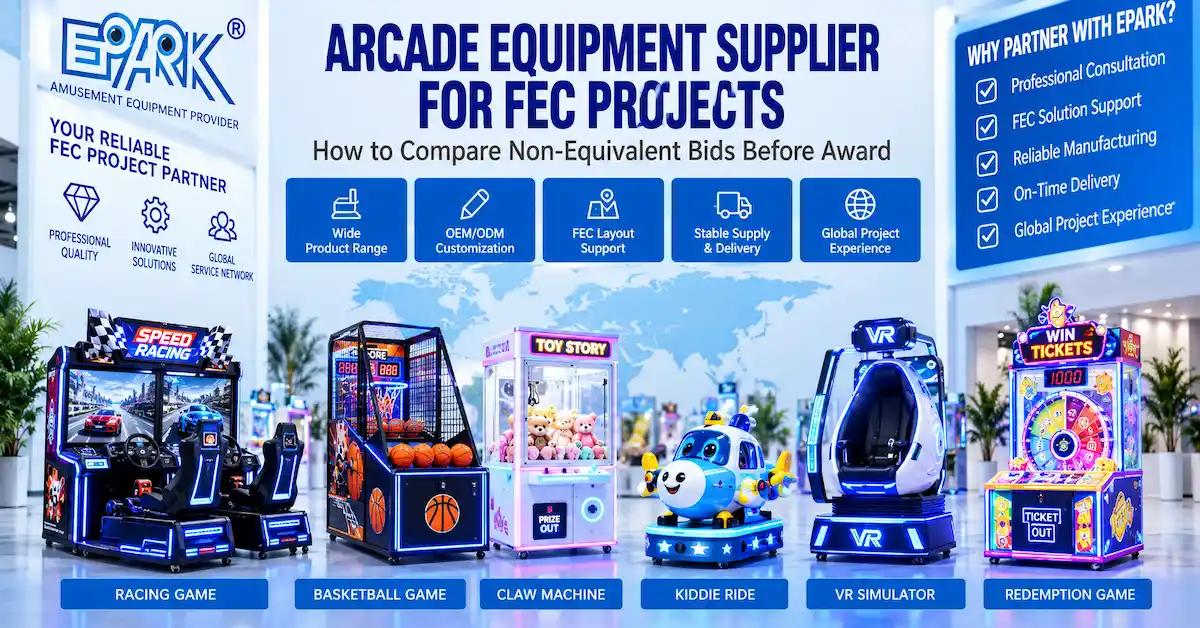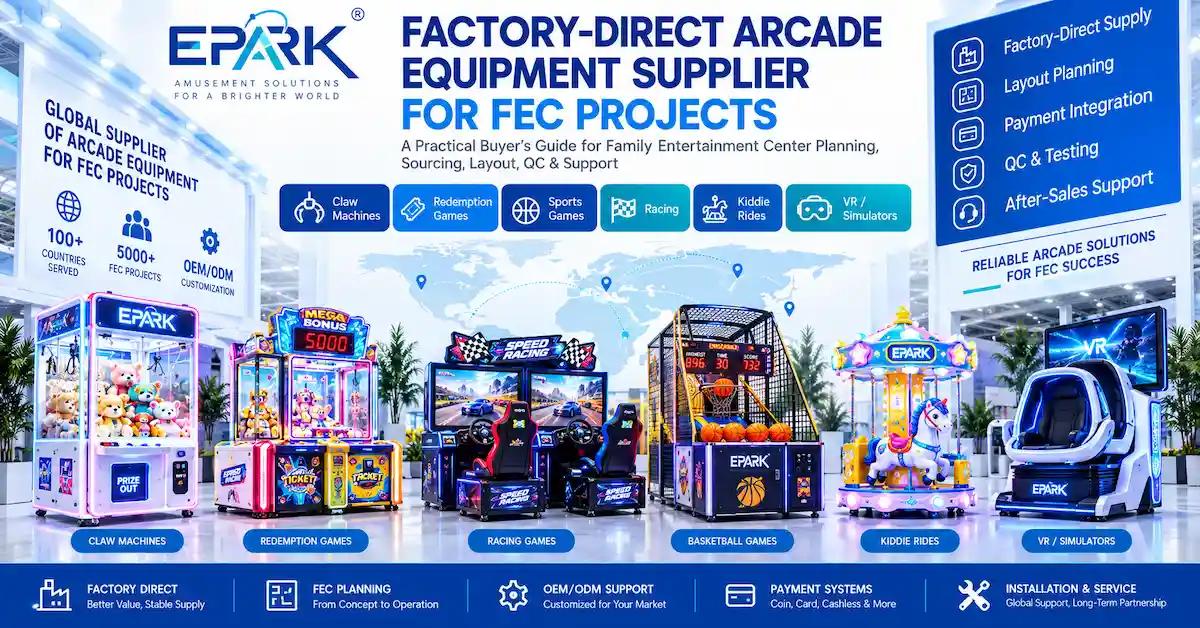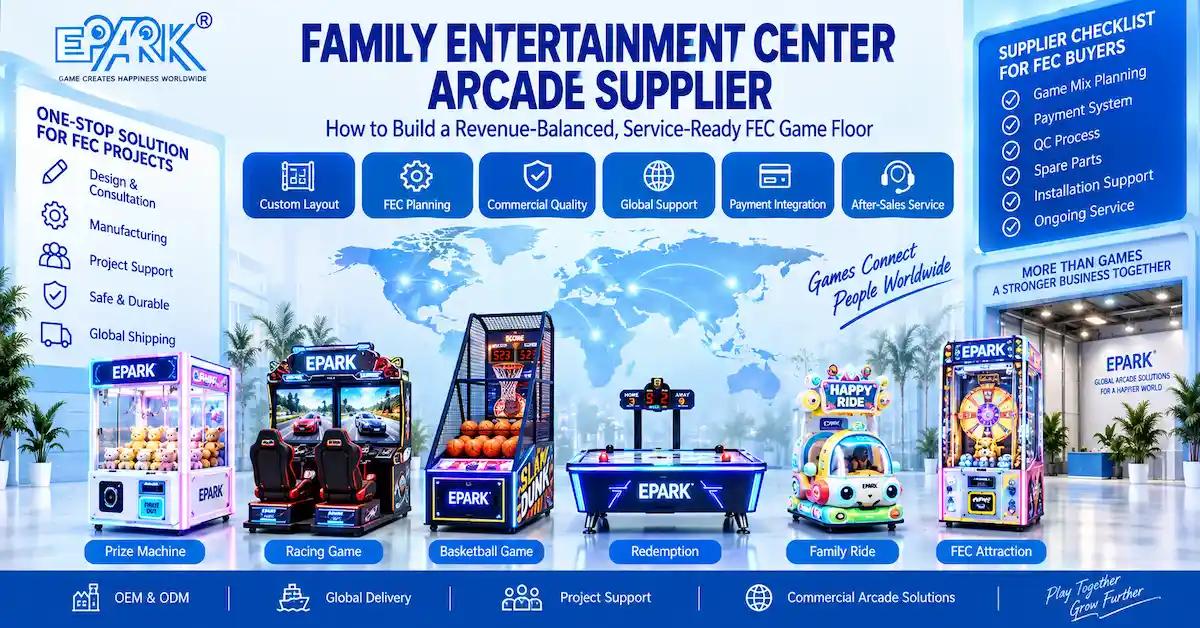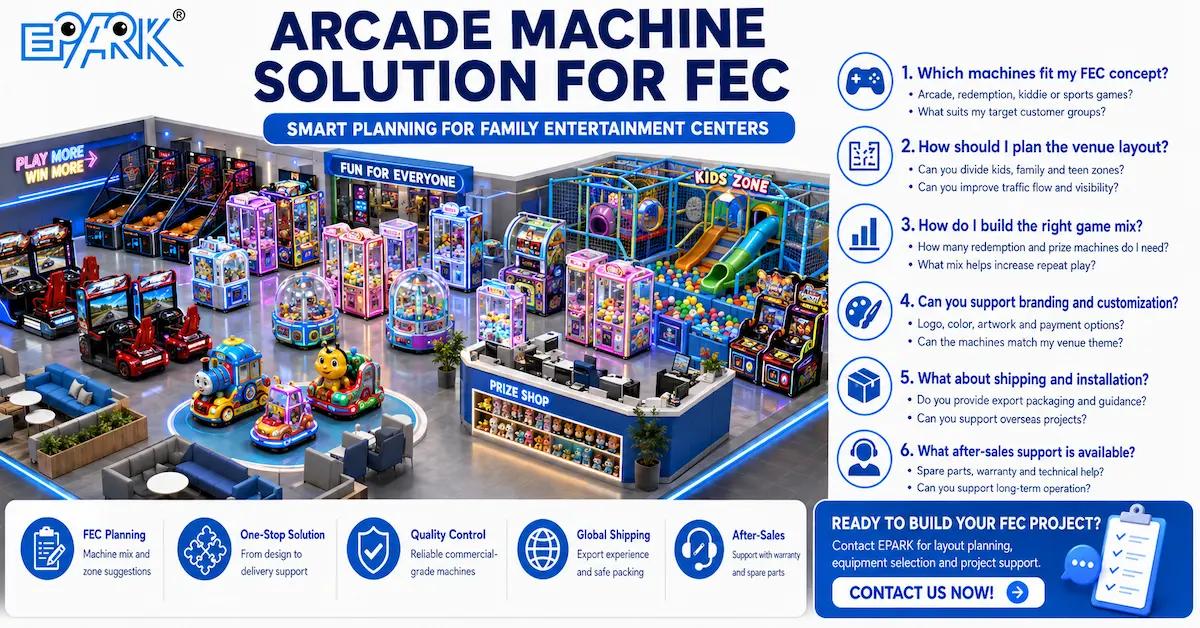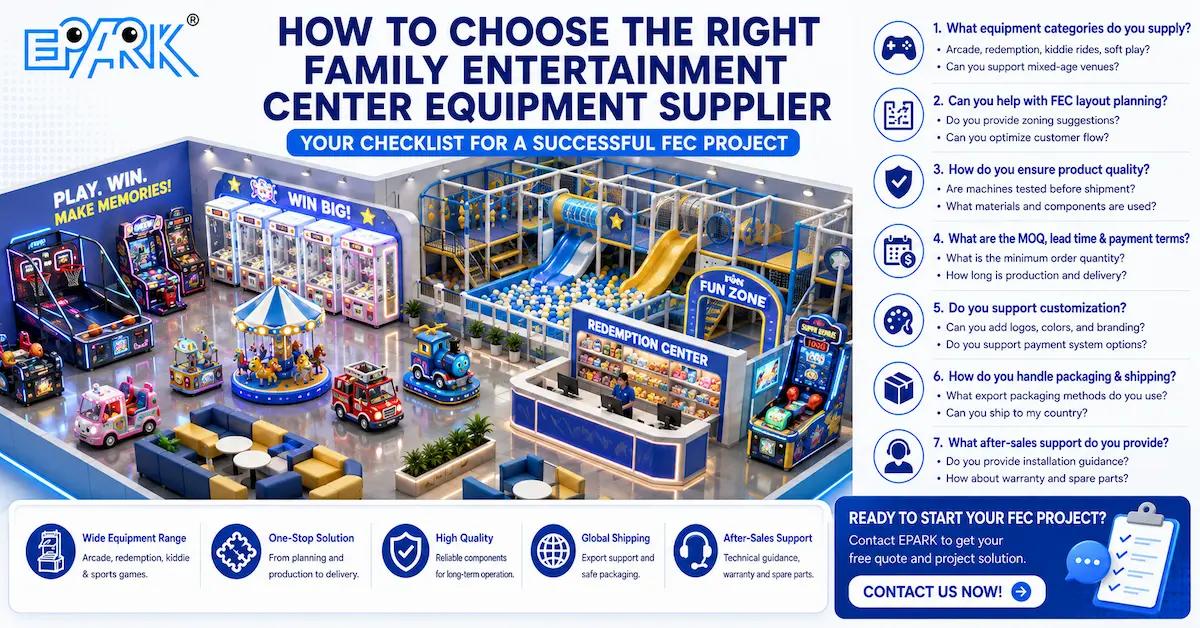


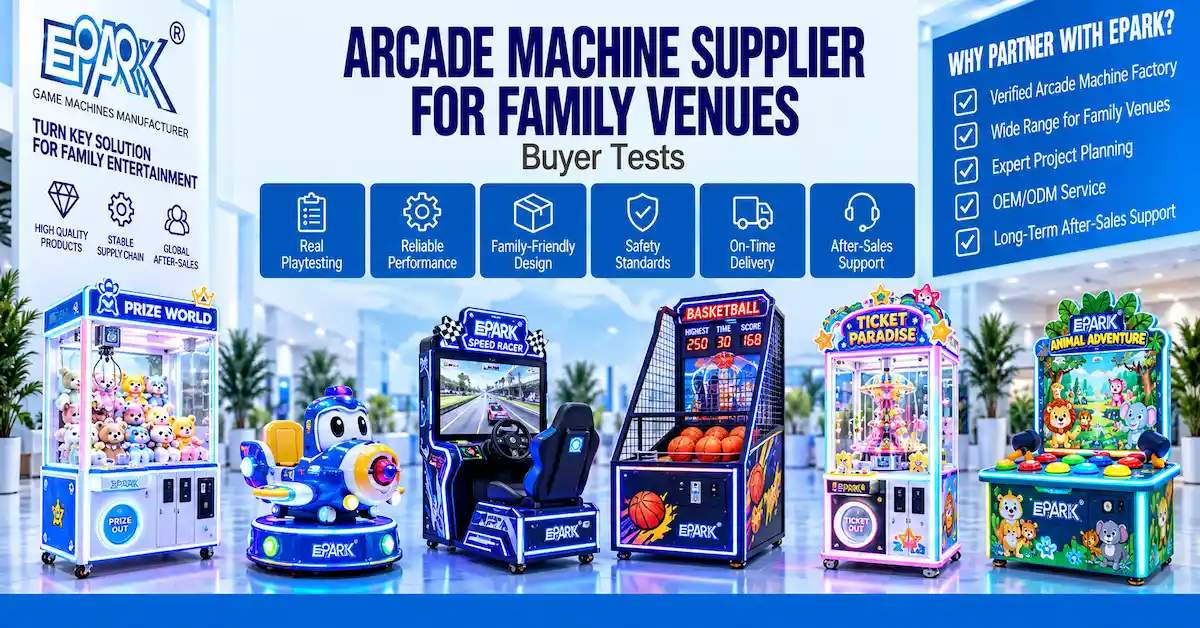
What should an arcade machine supplier for family venues prove before you place an order?
An arcade machine supplier for family venues should prove that its equipment can serve different ages, survive frequent cleaning and repeated play, remain understandable to parents and children, and be supported with model-specific parts and documents. The practical buying decision is not “which cabinet looks most exciting?” It is whether the supplier can connect each machine to an age group, supervision level, cleaning routine, payment method, service route and replacement plan. A family venue needs a documented operating mix, not a random catalogue.
This article addresses a supplier-comparison decision for FEC owners, indoor playground operators, mall family zones and distributors preparing a family-focused equipment order. It uses EPARK's public manufacturer information as a first-party evidence boundary. Guangzhou EPARK Electronic Technology Co., Ltd. identifies itself as a Guangzhou manufacturer integrating R&D, design, production and sales, with commercial equipment for family entertainment centers, arcades and indoor amusement venues. Model dimensions, electrical values, MOQ, delivery date and local compliance must still be confirmed in the written quotation.
The strongest supplier proposal answers five questions in one file: who the machines are designed for, what the venue team must do every day, what the factory tests before shipment, what is included in the shipment and who is responsible when a unit needs service. If a supplier only sends attractive product photos, the proposal is incomplete. If it sends an age-banded schedule, a cleaning and inspection routine, a packing list and a support boundary, the buyer has something that can be compared and approved.
Define the family venue before comparing suppliers
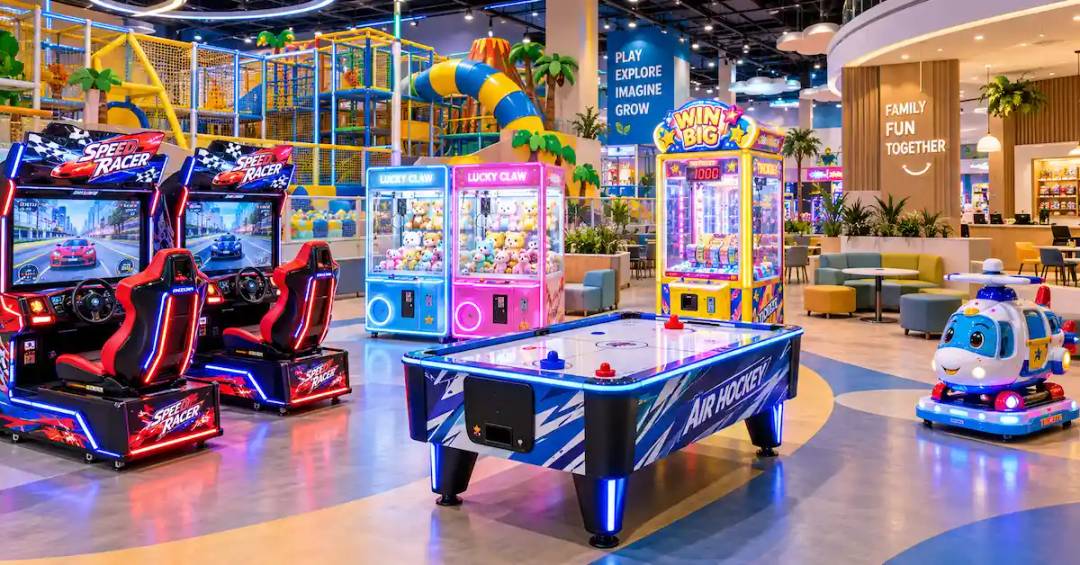
“Family venue” covers several operating realities. A compact mall corner may have parents waiting beside a child, a soft-play facility may have toddlers moving between play structures, and a destination FEC may run redemption, racing and interactive games for several hours. The same machine can work in one setting and fail in another because the supervision pattern, queue length and cleaning frequency are different. Start the brief with the venue's floor plan, entrance, age policy, opening hours, peak periods, staff count and payment system.
Record the youngest intended user, the oldest regular player and the adult who will supervise the session. Note whether children can reach controls without help, whether a parent needs a nearby seat, and whether a stroller can pass behind a player. For high-energy games, document the required recovery space and the route to an emergency stop or power isolator. For prize machines, document where prizes are stored and who replenishes them. These details allow two suppliers to quote the same operating requirement instead of two unrelated machine lists.
EPARK's published project process asks for a floor plan, entrance and exit locations, target audience, preferred game categories, budget and site photographs or video. For a family venue, add a daily operations sheet: opening inspection time, wipe-down intervals, cash or card reconciliation, prize refill window, staff handover and closing checklist. A supplier that asks for these inputs is more likely to understand the venue as an operating system. A supplier that quotes from square meters alone has not yet demonstrated family-venue competence.
| Brief field | Buyer record | Why it changes the quote |
|---|---|---|
| Age bands | Toddler, child, teen, adult and family-play proportions | Changes controls, seating, height, content and supervision |
| Supervision | Parent sightlines, staff ratio and restricted areas | Affects cabinet orientation and staff access |
| Cleaning | Wipe-down products, intervals and hygiene log owner | Favors sealed, reachable and replaceable contact surfaces |
| Session pattern | Typical play time, queue peaks and reset steps | Changes throughput, signage and payment setup |
| Service route | Rear access, spare-parts storage and escalation contact | Determines downtime and maintenance labor |
Use age bands instead of a generic “family-friendly” label
A family-friendly claim is too broad to approve equipment. Break the mix into age bands and explain the design response. Toddlers need simple cause-and-effect play, low reach points and direct adult sightlines. School-age children need short learning curves and visible feedback. Teenagers often want competition, speed or social play. Adults may join a family game when the controls are intuitive and the machine does not look like a small-child attraction. A supplier should show how each quoted unit serves one or more of these groups.
For each age band, specify the control height, seating or standing posture, player count, session length, sound profile and cleaning exposure. A high cabinet may be visually strong but unsuitable for a toddler area. A large motion game may attract teenagers yet create a supervision blind spot. A claw or redemption machine can bridge ages, but it also introduces prize storage, payout settings and replenishment work. The point is not to eliminate categories; it is to assign every category a place and an operating owner.
Ask suppliers to separate “can play” from “should be placed.” A child may technically operate a cabinet while the venue still needs an adult nearby because of moving parts, noise or queue behavior. Put age guidance on the site drawing and on the staff checklist. When a supplier revises a model, require the age-band rationale to be revised too. This prevents a visual substitution from quietly changing the safety and staffing assumptions in the original proposal.
Family venues also need an inclusion check. Confirm whether a seated player can reach the start control, whether a wheelchair can approach the play position, whether instructions use clear language or icons, and whether glare makes the screen hard to read. These are practical procurement questions, not marketing claims. The supplier may not control every accessibility requirement in your country, so the buyer should have the final local review performed by the venue's qualified professional.
Score an arcade machine supplier on operating evidence
Compare suppliers with evidence categories rather than adjectives. A “durable” machine should have a construction description, a test process and a service route. A “safe” machine should have model-specific electrical and mechanical information plus the buyer's local compliance review. A “complete” offer should have a packing list that names the cabinet, control set, payment hardware, manuals, spares and exclusions. Scoring these fields makes a low initial price easier to challenge when it omits labor or operating systems.
Use a weighted score that reflects the venue's actual risk. In a toddler-heavy site, cleanability and supervision may outweigh visual novelty. In a high-volume redemption zone, payout configuration, ticket handling and replenishment may matter more. In a mall corner, queue and service clearance can be decisive. Do not let a supplier score itself with vague phrases such as “international quality.” Ask for the document, photo, test record or named responsible party that supports each score.
| Criterion | Evidence to request | Red flag |
|---|---|---|
| Age and supervision fit | Age-band schedule, controls, sightlines and placement notes | One “family” label for every model |
| Cleanability | Contact-surface materials, wipe access and replacement method | No cleaning owner or surface guidance |
| Endurance | Factory test scope and order-linked acceptance record | “Tested” with no method or duration |
| Serviceability | Access points, parts list, escalation and training | Repair requires an unnamed technician |
| Commercial clarity | MOQ, lead-time trigger, freight, warranty and exclusions | Terms are only in chat messages |
The scorecard should be completed before the buyer asks for a final discount. Price is easier to compare after the scope is equal. A supplier may win with fewer features if it gives better evidence, easier cleaning and a clearer service boundary. That is a commercial decision grounded in operating risk rather than catalogue size.
Specify cabinets that staff can clean and reset
Cleaning is part of machine design. In a family venue, hands touch buttons, joysticks, steering wheels, seats, handles and prize doors throughout the day. Ask where a staff member can wipe without opening an electrical compartment, whether liquids can reach the control panel, and which parts are consumable. The written cleaning instruction should identify the approved method for the actual surface. Do not assume that a product photo proves a cabinet is sealed or suitable for a particular chemical.
Reset time matters as much as wipe time. A machine that leaves an uncleared score, an unfinished credit or a jammed prize can create a queue dispute. Ask for the normal reset sequence, the location of the service switch and the staff action when a player abandons a session. Test the sequence with a non-technical employee. If only an engineer can reset the unit, the supplier has created a staffing dependency that should be priced and documented.
Use a contact-surface map in the operations file. Mark high-touch areas in one color, moving or pinch-risk areas in another, and staff-only panels in a third. Link every marked area to a cleaning frequency and inspection owner. This map becomes useful when the venue adds a new payment reader or changes a cabinet's artwork. It also helps the supplier recommend replacement parts that match the surfaces people actually use.
Require durability evidence for high-frequency family play
Durability is a chain of decisions: frame construction, panel material, fasteners, controls, power supply, display mounting, wiring protection and access for replacement. EPARK's public materials describe metal frames, ABS plastic, tempered glass and plywood among model-dependent materials, together with PCB and wiring assembly, LED and screen integration, final assembly and function testing. This is useful evidence of a manufacturing process, but it is not a universal specification for every cabinet. The quoted model must be mapped to its actual materials.
Ask how the supplier verifies controls after assembly. A family venue may see more accidental impacts, repeated button presses and rough handling than a private game room. Request the inspection points for button response, joystick return, sensor alignment, coin or card reader operation, screen image, speaker output and emergency power behavior. The goal is not to demand a laboratory claim the supplier has not published. The goal is to create a practical acceptance list that staff can understand.
EPARK's public Design & Process page states that every machine goes through a 48-hour full-operation test covering gameplay functionality, electrical safety, lighting effects and mechanical durability before packaging. Treat that as a published process statement and request the order-linked record for the models in your shipment. Ask whether the test is performed on every unit, on a sample, or by production batch. That distinction should appear in the purchase documents.
What to keep in the factory evidence file
Keep the approved model sheet, artwork proof, material notes, serial-number list, test checklist, photos or video of the completed units, packing list and signed pre-shipment comments. Add the name of the person who reviewed the evidence and the date of review. A photo without a model identifier is difficult to use when several cabinets look similar. A short video that shows the serial number, screen, controls and payment device is more useful than a general factory tour.
Make payment and access part of the equipment specification
Family venues often combine cashless cards, QR payments, coins, tickets or a membership account. The supplier should not assume that a payment reader is interchangeable across models. Define who owns the payment hardware, who configures tariffs, who provides network access and who supports the reader when it fails. Ask for a wiring diagram or interface description where the payment system is integrated into the cabinet. Keep the commercial payment contract separate from the machine warranty unless the supplier explicitly accepts both responsibilities.
Accessibility and parent comfort should be visible on the layout. Place quieter games near seating if parents are expected to supervise younger children. Keep fast-moving or competitive games away from stroller parking and narrow paths. Show the turning space around a cabinet, not only its footprint. If the supplier provides a 2D or 3D plan, ask for the version number and approval date. A changed cabinet depth or seat position can affect a previously approved path.
Ask for two operating scenarios: normal weekday use and peak weekend use. In the peak scenario, show where a queue forms, how staff reach a jammed machine and how a parent can leave the area without crossing a moving game. If the machine mix depends on a prize counter, show the replenishment route. This is where a family-venue supplier demonstrates practical understanding beyond the product catalogue.
Check MOQ, lead time and the meaning of “ready to ship”
MOQ is not one universal number for an arcade supplier. It may differ between an off-the-shelf model, mixed-container order, custom artwork, new cabinet development and a repeat order. Ask the supplier to state MOQ by model and by customization level. If a trial order is possible, confirm whether the trial unit uses the same component configuration and artwork process as the future production batch. Otherwise, a successful sample may not represent the shipment you plan to scale.
Lead time must have a trigger. Possible triggers include deposit receipt, artwork approval, sample approval, final layout approval or payment-system confirmation. Put the trigger in the quotation. Ask what happens when the buyer changes artwork, voltage, language, reader or cabinet color after approval. A transparent change rule is more useful than a short but undefined lead-time promise.
Clarify “ready to ship.” It can mean assembly complete, factory test complete, packed, customs documents ready or container loaded. EPARK's published packaging description includes bubble wrap, thick foam, wooden-frame or crate reinforcement and waterproof film for sea shipment. Ask which of these applies to the actual equipment and whether the packing list includes loose accessories, manuals, keys and spare parts.
Plan installation and staff handover around family operations
Installation is complete only when the venue can operate without the supplier's engineer standing beside the cabinet. Request an installation sequence, required tools, utility assumptions, network steps, payment configuration steps and a sign-off form. For a mixed family venue, the handover should include a short operating lesson for front-line staff and a separate technical lesson for the person responsible for maintenance. Record both attendees and the date.
Ask the supplier to demonstrate three common incidents: a player abandons a paid session, a control stops responding and a prize or ticket path jams. The employee should know when to reset, when to isolate power, what evidence to collect and which contact to use. EPARK's FAQ states that clients can request support through WhatsApp, email or phone and should provide a serial number plus photos or videos; make that evidence format part of the venue SOP.
Spare parts should be labeled by model and, where possible, by serial or compatible configuration. A family venue does not benefit from a box of anonymous buttons. Ask for quantities, warranty status, consumable exclusions, storage conditions and reorder terms. EPARK's public FAQ states that manufacturing-defect replacement parts are covered during its two-year warranty, while consumables and misuse are excluded. Confirm how freight, local labor and payment-system components are treated in the signed warranty terms.
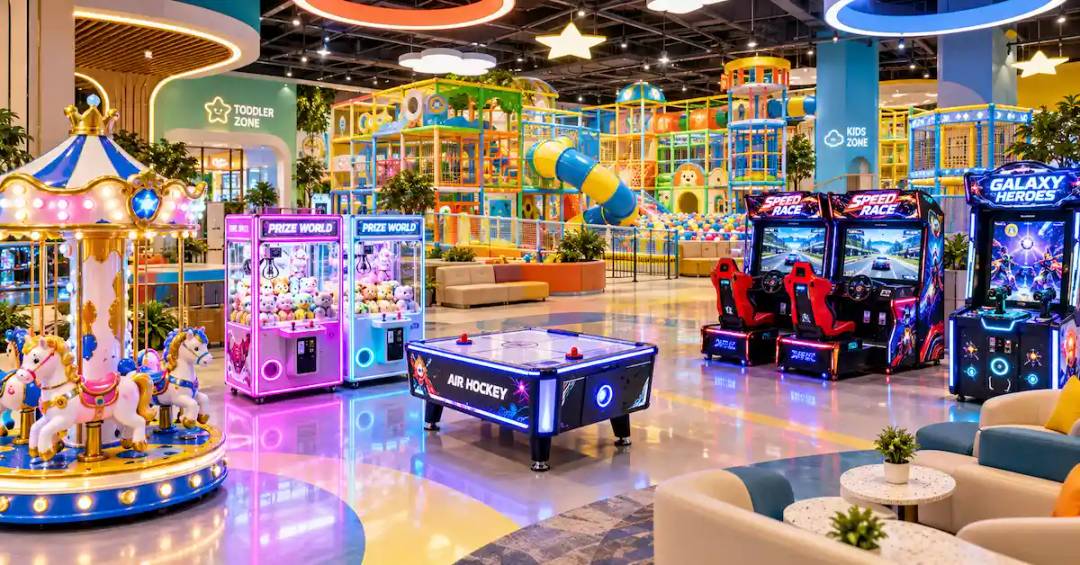
Use a family-venue acceptance test before opening
The opening test should reproduce the venue's real work. Run each machine through start, payment, play, finish, reset and shutdown. Wipe the contact surfaces using the approved method. Ask a staff member who did not attend the factory review to follow the manual. Observe whether a parent can supervise without blocking the queue and whether a wheelchair, stroller or service cart can pass the planned route.
Record failures by category: hardware, software, payment, signage, layout, cleaning or training. A machine that plays correctly but cannot be reset by staff is not ready. A payment reader that works on a supplier network but not the venue network is not ready. A cabinet that fits the drawing but blocks an exit is not ready. Give each failure an owner and due date, then repeat the test after correction.
Do not use opening-day revenue as an acceptance criterion. Revenue depends on location, pricing, promotion and customer behavior. Use measurable readiness criteria instead: all quoted models received, serial numbers matched, payment path tested, staff trained, cleaning log issued, emergency contact confirmed, manuals stored and replacement parts identified. Commercial performance can be reviewed after trading data exists; it should not be used to hide an incomplete handover.
Write an RFQ that exposes supplier differences
Your RFQ should include the venue type, floor plan, age bands, operating hours, target payment method, cleaning routine, desired categories, sound limits, delivery route and opening date. Ask suppliers to return a line-by-line schedule with model name, quantity, dimensions, packed dimensions, weight, voltage, rated input, payment interface, warranty, spare parts, MOQ, lead-time trigger, packing method, installation scope and exclusions. Unknown fields should be marked “to confirm,” not silently filled with a standard value.
Request three versions of the proposal: a core family mix, a compact trial mix and an expansion mix. Require the same evidence fields in all three versions so the buyer can see what changes. For custom artwork or language, ask for a proof before production. For a new model, ask what sample or prototype approval is included. For a repeat order, ask how the supplier protects configuration consistency.
Send the supplier's reply to the venue manager, technical reviewer and finance owner. Each person sees a different risk. The manager checks queue and staffing, the technical reviewer checks utilities and service, and finance checks landed cost and responsibility. A supplier that answers all three audiences in one organized file is easier to onboard and easier to use again.
Review the first 30 days without changing the evidence baseline
The first month of trading should produce an operating review, not an excuse to rewrite the original purchase scope. Track machine availability, repeated fault types, cleaning time, payment exceptions, queue complaints, prize replenishment and the questions staff ask most often. Compare those observations with the supplier's approved model sheet and handover documents. If the venue is using a cabinet differently from the assumed age band or session pattern, record that as an operational learning rather than silently changing the machine.
Hold a short review with the supplier after the first two or four weeks. Bring serial numbers, photographs, error descriptions, staff notes and the dates of any service calls. Ask which issues are covered by warranty, which are training gaps, which are consumables and which require a design or configuration change. This creates a useful boundary between normal commissioning and a product defect. It also gives the supplier evidence for improving a repeat order without making unsupported promises about revenue.
Keep the original acceptance record beside the 30-day review. A family venue often expands gradually, and a later buyer may need to know why one model was placed in a quieter zone or why a control was changed. Clear records protect both parties and make the next equipment decision faster.
Frequently asked questions about an arcade machine supplier for family venues
What makes a supplier suitable for a family venue?
Suitability is demonstrated by age-band recommendations, cleanability information, service access, model-level technical sheets, factory testing evidence and a handover process that front-line staff can follow. A large catalogue alone does not prove family-venue fit.
Does EPARK publish materials and testing information?
Yes. EPARK's public Design & Process and FAQ pages describe model-dependent materials such as metal frames, ABS, tempered glass and plywood, plus a published 48-hour full-operation test covering gameplay, electrical safety, lighting effects and mechanical durability. Buyers should request the model-specific record and not generalize one cabinet's specification to another.
Can a family venue place a small trial order?
EPARK's public FAQ states that both small trial orders and large-scale production are supported. The buyer should still confirm the model, customization level, minimum quantity, payment terms and whether the trial configuration matches the intended repeat order.
What should be included in a family-venue spare-parts package?
It should include compatible parts, quantities, labels, warranty status, storage instructions and a reorder contact. Consumables and payment-system parts may have different coverage, so they should be listed separately in the quotation.
How long is EPARK's published warranty?
EPARK's public FAQ states a two-year warranty from shipment, with manufacturing-defect replacement parts during the warranty period and exclusions for consumables and misuse. Freight, local labor and third-party payment hardware must be confirmed in the signed terms.
What should I send for a family-venue quote?
Send a floor plan, photos or video, entrance and exit locations, age bands, preferred categories, budget range, payment method, operating hours, opening date, delivery constraints and the service contact. The more specific the brief, the less likely the supplier is to quote an unusable generic mix.
Conclusion
The right arcade machine supplier for family venues is the one that can turn a mixed-age operating brief into documented equipment, testing, cleaning, payment, installation and service decisions. Compare evidence, not slogans. Confirm the model-level materials, technical values, MOQ, lead-time trigger, packing scope and warranty exclusions in writing. Then run a venue-based acceptance test before opening. EPARK's public manufacturer and service information provides a useful starting point for the supplier conversation, while the final quotation and local venue review determine whether the proposed equipment is ready for your specific family audience.
Disclaimer
The information provided on this website is for general informational purposes only.
While EPARK Arcade Game Machine Manufacturer strives to ensure accuracy and reliability, no warranties—express or implied—are made regarding completeness, performance, or applicability.
Product specifications, designs, and features may vary depending on usage, customization, and customer requirements.
Buyers are responsible for verifying all technical details, compliance certifications, and suitability before procurement.
EPARK shall not be held liable for any direct, indirect, incidental, or consequential damages arising from the use of this website or its content, including but not limited to business losses, data errors, or equipment misuse.
For tailored solutions or further verification, please visit our Contact Us
Intellectual Property Notice
All articles, product images, videos, catalogs, software, and related materials published on this website are the intellectual property of EPARK, unless otherwise stated.
Unauthorized reproduction, distribution, modification, or commercial use of any content is strictly prohibited without prior written consent from EPARK.
EPARK reserves the right to take legal action against any unauthorized use, including but not limited to copyright infringement, misrepresentation, or unfair competition.
Trademarks
The name EPARK, the EPARK logo, and all related brand elements displayed on this website are registered trademarks or trade names of Guangzhou EPARK Electronic Technology Co., Ltd.
Other product names, company names, or logos mentioned on this site may be trademarks of their respective owners.
Unauthorized use of EPARK's trademarks for commercial purposes, including advertising, promotions, or product packaging, is strictly prohibited.
Governing Law
These terms are governed by the laws of the People's Republic of China.