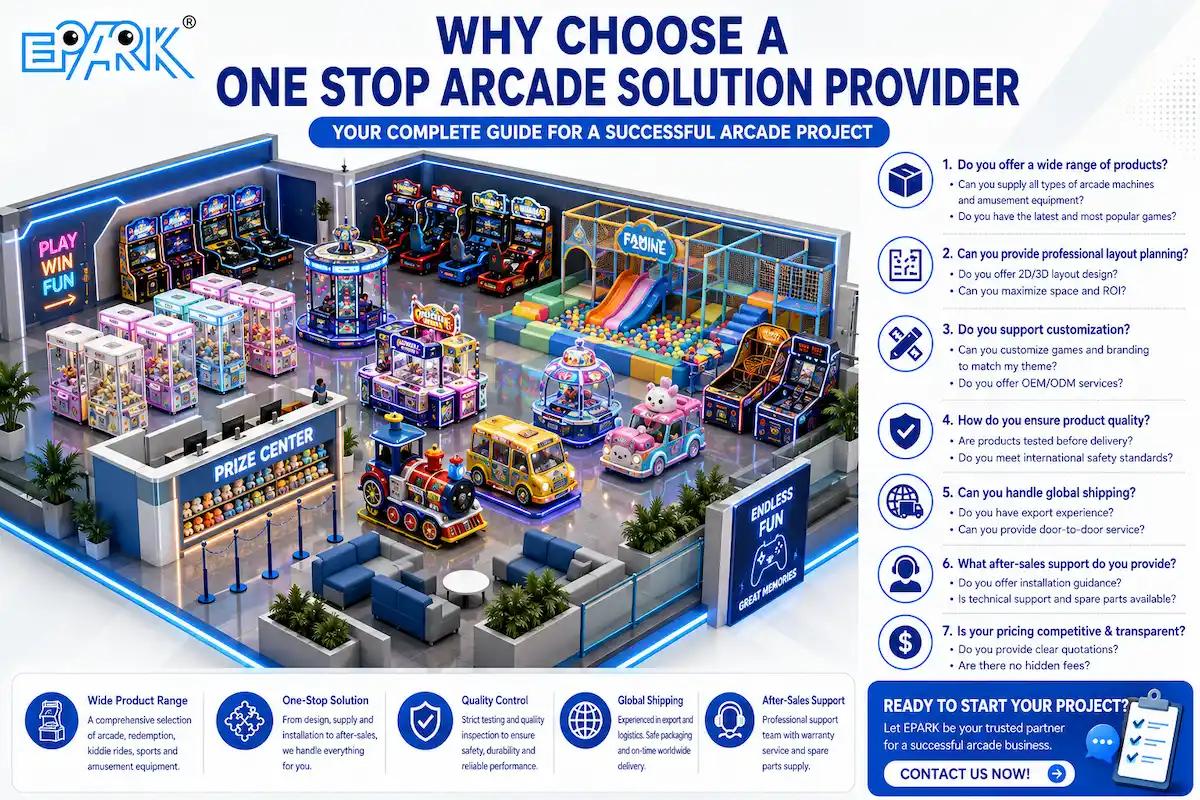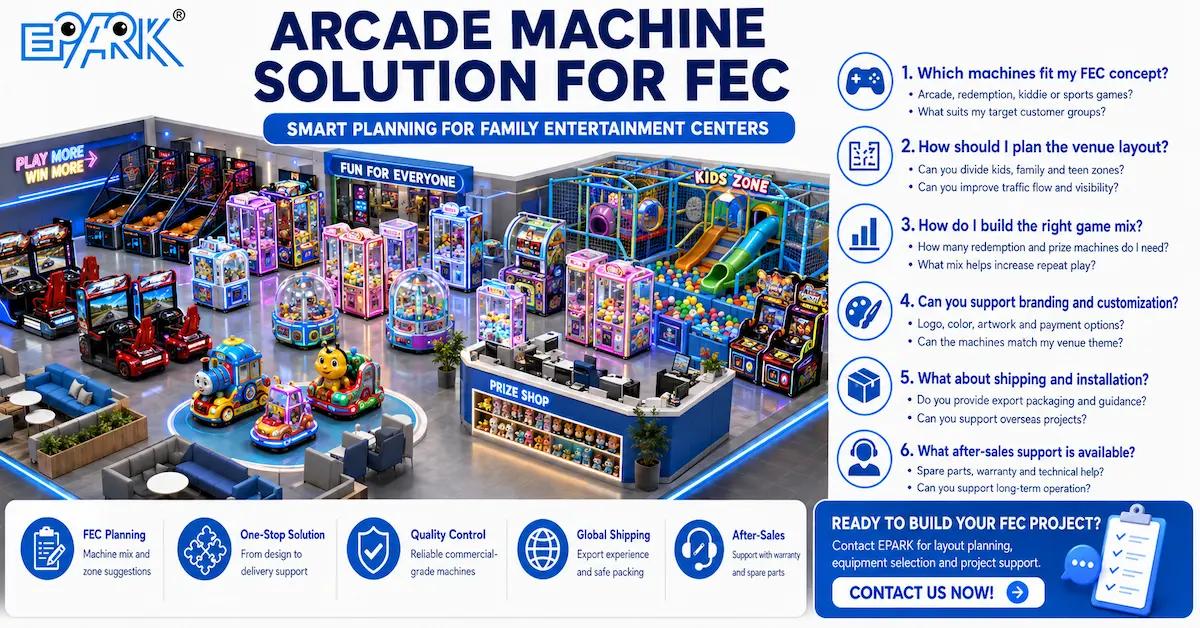


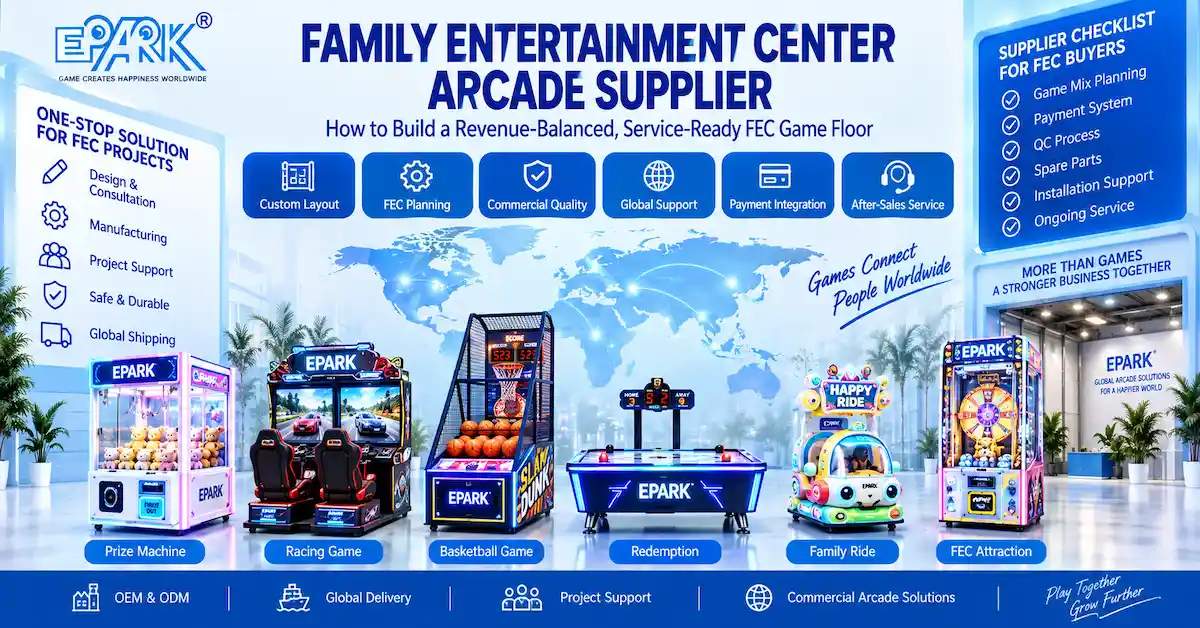
What Should a Family Entertainment Center Arcade Supplier Actually Solve?
A family entertainment center arcade supplier should not be evaluated only by how many machines appear in its catalog.
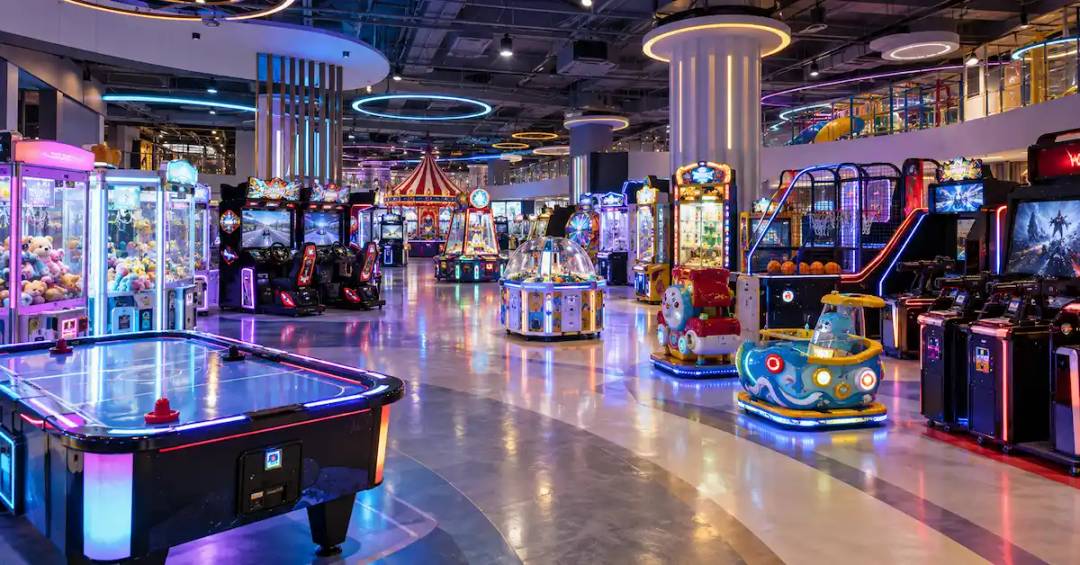
A real FEC is an operating environment. Different visitors enter with different expectations, machines compete for floor space, popular attractions create queues, redemption equipment affects prize operations, payment systems connect the arcade floor, and every machine eventually needs cleaning, maintenance, parts, or technical support.
For that reason, the supplier's real job is to help turn an equipment budget into a working entertainment floor.
That means connecting:
Audience → Venue → Game Roles → Zoning → Machine Specifications → Payment → QC → Delivery → Commissioning → Maintenance → Refresh
This is a different purchasing challenge from ordering several individual arcade cabinets.
If an FEC buyer purchases machines independently without connecting these decisions, several problems can appear after opening:
- Too many machines serving the same age group
- Attractive equipment concentrated in one zone while other areas feel weak
- Insufficient space around multiplayer games
- Long queues blocking circulation
- Inconsistent payment interfaces
- A redemption counter that does not match ticket-generation volume
- Machines that cannot be serviced easily in their installed positions
- Too many unique spare parts
- Premium equipment that is difficult for local technicians to maintain
- No clear strategy for replacing weak-performing machines
The right supplier should therefore help the buyer think beyond the transaction.
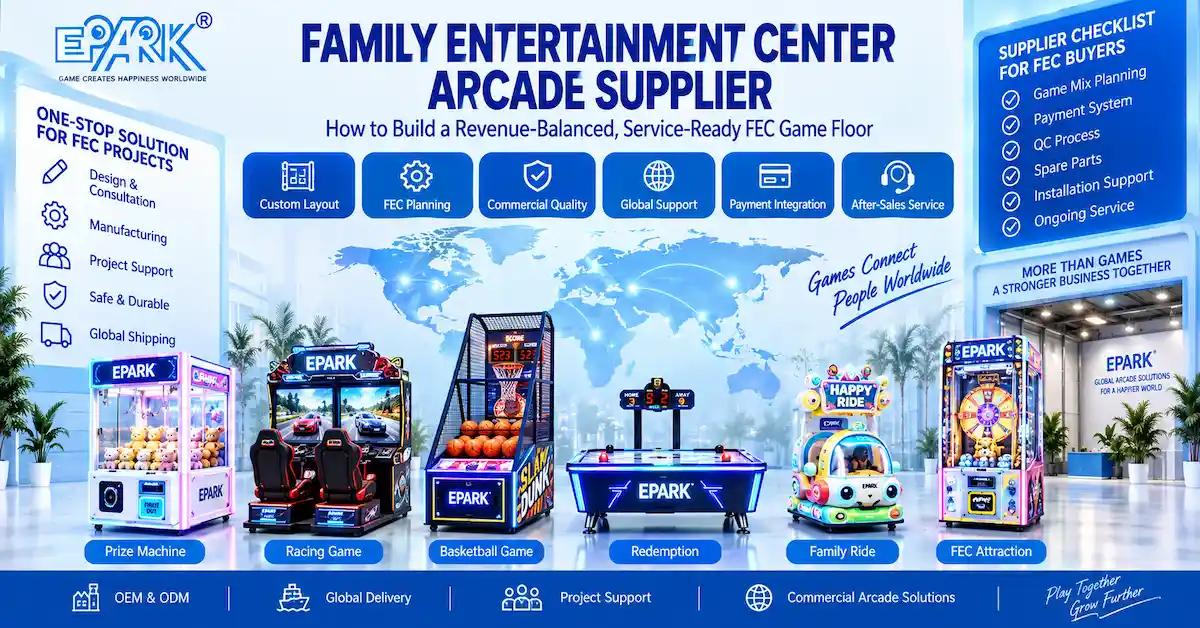
EPARK's current product structure includes commercial arcade machines as well as dedicated Family Entertainment Center solutions, while its published project process connects venue information, layout planning, production, testing, and support.
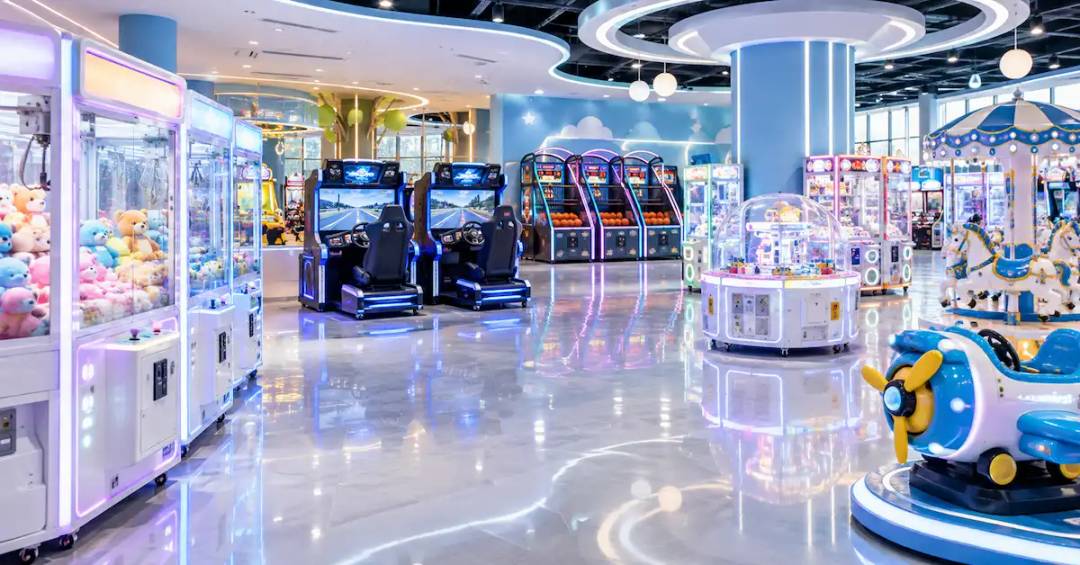
Start With the FEC Operating Model Before Choosing Machines
One of the most common procurement mistakes is beginning with a supplier's bestseller list.
A machine can be commercially successful in one venue and poorly suited to another.
Before asking an FEC arcade supplier for a quotation, define the operating model.
Who Will Visit the Venue?
A family entertainment center can serve several customer groups:
- Young children visiting with parents
- School-age children
- Teenagers
- Young adults
- Parents playing with children
- Groups of friends
- Birthday-party guests
- Mall visitors seeking short entertainment sessions
- Repeat local customers
These audiences do not use equipment in the same way.
A six-year-old may respond to simple interactive or prize-focused games. Teenagers may prefer competitive racing, shooting, basketball, or immersive attractions. Parents may participate in social games or prefer equipment they can play together with children.
A supplier proposal should therefore connect machines with actual users.
How Long Do You Expect Guests to Stay?
A short-stay mall arcade and a destination FEC require different portfolios.
A compact mall game zone may focus on:
- High visual attraction
- Easy-to-understand gameplay
- Quick transactions
- Compact machine footprints
A destination FEC designed for longer visits may require more layers:
- Anchor attractions
- Social competition
- Redemption play
- Kiddie entertainment
- Premium experiences
- Seating or rest areas
- Prize redemption
- Repeat-play variety
The purchasing brief should describe the intended visit, not just the venue area.
Build a Revenue-Balanced Arcade Portfolio
A professional FEC does not need equal quantities of every machine category.
It needs a balanced portfolio in which different machines perform different commercial jobs.
Attraction Machines
Attraction machines help create visual energy and draw customers toward the arcade floor.
These may include:
- Large racing simulators
- VR attractions
- Visually prominent prize machines
- Large shooting games
- Signature interactive equipment
They can be valuable, but they usually consume more capital and space.
The supplier should not recommend too many attraction machines simply because they look impressive in renderings.
Repeat-Play Machines
Some equipment works best because customers understand it quickly and may return to it several times during a visit.
Depending on the venue, this may include:
- Basketball
- Racing
- Air hockey
- Shooting
- Skill games
- Selected redemption games
These machines help provide depth to the entertainment experience.
Redemption Machines
Redemption products are not isolated cabinets.
They connect gameplay with ticket or point accumulation and the prize counter.
An FEC buyer therefore needs to consider the complete loop:
Play → Earn → Accumulate → Redeem → Re-engage
If the machines generate rewards faster than the prize area can process customers, operations suffer.
If the prize display is weak, the emotional value of the redemption system falls.
Family Machines
Some equipment should create opportunities for parents and children to play in the same venue without requiring the same skill level.
This can include:
- Accessible sports games
- Simple competition games
- Prize equipment
- Kiddie rides
- Selected interactive machines
Premium Machines
Premium machines should have a clear reason to exist.
They may support:
- Marketing
- Differentiation
- Higher perceived venue value
- A flagship experience
But premium does not automatically mean profitable.
The supplier should help buyers evaluate the relationship between investment, space, operating complexity, and customer demand.
Use a Machine Role Matrix Instead of a Catalog List
A practical supplier proposal can classify equipment by role.
| Machine Role | Main Purpose | Typical FEC Value | Purchasing Question |
|---|---|---|---|
| Anchor Attraction | Pull attention | Builds venue visibility | Is it strong enough to justify floor space? |
| Competitive Play | Social interaction | Encourages group participation | Can multiple guests play or watch comfortably? |
| Redemption | Reward-driven repeat play | Supports prize ecosystem | Does it fit the ticket/prize strategy? |
| Prize / Claw | Impulse and collection | Strong visual merchandising | Is prize replenishment practical? |
| Family Play | Broad age appeal | Supports mixed-age visits | Can parents and children participate easily? |
| Kiddie | Younger audience | Extends age coverage | Is it appropriate for the target family segment? |
| Premium / Immersive | Differentiation | Adds destination value | Can the venue maintain and support it? |
| Flex / Rotation | Portfolio refresh | Allows future change | Can it be relocated or replaced easily? |
The exact categories can vary.
What matters is that every machine has a commercial purpose.
An FEC supplier should be able to explain why a machine is in the proposed package, not simply why the machine itself is attractive.
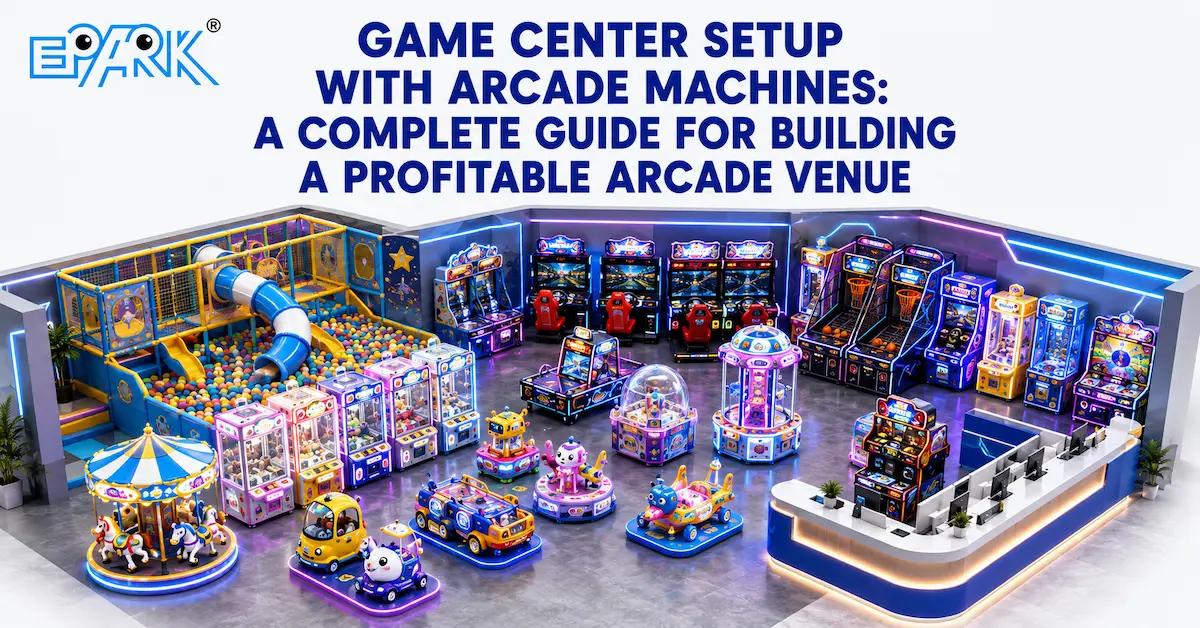
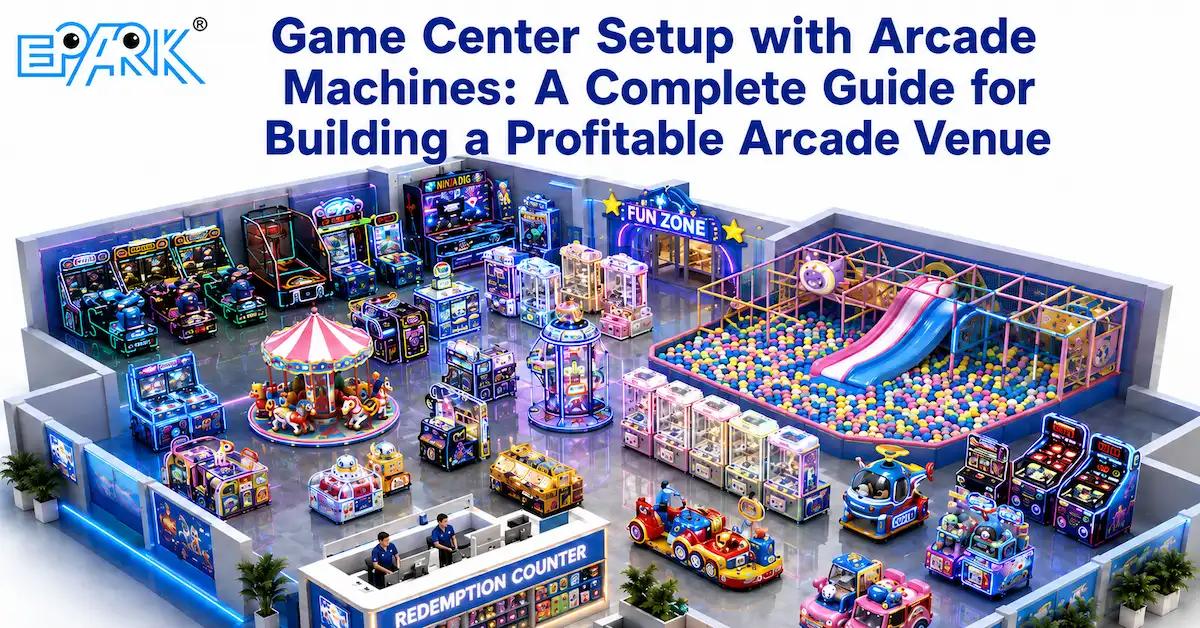
Plan FEC Zones Before Freezing the Equipment Order
Machine selection and floor planning should develop together.
EPARK's published design process begins with space size, floor plan, entrances, exits, target audience, preferred games, and budget before moving into 2D layout planning.
This is important because a cabinet's dimensions do not represent its full operating footprint.
A racing machine needs space for the player to enter and exit.
A basketball game needs shooting space.
A popular prize machine may need queue space.
A technician may need to open a rear or side service panel.
Entrance Zone
The entrance should communicate the venue's entertainment value quickly.
Suitable equipment may include visually strong machines that can be understood from a distance.
However, placing the highest-traffic machines directly at the entrance can create congestion.
The supplier should consider attraction and circulation together.
Competitive Zone
Racing, shooting, basketball, sports, and other multiplayer equipment can create energy when grouped strategically.
Players watch other players.
Groups compare results.
Competitive zones can therefore create a stronger social atmosphere than isolated cabinets scattered across the venue.
Redemption Zone
Redemption machines should have a logical relationship with the prize counter.
Staff need access for:
- Ticket or point management
- Prize replenishment
- Customer questions
- Machine service
- Prize inventory
The entire redemption ecosystem should be considered before equipment quantities are finalized.
Younger-Family Zone
Equipment intended for younger children should be positioned with supervision, visibility, and family circulation in mind.
Parents should not need to cross high-activity racing or shooting queues every time they reach the younger-player area.
Premium Attraction Zone
Large VR or motion attractions may need additional considerations:
- Queue area
- Operating supervision
- Safety clearance
- Electrical requirements
- Technical access
They should be positioned as deliberate attractions rather than simply fitted wherever floor space remains.
Floor Area Is Not the Same as Usable Arcade Area
An FEC buyer may tell the supplier:
“My venue is 500 square meters.”
That does not mean 500 square meters are available for machines.
The floor may also need:
- Entrance and reception
- Walkways
- Prize counter
- Seating
- Party room
- Staff area
- Storage
- Columns
- Emergency access
- Service clearance
- Payment stations
The correct workflow is therefore:
Measured Floor Plan → Non-Equipment Areas → Operating Zones → Machine Footprints → Player Space → Circulation → Final Equipment List
This is one reason buyers should review the EPARK Design & Process workflow before requesting a final equipment quotation.
Player Throughput Matters More Than Machine Count
An FEC with many machines is not automatically a strong FEC.
The venue must be able to serve customers at the times when demand is highest.
Understand Session Length
Different machines occupy players for different lengths of time.
A short skill game may process customers quickly.
A multiplayer simulator may keep a group engaged much longer.
Neither is automatically better.
The correct balance depends on the FEC's commercial model.
Watch Queue Spillover
Popular games can create standing audiences.
That can be positive because it generates energy.
But if the queue blocks:
- Other machines
- Main walkways
- Prize areas
- Exits
- Service access
then the layout becomes operationally weak.
Avoid Dead Corners
A technically correct layout can still contain visually weak areas.
Some zones may receive little traffic because:
- Customers cannot see them
- They are hidden behind large machines
- The route naturally bypasses them
- The equipment does not create enough visual pull
An experienced family entertainment center arcade supplier should review not only floor utilization, but also how visitors are likely to move through the space.
Payment Integration Should Be Planned at Project Level
Payment configuration should not be decided independently for every machine.
A complete FEC needs a consistent operating system.
Depending on the project, arcade equipment may use:
- Coins
- Tokens
- Cards
- QR-based systems
- Cashless readers
- Ticket or point systems
EPARK's current site describes support for coins, QR codes, cards, and ticket/point/redemption integration within its solution services. EPARK
Ask Who Owns the Integration
The supplier, payment-system provider, and venue operator should define responsibilities clearly.
Questions include:
- Who provides the reader?
- Who provides mounting requirements?
- Who installs the reader?
- Who configures communication?
- Who tests it before shipment?
- Who tests it again after installation?
- Who supports failures later?
Standardize Across the Floor
A unified payment architecture can simplify:
- Customer experience
- Staff training
- Revenue reporting
- Technical maintenance
- Machine replacement
A mixed environment in which every machine has a different payment method can create unnecessary friction.
Treat the Prize System as Part of Arcade Design
For redemption-focused FECs, the prize system affects customer motivation.
The arcade supplier may not control every detail of prize merchandising, but the equipment plan should account for it.
Estimate Reward Demand
More redemption equipment may create:
- More ticket or point volume
- More visits to the prize counter
- Higher prize replenishment requirements
- More staff interaction
This affects the operating model.
Make the Prize Counter Visible
The reward destination should reinforce motivation.
If customers cannot easily see the prize area, part of the redemption loop becomes less visible.
Plan Staff Access
Prize shelving, storage, replenishment, and customer service all need space.
Do not design the redemption counter only as a decorative element.
Define a Technical Specification Schedule for Every Machine
A supplier quotation becomes significantly safer when technical requirements are documented before production.
Use one controlled specification schedule.
| Specification Area | Information to Confirm | Why It Matters |
|---|---|---|
| Model | Exact supplier model / revision | Prevents substitution |
| Quantity | Final quantity | Production and layout control |
| Installed Dimensions | L × W × H | Layout verification |
| Operating Clearance | Player/service space | Real floor planning |
| Electrical | Voltage, frequency, plug | Market compatibility |
| Power | Machine requirement | Electrical planning |
| Payment | Approved interface | System consistency |
| Language | Interface requirement | Local operation |
| Controls | Wheel, guns, buttons, sensors, etc. | Service planning |
| Accessories | Included items | Prevents missing components |
| OEM Artwork | Approved revision | Brand consistency |
| Spare Parts | Agreed starter list | Downtime management |
| Packaging | Package count/dimensions | Delivery planning |
This schedule should follow the machine through production, QC, shipping, installation, and later service.
Design for Maintenance Before the Venue Opens
A machine that is difficult to service can become a long-term operating problem.
Maintenance access should therefore influence layout.
Check Service Doors
Can the technician open the machine properly in its final installed position?
Check Seat Removal
Can a racing seat or simulator component be removed without moving several neighboring machines?
Check Control Access
Can buttons, joysticks, guns, sensors, readers, and controllers be reached efficiently?
Check Cable Access
Can electrical and network connections be inspected safely?
Check Cleaning Access
Can staff clean the machine sides and surrounding floor?
These questions appear simple, but they become expensive when discovered after installation.
Reduce Unnecessary Technical Variety
FEC buyers often focus on visible game variety.
Behind the cabinets, too much technical variety can increase maintenance burden.
Where commercially appropriate, a supplier can help standardize selected components or configurations across machine families.
Examples may include:
- Payment hardware
- Common buttons
- Selected power components
- Common peripheral types
- Service connectors
- Internal labeling
- Spare-part references
The goal is not to make every machine identical.
It is to reduce unnecessary complexity where the customer cannot see a meaningful difference.
Build a Spare-Parts Architecture, Not a Spare-Parts Box
A bag of random components is not an after-sales system.
Each spare part should connect to a specific machine and revision.
A useful structure is:
Machine SKU → Machine Revision → Part Code → Part Description → Quantity → Storage Location
Store-Level Spare Parts
Keep small, frequently required parts close to the venue.
Critical Downtime Parts
Identify components that can stop important machines from operating.
Supplier-Level Parts
Low-frequency or expensive components may remain with the manufacturer until needed.
For deeper maintenance planning, the EPARK Arcade Equipment Maintenance Parts guide discusses model identification, compatibility, technical references, and replacement planning.
Ask the Supplier for Defined Project Deliverables
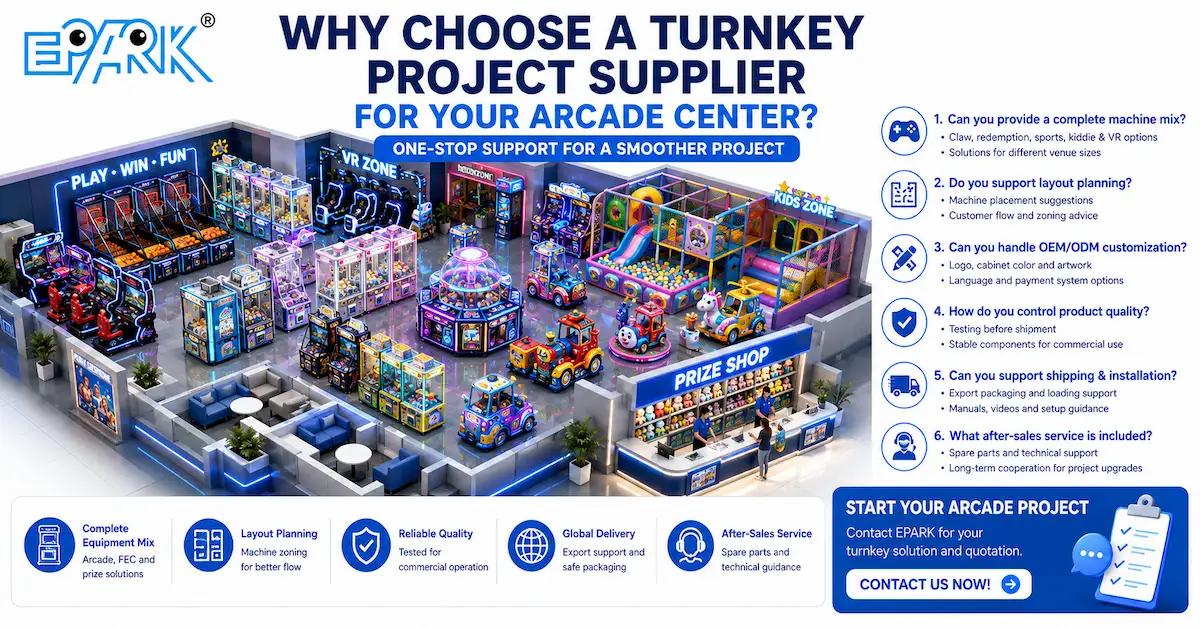
The phrase “one-stop solution” can mean different things to different companies.
A buyer should convert it into specific deliverables.
A supplier proposal may need to define:
Before Order
- Project questionnaire
- Product recommendations
- Preliminary equipment list
- 2D layout
- Quotation
- Technical review
Before Production
- Approved model list
- Final quantities
- Payment requirements
- Electrical configuration
- OEM artwork
- Project schedule
Before Shipment
- QC status
- Final packing information
- Package identification
- Spare-parts list
- Accessories list
- Shipping documents within agreed scope
Before Opening
Depending on the commercial arrangement:
- Installation instructions
- Remote technical guidance
- On-site support where agreed
- Payment-system testing
- Machine commissioning
- Staff orientation
After Opening
- Technical support
- Spare-parts supply
- Troubleshooting
- Repeat-order support
- Machine refresh planning
EPARK's current company and service pages describe its business as integrating R&D, design, production and sales, with services including customization, layout support and ongoing technical assistance.
QC Should Follow the FEC's Approved Configuration
Quality inspection should not stop at:
“The machine turns on.”
A machine may function correctly but still be wrong for the project.
Functional QC
Depending on category, test:
Racing Machines
- Screen
- Steering
- Pedals
- Buttons
- Audio
- Seat
- Game operation
- Multiplayer connection where applicable
Basketball Games
- Scoring sensors
- Ball return
- Display
- Lighting
- Buttons
- Mechanical structure
Shooting Games
- Gun/controller response
- Calibration
- Screen
- Audio
- Sensors
- Software operation
Claw / Prize Machines
- Claw motion
- Controls
- Prize mechanism
- Lighting
- Door locks
- Payment system
- Operating settings
Redemption Machines
- Sensors
- Ticket/point function
- Displays
- Controls
- Reward mechanism where applicable
Configuration QC
Also verify:
- Model
- Revision
- Quantity
- Voltage
- Plug
- Payment configuration
- Language
- OEM artwork
- Accessories
- Spare parts
Cosmetic QC
For customer-facing equipment, appearance matters.
Inspect:
- Cabinet surfaces
- Artwork
- Screens
- Lighting
- Seats
- Decorative components
- Visible scratches
An FEC floor is a visual environment, so cosmetic consistency is part of commercial quality.
Use an FEC Acceptance Matrix Before Shipment
A useful acceptance table can look like this:
| Acceptance Area | Buyer Question | Approval Evidence |
|---|---|---|
| Product Identity | Is this the approved model and revision? | Model record |
| Quantity | Does quantity match the PO? | Final equipment list |
| Function | Does the game operate correctly? | QC record / agreed evidence |
| Configuration | Is the payment/electrical setup correct? | Configuration checklist |
| Branding | Is the correct artwork applied? | Approved artwork comparison |
| Accessories | Are required items included? | Packing/accessory list |
| Parts | Are agreed spares included? | Spare-parts list |
| Appearance | Is finish acceptable? | Final inspection |
| Packing | Is product prepared for delivery? | Package record |
This gives the buyer and supplier one language for final approval.
Production Schedule and Change Control Matter for FEC Projects
FEC projects often involve many different machine categories.
A late change to one part of the order can affect:
- Production
- Artwork
- Payment integration
- QC
- Packing
- Container planning
- Delivery
- Installation
- Opening date
Set a Specification Freeze Date
After final approval, changes should be controlled.
Not every request needs to be rejected.
But every change should identify:
What changes?
What cost changes?
What schedule changes?
What documentation changes?
Track Revisions
Use revision numbers for:
- Machine configuration
- Artwork
- Equipment schedule
- Layout
- Spare-parts list
This is especially important when multiple teams are involved.
Evaluate Commercial Cost Beyond the Machine Price
The cheapest quotation does not always create the lowest-cost FEC.
The project may also need to account for:
- Freight
- Import charges
- Local delivery
- Site preparation
- Electrical work
- Payment hardware
- Installation
- Spare parts
- Prize inventory
- Staff training
- Maintenance
Calculate Installed Cost
A useful framework is:
**Equipment Cost
- Customization
- Packing & Freight
- Import / Destination Costs
- Installation / Site Costs
= Installed Equipment Cost**
Consider Operating Cost
Then add expected operating requirements such as:
- Service labor
- Spare parts
- Prize replenishment
- Software/content costs where applicable
- Equipment replacement
This produces a better comparison than unit price.
Compare Suppliers Through FEC Capability, Not Catalog Size
A supplier with 500 machines is not automatically stronger than one with a smaller but more controllable commercial range.
Use a weighted supplier scorecard.
| Evaluation Area | Suggested Weight |
|---|---|
| FEC Planning Capability | 15% |
| Product Range Fit | 10% |
| Layout & Zoning Support | 10% |
| Technical Specification Control | 10% |
| QC Process | 10% |
| Payment / Redemption Integration | 10% |
| Maintenance & Spare Parts | 10% |
| Customization | 5% |
| Delivery & Installation Support | 10% |
| Communication & Change Control | 5% |
| Commercial Competitiveness | 5% |
These weights are only an example.
A first-time investor may assign more weight to layout and implementation support.
An experienced FEC chain may assign more weight to repeatability, payment integration, and spare-parts commonality.
The key principle is to score what matters to operation.
One Supplier or Multiple Suppliers?
Some FEC projects use one main supplier.
Others combine specialist vendors.
Both approaches can work.
One Primary Supplier
Potential benefits include:
- Easier communication
- One equipment schedule
- More coordinated payment configuration
- Consolidated QC
- Simpler packing and shipping
- Easier project accountability
Multiple Specialist Suppliers
Potential benefits include:
- Deeper category specialization
- Access to unique products
- More supplier competition
- Reduced dependency on one source
But the buyer must coordinate:
- Technical standards
- Payment systems
- Delivery timing
- Spare parts
- documentation
- installation
EPARK already has a dedicated article on one-stop vs multiple-vendor arcade supply, so a buyer considering the sourcing model can evaluate that decision separately.
OEM and Venue Branding Should Support the FEC Experience
Customization can help a family entertainment center build a stronger identity.
Useful options may include:
- Logo
- Cabinet artwork
- Color palette
- Header graphics
- Product labels
- Prize-zone graphics
- Selected lighting themes
- Language
- Payment configuration
Build a System, Not Random Customized Machines
If every machine is customized independently, the arcade can look inconsistent.
Define a visual system across the venue.
For example:
Primary brand color + secondary accent + logo rules + header style + signage language
Then adapt those rules to different machines.
A basketball cabinet can remain sporty.
A claw machine can remain playful.
A racing machine can remain high-energy.
The common design language connects them without making every product visually identical.
Commissioning Should Be Planned Before Shipment
Commissioning is the point where delivered equipment becomes an operating arcade.
The supplier and buyer should clarify which activities are included.
Depending on the project, commissioning may involve:
- Unpacking
- Positioning
- Assembly
- Electrical connection
- Network preparation
- Payment-system installation
- Game setup
- Functional testing
- Ticket/reward testing
- Staff instruction
EPARK's service information lists installation and technical support among its available project services, but buyers should confirm the exact scope in the quotation rather than assuming every local task is included.
Run a Pre-Opening FEC Readiness Test
Before opening to customers, test the entire system as if the venue were already operating.
Test Customer Flow
Walk from:
Entrance → Payment → Games → Redemption → Exit
Look for congestion.
Test Peak Machine Groups
Run several machines simultaneously.
Observe:
- Sound
- lighting
- power
- network
- payment
- queue space
Test Staff Workflow
Can staff reach:
- Payment terminals
- Prize counter
- machine controls
- service panels
- storage
without disrupting guests?
Test Maintenance
Simulate a common service event.
Can the technician reach and replace the component efficiently?
Test Redemption
Run the full cycle from game reward to prize redemption.
The pre-opening test is the final chance to identify system-level problems before customers experience them.
The Supplier Relationship Should Continue After Opening
An FEC opening is not the end of equipment management.
It is the beginning of real performance data.
Review the First Operating Period
Track:
- Machine usage
- Downtime
- maintenance calls
- prize consumption
- queue behavior
- customer feedback
- service difficulty
Identify Strong and Weak Zones
A machine may perform poorly because of:
- Wrong location
- Wrong target audience
- Poor visibility
- Pricing
- game difficulty
- weak prize connection
Do not automatically assume the machine itself is the problem.
Create a Refresh Strategy
Over time, classify machines as:
Maintain → Relocate → Reconfigure → Refresh → Replace
This helps the FEC stay current without rebuilding the entire venue.
A Good Supplier Should Support the Second Order Better Than the First
The first FEC project teaches both buyer and supplier.
The second order should become more efficient.
A strong supplier relationship should preserve:
- Approved models
- technical specifications
- payment configuration
- artwork
- spare-parts references
- packing information
- previous QC findings
If every repeat purchase begins from zero, the relationship is not producing enough operational value.
For chain and expansion projects, repeatability can become more important than small first-order savings.
Red Flags When Evaluating an FEC Arcade Supplier
Several warning signs deserve additional investigation:
- The supplier recommends machines before asking about the venue
- Quotations do not identify technical configuration
- Product dimensions are provided without operating clearance
- Payment integration is treated as an afterthought
- No clear relationship exists between machines and spare parts
- QC means only “power-on test”
- Artwork approvals are handled only through informal messages
- The supplier cannot explain packaging or delivery responsibility
- Installation responsibilities are unclear
- Different departments give different technical answers
- Repeat-order configuration cannot be identified
- The supplier promises every service without defining scope
A good supplier does not need to say “yes” to every request.
It should identify constraints early enough for the buyer to make an informed decision.
What Information Should You Send a Family Entertainment Center Arcade Supplier?
A detailed inquiry produces a better proposal.
Prepare:
- Project country and city
- Venue type
- Measured floor plan
- Total and usable area
- Ceiling height
- Entrances and exits
- Target customer age groups
- Expected visitor profile
- Preferred arcade categories
- Prize/redemption strategy
- Payment-system requirements
- Brand and theme requirements
- Budget framework
- Target opening date
- Delivery destination
- Local installation capability
- Spare-parts expectations
- Future expansion plan
You do not need every answer to start the discussion.
Clearly distinguish confirmed requirements from open decisions.
Buyers with active FEC projects can review EPARK's arcade products and Family Entertainment Center solutions, then submit the venue plan and project brief through EPARK Contact Us.
Questions to Ask Before Approving the Supplier
Before placing the order, the buyer should be able to answer these questions clearly:
- Which customer segments does the proposed machine mix serve?
- What commercial role does each major machine category perform?
- Has the equipment list been checked against the measured layout?
- Are operating and maintenance clearances included?
- Is the payment system defined for every applicable machine?
- Is the prize/redemption strategy consistent with the equipment mix?
- Are electrical configurations confirmed for the destination market?
- Is the final QC checklist linked to the approved specification?
- Are spare parts identifiable by model and revision?
- Are installation, commissioning, and after-sales responsibilities clearly divided?
If several answers remain unclear, the project is probably not ready for final production approval.
Frequently Asked Questions
What Is a Family Entertainment Center Arcade Supplier?
A family entertainment center arcade supplier provides commercial game equipment and project support for FEC venues. Depending on the supplier and order scope, this may include machine selection, layout planning, technical configuration, payment integration, OEM customization, QC, packing, delivery preparation, installation guidance, spare parts, and after-sales support.
What Arcade Machines Are Suitable for an FEC?
Common categories include claw machines, redemption games, basketball machines, racing simulators, shooting games, sports games, kiddie rides, prize machines, VR attractions, and other interactive equipment.The right combination depends on venue size, target customers, business model, prize strategy, and local demand.
How Many Arcade Machines Does an FEC Need?
There is no reliable universal number. Installed machine quantity depends on usable floor area, machine dimensions, operating clearance, circulation, customer volume, prize/reception areas, seating, service access, and the specific equipment mix. Buyers should work from a measured layout rather than a simple machine-per-square-meter formula.
Should an FEC Buy From One Arcade Supplier?
Not always. One primary supplier can simplify project management, configuration, QC, shipping, and service, while multiple specialist suppliers can provide unique equipment and deeper category expertise. The best structure depends on project scale and the buyer's ability to coordinate multiple vendors.
How Should an FEC Choose Its Arcade Machine Mix?
Start with the target audience and commercial roles. Build a mix covering attraction, competitive/social play, redemption, prize play, family entertainment, and selected premium experiences. Avoid choosing machines only from bestseller lists.
Can FEC Arcade Machines Use a Cashless Card System?
Many commercial machines can support different payment solutions depending on their configuration. The buyer should define the chosen system, reader requirements, interface, installation responsibility, and testing procedure before production.
Why Is Layout Planning Important When Choosing a Supplier?
Layout determines whether equipment can actually operate effectively inside the venue. Good planning considers machine size, player position, queue space, traffic flow, prize areas, staff access, maintenance clearance, and site constraints.
What QC Should an FEC Buyer Request?
QC should cover functional operation, the approved technical configuration, payment setup, electrical requirements, artwork, accessories, appearance, spare parts, and packaging. The checklist should be relevant to each machine category.
What Spare Parts Should Be Ordered for an FEC?
There is no single universal kit. Buyers should prioritize common wear items, critical downtime components, and model-specific parts that are difficult to source locally. Every part should be connected to the machine model and revision it supports.
How Can I Request an FEC Arcade Equipment Proposal?
Prepare your floor plan, usable area, customer profile, preferred equipment categories, payment system, prize strategy, budget range, destination, opening schedule, and customization requirements. You can then contact EPARK with those details for a project-specific discussion.
Conclusion
Choosing a family entertainment center arcade supplier should be based on the supplier's ability to create an operating-ready arcade floor—not simply supply attractive machines. The strongest FEC projects connect customer segments, equipment roles, zoning, payment and redemption systems, technical specifications, QC, maintenance access, spare parts, commissioning, and future equipment refresh through one controlled plan.
If you are developing a new FEC or upgrading an existing venue, review the EPARK Family Entertainment Center solutions and send your floor plan, equipment goals, payment requirements, target market, budget, and opening schedule through EPARK Contact Us for a project-specific equipment proposal.
Disclaimer
The information provided on this website is for general informational purposes only.
While EPARK Arcade Game Machine Manufacturer strives to ensure accuracy and reliability, no warranties—express or implied—are made regarding completeness, performance, or applicability.
Product specifications, designs, and features may vary depending on usage, customization, and customer requirements.
Buyers are responsible for verifying all technical details, compliance certifications, and suitability before procurement.
EPARK shall not be held liable for any direct, indirect, incidental, or consequential damages arising from the use of this website or its content, including but not limited to business losses, data errors, or equipment misuse.
For tailored solutions or further verification, please visit our Contact Us
Intellectual Property Notice
All articles, product images, videos, catalogs, software, and related materials published on this website are the intellectual property of EPARK, unless otherwise stated.
Unauthorized reproduction, distribution, modification, or commercial use of any content is strictly prohibited without prior written consent from EPARK.
EPARK reserves the right to take legal action against any unauthorized use, including but not limited to copyright infringement, misrepresentation, or unfair competition.
Trademarks
The name EPARK, the EPARK logo, and all related brand elements displayed on this website are registered trademarks or trade names of Guangzhou EPARK Electronic Technology Co., Ltd.
Other product names, company names, or logos mentioned on this site may be trademarks of their respective owners.
Unauthorized use of EPARK's trademarks for commercial purposes, including advertising, promotions, or product packaging, is strictly prohibited.
Governing Law
These terms are governed by the laws of the People's Republic of China.