

Which arcade game supplier should a reseller choose?
The right arcade game supplier for resellers is the one that can turn a product list into a repeatable resale program. A reseller needs more than a low unit price or a large online catalog. The supplier must help the buyer choose machines that fit the target market, provide a stable configuration, protect the shipment, supply usable documents and parts, and answer the service questions that appear after the first sale. A supplier that cannot connect those steps may create an attractive first order but an unreliable catalog.
This is a supplier-comparison question for arcade distributors, importers, regional wholesalers, equipment dealers and FEC brands that sell or recommend machines to other operators. The decision is not the same as choosing one cabinet for a local venue. A reseller has to manage product positioning, inventory risk, customer expectations, installation questions, replacement parts and repeat orders. The useful result is a written supplier scorecard and a model-level RFQ, not a generic promise of factory quality.
Guangzhou EPARK Electronic Technology Co., Ltd. presents itself as a Guangzhou commercial amusement equipment manufacturer integrating R&D, design, production and sales. Its public product range includes coin-operated arcade machines, claw and gift machines, redemption games, VR and racing simulators, sports and skill games, kiddie rides and broader entertainment solutions. EPARK also describes OEM/ODM customization, layout planning, export support, installation guidance and after-sales service. Those published capabilities make it a reasonable supplier to evaluate; they do not replace an order-specific quotation, configuration sheet or support agreement.

Start with the reseller business model
Resellers often compare suppliers too late, after they have already selected a machine from a photograph. Begin with the customer and sales channel. A wholesaler serving independent arcades may need durable, easy-to-explain machines with common replacement parts. A distributor serving FEC investors may need a balanced mix, layout assistance and a project quotation. An importer selling through a catalog may need packaging photographs, model names, manuals and a reliable way to reorder the same revision. The supplier evaluation should reflect the business model before it reflects a product category.
| Reseller model | What the buyer is really selling | Supplier evidence to request |
|---|---|---|
| Catalog wholesaler | A coherent range of machines that can be quoted repeatedly | Model list, configuration fields, product images, manuals, packing data and reorder references |
| Regional distributor | Local market fit, delivery coordination and technical confidence for operators | Voltage, language, payment options, destination documents and escalation contacts |
| Project reseller | A site-ready equipment package with a defined handover | Layout assumptions, equipment schedule, installation scope, test record and acceptance list |
| Private brand reseller | A branded product line that can be reproduced without silent changes | Artwork approval, sample gate, revision control, packaging identity and written ownership terms |
Write down the first three customer questions your sales team receives. They may be about price, available models, delivery, payment, installation, warranty, spare parts or local compliance. A supplier that gives a clear answer to only the product question is not necessarily ready for a resale channel. The commercial test is whether the factory can help your team answer the full buying question without improvising.
For an arcade game supplier for resellers, that commercial test should be visible in the quote: the same model reference, evidence file and support route must survive the handoff from factory sales to the reseller's own customer.
Compare product breadth with product depth
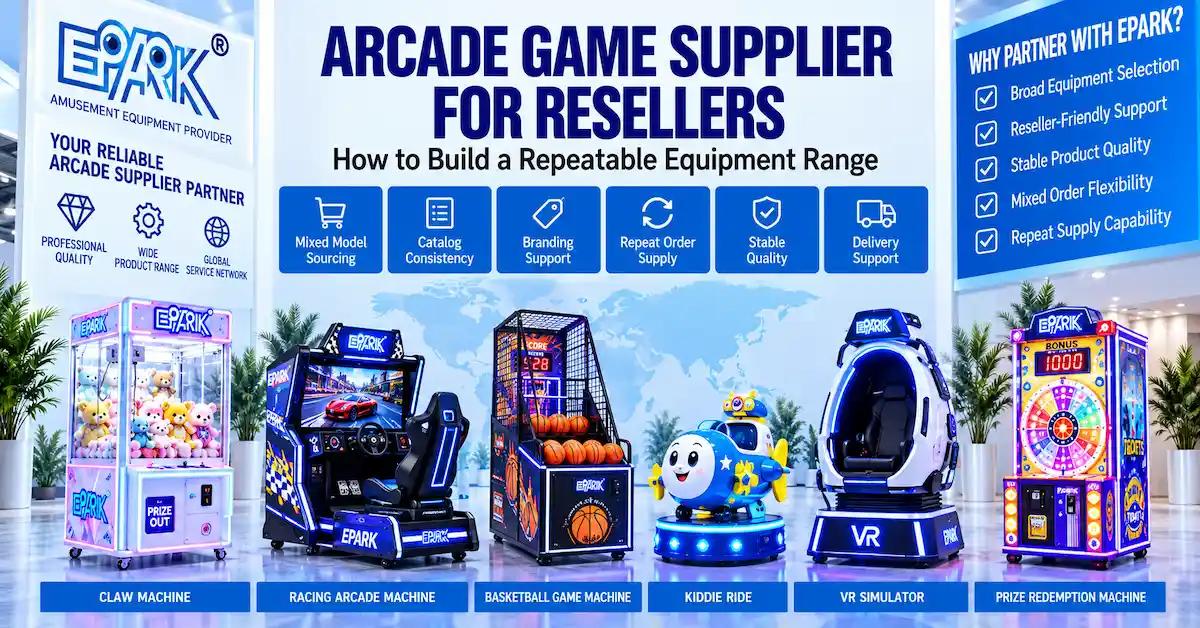
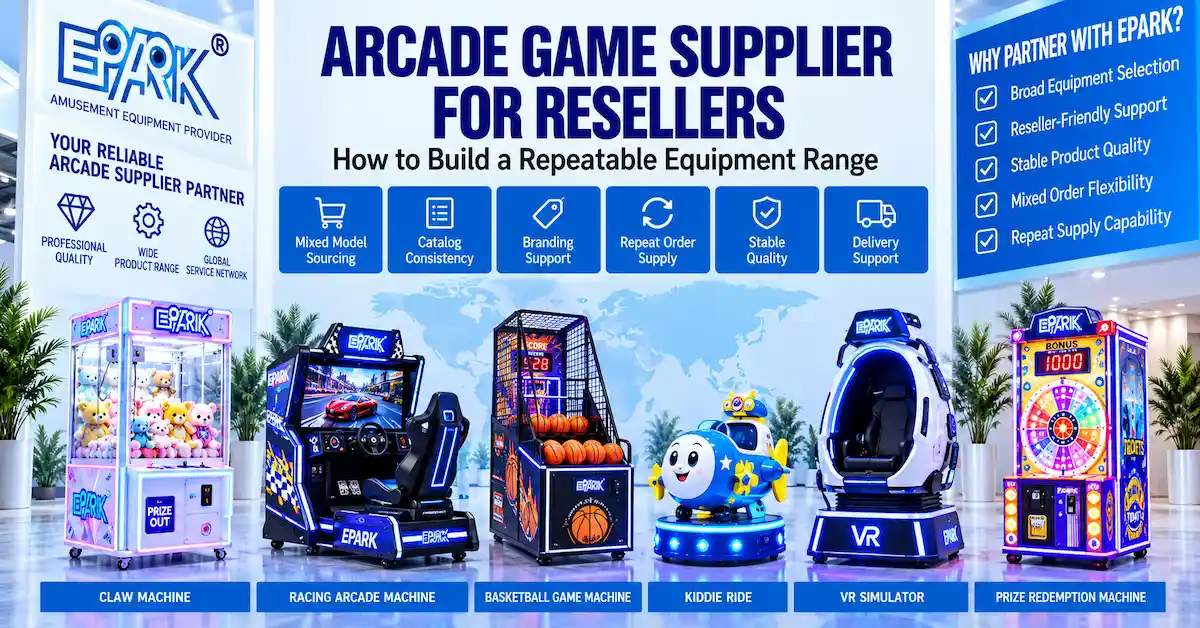
A broad catalog can be useful, but catalog breadth is not the same as supply capability. EPARK's website presents several equipment families: claw and prize machines, ticket and redemption games, basketball and other sports games, racing and driving simulators, VR systems, shooting and interactive games, kiddie rides and soft-play or family entertainment equipment. This range can help a reseller build a mixed proposal. It also creates a reason to ask which models are standard production items, which are project combinations and which are search-oriented pages describing a wider solution.
Product depth means that the supplier can explain a selected machine in enough detail for a resale transaction. Ask for the model reference, cabinet dimensions, player arrangement, display and control configuration, power requirement, payment method, language options, accessories, packed dimensions and net or gross weight. Ask whether the photograph represents the quoted model or a similar cabinet. Ask whether the manual and parts list match the current revision. These details allow the reseller to publish useful information instead of repeating generic claims.
Build a small launch range before adding every category
A reseller rarely needs the entire factory catalog on day one. Select a launch range with different commercial roles. A visible claw or prize unit may create a low-complexity entry product. A redemption or skill game may support a family venue package. A racing, VR or sports machine may act as a higher-value attraction. The exact mix depends on the channel and market; the important point is that every selected model has a reason to exist in the catalog.
- Choose a core model that can be quoted often and supported with clear documentation.
- Choose a supporting model that increases package value without introducing a completely different service burden.
- Choose a project model only when the customer has supplied the site, audience and operating assumptions needed to quote it responsibly.
- Keep a factory model reference connected to the reseller SKU so sales, warehouse and service teams do not use different names for the same machine.
This approach reduces the risk of becoming a catalog publisher without a reliable fulfillment system. It also gives the supplier a clear request: quote these models, in these configurations, for this destination and this customer type.
An arcade game supplier for resellers should be able to turn that short launch range into a repeatable model matrix, not ask the reseller to rebuild the product definition for every customer.
Send the target market, equipment categories, order pattern and destination so the supplier can separate standard models from project-specific scope.
Check the factory and the commercial handoffs
Supplier credibility is not proved by a factory photograph alone. EPARK's public company information identifies Guangzhou as its manufacturing location and describes an integrated R&D, design, production and sales operation. The website says it serves customers in more than 100 countries and presents a factory or production base at different sizes on different pages. Because the published area figures are not consistent across every page, a careful reseller should use the broader statement as background and request current production evidence for the selected order.
Look at the handoffs that matter to a resale transaction. Who receives the product brief? Who confirms the configuration? Who approves artwork or language? Who checks the first unit? Who releases the order to production? Who supplies the packing list and serial range? Who answers a service question after delivery? A supplier can have capable engineers and still create friction if those handoffs are not assigned.
| Handoff | Question for the supplier | Record the answer in |
|---|---|---|
| Product selection | Which model and revision are being quoted? | Reseller quote and model matrix |
| Configuration | What changes for voltage, language, payment, lighting or player setup? | Approved specification |
| Production release | What approves the first article or production revision? | Release sheet and change log |
| Shipment | Which packaging, serial and destination documents are supplied? | Packing list and shipping file |
| After-sales | How does the reseller open a technical or warranty case? | Support procedure and contact list |
Do not confuse a fast reply with a controlled process. A good pre-sales response identifies assumptions, open questions and the evidence that will be supplied later. This is especially important when a reseller promises delivery dates or product features to its own customer.
Evaluate materials, manufacturing and testing without inventing specifications
Commercial arcade equipment is exposed to repeated physical use, transport, cleaning and service. Ask how the cabinet, electronics and user-facing components are built, but keep the question model-specific. EPARK's published materials mention metal frames, ABS plastic, tempered glass, plywood or high-quality plywood, screens, controls, power supplies, speakers, LED lighting, PCB installation and wiring. Those categories are useful starting points. They do not establish one universal thickness, component brand or grade for every machine.
A reseller should request a bill of materials or component schedule where the detail affects safety, customer expectation, maintenance or compliance. Confirm whether a glass panel is tempered, whether a display size is fixed, whether a control is a standard or custom part, and whether a power supply or payment reader is included. Ask how substitutions are approved. A lower-cost substitute may be acceptable for one order, but it should not be silently introduced into a repeat product line.
EPARK's Design & Process information describes artwork printing and painting, electronic assembly, PCB installation, wiring, LED setup, screen and control integration, final assembly and function testing. It also states that each machine receives a 48-hour full-operation test before shipment, covering gameplay, electrical safety, lighting effects and mechanical durability. Use this as published factory-process evidence, then ask how it applies to the exact model, quantity and revision you will resell. A generic factory statement is not the same as an order-linked test record.
Questions that make factory testing useful to a reseller
- Is the 48-hour test applied to every unit or to a defined sample?
- Which serial numbers or production batch are connected to the test record?
- Are payment, ticket, prize, lighting, sound, controls and connected systems tested when they are part of the quoted configuration?
- What happens when a unit fails, and is the retest evidence retained?
- Can the reseller receive photographs, videos or a signed checklist before loading?
- Does the test cover a custom language, artwork, voltage or payment configuration?
These questions create usable sales evidence. They also protect the reseller from repeating an unsupported claim such as “all machines are tested for everything.” Specific evidence is easier for a customer to understand and easier for a service team to use later.
That is why an arcade game supplier for resellers should explain the difference between a public factory process and the order-linked evidence that a distributor can safely share with its buyer.
Review MOQ, samples, lead time and price as separate decisions
A reseller needs commercial terms that can be explained to customers. EPARK's public FAQ describes small trial orders and large-scale production, but it does not publish one universal MOQ for every model and customization level. The same caution applies to sample fees, prototype lead time, exclusivity, tooling, game content and intellectual-property ownership. Put these fields in the RFQ instead of assuming that a website image represents a standard offer.
Ask for at least three quantities: sample or first article, initial commercial order and repeat order. Ask whether mixed models can share a shipment, whether a container order changes the spare-parts or packing arrangement, and whether the quoted price includes export packing, freight, insurance, installation or local taxes. Keep equipment price separate from project services so the reseller can price the customer honestly.
Lead time should also be separated. A standard machine that is ready for final inspection is not the same as a custom cabinet that needs artwork, engineering, sample approval and production. EPARK's FAQ gives general ranges for small orders and larger or customized orders, while another FAQ statement discusses an OEM production period after design confirmation. Treat those as public guidance, not a guaranteed delivery promise. Require the quotation to state the start event, production time, inspection window and shipping assumptions.
| Field | Why it affects resale | Written confirmation needed |
|---|---|---|
| MOQ | Determines inventory exposure and customer order flexibility | Quantity by model and customization level |
| Sample | Creates a reference before the reseller sells a repeatable product | Sample type, cost, approval status and reuse in production |
| Lead time | Controls customer promises and launch planning | Start event, production days, inspection and shipping assumptions |
| Price basis | Prevents freight or service costs from being hidden in margin | Equipment, packing, freight, insurance, installation and taxes |
| Repeat order | Protects the catalog from revision drift | Model reference, revision, artwork and component continuity |
Check packaging, export documents and receiving risk
Resellers carry risk after the machine leaves the factory. A cabinet can be technically correct and still arrive with damaged glass, missing accessories, unclear carton marks or an incomplete packing list. EPARK's public process describes bubble wrap and thick foam, wooden frame or crate reinforcement and waterproof film for sea shipment. Confirm the exact protection for the quoted machine, especially screens, glass, control panels, loose parts and cabinets with protruding features.
Ask for packed dimensions, gross weight, carton or crate count, lifting points, loading photographs and the location of loose accessories. Confirm that the serial range and model references on the packing list match the quotation. If the reseller will forward goods to a customer, keep a receiving checklist that covers carton condition, visible damage, quantity, labels and photographs before unpacking.
Export documents depend on destination and order terms. Discuss invoice, packing list, certificate or test documentation, electrical information, manuals, warranty terms and any customer-specific documents before production finishes. EPARK's public pages mention CE, RoHS, ISO, EMC and SGS or related standards, but the available pages do not show one certificate number, validity period or model coverage for every product. A reseller should request the exact document that applies to the selected model and destination instead of advertising a blanket certification claim.
Map packing, shipping, installation, warranty and technical support to the exact models you plan to resell.
Plan after-sales support as part of the product
A reseller's reputation is tested when a machine needs a replacement part or a customer cannot complete setup. EPARK's public service and FAQ materials describe remote technical support, installation guidance, operation manuals, spare-parts supply, remote diagnostics and regional or on-site support options. They also state a two-year warranty from shipment for EPARK machines, with manufacturing-defect replacement parts covered during the warranty period and consumables or misuse excluded. The exact order terms still need to be confirmed in writing.
Build a support file for each model. Include the factory model, reseller SKU, serial range, wiring or setup reference, software or configuration notes, spare-parts list, warranty route and the information required to open a case. EPARK's FAQ says a warranty request should include the serial number, problem description and photographs or video. That is a practical minimum for a reseller's customer-service form too.
Do not promise a response, repair or replacement time that the supplier has not committed to. Public pages describe 24-hour replies in some FAQ answers and 24/7 technical support on the Service page; those statements do not automatically mean a 24-hour repair, dispatch or on-site visit. Explain the difference between initial response, diagnosis, parts availability, shipping and local labor.
Use a simple service escalation ladder
- Collect model, serial number, order reference, destination and symptom.
- Collect photographs or video that show the failure, connections and visible condition.
- Check whether the issue is setup, configuration, consumable, misuse, transport damage or a suspected manufacturing defect.
- Send the complete case to the supplier's agreed channel and record the date.
- Keep the diagnosis, approved replacement, shipping status and final result with the reseller's customer record.
This is not bureaucratic overhead. It gives the supplier enough information to help and gives the reseller a defensible record when a customer asks what happened.
Score the supplier before placing a repeat order
A scorecard makes supplier comparison less dependent on the most persuasive sales call. Weight the criteria according to the reseller's market, but keep the evidence column mandatory. A supplier can receive a strong score for product range and a weak score for documents or service; that result is more useful than a single overall impression.
| Criterion | What a strong answer includes | Evidence status |
|---|---|---|
| Product fit | Selected models match the channel, audience and venue type | Model matrix and customer use case |
| Configuration control | Revision, components, payment and language are explicit | Approved specification |
| Factory evidence | Production and testing claims are tied to the order | Photos, test record and inspection plan |
| Logistics | Packing, documents and delivery assumptions are visible | Packing list, freight quote and destination review |
| Service | Parts, warranty and technical escalation are usable | Support route and case checklist |
| Repeatability | A later order can reproduce the approved product | Golden reference and change-control record |
Use a “not verified” status when the supplier has not supplied evidence. That label is more useful than forcing a yes or no answer. It tells the reseller which question belongs in the next quotation or contract discussion.
The strongest arcade game supplier for resellers makes those unanswered fields easy to close with a model-specific RFQ instead of leaving the distributor to guess.
Questions resellers should send with an RFQ
A good RFQ gives the factory enough context to answer the commercial question. Include target countries, customer type, expected order pattern, machine categories, estimated quantities, voltage and plug requirements, language, payment method, delivery address or port, branding, packaging, spare parts and desired support. Ask the supplier to identify assumptions rather than filling gaps with a generic package.
A copy-ready request is: “Please recommend an initial resale range for our market and separate standard models from custom or project configurations. For each model, provide the factory reference, dimensions, power, payment options, language, packed dimensions, weight, MOQ, sample or first-article terms, production lead time, warranty route, spare-parts information and destination documents. Please identify the testing and packing evidence supplied before loading and explain how the same model and revision can be reordered.”
For a reseller that needs private branding, add the logo, artwork, packaging, sample, revision, exclusivity and intellectual-property questions separately. Do not allow the word “OEM” to hide a missing specification. Ask what is included in the price and what requires engineering or written approval.
When an arcade game supplier for resellers answers these fields clearly, the reseller can quote a customer without converting a factory assumption into an accidental promise.
Frequently asked questions for arcade resellers
What should an arcade game supplier for resellers provide first?
The supplier should provide a model-specific range, configuration details, commercial terms, packing information, test scope and a usable support route. A large catalog without those details is not enough for a repeat resale program.
Does EPARK publish a universal MOQ for resellers?
No universal MOQ for every machine and customization level is established in the public material reviewed. EPARK's FAQ discusses small trial orders and large-scale production, so the reseller should request MOQ by model, quantity, customization and shipment method.
Can a reseller mix claw, redemption, racing and VR machines?
EPARK publicly presents those equipment families and one-stop entertainment solutions. The reseller should still ask for a model matrix, packing plan, power requirements and support implications for the mixed order.
What factory evidence is useful in a reseller catalog?
Useful evidence includes the factory identity, model-specific photographs, configuration sheet, materials or component categories, test scope, packing method, manuals, warranty route and support contacts. Avoid turning a general claim into a product-specific promise without confirmation.
How should a reseller describe EPARK certifications?
Use careful wording such as “EPARK's website displays or mentions CE, RoHS, ISO, EMC or SGS-related standards.” Request the exact certificate, covered model, test scope and destination requirement before publishing a definitive certification statement.
What should happen if the supplier changes a component?
The change should be recorded with the affected model, reason, replacement specification, risk and approval status. A silent substitution can create a different product for the reseller's customer and a different spare-parts requirement.
How can a reseller reduce service disputes?
Keep the factory model and serial range connected to the reseller SKU, collect photographs or video for cases, publish realistic support boundaries and keep the warranty, consumables and local-labor exclusions visible.
Conclusion
Choosing an arcade game supplier for resellers is a decision about repeatability. The supplier must support a product range that fits the channel, a configuration that can be quoted accurately, factory evidence that can be connected to the order, packaging and documents that reduce receiving risk, and after-sales processes that protect the reseller's relationship with its customer.
EPARK's public information provides a factual starting point: Guangzhou manufacturing identity, multi-category commercial amusement equipment, OEM/ODM and layout support, a described production workflow, a stated 48-hour full-operation test, export packaging, logistics assistance and technical support. Turn those public capabilities into a model-specific RFQ, approved configuration, test record, packing file and support procedure before listing the machines for resale. That is how a catalog becomes a dependable supply program.
Include your market, customer type, model categories, quantities, destination and support requirements.
Disclaimer
The information provided on this website is for general informational purposes only.
While EPARK Arcade Game Machine Manufacturer strives to ensure accuracy and reliability, no warranties—express or implied—are made regarding completeness, performance, or applicability.
Product specifications, designs, and features may vary depending on usage, customization, and customer requirements.
Buyers are responsible for verifying all technical details, compliance certifications, and suitability before procurement.
EPARK shall not be held liable for any direct, indirect, incidental, or consequential damages arising from the use of this website or its content, including but not limited to business losses, data errors, or equipment misuse.
For tailored solutions or further verification, please visit our Contact Us
Intellectual Property Notice
All articles, product images, videos, catalogs, software, and related materials published on this website are the intellectual property of EPARK, unless otherwise stated.
Unauthorized reproduction, distribution, modification, or commercial use of any content is strictly prohibited without prior written consent from EPARK.
EPARK reserves the right to take legal action against any unauthorized use, including but not limited to copyright infringement, misrepresentation, or unfair competition.
Trademarks
The name EPARK, the EPARK logo, and all related brand elements displayed on this website are registered trademarks or trade names of Guangzhou EPARK Electronic Technology Co., Ltd.
Other product names, company names, or logos mentioned on this site may be trademarks of their respective owners.
Unauthorized use of EPARK's trademarks for commercial purposes, including advertising, promotions, or product packaging, is strictly prohibited.
Governing Law
These terms are governed by the laws of the People's Republic of China.