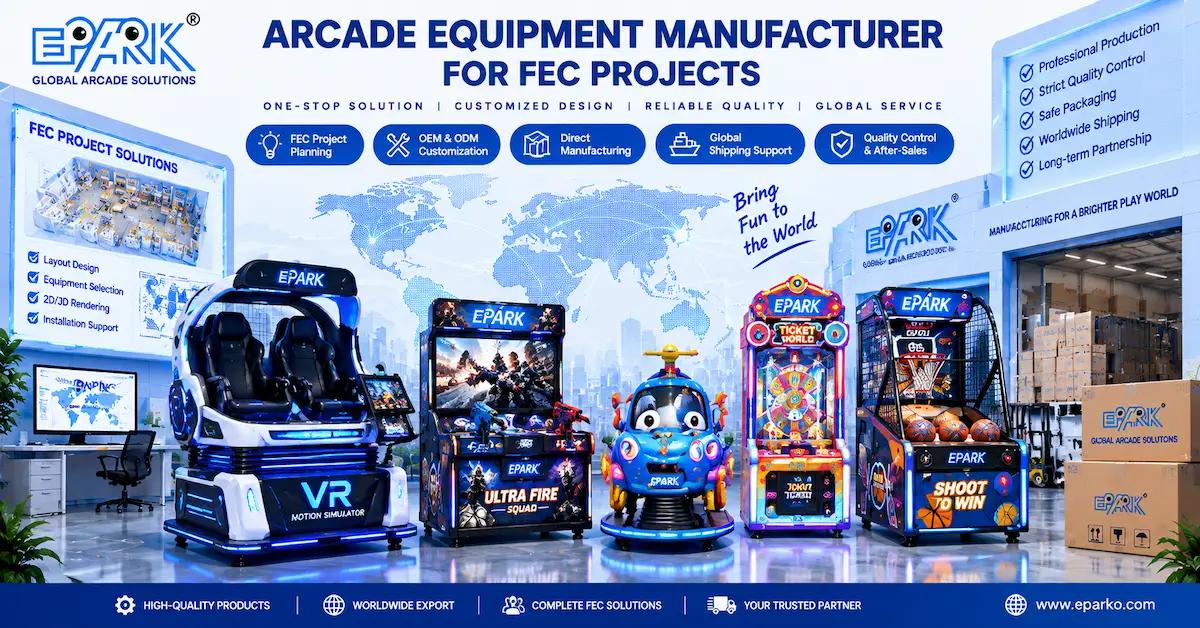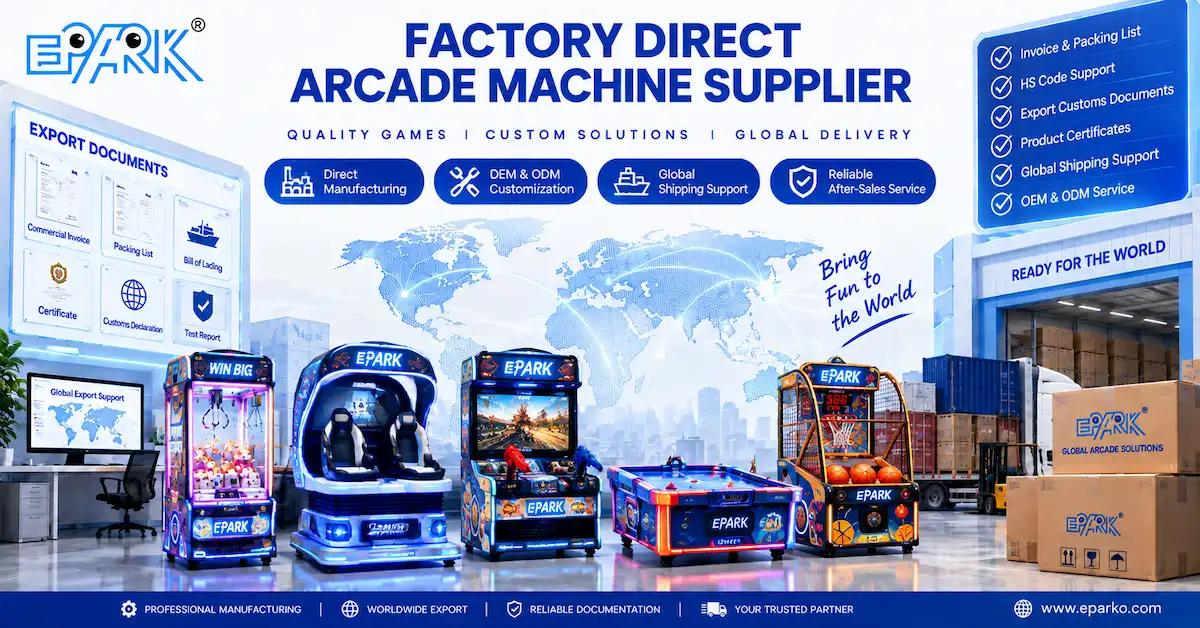


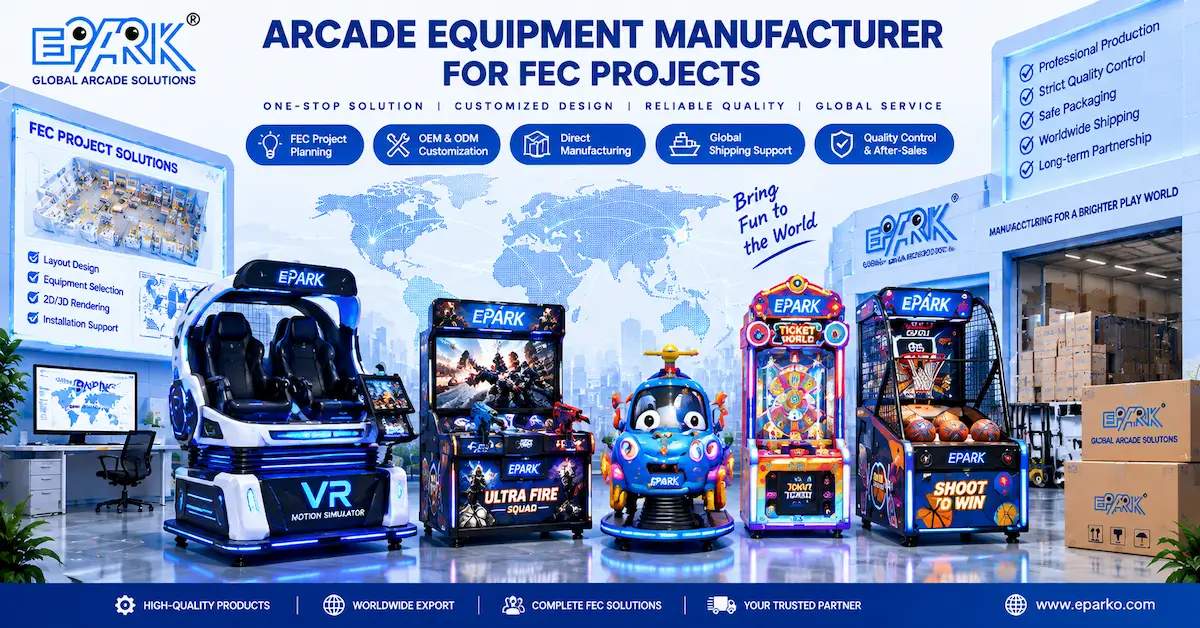
What Should an Arcade Equipment Manufacturer for FEC Projects Actually Provide?
An arcade equipment manufacturer for FEC projects should help a buyer turn a venue concept into a controlled equipment and delivery plan rather than simply supply a catalog of machines. A family entertainment center normally combines several visitor groups, game categories, operating zones, payment requirements, service areas, and maintenance needs. The manufacturer therefore needs to understand not only how individual machines are produced, but also how those machines will work together inside a commercial entertainment venue.
EPARK’s Family Entertainment Center solution and its published FEC project planning guidance show this project-oriented approach through equipment selection, zoning, layout planning, and long-term support.For a real project, buyers should convert those general capabilities into defined deliverables: equipment list, layout, configuration schedule, customization records, QC criteria, packing information, shipping responsibilities, installation scope, and after-sales documentation.
The key purchasing question is therefore not simply “Can this factory supply arcade machines?” It is “Can this manufacturer control the transition from venue requirements to approved equipment, factory production, shipment, installation, and future operation?”
Who Should Work Directly With an FEC Equipment Manufacturer?
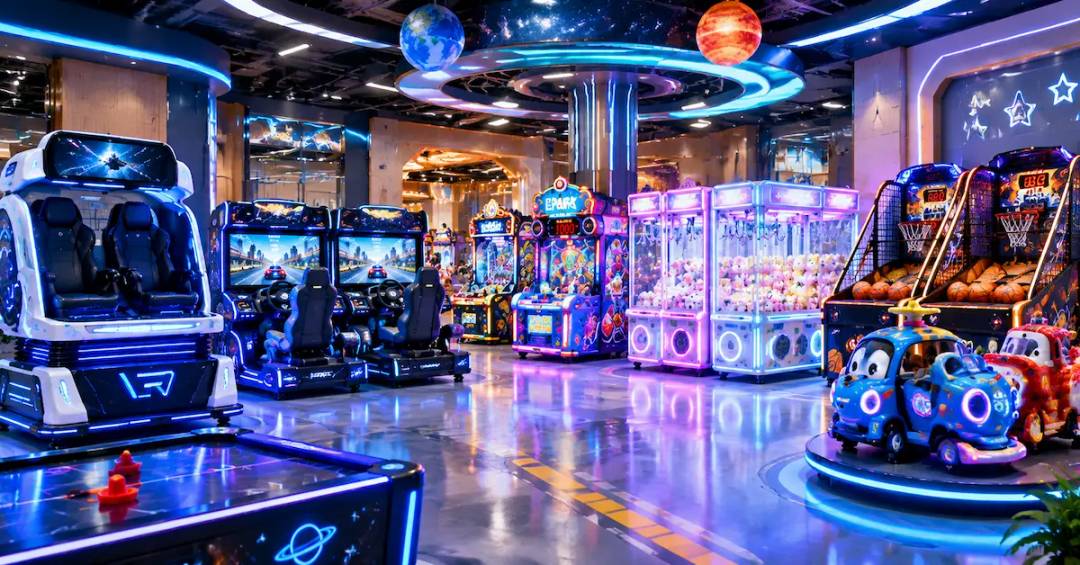
This sourcing model is especially relevant to investors opening a new family entertainment center, mall entertainment operators adding a large arcade zone, developers creating mixed indoor amusement projects, regional distributors supplying complete venues, and arcade chains standardizing new locations. These buyers typically need more than one machine category and therefore benefit from coordinated planning.
An experienced operator replacing five existing cabinets may not require complete project planning. Likewise, a small venue needing one readily available machine may be better served by local stock if delivery speed is the main priority. A complete FEC manufacturer relationship becomes more valuable when the buyer needs machine-mix planning, layout coordination, customization, bulk production, export preparation, installation guidance, and long-term parts support.
EPARK’s existing game machine factory for FEC projects guide emphasizes that FEC design needs to consider machine placement, customer flow, children’s areas, redemption zones, space, power, and maintenance access rather than simply maximizing cabinet count.
Start With the FEC Business Model Before Selecting Machines
One of the most common project mistakes is selecting attractive machines first and trying to build a floor plan around them later. An arcade equipment manufacturer for FEC projects should begin by understanding the venue itself: available floor area, target age groups, expected visitor mix, operating model, desired game categories, payment method, prize strategy, technical resources, and project schedule.
A family-oriented venue may need a different equipment balance from an arcade focused mainly on teenagers and young adults. A shopping-mall FEC may prioritize high-visibility attractions near the entrance, while a larger destination venue may support deeper zoning and longer-session attractions.
EPARK’s FEC equipment supplier guidance describes family entertainment centers as multi-zone commercial spaces involving arcade machines, claw machines, redemption games, kiddie rides, sports equipment, racing simulators, VR equipment, prize areas, and project support.
A practical planning brief should therefore answer:
Who will visit? What will they play? How long should different experiences last? Which machines create visual attraction, competitive play, prize engagement, or family participation? How will visitors move from one zone to another?
Build the Equipment Mix Around FEC Zones
An FEC should not contain dozens of unrelated machines selected only because they are popular individually. Each category should have a role in the venue.
| FEC Zone / Equipment Type | Typical Role | What the Buyer Should Confirm | Project Planning Concern |
|---|---|---|---|
| Racing & simulator zone | Competitive, immersive play | Display, steering, seats, link functions where applicable | Operating footprint, queue space,service access |
| Claw & prize zone | Visual attraction and prize play | Claw system, payment configuration, prize capacity | Refill access, visibility, machine density |
| Redemption zone | Ticket/points and repeat engagement | Scoring, reward interface, ticket or points system | Relationship to prize counter |
| Basketball & sports zone | Social and physical competition | Sensors, scoring, cabinet structure | Player clearance, ceiling and circulation |
| Shooting / skill games | Skill-based competitive play | Controllers, sensors,screen and player configuration | Safe operating space |
| VR / motion zone | Immersive attraction | Hardware, software, motion configuration where applicable | Operator support, cleaning and service area |
| Kiddie / family zone | Younger children and parent-child participation | Intended use, controls and operating limits | Visibility and supervision |
| Prize counter / service zone | Redemption and customer support | System integration and storage needs | Queue, inventory and staff workflow |
The manufacturer should help buyers understand these relationships rather than recommend machines only by unit price.
Plan the Layout Before Freezing the Equipment Order
A strong layout should account for machine footprints, player operating space, pedestrian circulation, waiting areas, maintenance access, payment stations, prize redemption, staff operations, and any food or seating areas included in the venue. A 300 m² project cannot be planned simply by dividing floor area by the average cabinet footprint.
EPARK describes customized 2D and 3D planning within its project work, while its concept-to-installation project guide discusses functional zoning, traffic flow, electrical and network planning, and equipment placement.
For a buyer, the most useful layout review should answer practical questions: Can maintenance doors open? Can a racing seat be removed? Is there enough room for basketball play? Can parents see younger children? Where will players wait for popular attractions? Can staff reach the machines without disrupting the entire zone?
A visually attractive rendering is useful, but it should not replace a measured plan linked to the final machine dimensions.
Create a Machine Specification Schedule Before Production
An arcade equipment manufacturer for FEC projects should be able to convert the final machine list into a controlled specification schedule. The table below represents information buyers should request; it does not claim that all EPARK products share the same values or configurations.
| Specification Area | Project Information to Confirm | Why It Matters |
|---|---|---|
| Machine identity | Product name,model and approved version | Repeat orders and QC |
| Quantity | Units required by model | Production and layout control |
| Operating dimensions | Assembled L × W × H | Venue planning |
| Packed dimensions | Export package size and package count | Shipping calculations |
| Weight | Net and gross packed weight | Handling and delivery |
| Electrical requirements | Model-specific voltage,frequency and power | Site electrical preparation |
| Player configuration | Players per unit and linked functions | Capacity and space planning |
| Payment system | Coin, token, card or configured cashless system | FEC system compatibility |
| Game / interface language | Required version where applicable | Destination-market usability |
| Network requirements | Applicable connections and system requirements | IT preparation |
| Accessories | Keys, cables, hardware,manuals and separated parts | Receiving inspection |
| Maintenance access | Required service clearance | Layout and maintenance planning |
| Customization | Artwork, logo, color, labeling and approved changes | OEM project control |
| Shipping format | Assembled or approved separated structure | Destination installation |
| Documentation | Manuals, QC records and applicable technical files | Handover and service |
This schedule should become the common reference for purchasing, production, QC, logistics, installation, and future spare-parts requests.
Evaluate Materials and Components by Machine Category
Commercial arcade equipment operates in public environments and can experience repeated daily interaction. Buyers should therefore ask how the actual machine is constructed rather than accept general descriptions such as “strong materials” or “premium components.”
Different categories can use different frames, cabinet materials, transparent panels, displays, controls, sensors, power supplies, motors, payment devices, lighting assemblies, speakers, wiring, and moving mechanisms. The relevant question is not whether a factory can name these parts; it is whether those components are controlled in the production version and can be identified later for service.
An FEC project should also consider serviceability during equipment selection. A machine that requires excessive disassembly for basic maintenance may create operational inconvenience even if its external appearance is attractive.
Workmanship Matters More When Dozens of Machines Share One Venue
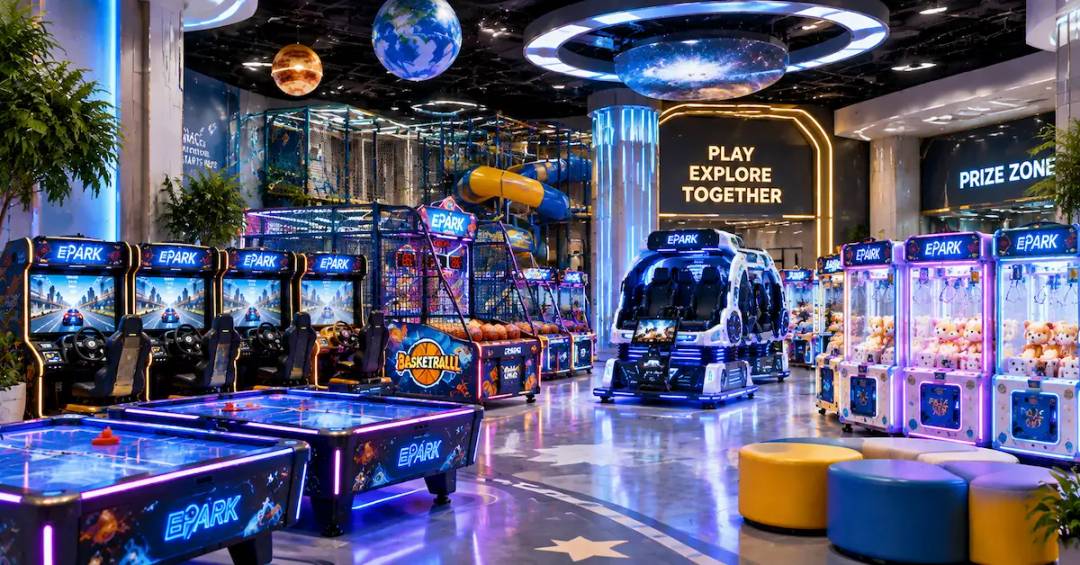
Small inconsistencies become more visible in a large project. Different wiring arrangements, undocumented board changes, mismatched artwork, incorrect payment settings, or missing accessories can create substantial installation work when repeated across many machines.
Buyers should therefore define observable workmanship criteria. These can include cabinet alignment, visible surface condition, secure mounting, door and lock operation, cable routing, connector identification, control installation, lighting, payment-device mounting, and model-specific mechanical checks.
EPARK’s factory capability guide presents production, design, customization, QC, and project support as interconnected factory capabilities. For an individual FEC, buyers should ask how those capabilities are applied to the selected order instead of relying only on general factory claims.
Turn Factory Quality Control Into an FEC Acceptance Plan
Testing one machine in isolation is not enough for a large FEC order. The project needs unit-level inspection plus configuration consistency across machines.
Relevant tests can include gameplay, control response, display, audio, lighting, payment recognition, score calculation, ticket or reward functions, sensors, mechanical operation, linked gameplay where ordered, and model-specific simulator functions.
For a card-system FEC, the acceptance plan should include the actual configured payment process. For redemption games, it should include the complete path from credit to game operation to reward output. For customized machines, confirm logos, graphics, labels, colors, and hardware changes.
A useful project structure separates:
Functional acceptance → configuration acceptance → cosmetic inspection → accessory check → packing inspection → shipping handover.
This makes it easier to identify where a problem occurred.
Do Not Assume Certifications Apply to Every Machine in the Project
A large FEC can include significantly different types of equipment. Documentation applying to one product family should not automatically be extended to another machine just because both appear in the same project.
Before ordering, identify any documentation required by the destination country, mall operator, project consultant, insurer, or other relevant party. Then request documents applicable to the selected models or product families and review whether customization changes their scope.
For overseas projects, also keep technical product documents separate from shipping paperwork. A packing list or commercial invoice performs a different function from a test report or compliance document.
Compare Manufacturers by Project Capability, Not Just Product Range
A large catalog does not automatically make a supplier suitable for an FEC project. Compare how the supplier handles coordinated project work.
| Manufacturer Capability | Basic Supplier Approach | Better FEC Project Approach |
|---|---|---|
| Equipment selection | Sends catalog | Recommends categories according to venue concept |
| Layout | Buyer places machines | Uses confirmed machine dimensions in project layout |
| Technical specifications | Product name only | Controlled model/configuration schedule |
| Payment system | Discussed after production | Confirmed before production |
| Customization | Logo added during production | Artwork and changes approved by revision |
| QC | Generic factory test | Project-specific inspection checklist |
| Packing | Standard packing statement | Model-specific packed dimensions and package records |
| Shipping | Gives freight price | Clarifies responsibilities and destination requirements |
| Installation | Sends manuals | Defines local and supplier responsibilities |
| Spare parts | Reactive sales | Parts linked to machine model and configuration |
| Repeat orders | Same product name | Approved version and change control retained |
The strongest manufacturer is the one that reduces uncertainty across the entire FEC project.
Capacity and Lead Time Should Be Planned by Project Stage
A project buyer should not evaluate capacity using only a statement such as “we can produce hundreds of machines per month.” A mixed FEC order can contain machines with different production and customization requirements.
Instead, build the schedule around project stages: layout confirmation, equipment-list approval, technical configuration, artwork approval, production, QC, packing, shipping preparation, international transport where applicable, installation, and commissioning.
EPARK publishes general order information through its FAQ, but a specific FEC should receive an order-specific schedule based on model mix, quantity, customization, and destination requirements.
If the project contains many machine categories, buyers may also discuss phased production or shipment rather than assuming everything must reach the venue at the same moment.
Compare Standard Machines, OEM Equipment, and Complete FEC Solutions
Different buyers need different manufacturing involvement.
| Supply Route | What the Manufacturer Provides | Best Fit | Key Buyer Control Point |
|---|---|---|---|
| Standard equipment | Existing machine configuration | Venue replacement or simple expansion | Exact model and included options |
| OEM branding | Existing equipment with approved brand changes | Distributor/private label | Artwork and version approval |
| Configured OEM | Standard platform plus hardware/configuration changes | Regional-market requirements | Compatibility and testing |
| ODM development | Greater design or functional development | Differentiated equipment concepts | Engineering scope and validation |
| Complete FEC project | Equipment mix plus project planning | New venue or major expansion | Layout, machine schedule and service boundaries |
EPARK’s custom game machine factory guidance describes branding, cabinet appearance, payment integration, and private-label development as different customization directions.
Buyers should decide which level is actually required. Starting a deep ODM project when a standard machine already fits the application can add unnecessary development time and cost.
Calculate Project Cost Beyond Machine Prices
FEC equipment cost should be evaluated at project level. Depending on the agreed scope, the buyer may need to consider machine prices, customization, payment hardware, spare parts, export packaging, freight, insurance if selected, customs-related costs, local transport, unloading, electrical preparation, installation, system integration, and future maintenance.
A lower machine quotation may exclude items another manufacturer has included. For this reason, each proposal should clearly separate:
equipment supply, customization, project services, shipping scope, installation assistance, optional items, and buyer responsibilities.
Buyers should also avoid treating predicted venue revenue or payback as guaranteed equipment performance.Commercial results depend on location, pricing, customer demand, operating costs, machine mix, maintenance, marketing, and many other factors beyond factory control.
Design OEM/ODM Customization Around the Complete FEC Theme
Customization can be particularly valuable when an FEC wants a coordinated appearance across different machine categories. Buyers may request color themes, logos, cabinet artwork, labels, payment hardware, prize-zone graphics, or more extensive technical changes.
The project should distinguish aesthetic customization from functional customization. Changing cabinet graphics is not the same engineering task as changing the payment interface or modifying a machine structure.
Approve customization in controlled stages and keep the final records linked to the machine models. This helps the factory reproduce equipment for future locations and helps technicians identify customized versions later.
Connect Equipment Manufacturing With Export and Delivery Planning
International FEC projects need manufacturing and logistics information to remain connected. Once the final machine configuration is approved, request packed dimensions, package counts, gross weights, separated components, and handling information.
EPARK’s international arcade machine shipping guide explains why shipping should be planned from actual packed configurations rather than generic machine quantities.
A racing simulator, basketball machine, compact claw machine, and VR attraction create different package structures. A manufacturer supporting an FEC project should therefore help ensure that the equipment schedule and the logistics schedule describe the same machines.
For multi-container projects, request package-to-container allocation so the receiving team knows which machines arrive in each shipment.
Define Installation Support Before Machines Leave the Factory
An arcade equipment manufacturer for FEC projects should help the buyer understand how equipment will move from packed shipment to operating venue, but the exact scope must be defined.
EPARK’s recent arcade supplier with installation support guide distinguishes remote guidance, local installation work, supplier supervision, testing, and staff preparation rather than assuming “installation support” means the same service in every project.
Create a responsibility table covering unloading, internal transport, assembly, electrical connection, network preparation, payment-system setup, machine configuration, testing, staff training, and unresolved issues. Identify which tasks are handled by the factory, local contractors, payment-system provider, venue staff, or other specialists.
Plan Maintenance and Spare Parts Before Opening
After-sales support should be part of supplier evaluation before the purchase order is released. An FEC with many equipment categories needs a structured way to identify machines and replacement components.
Keep model, serial or order reference, machine version, payment configuration, and service records. Discuss an initial spare-parts plan based on the actual machine mix instead of buying one generic kit.
Common maintenance categories can include controls, sensors, payment components, power supplies, selected boards, cables, motors, switches, locks, and model-specific assemblies.The appropriate stock depends on local technical capability, expected operating impact, supplier replenishment time, and actual maintenance history.
The goal is not to hold every possible component in the venue. It is to maintain enough identified parts and supplier access to restore important machines efficiently.
What Information Should You Send an Arcade Equipment Manufacturer for an FEC Quote?
A useful FEC inquiry should include much more than the question “How much are your arcade machines?” Provide the project country, venue type, measured floor area, floor plan, target customer groups, preferred machine categories, budget range where available, payment-system preference, branding requirements, planned opening period, and any project constraints.
If the site already exists, include photographs or videos that help explain entrances, columns, walls, available ceiling height, power locations, and other relevant conditions. If the project is still conceptual, clarify which information remains provisional so the equipment proposal can be updated later.
You can review EPARK’s Family Entertainment Center solution, project products and arcade solutions, and Design & Process before sending the project brief through Contact Us.
Frequently Asked Questions
1. What Does an Arcade Equipment Manufacturer for FEC Projects Do?
A project-oriented manufacturer supplies commercial arcade machines while also supporting functions such as equipment selection, configuration, layout coordination, customization, quality inspection, packing, shipping preparation, installation guidance, and after-sales service. The exact scope should be confirmed for each project.
2. What Equipment Does a Family Entertainment Center Usually Need?
The mix can include racing games, claw machines, redemption games, sports games, shooting machines, VR or simulator equipment, kiddie attractions, and prize-related equipment.The final balance should be based on target visitors, floor space, business model, and operating strategy rather than a fixed universal list.
3. Should I Finalize the Floor Plan Before Ordering Machines?
The floor plan and equipment list should be developed together. Confirmed machine dimensions help improve the layout, while the layout determines whether proposed machines have sufficient operating, circulation, and maintenance space.
4. How Many Arcade Machines Fit in an FEC?
There is no reliable universal machine-per-square-meter rule. Equipment sizes, player areas, pathways, queues, seating, prize zones, staff spaces, maintenance access, and local project requirements all affect capacity. Build the machine count from a measured layout.
5. Can EPARK Customize Arcade Machines for My FEC Brand?
EPARK publishes OEM/ODM and customization capabilities covering branding and commercial arcade solutions. The exact artwork, cabinet changes, payment configuration, or functional development required should be confirmed and approved for the selected models before production.
6.How Should FEC Buyers Check Machine Quality Before Shipment?
Use an order-specific checklist covering the approved configuration, gameplay, controls, displays, payment hardware, scoring or reward functions, relevant sensors and mechanisms, appearance, customization, accessories, and packing. Request appropriate evidence linked to the actual machines being supplied.
7. Can One Manufacturer Supply Different FEC Machine Categories?
A manufacturer may support several complementary equipment categories. EPARK’s FEC offering includes multiple arcade and amusement directions, but buyers should still evaluate the manufacturer’s capability for each important category and confirm the selected models individually.
8. Does an FEC Manufacturer Provide Installation Support?
EPARK publishes remote guidance and project support information, while broader support can vary according to the project. Confirm who handles unloading, assembly, electrical work, network setup, payment integration, testing, and staff training before shipment.
9.Should Spare Parts Be Ordered With a New FEC Project?
Discuss a model-specific starter spare plan before shipment. Prioritize components according to machine quantity, service impact, local technician capability, availability, and expected replenishment time rather than purchasing equal quantities of every possible component.
10. What Should I Send EPARK for an FEC Project Proposal?
Provide your floor plan, usable area, destination, target visitors, desired equipment categories, payment requirements, branding preferences, project schedule, and available budget information. Use EPARK Contact Us to submit the project details so the equipment and service scope can be discussed against an actual venue requirement.
Conclusion
Selecting an arcade equipment manufacturer for FEC projects is a project-management and supply-chain decision, not simply a machine-price comparison.A strong FEC sourcing process connects the venue concept with machine mix, measured layout, controlled specifications, components and workmanship, quality inspection, OEM/ODM customization, packaging, international delivery, installation responsibilities, spare parts, and long-term technical support. EPARK provides commercial arcade equipment and family entertainment center solutions that can serve as a starting point for this project process, while machine configurations, schedules, documents, and service boundaries should still be confirmed for each individual venue. Review the EPARK FEC solution or contact EPARK with your floor plan, destination, project area, target audience, equipment requirements, and opening schedule to discuss an FEC-specific equipment and project plan.
Disclaimer
The information provided on this website is for general informational purposes only.
While EPARK Arcade Game Machine Manufacturer strives to ensure accuracy and reliability, no warranties—express or implied—are made regarding completeness, performance, or applicability.
Product specifications, designs, and features may vary depending on usage, customization, and customer requirements.
Buyers are responsible for verifying all technical details, compliance certifications, and suitability before procurement.
EPARK shall not be held liable for any direct, indirect, incidental, or consequential damages arising from the use of this website or its content, including but not limited to business losses, data errors, or equipment misuse.
For tailored solutions or further verification, please visit our Contact Us
Intellectual Property Notice
All articles, product images, videos, catalogs, software, and related materials published on this website are the intellectual property of EPARK, unless otherwise stated.
Unauthorized reproduction, distribution, modification, or commercial use of any content is strictly prohibited without prior written consent from EPARK.
EPARK reserves the right to take legal action against any unauthorized use, including but not limited to copyright infringement, misrepresentation, or unfair competition.
Trademarks
The name EPARK, the EPARK logo, and all related brand elements displayed on this website are registered trademarks or trade names of Guangzhou EPARK Electronic Technology Co., Ltd.
Other product names, company names, or logos mentioned on this site may be trademarks of their respective owners.
Unauthorized use of EPARK's trademarks for commercial purposes, including advertising, promotions, or product packaging, is strictly prohibited.
Governing Law
These terms are governed by the laws of the People's Republic of China.