A factory serving global customers should understand that international orders involve additional requirements.
Capabilities may include:
Destination-market configuration
Export packaging
Shipment preparation
Product documentation coordination
Spare-parts planning
Remote technical support
International buyers should confirm market-specific requirements before production begins.
For example:
Voltage
Plug configuration
Payment system
Language
Packaging
These are easier to control before shipment than after the equipment arrives overseas.
Buyers can review EPARK's arcade machine FAQ for common purchasing and equipment questions.
Packaging Is Part of Factory Capability
Packaging should not be treated as an afterthought.
Commercial arcade machines can contain:
Screens
Glass
Acrylic
Controls
Decorative structures
Electronic systems
International transportation may involve multiple stages of handling.
A capable factory should consider how to protect:
Cabinet corners
Screens
Movable parts
Player controls
Internal components
Packaging quality can directly affect whether a correctly manufactured machine reaches the buyer in usable condition.
After-Sales Support Is Part of Factory Capability
For commercial buyers, the relationship should not end when the shipment leaves the factory.
Machines operate for extended periods and may eventually require:
Replacement parts
Troubleshooting
Technical guidance
Configuration support
Spare Parts
The factory should be able to help identify components such as:
Buttons
Sensors
Power supplies
Motors
Control boards
LED components
Payment-system parts
Technical Support
Depending on the project, support may include:
Remote troubleshooting
Replacement guidance
Configuration assistance
Operating information
Product Documentation
Useful information may include:
Product specifications
Component references
Manuals
Wiring information
Spare-parts information
Repeat-Order Support
A long-term factory partner should also be able to reproduce previous configurations.
This is especially important for:
Distributors
Arcade chains
Private-label brands
Manufacturing capability ends at shipment only for a short-term supplier. For a long-term factory partner, support should continue throughout the equipment lifecycle.
Which Factory Capabilities Matter Most for Different Buyers?
Not every buyer needs the same level of factory capability.
Buyer Type
Most Important Capabilities
Single arcade operator
Product quality + after-sales
FEC project
Product range + project support
Distributor
Production + repeatability
Private-label brand
Branding + customization
OEM buyer
Engineering + manufacturing
ODM buyer
Design + prototype + engineering
Arcade chain
Standardization + repeat supply
International buyer
Export support + spare parts
A good purchasing decision starts by identifying which capabilities actually matter for the business model.
Do All Buyers Need Full OEM and ODM Capability?
No.
Deeper capability is not always necessary.
If a buyer needs mature, standard commercial machines for a straightforward project, the most important factors may be:
Product quality
Correct configuration
Delivery reliability
Spare-parts support
Developing new cabinets, prototypes, or custom systems may add cost and complexity without improving the project.
Full OEM or ODM capability becomes more valuable when the buyer needs:
Unique equipment
Branded product lines
Exclusive SKUs
Market-specific configurations
Long-term product development
The correct level of capability should follow the business need.
How EPARK Supports Different Arcade Buyer Requirements
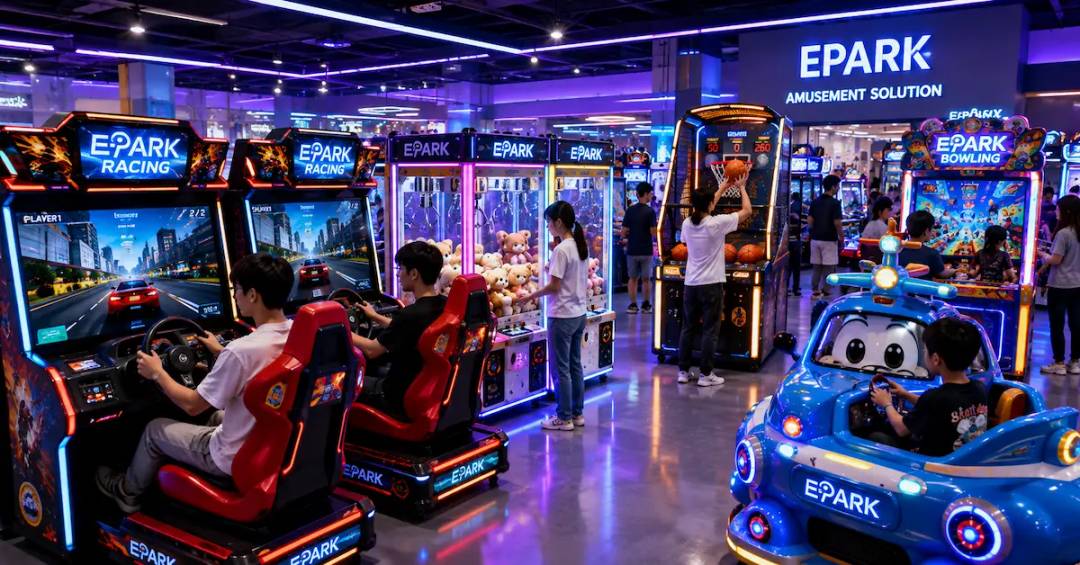
EPARK works with commercial arcade operators, distributors, FEC projects, and entertainment equipment buyers requiring different levels of manufacturing and customization support.
A buyer can begin by providing:
Target market
Venue type
Product categories
Quantity
Branding requirements
Customization requirements
Payment system
Voltage and language
Project schedule
The project can then be evaluated through an appropriate cooperation route:
Standard Product Supply → Market Configuration → OEM Customization → ODM Development
This helps avoid unnecessary development while still providing deeper manufacturing support when the project requires it.
What capabilities should a game machine factory have?
A commercial factory should typically support production, assembly, engineering, customization, quality control, project coordination, international order preparation, spare parts, and technical support.
What does game machine production include?
Production may include material preparation, cabinet assembly, wiring, electronics integration, controls, configuration, functional testing, inspection, and packaging.
Can a game machine factory design new arcade equipment?
Some factories with engineering and ODM capabilities can support cabinet design, technical development, prototype production, testing, and production preparation.
What arcade machine customization options are available?
Depending on the product, customization may include logos, artwork, colors, cabinet design, payment systems, language, voltage, controls, screens, packaging, and private labeling.
What is the difference between OEM and ODM capabilities?
OEM generally focuses on manufacturing or modifying products based on clearer buyer requirements, while ODM may involve deeper factory participation in product design, engineering, prototyping, and development.
How does a factory control arcade machine quality?
Quality control can include incoming-component inspection, assembly checks, functional testing, final configuration verification, and packaging inspection.
Can a game machine factory support large FEC projects?
Factories with sufficient product range, production capacity, project management, customization, and delivery coordination can support multi-category FEC or commercial arcade projects.
How does a game machine factory support international orders?
International support may include market-specific configurations, export packaging, shipment preparation, documentation coordination, spare-parts planning, and remote technical assistance.
What after-sales support should arcade buyers expect?
Depending on the supplier, support may include spare-parts identification, troubleshooting, technical guidance, manuals, replacement assistance, and repeat-order support.
How do I choose the right factory capability for my project?
Start with the business requirement. Standard buyers may prioritize quality and support, while distributors, private-label brands, OEM buyers, and ODM buyers may need stronger customization, engineering, repeat-production, or development capabilities.
Conclusion
A professional game machine factory should be evaluated as a complete manufacturing and support system rather than only as an assembly facility.
The most important capability layers are:
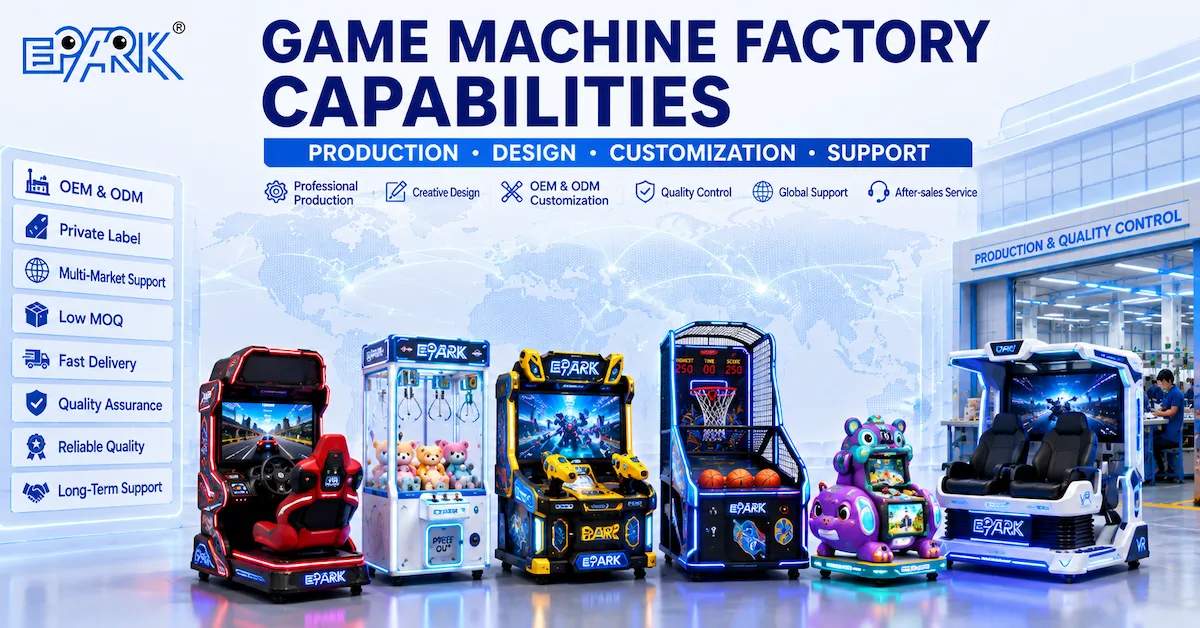
Production → Design & Engineering → Customization → Quality Control → Project Support → After-Sales
For commercial arcade buyers, these capabilities affect different stages of the equipment lifecycle.
Production determines whether machines can be supplied consistently.
Engineering determines whether products fit real operating requirements.
Customization helps equipment adapt to brands and markets.
Quality control protects batch consistency.
Project support helps coordinate complex orders.
After-sales service keeps equipment supportable after delivery.
The strongest factory is therefore not necessarily the one offering the most services.
It is the one whose capabilities match the buyer's actual business model and can support the equipment consistently from initial specification through long-term operation.